White paper 01 · Chapter 6
A phased chain: melt first, then sections, then iron from Cameroonian ore
The fastest credible route from ore exports to industrial value is a chain built backwards from the melt shop. A first phase that melts and casts billets in Cameroon creates the capability the country lacks, offers billets to re-rollers that import most of their charge, and builds the skills, power supply and port logistics the later phases need; sections and heavy long products follow; direct reduction of Cameroonian concentrate closes the chain when grade, gas and scale allow. On imported iron units the first phase saves little foreign exchange and competes behind the tariff, so it is the platform for local iron rather than the prize itself. Cameroon Steel’s reference configuration, RC-1, illustrates the sequence. Its figures are planned and indicative, not commitments.
In this chapter (7)
- 6.1 Five design principles
- 6.2 The reference configuration RC-1
- 6.3 Phase 1: a melt shop that makes billets in Cameroon
- 6.4 Phases 2 and 3: sections and heavy long products
- 6.5 The direct-reduction module: Cameroonian ore, when its conditions are met
- 6.6 Carbon: the phased chain starts low and stays below the world average
- 6.7 Why this order, and not another
6.1 Five design principles
The diagnosis of Chapters 1 to 3 and the international lessons of Chapter 4 lead to five principles for any ore-to-steel chain in Cameroon, whoever builds it.
- Start where the import bill is. Billets and other iron units are the largest steel import and the binding constraint on the existing industry [C06][C38]. The first investment should make iron units or billets in Cameroon.
- Use proven, modular technology. Electric arc furnaces of a few hundred thousand tonnes a year and direct-reduction modules from 0.25 Mtpa to 2.5 Mtpa are standard equipment with long operating records [T13][T20][T21]. A blast furnace is not suited to Cameroon’s fuel or market (Chapter 2).
- Secure the feed before building the furnace. No phase should depend on a supply that does not yet exist. The first phases run on imported and local scrap and on imported DRI or HBI; direct reduction waits for DR-grade concentrate and a gas contract.
- Put the chain at the port. Bulk inputs, exports and the gas field are all at Kribi (Chapter 7).
- Avoid adding to saturated segments without adding iron. New rolling capacity only makes sense if it comes with its own melt shop and a product mix that goes beyond domestic rebar.
6.2 The reference configuration RC-1
Cameroon Steel is developing a steel complex at Mboro, in the Kribi industrial-port zone, with a design capacity of 1 Mtpa of steel, built in phases [X04]. The foundation stone was laid on 30 December 2024 by the Prime Minister, representing the Head of State [X01]. The first phase is focused on reinforcing bar and wire rod, made from steel melted in an electric arc furnace. Cameroon Steel’s sister company, Cameroon Mining Company, holds the Mbalam exploitation permit [X01], and the Kribi zone lists steel linked to mineral exports among its development clusters [Z4].
To discuss the project in engineering terms, Cameroon Steel uses a reference configuration, RC-1, which sets out phases, capacities and indicative utility needs on the basis of international benchmarks. RC-1 is a planning tool; it is not a final design and its figures will change with detailed engineering. Its current edition, RC-1.1 (October 2026), targets the start of Phase 1 works from the first quarter of 2029, once the environmental certificate is obtained, a first heat in the second half of 2030 and ramp-up through 2031; Phase 2 (second melt line and light/medium sections mill) is indicative for 2032 to 2034 and Phase 3 (melt-shop expansion and heavy-section mill) for after 2034, both subject to market and financing; the direct-reduction (DR) module comes later, subject to ore, gas and approvals [F01]. Table 6.1 summarises it, and Figure 10.1 in Chapter 10 shows the sequence.
Table 6.1 RC-1 reference configuration by phase (planned / indicative)
| Phase 1 | Phases 1 and 2 | Phases 1 to 3 | DR module (reserve) | |
|---|---|---|---|---|
| Scope added | EAF melt shop, ladle furnace, billet caster; bar and wire-rod mill | Second melt line (EAF of the 40 t class, ladle furnace, caster); light and medium sections mill (angles, channels, flats) | Melt-shop expansion; heavy-section and H-beam mill | Direct-reduction module for Cameroonian concentrate |
| Finished capacity, cumulative | 0.3 Mtpa nameplate; sustained 0.27 to 0.30 | 0.5 Mtpa | 1.0 Mtpa (0.85 to 1.0) | unchanged; about 1 Mtpa of DRI (0.8 to 1.1) |
| Metallics needed | 0.36 Mtpa | 0.60 Mtpa | 1.21 Mtpa | up to 1.21 Mtpa met by own DRI |
| Average electrical load | about 36 MW | about 53 MW | about 94 MW | about 115 to 130 MW (derived) |
| Water make-up at 2 m³/t (1.5 to 3.0) | about 0.6 Mm³/yr | about 1.0 Mm³/yr | about 2.0 Mm³/yr | plus DR plant needs |
| Direct jobs | about 500 (450 to 550) | n/a | about 1,100 (900 to 1,300) | additional, not estimated |
| Iron-unit sources | Imported scrap and DRI or HBI; domestic scrap about 30 kt/yr (0 to 60, assumed) | as Phase 1 | as Phase 1 | Cameroonian DR-grade concentrate |
| Timing (target / indicative) | Works from Q1 2029; first heat H2 2030; ramp-up 2031 | Indicatively 2032 to 2034, subject to market and financing | After 2034, subject to market and financing | Later, subject to ore, gas and approvals |
Source: Cameroon Steel, RC-1 reference configuration and model, edition 10 October 2026 [F01]; benchmarks from IFC EHS guidelines and worldsteel as listed in Annex A. The DR module load is derived in Annex A from [T09]. Edition RC-1.1. Status: planned / indicative.
6.3 Phase 1: a melt shop that makes billets in Cameroon
The first phase is the most important, because it creates the capability that the country lacks today: making steel from iron units rather than reshaping steel made elsewhere.
What it does. An electric arc furnace melts a charge of scrap and direct-reduced iron; a ladle furnace adjusts temperature and chemistry; a continuous caster solidifies the steel into billets. The billets are reheated and rolled into reinforcing bar and wire rod. At its nameplate of 0.3 Mtpa of finished product, Phase 1 needs about 0.36 Mtpa of metallic charge, using a metallic yield of 88% and a combined casting and rolling yield of 94% [F01]. With a single furnace of the 40 t class, its expected sustained output is 270 to 300 kt a year; nameplate is reached only with debottlenecking [F01].
Where its iron comes from. National scrap arising, last measured at 53,000 to 61,833 t/yr in 2006 [C42], is already insufficient for the existing mills [C38]. RC-1.1 therefore assumes only about 30 kt/yr of domestic scrap for the works, within a range of 0 to 60 kt/yr [F01]. Phase 1 must run on imported DRI or HBI and imported scrap, which puts its bulk inbound flow through the port at about 351 kt a year, consumables included [F01]. RC-1 treats the share of DRI or HBI in the charge as a design variable, indicatively 20 to 50% with 30% as a planning value [F01]. Imported HBI is a traded commodity: Libyan HBI was offered at about US$370/t delivered to Italy and Türkiye in January 2026 [N03], and international DRI trade reached about 10.8 Mt in 2025 on trade-data basis [T13]. Contracted supply and the delivered cost of these imported iron units are not yet established (Chapter 11, E18).
Where its output goes. Phase 1’s melt shop makes billets, and its output is flexible between rolled products, wire rod and rebar, and merchant billets sold to the existing re-rollers, which import about 60% of their charge as billets: 161 kt in 2023 [C06][C38]. Rebar is saturated at home, with about 627 kt of capacity for about 180 kt of demand [C30], so Phase 1 tonnage has to go where it displaces imports or reaches new buyers: billets for the re-rollers, wire rod (7.8 kt imported in 2023 [C06]), certified rebar where projects require it, and exports within CEMAC. New rebar capacity on its own would close no gap.
What it saves, and what it does not. The economics paper of this series tests the first phase at border prices. On imported scrap and HBI, a Kribi works would retain about US$47 to 181 of foreign exchange per tonne of rebar, against US$48 to 170 for today’s re-rolling of imported billets: essentially the same (White paper 09, Chapter 9). Its rebar would compete behind the 20% tariff rather than at the border price before duty, and merchant billets would match delivered imports only in a low-cost case (White paper 09, Chapter 7; the series’ indicative comparison of a Kribi billet with a delivered import is in White paper 04, Chapter 8). On imported iron units, Phase 1 is therefore not a large foreign-exchange saver. Its case rests on certified quality, on merchant billets for re-rollers that today borrow hard currency to import them, and on the outlet it creates for local iron units, first scrap and later DRI, which is where the saving lies.
Why it comes first. Phase 1 trains operators, maintenance technicians and metallurgists in electric steelmaking, which no Cameroonian training institution currently teaches as a dedicated programme [K02][K03][K04]. It requires a high-voltage connection and port handling of bulk metallics, both of which later phases will reuse. And its average load of about 36 MW is about a third of the initial 100 MW of the 225 kV line being built to the port [F01][Z43]. That 100 MW serves the whole port platform, however: the port, a cement plant and more than 60 zone tenants [Z4][Z54]. An allocation to the steelworks, and power-quality measures for the arc furnace (static VAR compensation and adequate short-circuit capacity at the connection), remain to be agreed.
What it must avoid. Phase 1’s bar and wire-rod mill enters the most saturated part of the domestic market (Chapter 3). Its justification is the melt shop behind it, not additional rolling capacity: whenever merchant billets are worth more to the market than rolled bars, the melt shop’s output should go to the Douala re-rollers that import billets today.
6.4 Phases 2 and 3: sections and heavy long products
Sections are the next step because they are long products made from billets and blooms, need no new process route, and are largely imported. Cameroon imported US$26.3 m of sections and US$58.0 m of fabricated structures in 2023 [C06]. Light angles and flats are rolled locally in small quantities [C25]; medium and heavy sections and H-beams are not produced in Cameroon and are imported [C06].
RC-1’s Phase 2 adds a second melt line, with an electric arc furnace of the 40 t class, a ladle furnace and a caster, and a light and medium sections mill for angles, channels and flats, raising finished capacity to about 0.5 Mtpa, indicatively from 2032 to 2034. The second line is what makes the step possible: one furnace of that class gives at most about 0.32 Mt of liquid steel a year, so the 0.60 Mtpa of metallics that Phases 1 and 2 need cannot be melted without it. Phase 3 expands the melt shop and adds a heavy-section and H-beam mill, reaching the design capacity of 1 Mtpa after 2034 [F01][X04]. Metallic demand rises to about 0.60 Mtpa and then 1.21 Mtpa [F01].
At this scale, two facts become decisive. First, output of 1 Mtpa is more than twice Cameroon’s total chapter 72 imports of 412 kt in 2025 [C05]; more than half of it would have to be exported, to CEMAC neighbours, to West Africa or to wider AfCFTA markets. The timing of Phases 2 and 3 should follow evidence of demand, not a calendar. Second, 1.21 Mtpa of metallics cannot come from scrap. At this point the question of where the iron comes from stops being a sourcing detail and becomes the central strategic issue.
6.5 The direct-reduction module: Cameroonian ore, when its conditions are met
RC-1 reserves space and utilities for a direct-reduction module of about 1 Mtpa of DRI, sized to the melt shop’s iron-unit need at full capacity and subject to ore quality and gas supply, indicatively after 2034 [F01]. RC-1 holds it in reserve rather than scheduling it as a phase: its construction is gated on a set of conditions, not on a date.
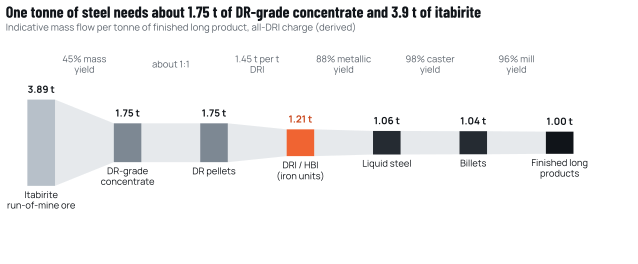
Source: Cameroon Steel derivation from RC-1 yields [F01], pellet ratio [N01] and testwork mass yield [O04]; method in Annex A.
The mass flow in Figure 6.1 shows what the module implies. For each tonne of finished long product made entirely from DRI, the chain needs about 1.21 t of DRI, about 1.75 t of DR-grade pellets at 1.45 t per tonne of DRI [N01], about the same tonnage of concentrate, and about 3.9 t of itabirite at the 45% mass yield achieved in testwork [O04]. A 1 Mtpa DRI module therefore needs about 1.45 Mtpa of pellets and about 3.2 Mtpa of itabirite run-of-mine ore.

Compare that with the ore that the 15% rule makes available (Figure 6.2). Fifteen per cent of Mbalam’s road-phase exports would be up to 1.5 Mtpa and of its rail-phase exports 3.75 Mtpa [O25][Z42]; fifteen per cent of Lobé’s planned 2028 concentrate output would be 0.6 Mtpa [O35]. In volume, the obligation covers the need of a 1 Mtpa DRI module. In grade, it does not: Mbalam’s direct-shipping ore is at 62% Fe and Lobé’s concentrate is planned above 60% Fe, whereas a shaft furnace needs a product near 67.5% Fe with low gangue [O05][O35][N16].
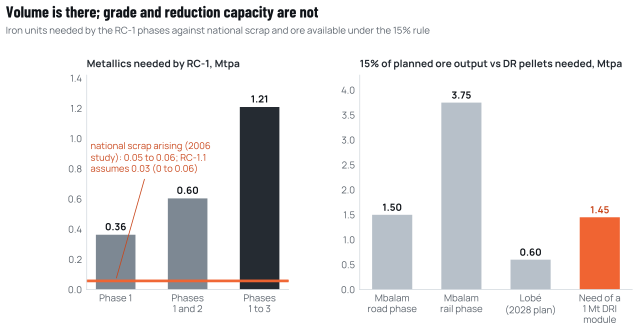
Source: RC-1 [F01]; scrap [C42]; Mbalam export plan [O25]; Lobé plan [O35]; 15% rule [Z42]; pellet ratio [N01]. Status: planned / derived.
Table 6.2 sets out the conditions that should be met before the module is built.
Table 6.2 Conditions for building the direct-reduction module on Cameroonian ore
| Condition | Threshold or test | Evidence today | Source |
|---|---|---|---|
| Grade | Concentrate near the DR basis of 67.5% Fe, 1.5% SiO2, 0.5% Al2O3, proven at pilot scale | 68% Fe, 1.8% SiO2, 0.2% Al2O3 in 2014 testwork only | [N16][O04] |
| Resource for local use | Certified resource and mine plan for the itabirite or concentrate dedicated to local supply | JORC itabirite resource of 5,638 Mt at 33.4% Fe; no mine plan for local supply | [O05] |
| Pelletising | Pellet plant at the mine or at Kribi, about 1.45 Mtpa | None planned publicly; 2011 study costed a 4 Mtpa plant at US$400 m | [N01][O01] |
| Gas | About 9.2 to 10 GJ per tonne of DRI, i.e. 8.4 to 9.1 bcf/yr for 1 Mtpa, under a long-term contract backed by a reserve audit | 75.5 bcf produced in 2025; LNG offtake ended July 2026; reserves not public | [T09][T10][E04][E09] |
| Power | Firm supply for about 115 to 130 MW average for the full chain | Kribi substation 100 MW initially, 330 to 400 MW later | [F01][Z43] |
| Bulk logistics | Handling about 1.45 Mtpa of pellets or concentrate | Mineral terminal of 125 Mtpa: MoU of 4 November 2025, completion expected within five to six years of March 2026; rail from 2030 | [O31][Z4][O25] |
| Offtake | Market for about 0.8 Mtpa of steel per Mt of DRI, or HBI exports | Domestic market about 0.45 Mtpa; CEMAC and AfCFTA | [C40][C07] |
| Contract | 15% offtake agreement with grade, export-parity price and timing | Obligation exists; terms not public | [Z42][O17] |
Source: Cameroon Steel analysis; thresholds from the sources shown.
The pelletising step deserves particular attention. In 2011 the former holder’s Mbalam "Stage 2" study envisaged 35 Mtpa of itabirite concentrate at 66% Fe and costed a 4 Mtpa pellet plant at US$400 m within a US$3.1 bn package that also required about 350 MW of power [O01]. A pellet plant sized for a single 1 Mtpa DRI module would be much smaller, about 1.45 Mtpa. It could sit at the mine, which avoids moving moisture-laden concentrate, or at Kribi, which allows it to serve both the DR module and export customers. That choice belongs in the feasibility work that the DR module requires.
6.6 Carbon: the phased chain starts low and stays below the world average
Electric steelmaking on Cameroon’s grid starts with a low carbon footprint. The latest published emission factor for that grid is about 226 g CO2/kWh, for 2024, a year in which the same Ember dataset puts hydropower at about 72% of generation [E56][E57]. The electricity regulator reports a higher hydropower share for 2025, about 90% [E15]; no emission factor has yet been published for that year. RC-1 keeps 226 g as a conservative planning value [F01]. On that basis, Phase 1’s estimated intensity is about 0.32 t CO2 per tonne of finished steel for direct (scope 1) and electricity (scope 2) emissions, and about 0.58 t including the upstream emissions of the imported DRI in the charge [F01]. For comparison, worldsteel’s 2024 averages are 0.69 t for scrap-based EAF, 1.47 t for DRI-EAF and 2.34 t for blast furnace and basic oxygen furnace, with a world average of 1.92 t [T01].
A gas-based DR module raises the chain’s direct emissions; on a direct and indirect basis, the IEA puts gas DRI-EAF at about 1.4 t of CO2 per tonne against 2.2 t for the blast-furnace route [T02]. But it keeps the chain well below the blast-furnace route, and modern shaft furnaces can take hydrogen: one supplier reports a 53% reduction against the blast-furnace route with natural gas and 86% with 100% hydrogen [T09]. Since the EU’s carbon border adjustment mechanism (CBAM) covers DRI, billets, rebar, wire rod and even iron-ore pellets [D08], and its certificate price reached €82.32/t of CO2 in the third quarter of 2026 [D05], a low and verified carbon intensity is a commercial asset for any export.
6.7 Why this order, and not another
Three alternative sequences were considered and set aside.
- Direct reduction first. Building a DR module before a melt shop would require, at once, DR-grade feed that does not yet exist at scale, a gas contract that has not been negotiated, and a melt shop large enough to absorb about 1 Mtpa of DRI or an export market for HBI. It concentrates every risk in a single investment, the pattern that failed at Ajaokuta (Chapter 4).
- A pellet plant at the mine for export only. Exporting DR-grade pellets rather than direct-shipping ore would add value and could be an excellent business in a market short of DR pellets [N01][N02]. It is complementary to the phased chain rather than an alternative: the same pellets can feed a Kribi DR module later. It does not by itself create a steel industry.
- More rebar capacity. Adding rolling capacity without a melt shop would deepen the saturation of Chapter 3 and increase billet imports.
The phased order follows the pattern of the successful cases. It starts where the import bill is, as Egypt’s semi-finished imports show was necessary; it starts at a deep-water port on imported raw materials, as Vietnam’s coastal complex did with imported ore; and it integrates backwards into national ore once grade, energy and scale are proven, as Algeria is now doing with Gara Djebilet.
Sources cited in this chapter
Bracketed markers refer to these sources; the full list is in the annex. Full list of sources
- C06UN Comtrade public API, Cameroon (reporter 120), HS 72/73 and 6-digit lines, 2019-2023. UN Statistics Division.comtradeapi.un.org/public/v1/preview/C/A/HS?reporterCode=120&period=20…
- C38Cameroun: le groupe Prometal décroche 26 milliards FCFA auprès d’Afreximbank…. Sikafinance, 30 Sep 2026.sikafinance.com/marches/cameroun-le-groupe-prometal-decroche-26-millia…
- T132025 World Direct Reduction Statistics. Midrex Technologies, Sep 2026.midrex.com/world-dri-statistics/world-dri-production-reaches-151-0-mt-…
- T20Nucor to build new rebar micro mill in North Carolina. Nucor Corp., 7 Apr 2022.nucor.com/news-release/nucor-to-build-new-rebar-micro-mill-in-north-ca…
- T21Commercial Metals Company to invest $300 million in its third micro mill. Steel Technology, n.d..steel-technology.com/projects/commercial-metals-company-to-invest-300-…
- X04Industrialisation: la voie royale de l’émergence. Cameroon Tribune, 2 Jan 2025.cameroon-tribune.cm/article.html/68558/fr.html/details_2
- X01Kribi: le Premier ministre, chef du gouvernement est là. Cameroon Tribune, 30 Dec 2024.cameroon-tribune.cm/article.html/68499/fr.html/details_2
- Z4Zone industrialo-portuaire de Kribi (KPIZ): jusqu’à +8 points de croissance et 150 000 emplois…. Investir au Cameroun, 4 Mar 2026.investiraucameroun.com/gestion-publique/0403-23163-zone-industrialo-po…
- F01Cameroon Steel reference configuration RC-1 (planning estimate), edition 10 October 2026 (RC-1.1). Cameroon Steel, 10 Oct 2026.Cited by title and date
- T09ENERGIRON technology (DRI-EAF with natural gas or H₂). EC ICIT, ref. 12 Feb 2026.innovation-centre-for-industrial-transformation.ec.europa.eu/innovativ…
- C42Bidoung J., Fomethe A., Yantio G., Melo U., La récupération et le recyclage des déchets ferromagnétiques: analyse de la situation au Cameroun (Déchets, Revue francophone d’écologie industrielle n°48). ENSP Yaoundé / MIPROMALO, Q4 2007.eid.episciences.org/7942/pdf
- N03BPI and HBI prices on the rise in Europe. SteelOrbis, 23 Jan 2026.steelorbis.com/steel-prices/steel-prices-market-analyses/scrap-and-raw…
- C30Production: les acteurs en présence. Cameroon Tribune, 11 May 2026.cameroon-tribune.cm/article.html/76600/fr.html/details_2
- K02ENSPY homepage (departments). ENSP Yaoundé, n.d..polytechnique.cm/
- K03EGEM, fiche d’identification. Université de Ngaoundéré, n.d..univ-ndere.cm/fr/etablissements/egem/
- K04EGCIM, fiche. Université de Ngaoundéré, n.d..univ-ndere.cm/fr/etablissements/egcim/
- Z43Kribi franchit la ligne électrique 225 kV. PAK, 6 Aug 2025.Cited by title and date
- Z54La ZIPK rayonne avec l’inauguration de la cimenterie CIMPOR!. PAK, 19 Jul 2024.Cited by title and date
- C25Prometal inaugure deux usines évaluées à 57 milliards F. Journal du Cameroun, 19 Jan 2024.fr.journalducameroun.com/prometal-inaugure-deux-usines-evaluees-a-57-m…
- C05Évolution du commerce extérieur en 2025 (version provisoire). INS Cameroun, Feb 2026 (posted 1 Apr 2026).ins-cameroun.cm/wp-content/uploads/2026/04/Note-sur-le-commerce-exteri…
- N01Iron ore supply for direct reduction: outlook and challenges (J. Atherton), Arab Steel Summit presentation. International Iron Metallics Association (IIMA), Oct 2024.2024.aisusteel.org/wp-content/uploads/2024/10/Dr-John-Atherton_IIMA.pd…
- O04Mbalam-Nabeba project presentation, Mining Indaba 2014 (itabirite testwork). Former holder of the Mbalam-Nabeba project (ASX-listed), Feb 2014.sdl.live.irmau.com/irm/PDF/2752_0/PresentationMiningIndaba2014
- O25Mbalam iron ore mine delays first exports to early 2026. Business in Cameroon, 13 Dec 2025.businessincameroon.com/public-management/1312-15495-mbalam-iron-ore-mi…
- Z42Loi n° 2023/014 du 19 décembre 2023 portant Code minier, Article 40(4) (official text, mirror). Rural-info (copy of the official text), 19 Dec 2023.rural-info.net/wp-content/uploads/2024/11/Loi-N°2023-014-du-19-decembr…
- O35Sinosteel reporte les exportations du fer de Kribi-Lobé à 2027 malgré 120 milliards FCFA déjà investis. EcoMatin, 11 Mar 2026.ecomatin.net/cameroun-sinosteel-reporte-les-exportations-du-fer-de-kri…
- O05Mbalam-Nabeba resources and reserves statement as at 20 May 2015 (JORC). Former holder of the Mbalam-Nabeba project (ASX-listed), 2015.sdl.live.irmau.com/irm/content/resources-reserves.aspx?RID=236
- N16Launch of DR-grade iron ore pellet premium weekly indicator. Fastmarkets, 1 Dec 2022.fastmarkets.com/insights/launch-of-dr-grade-iron-ore-pellet-premium-we…
- O01Mbalam Iron Ore Project: Stage 1 definitive feasibility study and Stage 2 pre-feasibility study (ASX release). Former holder of the Mbalam-Nabeba project (ASX-listed), 6 Apr 2011.sdl.live.irmau.com/irm/PDF/2074_0/SDLDeliversPositiveFeasibilityStudie…
- T10Suez Steel sets new benchmark in energy consumption for DRI production. Danieli, 16 Apr 2026.danieli.com/en/news-media/news/suez-steel-sets-new-benchmark-energy-co…
- E04Données pétrolières 2025. SNH, posted Jun 2026.snh.cm/wp-content/uploads/2026/06/Donnees-petrolieres-2025.pdf
- E09Le navire usine quitte le Cameroun, le gaz s’arrête. Camer.be, 9 Jul 2026.camer.be/93911/12:1/le-navire-usine-quitte-le-cameroun-le-gaz-sarrete-…
- O31CNPS, G-Stones join Kribi port mineral terminal project. Business in Cameroon, 7 Nov 2025.businessincameroon.com/mining/0711-15312-cnps-g-stones-join-kribi-port…
- C40Cameroun: Prometal décroche 26,2 milliards FCFA d’Afreximbank. Camer.be, 1 Oct 2026.camer.be/actualites/economie/cameroun-prometal-decroche-262-milliards-…
- C07UN Comtrade public API, CEMAC & Nigeria (reporters 266 Gabon, 178 Congo, 140 CAR, 566 Nigeria; mirror partners 148 Chad, 226 Eq. Guinea). UN Statistics Division.comtradeapi.un.org/public/v1/preview/C/A/HS?reporterCode=266&period=20…
- O17Cameroon Mining Company confirme l’entrée du projet Mbalam dans sa phase irréversible d’exécution. Camer.be via AllAfrica, 12 Dec 2025.fr.allafrica.com/stories/202512120475.html
- E56Carbon intensity of electricity generation (Ember data), Cameroon. Our World in Data.ourworldindata.org/grapher/carbon-intensity-electricity
- E57Electricity production by source (Ember and Energy Institute data), Cameroon. Our World in Data.ourworldindata.org/grapher/electricity-prod-source-stacked
- E15Rapport d’activités 2025 de l’ARSEL. ARSEL (electricity regulator), 7 Sep 2026.arsel-cm.org/wp-content/uploads/2026/09/Rapport-ARSEL-2025.pdf
- T01Sustainability Indicators 2025 report. worldsteel, Nov 2025 (upd. Feb 2026).worldsteel.org/wider-sustainability/sustainability-indicators/sustaina…
- T02Iron and Steel Technology Roadmap. IEA, Oct 2020.iea.blob.core.windows.net/assets/eb0c8ec1-3665-4959-97d0-187ceca189a8/…
- D08Regulation (EU) 2023/956 (CBAM), Annex I. EUR-Lex (OJ L 130), 16 May 2023.eur-lex.europa.eu/legal-content/EN/TXT/PDF/?uri=CELEX:32023R0956
- D05Price of CBAM certificates. European Commission, 5 Oct 2026 (latest).taxation-customs.ec.europa.eu/carbon-border-adjustment-mechanism/price…
- N02MENA will need an additional 30-40 million tons of DR pellets in the near future. GMK Center, 24 Nov 2025.gmk.center/en/news/mena-will-need-an-additional-30-40-million-tons-of-…
Cite this chapter
Cameroon Steel (2026). From ore to steel: Cameroon’s missing link is ironmaking, not rolling. White paper 01, chapter 6: A phased chain: melt first, then sections, then iron from Cameroonian ore. CS-WP-01. https://www.cameroon-steel.com/en/library/ore-to-steel/staged-chain/
Source