White paper 01 · Chapter 10
Recommendations: make the 15% rule produce iron
Cameroon has the ore, the port, the gas field and, since 2023, the legal principle of local transformation. To turn ore exports into industrial value it now needs three things: implementing rules that make the 15% obligation a bankable supply of DR-grade feed; energy and trade policies that reward ironmaking rather than rolling; and a chain built in phases, starting with a melt shop at Kribi. The recommendations below are addressed to government, to investors including Cameroon Steel, and to partners; most cost the budget little.
In this chapter (6)
10.1 Principles behind the recommendations
The recommendations follow from four conclusions of this paper.
- The value of Cameroon’s steel chain is upstream: ore and ironmaking hold about two-thirds or more of the value of a tonne of rebar on every price case tested (Chapter 8).
- The binding constraints are iron units and energy, not rolling capacity or demand for steel in general (Chapters 3 and 9).
- The 15% rule supplies volume but not grade: a share of direct-shipping ore cannot feed a shaft furnace (Chapters 2 and 6).
- Successful producers built in modules at ports, behind secure feed, and integrated backwards into domestic ore (Chapter 4).
The recommendations are grouped by the party best placed to act, and each carries an indicator by which progress can be judged. Their timing follows the published calendar of the ore, power and port projects and the RC-1.1 planning schedule (Figure 10.2).
10.2 For government
G1. Issue an implementing text for article 40(4) of the Mining Code. The text should answer the five open questions identified in Chapter 5:
- definition: recognise transformation by depth (concentration, agglomeration, reduction, steelmaking), with credit for the deeper steps, so that crushing and screening alone do not satisfy the obligation;
- grade: allow the obligation to be met with a grade-adjusted volume of concentrate, so that a smaller tonnage of DR-grade product counts for more than a larger tonnage of direct-shipping ore;
- price: set a reference price at export parity, the seaborne index adjusted for grade, less the freight and port charges the miner avoids by selling locally;
- timing: define ramp-up, carry-forward and what happens when either the mine or the processor is late;
- transparency: require each convention holder to report volumes, grades and prices supplied for local transformation, and publish the reports.
G2. Give the mines-metallurgy committee a public work programme. The committee created in December 2025 already has the mandate [Z79][Z80]. It should publish an annual report on compliance with the 15% rule, coordinate a pilot programme for DR-grade concentrate with the convention holders, and act as the single interlocutor for steel investors on ore, gas and power.
G3. Make tariffs reward ironmaking. In applying the new CEEAC-CEMAC common external tariff [P23], review the lines for billets, sections and direct-reduced iron so that duties escalate from ore to semi-finished to finished steel, instead of the flat 10% on ore, DRI and billets observed in 2023 [P24]. Apply the national preference of the Finance Law 2025 [P18] explicitly to billets and sections made in Cameroon. Over time, and once domestic iron units are available, replace the rebar import ban [C20] with a tariff and quality-standard regime that protects without freezing the market.
G4. Build trade-remedy capacity. Cameroon has no anti-dumping or safeguard practice in steel, while 62 countries had adopted 207 measures against Chinese steel by October 2025 [G30]. A small investigating unit, using CEMAC and WTO procedures, would allow the State to respond to import surges with targeted, temporary measures rather than bans.
G5. Secure gas for industry at Kribi. Commission an independent audit of the remaining reserves of the Sanaga Sud system; publish an allocation of gas for industrial use in the Kribi zone now that the LNG offtake has ended [E09]; clarify whether the tax on natural gas applies to gas used as a reductant [E11]; and prepare a model long-term gas sales agreement for industrial users.
G6. Publish a framework for heavy-industry power contracts. There is no regulated tariff above 10 MW [E15]. A published framework for high-voltage industrial contracts, combining a capacity charge, an energy charge and indexation, would let investors size plants and lenders assess them. Complete the 225 kV supply to the port by the end of 2026, as planned [Z43], publish how its first 100 MW will be allocated among port-platform users and the power-quality terms for arc-furnace loads, and prepare its later 330 to 400 MW stage in step with industrial demand.
G7. Sequence port and rail investments with the chain. Reserve berth and storage capacity for steel inputs and products in the planned mineral terminal’s steel cluster [O31]; advance the Édéa-Kribi-Lolabé-Campo railway [Z45]; and deliver the port-platform water plant planned for early 2027 [Z44].
G8. Create a national ferrous-metallurgy programme. With ENSP Yaoundé, the Ngaoundéré mining and minerals schools and IUT Douala [K02][K03][K08], create a degree and technician track in iron and steelmaking, with industrial placements, so that the local-employment provisions of the Mining Code [O36] can be met in skilled as well as unskilled jobs.
10.3 For investors, including Cameroon Steel
I1. Build the melt shop first. Begin with an electric arc furnace, ladle furnace and billet caster sized within the first 100 MW available at Kribi, as RC-1 Phase 1 does at about 36 MW average load, with an agreed allocation of that shared supply and power-quality measures for the arc furnace [F01][Z43]. The melt shop is the asset the country lacks; it should be the anchor of the first phase, with its output flexible between rolled products and merchant billets.
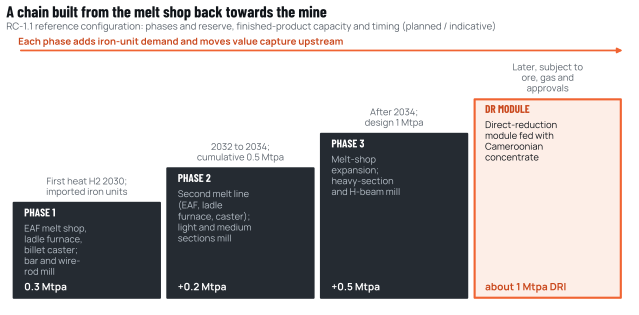
Source: Cameroon Steel, RC-1 reference configuration [F01]; design capacity [X04]. Status: planned / indicative.
I2. Secure iron units from several sources. Contract HBI and DRI from more than one origin, organise scrap collection that brings informal collectors into a formal supply chain, and offer merchant billets to the existing re-rollers, which import about 60% of their charge as billets today [C38].
I3. Move beyond rebar on evidence of demand. Trigger the sections and heavy long-product phases when customers in Cameroon, CEMAC and wider AfCFTA markets are identified; medium and heavy sections are not produced in Cameroon and are imported today [C06], and they are not targeted by the new regional rebar mills.
I4. Prepare the DR module now, build it later. Fund pilot-scale concentration, pelletising and reduction tests on Cameroonian ore; agree with the convention holders the grade and price terms of supply under the 15% rule; evaluate whether the pellet plant should sit at the mine or at Kribi; specify hydrogen-ready direct-reduction equipment; and reserve the site and utilities, as RC-1 does [F01].
I5. Measure carbon and meet international standards from the start. Install measurement, reporting and verification for emissions that satisfies the EU’s CBAM [D04], and carry out environmental and social assessment to IFC Performance Standards, so that exports and international finance remain open.
10.4 For partners
P1. Development-finance institutions: finance phase by phase. Lenders such as the AfDB, already supporting the Kribi industrial zone [Z13], and Afreximbank, already lending to Cameroonian steel [C38], can match their financing to the phases of the chain: working-capital and equipment finance for Phase 1, project finance for later phases, and guarantees for long-term gas and power contracts that the State alone cannot back.
P2. Miners: invest in grade. Convention holders can meet the 15% obligation in its most valuable form by producing DR-grade concentrate, either for a Cameroonian DR module or for export to a market expected to remain short of DR pellets until about 2030 [N02]. Co-investment in a pellet plant is a natural extension of a mine’s business.
P3. Technology suppliers: bring modular, hydrogen-ready equipment and training. Direct-reduction modules from 0.25 Mtpa [T13] and electric arc furnaces suited to a high share of DRI exist and are proven in Africa (Chapter 4). Supplier training packages should be part of every contract.
P4. Regional institutions: settle the rules of origin. CEMAC and the AfCFTA Secretariat can clarify how chapter 72 products made from imported iron units qualify for preferential treatment [P31], which will determine whether early phases of the chain can export within the continent.
Table 10.1 Recommendations at a glance
| # | Recommendation | Lead | Window | Indicator of success |
|---|---|---|---|---|
| G1 | Implementing text for art. 40(4): definition, grade, export-parity price, timing, reporting | Ministry of Mines; mines-metallurgy committee | 2026 to 2027 | Text adopted; first offtake contract signed on its terms |
| G2 | Public work programme and annual 15% compliance report | Mines-metallurgy committee | 2026 onwards | First report published |
| G3 | Tariff escalation from ore to semis to finished steel; national preference for local billets | Ministry of Finance; Customs | 2026 to 2028 | Billet and section lines reviewed in the new tariff |
| G4 | Trade-remedy capacity | Ministry of Trade | 2026 to 2028 | Investigating unit operational |
| G5 | Gas reserve audit and industrial allocation at Kribi | Energy and mines ministries; SNH | 2026 to 2028 | Audit published; allocation decided |
| G6 | Framework for power contracts above 10 MW; 225 kV supply delivered | Ministry of Water and Energy; regulator | 2026 to 2027 | Framework published; 100 MW available at the port; steelworks allocation agreed |
| G7 | Berth in the steel cluster; Édéa-Kribi rail; water plant | Port authority; KPIZ; Ministry of Transport | 2026 to 2032 | Berth allocated; rail financing closed |
| G8 | National ferrous-metallurgy programme | Higher education; universities; industry | 2027 onwards | First cohort enrolled |
| I1 | Melt shop first, within the first 100 MW | Investors | Phase 1: works from 2029; first heat targeted H2 2030 | Billets cast in Cameroon |
| I2 | Multi-source iron units; scrap collection; merchant billets | Investors | Phase 1 onwards | Contracts with at least two origins |
| I3 | Sections on evidence of demand | Investors | Phase 2, indicatively 2032 to 2034; Phase 3 after 2034 | Offtake agreements before investment |
| I4 | Prepare the DR module: pilot tests, grade terms, pellet-plant siting | Investors; miners | Now to 2034; module indicative after 2034 | Pilot results; signed grade and price terms |
| I5 | CBAM-grade emissions measurement; IFC-standard ESIA | Investors | Phase 1 onwards | Verified emissions report |
| P1 | Phase-by-phase finance; guarantees for gas and power contracts | DFIs | Each phase | Financing closed for each phase |
| P2 | DR-grade concentrate and pellet co-investment | Miners | 2027 onwards | DR-grade product made at pilot scale |
| P3 | Modular, hydrogen-ready equipment; training | Technology suppliers | Each phase | Training hours delivered |
| P4 | Rules of origin for chapter 72 under AfCFTA | CEMAC; AfCFTA Secretariat | 2026 to 2028 | Published rules |
Source: Cameroon Steel. Windows are indicative and follow the published calendars of the ore, power and port projects and the RC-1.1 planning schedule [F01].
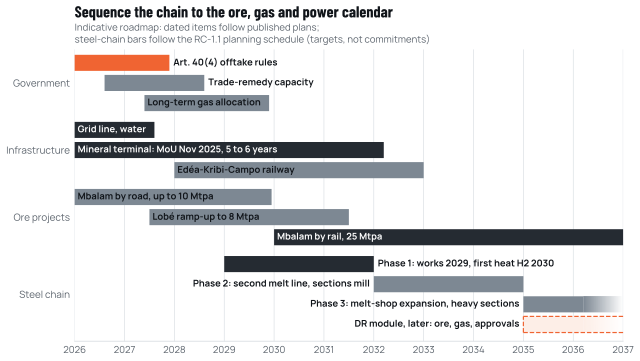
Source: Cameroon Steel; Mbalam export plan [O25]; Lobé ramp-up [O35]; Kribi 225 kV line and water plant [Z43], [Z44]; mineral terminal [O31]; rail MoU [Z45]; DR-pellet market outlook [N02]; RC-1.1 phases and schedule [F01]. Status: illustrative.
10.5 How the recommendations answer the lessons of other producers
Each recommendation responds to one of the seven lessons drawn in Chapter 4, and it is worth making the link explicit, because the same mistakes recur across countries.
- Match the route to the energy. G5 and G6 secure gas and power for a DRI-EAF route, the one that fits Cameroon’s gas field and hydro-based grid, rather than a coal-based route the country cannot supply.
- Secure the feed before the furnace. G1, I2, I4 and P2 make sure that each phase has its iron units before it is built: imported and local scrap and HBI for the melt shop, DR-grade concentrate contracted under the 15% rule for the DR module.
- Build in modules. I1, I3 and P1 tie each investment and each financing to a phase, avoiding the single oversized commitment that failed at Ajaokuta.
- Start where the import bill is. I1 targets billets, the largest import, and I3 sections, the next gap among long products.
- Protect intelligently and temporarily. G3 and G4 replace a ban on the most saturated product with tariffs that escalate along the chain and with targeted trade remedies, as Egypt and Vietnam use.
- Bring in anchor partners. P1 and P3 bring finance and proven technology; P2 brings the miners, whose ore is the chain’s ultimate source of value.
- Put the plant at the port. G7 sequences berth, rail and water at Kribi with the phases of the chain.
Two cross-cutting points complete the picture. First, coordination matters more than any single instrument: the ore projects, the gas allocation, the power supply and the port terminals are under different ministries and companies, and the mines-metallurgy committee (G2) is the natural place to align them. Second, transparency is itself an industrial policy. Publishing the terms of local supply under the 15% rule, the compliance reports and the gas allocation would reduce the risk premium that lenders apply to Cameroonian projects, in a country whose EITI status is suspended [O52] and whose fiscal room is limited [P32].
10.6 What success would look like by the mid-2030s
If these recommendations are followed, the Cameroonian steel chain in the mid-2030s would look different from today’s in four measurable ways:
- billets cast in Cameroon would replace a large part of the 161 kt imported in 2023 [C06] in the re-rollers’ charge, and the leading re-rollers would no longer need to borrow hard currency to import them;
- medium and heavy sections would be made locally and exported within CEMAC, rather than imported;
- a DR-grade concentrate from Cameroonian ore would have been produced at pilot scale, its supply under the 15% rule contracted on transparent terms, and a decision on a direct-reduction module taken on evidence;
- the share of the gross price build-up of a tonne of rebar occurring in Cameroon would have moved from about one-fifth towards one-third, with a clear path to most of it (Chapter 8).
None of these outcomes requires a large public subsidy. They require rules, contracts and sequencing, which are within the State’s and the industry’s control.
Sources cited in this chapter
Bracketed markers refer to these sources; the full list is in the annex. Full list of sources
- Z79Cameroon reviews metals industry to address supply and energy constraints. Business in Cameroon, 29 Apr 2026.businessincameroon.com/public-management/2904-16094-cameroon-reviews-m…
- Z80Le Cameroun prépare l’exportation de son acier vers les marchés de la ZLECAf. Ecomatin (V. Bagal), 16 Apr 2026.ecomatin.net/le-cameroun-prepare-lexportation-de-son-acier-vers-les-ma…
- P23Cameroon applies CEEAC common external tariff from January 1, 2026. Business in Cameroon, 12 Jan 2026.businessincameroon.com/public-management/1201-15594-cameroon-applies-c…
- P24WITS TRAINS API, Cameroon reported MFN tariffs by HS6 (2023). World Bank / UNCTAD.wits.worldbank.org/API/V1/SDMX/V21/datasource/TRN/reporter/120/partner…
- P18Innovations douanières de la Loi de Finances 2025. MINFI, Direction Générale des Douanes, Jan 2025.minfi.gov.cm/wp-content/uploads/2025/01/EXPOSE_DGD_LF_2025.pdf
- C20Press report of the sealing by customs of more than 7,300 t of imported reinforcing bar, December 2020 (headline and address not reproduced: they name the importer). Business in Cameroon, 16 Dec 2020.Cited by title and date
- G3062 countries implemented 207 restrictions against steel products from China. GMK Center, 13 Oct 2025.gmk.center/en/infographic/62-countries-implemented-207-restrictions-ag…
- E09Le navire usine quitte le Cameroun, le gaz s’arrête. Camer.be, 9 Jul 2026.camer.be/93911/12:1/le-navire-usine-quitte-le-cameroun-le-gaz-sarrete-…
- E11Industrial gas: Cameroon suspends GDC’s 20% price hiking plan. Business in Cameroon, 18 Jul 2023.businessincameroon.com/energy/1807-13291-industrial-gas-cameroon-suspe…
- E15Rapport d’activités 2025 de l’ARSEL. ARSEL (electricity regulator), 7 Sep 2026.arsel-cm.org/wp-content/uploads/2026/09/Rapport-ARSEL-2025.pdf
- Z43Kribi franchit la ligne électrique 225 kV. PAK, 6 Aug 2025.Cited by title and date
- O31CNPS, G-Stones join Kribi port mineral terminal project. Business in Cameroon, 7 Nov 2025.businessincameroon.com/mining/0711-15312-cnps-g-stones-join-kribi-port…
- Z45Ligne ferroviaire Édéa-Kribi-Lolabé-Campo: une nouvelle étape…. PAK, 4 Jun 2026.Cited by title and date
- Z44Énergie et infrastructures: un nouvel élan pour la compétitivité du Port de Kribi. PAK, 19 Aug 2026.Cited by title and date
- K02ENSPY homepage (departments). ENSP Yaoundé, n.d..polytechnique.cm/
- K03EGEM, fiche d’identification. Université de Ngaoundéré, n.d..univ-ndere.cm/fr/etablissements/egem/
- K08ISTD / IUT Douala (homepage). iut-dla.cm, n.d..iut-dla.cm/
- O36Mining 2026, Cameroon (Chazai Wamba). Chambers Global Practice Guides, updated 27 Jan 2026.practiceguides.chambers.com/practice-guides/mining-2026/cameroon
- F01Cameroon Steel reference configuration RC-1 (planning estimate), edition 10 October 2026 (RC-1.1). Cameroon Steel, 10 Oct 2026.Cited by title and date
- X04Industrialisation: la voie royale de l’émergence. Cameroon Tribune, 2 Jan 2025.cameroon-tribune.cm/article.html/68558/fr.html/details_2
- C38Cameroun: le groupe Prometal décroche 26 milliards FCFA auprès d’Afreximbank…. Sikafinance, 30 Sep 2026.sikafinance.com/marches/cameroun-le-groupe-prometal-decroche-26-millia…
- C06UN Comtrade public API, Cameroon (reporter 120), HS 72/73 and 6-digit lines, 2019-2023. UN Statistics Division.comtradeapi.un.org/public/v1/preview/C/A/HS?reporterCode=120&period=20…
- D04CBAM legislation and guidance. European Commission, n.d..taxation-customs.ec.europa.eu/carbon-border-adjustment-mechanism/cbam-…
- Z13Cameroon: AfDB Group supports development of integrated industrial zone at the Port of Kribi. AfDB via AllAfrica (AfDB page returned 403), 2 Mar 2026.allafrica.com/stories/202603100682.html
- N02MENA will need an additional 30-40 million tons of DR pellets in the near future. GMK Center, 24 Nov 2025.gmk.center/en/news/mena-will-need-an-additional-30-40-million-tons-of-…
- T132025 World Direct Reduction Statistics. Midrex Technologies, Sep 2026.midrex.com/world-dri-statistics/world-dri-production-reaches-151-0-mt-…
- P31AfCFTA e-Tariff Book. AfCFTA Secretariat, n.d..au-afcfta.org/etariff/
- O25Mbalam iron ore mine delays first exports to early 2026. Business in Cameroon, 13 Dec 2025.businessincameroon.com/public-management/1312-15495-mbalam-iron-ore-mi…
- O35Sinosteel reporte les exportations du fer de Kribi-Lobé à 2027 malgré 120 milliards FCFA déjà investis. EcoMatin, 11 Mar 2026.ecomatin.net/cameroun-sinosteel-reporte-les-exportations-du-fer-de-kri…
- O52Cameroon, country page (Validation, reports, Mining Code reference). EITI International Secretariat.eiti.org/countries/cameroon
- P32IMF staff concludes Post-Financing Assessment mission to Cameroon (PR 26/314). IMF, 1 Oct 2026.imf.org/en/news/articles/2026/10/01/pr26314-imf-staff-concludes-assesm…
Cite this chapter
Cameroon Steel (2026). From ore to steel: Cameroon’s missing link is ironmaking, not rolling. White paper 01, chapter 10: Recommendations: make the 15% rule produce iron. CS-WP-01. https://www.cameroon-steel.com/en/library/ore-to-steel/recommendations/
Source