White paper 01 · Chapter 3
Cameroon imports iron units and flat steel, not rebar
Cameroon uses about 450 kt of steel a year and imported 412 kt of chapter 72 iron and steel in 2025, a third more than in 2024. The largest single import is not a finished product but billets, the semi-finished feed of the country’s own rolling mills; flat products and heavy sections come next. Rebar, banned from import since 2016, is a domestic and even an export product. The market therefore points to iron units, billets and non-rebar products as the targets for import substitution.
In this chapter (7)
- 3.1 A small market that grows with construction
- 3.2 Imports: tonnage up, unit values down
- 3.3 Billets first, flat products second, rebar almost nothing
- 3.4 The domestic industry: ample rolling, thin melting, short of feed
- 3.5 Prices and protection
- 3.6 The regional market is real but contested
- 3.7 What the market says about where to invest
3.1 A small market that grows with construction
Cameroon’s steel demand is a construction story. Real GDP grew by 3.5% in 2025, according to the national statistics institute (INS), while construction value added grew by 4.3% for the second year running and reached 1,991.1 bn FCFA, about 5.8% of GDP [C09]. The 2026 State budget of 8,816.4 bn FCFA allocates 2,026.3 bn FCFA to public investment [C16]. The housing deficit is estimated at 1.8 to 2.0 million units, with demand of about 300,000 units a year against about 150,000 supplied [C15]. More than half of Cameroonians, 55.7% in 2025, live in towns and cities [C13].
Apparent steel use, that is production plus imports minus exports of finished steel, is put by the industry at about 450 kt/yr [C40]. That is roughly 15 kg per inhabitant on the World Bank’s 2025 population estimate of 29.88 million [C13], or about 20 kg on the provisional census count of 22.7 million published in October 2026 [C14]. Either way it is low: worldsteel puts average steel use at 29.2 kg per person for Africa, 22.5 kg for Africa excluding Egypt and South Africa, and 209 kg for the world in 2025 [G05].
The regional trend is favourable. Africa’s apparent steel use rose 10.4% to 45.0 Mt in 2025, and worldsteel’s April 2026 outlook forecasts growth of 3.8% in 2026 and 4.6% in 2027, describing the post-2023 recovery as a "transformative shift" [G09]. Africa, however, met that demand largely from imports: 32.9 Mt in 2025, up from 23.9 Mt in 2024, with China’s share rising from 13.8 Mt to 19.4 Mt [G05][G06]. Global excess capacity, estimated by the OECD at 640 Mt in 2025 and heading for 745 Mt by 2028 [G16], is looking for unprotected markets, and Sub-Saharan Africa is one of them.
3.2 Imports: tonnage up, unit values down
Cameroon’s imports of chapter 72 goods (iron and steel in primary, semi-finished and rolled forms) more than doubled between 2019 and 2025, from 182,890 t to 412,049 t [C01][C05]. Imports of chapter 73 articles (structures, tubes, wire products and other fabrications) rose more slowly, from 72,253 t to 84,008 t [C01][C05]. The 2025 jump was the steepest of the period: +33% in a single year.
At the same time, the average value of a kilogram of chapter 72 imports fell from a peak of 783 FCFA in 2022 to 413 FCFA in 2025, about €629 per tonne [C02][C05]. Two forces explain the divergence. International prices fell from their 2021 and 2022 highs as Chinese exports reached records of 111 Mt in 2024 and 119 Mt in 2025 on a customs basis [G19][G20]; and the import mix shifted towards cheaper semi-finished steel as Cameroon’s rolling capacity grew.
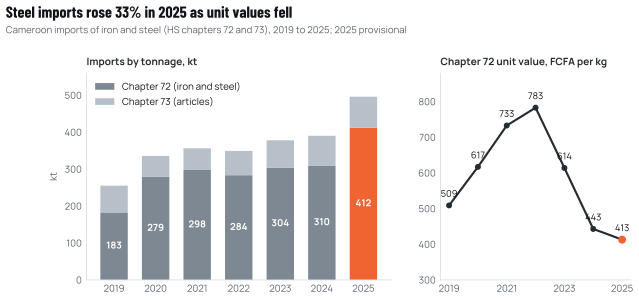
Source: INS, notes on foreign trade 2020 to 2025 [C01], [C02], [C03], [C04], [C05].
In value, iron and steel imports cost the country 170.1 bn FCFA for chapter 72 and 108.0 bn FCFA for chapter 73 in 2025, a total of 278.1 bn FCFA, about €424 m [C05]. That is 5.3% of all imports and 13.0% of Cameroon’s trade deficit of 2,145.2 bn FCFA [C05]. Steel is therefore one of the few industrial import lines large enough to move the external balance.
3.3 Billets first, flat products second, rebar almost nothing
UN Comtrade gives the product detail for 2023, the latest year Cameroon has reported [C06]. Of US$310.4 m of chapter 72 imports that year, billets and other semi-finished steel (HS 7207) accounted for US$151.7 m, about 49%, on a volume of 161.4 kt [C06]. Flat products followed: hot-rolled coil (US$18.3 m), cold-rolled coil (47.5 kt, US$52.0 m) and coated sheet (30.5 kt, US$32.2 m), together about US$102.5 m [C06]. Sections (HS 7216) cost US$26.3 m, wire rod US$8.1 m for 7.8 kt, wire US$5.1 m and rebar US$3.3 m [C06]. In chapter 73, fabricated structures (HS 7308) cost US$58.0 m for 25.7 kt and welded tubes (HS 7306) US$26.0 m for 9.5 kt [C06].
One caution applies. Comtrade’s declared values for billets imply about US$940/t in 2023, well above international billet prices at the time, so values by line should be used with care; tonnages are more reliable [C06]. The ranking does not change on a tonnage basis: billets are the largest line by a wide margin.
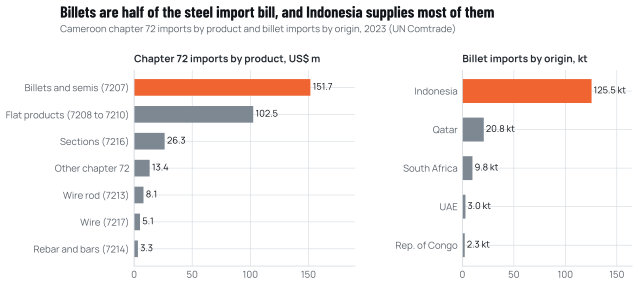
Source: UN Comtrade, Cameroon (reporter 120), HS 72 at four- and six-digit level, 2023 [C06].
The origin of the billets is concentrated. Indonesia supplied 125.5 kt, 78% of the total, followed by Qatar (20.8 kt), South Africa (9.8 kt), the United Arab Emirates (3.0 kt) and the Republic of Congo (2.3 kt) [C06]. For chapter 72 as a whole, China (US$125.5 m) and Indonesia (US$119.3 m) dominated, ahead of Qatar, South Africa, Türkiye, Belgium and India [C06]. A single-country dependence for the main feed of the domestic industry is a supply risk in its own right, independent of price.
Three conclusions follow from the product detail:
- Iron units are the import. About half of chapter 72 spending buys semi-finished steel for local mills. Every tonne of billet made in Cameroon and sold to these mills, from local or imported iron units, displaces a tonne of these imports directly; billets rolled into yet more rebar do not.
- Flat steel is the second gap. About 95 to 100 kt a year of hot-rolled, cold-rolled and coated sheet is fully imported [C06]. Flat products need a different and far more capital-intensive chain (slab casting, hot strip mill, cold mill, coating line), which is beyond the scale of the Cameroonian market for now.
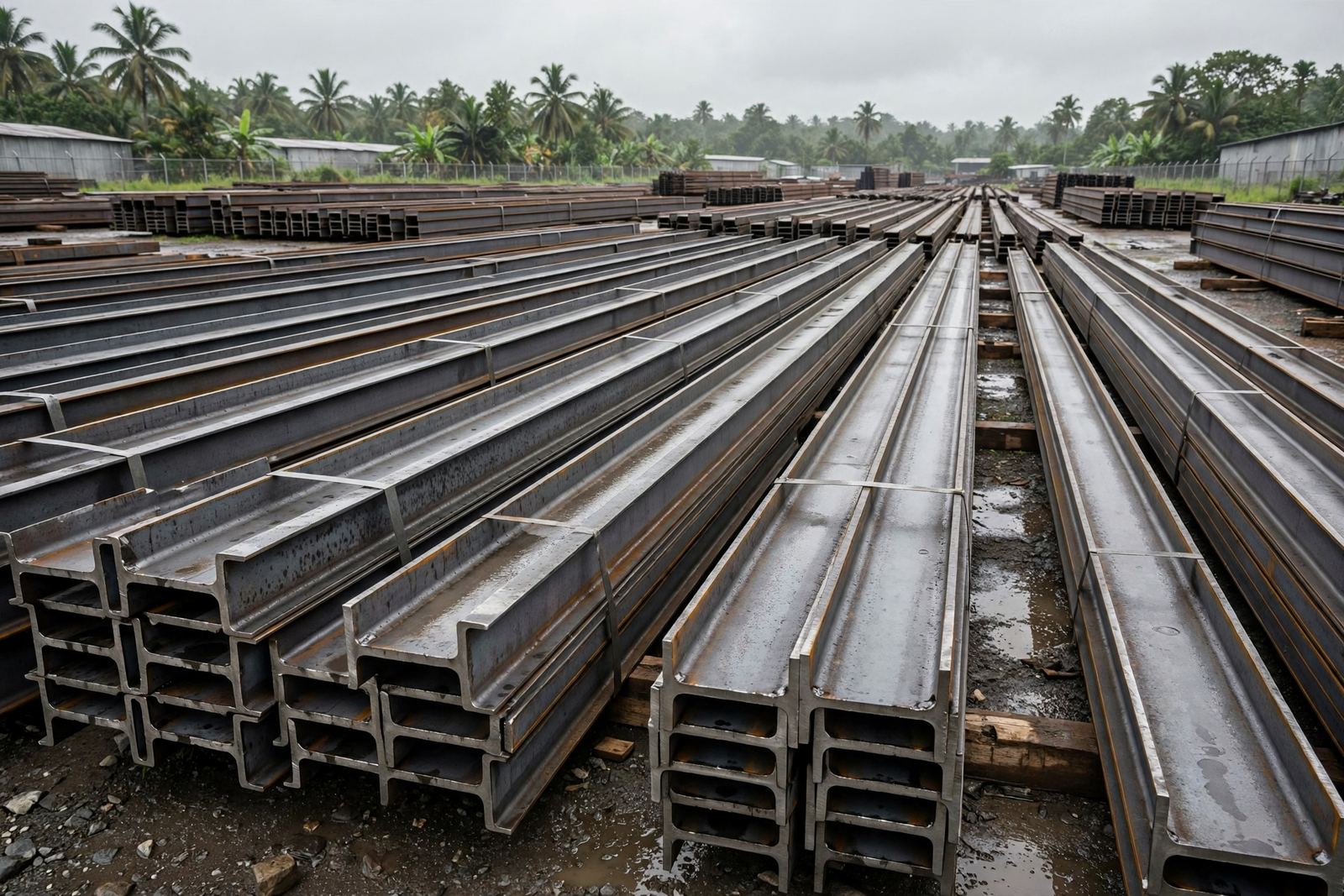
- Sections and structures are largely imported. Light angles and flats are rolled locally in small quantities [C25]; medium and heavy sections and H-beams are not produced in Cameroon and are imported [C06]; structures imported under HS 7308 contain them in fabricated form. These are long products made from billets or blooms, which places them within reach of a phased chain.
3.4 The domestic industry: ample rolling, thin melting, short of feed
Cameroon’s steel industry is a cluster of re-rollers and small melt shops around Douala. The largest, Prometal, inaugurated two plants worth 57 bn FCFA in January 2024, with a rolling mill supplied by SMS group that makes wire rod, beams, angles, flats and rebar; the group reports about 360 kt/yr of finished steel and 1,000 direct jobs [C25][C26]. Prometal’s electric arc furnace, presented in 2023 as the first in Central Africa, was reported at about 200,000 t/yr of rebar [C27]. Aciéries du Cameroun was reported at 250,000 t/yr in 2021 and Metafrique Steel at 60,000 t/yr, scrap-based [C27]. Smaller units include a rebar plant financed by a 8.95 bn FCFA loan from the regional development bank BDEAC [C36].
The industry’s electricity bills give a sense of how much melting actually happens: Prometal paid 8.37 bn FCFA in 2024, Metafrique 3.81 bn, Acero Metal 3.11 bn and Aciéries du Cameroun 1.61 bn [C31]. Prometal’s load was about 40 MW, rising to about 90 MW once its aluminium affiliate runs, and it moved to a high-voltage supply with a dedicated 50 MVA transformer [C31].
The industry association Ocitram published capacity and demand by product in May 2026 (Table 3.1). Every product line has more capacity than the market needs, and all but annealed wire have at least twice as much.
Table 3.1 Capacity and domestic demand by product, as reported by the industry, May 2026
| Product | Installed capacity (kt/yr) | Domestic demand (kt/yr) | Capacity over demand |
|---|---|---|---|
| Reinforcing bar | 627 | 180 | 3.5 times |
| Wire rod and nails | 72 | 36 | 2.0 times |
| Sheets | 43 | 21 | 2.0 times |
| Tubes | 34 | 14 | 2.4 times |
| Annealed wire | 2.8 | 1.8 | 1.6 times |
| All steel transformation | about 1,200 | about 450 | about 2.7 times; mills run at about 50% |
Source: Ocitram as reported by Cameroon Tribune [C30]; total capacity, demand and utilisation [C38][C40]. The rebar capacity figure is printed as "627 tonnes" in the source and is read as 627 kt, consistent with the industry total.
The constraint is feed, not capacity. Local scrap covers about 40% of the mills’ needs and the balance is imported as billets [C38]. Scrap purchase prices rose by about 30% [C40]. The only quantified study of national scrap arising, using 2006 data, found 53,000 to 61,833 t/yr, collected 53% by recyclers, 29% by small "casseurs" and 15% by exporters [C42]. Recorded scrap exports, 3,675 t in 2019, fell to almost nothing afterwards [C06]; no legal export ban was found, so the fall is best read as a de facto restriction [C58]. Even if every tonne of national scrap reached a furnace, it would feed only a fraction of the existing mills.
Two further facts complete the picture. Quality remains a concern: the standards body ANOR sanctioned non-compliant rebar in 2024, and in January 2026 the government refused to revise the mandatory rebar standard to admit a lower grade [C34][C35]. And in September 2026 Prometal secured a €40 m (26.2 bn FCFA) revolving facility from Afreximbank to import billets [C38][C39][C40]. The country’s leading producer is financing imported iron units because there is no domestic source.
3.5 Prices and protection
Rebar is a price-controlled product. In October 2023 the Ministry of Commerce lowered homologated producer prices in Douala; the 12 mm FE500 bar went from 6,900 to 6,750 FCFA, while the street price stood at about 7,500 FCFA [C44]. At 10.66 kg per 12-metre bar, the homologated price implies about 633,000 FCFA/t, roughly €965/t [C44]. Turkish rebar was offered for export at US$550 to 575/t FOB at the same time [G37]. Even so, Cameroonian rebar was reported to be about 10% cheaper than in Côte d’Ivoire and about 25% cheaper than in Gabon in August 2023 [C45].
The tariff structure protects finished products more than semis, but unevenly. Under the CEMAC common external tariff as applied by Cameroon, rebar carries a 20% duty, while billets, iron ore, DRI and scrap carry 10%, sections and hot-rolled coil 10%, and wire rod only 5% [P24]. A new CEEAC-CEMAC tariff applies from 1 January 2026, but its steel-line rates had not been published at the cut-off date [P23]. Since 2026 an environmental tax of 5,000 FCFA per tonne of reinforcing bar (fer à béton) has been payable by local producers and importers alike [P19]. Chapter 5 discusses how these instruments could be aligned with the goal of local ironmaking.
3.6 The regional market is real but contested
Cameroon is the largest steel importer in the Central African Economic and Monetary Community (CEMAC). The sum of chapter 72 imports reported or mirrored for its members came to about US$501 m in 2023, of which Cameroon accounted for about 62% [C06][C07]. The other members import rebar directly or through Cameroon.
Table 3.2 Steel imports of Cameroon’s neighbours, latest available year
| Country | Chapter 72 imports | Rebar (HS 7214) | Note | Source |
|---|---|---|---|---|
| Gabon | US$68.5 m (2023) | 50.7 kt (2023) | VAT on local rebar cut from 10% to 3% (July 2026); new 120 kt/yr scrap-based mill at Nkok | [C07][C52][C39] |
| Republic of Congo | US$45.5 m (2024) | 32.8 kt (2024) | Large chapter 73 imports (oil and gas) | [C07] |
| Chad | US$73.4 m (2023, mirror data) | Cameroon supplied 25.9 kt of bars (2023) | Benin and Cameroon the main suppliers | [C07][C06] |
| Equatorial Guinea | US$11.6 m (2023, mirror data) | n/a | China and Türkiye the main suppliers | [C07] |
| Central African Republic | US$2.6 m (2024) | 1.0 kt | Small market | [C07] |
| Nigeria | US$225.7 m (2024) | n/a | Down from US$930.4 m in 2021 | [C07] |
Source: UN Comtrade [C07] and as shown; CEMAC total derived.
The neighbours are also building their own rolling capacity. Prometal is building a 120,000 t/yr scrap-based rebar mill in Gabon’s Nkok special economic zone [C39], the Fokou group is adding scrap capacity at Port-Gentil [C53], and Gabon has cut VAT on locally made rebar [C52]. Further afield, new 300 kt/yr bar and wire-rod mills were ordered in 2026 for Tanzania and Abidjan [A21][A22]. Regional rebar is becoming as contested as domestic rebar. Billets, sections and iron units are not.
3.7 What the market says about where to invest
The import and industry data lead to a simple ranking of opportunities for a Cameroonian steel chain:
- Iron units and billets are the largest import, have a captive domestic buyer in the existing re-rollers, which import about 60% of their charge [C38], and are the binding constraint on the whole industry.
- Medium and heavy sections are not produced in Cameroon and are imported, are made from billets or blooms, and are not yet targeted by the new regional mills.
- Flat products are a real gap but require a scale and capital outlay beyond the current market.
- Rebar is saturated at home and increasingly contested in the region; new rebar capacity adds little value unless it comes with its own iron units.
The policy and investment question is therefore not whether Cameroon needs more steel mills. It is whether it can make the iron that its existing and future mills need, and where it can make it most cheaply. Chapter 4 looks at how other producers answered that question.
Sources cited in this chapter
Bracketed markers refer to these sources; the full list is in the annex. Full list of sources
- C09Les Comptes Nationaux de 2025. INS Cameroun, Aug 2026 (posted 2 Sep 2026).ins-cameroun.cm/wp-content/uploads/2026/09/Comptes_Nationaux_2025_FR_V…
- C16Budget 2026-8 816,4 milliards FCFA…. MINFI, 26 Nov 2025.minfi.gov.cm/budget-2026-8-8164-milliards-fcfa-pour-consolider-la-stab…
- C152024 Housing Finance Yearbook, Cameroon profile. Centre for Affordable Housing Finance in Africa (CAHF), Jan 2024 (PDF Mar 2025).housingfinanceafrica.org/wp-content/uploads/2025/03/CAMEROON.pdf
- C13WDI API: SP.POP.TOTL; SP.URB.TOTL.IN.ZS (CMR). World Bank, updated 8 Oct 2026.api.worldbank.org/v2/country/CMR/indicator/SP.POP.TOTL?format=json
- C40Cameroun: Prometal décroche 26,2 milliards FCFA d’Afreximbank. Camer.be, 1 Oct 2026.camer.be/actualites/economie/cameroun-prometal-decroche-262-milliards-…
- C14Cameroun: bouclage du 4e RGPH, 22,7 millions d’habitants recensés. Journal du Cameroun, 5 Oct 2026.fr.journalducameroun.com/cameroun-bouclage-du-4e-rgph-227-millions-dha…
- G05World Steel in Figures 2026 (page and PDF). worldsteel, 4 Jun 2026.worldsteel.org/data/world-steel-in-figures/world-steel-in-figures-2026…
- G09worldsteel Short Range Outlook April 2026 (release + Table 1). worldsteel, 14 Apr 2026.worldsteel.org/media/press-releases/2026/worldsteel-short-range-outloo…
- G06World Steel in Figures 2025. worldsteel, Jun 2025.worldsteel.org/data/world-steel-in-figures/world-steel-in-figures-2025…
- G16OECD: global steel excess capacity set to reach 745 million mt by 2028. EUROMETAL (Platts), 5 Jun 2026.eurometal.net/oecd-global-steel-excess-capacity-set-to-reach-745-milli…
- C05Évolution du commerce extérieur en 2025 (version provisoire). INS Cameroun, Feb 2026 (posted 1 Apr 2026).ins-cameroun.cm/wp-content/uploads/2026/04/Note-sur-le-commerce-exteri…
- C06UN Comtrade public API, Cameroon (reporter 120), HS 72/73 and 6-digit lines, 2019-2023. UN Statistics Division.comtradeapi.un.org/public/v1/preview/C/A/HS?reporterCode=120&period=20…
- C01Commerce extérieur du Cameroun en 2020. INS Cameroun, Jul 2021.ins-cameroun.cm/wp-content/uploads/2025/07/Note-Commerce-exterieur-202…
- C02Note sur le commerce extérieur 2022. INS Cameroun, Dec 2023 (rev. 13 Feb 2024).ins-cameroun.cm/wp-content/uploads/2025/07/Note-sur-le-Commerce-Exteri…
- G19China increased steel exports by 7.5% y/y in 2025. GMK Center, 14 Jan 2026.gmk.center/en/news/china-increased-steel-exports-by-7-5-y-y-in-2025/
- G20China’s rapidly growing steel exports will lose momentum from 2026 onwards. GMK Center, 24 Dec 2025.gmk.center/en/infographic/china-s-rapidly-growing-steel-exports-will-l…
- C03Commerce extérieur du Cameroun en 2023. INS Cameroun, Apr 2024.ins-cameroun.cm/wp-content/uploads/2025/07/Note-sur-le-Commerce-Exteri…
- C04Évolution du commerce extérieur en 2024. INS Cameroun, Aug 2025.ins-cameroun.cm/wp-content/uploads/2025/12/Commext_2024_FR_Edite-final…
- C25Prometal inaugure deux usines évaluées à 57 milliards F. Journal du Cameroun, 19 Jan 2024.fr.journalducameroun.com/prometal-inaugure-deux-usines-evaluees-a-57-m…
- C26Cameroun: Prometal (Hayssam El Jammal) se dote de deux nouvelles usines de production d’aciers. EcoMatin, 19 Jan 2024.ecomatin.net/cameroun-prometal-hayssam-el-jammal-se-dote-de-deux-nouve…
- C27Matériaux de construction: l’offensive locale. Cameroon Tribune, 24 Apr 2023.cameroon-tribune.cm/article.html/56766/en.html/details_2
- C36Cameroun: Quifeurou obtient un prêt de 9 milliards FCFA pour une usine de fer à béton à Douala. EcoMatin, 26 Aug 2025.ecomatin.net/cameroun-quifeurou-obtient-un-pret-de-9-milliards-fcfa-po…
- C31Prometal, Acero Metal, Aciéries du Cameroun… qui est le plus gros consommateur d’électricité de la métallurgie camerounaise. EcoMatin, 15 Jul 2026.ecomatin.net/prometal-acero-metal-acieries-du-cameroun-qui-est-le-plus…
- C30Production: les acteurs en présence. Cameroon Tribune, 11 May 2026.cameroon-tribune.cm/article.html/76600/fr.html/details_2
- C38Cameroun: le groupe Prometal décroche 26 milliards FCFA auprès d’Afreximbank…. Sikafinance, 30 Sep 2026.sikafinance.com/marches/cameroun-le-groupe-prometal-decroche-26-millia…
- C42Bidoung J., Fomethe A., Yantio G., Melo U., La récupération et le recyclage des déchets ferromagnétiques: analyse de la situation au Cameroun (Déchets, Revue francophone d’écologie industrielle n°48). ENSP Yaoundé / MIPROMALO, Q4 2007.eid.episciences.org/7942/pdf
- C58Lutte contre la vie chère: le Cameroun limite les exportations de certains produits. EcoMatin, 27 Apr 2022.ecomatin.net/lutte-contre-la-vie-chere-le-cameroun-limite-les-exportat…
- C34Cameroon rejects fresh push to revise rebar standard. Business in Cameroon, 26 Jan 2026.businessincameroon.com/construction/2601-15657-cameroon-rejects-fresh-…
- C35Cameroun: le gouvernement rejette une demande de révision de la norme du fer à béton. EcoMatin, 5 Feb 2026.ecomatin.net/cameroun-le-gouvernement-rejette-une-demande-de-revision-…
- C39Prometal obtient 26 milliards FCFA d’Afreximbank pour soutenir son expansion industrielle. EcoMatin, 30 Sep 2026.ecomatin.net/prometal-obtient-26-milliards-fcfa-dafreximbank-pour-sout…
- C44Fer à béton: les producteurs acceptent une baisse des prix. EcoMatin, 23 Oct 2023.ecomatin.net/fer-a-beton-les-producteurs-acceptent-une-baisse-des-prix
- G37Weekly steel prices (archive 23160). AISU, 22 Oct 2023.aisusteel.org/en/archives/23160
- C45Métallurgie: les locaux battent le fer chaud. Cameroon Tribune, 17 Aug 2023.cameroon-tribune.cm/article.html/59491/fr.html/details_2
- P24WITS TRAINS API, Cameroon reported MFN tariffs by HS6 (2023). World Bank / UNCTAD.wits.worldbank.org/API/V1/SDMX/V21/datasource/TRN/reporter/120/partner…
- P23Cameroon applies CEEAC common external tariff from January 1, 2026. Business in Cameroon, 12 Jan 2026.businessincameroon.com/public-management/1201-15594-cameroon-applies-c…
- P19Cameroon, Republic of: Corporate, Other taxes. PwC Worldwide Tax Summaries, reviewed 14 Aug 2026.taxsummaries.pwc.com/republic-of-cameroon/corporate/other-taxes
- C07UN Comtrade public API, CEMAC & Nigeria (reporters 266 Gabon, 178 Congo, 140 CAR, 566 Nigeria; mirror partners 148 Chad, 226 Eq. Guinea). UN Statistics Division.comtradeapi.un.org/public/v1/preview/C/A/HS?reporterCode=266&period=20…
- C52Le Gabon réduit la TVA sur le fer à béton local. EcoMatin, 4 Aug 2026.ecomatin.net/le-gabon-reduit-la-tva-sur-le-fer-a-beton-local-pour-stim…
- C53Gabon: le groupe Fokou lance une nouvelle unité d’acier à Port-Gentil. EcoMatin, 18 Sep 2026.ecomatin.net/gabon-le-groupe-fokou-lance-une-nouvelle-unite-dacier-a-p…
- A21GSM Tanzania selects Danieli for new rebar and wire-rod mill. Danieli, 14 Sep 2026.danieli.com/en/GSM-Tanzania-selects-Danieli-for-new-rebar-and-wirerod-…
- A22B5Plus Group awards Danieli bar and wire-rod mill project. Danieli, 23 Sep 2026.danieli.com/en/B5Plus-Group-awards-Danieli-bar-and-wirerod-mill-projec…
Cite this chapter
Cameroon Steel (2026). From ore to steel: Cameroon’s missing link is ironmaking, not rolling. White paper 01, chapter 3: Cameroon imports iron units and flat steel, not rebar. CS-WP-01. https://www.cameroon-steel.com/en/library/ore-to-steel/consumption-imports/
Source