White paper 01 · Chapter 1
The gap is upstream: Cameroon rolls steel but makes no iron
Cameroon already rolls more steel than it uses, yet it makes almost none of the iron that steel is made from. Its mills re-roll imported billets and scarce local scrap; no plant in the country turns ore into pellets or iron units. On dated 2025 and 2026 market prices, the steps Cameroon does not perform, from ore to iron units, account for about seven-tenths of the value of a tonne of reinforcing bar.
In this chapter (5)
1.1 Seven steps separate a tonne of ore from a tonne of rebar
Steel reaches a building site at the end of a chain of physical transformations. Each step takes an input, removes something (rock, oxygen, impurities, shape) and passes on a product that is worth more per tonne than what came in. Understanding where Cameroon sits on that chain is the starting point of any serious discussion of local value addition, so it is worth setting the steps out plainly.
Mining extracts iron-bearing rock. Some ore is rich enough to be sold almost as mined after crushing and screening; the trade calls this direct-shipping ore (DSO). The Mbalam-Nabeba reserve, at 62.2% iron, is of this kind [O05]. Most of Cameroon’s tonnage, however, is itabirite or magnetite at about 30 to 35% iron, which must be upgraded before anyone will buy it [O05][O32][O42].
Beneficiation grinds the ore and separates iron minerals from silica and alumina by gravity, magnetic or flotation methods. The output is a fine concentrate. Testwork on Mbalam itabirite produced a concentrate of 68% iron with 1.8% silica and 0.2% alumina, at a mass yield of 45% [O04]: every tonne of concentrate needs a little over two tonnes of rock.
Agglomeration turns fine concentrate into something a furnace can use. Pelletising rolls the concentrate into balls and hardens them in an induration furnace. Pellets come in two broad qualities: blast-furnace (BF) grade, and the purer direct-reduction (DR) grade, assessed by price reporters on a basis of 67.5% iron, 1.5% silica and 0.5% alumina [N16].
Ironmaking removes the oxygen bound to the iron. There are two industrial families. The blast furnace melts sinter, pellets and lump ore with coke made from coking coal; it produces liquid pig iron and dominates world output. Direct reduction instead strips oxygen in the solid state with a reducing gas, usually reformed natural gas, in a shaft furnace; the product is direct-reduced iron (DRI), or its compacted, shippable form, hot-briquetted iron (HBI). The world made 151.0 Mt of DRI in 2025, 65.1% of it in gas-based plants [T13].
Steelmaking melts iron units and adjusts chemistry. In an electric arc furnace (EAF), electricity melts a charge of scrap, DRI or HBI; a ladle furnace refines the liquid steel; a continuous caster solidifies it into square billets (for long products) or flat slabs. Electric steelmaking produced 30.3% of the world’s crude steel in 2025 [G05], and 89.0% of Africa’s [G05].
Rolling reheats billets and passes them through stands of rolls to make reinforcing bar (rebar), wire rod, merchant bars, angles, channels and heavier sections such as H-beams.
Fabrication and use cut, bend, weld and assemble those products into buildings, bridges, towers and machines.
Table 1.1 The iron and steel value chain, step by step, and Cameroon’s position in October 2026
| Step | Main input | Main output | What it needs | Cameroon, October 2026 |
|---|---|---|---|---|
| Mining | Ore body | DSO or run-of-mine ore | Deposit, permit, haulage | Several projects; first exports pending [O24][O35] |
| Beneficiation | Run-of-mine ore | Concentrate, 60 to 68% Fe | Water, power, grinding | Crushing at Mbalam; Lobé concentrator under construction [O29][O35] |
| Pelletising | Concentrate | BF or DR pellets | Fuel, binder, scale | None |
| Direct reduction | DR pellets | DRI or HBI | Natural gas or hydrogen, power | None; Sub-Saharan Africa made 0.09 Mt in 2025 (Midrex statistics) [T13] |
| Melt shop | Scrap, DRI, HBI | Liquid steel, billets | Firm power, electrodes, oxygen | One EAF disclosed, about 0.2 Mtpa, scrap-based [C27] |
| Rolling | Billets | Rebar, wire rod, sections | Reheating fuel, power | About 1.2 Mtpa installed, about 50% used [C38][C40] |
| Use | Long and flat products | Buildings, works | Construction demand | About 0.45 Mtpa apparent use [C40] |
Source: compiled by Cameroon Steel from the sources shown; status as reported at 10 October 2026.
The term that recurs throughout this paper is iron units: the iron-bearing feed of a steel furnace, whether scrap, DRI, HBI or pig iron. A country can roll steel without making iron units, as long as it imports billets or collects enough scrap. It cannot capture the value of its own ore without making them.
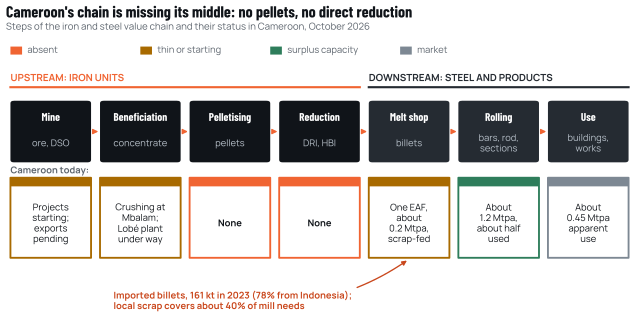
Source: Cameroon Steel analysis of [C06], [C27], [C38], [C40], [O24], [O35].
1.2 Cameroon sits at both ends of the chain and not in the middle
Laid out step by step, Cameroon’s position resembles an hourglass. At the top is a large and growing ore pipeline. Global Energy Monitor counts 64 Mtpa of iron-ore mine capacity in development in Cameroon, 9% of the world pipeline and the fourth largest after Australia, China and Guinea [G18]. The State’s 2026 to 2030 iron-ore programme puts 1,748 bn FCFA, about US$3.1 bn, behind three projects: Kribi-Lobé, Mbalam and Bipindi-Grand Zambi [O29].
At the bottom is a sizeable downstream industry. Cameroon’s steel transformers have about 1.2 Mtpa of installed capacity and run at about half of it [C38][C40]. The industry body Ocitram puts reinforcing-bar capacity at 627 kt/yr against domestic rebar demand of about 180 kt/yr [C30]. Apparent steel use is about 450 kt/yr [C40], roughly 15 kg per inhabitant on the World Bank’s population estimate [C13], against 209 kg worldwide and 29.2 kg for Africa [G05].
In the middle there is almost nothing. No pellet plant, no direct-reduction plant and no blast furnace operates in Cameroon. Sub-Saharan Africa as a whole made 0.09 Mt of DRI in 2025 on Midrex plant statistics, and its two shaft-furnace DR plants, at Warri in Nigeria and Saldanha in South Africa, were idle [T13]. Cameroon’s melt shops are few and small: Prometal’s electric arc furnace, presented in 2023 as the first of its kind in Central Africa, was reported at about 200,000 t/yr [C27], and the other mills are scrap-based or re-roll bought-in billets [C27][C29].
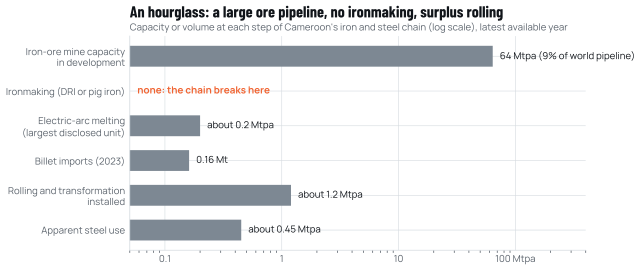
Source: [G18] (ore pipeline, 2026), [T13] (DRI), [C27] (EAF), [C06] (billet imports, 2023), [C38], [C40] (rolling capacity, apparent use).
The consequence is visible in the trade data. Billets and other semi-finished steel (HS 7207) were Cameroon’s largest single steel import in 2023: 161.4 kt, 78% of it from Indonesia [C06]. By value they made up about half of the chapter 72 import bill [C06]. Local scrap covers only about 40% of what the mills need [C38]. In September 2026 the largest producer, Prometal, signed a €40 m revolving facility with Afreximbank specifically to import billets [C38][C39]. A country that rolls more rebar than it can use is borrowing hard currency to buy the semi-finished steel that feeds its mills.
1.3 Most of the value sits before the rolling mill
Market prices show where value is added. On dated assessments, a tonne of 62% iron-ore fines averaged US$100.2/dmt in 2025 on a cost-and-freight basis into China [G31]. Hot-briquetted iron from Libya was offered at about US$370/t delivered to Italy and Türkiye in January 2026 [N03]. Brazilian merchant pig iron sold at about US$475/t free on board in August 2026 [N04]. Chinese billets were quoted at US$465 to 470/t FOB on 3 October 2026, and Turkish rebar at US$620 to 630/t FOB the same week [G34].
These prices are for different products, places and dates, so they cannot be read as a single value chain without adjustment. Chapter 8 builds that adjustment explicitly, converting each price into its contribution to one tonne of finished rebar with the yields set out in Annex A. The broad result is robust to reasonable changes in the inputs:
- the ore that goes into a tonne of rebar is worth about 28% of the rebar’s price;
- turning that ore into iron units (pelletising and direct reduction) adds about 43%;
- melting and casting the iron units into billets adds about 6%;
- rolling the billets into rebar adds about 22%.
The figures are illustrative, not a forecast of anyone’s margin. Their message is structural. Today, Cameroon’s mills capture the rolling step and, where they melt scrap, a share of the melting step. They do not capture the ironmaking step, which is the largest, and the ore step accrues to the country only if its ore is mined and sold, which at the time of writing it largely is not [O28].
1.4 The rolling-first model has reached its limits
For a decade, Cameroon’s steel policy has protected the end of the chain. The Prime Minister’s office suspended rebar imports on 31 May 2016 [C20], and Customs reaffirmed the ban on 3 April 2023 [C21]; no document lifting it has been found [C34]. A mandatory rebar standard has applied since 2022 and the Prime Minister’s office refused to revise it in January 2026 [C34][C35]. Rebar prices are homologated by the Ministry of Commerce: in October 2023 the Douala price of a 12 mm FE500 bar implied about 633,000 FCFA/t, roughly €965/t [C44].
That protection did its job. Investment followed: Prometal inaugurated two plants worth 57 bn FCFA in January 2024, adding wire rod, beams, angles and flats to its range [C25]. Wire-rod imports collapsed from 58.1 kt in 2021 to 7.8 kt in 2023 as local rolling replaced them [C06]. Cameroon even exports rebar, about 31 kt in 2025, mostly to Chad [C05][C06].
Three signals show that the model has run its course.
Capacity has overshot demand. With about 1.2 Mtpa of installed transformation capacity against about 450 kt/yr of apparent use, mills run at about 50% [C38][C40], and more than 30 bn FCFA of unsold stock was reported in September 2026 [C41]. The Prime Minister’s strategic committee on mines-metallurgy integration, reviewing the metals industry in April 2026, found domestic capacity in excess of local demand [Z79]. Adding rolling capacity does not add value; it divides the same demand among more mills.
Feedstock is the binding constraint. The only quantified national study put ferrous scrap arising at 53,000 to 61,833 t/yr, using 2006 data [C42]. Scrap purchase prices rose by about 30% recently [C40], and recorded scrap exports fell to near zero after 2019 [C06]. When mills cannot find scrap they import billets, and billet imports are the largest single item in the steel import bill [C06].
The foreign-exchange cost is rising. Chapter 72 imports rose 33% in tonnage in 2025, to 412,049 t worth 170.1 bn FCFA [C05]. Together with chapter 73 articles, iron and steel imports reached 278.1 bn FCFA in 2025, 5.3% of all imports and 13.0% of the trade deficit [C05]. The Central African Monetary Community’s foreign reserves stood at 4.2 months of imports at the end of 2025 [P07]. An import bill dominated by semi-finished steel is a direct claim on those reserves.
Table 1.2 What protection achieved, and what it did not
| Indicator | Before or at the start | Latest | Source |
|---|---|---|---|
| Rebar imports (HS 7214) | 14.0 kt (2020) | 3.3 US$ m, tonnage not reported (2023) | [C06] |
| Wire-rod imports (HS 7213) | 58.1 kt (2021) | 7.8 kt (2023) | [C06] |
| Rebar exports | 33.4 kt (2021) | 31.0 kt (2025) | [C02][C05] |
| Billet imports (HS 7207) | 52.5 kt (2019) | 161.4 kt (2023) | [C06] |
| Chapter 72 imports | 182.9 kt (2019) | 412.0 kt (2025) | [C01][C05] |
| Rolling and transformation utilisation | n/a | about 50% (2026) | [C38][C40] |
Source: Cameroon Steel compilation from INS foreign-trade notes and UN Comtrade.
Protection moved rolling home. It did not move ironmaking home, and the growth of billet imports since 2019 shows that the country’s dependence has shifted up the chain rather than disappeared.
1.5 The opportunity is a chain that runs back towards the mine
The policy environment has begun to shift in the same direction as this diagnosis. The 2023 Mining Code requires mining conventions to make a minimum of 15% of production available for local transformation (art. 40(4)) [Z42]. The Kribi-Lobé convention of May 2022 already reserved 15% of production for the local market [O33], and the Mbalam convention, as described by Cameroon Mining Company (CMC), provides for 15% of production to be transformed locally; the same source presents Cameroon Steel as the future national steel hub of the programme [O17]. In December 2025 the Prime Minister created a strategic committee on mines-metallurgy integration, whose mandate includes a reliable iron-ore supply chain for local steelmakers and enforcement of the Mining Code’s local-processing requirements [Z79][Z80]. The Kribi industrial-port zone lists "steel linked to mineral exports" among its development clusters [Z4].
These are necessary conditions, not sufficient ones. A 15% share of a DSO export stream does not, by itself, make a tonne of iron: the ore must be of the right grade, it must be reduced with gas or hydrogen, and the reduced iron must find a melt shop and a market. The rest of this paper examines each of those links:
- Chapter 2 assesses Cameroon’s ore and which ironmaking routes each grade can feed;
- Chapter 3 sets out the steel the country consumes and imports, product by product;
- Chapter 4 draws lessons from Egypt, Algeria, Nigeria, India, Vietnam and Brazil;
- Chapter 5 reviews the beneficiation policy framework and its gaps;
- Chapter 6 proposes a phased chain, using Cameroon Steel’s reference configuration as an illustrative case;
- Chapter 7 explains why Kribi is the natural hinge of that chain;
- Chapter 8 quantifies, illustratively, the value captured at each step;
- Chapters 9 and 10 set out the risks and the recommendations.
Sources cited in this chapter
Bracketed markers refer to these sources; the full list is in the annex. Full list of sources
- O05Mbalam-Nabeba resources and reserves statement as at 20 May 2015 (JORC). Former holder of the Mbalam-Nabeba project (ASX-listed), 2015.sdl.live.irmau.com/irm/content/resources-reserves.aspx?RID=236
- O32Cameroon signs iron ore deal with Sinosteel (citing Reuters). Mining Technology, 23 May 2022.mining-technology.com/news/sinosteel-deal-iron-cameroon/
- O42Afferro Mining Inc., publication of Q3 results. Afferro (newswire.ca), 19 Nov 2013.newswire.ca/news-releases/afferro-mining-inc---publication-of-q3-resul…
- O04Mbalam-Nabeba project presentation, Mining Indaba 2014 (itabirite testwork). Former holder of the Mbalam-Nabeba project (ASX-listed), Feb 2014.sdl.live.irmau.com/irm/PDF/2752_0/PresentationMiningIndaba2014
- N16Launch of DR-grade iron ore pellet premium weekly indicator. Fastmarkets, 1 Dec 2022.fastmarkets.com/insights/launch-of-dr-grade-iron-ore-pellet-premium-we…
- T132025 World Direct Reduction Statistics. Midrex Technologies, Sep 2026.midrex.com/world-dri-statistics/world-dri-production-reaches-151-0-mt-…
- G05World Steel in Figures 2026 (page and PDF). worldsteel, 4 Jun 2026.worldsteel.org/data/world-steel-in-figures/world-steel-in-figures-2026…
- O24Cameroun: les premières exportations du fer de Mbalam repoussées au 1er trimestre 2026. EcoMatin, 4 Dec 2025.ecomatin.net/cameroun-les-premieres-exportations-du-fer-de-mbalam-repo…
- O35Sinosteel reporte les exportations du fer de Kribi-Lobé à 2027 malgré 120 milliards FCFA déjà investis. EcoMatin, 11 Mar 2026.ecomatin.net/cameroun-sinosteel-reporte-les-exportations-du-fer-de-kri…
- O29Cameroon plans $3.1B iron ore push starting 2026. Daba Finance (republished by AllAfrica), 14 Feb 2026.dabafinance.com/en/news/cameroon-mining-investment-2026-2030
- C27Matériaux de construction: l’offensive locale. Cameroon Tribune, 24 Apr 2023.cameroon-tribune.cm/article.html/56766/en.html/details_2
- C38Cameroun: le groupe Prometal décroche 26 milliards FCFA auprès d’Afreximbank…. Sikafinance, 30 Sep 2026.sikafinance.com/marches/cameroun-le-groupe-prometal-decroche-26-millia…
- C40Cameroun: Prometal décroche 26,2 milliards FCFA d’Afreximbank. Camer.be, 1 Oct 2026.camer.be/actualites/economie/cameroun-prometal-decroche-262-milliards-…
- C06UN Comtrade public API, Cameroon (reporter 120), HS 72/73 and 6-digit lines, 2019-2023. UN Statistics Division.comtradeapi.un.org/public/v1/preview/C/A/HS?reporterCode=120&period=20…
- G18Pedal to the Metal 2026. Global Energy Monitor, May 2026.globalenergymonitor.org/sites/default/files/2026-05/Pedal%20to%20the%2…
- C30Production: les acteurs en présence. Cameroon Tribune, 11 May 2026.cameroon-tribune.cm/article.html/76600/fr.html/details_2
- C13WDI API: SP.POP.TOTL; SP.URB.TOTL.IN.ZS (CMR). World Bank, updated 8 Oct 2026.api.worldbank.org/v2/country/CMR/indicator/SP.POP.TOTL?format=json
- C29Métallurgie: les industriels dénoncent la présence du fer à béton contrefait. EcoMatin, 22 Jun 2023.ecomatin.net/metallurgie-les-industriels-du-secteur-denoncent-la-prese…
- C39Prometal obtient 26 milliards FCFA d’Afreximbank pour soutenir son expansion industrielle. EcoMatin, 30 Sep 2026.ecomatin.net/prometal-obtient-26-milliards-fcfa-dafreximbank-pour-sout…
- G31Commodity Markets Outlook, Historical Data, Annual (xlsx). World Bank, 2 Sep 2026.thedocs.worldbank.org/en/doc/74e8be41ceb20fa0da750cda2f6b9e4e-00500120…
- N03BPI and HBI prices on the rise in Europe. SteelOrbis, 23 Jan 2026.steelorbis.com/steel-prices/steel-prices-market-analyses/scrap-and-raw…
- N04Prices for Brazilian pig iron stabilised at $475 per tonne in August. GMK Center, 7 Sep 2026.gmk.center/en/news/prices-for-brazilian-pig-iron-stabilised-at-475-per…
- G34Weekly steel prices (archive 40468). Arab Iron & Steel Union (AISU), 3 Oct 2026.aisusteel.org/en/archives/40468
- O28Exploitations: la revue des gisements. Cameroon Tribune, 11 May 2026.cameroon-tribune.cm/articles/11125/fr/details_2
- G35Weekly steel prices (archive 36573). AISU, 18 Oct 2025.aisusteel.org/en/archives/36573
- G36Weekly steel prices (archive 30176). AISU, 5 Nov 2024.aisusteel.org/en/archives/30176
- G38Weekly steel prices (archive 29546). AISU, 6 Oct 2024.aisusteel.org/en/archives/29546
- C20Press report of the sealing by customs of more than 7,300 t of imported reinforcing bar, December 2020 (headline and address not reproduced: they name the importer). Business in Cameroon, 16 Dec 2020.Cited by title and date
- C21Métallurgie: les importations du fer à béton interdites jusqu’à nouvel ordre. EcoMatin, 10 Apr 2023.ecomatin.net/metallurgie-les-importations-du-fer-a-beton-interdites-ju…
- C34Cameroon rejects fresh push to revise rebar standard. Business in Cameroon, 26 Jan 2026.businessincameroon.com/construction/2601-15657-cameroon-rejects-fresh-…
- C35Cameroun: le gouvernement rejette une demande de révision de la norme du fer à béton. EcoMatin, 5 Feb 2026.ecomatin.net/cameroun-le-gouvernement-rejette-une-demande-de-revision-…
- C44Fer à béton: les producteurs acceptent une baisse des prix. EcoMatin, 23 Oct 2023.ecomatin.net/fer-a-beton-les-producteurs-acceptent-une-baisse-des-prix
- C25Prometal inaugure deux usines évaluées à 57 milliards F. Journal du Cameroun, 19 Jan 2024.fr.journalducameroun.com/prometal-inaugure-deux-usines-evaluees-a-57-m…
- C05Évolution du commerce extérieur en 2025 (version provisoire). INS Cameroun, Feb 2026 (posted 1 Apr 2026).ins-cameroun.cm/wp-content/uploads/2026/04/Note-sur-le-commerce-exteri…
- C4140 millions d’euros d’Afreximbank: Prometal sécurise ses billettes d’acier alors que la ferraille camerounaise s’épuise. Cameroun24, 10 Oct 2026.cameroun24.net/article/76267-40-millions-d-euros-d-afreximbank-prometa…
- Z79Cameroon reviews metals industry to address supply and energy constraints. Business in Cameroon, 29 Apr 2026.businessincameroon.com/public-management/2904-16094-cameroon-reviews-m…
- C42Bidoung J., Fomethe A., Yantio G., Melo U., La récupération et le recyclage des déchets ferromagnétiques: analyse de la situation au Cameroun (Déchets, Revue francophone d’écologie industrielle n°48). ENSP Yaoundé / MIPROMALO, Q4 2007.eid.episciences.org/7942/pdf
- P07Zone Cémac: la BEAC annonce un ralentissement de croissance à 2,4%. AllAfrica (Les Dépêches de Brazzaville), 17 Dec 2025.fr.allafrica.com/stories/202512170629.html
- C02Note sur le commerce extérieur 2022. INS Cameroun, Dec 2023 (rev. 13 Feb 2024).ins-cameroun.cm/wp-content/uploads/2025/07/Note-sur-le-Commerce-Exteri…
- C01Commerce extérieur du Cameroun en 2020. INS Cameroun, Jul 2021.ins-cameroun.cm/wp-content/uploads/2025/07/Note-Commerce-exterieur-202…
- Z42Loi n° 2023/014 du 19 décembre 2023 portant Code minier, Article 40(4) (official text, mirror). Rural-info (copy of the official text), 19 Dec 2023.rural-info.net/wp-content/uploads/2024/11/Loi-N°2023-014-du-19-decembr…
- O33Fer de Lobé: l’État octroie le permis d’exploitation à Sinosteel. EcoMatin, 7 Sep 2022.ecomatin.net/fer-de-lobe-malgre-des-contestations-letat-octroie-le-per…
- O17Cameroon Mining Company confirme l’entrée du projet Mbalam dans sa phase irréversible d’exécution. Camer.be via AllAfrica, 12 Dec 2025.fr.allafrica.com/stories/202512120475.html
- Z80Le Cameroun prépare l’exportation de son acier vers les marchés de la ZLECAf. Ecomatin (V. Bagal), 16 Apr 2026.ecomatin.net/le-cameroun-prepare-lexportation-de-son-acier-vers-les-ma…
- Z4Zone industrialo-portuaire de Kribi (KPIZ): jusqu’à +8 points de croissance et 150 000 emplois…. Investir au Cameroun, 4 Mar 2026.investiraucameroun.com/gestion-publique/0403-23163-zone-industrialo-po…
Cite this chapter
Cameroon Steel (2026). From ore to steel: Cameroon’s missing link is ironmaking, not rolling. White paper 01, chapter 1: The gap is upstream: Cameroon rolls steel but makes no iron. CS-WP-01. https://www.cameroon-steel.com/en/library/ore-to-steel/value-chain-gap/
Source