White paper 01 · Chapter 7
Kribi is the hinge: where ore, gas, power and deep water meet
A steel chain lives or dies on the cost of moving bulk materials, and only one place in Cameroon brings together a deep-water port, a producing gas field, a high-voltage connection under construction, an industrial zone with a steel cluster, and the planned terminus of the iron-ore railways. That place is Kribi. Its port is growing fast, its zone is now run by a dedicated company, and its power supply will reach 100 MW for the whole port platform at the end of 2026; the gas, rail and bulk-terminal links needed for the later phases of the chain are planned but not yet secured.
In this chapter (7)
- 7.1 Location decides the economics of a steel chain
- 7.2 The port: deep water, fast growth, and a mineral terminal in preparation
- 7.3 The zone: an industrial platform with a steel cluster
- 7.4 Power: from 100 MW to 400 MW at the port
- 7.5 Gas: a field off Kribi that has just lost its main buyer
- 7.6 Rail, road and water: the links still being built
- 7.7 What Kribi still needs for the full chain
7.1 Location decides the economics of a steel chain
Steelmaking is a business of moving heavy, low-value materials. For each tonne of finished long product made entirely from DRI, about 1.75 t of pellets enter the plant and 1 t of steel leaves it, before counting lime, alloys, electrodes and refractories (Chapter 6). A plant that receives its iron by sea or rail and ships its products by sea or road should sit where those flows meet, to avoid paying twice for handling.
That is why the most instructive plants in Chapter 4 are at ports. Brazil’s Pecém slab plant is linked by conveyor to a deep-water port about 10 km away [N07]. Vale’s proposed iron and steel hubs in Saudi Arabia, the United Arab Emirates and Oman are all in port industrial zones [N08]. Vietnam’s Dung Quat complex is on the coast and imports most of its ore [N13].
In Cameroon, Kribi has all of the elements at once (Figure 7.1). The Kribi-Lobé deposit lies within about 30 km of the port and the Mbalam railway is planned to end at Kribi, at Lolabé (Chapter 2); the Sanaga Sud gas field, offshore, and the Kribi gas power plant lie about 30 to 40 km to the north, the plant linked to the port by the 42 km 225 kV line; a 225 kV line is being built to the port; and the Kribi Port Industrial Zone lists "steel linked to mineral exports" among its development clusters [Z4].
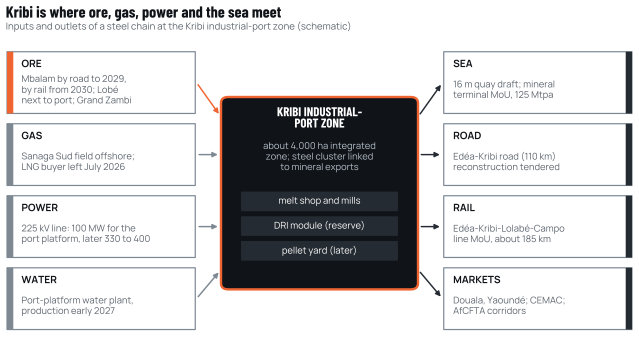
Source: Cameroon Steel, schematic from [Z4], [Z5], [O25], [O35], [E09], [Z43], [Z44], [Z52], [Z46], [Z45], [Z80].
7.2 The port: deep water, fast growth, and a mineral terminal in preparation
The deep-water port of Kribi, at Mboro, has a quay depth of 16 m. The port authority’s 2020 guide gives a capacity of about 70,000 deadweight tonnes for general-port vessels and up to 350,000 deadweight tonnes for future industrial terminals [Z37]. A second container terminal with a 715 m quay began operations in May 2025, with a capacity of 1.2 million twenty-foot equivalent units (TEU) a year [E43][Z50].
Traffic has grown quickly. The port handled 12.7 Mt in 2025, up 19%, and 555,398 TEU, making it Cameroon’s first container port with 37.5% of national container traffic [E44][Z45]. Growth has brought congestion: import containers waited 25.28 days on average and terminal productivity fell 18% to 33 moves an hour in 2026 [E45]. The container terminal operator is investing 21.5 bn FCFA to add 8 ha of yard and raise static capacity from 24,000 to 34,000 TEU by the end of 2027 [Z49].
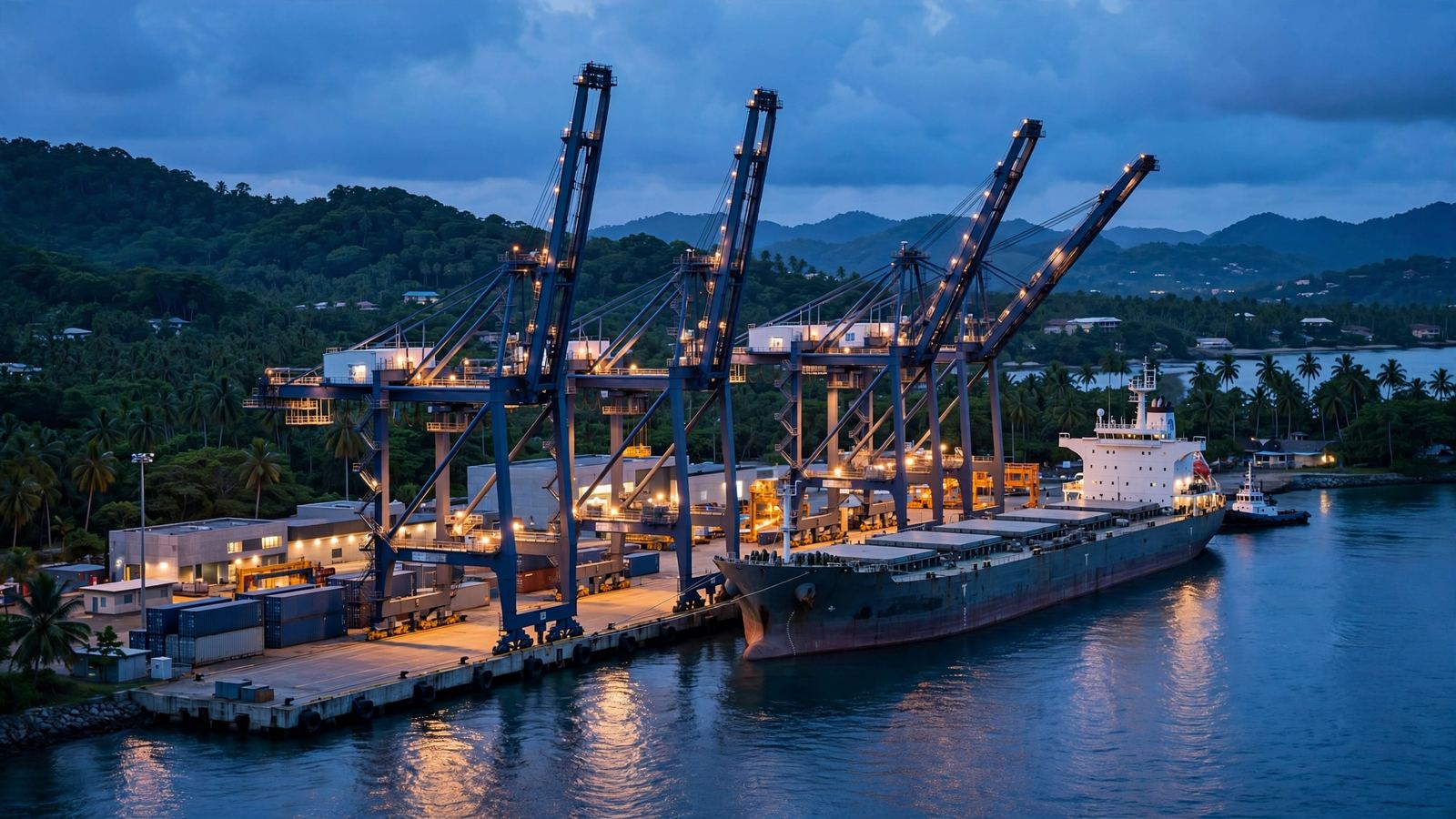
For a steel chain, the bulk facilities matter more than the container terminal. The multipurpose terminal handles clinker, wheat and other cargo, and was designated to export the first Bipindi-Grand Zambi ore [Z46][Z74]. A dedicated mineral terminal is in preparation: on 4 November 2025 the port authority, the national social insurance fund (CNPS), the Mbalam project consortium and G-Stones signed a memorandum of understanding for a terminal of 125 Mtpa on 330 ha, including 90 ha of storage and a steel cluster, to be phased from a first jetty of about 30 Mtpa, at a reported cost of about US$2 bn [O31][Z52]. In March 2026 the port authority’s Director General said that the mineral and hydrocarbon terminals should be completed within five to six years, in partnership with their developers [Z4]: on that basis, counted from March 2026, a mineral terminal would be completed in about 2031 to 2032.
7.3 The zone: an industrial platform with a steel cluster
On 26 February 2026 the port authority created Kribi Port Industrial Zone S.A. (KPIZ), a company owned with Africa Global Logistics, Arise Integrated Industrial Platforms and Belmont Investments, to design, finance, develop, operate and maintain an integrated industrial zone of about 4,000 ha [Z1][Z4]. About 300 ha were already operational, with more than 60 companies installed or installing, in March 2026 [Z4]. The zone is planned to develop by sector clusters: wood processing and logistics; steel linked to mineral exports; petrochemicals; agro-industry; and construction materials [Z4].
The zone’s investment programme is €795 m over 15 years, with a first phase of €400 m, and its planned financiers include the African Development Bank, the European Union’s Global Gateway programme and the IFC [Z5]. The AfDB announced in March 2026 that it would mobilise about €411 m of public finance, intended to catalyse about €384 m of private investment [Z13]. The zone offers internal roads, energy, water, sanitation and telecommunications networks and a one-stop shop for investors [Z4][Z12], and its promoters expect up to 150,000 direct and indirect jobs over 15 years [Z4].
Demand for land is strong. As at mid-2025, the port authority had recorded about 150 requests covering 3,883 ha against 48 authorisations covering 196 ha (notice published in January 2026) [Z29]. Heavy industry has started to arrive: a 1 Mtpa cement plant was inaugurated by the Prime Minister in July 2024 [Z54], a bitumen plant with a small refinery received its refining licence in April 2026 [Z55], and in May 2026 the port authority tendered 3.5 bn FCFA of works to service 20 ha at Mboro with a 30 kV network, water, fibre, roads and drainage [Z30]. Kribi port is classified as an economic zone [P10], which under the 2025 investment ordinance extends the operating-phase incentives to seven years [Z39].
7.4 Power: from 100 MW to 400 MW at the port
Electricity is the input that most often stops African steel plants, and Kribi’s supply is improving from a low base. In May 2025 only about 13 MW of the local thermal capacity of 176 MW was available to Kribi, the rest feeding the southern grid [Z34]. A 42 km, 225 kV double-circuit line from the Kribi gas power plant to the port, with a 225/30 kV substation of three 60 MVA transformers, will provide 100 MW immediately and 330 to 400 MW at a later stage for the whole port platform. Works began on 6 August 2025 at a cost of about 35 bn FCFA, commissioning is planned for the end of 2026, and the Minister of Water and Energy inspected progress in August 2026 [Z43][Z44].
The Kribi gas power plant itself has 216 MW installed under a 330 MW licence; it delivered 559.67 GWh in 2025 against 1,031 GWh planned, a capacity factor of about 30% [E15][E24]. A 114 MW extension was planned in 2020 with AfDB support but has not been built [E25], and the State is buying out the plant’s private majority shareholder [E26]. Nationally, Cameroon had 2,033 MW installed against a peak demand of 1,278 MW in 2025, with about 90% of generation from hydropower [E15], but 150 MW of industrial demand was unmet in October 2026 while the 400 kV line from the Nachtigal dam awaited completion, now due in November 2026 [E16]. Cameroon’s hydropower potential is estimated at about 115 TWh/yr, about 4% of it developed [E32].
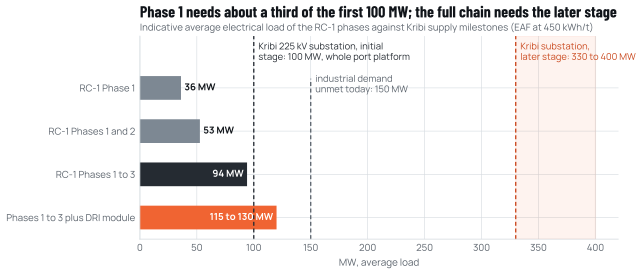
Source: RC-1 loads [F01]; DRI module derived from [T09] (Annex A); Kribi substation [Z43], [Z44]; unmet industrial demand [E16]. Status: planned / derived.
Figure 7.2 compares RC-1’s indicative average loads with the Kribi supply milestones. Phase 1, at about 36 MW on average (about 38 MW at the upper planning value for a charge with 30% DRI, Annex A), is about a third of the initial 100 MW, even allowing for the higher peak of an arc furnace. That 100 MW, however, serves the whole port platform: the port, a cement plant and more than 60 zone tenants [Z4][Z54]. No allocation to the steelworks has been published, and an arc furnace on a 225/30 kV substation needs power-quality measures (static VAR compensation to contain flicker, and adequate short-circuit capacity at the connection) that remain to be agreed with the grid operator. Phases 1 to 3 at about 94 MW approach the initial limit, and the full chain with a DR module, at about 115 to 130 MW, needs the later stage of the substation. These loads are significant at national scale: 94 MW is about 7% of the 2025 national peak [E15]. The terms matter as much as the megawatts. There is no regulated tariff above 10 MW, so an industrial user negotiates a bilateral high-voltage contract; Cameroon’s largest steel producer moved to a high-voltage supply with a dedicated 50 MVA transformer [C31][E15].
7.5 Gas: a field off Kribi that has just lost its main buyer
The Sanaga Sud field, offshore Kribi, produced 74.3 bcf of Cameroon’s 75.5 bcf of gas in 2025 [E04]. About 95% of national output was sold as feed to the Hilli Episeyo floating LNG vessel [E04], which left Cameroon in July 2026 for a charter in Argentina [E08][E09]; press reports put the resulting loss of gas revenue at 235 bn FCFA over 2026 and 2027 [E09]. The Kribi power plant continues to receive gas through existing pipelines, but no replacement liquefaction has been arranged [E02][E10].
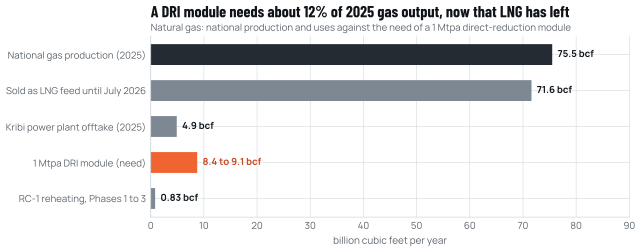
Source: production and uses [E04]; LNG departure [E09]; DRI gas need derived from [T09], [T10]; RC-1 reheating from [F01]. Status: sourced / derived.
For a DRI plant, the departure of the LNG buyer is both an opportunity and a warning. It is an opportunity because gas that used to be exported now needs a buyer, and a DR module would be a large, steady, long-term domestic customer: a 1 Mtpa module needs about 9.2 to 10 GJ of gas per tonne of DRI [T09][T10], or 8.4 to 9.1 bcf/yr, about 12% of 2025 output. At the 2025 prices paid by the Kribi power plant (about US$3.2 per Mscf) and by an industrial buyer (about US$5.6) [E04], the gas would cost roughly US$29 to 51 per tonne of DRI (derived, Annex A). It is a warning because the reserves behind that supply are not publicly certified. About 600 bcf had been developed at Sanaga Sud to supply the LNG vessel, in natural decline, and the larger cross-border Yoyo-Yolanda resource of about 2.5 Tcf needs about US$4 bn of investment and has no final investment decision [E02]. A gas contract for a DR module should therefore rest on an independent reserve audit and include flexibility on volumes.
7.6 Rail, road and water: the links still being built
No railway reaches Kribi today; the line that would link it to the national network at Édéa is at the memorandum stage [Z45]. Two rail projects would change that. A memorandum signed on 4 June 2026 by the Government, Africa Global Logistics and CAMALCO covers the feasibility, design, financing, construction and operation of an Édéa-Kribi-Lolabé-Campo line of about 185 km, which would connect Kribi to the existing metre-gauge network at Édéa [Z45]. The Mbalam-Kribi mineral railway, the subject of a public-private partnership contract signed in February 2022 together with a concession for the mineral terminal [Z53], is now reported as a 659 km corridor costing more than US$8 bn [O27]; Mbalam’s export plan assumes it from 2030 [O25].
By road, the international tender to reconstruct the 110 km Édéa-Kribi road was signed in February 2025 [Z46]. For water, a dedicated intake and treatment plant for the port platform is planned to start production in early 2027 [Z44], which matters for a steel plant whose closed-loop make-up need RC-1 estimates at about 2 m³ per tonne of product [F01].
Table 7.1 Kribi infrastructure readiness for each phase of the chain
| Element | Capacity or scope | Status and date | Needed for | Source |
|---|---|---|---|---|
| Quay depth | 16 m; up to 350,000 dwt for future industrial terminals | Operating | All phases | [Z37] |
| Container terminal | 1.2 M TEU/yr; 555,398 TEU handled in 2025 | Operating; congested; expansion to end-2027 | Phase 1 consumables and exports | [E43][Z45][Z49] |
| Multipurpose terminal | Clinker, wheat, first Grand Zambi ore | Operating | Phase 1 metallics | [Z46][Z74] |
| Mineral terminal | 125 Mtpa, phased; includes a steel cluster | MoU 4 November 2025; completion expected within five to six years of March 2026 | DR module | [O31][Z52][Z4] |
| 225 kV line and substation | 100 MW, later 330 to 400 MW | Commissioning planned end-2026 | Phase 1 (share of the 100 MW, to be allocated); DR module (later stage) | [Z43][Z44] |
| Kribi gas power plant | 216 MW installed, 330 MW licence | Operating at about 30% capacity factor | Power and gas | [E15][E24] |
| Natural gas | Sanaga Sud; 75.5 bcf national output in 2025 | LNG buyer left July 2026; reserves not public | DR module | [E04][E09] |
| Water plant | Port-platform intake and treatment | Production early 2027 | All phases | [Z44] |
| Rail to Édéa, Lolabé and Campo | About 185 km | MoU June 2026 | Phases 2 and 3 distribution | [Z45] |
| Mbalam-Kribi railway | 659 km corridor; more than US$8 bn | PPP contract 2022; rail phase from 2030 | DR module ore supply | [Z53][O27][O25] |
| Édéa-Kribi road | 110 km reconstruction | Tender signed February 2025 | All phases | [Z46] |
| Industrial land | About 4,000 ha zone; 300 ha operational | KPIZ created February 2026 | All phases | [Z4] |
Source: Cameroon Steel compilation; port-authority documents are cited by title and date in Annex C.
7.7 What Kribi still needs for the full chain
Kribi is ready, or nearly ready, for Phase 1, subject to an allocation of the first 100 MW and agreed power-quality measures. Its quay, its multipurpose terminal, the first 100 MW of the 225 kV supply, the water plant and the zone’s serviced land are in place or due by early 2027. The later phases depend on links that are planned but not secured:
- firm power at the later stage of the substation, and a bilateral high-voltage contract framework for heavy industry;
- a long-term gas allocation for industrial use at Kribi, backed by a reserve audit, now that the LNG offtake has ended;
- bulk handling for about 1.5 Mtpa of pellets or concentrate, in the mineral terminal or a dedicated berth within the steel cluster;
- rail for ore from Mbalam and for steel products to Édéa and the national network;
- housing, training and services for a workforce that RC-1 estimates at about 1,100 direct jobs at full capacity [F01].
None of these is unusual for an industrial port, and several are already in the State’s and the zone’s programmes; the task is to sequence them with the phases of the chain (Chapter 10).
Sources cited in this chapter
Bracketed markers refer to these sources; the full list is in the annex. Full list of sources
- N07ArcelorMittal takes ownership of Brazilian slab plant. AIST, Mar 2023.aist.org/arcelormittal-takes-ownership-of-brazilian-slab-plant
- N08Vale signs agreements to develop Mega Hubs in the Middle East and provide decarbonization solutions for steelmaking. Vale, Oct 2022.vale.com/w/vale-signs-agreements-to-develop-mega-hubs-in-the-middle-ea…
- N13Hòa Phát Group proposes development of Thạch Khê iron ore mine. AIST, 27 May 2026.aist.org/hoa-phat-group-proposes-development-of-thach-khe-iron-ore-min…
- Z4Zone industrialo-portuaire de Kribi (KPIZ): jusqu’à +8 points de croissance et 150 000 emplois…. Investir au Cameroun, 4 Mar 2026.investiraucameroun.com/gestion-publique/0403-23163-zone-industrialo-po…
- Z5Port de Kribi: AGL, Arise IIP et Belmont s’allient au PAK pour une zone industrielle de 521 milliards FCFA sur 4 000 ha. Investir au Cameroun, 20 Feb 2026.investiraucameroun.com/gestion-publique/2002-23123-port-de-kribi-agl-a…
- O25Mbalam iron ore mine delays first exports to early 2026. Business in Cameroon, 13 Dec 2025.businessincameroon.com/public-management/1312-15495-mbalam-iron-ore-mi…
- O35Sinosteel reporte les exportations du fer de Kribi-Lobé à 2027 malgré 120 milliards FCFA déjà investis. EcoMatin, 11 Mar 2026.ecomatin.net/cameroun-sinosteel-reporte-les-exportations-du-fer-de-kri…
- E09Le navire usine quitte le Cameroun, le gaz s’arrête. Camer.be, 9 Jul 2026.camer.be/93911/12:1/le-navire-usine-quitte-le-cameroun-le-gaz-sarrete-…
- Z43Kribi franchit la ligne électrique 225 kV. PAK, 6 Aug 2025.Cited by title and date
- Z44Énergie et infrastructures: un nouvel élan pour la compétitivité du Port de Kribi. PAK, 19 Aug 2026.Cited by title and date
- Z52Kribi Deep Sea Port, investors partner to construct 125-million-tonne mineral terminal worth $2 billion. Business in Cameroon, 5 Nov 2025.businessincameroon.com/transport/0511-15300-kribi-deep-sea-port-invest…
- Z46Bilan et perspectives, Les voyants sont au vert. PAK, 13 Mar 2025.Cited by title and date
- Z45Ligne ferroviaire Édéa-Kribi-Lolabé-Campo: une nouvelle étape…. PAK, 4 Jun 2026.Cited by title and date
- Z80Le Cameroun prépare l’exportation de son acier vers les marchés de la ZLECAf. Ecomatin (V. Bagal), 16 Apr 2026.ecomatin.net/le-cameroun-prepare-lexportation-de-son-acier-vers-les-ma…
- Z37Guide du Port de Kribi. PAK (PDF), Aug 2020.Cited by title and date
- E43La Lettre du PAK n°254. Port Autonome de Kribi, May 2025.Cited by title and date
- Z50Kribi Port’s net profit exceeds CFA4 billion after strong year for cargo traffic. Business in Cameroon, 29 Jun 2026.businessincameroon.com/transport/2906-16378-kribi-port-s-net-profit-ex…
- E44Au Cameroun, le port de Kribi revendique la place de premier terminal à conteneurs. EcoMatin, 22 Apr 2026.ecomatin.net/au-cameroun-le-port-de-kribi-revendique-la-place-de-premi…
- E45Port de Kribi: l’explosion du trafic commence à saturer le terminal à conteneurs. EcoMatin, 5 Oct 2026.ecomatin.net/port-de-kribi-lexplosion-du-trafic-commence-a-saturer-le-…
- Z49Port de Kribi: 21,5 milliards de FCFA pour accroître de 30% les capacités du terminal à conteneurs. Investir au Cameroun, 8 Oct 2026.investiraucameroun.com/infrastructures/0810-23934-port-de-kribi-21-5-m…
- Z74Grand Zambi: le fer de Bipindi au service de l’essor du Port de Kribi. PAK, 17 Jan 2025.Cited by title and date
- O31CNPS, G-Stones join Kribi port mineral terminal project. Business in Cameroon, 7 Nov 2025.businessincameroon.com/mining/0711-15312-cnps-g-stones-join-kribi-port…
- Z1La Lettre du PAK n°264: "Lancement de Kribi Port Industrial Zone, L’avenir a commencé" and "Réaction: Yves Roger Melingui, DG de KPIZ". Port Autonome de Kribi (newsletter PDF), Feb 2026 (uploaded May 2026).Cited by title and date
- Z13Cameroon: AfDB Group supports development of integrated industrial zone at the Port of Kribi. AfDB via AllAfrica (AfDB page returned 403), 2 Mar 2026.allafrica.com/stories/202603100682.html
- Z12KPIZ officially launched: a new economic hub for Cameroon and CEMAC. AGL (press release), n.d. (Feb-Mar 2026).aglgroup.com/en/News/lancement-KPIZ
- Z29AMI n°013/AMI/PAK/2026 (Port Workers’ City / KPCiZ). ARMP, 30 Jan 2026.armp.cm/details?type_publication=AMI&id_publication=6073
- Z54La ZIPK rayonne avec l’inauguration de la cimenterie CIMPOR!. PAK, 19 Jul 2024.Cited by title and date
- Z55Cameroon speeds up Kribi bitumen plant with tax breaks and refining license. Business in Cameroon, 10 Jun 2026.businessincameroon.com/public-management/1006-16302-cameroon-speeds-up…
- Z30Le port de Kribi engage 3,5 milliards FCFA pour préparer l’arrivée de nouveaux industriels. Ecomatin (L. Onguene), 11 May 2026.ecomatin.net/cameroun-le-port-de-kribi-engage-35-milliards-fcfa-pour-p…
- P102024 Investment Climate Statements: Cameroon. US Department of State, 2024.state.gov/reports/2024-investment-climate-statements/cameroon/
- Z39Ordonnance n° 2025/002 du 18 juillet 2025 fixant les incitations à l’investissement. Presidency (copy on GECAM), 18 Jul 2025.legecam.cm/wp-content/uploads/2025/08/ordonnance_n_2025_002_du_18_07_2…
- Z34Zone industrielle Kribi: 400 milliards FCFA investis et 53 entreprises autorisées à s’implanter depuis 2018. Investir au Cameroun, 20 May 2025.investiraucameroun.com/gestion-publique/2005-22033-zone-industrielle-k…
- E15Rapport d’activités 2025 de l’ARSEL. ARSEL (electricity regulator), 7 Sep 2026.arsel-cm.org/wp-content/uploads/2026/09/Rapport-ARSEL-2025.pdf
- E24Kribi Power Development Corporation. MIGA (World Bank Group), 2014.miga.org/project/kribi-power-development-corporation-0
- E25The AfDB praises the impacts of the planned extension of the Kribi gas-fired power plant. Business in Cameroon, 1 Jul 2020.businessincameroon.com/energy/0107-10486-the-afdb-praises-the-impacts-…
- E26Au Cameroun, l’État veut reprendre les centrales de Kribi et Dibamba à Globeleq. Forbes Afrique, 11 Aug 2026.forbesafrique.com/au-cameroun-letat-veut-reprendre-les-centrales-de-kr…
- E16Nachtigal power line delays leave 150 MW of industrial demand unmet. Business in Cameroon, 9 Oct 2026.businessincameroon.com/public-management/0910-16939-nachtigal-power-li…
- E32Cameroon, Energy (Country Commercial Guide). US International Trade Administration, 13 Apr 2026.trade.gov/country-commercial-guides/cameroon-energy
- F01Cameroon Steel reference configuration RC-1 (planning estimate), edition 10 October 2026 (RC-1.1). Cameroon Steel, 10 Oct 2026.Cited by title and date
- T09ENERGIRON technology (DRI-EAF with natural gas or H₂). EC ICIT, ref. 12 Feb 2026.innovation-centre-for-industrial-transformation.ec.europa.eu/innovativ…
- C31Prometal, Acero Metal, Aciéries du Cameroun… qui est le plus gros consommateur d’électricité de la métallurgie camerounaise. EcoMatin, 15 Jul 2026.ecomatin.net/prometal-acero-metal-acieries-du-cameroun-qui-est-le-plus…
- E04Données pétrolières 2025. SNH, posted Jun 2026.snh.cm/wp-content/uploads/2026/06/Donnees-petrolieres-2025.pdf
- E08Golar, partners approve first vessel in Argentine gas export project. Rigzone, 6 May 2025.rigzone.com/news/golar_partners_approve_first_vessel_in_argentine_gas_…
- E02Cameroon’s SNH eyes Yoyo-Yolanda and new exploration blocks to sustain gas growth. Business in Cameroon, 6 Jul 2026.businessincameroon.com/energy/0607-16422-cameroon-s-snh-eyes-yoyo-yola…
- E10Cameroun: SNH, huit ans de location, zéro infrastructure. AllAfrica (Camer.be), 1 Jun 2026.fr.allafrica.com/stories/202606010513.html
- T10Suez Steel sets new benchmark in energy consumption for DRI production. Danieli, 16 Apr 2026.danieli.com/en/news-media/news/suez-steel-sets-new-benchmark-energy-co…
- Z53Chemin de fer Mbalam-Kribi et terminal minéralier: un tournant pour l’intégration régionale. PAK, 25 Feb 2022.Cited by title and date
- O27Mbalam-Nabeba: production de fer lancée, exportations retardées en 2026. Afrik.com, 7 Apr 2026.afrik.com/mbalam-nabeba-production-de-fer-lancee-exportations-retardee…
Cite this chapter
Cameroon Steel (2026). From ore to steel: Cameroon’s missing link is ironmaking, not rolling. White paper 01, chapter 7: Kribi is the hinge: where ore, gas, power and deep water meet. CS-WP-01. https://www.cameroon-steel.com/en/library/ore-to-steel/kribi-hinge/
Source