白皮书01 · 摘要 · 中文摘要
执行摘要
喀麦隆拥有储量可观、部分为高品位的铁矿资源和不断增长的建筑市场,却只获取了从矿山到建筑工地之间价值的一小部分。缺口不在轧钢环节,喀麦隆的轧钢厂已经多于所需;缺口在上游,即本国轧钢厂依赖进口、而国内没有任何工厂生产的含铁原料和钢坯。2023年《矿业法》要求至少15%的矿山产量可供本地转化,再加上在克里比分期建设的钢铁产业链,可以把矿石出口转化为工业价值,前提是这一规则能够提供可用于炼铁的原料,而不是原矿。
本页为本章中文摘要;英文全文附于其后,可展开阅读。
本章目录(7)
ES.1 十项主要结论
- 喀麦隆钢铁产业链有两端而无中段。喀麦隆开发中的铁矿产能达6400万吨/年,项目规模居全球第四[G18];钢材轧制及加工产能约120万吨/年[C38]。两者之间没有球团,没有直接还原,也没有高炉;据Midrex的工厂统计,2025年整个撒哈拉以南非洲的直接还原铁(DRI)产量仅为9万吨[T13]。
- 进口账单实质上是含铁原料账单。 2025年第72章进口量增长33%,达41.2万吨,价值1701亿中非法郎;加上第73章钢铁制品,钢铁占贸易逆差的13.0%[C05]。2023年钢坯是最大单项进口,达16.14万吨,约占第72章进口支出的一半,其中78%来自印度尼西亚[C06]。
- 轧钢已经饱和,原料才是制约。钢筋产能为62.7万吨/年,约为国内需求18万吨/年的3.5倍[C30];轧钢厂开工率约为50%[C38][C40],本地废钢仅能满足其约40%的需求[C38]。2026年9月,最大生产商向非洲进出口银行(Afreximbank)借款4000万欧元,专门用于进口钢坯[C38][C39]。
- 制约因素不是矿量,而是品位。唯一符合规范的储量姆巴拉姆-纳贝巴(Mbalam-Nabeba)拥有含铁62.2%的储量5.17亿吨,其中约1.54亿吨位于喀麦隆境内(Mbarga),约3.63亿吨位于刚果(布)境内(Nabeba);另有含铁33.4%的条带状含铁石英岩(itabirite,伊塔比里特矿)56.38亿吨,其中39.24亿吨位于喀麦隆境内的Mbarga[O05]。其直运矿(DSO, direct-shipping ore)适合出口和高炉,而不适合气基直接还原;后者需要含铁约67.5%、二氧化硅和氧化铝含量低的球团[N16]。满足这一基准的含铁68%精矿,迄今仅在2014年的试验中制得[O04]。
- DR级原料在全球稀缺,因而价值更高。商品直接还原级(DR级)球团需求可能从2022年的4640万吨增至2033年的1.173亿吨,其中3160万吨/年尚无明确供应来源[N01];仅中东和北非在未来几年内就需增加3000万至4000万吨/年[N02]。喀麦隆的DR级精矿在国内外都会有买家。
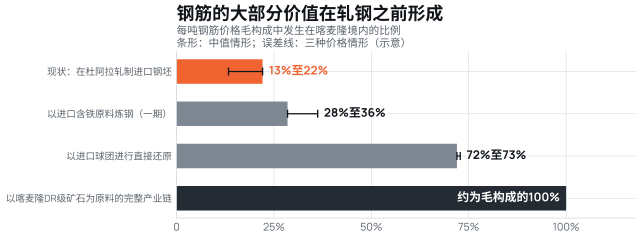
- 每吨钢筋的大部分价值在轧钢之前形成。按2025年和2026年的时点价格,矿石和炼铁占每吨钢筋价值的64至72%,熔炼占6至15%,轧制占13至22%(示意,见第8章)。1吨DR级精矿一路加工成钢筋后的价值,约为同一吨精矿作为矿石出售时价值的3.6倍。
- 政策已要求本地转化,但尚未使其具备融资可行性。《矿业法》第40条第4款规定了15%的最低比例[Z42],姆巴拉姆和洛贝的采矿协议均含有15%条款[O17][O33],总理府下设的委员会自2025年12月起协调矿业与冶金一体化[Z79]。但尚无公开文本界定转化方式、品位、价格或时间,而且关税对钢坯与铁矿石同样征收10%[P24]。
- 成功的产钢国都是从港口的炼钢厂或直接还原厂向上游反向建设的。阿尔及利亚依靠气基直接还原铁,在2021年至2025年间由100万吨钢材逆差转为100万吨顺差[A04];埃及轧钢能力超过炼铁能力后,进口转向钢坯[A07];越南以进口矿石建成沿海钢铁综合体[N13]。尼日利亚的阿贾奥库塔(Ajaokuta)是一个各要素互不匹配的巨型项目,至今从未产出钢水[N14]。
- 在克里比分期建设的产业链可以逐步获取价值。先建炼钢厂,有需求证据后再建型材轧机,待品位、天然气和规模条件具备后,再以喀麦隆精矿进行直接还原。Cameroon Steel的参考配置RC-1展示了这一顺序:一期额定产能30万吨/年(预计持续产量27万至30万吨),目标2029年起开工建设、2030年下半年首炉出钢,2034年后逐步达到100万吨/年的设计产能,并为更晚建设的约100万吨/年直接还原铁预留空间(规划值/指示性)[F01][X04]。一期的钢坯既可轧成线材和钢筋,也可出售给现有轧钢厂,后者约60%的炉料依赖进口[C38];以进口含铁原料生产时,它只能在关税保护下竞争,节省的外汇与这些轧钢厂相差无几(白皮书09)。
- 克里比是枢纽,其后续环节必须落实。克里比拥有水深16米的码头[Z37]、设有钢铁产业集群的工业区[Z4]、自2026年底起供整个港区平台使用的225千伏100兆瓦供电[Z43],以及一个已于2026年7月失去液化天然气(LNG)买家的气田[E09]。直接还原模块每年约需90亿立方英尺天然气,约占2025年产量的12%[E04],还需要变电站后期330至400兆瓦阶段的稳定电力供应、散货装卸能力以及姆巴拉姆铁路。
ES.2 诊断:沙漏型经济
喀麦隆即将成为铁矿石出口国。国家2026至2030年计划投入17480亿中非法郎(约31亿美元),用于姆巴拉姆、比平迪-大赞比和克里比-洛贝三个项目[O29]。姆巴拉姆的开发商计划在2029年前通过公路出口至多1000万吨/年,2030年起通过铁路出口2500万吨/年[O25];洛贝计划到2031年将精矿产量提高到800万吨/年[O35]。与此同时,国内钢铁工业依赖进口钢坯和稀缺的废钢,轧钢厂开工率仅为一半。
上端是规模庞大且不断增长的矿石流,下端是已经饱和的轧钢工业,中间一片空白:这就是本文第1章所描述的沙漏结构。它解释了喀麦隆为何能够同时出口矿石和进口钢材,也解释了为何增加轧钢厂无法改变这一局面。制约因素是铁。
需求面稳固,但规模较小。表观钢材消费量约为45万吨/年[C40],按不同的人口估算,人均约15至20千克[C13][C14],而非洲平均为29.2千克,全球为209千克[G05]。2025年建筑业实际增长4.3%[C09],住房缺口估计为180万至200万套[C15],非洲钢材消费量预计2026年增长3.8%、2027年增长4.6%[G09]。100万吨/年规模的国家产业链需要中部非洲经济与货币共同体(CEMAC)及更广阔的出口市场:喀麦隆目前每年已出口约3.1万吨钢筋,主要销往乍得[C05][C06]。
ES.3 方案:分期建设产业链
本文提出从炼钢厂向上游反向建设产业链,每一步都应能凭自身条件成立,且在条件具备之前不作投入(第6章)。
- 一期:在喀麦隆生产钢坯。 建设电弧炉、钢包精炼炉和钢坯连铸机,配套棒线材轧机,以废钢和进口直接还原铁或热压块铁(HBI)为原料。在RC-1中,一期成品额定产能为30万吨/年(预计持续产量27万至30万吨),需金属料约36万吨/年,平均负荷约36兆瓦,处于225千伏线路为整个港区平台提供的首批100兆瓦之内;向钢厂分配多少电力尚待商定[F01][Z43]。目标2029年起开工建设,2030年下半年首炉出钢,2031年爬坡[F01]。其产品可在线材、钢筋与出售给现有轧钢厂的商品钢坯之间灵活调配;这些轧钢厂约60%的炉料为进口钢坯(2023年16.1万吨)[C06][C38]。由于钢筋产能已是需求的3.5倍[C30],其产量必须用于替代进口钢坯和线材或出口至CEMAC,而不是增加国内钢筋供应。以进口含铁原料生产时,其每吨节省的外汇与现有轧钢厂大致相当,且只能在关税保护下竞争(白皮书09);因此其立足点在于质量、商品钢坯以及为本地铁源创造的出路。它还将培养后续各期所需的技能和基础设施。
- 二期和三期:型材和重型长材。 轻型角钢和扁钢在国内有少量轧制[C25];中型和重型型材及H型钢在喀麦隆没有生产,依赖进口[C06]。二期(第二条熔炼线及轻中型型材轧机)暂定2032至2034年,三期(炼钢扩能及重型型材轧机)2034年后,两期将使RC-1达到100万吨/年的设计产能[F01][X04];两期均应以需求证据(包括出口需求)为前提。
- 直接还原模块:条件具备时以喀麦隆精矿生产。 约100万吨/年的直接还原铁模块需DR级球团约145万吨/年[N01],天然气84亿至91亿立方英尺/年[T09][T10];RC-1将其列为预留模块,时间更晚,视矿石、天然气和审批情况而定[F01]。只有在DR级精矿经中试规模验证并按15%规则签订合同、天然气以经审计的长期合同落实、稳定电力供应和散货装卸能力到位之后,才应建设该模块。
这一顺序借鉴了其他国家的成功经验,也避开了失败的教训(第4章):从进口额最大的环节起步,采用模块化的成熟设备,在每座炉子建成之前先落实原料,并依托深水港。它还应对了第9章识别的四项关键风险:钢筋饱和(这是只轧钢、不炼铁的遗留问题),以及与含铁原料和能源相关的三项风险,即含铁原料短缺、DR级原料尚未落实和稳定电力供应。
碳排放方面,这一产业链的起点较低。依托喀麦隆以水电为主的电网,RC-1一期直接排放和电力排放的估算强度约为每吨成品钢0.32吨二氧化碳,计入进口直接还原铁的上游排放后约为0.58吨[F01],而全球平均为1.92吨[T01]。这一点很重要,因为欧盟碳边境调节机制(CBAM)现已覆盖直接还原铁、钢坯、钢筋、线材和球团[D08]。
ES.4 本文对政府、投资者和合作伙伴的建议
第10章提出了十七项建议,其中五项最为关键。
- 出台《矿业法》第40条第4款的实施文本:按转化深度界定本地转化,按出口平价为本地供应定价,将义务与DR级精矿挂钩,并要求公开报告。
- 在克里比为工业分配天然气:鉴于液化天然气承购已经终止,应以萨纳加南气田储量的独立审计为依据。
- 建立10兆瓦以上重工业用电合同框架,按时建成225千伏供电及其后期扩容,并公布电弧炉负荷的电力分配和电能质量条件。
- 以关税和贸易救济措施鼓励炼铁:关税从矿石到半成品再到成品逐级递增,对本地生产的钢坯和型材实行国民优先,并具备应对进口激增的能力。
- 对投资者而言,先建炼钢厂,现在就为直接还原模块做准备:开展DR级精矿中试,与采矿协议持有人商定品位和价格条款,选用可用氢的设备,并由发展金融机构逐期提供融资。
这些措施都不需要大额公共补贴。综合实施后,每吨钢筋价格毛构成中发生在喀麦隆境内的份额,将从目前的约五分之一,在建成炼钢厂后迈向三分之一,并在喀麦隆矿石实现国内还原后达到其中大部分(未扣除进口消耗品和资本成本)(图 ES.1)。
ES.5 关于本文
本文是Cameroon Steel发布的十份白皮书中的第一份。Cameroon Steel正在克里比港综合工业区内的姆博罗(Mboro)分期筹建一座设计产能为100万吨/年的钢铁综合体[X04];2024年12月30日,总理代表国家元首为其奠基[X01]。Cameroon Steel的姊妹公司Cameroon Mining Company持有姆巴拉姆开采许可证[X01]。本文从这一立场出发撰写,读者应据此加以权衡;正因如此,本文尽可能依据公开且注明出处的证据。
资料来源。 每个数字都附有标记,对应全文版附录C的资料来源清单:国际数据来自世界钢铁协会(worldsteel)、经济合作与发展组织(OECD)、世界银行、国际能源署(IEA)和Midrex;喀麦隆数据来自喀麦隆国家统计局(INS)、电力监管机构、国家碳氢化合物公司和国内媒体;企业、部委和港口文件按标题和日期引用。数据截止日期为2026年10月10日。
数字状态。 标为“推算”的数字是分析师基于注明来源的输入数据所作的计算,方法见全文版附录A。标为“示意”的数字仅显示数量级,并非对任何工厂收入或利润的预测。Cameroon Steel参考配置RC-1的数字为“规划值”或“指示性”数字:它们是工程规划值而非承诺,并将随详细设计而变化。本文不提供该项目的投资金额或财务回报。
结构。 第1章阐述价值链缺口;第2章阐述铁矿资源与品位;第3章阐述消费与进口;第4章总结六个产钢国的经验;第5章评述选矿政策;第6章提出分期产业链;第7章论述克里比;第8章分析价值获取的经济性;第9章分析风险;第10章提出建议;第11章列出仍然缺失的证据及其获取方式。随后是四个附录:方法与假设(附录A)、术语表(附录B)、资料来源(附录C)以及每幅图表背后的数据(附录D)。
利益声明。 本文由Cameroon Steel发布,该公司正在克里比筹建一座钢铁厂。本文旨在为公共讨论提供参考;其分析独立于任何商业要约,所有数据均注明来源或标明其状态。
ES.6 关于本摘要版
本文为白皮书01的中文摘要版:执行摘要为全文翻译,第1章至第10章及证据缺口为逐章摘要。完整正文共11章和4个附录(包括方法与假设、资料来源以及每幅图表背后的数据),以英文版(WP01-en.pdf)和法文版(WP01-fr.pdf)发布。方括号中的资料来源标记对应上述版本附录C中的来源清单。文中图号沿用完整版的编号。
英文全文 11分钟 · 2546词Executive summary
Cameroon holds large iron ore deposits, some of them high-grade, and a growing construction market, yet it captures little of the value between the mine and the building site. The gap is not in rolling, where the country already has more mills than it needs; it is upstream, in the iron units and billets that its mills import and that no Cameroonian plant makes. The 2023 Mining Code’s requirement that at least 15% of mine output be available for local transformation, together with a steel chain built in phases at Kribi, can turn ore exports into industrial value, provided the rule is made to deliver iron-grade feed rather than raw ore.
ES.1 Ten findings
- Cameroon’s steel chain has its ends but not its middle. The country has 64 Mtpa of iron-ore mine capacity in development, the world’s fourth-largest pipeline [G18], and about 1.2 Mtpa of steel rolling and transformation capacity [C38]. Between the two there is no pelletising, no direct reduction and no blast furnace; Sub-Saharan Africa as a whole made only 0.09 Mt of direct-reduced iron in 2025 on Midrex plant statistics [T13].
- The import bill is a bill for iron units. Chapter 72 imports rose 33% to 412,049 t in 2025, worth 170.1 bn FCFA; with chapter 73 articles, steel accounted for 13.0% of the trade deficit [C05]. Billets were the largest single import in 2023, at 161.4 kt and about half of chapter 72 spending, 78% of them from Indonesia [C06].
- Rolling is saturated; feed is the constraint. Rebar capacity of 627 kt/yr is about 3.5 times domestic demand of 180 kt/yr [C30], mills run at about 50% [C38][C40], and local scrap covers only about 40% of their needs [C38]. In September 2026 the leading producer borrowed €40 m from Afreximbank specifically to import billets [C38][C39].
- Tonnage is not the constraint; grade is. The only code-compliant reserve, Mbalam-Nabeba, holds 517 Mt at 62.2% Fe, about 154 Mt of it on the Cameroonian side and 363 Mt in Congo, and 5,638 Mt of itabirite at 33.4% Fe, 3,924 Mt of it at Mbarga in Cameroon [O05]. Its direct-shipping ore suits export and blast furnaces, not gas-based direct reduction, which needs pellets near 67.5% Fe with low silica and alumina [N16]. A 68% Fe concentrate meeting that basis has been made only in 2014 testwork [O04].
- DR-grade feed is scarce worldwide, which raises its value. Merchant demand for DR-grade pellets could grow from 46.4 Mt in 2022 to 117.3 Mt in 2033, leaving 31.6 Mtpa without an identified source [N01]; the Middle East and North Africa alone need 30 to 40 Mtpa more within a few years [N02]. A Cameroonian DR-grade concentrate would have buyers at home and abroad.
- Most of the value of a tonne of rebar is made before the rolling mill. On dated 2025 and 2026 prices, ore and ironmaking account for 64 to 72% of the value of a tonne of rebar, melting for 6 to 15% and rolling for 13 to 22% (illustrative, Chapter 8). Carried through to rebar, a tonne of DR-grade concentrate is worth about 3.6 times as much as the same tonne sold as ore.
- Policy now requires local transformation but does not yet make it bankable. Article 40(4) of the Mining Code sets a 15% minimum [Z42], the Mbalam and Lobé conventions contain 15% clauses [O17][O33], and a committee at the Prime Minister’s office has coordinated mines-metallurgy integration since December 2025 [Z79]. No public text yet defines transformation, grade, price or timing, and the tariff charges billets the same 10% as iron ore [P24].
- Successful producers built backwards from a port-based melt shop or DR plant. Algeria moved from a 1 Mt steel deficit to a 1 Mt surplus between 2021 and 2025 with gas-based DRI [A04]; Egypt’s imports shifted towards billets as its rolling outgrew its ironmaking [A07]; Vietnam built a coastal complex on imported ore [N13]. Nigeria’s Ajaokuta, a mismatched megaproject, has never produced liquid steel [N14].
- A phased chain at Kribi can capture the value step by step. A melt shop first, sections on evidence of demand, and direct reduction of Cameroonian concentrate when grade, gas and scale allow. Cameroon Steel’s reference configuration RC-1 illustrates the sequence: Phase 1 at a nameplate of 0.3 Mtpa (expected sustained output 270 to 300 kt), with works targeted from 2029 and a first heat in the second half of 2030, rising to a design capacity of 1 Mtpa after 2034, with a reserve for about 1 Mtpa of DRI later (planned / indicative) [F01][X04]. Phase 1’s billets can be rolled into wire rod and rebar or sold to the existing re-rollers, which import about 60% of their charge [C38]; on imported iron units it competes behind the tariff and saves little foreign exchange relative to those re-rollers (White paper 09).
- Kribi is the hinge, and its later links must be secured. Kribi offers a 16 m quay [Z37], an industrial zone with a steel cluster [Z4], a 225 kV supply of 100 MW for the whole port platform from the end of 2026 [Z43] and a gas field that lost its LNG buyer in July 2026 [E09]. A DR module would need about 9 bcf of gas a year, about 12% of 2025 output [E04], firm power at the substation’s later 330 to 400 MW stage, bulk handling and the Mbalam railway.
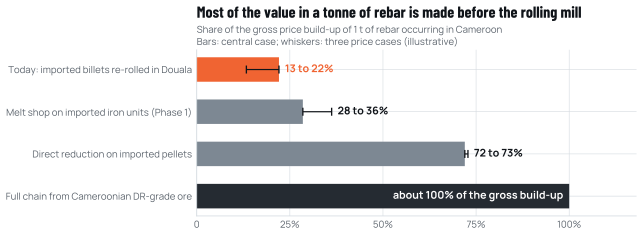
Source: Cameroon Steel calculation from [G31], [N03], [G34], RC-1 yields [F01] and pellet ratio [N01]; method in Chapter 8 and Annex A. Gross price spreads, not value added. Status: illustrative.
ES.2 The diagnosis: an hourglass economy
Cameroon is about to become an iron-ore exporter. The State’s 2026 to 2030 programme commits 1,748 bn FCFA, about US$3.1 bn, to three projects: Mbalam, Bipindi-Grand Zambi and Kribi-Lobé [O29]. Mbalam’s developer plans up to 10 Mtpa of exports by road until 2029 and 25 Mtpa by rail from 2030 [O25]; Lobé plans to raise concentrate output to 8 Mtpa by 2031 [O35]. At the same time, the country’s steel industry runs on imported billets and scarce scrap, and its rolling mills run at half capacity.
That combination, a large and growing ore stream at the top, a saturated rolling industry at the bottom and nothing in between, is the hourglass this paper describes in Chapter 1. It explains why Cameroon can export ore and import steel at the same time, and why more rolling mills would not change the picture. The constraint is iron.
The demand side is solid but small. Apparent steel use is about 450 kt/yr [C40], roughly 15 to 20 kg per inhabitant depending on the population estimate [C13][C14], against 29.2 kg for Africa and 209 kg for the world [G05]. Construction grew 4.3% in real terms in 2025 [C09], the housing deficit is estimated at 1.8 to 2.0 million units [C15] and Africa’s steel use is forecast to grow by 3.8% in 2026 and 4.6% in 2027 [G09]. A national chain at the scale of 1 Mtpa would need export markets in CEMAC and beyond: Cameroon already exports about 31 kt of rebar a year, mostly to Chad [C05][C06].
ES.3 The proposal: a chain built in phases
The paper proposes a chain built backwards from the melt shop, with each step designed to stand on its own merits and none committed before its conditions are met (Chapter 6).
- Phase 1: make billets in Cameroon. An electric arc furnace, ladle furnace and billet caster, with a bar and wire-rod mill, running on scrap and imported DRI or HBI. In RC-1 this phase has a nameplate of 0.3 Mtpa of finished product (expected sustained output 270 to 300 kt), needs about 0.36 Mtpa of metallics and draws about 36 MW of average load, within the first 100 MW that the 225 kV line brings to the whole port platform; an allocation to the steelworks remains to be agreed [F01][Z43]. Works are targeted from 2029, with a first heat in the second half of 2030 and ramp-up in 2031 [F01]. Its output is flexible between wire rod and rebar and merchant billets for the existing re-rollers, which import about 60% of their charge as billets (161 kt in 2023) [C06][C38]; with rebar capacity at 3.5 times demand [C30], its tonnage has to displace imported billets and wire rod or be exported within CEMAC, not add to domestic rebar. On imported iron units it saves about as much foreign exchange per tonne as today’s re-rollers and competes behind the tariff (White paper 09), so its case rests on quality, merchant billets and the outlet it creates for local iron. It also builds the skills and infrastructure that later phases need.
- Phases 2 and 3: sections and heavy long products. Light angles and flats are rolled locally in small quantities [C25]; medium and heavy sections and H-beams are not produced in Cameroon and are imported [C06]. Phase 2 (second melt line and light/medium sections mill), indicatively 2032 to 2034, and Phase 3 (melt-shop expansion and heavy-section mill), after 2034, would take RC-1 to its design capacity of 1 Mtpa [F01][X04]; both should follow evidence of demand, including exports.
- The direct-reduction module: Cameroonian concentrate, when its conditions are met. A module of about 1 Mtpa of DRI, needing about 1.45 Mtpa of DR-grade pellets [N01] and 8.4 to 9.1 bcf/yr of gas [T09][T10], held in reserve in RC-1 and indicative after 2034 [F01]. It should be built only when DR-grade concentrate has been proven at pilot scale and contracted under the 15% rule, when gas is secured by an audited long-term contract, and when firm power and bulk handling are in place.
The order mirrors what worked elsewhere and avoids what failed (Chapter 4): it starts where the import bill is, uses modular and proven equipment, secures feed before each furnace and sits at a deep-water port. It also manages the four critical risks identified in Chapter 9: rebar saturation, the legacy of rolling without iron, and three that concern iron units and energy, namely iron-unit shortage, the lack so far of DR-grade feed, and firm power.
On carbon, the chain starts low. On Cameroon’s hydro-based grid, RC-1 Phase 1 has an estimated intensity of about 0.32 t of CO2 per tonne of finished steel for direct and electricity emissions, and about 0.58 t including the upstream emissions of imported DRI [F01], against a world average of 1.92 t [T01]. That matters because the EU’s carbon border adjustment mechanism now covers DRI, billets, rebar, wire rod and pellets [D08].
ES.4 What the paper asks of government, investors and partners
Chapter 10 sets out seventeen recommendations. Five carry most of the weight.
- An implementing text for article 40(4) that defines transformation by depth, prices local supply at export parity, links the obligation to DR-grade concentrate, and requires public reporting.
- A gas allocation for industry at Kribi, backed by an independent audit of Sanaga Sud reserves, now that the LNG offtake has ended.
- A framework for heavy-industry power contracts above 10 MW, timely delivery of the 225 kV supply and its later stage, and published allocation and power-quality terms for arc-furnace loads.
- Tariffs and trade remedies that reward ironmaking: duties that escalate from ore to semis to finished steel, national preference for locally made billets and sections, and a capacity to respond to import surges.
- For investors, a melt shop first and the DR module prepared now: pilot testwork on DR-grade concentrate, grade and price terms with convention holders, and hydrogen-ready equipment, with development-finance institutions financing phase by phase.
None of these requires a large public subsidy. Together they would move the share of the gross price build-up of a tonne of rebar occurring in Cameroon from about one-fifth today towards one-third with a melt shop, and towards most of it, before imported consumables and capital service, once Cameroonian ore is reduced at home (Figure ES.1).
ES.5 About this paper
This is the first of ten white papers published by Cameroon Steel, which is developing a phased steel complex at Mboro, in the Kribi industrial-port zone, with a design capacity of 1 Mtpa [X04]; its foundation stone was laid on 30 December 2024 by the Prime Minister, representing the Head of State [X01]. Cameroon Steel’s sister company, Cameroon Mining Company, holds the Mbalam exploitation permit [X01]. The paper is written from that vantage point, and readers should weigh it accordingly; for that reason it relies on public, cited evidence wherever possible.
Sources. Every figure carries a marker that maps to the list of sources in Annex C: international data from worldsteel, the OECD, the World Bank, the IEA and Midrex; Cameroonian data from the national statistics institute (INS), the electricity regulator, the national hydrocarbons company and the national press; and company, ministry and port documents cited by title and date. The data cut-off is 10 October 2026.
Status of figures. Figures marked derived are analyst arithmetic on sourced inputs, with the method in Annex A. Figures marked illustrative show orders of magnitude and are not forecasts of any plant’s revenue or margin. Figures for Cameroon Steel’s reference configuration, RC-1, are planned or indicative: they are engineering planning values, not commitments, and they will change with detailed design. The paper gives no investment amounts or financial returns for the project.
Structure. Chapter 1 sets out the value-chain gap; Chapter 2 the ore endowment and grades; Chapter 3 consumption and imports; Chapter 4 lessons from six producers; Chapter 5 beneficiation policy; Chapter 6 the phased chain; Chapter 7 Kribi; Chapter 8 the economics of value capture; Chapter 9 risks; Chapter 10 recommendations; and Chapter 11 the evidence that is still missing and how it will be obtained. Four annexes follow: the method and assumptions (Annex A), a glossary (Annex B), the sources (Annex C) and the data behind every exhibit (Annex D).
Statement of interest. This paper is published by Cameroon Steel, which is developing a steelworks at Kribi. It is written to inform public debate; its analysis is independent of any commercial offer, and every figure is sourced or labelled with its status.
本章引用的资料来源
方括号内的标记对应以下来源(按原文语言列出),完整列表见附录。 完整来源列表
- O05Mbalam-Nabeba resources and reserves statement as at 20 May 2015 (JORC). Former holder of the Mbalam-Nabeba project (ASX-listed),2015年.sdl.live.irmau.com/irm/content/resources-reserves.aspx?RID=236
- C05Évolution du commerce extérieur en 2025 (version provisoire). INS Cameroun,2026年2月(发布:2026年4月1日).ins-cameroun.cm/wp-content/uploads/2026/04/Note-sur-le-commerce-exteri…
- C06UN Comtrade public API, Cameroon (reporter 120), HS 72/73 and 6-digit lines, 2019-2023. UN Statistics Division.comtradeapi.un.org/public/v1/preview/C/A/HS?reporterCode=120&period=20…
- C38Cameroun: le groupe Prometal décroche 26 milliards FCFA auprès d’Afreximbank…. Sikafinance,2026年9月30日.sikafinance.com/marches/cameroun-le-groupe-prometal-decroche-26-millia…
- C40Cameroun: Prometal décroche 26,2 milliards FCFA d’Afreximbank. Camer.be,2026年10月1日.camer.be/actualites/economie/cameroun-prometal-decroche-262-milliards-…
- Z42Loi n° 2023/014 du 19 décembre 2023 portant Code minier, Article 40(4) (official text, mirror). Rural-info (copy of the official text),2023年12月19日.rural-info.net/wp-content/uploads/2024/11/Loi-N°2023-014-du-19-decembr…
- G18Pedal to the Metal 2026. Global Energy Monitor,2026年5月.globalenergymonitor.org/sites/default/files/2026-05/Pedal%20to%20the%2…
- T132025 World Direct Reduction Statistics. Midrex Technologies,2026年9月.midrex.com/world-dri-statistics/world-dri-production-reaches-151-0-mt-…
- C30Production: les acteurs en présence. Cameroon Tribune,2026年5月11日.cameroon-tribune.cm/article.html/76600/fr.html/details_2
- C39Prometal obtient 26 milliards FCFA d’Afreximbank pour soutenir son expansion industrielle. EcoMatin,2026年9月30日.ecomatin.net/prometal-obtient-26-milliards-fcfa-dafreximbank-pour-sout…
- N16Launch of DR-grade iron ore pellet premium weekly indicator. Fastmarkets,2022年12月1日.fastmarkets.com/insights/launch-of-dr-grade-iron-ore-pellet-premium-we…
- O04Mbalam-Nabeba project presentation, Mining Indaba 2014 (itabirite testwork). Former holder of the Mbalam-Nabeba project (ASX-listed),2014年2月.sdl.live.irmau.com/irm/PDF/2752_0/PresentationMiningIndaba2014
- N01Iron ore supply for direct reduction: outlook and challenges (J. Atherton), Arab Steel Summit presentation. International Iron Metallics Association (IIMA),2024年10月.2024.aisusteel.org/wp-content/uploads/2024/10/Dr-John-Atherton_IIMA.pd…
- N02MENA will need an additional 30-40 million tons of DR pellets in the near future. GMK Center,2025年11月24日.gmk.center/en/news/mena-will-need-an-additional-30-40-million-tons-of-…
- O17Cameroon Mining Company confirme l’entrée du projet Mbalam dans sa phase irréversible d’exécution. Camer.be(经AllAfrica转载),2025年12月12日.fr.allafrica.com/stories/202512120475.html
- O33Fer de Lobé: l’État octroie le permis d’exploitation à Sinosteel. EcoMatin,2022年9月7日.ecomatin.net/fer-de-lobe-malgre-des-contestations-letat-octroie-le-per…
- Z79Cameroon reviews metals industry to address supply and energy constraints. Business in Cameroon,2026年4月29日.businessincameroon.com/public-management/2904-16094-cameroon-reviews-m…
- P24WITS TRAINS API, Cameroon reported MFN tariffs by HS6 (2023). World Bank / UNCTAD.wits.worldbank.org/API/V1/SDMX/V21/datasource/TRN/reporter/120/partner…
- A04Algeria’s steel industry: why is it growing. GMK Center,2026年7月28日.gmk.center/en/posts/algeria-s-steel-industry-why-is-it-growing/
- A07Egypt’s steel industry: protection from within. GMK Center,2026年7月23日.gmk.center/en/posts/egypt-s-steel-industry-protection-from-within/
- N13Hòa Phát Group proposes development of Thạch Khê iron ore mine. AIST,2026年5月27日.aist.org/hoa-phat-group-proposes-development-of-thach-khe-iron-ore-min…
- N14Mr. President, it’s time to make final decision on Ajaokuta Steel, NIOMCO. ThisDay,2026年7月15日.thisdaylive.com/2026/07/15/mr-president-its-time-to-make-final-decisio…
- F01Cameroon Steel reference configuration RC-1 (planning estimate), edition 10 October 2026 (RC-1.1). Cameroon Steel,2026年10月10日.按标题和日期引用
- X04Industrialisation: la voie royale de l’émergence. Cameroon Tribune,2025年1月2日.cameroon-tribune.cm/article.html/68558/fr.html/details_2
- Z37Guide du Port de Kribi. PAK (PDF),2020年8月.按标题和日期引用
- Z4Zone industrialo-portuaire de Kribi (KPIZ): jusqu’à +8 points de croissance et 150 000 emplois…. Investir au Cameroun,2026年3月4日.investiraucameroun.com/gestion-publique/0403-23163-zone-industrialo-po…
- Z43Kribi franchit la ligne électrique 225 kV. PAK,2025年8月6日.按标题和日期引用
- E09Le navire usine quitte le Cameroun, le gaz s’arrête. Camer.be,2026年7月9日.camer.be/93911/12:1/le-navire-usine-quitte-le-cameroun-le-gaz-sarrete-…
- E04Données pétrolières 2025. SNH,发布:2026年6月.snh.cm/wp-content/uploads/2026/06/Donnees-petrolieres-2025.pdf
- G31Commodity Markets Outlook, Historical Data, Annual (xlsx). World Bank,2026年9月2日.thedocs.worldbank.org/en/doc/74e8be41ceb20fa0da750cda2f6b9e4e-00500120…
- N03BPI and HBI prices on the rise in Europe. SteelOrbis,2026年1月23日.steelorbis.com/steel-prices/steel-prices-market-analyses/scrap-and-raw…
- G34Weekly steel prices (archive 40468). Arab Iron & Steel Union (AISU),2026年10月3日.aisusteel.org/en/archives/40468
- O29Cameroon plans $3.1B iron ore push starting 2026. Daba Finance (republished by AllAfrica),2026年2月14日.dabafinance.com/en/news/cameroon-mining-investment-2026-2030
- O25Mbalam iron ore mine delays first exports to early 2026. Business in Cameroon,2025年12月13日.businessincameroon.com/public-management/1312-15495-mbalam-iron-ore-mi…
- O35Sinosteel reporte les exportations du fer de Kribi-Lobé à 2027 malgré 120 milliards FCFA déjà investis. EcoMatin,2026年3月11日.ecomatin.net/cameroun-sinosteel-reporte-les-exportations-du-fer-de-kri…
- C13WDI API: SP.POP.TOTL; SP.URB.TOTL.IN.ZS (CMR). World Bank,更新:2026年10月8日.api.worldbank.org/v2/country/CMR/indicator/SP.POP.TOTL?format=json
- C14Cameroun: bouclage du 4e RGPH, 22,7 millions d’habitants recensés. Journal du Cameroun,2026年10月5日.fr.journalducameroun.com/cameroun-bouclage-du-4e-rgph-227-millions-dha…
- G05World Steel in Figures 2026 (page and PDF). worldsteel,2026年6月4日.worldsteel.org/data/world-steel-in-figures/world-steel-in-figures-2026…
- C09Les Comptes Nationaux de 2025. INS Cameroun,2026年8月(发布:2026年9月2日).ins-cameroun.cm/wp-content/uploads/2026/09/Comptes_Nationaux_2025_FR_V…
- C152024 Housing Finance Yearbook, Cameroon profile. Centre for Affordable Housing Finance in Africa (CAHF),2024年1月(PDF:2025年3月).housingfinanceafrica.org/wp-content/uploads/2025/03/CAMEROON.pdf
- G09worldsteel Short Range Outlook April 2026 (release + Table 1). worldsteel,2026年4月14日.worldsteel.org/media/press-releases/2026/worldsteel-short-range-outloo…
- C25Prometal inaugure deux usines évaluées à 57 milliards F. Journal du Cameroun,2024年1月19日.fr.journalducameroun.com/prometal-inaugure-deux-usines-evaluees-a-57-m…
- T09ENERGIRON technology (DRI-EAF with natural gas or H₂). EC ICIT,引用:2026年2月12日.innovation-centre-for-industrial-transformation.ec.europa.eu/innovativ…
- T10Suez Steel sets new benchmark in energy consumption for DRI production. Danieli,2026年4月16日.danieli.com/en/news-media/news/suez-steel-sets-new-benchmark-energy-co…
- T01Sustainability Indicators 2025 report. worldsteel,2025年11月(更新:2026年2月).worldsteel.org/wider-sustainability/sustainability-indicators/sustaina…
- D08Regulation (EU) 2023/956 (CBAM), Annex I. EUR-Lex (OJ L 130),2023年5月16日.eur-lex.europa.eu/legal-content/EN/TXT/PDF/?uri=CELEX:32023R0956
- X01Kribi: le Premier ministre, chef du gouvernement est là. Cameroon Tribune,2024年12月30日.cameroon-tribune.cm/article.html/68499/fr.html/details_2
引用本章
Cameroon Steel(2026)。从矿石到钢铁:喀麦隆缺失的环节是炼铁,而非轧钢(中文摘要版)。白皮书01,摘要:执行摘要。CS-WP-01。https://www.cameroon-steel.com/zh/library/ore-to-steel/executive-summary/
来源