白皮书01 · 第4章 · 中文摘要
成功的产钢国使炼铁与本国天然气、矿石和市场相匹配
六个产钢国的经验表明了什么能把矿石变成钢铁工业。埃及和阿尔及利亚依托廉价天然气和模块化直接还原,在数年内替代了进口;巴西和印度说明仅靠矿产财富不能形成钢铁产业链;越南说明临港钢铁综合体可以先用进口矿石;尼日利亚则显示了与矿石、燃料和物流不相匹配的巨型项目的代价。
本页为本章中文摘要;英文全文附于其后,可展开阅读。
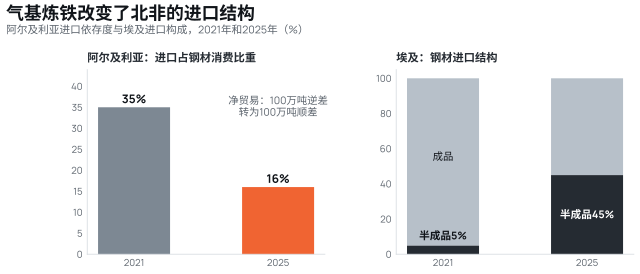
埃及2025年粗钢产量1060万吨[G05],其产业建立在进口DR级球团、国产天然气和电弧炉之上[N01]。其轧钢产能约2000万吨/年,开工率约50%,半成品占钢材进口的比重从2021年的5%升至2025年的45%[A07],与喀麦隆的情形相似;自2026年4月起,埃及对钢坯征收13%的关税[A06][A07]。阿尔及利亚依靠外国直接投资建设气基直接还原铁与电弧炉一体化项目,在2021年至2025年间由约100万吨钢材逆差转为约100万吨顺差,进口占消费的比重从35%降至16%[A03][A04]。
尼日利亚阿贾奥库塔(Ajaokuta)钢厂约于1979年开工建设,约47年后高炉从未点火,也从未产出钢水[N14]:所选技术需要该国并不具备的焦煤,规模由政治而非市场决定,物流设施从未建成。越南先在沿海建设港口型综合体,以进口矿石起步,2025年粗钢产量2470万吨[N12],现正转向开发本国铁矿[N13]。巴西2025年出口铁矿石4.164亿吨,粗钢产量却只有3330万吨[N05][N06]。
对喀麦隆的启示是:依据现有能源选择直接还原铁加电弧炉路线,先落实原料再建炉,模块化建设,从进口额最大的环节起步,并把工厂建在深水港。样本中没有一个国家是从矿山一步跨到钢铁的;成功者都从港口的炼钢厂或直接还原厂起步,再向本国矿石反向整合。
英文全文 13分钟 · 2970词Successful producers matched ironmaking to their gas, their ore and their market
Six producers show what turns ore into a steel industry and what does not. Egypt and Algeria used cheap natural gas and modular direct reduction to replace imports within a few years. Brazil and India show that ore wealth alone does not create a steel chain. Vietnam shows that a port-based complex can thrive on imported ore and add its own later. Nigeria shows the cost of a megaproject mismatched to its ore, its fuel and its logistics. The common thread for Cameroon is to sequence proven, modular technology behind secure feed and a deep-water port.
4.1 Six cases, one question
Every country with iron ore faces the same choice: export it, or turn some of it into iron and steel at home. The answer depends on four things that vary from country to country: the grade of the ore, the energy available to reduce it, the size and protection of the domestic market, and the logistics that connect mine, plant and port. Table 4.1 compares six producers on those four dimensions, chosen because each illuminates a decision Cameroon now faces.
Table 4.1 Six producers compared on the four determinants of an ore-to-steel chain
| Country | Ore base | Energy | Iron route | Key policy instruments | Outcome | Lesson for Cameroon |
|---|---|---|---|---|---|---|
| Egypt | Imported DR pellets | Domestic gas | Gas DRI to EAF | Duties on billets and coil; anti-dumping | 10.6 Mt steel (2025); semis 45% of imports | Gas DRI works in Africa; protect semis too |
| Algeria | Imported pellets; own ore from 2026 | Cheap domestic gas | Gas DRI to EAF | 30% duty; import certificates; price preference | Net importer to net exporter, 2021 to 2025 | Fast results, but trade defence abroad |
| Nigeria | Itakpe ore, never delivered at scale | Coal planned | Blast furnace never blown; idle DR plant | State ownership; revival plans | No liquid steel in about 47 years | Match technology to ore and fuel; logistics first |
| India | Large domestic ore base | Coal, some gas | Blast furnace; coal-based DRI | Steel policy; export duties in 2022 | 164.9 Mt steel (2025) | Market size drives scale; export taxes are blunt |
| Vietnam | Mostly imported ore | Coal | Coastal blast-furnace complex | Anti-dumping on coil | 24.7 Mt steel (2025), +12% | A port complex can come before local ore |
| Brazil | Very large, high grade | Coal, charcoal | Blast furnace; port slab plant | Import quotas | 416.4 Mt ore exported vs 33.3 Mt steel | Ore wealth alone does not create steel |
Source: Cameroon Steel synthesis of [G05], [T13], [A04], [A07], [N14], [G01], [N10], [N12], [N13], [N05], [N06] and sources cited in this chapter.
4.2 Egypt: gas-based direct reduction on imported pellets
Egypt is Africa’s largest steel producer, with 10.6 Mt of crude steel in 2025 [G05], and its industry is built on gas-based direct reduction. worldsteel puts Egyptian DRI output at 6.6 Mt in 2025, and Midrex at 6.06 Mt [G05][T13]. Egypt is listed among the countries whose DR plants run on merchant pellets bought on the world market [N01]: its own ore is not of DR grade. The chain was assembled from imported pellets, domestic gas and electric arc furnaces, and the largest producer, Ezz Steel, now has about 7 Mtpa of rolling capacity, 2.3 Mtpa of it for hot-rolled coil and 4.7 Mtpa for long products [A07].
Egyptian plants are among the most efficient in the world. Suez Steel’s modernised DR plant now consumes about 2.2 Gcal of gas and 93 kWh of electricity per tonne of DRI [A07]; its technology supplier reported a sustained figure below 2.2 Gcal, about 9.2 GJ per tonne [T10]. Beshay Steel commissioned a 2 Mtpa DRI module during its 2021 to 2025 programme [A07].
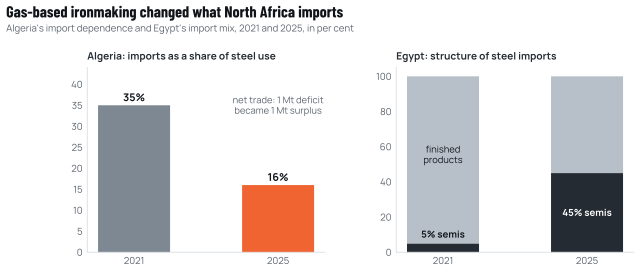
Two features of Egypt’s experience are directly relevant to Cameroon. First, rolling capacity outran ironmaking: the sector has about 20 Mtpa of rolling capacity running at roughly 50% [A07], and the structure of its imports has shifted accordingly. Finished products made up 95% of steel imports in 2021 and 55% in 2025, while semi-finished steel rose from 5% to 45% [A07]. That is Cameroon’s situation on a larger scale: mills that need billets more than the market needs bars.
Second, Egypt protects semi-finished steel as well as finished products. Since April 2026 billets carry a 13% duty with a minimum of US$65/t and an annual quota of 176,700 t, hot-rolled coil 13.6% with a minimum of US$75.25/t, and Chinese rebar an anti-dumping duty of 29% [A06][A07]. The vulnerability of the model is its feed: DR plants that depend on seaborne pellets are exposed to the supply tightness described in Chapter 2, with the Middle East and North Africa alone expected to need 30 to 40 Mtpa more DR pellets within a few years [N02].
4.3 Algeria: from importer to net exporter in four years
Algeria shows how fast a gas-rich country can substitute imports once it commits to direct reduction at scale. In 2021 it ran a steel deficit of about 1 Mt; by 2025 it was a net exporter of about 1 Mt, and imports fell from 35% to 16% of consumption [A03][A04]. Crude steel output reached 5.5 Mt in 2025, up from 4.5 Mt in 2024 [G05].
The engine of that change was foreign direct investment in gas-based DRI-EAF complexes. Tosyali Algérie, a Turkish-owned complex near Oran, has 6.2 Mtpa of steelmaking capacity, 5 Mtpa of DRI capacity, a third EAF of 2.7 Mtpa and a hot strip mill of 2.5 Mtpa [A04]. Algerian Qatari Steel at Bellara added a 2.5 Mtpa DRI module in 2021 to 2.2 Mtpa of steelmaking, and the smaller Ozmert plant a 0.5 Mtpa DRI module in 2024 [A04]. The State’s historic integrated works at El Hadjar, with 2 Mtpa of nominal capacity, produces 1 to 1.5 Mtpa on worn equipment [A04].
Source: [A03], [A04] (Algeria); [A07] (Egypt).
The policy package was generous. Domestic gas for industry cost less than 10% of production costs in 2023 to 2025, saving Tosyali an estimated US$50 to 80 per tonne of finished steel; imports face a 30% basic duty; Algerian products enjoy a price preference of up to 25% in public procurement; and an import-agency certificate is refused automatically where similar local production exists [A04]. Algeria is now integrating backwards into ore: a 950 km railway linking the Gara Djebilet deposit to Béchar and the north was inaugurated in early 2026, and a first processing unit of 4 Mtpa of ore was due to start by the end of April 2026, with Tosyali’s complex among the intended users [N15].
The other side of the ledger is cost and exposure. Tosyali’s newest complex was announced at US$2.5 bn for 1.6 Mtpa, about US$1,560 per tonne of capacity [A26]. And the United States imposed, in July 2026, an anti-dumping duty of 127.32% and a countervailing duty of 72.94% on Algerian rebar, partly on the ground that cheap gas is a subsidy [A04]. A chain built on subsidised energy can win its home market and lose its export markets.
4.4 Nigeria: the cost of a mismatched megaproject
Nigeria is the cautionary tale of African steel. The Ajaokuta steel complex was begun around 1979 under a cooperation agreement with the Soviet Union, around a blast furnace designed to use ore from Itakpe, about 65 km away. Some 47 years later, its blast furnace has never been blown and it has never produced liquid steel; Itakpe ore has never been fully produced and delivered to the plant, and the rail links that were to connect mine, mill and port remain incomplete [N14]. In Warri, the Delta Steel direct-reduction plant, with 1.02 Mtpa of capacity built in 1982, is idle [T13].
Ajaokuta failed on each of the four determinants. Its technology, a blast furnace, required coking coal Nigeria does not produce in quantity and ore of a quality Itakpe did not deliver; its scale was set by politics rather than by the market; its logistics were never completed; and the project was repeatedly rescued with public money rather than disciplined by customers. Political claims that it would create half a million jobs [P05] show how large promises can obscure basic engineering questions.
Nigeria still has the demand. Its chapter 72 imports were US$930.4 m in 2021 and US$225.7 m in 2024, after the naira devaluation compressed them [C07]. Global Energy Monitor counts only 0.6 Mtpa of operating steel capacity in plants of at least 0.5 Mtpa, but 3.0 Mtpa of EAF capacity in development [G18], including a US$450 m hot-rolled coil plant [A16]. The lesson for Cameroon is not that Africa cannot make steel; it is that the chain must be built in modules that work at each step, with feed and logistics secured before the furnace.
4.5 India: a large market and captive ore
India is the world’s second-largest steel producer, with 164.9 Mt of crude steel in 2025, up 10.4% [G01]. Its National Steel Policy of 2017 set targets of 300 Mt of crude steel capacity and 255 Mt of production by 2030-31, with per-capita consumption rising to 158 kg [N10]. India is also the world’s largest maker of DRI, 58.8 Mt in 2025, but 49.9 Mt of that came from coal-fired rotary kilns and only 8.9 Mt from gas [T13]. Coal-based DRI emits about three times as much CO2 directly as gas-based DRI [T02], which exposes Indian exporters to carbon border measures.
India illustrates two policy lessons. The first is that a large domestic market and captive ore make scale possible: steelmakers can integrate from mine to mill because the market absorbs their output. The second is that export taxes on ore are a blunt instrument. In May 2022 India imposed a 50% duty on exports of low-grade iron-ore lumps and fines and a 45% duty on pellets, to cool domestic prices; it withdrew them in November 2022 [N11]. The measure redirected ore to domestic mills for six months but disrupted miners, pellet makers and their customers, and did not survive the first change in market conditions.
Cameroon’s approach under the 2023 Mining Code is different in kind. It does not tax exports; it obliges each convention to set aside a minimum share of production for local transformation [Z42]. A quantity rule written into long-term conventions is more predictable for investors than a tax that changes with prices, provided the rule is backed by clear offtake terms. Chapter 5 discusses what those terms should contain.
4.6 Vietnam: a port-based complex can run on imported ore
Vietnam’s crude steel output reached 24.7 Mt in 2025, a five-year high and 12% more than in 2024, according to the Vietnam Steel Association; exports rose to 3.15 Mt [N12]. Growth accelerated in 2026: Vietnam’s output rose 29.1% year on year in January to August, to 20.6 Mt [G04].
The country’s largest producer built its flagship integrated complex at Dung Quat, on the coast of Quang Ngai province, and imports most of its iron ore because domestic sources are limited. In May 2026 it proposed to develop the Thach Khe deposit, estimated at about 500 Mt, to reduce that dependence [N13]. Vietnam therefore reversed the sequence many ore-rich countries follow: it built a deep-water, port-based steel complex first, served a fast-growing construction market, and is only now looking to integrate back into domestic ore. It also uses trade defence to protect new capacity, with provisional anti-dumping duties of 19.38 to 27.83% on Chinese hot-rolled coil from March 2025 [G27], and it moves into specialised products: a 700,000 t/yr rail and special-steel plant broke ground in 2026 [N12].
For Cameroon, Vietnam’s lesson is that a coastal plant with good port access can start on imported raw materials, as Dung Quat did with imported ore and coal, and integrate backwards when its own ore is ready. That is the logic of the phased chain proposed in Chapter 6, which starts instead on imported iron units for an electric arc furnace.
4.7 Brazil: ore wealth does not make a steel industry by itself
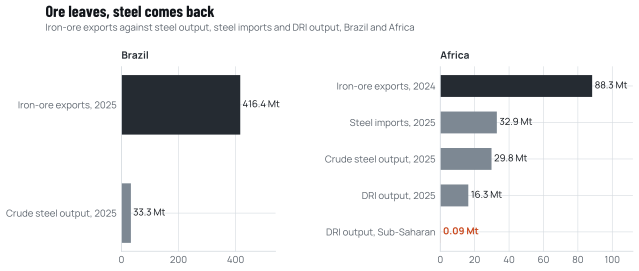
Brazil exported a record 416.4 Mt of iron ore in 2025, the first time its shipments exceeded 400 Mt [N05]. Its crude steel output the same year was 33.3 Mt, down 1.6% [N06]. The ratio, more than twelve tonnes of ore exported for every tonne of steel made, shows that abundant high-grade ore and a large economy do not by themselves create a proportionate steel industry; Brazilian mills face the same import competition as everyone else and the country has used quotas on 11 steel products, with a 25% duty above quota, since 2024 [G29].
Source: [N05], [N06] (Brazil); [G05], [T13] (Africa). Africa’s ore exports refer to 2024; other values to 2025.
Brazil also offers the most relevant model of downstream investment by an ore miner. The Pecém steel company (CSP) in Ceará, a 3 Mtpa blast-furnace slab plant commissioned in 2016 and linked by conveyor to a deep-water port, was built by the miner Vale with the Korean steelmakers POSCO and Dongkuk [N07]. ArcelorMittal bought it in March 2023 at an enterprise value of about US$2.2 bn and cited the option of adding direct reduction and rolling at the site [N07]. In October 2022 Vale signed agreements with Saudi Arabia, the United Arab Emirates and Oman to study "mega hubs" in port industrial zones that would make HBI and steel products from Vale’s agglomerated ore, noting that gas-based HBI emits about 60% less CO2 than blast-furnace pig iron [N08].
The pattern is clear: miners that want to add value build or co-invest in iron and steel plants at ports with access to gas, in partnership with established steelmakers that bring technology and markets. Kribi offers the same combination of port, gas and ore within one industrial zone.
4.8 Guinea and Mauritania: beneficiation written into the deal
Africa’s newest iron-ore giant takes a further step. Simandou in Guinea, which began operations in November 2025 and is designed for up to 120 Mtpa [A10][N09], operates under a co-development agreement that requires the companies to submit a feasibility study for either a 500,000 t/yr steel mill or a 2 Mtpa pellet plant within two years of the mine entering production. A study for a 2 Mtpa pellet plant was reviewed by the mines ministry in June 2026; it projects up to 1,950 construction jobs and 788 permanent positions [N09]. Mauritania’s state miner SNIM is studying a 2.5 Mtpa green-iron project with a partner [A19], and Namibia opened Africa’s first hydrogen-based iron pilot in April 2025 [D14].
These agreements share a feature that Cameroon can borrow: the beneficiation obligation is specific (a pellet plant or a mill of stated size), time-bound (two years from first production) and modest relative to the mine (2 Mt of pellets against up to 120 Mt of ore).
4.9 Seven lessons for Cameroon
The six country cases and the newer African conventions point to seven practical lessons.
- Match the ironmaking route to the energy you have. Egypt and Algeria chose gas-based direct reduction because they have gas; Nigeria chose a coal-based blast furnace without coking coal. Cameroon’s gas and hydro power point to DRI-EAF, not to a blast furnace.
- Secure the feed before building the furnace. Egypt and Algeria began on imported pellets and Algeria is only now bringing its own ore on line; Ajaokuta never received its ore. A Cameroonian DR plant should be built when DR-grade concentrate is assured, from local or imported sources.
- Build in modules and grow with the market. DR modules range from 0.25 Mtpa to 2.5 Mtpa [T13]; EAF mini-mills of 0.3 to 0.5 Mtpa are standard [T20][T21]. Oversized single projects fail.
- Start where the import bill is. Egypt’s import mix shifted to semis as rolling outgrew ironmaking. In Cameroon, billets are the largest import; making them locally is the first step.
- Protect intelligently and temporarily. Algeria’s and Egypt’s trade measures cover semis as well as finished goods, and Vietnam uses trade remedies rather than bans. Protection should reward ironmaking and be paired with competition and quality standards.
- Bring in anchor partners with technology and markets. Tosyali in Algeria and the Korean steelmakers at Pecém brought proven processes and offtake.
- Put the plant at the port. Vietnam’s Dung Quat, Brazil’s Pecém and Vale’s Gulf hubs all sit at deep-water ports with access to gas or power. Kribi is Cameroon’s equivalent.
Other sources cited in the English text
- T132025 World Direct Reduction Statistics. Midrex Technologies, Sep 2026.midrex.com/world-dri-statistics/world-dri-production-reaches-151-0-mt-…
- G01December 2025 crude steel production and 2025 global totals. worldsteel, 23 Jan 2026.worldsteel.org/media/press-releases/2026/december-2025-crude-steel-pro…
- N10National Steel Policy (NSP) 2017. Government of India, Ministry of Steel, May 2017.steel.gov.in/node/84
- T10Suez Steel sets new benchmark in energy consumption for DRI production. Danieli, 16 Apr 2026.danieli.com/en/news-media/news/suez-steel-sets-new-benchmark-energy-co…
- N02MENA will need an additional 30-40 million tons of DR pellets in the near future. GMK Center, 24 Nov 2025.gmk.center/en/news/mena-will-need-an-additional-30-40-million-tons-of-…
- N15Algeria has opened a railway line for the development of the Gara Djebilet deposit. GMK Center, 2 Feb 2026.gmk.center/en/news/algeria-has-opened-a-railway-line-for-the-developme…
- A26Le turc Tosyali va construire un nouveau complexe sidérurgique en Algérie. Managers.tn, 27 Apr 2026.managers.tn/2026/04/27/lalgerie-attire-les-grands-le-turc-tosyali-va-y…
- P05Ajaokuta Steel Complex to create 500,000 jobs, others. Nairametrics, 9 Oct 2023.nairametrics.com/2023/10/09/ajaokuta-steel-complex-to-create-500000-jo…
- C07UN Comtrade public API, CEMAC & Nigeria (reporters 266 Gabon, 178 Congo, 140 CAR, 566 Nigeria; mirror partners 148 Chad, 226 Eq. Guinea). UN Statistics Division.comtradeapi.un.org/public/v1/preview/C/A/HS?reporterCode=266&period=20…
- G18Pedal to the Metal 2026. Global Energy Monitor, May 2026.globalenergymonitor.org/sites/default/files/2026-05/Pedal%20to%20the%2…
- A16China’s Stellar Steel invests $450 million in a new steel plant in Nigeria. GMK Center, 27 Oct 2025.gmk.center/en/news/china-s-stellar-steel-invests-450-million-in-a-new-…
- T02Iron and Steel Technology Roadmap. IEA, Oct 2020.iea.blob.core.windows.net/assets/eb0c8ec1-3665-4959-97d0-187ceca189a8/…
- N112022 export duty withdrawal (iron ore and pellets), policies database. International Energy Agency, 2022.iea.org/policies/18745-2022-export-duty-withdrawal-iron-ore-and-pellet…
- Z42Loi n° 2023/014 du 19 décembre 2023 portant Code minier, Article 40(4) (official text, mirror). Rural-info (copy of the official text), 19 Dec 2023.rural-info.net/wp-content/uploads/2024/11/Loi-N°2023-014-du-19-decembr…
- G04August 2026 crude steel production. worldsteel, 24 Sep 2026.worldsteel.org/media/press-releases/2026/august-2026-crude-steel-produ…
- G27Vietnam revises provisional anti-dumping duties on hot-rolled steel from China. GMK Center, 13 May 2025.gmk.center/en/news/vietnam-revises-provisional-anti-dumping-duties-on-…
- G29Brazil introduces import quotas on 11 types of steel products. GMK Center, 24 Apr 2024.gmk.center/en/news/brazil-introduces-import-quotas-on-11-types-of-stee…
- N07ArcelorMittal takes ownership of Brazilian slab plant. AIST, Mar 2023.aist.org/arcelormittal-takes-ownership-of-brazilian-slab-plant
- N08Vale signs agreements to develop Mega Hubs in the Middle East and provide decarbonization solutions for steelmaking. Vale, Oct 2022.vale.com/w/vale-signs-agreements-to-develop-mega-hubs-in-the-middle-ea…
- A10Simandou partners celebrate start of operations. Rio Tinto, 11 Nov 2025.riotinto.com/en/news/releases/2025/simandou-partners-celebrate-start-o…
- N09Guinea takes first step toward processing Simandou iron ore at home. Ecofin Agency, 19 Jun 2026.ecofinagency.com/news-industry/1906-56609-guinea-takes-first-step-towa…
- A19North African green steel will soon be in demand in the EU, an overview. GMK Center, 25 Aug 2025.gmk.center/en/posts/north-african-green-steel-will-soon-be-in-demand-i…
- D14Global Gateway: Namibia becomes pioneer for Africa’s green transition. European Commission (INTPA), 11 Apr 2025.international-partnerships.ec.europa.eu/news-and-events/news/global-ga…
- T20Nucor to build new rebar micro mill in North Carolina. Nucor Corp., 7 Apr 2022.nucor.com/news-release/nucor-to-build-new-rebar-micro-mill-in-north-ca…
- T21Commercial Metals Company to invest $300 million in its third micro mill. Steel Technology, n.d..steel-technology.com/projects/commercial-metals-company-to-invest-300-…
本章引用的资料来源
方括号内的标记对应以下来源(按原文语言列出),完整列表见附录。 完整来源列表
- G05World Steel in Figures 2026 (page and PDF). worldsteel,2026年6月4日.worldsteel.org/data/world-steel-in-figures/world-steel-in-figures-2026…
- N01Iron ore supply for direct reduction: outlook and challenges (J. Atherton), Arab Steel Summit presentation. International Iron Metallics Association (IIMA),2024年10月.2024.aisusteel.org/wp-content/uploads/2024/10/Dr-John-Atherton_IIMA.pd…
- A07Egypt’s steel industry: protection from within. GMK Center,2026年7月23日.gmk.center/en/posts/egypt-s-steel-industry-protection-from-within/
- A06Egypt has imposed a temporary duty on imports of HRC at 13.6%. GMK Center,2025年9月15日.gmk.center/en/news/egypt-has-imposed-a-temporary-duty-on-imports-of-ho…
- A03Protecting the steel market: how it’s done in North Africa. GMK Center,2026年9月2日.gmk.center/en/posts/protecting-the-steel-market-how-it-s-done-in-north…
- A04Algeria’s steel industry: why is it growing. GMK Center,2026年7月28日.gmk.center/en/posts/algeria-s-steel-industry-why-is-it-growing/
- N14Mr. President, it’s time to make final decision on Ajaokuta Steel, NIOMCO. ThisDay,2026年7月15日.thisdaylive.com/2026/07/15/mr-president-its-time-to-make-final-decisio…
- N12Vietnam’s 2025 crude steel output hits 5-year high (Vietnam Steel Association data). The Investor,2026年2月10日.theinvestor.vn/vietnams-2025-crude-steel-output-hits-5-year-high-d1835…
- N13Hòa Phát Group proposes development of Thạch Khê iron ore mine. AIST,2026年5月27日.aist.org/hoa-phat-group-proposes-development-of-thach-khe-iron-ore-min…
- N05Brazil’s iron-ore exports hit annual record in 2025 (Reuters, citing the Ministry of Development, Industry, Trade and Services). Engineering News,2026年1月7日.engineeringnews.co.za/article/brazils-iron-ore-exports-hit-annual-reco…
- N06Produção de aço bruto cai 1,1% em Minas Gerais e 1,6% no Brasil em 2025 (Instituto Aço Brasil data). Diário do Comércio,2026年1月20日.diariodocomercio.com.br/economia/producao-aco-minas-gerais-brasil-2/
引用本章
Cameroon Steel(2026)。从矿石到钢铁:喀麦隆缺失的环节是炼铁,而非轧钢(中文摘要版)。白皮书01,第4章:成功的产钢国使炼铁与本国天然气、矿石和市场相匹配。CS-WP-01。https://www.cameroon-steel.com/zh/library/ore-to-steel/lessons-producers/
来源