白皮书01 · 第8章 · 中文摘要
炼铁是最大价值所在,炼钢厂是通向它的大门
按2025年和2026年的时点市场价格,矿石和炼铁合计占每吨钢筋市场价值的64至72%,轧制占13至22%,熔炼占6至15%。喀麦隆的轧钢厂目前只获取轧制环节;炼钢厂是通向炼铁这一最大价值的大门。
本页为本章中文摘要;英文全文附于其后,可展开阅读。
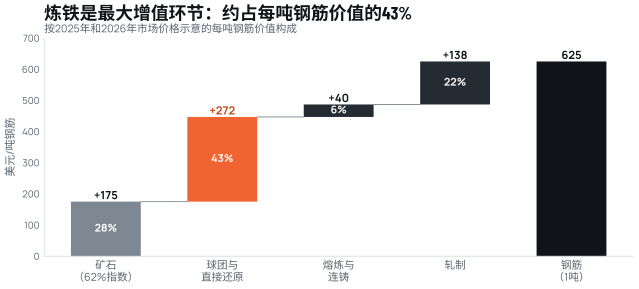
本章将各环节的国际价格换算为对1吨钢筋的贡献。按中间价格,每吨钢筋价值625美元:矿石(1.75吨,每吨100美元)约175美元,占28%[G31];球团和直接还原增加约272美元,占43%[N03];熔炼与连铸增加约40美元,占6%;轧制增加约138美元,占22%[G34]。在低价含铁原料和高价钢坯两种情形下,排序保持不变。上述数字是示意性的价格毛差,反映价值所在,并非增加值,也非任何企业的利润。
以进口含铁原料进行熔炼,增值很薄:炼钢厂的优势在于免去钢坯运费,并只对金属炉料而非钢坯缴纳关税(进口废钢、直接还原铁和热压块铁同样适用10%税率)[P24];其战略价值在于为本地直接还原铁提供出路。成本比较见白皮书09第7章和白皮书04第8章。1吨DR级精矿作为矿石出售约值100美元,一路加工成钢筋约值357美元,约为前者的3.6倍。一座100万吨/年直接还原模块使用约145万吨/年精矿:作为矿石约值1.45亿美元,制成约83万吨长材则约值5.17亿美元。
外汇效益取决于含铁原料:白皮书09测算,以进口废钢和热压块铁生产时,每吨钢筋保留外汇47至181美元,与现有轧钢厂的48至170美元相当;使用国产含铁原料时为545至645美元(白皮书09,第9章)。只有当矿石、天然气和电力均为国产、仅钢材跨境时,才能实现持久的外汇节约。分期产业链可将每吨钢筋价格毛构成中发生在喀麦隆境内的份额,从目前的约五分之一提高到建成炼钢厂后的约四分之一至三分之一,并在本国精矿实现国内还原后达到其中大部分(未扣除进口消耗品和资本成本)。
英文全文 12分钟 · 2774词Ironmaking is the prize; the melt shop is the door to it
On dated 2025 and 2026 market prices, ore and ironmaking together account for 64 to 72% of the market value of a tonne of reinforcing bar, rolling for 13 to 22% and melting for 6 to 15%. Cameroon’s mills capture today only the rolling step. A melt shop adds the melting step and, more importantly, creates the outlet that makes local ironmaking possible; carried through direct reduction, melting and rolling, each tonne of Cameroonian concentrate would be worth about 3.6 times its value as ore, and about 2.6 times as DRI alone. These figures are illustrative gross price spreads: they describe where value sits, not value added or anyone’s profit.
8.1 Method: from dated prices to value per tonne of rebar
There is no single published price chain from Cameroonian ore to Cameroonian rebar, because the intermediate products are not traded in Cameroon. The approach used here is transparent and reproducible:
- take a dated international price for the main iron-bearing product of each step (ore, iron units, billets, rebar);
- convert each price into its contribution to one tonne of finished rebar, using the tonnes of each product needed per tonne of rebar;
- read the difference between successive steps as the market value that step adds.
The difference is a gross spread over the iron-bearing input. It is not value added in the national-accounts sense, which would also deduct energy, consumables and services, and it is not a profit margin, which would also deduct labour, maintenance, depreciation and financing. It shows where in the chain market value is created, which is the question that matters for policy.
Table 8.1 Price inputs used in the value-capture analysis
| Product | Basis | Date | Price (US$/t) | Used | Source |
|---|---|---|---|---|---|
| Iron ore, 62% Fe fines | CFR China, annual average | 2025 | 100.2 | 100 | [G31] |
| Iron ore, 62% Fe fines | CFR China; monthly and weekly | Sep and 3 Oct 2026 | 97.7; 97 | low case 97 | [G32][G34] |
| Iron ore, forecast | World Bank | 2026f; 2027f | 97; 95 | context | [G33] |
| Hot-briquetted iron | Libya, CFR Italy and Türkiye | Jan 2026 | 370 | 370 | [N03] |
| Hot-briquetted iron | Russia, CFR Türkiye | Jan 2026 | below 330 | low case 330 | [N03] |
| Pig iron | Brazil, FOB | Aug 2026 | 475 | context | [N04] |
| Heavy melting scrap 1&2 (80:20) | CFR Türkiye | 3 Oct 2026 | 403 | context | [G34] |
| Billet | China, FOB | 3 Oct 2026 | 465 to 470 | 467.5 | [G34] |
| Billet | ex-CIS, CFR Türkiye | 3 Oct 2026 | 515 to 525 | high case 520 | [G34] |
| Rebar | Türkiye, FOB | 3 Oct 2026 | 620 to 630 | 625 | [G34] |
| Wire rod | Türkiye, FOB | 3 Oct 2026 | 650 to 660 | context | [G34] |
| Rebar, Douala homologated (Ø12 FE500) | Producer price, FCFA | Oct 2023 | about 633,000 FCFA/t (about €965) | context | [C44] |
Source: as shown. FOB: free on board at the exporting port; CFR: cost and freight to the destination port.
The mass ratios come from RC-1’s planning yields and from published industry ratios (Annex A): one tonne of rebar needs about 1.04 t of billets (rolling yield 96%), 1.06 t of liquid steel (casting yield 98%), 1.21 t of iron units (metallic yield 88%) [F01], and, if those iron units are DRI, about 1.75 t of DR-grade pellets at 1.45 t per tonne of DRI [N01].
Three simplifications should be kept in mind. The prices refer to different places and dates between January and October 2026, with the ore price as a 2025 average. The ore is valued at the 62% Fe index although DR-grade pellets carry a premium that is negotiated in quarterly contracts and not publicly reported [N16]; this understates the ore and pelletising step and overstates the reduction step by the same amount, but does not change their sum. And international prices are used throughout, although Cameroonian rebar sells at a regulated domestic price.
8.2 Where the value is made
With the central prices, the value of a tonne of rebar, US$625, builds up as follows (Figure 8.1):
- ore: 1.75 t at US$100 = about US$175, or 28%;
- pelletising and direct reduction: 1.21 t of iron units at US$370 = about US$447, an increment of about US$272, or 43%;
- melting and casting: 1.04 t of billets at US$467.5 = about US$487, an increment of about US$40, or 6%;
- rolling: rebar at US$625, an increment of about US$138, or 22%.
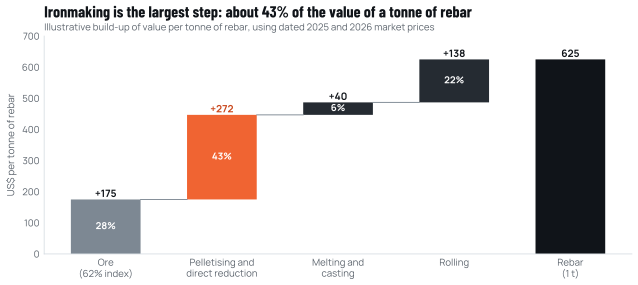
Source: Cameroon Steel calculation from [G31], [N03], [G34], RC-1 yields [F01] and pellet ratio [N01]; method in Annex A. Status: illustrative.
The shares move with prices, but the ranking does not. Table 8.2 recalculates the build-up under two alternative cases: a low iron-unit case, with Russian HBI at US$330/t and ore at US$97/t, and a high billet case, with billets valued at the delivered ex-CIS price into Türkiye of US$520/t. In every case, ore and ironmaking together account for 64 to 72% of the value of a tonne of rebar, while melting and rolling together account for 28 to 36%.
Table 8.2 Value per tonne of rebar by step under three price cases (US$ and share of US$625)
| Step | Central case | Low iron-unit case | High billet case |
|---|---|---|---|
| Ore (1.75 t) | 175 (28%) | 170 (27%) | 175 (28%) |
| Pelletising and direct reduction | 272 (43%) | 229 (37%) | 272 (43%) |
| Melting and casting | 40 (6%) | 88 (14%) | 95 (15%) |
| Rolling | 138 (22%) | 138 (22%) | 83 (13%) |
| Ore and ironmaking together | 447 (72%) | 399 (64%) | 447 (72%) |
| Melting and rolling together | 178 (28%) | 226 (36%) | 178 (28%) |
Source: Cameroon Steel calculation; inputs in Table 8.1 and Annex A. Shares may not add to 100% because of rounding. Status: illustrative.
The melting step deserves comment, because it is the step that a first-phase melt shop captures. On imported iron units at international prices it is thin: billets made from HBI at US$370 are worth only about US$40 more per tonne of rebar than the HBI itself, and billets made from scrap bought at the Turkish import price of US$403/t [G34] would be worth almost exactly what the scrap cost. That is why Chinese billets at US$465 to 470/t FOB, a product of overcapacity [G16], are hard to beat with imported feed. A Cameroonian melt shop earns its place in three other ways: by avoiding billet freight and paying duty only on the metallic charge rather than on the billet, since imported scrap, DRI and HBI carry the same 10% as billets [P24]; by gaining access, over time, to cheaper local iron units, first local scrap and later local DRI; and by giving the country the furnace that local iron units need. The melt shop is the door to the ironmaking prize, not the prize itself. White paper 09 (Chapter 7) tests a Kribi melt shop on imported iron units against delivered imports in detail, and White paper 04 (Chapter 8) sets out the series’ indicative comparison of the cost of a Kribi billet with a delivered import; this chapter does not restate their cost ranges.
8.3 What Cameroon captures today, and under each configuration
Applying the three price cases to the configurations of Chapter 6 gives the share of the gross price build-up of a tonne of rebar that occurs in Cameroon (Figure ES.1 in the executive summary):
- today, with imported billets re-rolled in Douala, about 22%, or 13 to 22% across the price cases;
- with a melt shop on imported iron units (Phase 1), about 28%, or 28 to 36%;
- with direct reduction on imported pellets, about 72% (72 to 73%), less the pellet premium that would accrue abroad;
- with the full chain from Cameroonian DR-grade ore, the whole gross spread by construction and, in practice, most of it once imported electrodes, alloys, refractories, spares and the foreign capital charge are deducted.
These shares measure where the gross price build-up occurs, not value added: each also contains imported consumables and services, and the capital charge of foreign-financed plant, which a national-accounts measure would deduct.
Today’s figure understates what Cameroonian mills earn, because the domestic rebar price is protected. In October 2023 the homologated Douala price of a 12 mm FE500 bar implied about 633,000 FCFA/t, roughly €965/t [C44], when Turkish rebar was offered for export at US$550 to 575/t FOB [G37]. That premium is paid by Cameroonian builders and households through the import ban; it is a transfer within the economy rather than value created by the chain. A phased chain should aim to earn its margin from making iron, not from the ban.
A second way to see the prize is to follow one tonne of DR-grade concentrate (Figure 8.2). Sold as ore at the 62% Fe index, it would fetch about US$100. Turned into DRI, at 1.45 t of pellets per tonne of DRI, it yields products worth about US$255; as billets, about US$278; as rebar, about US$357, roughly 3.6 times its value as ore.
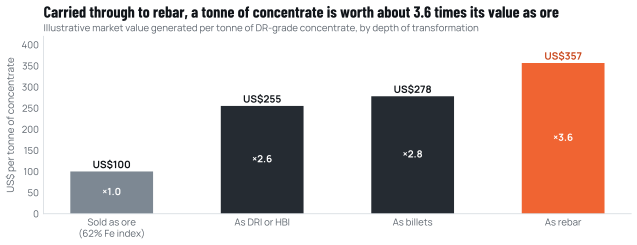
Source: Cameroon Steel calculation from [G31], [N03], [G34], [F01], [N01]. Status: illustrative.
At the scale of RC-1’s DR module, the numbers become national. A 1 Mtpa DRI module would use about 1.45 Mtpa of DR-grade concentrate. Sold as ore at US$100/t, that concentrate would earn about US$145 m a year. Reduced to DRI, it would become about US$370 m of iron units; melted and rolled, about 0.83 Mt of finished long products worth about US$517 m at the central rebar price. The difference, about US$370 m a year of additional gross output, is what local transformation of a single DR module’s worth of ore can add to the economy before costs. It is not profit, and it requires capital, energy and labour to earn; but it is the order of magnitude that should inform the design of the 15% rule.
8.4 Foreign exchange: the case rests on local iron units
Steel is a large item in Cameroon’s external accounts. Chapter 72 imports cost 170.1 bn FCFA, about €259 m, in 2025, and chapters 72 and 73 together accounted for 13.0% of the trade deficit [C05]. Billets alone were about 161 kt in 2023 [C06]; at the October 2026 Chinese export price of about US$467.5/t they would be worth about US$75 m, although Comtrade’s declared value was about twice that [C06][G34].
The foreign-exchange effect of each step differs sharply.
- A melt shop on imported iron units saves the foreign exchange spent on billets but spends most of it again on HBI and imported scrap. Per tonne of rebar, imported iron units cost about US$447 against about US$487 for the billets they replace; the net saving is the melting increment, the avoided freight on billets and the domestic electricity, labour and services used in melting.
- Direct reduction on Cameroonian concentrate saves almost all of that US$447 per tonne of rebar, since ore, gas and electricity are domestic. This is where the foreign-exchange case for local ironmaking lies.
- Merchant billets reduce the import bill directly only where they replace imported billets in the re-rollers’ charge, about 60% of it today [C38]; billets rolled into more domestic rebar displace domestic production rather than imports.
- Exports add foreign exchange. At full RC-1 capacity of 1 Mtpa, output would exceed Cameroon’s total chapter 72 imports of 412 kt more than twice over [C05], so more than half of the output would be sold abroad. As an illustration only, 0.5 Mtpa sold at the October 2026 Turkish rebar price of US$620 to 630/t FOB would be worth about US$310 to 315 m a year [G34]; realised prices in CEMAC markets would differ.
White paper 09 reaches the same conclusion with a fuller accounting of imported content, including electrodes, alloys, refractories and spares. On imported scrap and HBI, a Kribi works would retain about US$47 to 181 of foreign exchange per tonne of rebar, against US$48 to 170 for today’s re-rolling of imported billets, and about US$545 to 645 with domestic iron units (White paper 09, Chapter 9). Phase 1 on imported iron units therefore saves about what the re-rollers already save; the large saving comes only with domestic iron.
Domestic gas and power also change the balance. At 2025 Cameroonian prices, the gas for a tonne of DRI would cost about US$29 to 51 (Annex A) [E04], paid to domestic producers rather than to foreign suppliers of HBI or billets.
8.5 Jobs and industrial value added
RC-1 indicates about 500 direct jobs (450 to 550) and about 1,000 indirect jobs (800 to 1,500) for Phase 1, and about 1,100 direct jobs (900 to 1,300) at the full capacity of 1 Mtpa, before any DR module [F01]. These figures sit within the range of comparable plants. Prometal reports about 1,000 direct jobs for about 360 kt/yr of finished steel [C25]; Kenya’s ore-based Devki plant at Kwale, 500 kt/yr, reported 2,500 direct and 9,000 indirect jobs at its opening [A23]; and US micro-mills of about 0.39 to 0.45 Mtpa (430,000 to 500,000 tons as announced, read as US short tons, the unit of Commercial Metals Company’s reports) employ about 200 to 230 people [T20][T23].
Indirect employment depends on the depth of local supply chains. Global evidence suggests that every two jobs in steel support thirteen in its supply chain [P01], and the European steel industry reports Type I and Type II employment multipliers of 6.2 and 8.6 [P02]. Applied to Cameroon these are upper bounds, because local suppliers of refractories, spare parts, engineering and logistics are thinner than in Europe. The Mining Code’s rule that 95% of non-skilled mining jobs go to Cameroonians [O36] and the investment ordinance’s job criterion [Z39] point in the same direction: local transformation is also a strategy for skilled industrial employment.
At the macroeconomic level, manufacturing accounted for about 13.3% of GDP in 2025 [C09] against the SND30 target of 25% by 2030 [P13]. Few single projects can move that ratio; an ore-to-steel chain at the scale of 1 Mtpa is one of them.
8.6 What the economics imply for policy and investment
Four conclusions follow.
- The value is upstream. Ore and ironmaking hold about two-thirds or more of a tonne of rebar’s market value under every price case tested. Policies that protect only rolling protect a minor share of the chain.
- A melt shop is necessary but not sufficient. On imported iron units it captures a modest increment; its strategic value is as the outlet without which local DRI has no buyer.
- The 15% rule should be judged by the iron it creates. One DR module’s worth of concentrate is worth about US$145 m a year as ore and about US$517 m as finished long products. A rule satisfied by crushing ore would capture none of that difference.
- Foreign exchange follows iron units. The large and durable saving comes when ore, gas and power are domestic and only the steel crosses the border.
Other sources cited in the English text
- G32Pink Sheet, October 2026. World Bank, 2 Oct 2026.thedocs.worldbank.org/en/doc/74e8be41ceb20fa0da750cda2f6b9e4e-00500120…
- G33Commodity Markets Outlook April 2026, Forecasts (Table 1). World Bank, Apr 2026.thedocs.worldbank.org/en/doc/f3138644a1e8e2bb631399ae11d6c408-00500120…
- N04Prices for Brazilian pig iron stabilised at $475 per tonne in August. GMK Center, 7 Sep 2026.gmk.center/en/news/prices-for-brazilian-pig-iron-stabilised-at-475-per…
- C44Fer à béton: les producteurs acceptent une baisse des prix. EcoMatin, 23 Oct 2023.ecomatin.net/fer-a-beton-les-producteurs-acceptent-une-baisse-des-prix
- N16Launch of DR-grade iron ore pellet premium weekly indicator. Fastmarkets, 1 Dec 2022.fastmarkets.com/insights/launch-of-dr-grade-iron-ore-pellet-premium-we…
- G16OECD: global steel excess capacity set to reach 745 million mt by 2028. EUROMETAL (Platts), 5 Jun 2026.eurometal.net/oecd-global-steel-excess-capacity-set-to-reach-745-milli…
- G37Weekly steel prices (archive 23160). AISU, 22 Oct 2023.aisusteel.org/en/archives/23160
- C05Évolution du commerce extérieur en 2025 (version provisoire). INS Cameroun, Feb 2026 (posted 1 Apr 2026).ins-cameroun.cm/wp-content/uploads/2026/04/Note-sur-le-commerce-exteri…
- C06UN Comtrade public API, Cameroon (reporter 120), HS 72/73 and 6-digit lines, 2019-2023. UN Statistics Division.comtradeapi.un.org/public/v1/preview/C/A/HS?reporterCode=120&period=20…
- C38Cameroun: le groupe Prometal décroche 26 milliards FCFA auprès d’Afreximbank…. Sikafinance, 30 Sep 2026.sikafinance.com/marches/cameroun-le-groupe-prometal-decroche-26-millia…
- E04Données pétrolières 2025. SNH, posted Jun 2026.snh.cm/wp-content/uploads/2026/06/Donnees-petrolieres-2025.pdf
- C25Prometal inaugure deux usines évaluées à 57 milliards F. Journal du Cameroun, 19 Jan 2024.fr.journalducameroun.com/prometal-inaugure-deux-usines-evaluees-a-57-m…
- A23Devki opens Sh50bn steel plant in Kwale. Capital FM Kenya, 20 Nov 2022.capitalfm.africa/devki-opens-sh50bn-steel-plant-in-kwale/
- T20Nucor to build new rebar micro mill in North Carolina. Nucor Corp., 7 Apr 2022.nucor.com/news-release/nucor-to-build-new-rebar-micro-mill-in-north-ca…
- T23Rebar manufacturing facility coming to Eastern Panhandle. West Virginia Public Broadcasting, 8 Dec 2022.wvpublic.org/story/economy/rebar-manufacturing-facility-coming-to-east…
- P01Economic and social impact of the global steel industry (infographic). worldsteel / Oxford Economics, May 2019.worldsteel.org/wp-content/uploads/Steel-social-and-economic-impact.pdf
- P02European Steel in Figures 2025. EUROFER, Jun 2025.eurofer.eu/assets/publications/brochures-booklets-and-factsheets/europ…
- O36Mining 2026, Cameroon (Chazai Wamba). Chambers Global Practice Guides, updated 27 Jan 2026.practiceguides.chambers.com/practice-guides/mining-2026/cameroon
- Z39Ordonnance n° 2025/002 du 18 juillet 2025 fixant les incitations à l’investissement. Presidency (copy on GECAM), 18 Jul 2025.legecam.cm/wp-content/uploads/2025/08/ordonnance_n_2025_002_du_18_07_2…
- C09Les Comptes Nationaux de 2025. INS Cameroun, Aug 2026 (posted 2 Sep 2026).ins-cameroun.cm/wp-content/uploads/2026/09/Comptes_Nationaux_2025_FR_V…
- P13Stratégie Nationale de Développement 2020-2030 (SND30). Republic of Cameroon / MINEPAT (hosted by FAOLEX), 2020.faolex.fao.org/docs/pdf/cmr211554.pdf
本章引用的资料来源
方括号内的标记对应以下来源(按原文语言列出),完整列表见附录。 完整来源列表
- G31Commodity Markets Outlook, Historical Data, Annual (xlsx). World Bank,2026年9月2日.thedocs.worldbank.org/en/doc/74e8be41ceb20fa0da750cda2f6b9e4e-00500120…
- N03BPI and HBI prices on the rise in Europe. SteelOrbis,2026年1月23日.steelorbis.com/steel-prices/steel-prices-market-analyses/scrap-and-raw…
- G34Weekly steel prices (archive 40468). Arab Iron & Steel Union (AISU),2026年10月3日.aisusteel.org/en/archives/40468
- P24WITS TRAINS API, Cameroon reported MFN tariffs by HS6 (2023). World Bank / UNCTAD.wits.worldbank.org/API/V1/SDMX/V21/datasource/TRN/reporter/120/partner…
- F01Cameroon Steel reference configuration RC-1 (planning estimate), edition 10 October 2026 (RC-1.1). Cameroon Steel,2026年10月10日.按标题和日期引用
- N01Iron ore supply for direct reduction: outlook and challenges (J. Atherton), Arab Steel Summit presentation. International Iron Metallics Association (IIMA),2024年10月.2024.aisusteel.org/wp-content/uploads/2024/10/Dr-John-Atherton_IIMA.pd…
引用本章
Cameroon Steel(2026)。从矿石到钢铁:喀麦隆缺失的环节是炼铁,而非轧钢(中文摘要版)。白皮书01,第8章:炼铁是最大价值所在,炼钢厂是通向它的大门。CS-WP-01。https://www.cameroon-steel.com/zh/library/ore-to-steel/economics-value-capture/
来源