白皮书01 · 第5章 · 中文摘要
政策已要求本地转化,但尚未使其具备融资可行性
喀麦隆的政策框架已从保护轧钢厂转向要求每座矿山将部分产量在国内转化。法律、采矿协议和总理府的专门机构已指向同一目标;仍然缺少的,是把义务变成可融资供应合同的配套机制。
本页为本章中文摘要;英文全文附于其后,可展开阅读。
2023年《矿业法》第40条第4款要求每份采矿协议将至少15%的产量用于本地转化[Z42];克里比-洛贝和姆巴拉姆(Mbalam)的采矿协议已含15%条款[O33][O17];2025年12月,总理府设立矿业与冶金一体化战略委员会,负责组织向本地钢厂可靠供应铁矿石并监督执行[Z79][Z80]。按15%计算,姆巴拉姆公路阶段可供150万吨/年,铁路阶段可供375万吨/年[O25]。
然而,公开文本尚未回答五个问题:何为转化,破碎筛分是否算数;需要何种品位;以何种价格,最简便的是出口平价;何时交付;在何地交付。含铁62%的直运矿不能直接供给直接还原厂,义务若可通过破碎完成,就不会产出任何铁。
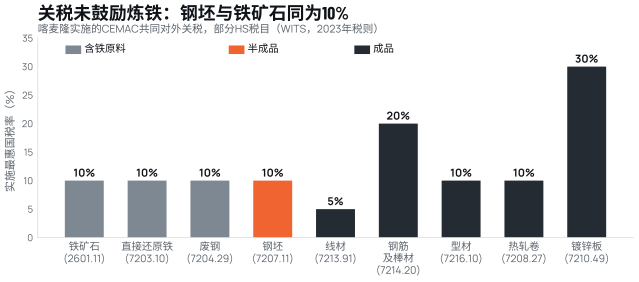
关税同样未鼓励炼铁:钢坯与铁矿石、直接还原铁和废钢同为10%,钢筋为20%,线材仅为5%[P24];2016年起实施的钢筋进口禁令保护的恰恰是最饱和的环节[C20][C21],钢铁领域也没有任何贸易救济措施实践。能源政策是最薄弱的一环:尚未向克里比港综合工业区公开分配天然气,10兆瓦以上用电也没有监管电价[E15]。财政空间有限[P32],因此最有价值的下一步是低成本的实施文本:按深度界定转化,按出口平价为本地供应定价,并将15%义务与DR级精矿挂钩。
英文全文 10分钟 · 2360词Policy now requires local transformation; it does not yet make it bankable
Cameroon’s policy framework has moved from protecting rolling mills to requiring that part of each mine’s output be transformed at home. The 2023 Mining Code sets a minimum of 15% for local transformation, two major conventions already contain the clause, and a committee at the Prime Minister’s office now has the mandate to enforce it. What is still missing is the machinery that turns an obligation into a bankable supply contract: a definition of transformation, a grade and pricing rule, a tariff structure that rewards ironmaking, and an allocation of gas and power.
5.1 Four layers of policy now point the same way
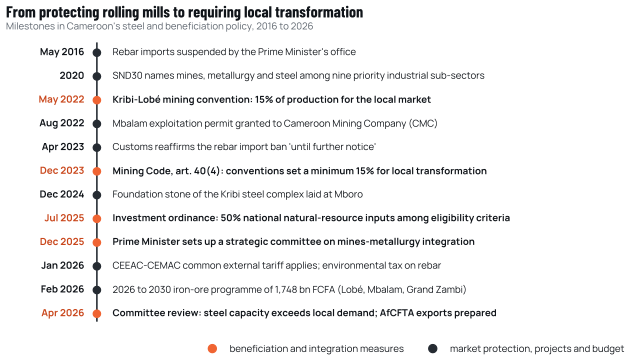
Local beneficiation policy in Cameroon is not one instrument but four layers, built up over a decade (Figure 5.1).
Source: [C20], [P13], [O33], [Z69], [C21], [Z42], [X01], [Z39], [Z79], [P23], [P19], [O29], [Z80].
Strategy. The National Development Strategy 2020 to 2030 (SND30) names "mines, metallurgy and steel" among nine priority industrial sub-sectors and adopts the doctrine of accelerating import substitution while densifying exports [P13]. It targets manufacturing value added of 25% of GDP by 2030 [P13], against about 13.3% in 2025 on national-accounts data [C09]. The earlier Industrialisation Master Plan (PDI) aimed to raise industry from 13% to 24% of GDP by 2035, with particular emphasis on metallurgy and steel, and was being revised in late 2024 [P14][P15]. SND30 says little about ore beneficiation as such and cites iron among the projects of earlier decades that did not materialise [P13].
Law. The Mining Code, Law No. 2023/014 of 19 December 2023, replaced the 2016 Code [O52][O36]. Its article 40(4) requires every mining convention to set out how production will be made available for local transformation, at a minimum rate of 15% [Z42]. The Code also gives the State a free carried interest of 10% in industrial mines, with an option to take up to 25% more (art. 47), and sets production-sharing ranges of 2 to 15% for non-precious substances (art. 48) [Z42]. Its local-content provisions reserve 95% of non-skilled jobs for Cameroonians (art. 124), give priority to Cameroonian subcontractors (art. 125) and require skills and technology transfer (art. 126) [O36]. Implementing decrees followed in November 2024 [O36].
Contracts. The Code codifies a practice that already existed in conventions. The Kribi-Lobé convention of May 2022 reserves 15% of production for the local market [O33][O34]. The Mbalam convention, as described by Cameroon Mining Company, authorises CMC to mine the deposit "while locally transforming 15% of its production"; the same source presents Cameroon Steel as the future national steel hub of the programme, without saying that the convention names the company [O17]. The terms of the Bipindi-Grand Zambi investment agreement on local supply were not found in public sources [O37].
Institutions and incentives. On 10 December 2025 the Prime Minister set up a strategic committee on mines-metallurgy integration, chaired by Dr Tang Ahanda Barnabé, special adviser to the Prime Minister [Z79][Z80]. Its mandate includes a reliable iron-ore supply chain for local steelmakers, enforcement of the Mining Code’s local-processing requirements and protection of domestic industry [Z79][Z80]. Its review of the metals industry in April 2026 found domestic capacity in excess of local demand and began preparing steel exports under the African Continental Free Trade Area (AfCFTA) [Z79][Z80]. In parallel, Ordinance No. 2025/002 of 18 July 2025, ratified by Law No. 2025/015 of 17 December 2025, replaced the 2013 investment-incentives law [Z39][Z40][Z41]. New projects must meet at least two eligibility criteria, among them one direct job per 50 m FCFA invested and, for industrial projects, at least 50% of inputs drawn from national natural resources; projects in economic zones receive an operating phase extended to seven years; and investors must present a local-skills and technology-transfer programme and evidence of financing [Z39].
5.2 What the 15% rule settles, and what it leaves open
Article 40(4) settles the principle and the floor. It establishes that a share of every convention’s output must be available for local transformation and that the share cannot be lower than 15% [Z42]. For the projects now starting, the volumes are significant (Chapter 6): 15% of Mbalam’s planned road phase of up to 10 Mtpa is 1.5 Mtpa; 15% of its rail phase of 25 Mtpa is 3.75 Mtpa [O25]; 15% of Lobé’s planned concentrate output is 0.6 Mtpa at 4 Mtpa in 2028 and 1.2 Mtpa at 8 Mtpa in 2031 [O35].
What the rule does not settle, at least in the public texts, is how that ore reaches a local processor. Five questions remain open.
- What counts as transformation? Crushing and screening, concentration, pelletising, direct reduction and steelmaking all transform ore, but they add very different value. If crushing counts, the obligation can be met at the mine gate without creating any iron.
- What grade? Fifteen per cent of a direct-shipping ore stream at 62% Fe is not a feed for a direct-reduction plant (Chapter 2). The rule says nothing about whether the miner must supply a concentrate of a given grade or simply a share of what it produces.
- At what price? A local buyer paying the full seaborne price gains only the freight saving; a buyer paying a regulated discount transfers value from the miner and, through royalties and the State’s equity, from the Treasury. The rule needs a reference price, most simply export parity, that is, the seaborne index adjusted for grade and less the freight and port costs the miner avoids.
- When? If the local processor is not ready, does the obligation lapse, accumulate or convert into a payment? Without a timing rule, a miner may reasonably argue that no buyer exists.
- Where and how? Delivery at the mine, at a rail siding or at the Kribi terminal implies different logistics costs and responsibilities.
The Guinea precedent described in Chapter 4 shows how such questions can be answered in a convention: a specific facility (a 2 Mtpa pellet plant or a 0.5 Mtpa steel mill), a deadline (a feasibility study within two years of first production) and a reviewing authority [N09].
5.3 Tariffs and trade rules do not yet reward ironmaking
Cameroon’s external tariff protects finished products more than inputs, but it does not distinguish between raw ore and semi-finished steel. Under the CEMAC common external tariff as applied in 2023, iron ore, direct-reduced iron, ferrous scrap and billets all carry a 10% duty, as do sections and hot-rolled coil; rebar carries 20%, galvanised sheet 30%, and wire rod only 5% [P24]. A billet melted in Cameroon competes against an imported billet that pays the same duty as the iron ore it might have been made from.
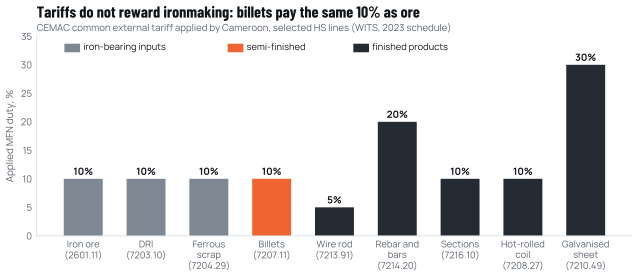
Source: World Bank WITS, Cameroon reported MFN tariffs by HS line, 2023 [P24]. The new CEEAC-CEMAC tariff applies from 1 January 2026; its steel-line rates were not published at the cut-off date [P23].
Several features of the trade regime create room for adjustment. Cameroon’s WTO bindings cover only 0.2% of non-agricultural tariff lines, so steel duties are effectively unbound and can legally be adjusted [P26]. A new CEEAC-CEMAC common external tariff applies from 1 January 2026, with bands reported as 0, 5, 10, 20 and 40%; its steel lines were not yet public at the cut-off date [P23]. The Finance Law for 2025 introduced a "national preference" under which imported goods that have locally made equivalents lose customs facilities, with exceptions for goods under the economic partnership agreements with the EU and UK, AfCFTA, CEMAC and CEEAC [P18].
Other instruments protect the step that least needs protection. The 2016 rebar import ban, still in force [C20][C21][C34], shields the most saturated product. Price homologation caps what local mills can charge for rebar [C44]. The environmental tax introduced in 2026, 5,000 FCFA per tonne of reinforcing bar (fer à béton), applies equally to local producers and importers [P19]. And Cameroon has no trade-remedy practice in steel, while 62 countries had adopted 207 measures against Chinese steel by October 2025 [G30] and neighbours such as Egypt protect billets explicitly [A07].
Regional rules matter for exports. Cameroon ratified the AfCFTA agreement on 31 January 2020 and deposited its instrument on 1 December 2020 [P27]. The rules of origin that will apply to chapter 72 products, for example whether a billet melted from imported DRI qualifies as Cameroonian, were not verified for this paper [P31]. The answer will decide whether a phased chain that begins on imported iron units can export into the continental market.
5.4 Energy policy is the missing layer
A steel chain that reaches back to direct reduction needs natural gas and firm power, and here the policy framework is thinnest.
Gas. In 2025 Cameroon produced 75.5 bcf of natural gas, about 98.5% of it from the Sanaga Sud field off Kribi; about 95% was sold as feed to the Hilli Episeyo floating liquefaction vessel [E04]. The vessel left Cameroon in July 2026 for a new charter in Argentina [E08][E09]. Gas sold in 2025 to the Kribi power plant cost about 1,830 FCFA per thousand cubic feet (Mscf), roughly US$3.2, and gas sold to an industrial buyer 3,135 FCFA/Mscf, roughly US$5.6 [E04]. A tax of 70 FCFA per cubic metre on natural gas has applied since 2023; whether it would apply to gas used as a reductant was not established [E11]. No allocation of gas to the Kribi industrial zone in a published master plan was found.
Power. No regulated tariff exists above 10 MW: large industrial users contract bilaterally at high voltage. The six legacy high-voltage customers paid an average of 18.4 FCFA/kWh in 2025, the published band for 9 to 10 MW implies about 44 FCFA/kWh in 2026, and the regulator’s cost-reflective average is 105.46 FCFA/kWh [E15][E17][E37]. Chapter 7 discusses supply at Kribi.
5.5 Fiscal room is limited, so incentives must be targeted
Cameroon’s fiscal position constrains what the State can offer. The IMF rates the country at high overall risk of debt distress [P32], noted fiscal slippage in 2025 [P09], and CEMAC foreign reserves fell to 4.2 months of imports at the end of 2025 [P07]. Open-ended tax exemptions will be scrutinised, and the State’s own resources are already committed to the 1,748 bn FCFA iron-ore programme [O29]. Cameroon’s suspension from the Extractive Industries Transparency Initiative in February 2024, with a validation score of 53, adds a governance argument for transparent, rules-based beneficiation terms [O52].
This argues for instruments that cost the budget little: clear offtake rules, a tariff structure that rewards ironmaking, trade-remedy capacity, and long-term energy contracts, rather than large subsidies.
Table 5.1 Instruments relevant to local transformation of iron ore: status, gaps and possible complements
| Instrument | Status | What it does | Gap | Possible complement |
|---|---|---|---|---|
| Mining Code, art. 40(4) | In force since Dec 2023 [Z42] | Minimum 15% of output for local transformation | No definition, grade, price or timing in public texts | Implementing text on definition, export-parity price, delivery and timing |
| Mining conventions (Lobé, Mbalam) | Signed 2022 [O33][O17] | 15% for local market or local transformation | Terms not public | Publish offtake terms; align with the Code |
| PM’s mines-metallurgy committee | Created Dec 2025 [Z79] | Organises ore supply to steelmakers; enforcement | No published work programme | Annual public report on 15% compliance |
| Investment ordinance 2025/002 | In force [Z39] | Rewards national resource inputs and jobs | Incentive value for ironmaking not differentiated | Higher tier for ironmaking from national ore |
| CEMAC common external tariff | 10% on ore, DRI, billets; 20% on rebar [P24] | Protects finished products | No escalation from ore to semis | Review billet and section lines in the new CET |
| Rebar import ban | Since 2016 [C20][C21] | Protects rebar rolling | Protects the saturated step only | Phase into a tariff and quality regime over time |
| National preference (Finance Law 2025) | In force [P18] | Removes customs facilities for imports with local equivalents | Coverage of semis unclear | Apply explicitly to billets made locally |
| Trade remedies | None in steel | n/a | No anti-dumping or safeguard practice | Build investigating capacity |
| Gas allocation and pricing | No published allocation to Kribi zone | n/a | Reserves and price for a DRI plant unknown | Reserve audit and long-term supply contract |
| Electricity above 10 MW | Bilateral only [E15] | n/a | No reference tariff for heavy industry | Published framework for high-voltage industrial contracts |
Source: Cameroon Steel analysis of the sources shown.
5.6 From obligation to bankable supply
The direction of policy is right and consistent with the experience of other producers (Chapter 4). The 15% floor gives local transformation a legal basis that few African ore producers have; the mines-metallurgy committee gives it an owner; the investment ordinance rewards the use of national resources. To become bankable, that is, to support a lender’s decision to finance a pellet plant or a DR module, the obligation must become a contract that specifies grade, price, volume, timing and delivery, backed by tariff and energy policies that make ironmaking competitive with imported billets. Chapter 10 sets out a short list of measures to that end.
Other sources cited in the English text
- P13Stratégie Nationale de Développement 2020-2030 (SND30). Republic of Cameroon / MINEPAT (hosted by FAOLEX), 2020.faolex.fao.org/docs/pdf/cmr211554.pdf
- Z69Cameroon initiates Mbalam iron ore mine construction amidst funding uncertainty. Business in Cameroon, 21 Dec 2023.businessincameroon.com/mining/2112-13576-cameroon-initiates-mbalam-iro…
- X01Kribi: le Premier ministre, chef du gouvernement est là. Cameroon Tribune, 30 Dec 2024.cameroon-tribune.cm/article.html/68499/fr.html/details_2
- Z39Ordonnance n° 2025/002 du 18 juillet 2025 fixant les incitations à l’investissement. Presidency (copy on GECAM), 18 Jul 2025.legecam.cm/wp-content/uploads/2025/08/ordonnance_n_2025_002_du_18_07_2…
- P19Cameroon, Republic of: Corporate, Other taxes. PwC Worldwide Tax Summaries, reviewed 14 Aug 2026.taxsummaries.pwc.com/republic-of-cameroon/corporate/other-taxes
- O29Cameroon plans $3.1B iron ore push starting 2026. Daba Finance (republished by AllAfrica), 14 Feb 2026.dabafinance.com/en/news/cameroon-mining-investment-2026-2030
- C09Les Comptes Nationaux de 2025. INS Cameroun, Aug 2026 (posted 2 Sep 2026).ins-cameroun.cm/wp-content/uploads/2026/09/Comptes_Nationaux_2025_FR_V…
- P14Le Cameroun se dote d’un nouveau Plan directeur d’industrialisation. Le360 Afrique, 4 Apr 2017.afrique.le360.ma/autres-pays/economie/2017/04/04/10804-le-cameroun-se-…
- P15« Des actions concrètes pour renforcer les infrastructures industrielles » (MINMIDT). Cameroon Tribune, 1 Nov 2024.cameroon-tribune.cm/article.html/67712/fr.html/details_2
- O52Cameroon, country page (Validation, reports, Mining Code reference). EITI International Secretariat.eiti.org/countries/cameroon
- O36Mining 2026, Cameroon (Chazai Wamba). Chambers Global Practice Guides, updated 27 Jan 2026.practiceguides.chambers.com/practice-guides/mining-2026/cameroon
- O34Le Cameroun signe avec une société chinoise une convention minière de plus de 700 millions de dollars. Le360 Afrique (MAP), 7 May 2022.afrique.le360.ma/autres-pays/economie/2022/05/07/37953-le-cameroun-sig…
- O37Grand Zambi iron ore: G-Stones reportedly ready to start exploitation in the next few months. Business in Cameroon, 30 Aug 2023.businessincameroon.com/mining/3008-13380-grand-zambi-iron-ore-g-stones…
- Z40L’API lance la sensibilisation autour de l’ordonnance de 2025…. Droit Médias Finance, 13 May 2026.droitmediasfinance.com/index.php/actualites/droit-ohada-affaires/1260-…
- Z41Investing In… 2026: Cameroon. Chambers & Partners, 2026.gpg-pdf.chambers.com/investing-in-2026/107/
- O35Sinosteel reporte les exportations du fer de Kribi-Lobé à 2027 malgré 120 milliards FCFA déjà investis. EcoMatin, 11 Mar 2026.ecomatin.net/cameroun-sinosteel-reporte-les-exportations-du-fer-de-kri…
- N09Guinea takes first step toward processing Simandou iron ore at home. Ecofin Agency, 19 Jun 2026.ecofinagency.com/news-industry/1906-56609-guinea-takes-first-step-towa…
- P26Tariff profile: Cameroon. WTO, n.d..wto.org/english/res_e/statis_e/daily_update_e/tariff_profiles/CM_e.pdf
- P18Innovations douanières de la Loi de Finances 2025. MINFI, Direction Générale des Douanes, Jan 2025.minfi.gov.cm/wp-content/uploads/2025/01/EXPOSE_DGD_LF_2025.pdf
- C34Cameroon rejects fresh push to revise rebar standard. Business in Cameroon, 26 Jan 2026.businessincameroon.com/construction/2601-15657-cameroon-rejects-fresh-…
- C44Fer à béton: les producteurs acceptent une baisse des prix. EcoMatin, 23 Oct 2023.ecomatin.net/fer-a-beton-les-producteurs-acceptent-une-baisse-des-prix
- G3062 countries implemented 207 restrictions against steel products from China. GMK Center, 13 Oct 2025.gmk.center/en/infographic/62-countries-implemented-207-restrictions-ag…
- A07Egypt’s steel industry: protection from within. GMK Center, 23 Jul 2026.gmk.center/en/posts/egypt-s-steel-industry-protection-from-within/
- P27List of countries which have signed, ratified/acceded to the AfCFTA Agreement. African Union Commission, 22 May 2026.au.int/sites/default/files/treaties/36437-sl-AGREEMENT_ESTABLISHING_TH…
- P31AfCFTA e-Tariff Book. AfCFTA Secretariat, n.d..au-afcfta.org/etariff/
- E04Données pétrolières 2025. SNH, posted Jun 2026.snh.cm/wp-content/uploads/2026/06/Donnees-petrolieres-2025.pdf
- E08Golar, partners approve first vessel in Argentine gas export project. Rigzone, 6 May 2025.rigzone.com/news/golar_partners_approve_first_vessel_in_argentine_gas_…
- E09Le navire usine quitte le Cameroun, le gaz s’arrête. Camer.be, 9 Jul 2026.camer.be/93911/12:1/le-navire-usine-quitte-le-cameroun-le-gaz-sarrete-…
- E11Industrial gas: Cameroon suspends GDC’s 20% price hiking plan. Business in Cameroon, 18 Jul 2023.businessincameroon.com/energy/1807-13291-industrial-gas-cameroon-suspe…
- E17Décision fixant le montant de la RMA ENEO au titre de l’exercice 2025 (réajustée). ARSEL, 19 Dec 2025.arsel-cm.org/wp-content/uploads/2026/01/Decision-fixant-le-Montant-de-…
- E37Tableaux tarifaires, Décision ARSEL N°00000427 (MT 2023-2025). ARSEL, uploaded Jan 2026.arsel-cm.org/wp-content/uploads/2026/01/TABLEAUX-TARIFAIRES-decision-M…
- P09IMF Executive Board concludes 2026 Article IV consultation with Cameroon (PR 26/096). IMF, 30 Mar 2026.imf.org/en/news/articles/2026/03/30/pr-26096-cameroon-imf-executive-bo…
- P07Zone Cémac: la BEAC annonce un ralentissement de croissance à 2,4%. AllAfrica (Les Dépêches de Brazzaville), 17 Dec 2025.fr.allafrica.com/stories/202512170629.html
本章引用的资料来源
方括号内的标记对应以下来源(按原文语言列出),完整列表见附录。 完整来源列表
- Z42Loi n° 2023/014 du 19 décembre 2023 portant Code minier, Article 40(4) (official text, mirror). Rural-info (copy of the official text),2023年12月19日.rural-info.net/wp-content/uploads/2024/11/Loi-N°2023-014-du-19-decembr…
- O33Fer de Lobé: l’État octroie le permis d’exploitation à Sinosteel. EcoMatin,2022年9月7日.ecomatin.net/fer-de-lobe-malgre-des-contestations-letat-octroie-le-per…
- O17Cameroon Mining Company confirme l’entrée du projet Mbalam dans sa phase irréversible d’exécution. Camer.be(经AllAfrica转载),2025年12月12日.fr.allafrica.com/stories/202512120475.html
- Z79Cameroon reviews metals industry to address supply and energy constraints. Business in Cameroon,2026年4月29日.businessincameroon.com/public-management/2904-16094-cameroon-reviews-m…
- Z80Le Cameroun prépare l’exportation de son acier vers les marchés de la ZLECAf. Ecomatin (V. Bagal),2026年4月16日.ecomatin.net/le-cameroun-prepare-lexportation-de-son-acier-vers-les-ma…
- O25Mbalam iron ore mine delays first exports to early 2026. Business in Cameroon,2025年12月13日.businessincameroon.com/public-management/1312-15495-mbalam-iron-ore-mi…
- P24WITS TRAINS API, Cameroon reported MFN tariffs by HS6 (2023). World Bank / UNCTAD.wits.worldbank.org/API/V1/SDMX/V21/datasource/TRN/reporter/120/partner…
- C20Press report of the sealing by customs of more than 7,300 t of imported reinforcing bar, December 2020 (headline and address not reproduced: they name the importer). Business in Cameroon,2020年12月16日.按标题和日期引用
- C21Métallurgie: les importations du fer à béton interdites jusqu’à nouvel ordre. EcoMatin,2023年4月10日.ecomatin.net/metallurgie-les-importations-du-fer-a-beton-interdites-ju…
- E15Rapport d’activités 2025 de l’ARSEL. ARSEL (electricity regulator),2026年9月7日.arsel-cm.org/wp-content/uploads/2026/09/Rapport-ARSEL-2025.pdf
- P32IMF staff concludes Post-Financing Assessment mission to Cameroon (PR 26/314). IMF,2026年10月1日.imf.org/en/news/articles/2026/10/01/pr26314-imf-staff-concludes-assesm…
- P23Cameroon applies CEEAC common external tariff from January 1, 2026. Business in Cameroon,2026年1月12日.businessincameroon.com/public-management/1201-15594-cameroon-applies-c…
引用本章
Cameroon Steel(2026)。从矿石到钢铁:喀麦隆缺失的环节是炼铁,而非轧钢(中文摘要版)。白皮书01,第5章:政策已要求本地转化,但尚未使其具备融资可行性。CS-WP-01。https://www.cameroon-steel.com/zh/library/ore-to-steel/beneficiation-policy/
来源