白皮书01 · 第2章 · 中文摘要
喀麦隆铁矿储量充足,品位决定工艺路线
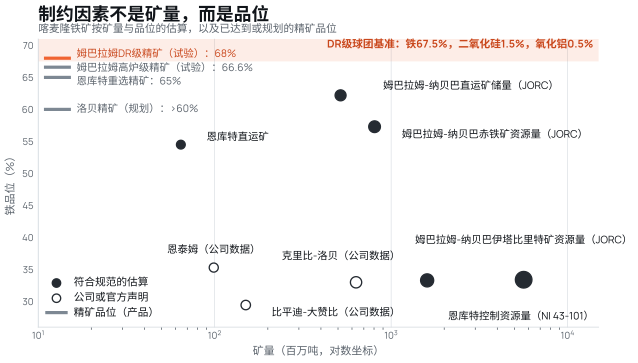
喀麦隆的铁矿资源以数十亿吨计,矿量并不制约本地炼钢,品位才是关键。唯一符合规范的储量是含铁62.2%的直运矿(DSO),适合出口和高炉;气基直接还原所需的含铁67至68%的产品,迄今仅在试验中制得。
本页为本章中文摘要;英文全文附于其后,可展开阅读。
姆巴拉姆(Mbalam)-纳贝巴(Mbalam-Nabeba)是唯一按JORC规范报告储量的矿床:该矿床跨越喀麦隆与刚果(布)边界;截至2015年5月(JORC规范2012年版),概略储量5.17亿吨,含铁62.2%,其中约1.54亿吨位于喀麦隆境内(Mbarga),约3.63亿吨位于刚果(布)境内(Nabeba);其下的条带状含铁石英岩(itabirite,伊塔比里特矿)资源量达56.38亿吨,含铁33.4%,其中39.24亿吨位于喀麦隆境内[O05]。克里比-洛贝磁铁矿6.328亿吨,含铁约33%[O32],其他矿床也多为低品位矿。国家2026至2030年计划投入17480亿中非法郎于三个项目[O29],但各项目进度均曾推迟。
品位决定可行的炼铁路线。高炉通过造渣排出脉石,而气基竖炉在固态下还原,二氧化硅和氧化铝全部留在直接还原铁中。因此竖炉需要DR级球团,价格报告机构的基准为含铁67.5%、二氧化硅1.5%、氧化铝0.5%[N16]。姆巴拉姆直运矿的二氧化硅与氧化铝合计达7.3%[O05],不能作为直接还原原料;2014年试验以伊塔比里特矿制得含铁68%、二氧化硅1.8%、氧化铝0.2%的精矿,质量收得率45%[O04],但从未实现工业化生产。
DR级原料在全球稀缺:商品DR级球团需求可能从2022年的4640万吨增至2033年的1.173亿吨,其中3160万吨/年尚无明确来源[N01]。矿量不成问题:姆巴拉姆公路阶段出口量的15%即为150万吨/年[O25][Z42],而一座100万吨/年的直接还原模块约需145万吨/年球团[N01]。因此,本地转化政策应以品位为目标,而不仅仅以吨位为目标。
英文全文 11分钟 · 2503词Cameroon’s ore is large enough; its grade decides the route
Cameroon’s iron-ore endowment is measured in billions of tonnes and its project pipeline is the world’s fourth largest. Tonnage is therefore not the constraint on local steelmaking. Grade is: the country’s only code-compliant reserve is direct-shipping ore at 62.2% iron, suited to export and blast furnaces, while gas-based direct reduction needs a 67 to 68% iron product that Cameroon has so far made only in testwork.
2.1 An endowment measured in billions of tonnes
The most thoroughly documented iron-ore body in Cameroon is Mbalam-Nabeba, which straddles the border with the Republic of Congo. It is also the only one with a reserve statement prepared under the JORC code, Australia’s standard for public reporting of mineral resources and reserves. As at 20 May 2015, the probable ore reserve, reported under the 2012 edition of the code, stood at 517 Mt at 62.2% Fe, with 4.46% silica, 2.80% alumina and 0.09% phosphorus [O05]. The reserve is split between the Mbarga deposit in Cameroon (134 Mt at 63.1% Fe, plus 19.6 Mt at 61.4% at Mbarga South), about 154 Mt in all, and the Nabeba deposits in Congo (328 Mt at 62.2% Fe, 27.9 Mt at 58.8% at Nabeba North-West and 7.6 Mt at 61.1% at Nabeba South), about 363 Mt [O05].
Beneath the high-grade cap lies a much larger body of lower-grade rock. The same statement reports a high-grade haematite resource of 805.7 Mt at 57.3% Fe and an itabirite resource of 5,638 Mt at 33.4% Fe, of which 3,924 Mt sit at Mbarga in Cameroon [O05]. An exploration target published in 2014 suggested 9.3 to 13.2 billion tonnes at 30 to 40% Fe across the project [O04]. Itabirite is a banded rock of iron oxide and quartz; it is not saleable as mined but can be ground and concentrated to a high-grade product.
Public statements give other figures. Cameroon Tribune, reporting the foundation-stone ceremony of the Kribi steel complex, cited reserves "over 2 billion tonnes", including 517 Mt of direct-shipping ore above 62.3% Fe [X01]; in October 2024 the Minister of Mines referred to "proven reserves of 887 Mt" [O55]. These figures are not code-compliant estimates and this paper uses the JORC figures throughout, labelling other numbers as company or official statements.
Mbalam is one of several deposits in the south of the country, most of them within reach of Kribi:
- Kribi-Lobé, held by Sinosteel Cam SA, a magnetite deposit of 632.8 Mt at about 33% Fe, under a convention signed in May 2022 for 10 Mtpa of run-of-mine ore producing about 4 Mtpa of concentrate at 60% Fe [O32][O34]. The convention reserves 15% of production for the local market, and the exploitation permit followed in 2022 [O33].
- Bipindi-Grand Zambi, held by G-Stones Resources, reported at 150 Mt at 29.45% Fe, with a target of 1.3 Mtpa of concentrate [O38][O40].
- Nkout, near Djoum, with an NI 43-101 estimate (2013) of 1.6 billion tonnes indicated at 33.3% Fe and 0.9 billion tonnes inferred at 30.8%, plus 64.3 Mt of direct-shipping material at 54.5% Fe [O42][O43].
- Ntem, 98.8 Mt at 35.3% Fe on a 2025 company figure [O44], and Ngovayang, where published figures range from 111 Mt to 800 Mt and the exploration licences expired in September 2024 [O49][O50].
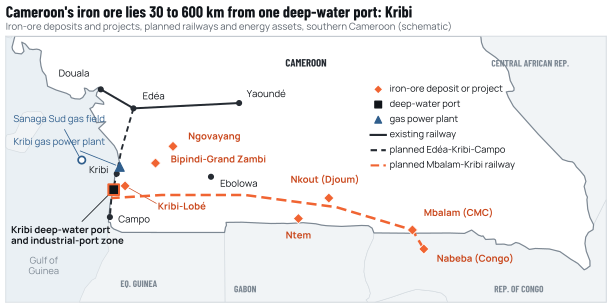
Source: Cameroon Steel, drawn on Natural Earth 1:50m boundaries; deposits from [O05], [O32], [O37], [O42], [O44], [O49]; railways from [O01], [Z45]; Kribi power plant [E24]. Indicative locations; not a survey map.
Table 2.1 Cameroon’s principal iron-ore deposits and projects, as published
| Deposit | Holder | Tonnage and grade | Basis | Status, 2026 |
|---|---|---|---|---|
| Mbalam-Nabeba DSO | CMC (Cameroon); Congo side separate | 517 Mt at 62.2% Fe (154 Mt in Cameroon) | JORC 2012 code, statement of May 2015 [O05] | First export targeted for early 2026, then possibly 2027 [O25][O28] |
| Mbalam-Nabeba itabirite | as above | 5,638 Mt at 33.4% Fe (3,924 Mt in Cameroon) | JORC resource [O05] | DR-grade concentrate in testwork only [O04] |
| Kribi-Lobé | Sinosteel Cam SA | 632.8 Mt at about 33% Fe | Company [O32] | Exports moved to July 2027; concentrate above 60% Fe [O35] |
| Bipindi-Grand Zambi | G-Stones Resources | 150 Mt at 29.45% Fe | Company and official [O38] | Bank financing of 41.2 bn FCFA; BEAC window approved Dec 2025 [O40][O41] |
| Nkout | Investor consortium | 1.6 Bt indicated at 33.3% Fe | NI 43-101, 2013 [O42] | Blocked by an investor dispute; start now 2027 [O47] |
| Ntem | Caminex | 98.8 Mt at 35.3% Fe | Company, 2025 [O44] | Dormant |
| Ngovayang | Camina SA | 111 Mt to 800 Mt, about 35% Fe | Inconsistent [O49][O50] | Licences expired September 2024 |
Source: as shown. Company and official statements are not code-compliant estimates.
The national picture is therefore one of abundance at low grade and a single proven body of high-grade ore. Global Energy Monitor’s 2026 tracker counts 64 Mtpa of iron-ore mine capacity in development in Cameroon, 9% of the global pipeline, which ranks the country fourth, after Australia (179 Mtpa), China (124 Mtpa) and Guinea (120 Mtpa) [G18]. For comparison, the whole of Africa produced 89.2 Mt of iron ore in 2024 and exported 88.3 Mt [G05].
2.2 The 2026 to 2030 programme sets the calendar
The State has committed public resources to three projects. The finance-law annex for 2026 to 2030 carries an iron-ore investment programme of 1,748 bn FCFA, about US$3.1 bn: 747 bn FCFA for Mbalam, 570 bn FCFA for Bipindi-Grand Zambi and 431 bn FCFA for Kribi-Lobé [O29]. Each project has a published calendar that slipped at least once.
Mbalam. Cameroon Mining Company received the Mbalam exploitation permit in August 2022 [Z69] and launched works in December 2023 [O17]. CMC described a processing plant of 3.6 Mtpa rising to 10 Mtpa by 2027 [O17]; the plant was reported 30% complete in December 2025, when first exports were moved to the first quarter of 2026 [O24]. The export plan is in two phases: up to 10 Mtpa by road in 75-tonne-axle trucks between 2026 and 2029, then 25 Mtpa by rail from 2030 to 2050 [O25]. In April 2026 first shipments were "not yet confirmed" [O27], and in May 2026 Cameroon Tribune reported uncertainties that could push the start to 2027 [O28]. The railway corridor is reported at 659 km, 540 km of it in Cameroon, with a cost above US$8 bn [O27]; the 2011 feasibility study had costed a 510 km line from Mbarga to the coast plus a 70 km spur to Nabeba [O01].
Kribi-Lobé. Sinosteel has moved first exports to July 2027, after spending about US$200 m of a US$700 m budget; it plans a 42 MW thermal plant and a ramp-up of concentrate output from 2 Mtpa to 4 Mtpa in 2028 and 8 Mtpa in 2031, at more than 60% Fe [O35].
Bipindi-Grand Zambi. Five banks have backed 41.2 bn FCFA of a 68.7 bn FCFA financing, and the central bank’s special refinancing window was approved in December 2025 [O40][O41]. A first export, targeted for mid-2025, has not been confirmed in the sources reviewed [O38].
Two lessons follow. First, Cameroon’s iron-ore exports are about to begin, after a decade and a half of announcements, and the State has a direct financial stake in their success. Second, the timing is uncertain enough that a downstream steel chain should not be designed to depend on any single mine starting on schedule. Chapter 6 returns to that point.
2.3 Grade decides which ironmaking route is open
Iron ore is sold on its iron content and its impurities. For a steelmaker the critical impurities are silica and alumina, together called gangue, because they do not leave the iron during reduction.
In a blast furnace, gangue melts into a liquid slag fluxed with limestone and is tapped off. The furnace tolerates ores with several per cent of silica and alumina, which is why 62% Fe fines are the world’s benchmark seaborne product [G31].
In a gas-based shaft furnace, the ore is reduced in the solid state. Nothing melts, so every tonne of silica and alumina in the pellet stays in the DRI and must be slagged off later in the electric arc furnace, at the cost of extra electricity, flux and slag. Shaft-furnace operators therefore buy DR-grade pellets. The price reporter Fastmarkets assesses the DR-grade pellet premium on a basis of 67.5% Fe, 1.5% silica and 0.5% alumina, in a market that runs mainly on long-term contracts with quarterly premium settlements [N16].
Measured against that basis, Cameroon’s products fall into three groups:
- Mbalam direct-shipping ore, at 62.2% Fe with 7.3% silica plus alumina [O05], is a good seaborne and blast-furnace product but is not a DR feed.
- The Lobé concentrate planned at more than 60% Fe [O35], the Nkout gravity concentrate at 65% Fe [O42] and the Mbalam blast-furnace concentrate from testwork, at 66.6% Fe with 3.5% silica and 0.3% alumina [O04], sit in between: suited to export, to blast furnaces and to the newer DRI-plus-smelter route, but not to a conventional shaft furnace feeding an EAF.
- The Mbalam DR concentrate produced in testwork, at 68% Fe, 1.8% silica, 0.2% alumina and 0.03% phosphorus [O04], meets the DR basis on iron and total gangue. It was obtained by grinding itabirite to 80% passing 53 micrometres, at a mass yield of 45% and an iron recovery of 81% [O04]. It has never been produced at industrial scale.
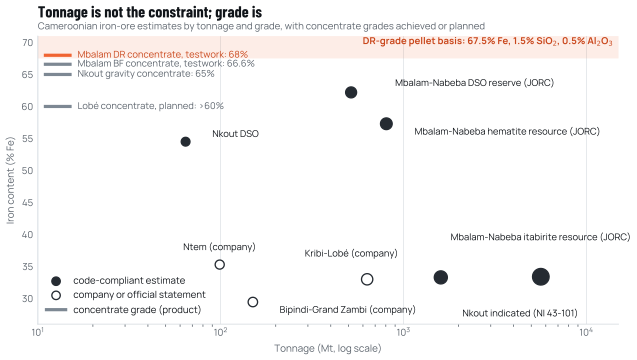
Source: [O05], [O04], [O42], [O32], [O35], [O38], [O44]; DR-grade basis [N16]. The Mbalam-Nabeba points cover both sides of the border: about 154 Mt of the reserve is in Cameroon.
The second route matters because it widens the options. Iron-metallics specialists list the use of blast-furnace pellets in direct reduction, followed by an intermediate electric smelting step between the DR plant and the steel plant, among the responses to the shortage of DR-grade ore [N01]. A smelter melts the DRI, separates the gangue as slag and delivers liquid iron to the steel plant; it tolerates lower-grade feed but adds a process step, capital and electricity. Figure 2.3 summarises, as an analyst assessment, which Cameroonian feeds suit which route.
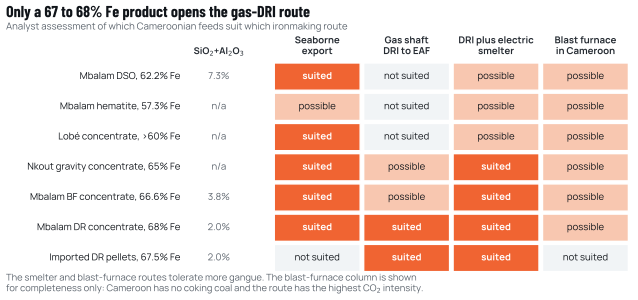
Source: Cameroon Steel assessment from [O05], [O04], [O42], [O35], [N16], [N01], [T02].
The fourth column of the matrix, a blast furnace in Cameroon, is shown only for completeness. The country has no coking coal; a new integrated blast-furnace works costs about US$1.2 bn per million tonnes [T04] and needs multi-million-tonne scale; and the route emits about 2.34 t of CO2 per tonne of crude steel against 1.47 t for DRI-EAF [T01], a gap that the European Union’s carbon border mechanism now prices on exports [D01][D08].
2.4 DR-grade feed is scarce worldwide, which raises its value
If Cameroon can make DR-grade concentrate, it will be entering a tight market. The International Iron Metallics Association (IIMA) estimates that direct-reduction plants using merchant ore needed about 46.4 Mt of DR-grade pellets in 2022, assuming 1.45 t of pellets per tonne of DRI, and that demand could reach 117.3 Mt by 2033 as announced plants come on stream [N01]. Against announced supply additions from the main pellet producers, IIMA’s scenario leaves 31.6 Mtpa of 2033 demand without an identified source [N01].
The Middle East and North Africa illustrate the pressure. Direct-reduction capacity in the region, excluding Iran, was about 33 Mtpa in late 2025 and is expected to grow by 21 to 23 Mtpa within two to three years, to about 55 Mtpa of DRI and HBI; regional DR-pellet demand would then reach 85 to 90 Mtpa, and the market is expected to remain in deficit until 2030 [N02]. The think-tank Agora Industry warned in 2023 that DR-grade ore supply will lag demand by 2030 [D12].
Scarcity cuts both ways. It raises the value of a future Cameroonian DR-grade concentrate, whether used at home or sold to direct-reduction plants abroad. It also means that a Cameroonian DRI plant cannot count on imported DR pellets being cheap or abundant. Either way, the ability to make DR-grade concentrate from Cameroonian itabirite is a strategic asset, and it is the piece of the chain that today exists only on paper.
2.5 What this means for local transformation
Three conclusions shape the rest of this paper.
Volume will not be the problem. Fifteen per cent of Mbalam’s planned road-phase exports of up to 10 Mtpa is 1.5 Mtpa, and 15% of the rail phase’s 25 Mtpa is 3.75 Mtpa [O25][Z42]. A 1 Mtpa direct-reduction module needs about 1.45 Mtpa of pellets [N01]. The quantities line up, but in tonnage only: the DR feed would have to come from itabirite mined and concentrated outside the DSO export stream.
Grade will be. Those 1.5 to 3.75 Mtpa would be direct-shipping ore at about 62% Fe, which cannot feed a shaft furnace without upgrading. Turning the 15% obligation into iron requires a concentrator and pellet plant working on itabirite, of the kind the former holder’s 2011 Mbalam "Stage 2" study sized at 35 Mtpa of concentrate at 66% Fe and for which it costed a 4 Mtpa pellet plant at US$400 m within a US$3.1 bn package [O01], or a decision to take the smelter route with lower-grade feed.
Evidence must be built. The 68% Fe concentrate is a testwork result from 2014 [O04]. Before any investor commits to a DR module on Cameroonian ore, the industry needs pilot-scale concentration and pelletising tests, reduction tests in a shaft-furnace simulator, and a certified resource statement for the itabirite to be mined for local use. Chapter 11 lists these evidence gaps and how they can be closed.
Other sources cited in the English text
- X01Kribi: le Premier ministre, chef du gouvernement est là. Cameroon Tribune, 30 Dec 2024.cameroon-tribune.cm/article.html/68499/fr.html/details_2
- O55Interview: « Lorsque l’industrie minière atteindra le niveau que nous visons… », Fuh Calistus Gentry, Minister of Mines. EcoMatin, 9 Oct 2024.ecomatin.net/cameroun-lorsque-lindustrie-miniere-atteindra-le-niveau-q…
- O34Le Cameroun signe avec une société chinoise une convention minière de plus de 700 millions de dollars. Le360 Afrique (MAP), 7 May 2022.afrique.le360.ma/autres-pays/economie/2022/05/07/37953-le-cameroun-sig…
- O33Fer de Lobé: l’État octroie le permis d’exploitation à Sinosteel. EcoMatin, 7 Sep 2022.ecomatin.net/fer-de-lobe-malgre-des-contestations-letat-octroie-le-per…
- O40Five banks back CFA41bn financing for Grand Zambi iron project. Business in Cameroon, 17 Feb 2026.businessincameroon.com/mining/1702-15775-five-banks-back-cfa41bn-finan…
- O43Afferro more than doubles Cameroon iron-ore resource. Engineering News (Creamer Media), 30 May 2013.engineeringnews.co.za/article/afferro-more-than-doubles-cameroon-iron-…
- O49Jindal Steel races to secure Cameroon iron mine amid environmental concerns. Business in Cameroon, 2 Sep 2024.businessincameroon.com/public-management/0209-14108-jindal-steel-races…
- O50Indian Jindal Steel & Power seeks tax and customs incentives for Ngovayang. Business in Cameroon, 30 Apr 2019.businessincameroon.com/mining/3004-9084-cameroon-indian-jindal-steel-p…
- O37Grand Zambi iron ore: G-Stones reportedly ready to start exploitation in the next few months. Business in Cameroon, 30 Aug 2023.businessincameroon.com/mining/3008-13380-grand-zambi-iron-ore-g-stones…
- O01Mbalam Iron Ore Project: Stage 1 definitive feasibility study and Stage 2 pre-feasibility study (ASX release). Former holder of the Mbalam-Nabeba project (ASX-listed), 6 Apr 2011.sdl.live.irmau.com/irm/PDF/2074_0/SDLDeliversPositiveFeasibilityStudie…
- Z45Ligne ferroviaire Édéa-Kribi-Lolabé-Campo: une nouvelle étape…. PAK, 4 Jun 2026.Cited by title and date
- E24Kribi Power Development Corporation. MIGA (World Bank Group), 2014.miga.org/project/kribi-power-development-corporation-0
- O28Exploitations: la revue des gisements. Cameroon Tribune, 11 May 2026.cameroon-tribune.cm/articles/11125/fr/details_2
- O41Cameroon turns to BEAC’s special window to back Grand Zambi iron project. Ecofin Agency, 18 Feb 2026.ecofinagency.com/news-industry/1802-53042-cameroon-turns-to-beac-s-spe…
- O47Une bataille entre investisseurs bloque l’exploitation du fer de Nkout. EcoMatin, 9 Sep 2026.ecomatin.net/cameroun-une-bataille-entre-investisseurs-bloque-lexploit…
- G18Pedal to the Metal 2026. Global Energy Monitor, May 2026.globalenergymonitor.org/sites/default/files/2026-05/Pedal%20to%20the%2…
- G05World Steel in Figures 2026 (page and PDF). worldsteel, 4 Jun 2026.worldsteel.org/data/world-steel-in-figures/world-steel-in-figures-2026…
- Z69Cameroon initiates Mbalam iron ore mine construction amidst funding uncertainty. Business in Cameroon, 21 Dec 2023.businessincameroon.com/mining/2112-13576-cameroon-initiates-mbalam-iro…
- O17Cameroon Mining Company confirme l’entrée du projet Mbalam dans sa phase irréversible d’exécution. Camer.be via AllAfrica, 12 Dec 2025.fr.allafrica.com/stories/202512120475.html
- O24Cameroun: les premières exportations du fer de Mbalam repoussées au 1er trimestre 2026. EcoMatin, 4 Dec 2025.ecomatin.net/cameroun-les-premieres-exportations-du-fer-de-mbalam-repo…
- O27Mbalam-Nabeba: production de fer lancée, exportations retardées en 2026. Afrik.com, 7 Apr 2026.afrik.com/mbalam-nabeba-production-de-fer-lancee-exportations-retardee…
- G31Commodity Markets Outlook, Historical Data, Annual (xlsx). World Bank, 2 Sep 2026.thedocs.worldbank.org/en/doc/74e8be41ceb20fa0da750cda2f6b9e4e-00500120…
- T02Iron and Steel Technology Roadmap. IEA, Oct 2020.iea.blob.core.windows.net/assets/eb0c8ec1-3665-4959-97d0-187ceca189a8/…
- T04Making Net-Zero Steel Possible. Mission Possible Partnership, Sep 2022.missionpossiblepartnership.org/wp-content/uploads/2026/10/Making-Net-Z…
- T01Sustainability Indicators 2025 report. worldsteel, Nov 2025 (upd. Feb 2026).worldsteel.org/wider-sustainability/sustainability-indicators/sustaina…
- D01Carbon Border Adjustment Mechanism. European Commission (DG TAXUD), n.d..taxation-customs.ec.europa.eu/carbon-border-adjustment-mechanism_en
- D08Regulation (EU) 2023/956 (CBAM), Annex I. EUR-Lex (OJ L 130), 16 May 2023.eur-lex.europa.eu/legal-content/EN/TXT/PDF/?uri=CELEX:32023R0956
- N02MENA will need an additional 30-40 million tons of DR pellets in the near future. GMK Center, 24 Nov 2025.gmk.center/en/news/mena-will-need-an-additional-30-40-million-tons-of-…
- D1215 Insights on the Global Steel Transformation. Agora Industry, 15 Jun 2023.agora-industry.org/publications/15-insights-on-the-global-steel-transf…
本章引用的资料来源
方括号内的标记对应以下来源(按原文语言列出),完整列表见附录。 完整来源列表
- O05Mbalam-Nabeba resources and reserves statement as at 20 May 2015 (JORC). Former holder of the Mbalam-Nabeba project (ASX-listed),2015年.sdl.live.irmau.com/irm/content/resources-reserves.aspx?RID=236
- O32Cameroon signs iron ore deal with Sinosteel (citing Reuters). Mining Technology,2022年5月23日.mining-technology.com/news/sinosteel-deal-iron-cameroon/
- O29Cameroon plans $3.1B iron ore push starting 2026. Daba Finance (republished by AllAfrica),2026年2月14日.dabafinance.com/en/news/cameroon-mining-investment-2026-2030
- N16Launch of DR-grade iron ore pellet premium weekly indicator. Fastmarkets,2022年12月1日.fastmarkets.com/insights/launch-of-dr-grade-iron-ore-pellet-premium-we…
- O04Mbalam-Nabeba project presentation, Mining Indaba 2014 (itabirite testwork). Former holder of the Mbalam-Nabeba project (ASX-listed),2014年2月.sdl.live.irmau.com/irm/PDF/2752_0/PresentationMiningIndaba2014
- N01Iron ore supply for direct reduction: outlook and challenges (J. Atherton), Arab Steel Summit presentation. International Iron Metallics Association (IIMA),2024年10月.2024.aisusteel.org/wp-content/uploads/2024/10/Dr-John-Atherton_IIMA.pd…
- O25Mbalam iron ore mine delays first exports to early 2026. Business in Cameroon,2025年12月13日.businessincameroon.com/public-management/1312-15495-mbalam-iron-ore-mi…
- Z42Loi n° 2023/014 du 19 décembre 2023 portant Code minier, Article 40(4) (official text, mirror). Rural-info (copy of the official text),2023年12月19日.rural-info.net/wp-content/uploads/2024/11/Loi-N°2023-014-du-19-decembr…
- O42Afferro Mining Inc., publication of Q3 results. Afferro (newswire.ca),2013年11月19日.newswire.ca/news-releases/afferro-mining-inc---publication-of-q3-resul…
- O35Sinosteel reporte les exportations du fer de Kribi-Lobé à 2027 malgré 120 milliards FCFA déjà investis. EcoMatin,2026年3月11日.ecomatin.net/cameroun-sinosteel-reporte-les-exportations-du-fer-de-kri…
- O38Grand Zambi iron ore project now targets first exports in August 2025. Business in Cameroon,2025年6月3日.businessincameroon.com/mining/0306-14716-grand-zambi-iron-ore-project-…
- O44Gisements de fer: la Libyan Foreign Bank réactive Nkout et Ntem avec des partenaires émiratis. EcoMatin,2025年5月27日.ecomatin.net/cameroun-gisements-de-fer-la-libyan-foreign-bank-reactive…
引用本章
Cameroon Steel(2026)。从矿石到钢铁:喀麦隆缺失的环节是炼铁,而非轧钢(中文摘要版)。白皮书01,第2章:喀麦隆铁矿储量充足,品位决定工艺路线。CS-WP-01。https://www.cameroon-steel.com/zh/library/ore-to-steel/ore-endowment/
来源