White paper 10 · Quality
Safer buildings need rebar that meets its declared grade
Building safety depends on rebar that meets its declared grade; certified, traceable production raises the floor.
Derived Counted from the English manuscript when the site was generated; print equivalent = words ÷ 350.
You are reading the full English edition. Also online: Édition française complète中文摘要版
Executive summary
What the study shows
Read the full executive summaryReinforcing steel standards, testing and certification in Cameroon, and why certified production with traceable quality control, enforced at the point of sale and on site, is the fastest way to raise the floor.
Source: white paper 10, executive summary; bracketed markers refer to the list of sources in the annex.
Main findings
- Rebar quality has become a public-safety question in Cameroon. Building collapses in Douala in July 2023 (33 to about 40 deaths reported) and July 2026 (six deaths) had several reported causes, including the absence of a building permit and a building already declared unsafe [S20][S21][S22]. Practitioners have linked collapses to poor bars [S10], and when the Government refused in January 2026 to revise the rebar standard, the press reported that it cited deadly collapses linked to substandard materials [S06][S08]. This paper attributes no collapse to steel, but treats rebar as the one cause that can be verified cheaply before construction.
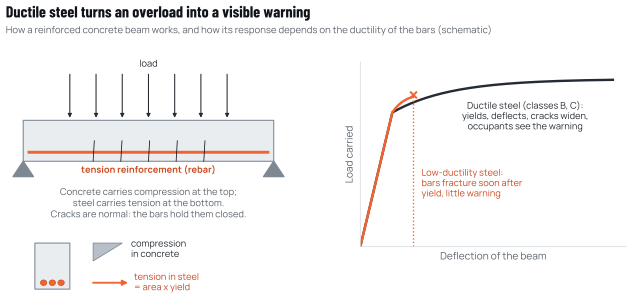
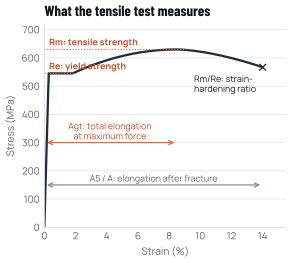
- A grade is a bundle of four properties, and the market discusses only one. "Fe500" promises a yield strength, but a design also assumes a cross-section (checked by mass per metre), ductility (strain at maximum force Agt and strength ratio Rm/Re) and bond (rib geometry). Ductility and section are the properties most often missing and least visible to the buyer.
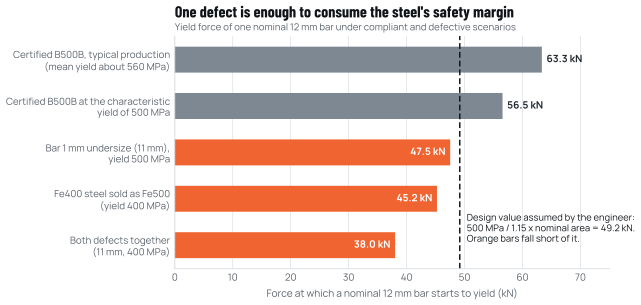
- One defect is enough to consume the steel’s safety margin. A nominal 12 mm grade 500 bar is designed to carry 49.2 kN at yield. Rolled one millimetre undersize it yields at 47.5 kN; made of grade 400 steel at 45.2 kN; with both defects at 38.0 kN, 23% below the design value (derived, Figure ES.1). These bars show no distress in everyday use; they remove the reserve that covers overloads, poor concrete and the extra floors owners often add.
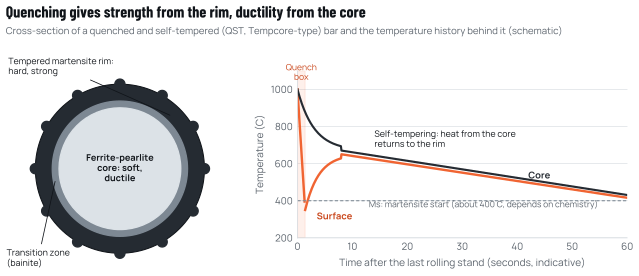
- Good rebar is made by an honest route that can be audited. Grade 500 within the weldability limit (carbon equivalent of 0.50% or less) is reached by quenching and self-tempering the bar or by microalloying, in a melt shop that refines each heat and analyses it by spectrometer [S31][S48]. Bars made strong by excess carbon, or re-rolled from scrap of unknown composition, are brittle, weld badly and vary from bundle to bundle.
- The main standards agree on strength but differ on ductility, bond and proof. European-family grades (B500B under BS 4449 or NF A 35-080-1, Eurocode 2 class B) guarantee Agt of at least 5% and Rm/Re of at least 1.08, cap overstrength and are normally proven by third-party certification [S30][S31][S38]. ASTM A615 Grade 60 guarantees a lower yield, elongation after fracture and no carbon-equivalent limit [S34][S35]. Specifiers should name "NC 236 Fe500 with class B ductility", the weldability limit and the proof required, never "Fe500" alone.
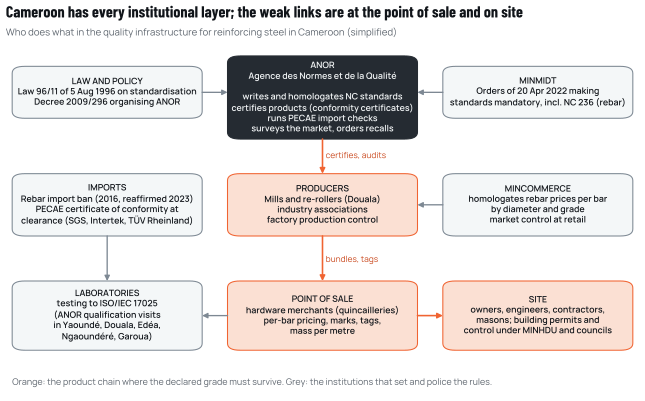
- Cameroon’s legal chain is complete and has been enforced. Law 96/11 (1996), ANOR (2009), the PECAE import-conformity programme (2015, operational 2016), the rebar import ban (2016, reaffirmed 2023) and the mandatory NC 236 standard (2022) form a coherent system [S04][S12][S13][S14][S15]. ANOR withdrew a certificate and recalled bars of a grade absent from the standard in October 2024, and the Government refused to revise the standard in January 2026 [S04][S05][S06][S07].
- Pricing per bar rewards light bars. Homologated prices are set per bar, taken here as the standard commercial length of 12 m (assumed): about 600 to 650 FCFA per kg at nominal mass in October 2023 [S11]. A bar at the edge of the 4.5% tolerance costs the buyer 4.7% more per kilogram; a bar one size light, 19% more (derived). Pricing and payment per tonne would remove the incentive to roll light without changing price levels.
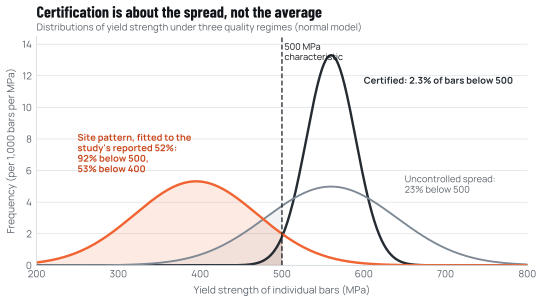
- The regional evidence points to unmarked and uncontrolled bars. In a 2023 study of 24 bars sampled on building sites in Bamenda, Douala, Maroua and Yaoundé, 11 had yield stresses below 400 MPa (the study reports 52%; its own counts give 46%; sampling years are not stated), and bars without a manufacturer’s mark failed every test [S19]. Nigeria’s standards body sealed 13 plants in 2020 after most samples failed diameter and mass per metre [S25]; an Ethiopian market study found yield scatter two to three times that of controlled production [S28][S29].
- Five site checks catch most defective bars before they reach a column. Checking paperwork, reading the rolled-in mark, weighing three bars per diameter, measuring ribs and bending a sample cold take less than an hour per delivery. Bars without a legible mill mark should not be used in structural members. Laboratory tests settle the remaining doubts, especially on strength.
- On the coast, cover and concrete decide durability. Kribi and Douala stay above 80% relative humidity in every month [S50]. Eurocode 2 recommends at least 35 mm of cover for durability against airborne salt and 45 mm in splash zones, plus a 10 mm execution allowance, with dense concrete [S36][S37]. Spacers, low water/cement ratios and curing protect bars more than any coating.
Contents
12 chapters, 4 annexes
Every chapter opens with its conclusion. The annexes set out the method, the glossary and the list of sources.
- SummaryExecutive summary: safer buildings start with bars that meet their grade10 min · 1 fig.
- Chapter 1Rebar quality decides whether a concrete building warns before it fails11 min · 3 fig.
- Chapter 2Good rebar is designed in the melt shop and fixed in the rolling mill13 min · 4 fig.
- Chapter 3The main standards agree on strength but differ on ductility, bond and proof13 min · 2 fig.
- Chapter 4Cameroon has the legal tools for rebar quality; surveillance and testing are the gaps12 min · 3 fig.
- Chapter 5A mill proves quality with statistics and traceability, not with single tests12 min · 3 fig.
- Chapter 6Most defective bars can be caught on site with a scale, a tape and a bend10 min · 3 fig.
- Chapter 7Specify the full grade, demand the proof and verify every delivery12 min · 2 fig.
- Chapter 8On the coast, cover and concrete protect the bar more than the steel itself11 min · 3 fig.
- Chapter 9Wire rod, mesh and sections need the same discipline, with their own tests11 min · 1 fig.
- Chapter 10Ten measures would raise the floor of rebar quality within five years10 min · 1 fig.
- Chapter 11Evidence gaps: what is not yet known, and how it can be found out7 min
Annexes
Go further
Related white papers
- WP03Electric steelmaking is the right route for Central AfricaTechnology · 2.9 h
- WP04Cameroon’s steel gap lies in iron units, not in rebarMarket · 3.1 h
- WP08Cameroon can staff its steel industry if training starts before the furnace doesSkills · 2.7 h
Related Labs tools
- Rebar estimator
How much steel does my building need, and in which bar sizes?
- Steel route lab
Which steelmaking route uses the least energy and emits the least CO₂?
Cite this white paper
CS-WP-10
Cameroon Steel (2026). Safer buildings need rebar that meets its declared grade. White paper 10, CS-WP-10. https://www.cameroon-steel.com/en/library/quality-steel/
- Reference
- CS-WP-10
- Edition
- 10 October 2026
- Status
- First edition
- Classification
- Public