White paper 10 · Chapter 3
The main standards agree on strength but differ on ductility, bond and proof
Every major rebar standard builds its grades around a minimum yield strength of 400 to 500 MPa, so a buyer comparing labels sees little difference. The differences lie elsewhere. The European family (EN 10080 and its national versions BS 4449 and NF A 35-080-1, read with Eurocode 2) guarantees ductility through two measured quantities, caps the yield strength, defines bond by rib geometry and is normally proven by third-party certification with statistical evaluation. The general American bar standard, ASTM A615 Grade 60, guarantees minimum strength and elongation but not ductility in the European sense, nor weldability. A Cameroonian specifier should therefore name a full grade, a standard and a proof, never "Fe500" alone.
In this chapter (8)
- 3.1 Five families of standards meet in the Cameroonian market
- 3.2 Strength: similar numbers, different meanings of "minimum"
- 3.3 Ductility: the largest difference between the families
- 3.4 Section: mass per metre is the honest measure of a bar’s size
- 3.5 Bond: ribs are specified by geometry and verified by measurement
- 3.6 Bendability: the rebend test catches what the tensile test misses
- 3.7 Proof is the part of a standard that buyers forget
- 3.8 What this means for a Cameroonian specifier
3.1 Five families of standards meet in the Cameroonian market
Steel used in Cameroonian buildings reaches site through several channels: domestic mills producing to the national standard, contractors bringing their home-country specifications, donors and development banks requiring European or American references, and designers trained in French, British or American practice. Five families of documents therefore coexist.
Eurocode 2 (EN 1992-1-1) is a design code, not a product standard. Its Annex C states what properties the designer may assume for reinforcement of classes A, B and C: a characteristic yield strength between 400 and 600 MPa, a minimum ratio k = (ft/fy)k, a minimum characteristic strain at maximum force εuk, a fatigue stress range and a minimum relative rib area [S30][S36]. It is the bridge between the structural calculation and the product.
EN 10080:2005 sets general technical delivery conditions for weldable reinforcing steel but does not itself define grades; it was withdrawn as a harmonised European standard in 2008 because some countries’ legal requirements for additional properties were not met, and grades continue to be defined nationally [S33][S39]. BS 4449:2005+A3:2016 defines grades B500A, B500B and B500C, which correspond to the three ductility classes of Eurocode 2, all with a characteristic yield strength of 500 MPa [S33][S38]. NF A 35-080-1 plays the same role in France; its most common grade, B500B, is certified under the AFCAB scheme [S31][S42].
ISO 6935-2:2019 is the international standard for ribbed bars. It offers a menu of grades and ductility classes from which national bodies can choose, and many African standards are drafted from it [S43].
ASTM A615/A615M is the general American specification for deformed carbon-steel bars, with Grade 60 [420] the common choice; ASTM A706/A706M is its low-alloy counterpart for applications that require controlled tensile properties and weldability, notably seismic design [S34][S40][S41].
NC 236, the Cameroonian standard Acier pour béton armé: fer à béton, made mandatory by a ministerial order of 20 April 2022, recognises high-bond (ribbed) bars of grades Fe400 and Fe500 and smooth bars of grades Fe215 and Fe235 [S04][S05]. The press has referred to its 2021 edition (NC 236:2021) and, in 2026, to an edition coded NC 236/2024/06 [S04][S06]. The designations echo the older French grades FeE 400 and FeE 500, which France has since replaced by the B500 family [S72]. The full text of NC 236 is not freely available online; this paper therefore describes its grades and legal status but does not reproduce its numerical requirements (see the evidence-gaps chapter).
Contractors from China often add a sixth reference, GB/T 1499.2, whose grades HRB400 and HRB500 have seismic "E" variants with a minimum strength ratio and a cap on overstrength [S73]. The point is not to choose one family for its own sake, but to recognise that the same nominal "500 MPa bar" can carry very different guarantees.
3.2 Strength: similar numbers, different meanings of "minimum"
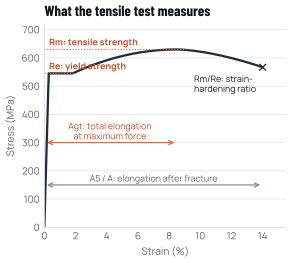
Source: Cameroon Steel schematic; definitions after ISO 6892-1 and EN ISO 15630-1 [S44][S45].
The headline yield strengths converge: 500 MPa for the European B500 grades and Cameroon’s Fe500, 420 MPa for ASTM Grade 60. What differs is the statistical meaning of the number.
In the European family the 500 MPa is a characteristic value: the long-term production must show, with stated statistical confidence, that no more than 5% of bars fall below it, and each individual test must also exceed a minimum slightly below it. Under the French scheme for B500B, for example, the characteristic yield is 500 MPa and the individual minimum 475 MPa [S31]. In ASTM practice the 420 MPa of Grade 60 is a minimum for each test, without a stated fractile [S34][S40].
The European family also caps the yield strength. Under the AFCAB scheme the ratio of actual to nominal yield must stay below 1.30 as a characteristic value and below 1.32 for any test [S31]; several national versions cap the yield at 650 MPa [S32]. ASTM A706 caps Grade 60 at 540 MPa (78 ksi) [S34], while ASTM A615 sets no maximum [S34]. A cap may look odd in a quality standard, but a bar that is much stronger than declared shifts the failure from the ductile steel to the brittle concrete, and makes a structure designed for ductile hinging behave less predictably.
The tensile strength requirement is where ASTM A615 has moved most. Editions of the CRSI reference material show Grade 60 with a minimum tensile strength of 90,000 psi (620 MPa) [S34]; the current edition, as summarised by a major US producer in 2021, requires 80,000 psi (550 MPa) and sets no minimum ratio of tensile to yield strength for Grade 60 [S35]. ASTM A706 Grade 60, by contrast, requires a tensile strength of at least 80,000 psi and at least 1.25 times the actual yield strength [S34].
The figure on the right defines the quantities. Re is the yield strength; Rm the tensile strength; Agt the total elongation at maximum force, the strain the bar can sustain while still carrying increasing load; A (or A5) the elongation after fracture, which includes the local necking just before the bar breaks. Agt is the more meaningful measure of usable ductility because necking happens over a very short length of bar.
3.3 Ductility: the largest difference between the families
The European family controls ductility directly, by setting a minimum Agt and a minimum Rm/Re for each class. ASTM A615 controls it indirectly, through the elongation after fracture measured over a 200 mm (8 in) gauge length: 9% for the smaller sizes, falling to 7% for the larger ones [S34][S35]. Elongation after fracture is a useful screen for brittle steel, but it is not the same property: a bar can show 9% elongation after fracture, most of it concentrated in the neck, and still have a small uniform elongation and a low strength ratio. This is why Eurocode-based designs should not treat A615 Grade 60 as equivalent to B500B without checking Agt and Rm/Re on the mill certificate.
Table 3.1 How the main reference documents define a grade 500 class (or Grade 60) reinforcing bar (summary)
| Property | EN 1992-1-1 Annex C, class B (design) | B500B under BS 4449 / NF A 35-080-1 | ASTM A615 Grade 60 [420] | ASTM A706 Grade 60 [420] | NC 236 Fe500 (Cameroon, mandatory) |
|---|---|---|---|---|---|
| Nature | Properties the designer may assume | Product standard, usually with third-party certification | Product standard | Product standard, low-alloy, weldable | Mandatory national product standard |
| Yield strength | fyk 400 to 600 MPa | 500 MPa characteristic; 475 MPa individual minimum (NF) | 420 MPa minimum per test | 420 MPa minimum, 540 MPa maximum | Grade 500 by designation |
| Maximum yield | Not set for class B | Re,act/Re,nom ≤ 1.30 characteristic, ≤ 1.32 any test (NF); 650 MPa in several versions | None | 540 MPa | Not public |
| Strength ratio | k ≥ 1.08 | Rm/Re ≥ 1.08 characteristic (≥ 1.06 any test, NF) | Tensile ≥ 550 MPa (620 MPa in earlier editions); no ratio | Tensile ≥ 550 MPa and ≥ 1.25 × actual yield | Not public |
| Ductility | εuk ≥ 5.0% | Agt ≥ 5.0% characteristic (≥ 4% any test, NF) | Elongation after fracture in 200 mm ≥ 9% to 7% by size | Elongation after fracture ≥ 14% to 10% by size | Not public |
| Bendability | Bend or rebend test required | Rebend test: no brittleness after ageing | Bend test, 180° round a pin of 3.5d to 9d by size | Bend test round a pin of 3d to 8d | Not public |
| Mass tolerance | ±6.0% (d ≤ 8 mm), ±4.5% (d > 8 mm) | ±6.0% / ±4.5% | Each bar ≥ 94% of nominal mass | Each bar ≥ 94% of nominal mass | Not public |
| Weldability | Weldable steel assumed | Ceq ≤ 0.50%, C ≤ 0.22%, P and S ≤ 0.050%, N ≤ 0.012%, Cu ≤ 0.80% | No carbon-equivalent limit | CE ≤ 0.55% with C, Mn, P, S, Si limits | Not public |
| Bond | fR minimum by size (Table 3.3) | Rib geometry and fR as certified | Deformation spacing, height and gap limits | As A615 | Ribbed ("haute adhérence") |
| Proof of conformity | Assumed by the design | Factory production control, initial and audit testing, surveillance by a certification body | Mill test report | Mill test report | ANOR conformity certificate |
Source: [S30][S36] for Eurocode 2; [S31][S32][S38] for the European product standards (NF values from the AFCAB certificate summary); [S34][S35][S40][S41] for ASTM; [S04][S05] for NC 236. Summary for orientation only; the current edition of each standard governs.
The table explains a common confusion in Cameroonian procurement. A bid can offer "Fe500 equivalent to B500B or A615 Grade 60" as if these were interchangeable. They are not: the European grade promises a strength ratio and a uniform elongation; A615 Grade 60 promises a higher elongation after fracture but no strength ratio, a lower yield and no weldability; A706 promises the strongest ductility controls and weldability but at grade 420 strength.
3.4 Section: mass per metre is the honest measure of a bar’s size
Because ribs make a bar’s outline irregular, standards define its size through its mass per metre rather than through a measured diameter. The nominal cross-sectional area is that of a circle of the nominal diameter d, and the nominal mass follows from the density of steel, 7,850 kg/m³:
mass per metre (kg/m) = π/4 × d² × 7,850 × 10⁻⁶ ≈ 0.00617 × d², with d in millimetres.
This simple formula is the most powerful quality tool available to a site: weighing a full bar and dividing by its length tells a buyer, within a few per cent, how much steel he has actually bought.
Table 3.2 Nominal mass per metre and mass tolerances of common bar sizes
| Nominal diameter (mm) | Area (mm²) | Mass (kg/m) | Mass of a 12 m bar (kg) | EN family tolerance | Lightest 12 m bar allowed (kg) | Bars per tonne (12 m) |
|---|---|---|---|---|---|---|
| 6 | 28.3 | 0.222 | 2.66 | ±6.0% | 2.50 | 375 |
| 8 | 50.3 | 0.395 | 4.74 | ±6.0% | 4.46 | 211 |
| 10 | 78.5 | 0.617 | 7.40 | ±4.5% | 7.07 | 135 |
| 12 | 113.1 | 0.888 | 10.66 | ±4.5% | 10.18 | 93 |
| 14 | 153.9 | 1.208 | 14.50 | ±4.5% | 13.84 | 68 |
| 16 | 201.1 | 1.578 | 18.94 | ±4.5% | 18.08 | 52 |
| 20 | 314.2 | 2.466 | 29.59 | ±4.5% | 28.26 | 33 |
| 25 | 490.9 | 3.853 | 46.24 | ±4.5% | 44.16 | 21 |
| 32 | 804.2 | 6.313 | 75.76 | ±4.5% | 72.35 | 13 |
| 40 | 1,256.6 | 9.865 | 118.38 | ±4.5% | 113.05 | 8 |
Source: area, mass, 12 m mass and bars per tonne derived from the nominal diameter and a density of 7,850 kg/m³ (Annex A); tolerances from the European reference standards [S31][S32][S38]. Under ASTM A615 and A706 no individual bar may weigh less than 94% of its nominal mass [S34]. Bars per tonne rounded down.
The tolerance is a band around the nominal mass, not a licence to produce at its lower edge. A mill that aims its rolling at the bottom of the band to save steel will, through normal scatter, produce bars outside it. Certified mills aim close to nominal mass and record the deviation of each lot on the inspection certificate.
3.5 Bond: ribs are specified by geometry and verified by measurement
The ribs on a bar are what make it a high-bond bar. Their height, spacing, inclination and the gaps between their ends determine how much force the bar can transfer to the surrounding concrete over a given length, and therefore the anchorage and lap lengths a designer may use. Eurocode 2 summarises rib geometry in a single parameter, the relative rib area fR, the projected area of the ribs per unit length divided by the bar’s circumference [S36].
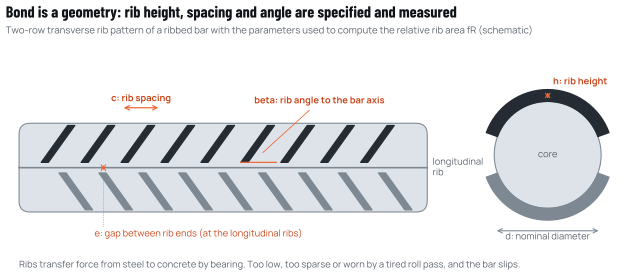
Source: Cameroon Steel schematic. Parameter definitions after EN 1992-1-1 and the AFCAB certification summary [S31][S36].
Table 3.3 How bond and identification are specified (summary)
| Requirement | European family (Eurocode 2, EN 10080, BS 4449, NF A 35-080-1) | ASTM A615 / A706 |
|---|---|---|
| Bond parameter | Minimum relative rib area fR: 0.035 for 5 to 6 mm, 0.040 for 6.5 to 12 mm, 0.056 above 12 mm (Eurocode 2 recommended values) | Deformation geometry rather than fR |
| Rib geometry | Rib height, spacing and inclination within ranges; for a two-row crescent pattern, fR is computed as 0.56 × h / c in the French certification scheme | Average spacing not more than 0.7 d; sum of gaps not more than 12.5% of the nominal perimeter; deformations inclined at least 45° to the axis; minimum height by size |
| Identification | Rolled-in pattern identifying the producing country and mill; label with heat, grade, standard and certification mark | Rolled-in symbols for mill, size, type (A615 or A706) and grade |
| Bundle label | Heat number, mass, diameter, length, standard, certification logos | Heat number on mill test report |
Source: [S31][S32][S36] (European family); [S34][S40][S41] (ASTM). Recommended values may be modified by national annexes.
A practical consequence of the fR formula is worth spelling out. For a 16 mm bar with a crescent rib pattern, an fR of 0.056 requires the ratio of rib height to spacing to be at least 0.10 (derived: 0.056 / 0.56). With a rib spacing of 10 mm, the ribs must stand at least 1.0 mm proud of the core. A worn finishing roll that produces ribs of 0.7 mm on the same spacing gives an fR of about 0.039, below the minimum, and the bar no longer anchors as the designer assumed (derived). Rib height is measurable on site with a depth gauge, and rib spacing with a ruler laid along ten ribs.
3.6 Bendability: the rebend test catches what the tensile test misses
Bars are bent cold on site into hooks, links and cranks, and some are straightened again after being cast into a starter joint. A bar that cracks on the outside of a bend has a hidden defect at the place where the force must be anchored. Standards therefore require a bend test (bending a sample through 180° round a mandrel of specified diameter and checking for cracks) or a rebend test (bending, artificially ageing, then bending back, which reveals embrittlement from nitrogen or excess carbon) [S31][S38][S40]. The ASTM A615 bend test uses a pin of 3.5 bar diameters for small sizes rising to 9 diameters for the largest; A706, being more ductile, uses a tighter pin of 3 to 8 diameters [S40][S41]. The French certification scheme requires the absence of brittleness in a bend and rebend test and certifies separately the ability of a bar to be straightened after bending [S31].
The bend test is also the simplest mechanical test a site can perform without a laboratory, as the chapter on defects explains.
3.7 Proof is the part of a standard that buyers forget
A standard says what a bar must be. It does not by itself prove that a given bundle is what it says. The European family relies on third-party product certification: a certification body assesses the mill’s factory production control, conducts initial type testing, audits the mill periodically, takes its own samples for independent testing, and evaluates the long-term statistics of the mill’s results before granting the right to use its mark. The AFCAB certificate summarised in this paper, for example, is valid for a stated period, subject to periodic surveillance, and its validity can be checked online by any buyer [S31]. In the United Kingdom the CARES scheme plays the same role for BS 4449 [S33].
ASTM product standards do not themselves require third-party certification; conformity is shown by the producer’s mill test report and, where the purchaser wishes, by acceptance testing.
In Cameroon, the conformity of domestic rebar with NC 236 is attested by a conformity certificate issued by ANOR, the national standards and quality agency. The case of October 2024, in which ANOR withdrew a certificate it had issued on 15 January 2024 and ordered the recall of bars marketed as Fe450, a grade absent from NC 236, shows both that the system works and that a certificate is only as good as the surveillance that follows it [S04][S05].
3.8 What this means for a Cameroonian specifier
Three practical conclusions follow from the comparison.
First, name the full requirement. A specification that reads "NC 236 Fe500" fixes the legal grade. It should add the properties a Eurocode-based design assumes: ductility class B (Agt ≥ 5.0% and Rm/Re ≥ 1.08 as characteristic values), a maximum yield ratio, a carbon equivalent of 0.50% or lower when bars will be welded, and mass tolerances to the European family. Wording for such clauses is proposed in the chapter on specification and acceptance.
Second, do not accept equivalence claims without numbers. "Equivalent to B500B" should be demonstrated on the mill certificate for each heat: Agt, Rm/Re, Ceq and mass per metre, not only yield strength.
Third, ask for the proof, not only the product. A valid third-party certificate with surveillance, or an ANOR conformity certificate that is checked to be current, is worth more than any individual test report, because it covers the production that was not tested.
Sources cited in this chapter
Bracketed markers refer to these sources; the full list is in the annex. Full list of sources
- S30EN 1992 Eurocode 2: Design of concrete structures (J. Walraven), workshop "Eurocodes: background and applications", Brussels, 18 to 20 Feb 2008. European Commission (DG Enterprise and Industry, Joint Research Centre), Feb 2008.eurocodes.fi/wp-content/uploads/1992/sahkoinen1992/EN-1992.pdf
- S36EN 1992-1-1:2004 Eurocode 2: Design of concrete structures, Part 1-1: General rules and rules for buildings (with corrigenda). European Committee for Standardization (CEN), 2004.eurocodes.jrc.ec.europa.eu/EN-Eurocodes/eurocode-2-design-concrete-str…
- S33Standards for reinforcement. The Concrete Centre (UK).concretecentre.com/Codes/European-standards-for-reinforcement.aspx
- S39EN 10080:2005 Steel for the reinforcement of concrete. Weldable reinforcing steel. General. CEN, 2005.standards.cencenelec.eu
- S38BS 4449:2005+A3:2016 Steel for the reinforcement of concrete. Weldable reinforcing steel. Bar, coil and decoiled product. Specification. British Standards Institution (BSI), 2016.boutique.afnor.org/en-gb/standard/bs-44492005-a32016/steel-for-the-rei…
- S31Certificat N° B03/176 rév. 16, aciers pour béton armé, NF A 35-080-1 nuance B500B (fiche descriptive and caractéristiques certifiées). Association Française de Certification des Armatures du Béton (AFCAB), AFNOR Certification, 6 Jun 2025.feralpi-stahl.com/sites/default/files/media/certifications/NF%20AFCAB-…
- S42NF A 35-080-1 Aciers pour béton armé: aciers soudables, partie 1: barres et couronnes. AFNOR, current edition.boutique.afnor.org
- S43ISO 6935-2:2019 Steel for the reinforcement of concrete, Part 2: Ribbed bars. International Organization for Standardization (ISO), 2019.iso.org
- S34Rebar 101 (presentation: ASTM bar specifications, tensile and elongation tables, permissible variation in weight, marking). Concrete Reinforcing Steel Institute (CRSI), hosted by New Jersey Institute of Technology, n.d..web.njit.edu/~washd/cim101/download/notes/CRSI/Rebar101_University%20%…
- S40ASTM A615/A615M Standard specification for deformed and plain carbon-steel bars for concrete reinforcement. ASTM International, current edition.store.astm.org
- S41ASTM A706/A706M Standard specification for deformed and plain low-alloy steel bars for concrete reinforcement. ASTM International, current edition.store.astm.org
- S04Cameroun: pour non-respect des normes, le fer à béton de la société […] retiré du marché (name of the producer omitted here). EcoMatin, 21 Oct 2024.Cited by title and date
- S05Cameroon revokes […] compliance certificate for rebar, orders recall of products (name of the producer omitted here). Business in Cameroon, 17 Oct 2024.Cited by title and date
- S06Cameroun: le gouvernement rejette une demande de révision de la norme du fer à béton. EcoMatin, 5 Feb 2026.ecomatin.net/cameroun-le-gouvernement-rejette-une-demande-de-revision-…
- S72NF A35-016 Concrete reinforcing steels, weldable ribbed bars and coils of grade FeE500 (catalogue record). AFNOR, catalogue accessed Oct 2026.boutique.afnor.org/en-gb/standard/nf-a35016/concrete-reinforcing-steel…
- S73GB/T 1499.2-2018 Steel for the reinforcement of concrete, Part 2: Hot rolled ribbed bars. Standardization Administration of China, 2018.openstd.samr.gov.cn
- S44ISO 15630-1:2019 Steel for the reinforcement and prestressing of concrete, Test methods, Part 1: Reinforcing bars, rods and wire (EN ISO 15630-1). ISO; CEN, 2019.iso.org
- S45ISO 6892-1:2019 Metallic materials, Tensile testing, Part 1: Method of test at room temperature. ISO, 2019.iso.org
- S32Technical specification SPF400 rev. 12, Rebars B500 (chemical, mechanical and dimensional requirements under EN 10080 and national standards). Ferriere Nord S.p.A. (Pittini group), 14 Sep 2021.pittini.it/wp-content/uploads/Pittini-Group-Reinforcing-Steel-Bars-B50…
- S35Engineering Bulletin #1: Mechanical properties, ChromX (ASTM A1035) compared with ASTM A615 Grades 60, 80 and 100. Commercial Metals Company (CMC), 12 May 2021.cmc.com/getmedia/83bc1448-b2ed-47b1-9b4e-56951d4b7212/1_Mechanical_Pro…
Cite this chapter
Cameroon Steel (2026). Safer buildings need rebar that meets its declared grade. White paper 10, chapter 3: The main standards agree on strength but differ on ductility, bond and proof. CS-WP-10. https://www.cameroon-steel.com/en/library/quality-steel/standards-landscape/
Source