White paper 10 · Chapter 10
Ten measures would raise the floor of rebar quality within five years
Cameroon does not need a new legal framework for rebar quality; it needs the existing one to reach the merchant’s yard and the building site. Ten measures, most of them administrative and inexpensive, would do this: make the standard and the list of certified producers public, strengthen certification with surveillance and statistics, sample and publish at merchants, price by the tonne, require certified steel in public contracts and permitted buildings, build accredited testing capacity, train the people who handle steel, set durability rules for the coast and report annually. Three of them, transparency of certification, stronger certification and a public procurement clause, carry most of the benefit and can start in 2027.
In this chapter (9)
- 10.1 The strategy is to make good bars easy to recognise and bad bars risky to sell
- 10.2 Transparency comes first because it costs least and helps everyone
- 10.3 Certification must prove the population, not the sample
- 10.4 Surveillance and pricing reach the point of sale
- 10.5 Public procurement and building permits create demand for certified steel
- 10.6 Testing capacity and skills make the measures work
- 10.7 Producers have their own part to play
- 10.8 The benefits are large and fall on the public
- 10.9 Progress should be measured and published
10.1 The strategy is to make good bars easy to recognise and bad bars risky to sell
The previous chapters lead to a simple diagnosis. The mandatory standard is right and has been defended. The weak points are information and incentives downstream of the mill: buyers cannot easily tell a certified bar from an uncertified one, merchants are paid per bar rather than per kilogram, few sites check deliveries, and non-conformity is rarely made public. A substandard bar therefore competes on price with a good one, and often wins.
The ten measures below change that balance in three ways:
- Transparency: buyers can see which producers are certified, what their marks look like and how their products performed in surveillance.
- Incentives: price and payment are tied to the mass and certification of steel, not to the number of bars.
- Checks at every layer: mills test themselves and are audited, merchants are sampled, sites accept deliveries against a routine, and public contracts pay only for accepted steel.
None of the measures relaxes the standard, imports a new regulator or requires large public spending. Most can be implemented by the institutions that already exist, with modest budgets for sampling, testing and training.
Table 10.1 Ten recommendations to raise the floor of rebar quality in Cameroon
| No. | Measure | Lead | Instrument | Start or window | Indicator of success |
|---|---|---|---|---|---|
| R1 | Publish the essential requirements of NC 236 and a public register of certified producers, with their rolled-in marks and certificate validity | ANOR | Website register; free summary of the standard | 2027 | Register online and updated monthly |
| R2 | Strengthen certification: surveillance audits, independent sampling, statistical evaluation of characteristic values, mandatory reporting of Agt, Rm/Re and Ceq | ANOR, producers | Certification rules; scheme document | 2027 | All certified producers audited and sampled at least twice a year |
| R3 | Sample rebar at merchants in the main cities and publish results by brand and diameter | ANOR, MINCOMMERCE | Market surveillance programme | 2027 | Share of conforming samples rising year on year |
| R4 | Homologate prices per tonne and require the nominal mass per bar to be displayed; allow sale by weight | MINCOMMERCE | Homologation decision | 2027 | Price lists in FCFA per tonne; mass displayed at merchants |
| R5 | Require certified NC 236 bars with class B ductility, type 3.1 certificates and site acceptance in all public works contracts; pay only for accepted steel | Ministry of Public Contracts, contracting authorities | Standard bidding documents; supervision terms of reference | 2027 | Clause in all new public works contracts |
| R6 | Link building permits for multi-storey and public buildings to certified steel, acceptance records and inspection before concreting | MINHDU, municipalities | Permit conditions; inspection checklists | 2027 to 2029 | Share of permitted sites with acceptance records |
| R7 | Build accredited testing capacity for rebar in each main city, including mobile testing for sites | ANOR, public and private laboratories, universities | ISO/IEC 17025 accreditation; ANOR qualification platform | 2027 to 2029 | Number of laboratories qualified for rebar tests, by city |
| R8 | Train masons, foremen and engineers in steel acceptance, bending, cover and storage | Producers, professional bodies, vocational and engineering schools | One-day site module; curriculum updates | 2027 onwards | People trained per year; modules in curricula |
| R9 | Set durability rules for coastal construction: cover, spacers, concrete mixes and curing by exposure class | MINHDU, ANOR | Technical guidance; national annex values | 2027 to 2028 | Guidance published; cover checked in inspections |
| R10 | Publish an annual report on rebar conformity, surveillance results and enforcement actions | ANOR | Annual report | 2028 onwards | Report published each year |
Source: Cameroon Steel proposals based on the analysis in this paper. Leads are indicative; institutions decide their own programmes.
10.2 Transparency comes first because it costs least and helps everyone
R1. Publish the essentials and the register. The full text of NC 236 is a priced document, which is normal for standards. But a buyer does not need the full text to protect himself; he needs to know which grades are lawful, what properties they guarantee, how bars must be marked, and which producers hold a valid certificate. ANOR already publishes communiqués and runs an online reporting channel [S74]; a public register of certified rebar producers, with a photograph of each producer’s rolled-in mark, the grades and diameters covered and the validity dates, would let any merchant, engineer or mason verify a bundle in minutes. Certification bodies abroad already publish their certificates for this reason [S31].
R10. Report every year. An annual report on rebar conformity, giving the number of samples tested, the share conforming by city and by brand, and the enforcement actions taken, turns surveillance into deterrence. Published results reward compliant producers in the market, which is the most durable incentive available.
10.3 Certification must prove the population, not the sample
R2. Strengthen certification. A conformity certificate is valuable to the extent that the production it covers is audited and sampled after the certificate is granted. The Fe450 episode showed both the value and the limits of certification: a certificate covering a grade absent from the standard was issued, then withdrawn nine months later [S04][S05]. A certification scheme for rebar should include, at a minimum:
- an initial assessment of factory production control, laboratory competence and traceability;
- periodic surveillance audits, unannounced where possible;
- independent sampling at the mill and in the market, with testing in a qualified laboratory;
- statistical evaluation of the producer’s results against the characteristic values of the standard (see the testing chapter);
- mandatory reporting of ductility (Agt and Rm/Re) and of the carbon equivalent, so that buyers can see the properties a Eurocode-based design relies on;
- clear rules for suspension and withdrawal, and publication of both.
International practice offers tested models, such as the AFCAB and CARES schemes [S31][S33], and Cameroonian producers who already hold management-system certificates under ISO 9001 [S10][S78] have part of the documentation in place.
10.4 Surveillance and pricing reach the point of sale
R3. Sample at merchants and publish. Market surveillance closes the loop between the mill and the buyer. A programme that buys bars anonymously at hardware merchants in Douala, Yaoundé and the regional capitals, weighs and tests them, and publishes the results by brand and diameter, would expose light and mislabelled products quickly. Weighing alone, which costs almost nothing, would catch the commonest defect. The programme can be shared between ANOR, which certifies and surveys products [S16], and the Ministry of Commerce, which already controls prices at retail [S11].
R4. Price by the tonne. Homologating prices per tonne, with the per-bar price derived from the nominal mass, removes the incentive to roll light bars without changing the price level (see the chapter on the quality infrastructure). Requiring merchants to display the nominal mass of each bar and allowing sale by weight gives buyers the information to protect themselves. The fiscal system already uses a tonnage basis for steel, through the environmental tax introduced in 2026 [S66].
10.5 Public procurement and building permits create demand for certified steel
R5. Make certified steel a condition of payment in public works. The State’s public investment budget of 2,026.3 billion FCFA in 2026 [S80] makes it the decisive buyer. A standard clause in the technical specifications of public works contracts, based on the model clauses in this paper, together with supervision terms of reference that include rebar acceptance and payment conditions that require acceptance records, would create a large and predictable demand for certified bars. The public procurement framework set by Decree No. 2018/366 [S54] and the standard bidding documents of the Ministry of Public Contracts [S81] are the natural vehicles.
R6. Link permits to materials. For multi-storey and public buildings, the building permit could carry conditions requiring certified steel, a site acceptance record for each delivery and an inspection of reinforcement before each concrete pour. Municipalities already seal buildings at risk, as in Douala in 2026 [S22]; adding a materials condition at the permit stage moves control from the end of a building’s life to its beginning.
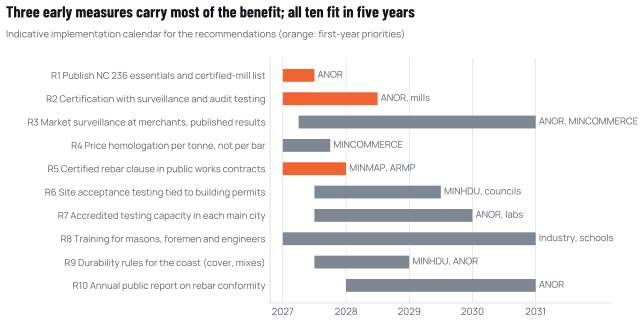
Source: Cameroon Steel indicative calendar. Timing depends on decisions by the institutions concerned.
10.6 Testing capacity and skills make the measures work
R7. Build accredited testing capacity. Certification, surveillance and site acceptance all need laboratories that can test rebar reliably: a calibrated universal testing machine with an extensometer, bending equipment, a balance and trained staff working to EN ISO 15630-1 and ISO 6892-1 [S44][S45], with competence demonstrated under ISO/IEC 17025 [S55]. ANOR’s programme of laboratory qualification visits in five cities [S18] is the right starting point. The aim should be at least one qualified laboratory for rebar in each main city, with mobile capacity for sites far from them, and with fees low enough that a contractor will use them.
R8. Train the people who handle steel. The person who decides whether a bundle is used is often a foreman or a mason. A one-day practical module, covering marks, weighing, bending, storage, cover and spacers, can be delivered on site by producers, professional bodies and vocational schools. Engineering curricula should give future engineers a firm grounding in steel properties, standards and certificates; the departments of the national polytechnic school in Yaoundé include civil, mechanical and industrial engineering but no dedicated metallurgy department [S85].
R9. Set durability rules for the coast. Guidance on cover, spacers, concrete mixes and curing by exposure class, consistent with Eurocode 2 and EN 206 recommended values [S36][S37], would make durability on the coast a matter of routine rather than individual judgement. Values chosen for a national annex should be published so that designers use them consistently.
10.7 Producers have their own part to play
The measures above are mainly for public institutions. Producers, including new entrants, can raise the floor faster than any regulation by competing on proven quality. In practice this means rolling every bar with a legible mill mark, aiming at nominal mass rather than the edge of the tolerance, publishing the properties their certificates guarantee, supplying a type 3.1 certificate with every delivery, inviting independent sampling, and supporting training for the masons and foremen who use their products.
10.8 The benefits are large and fall on the public
The costs of these measures are modest: sampling and testing budgets, laboratory equipment and accreditation, training days and administrative time. Their benefits fall on the people who live and work in Cameroonian buildings, most of whom never see the steel inside their walls. A higher floor of rebar quality protects them in three ways: against the loss of strength that a light or mislabelled bar silently imposes, against the loss of warning that a brittle bar brings, and, on the coast, against the early corrosion that thin cover and poor concrete invite.
For the steel industry the measures are also an opportunity. A market in which quality is visible rewards investment in melt shops, laboratories and certification, and supports exports to neighbouring countries, which already absorb about 31,000 t of Cameroonian bars a year [S52][S76], and where buyers increasingly ask for proof. The policy already chosen by the Government, to hold the standard rather than dilute it [S06][S07], points in the same direction. The task now is to make that standard visible in every bundle sold and every column cast.
10.9 Progress should be measured and published
The measures will only be judged effective if their results are measured. Five indicators, published each year in the conformity report proposed under R10, would tell the public, the industry and the Government whether the floor is rising:
- Market conformity: the share of bars sampled at merchants that meet the mass tolerance, carry a legible mill mark and pass tensile and bend tests, by city and by producer.
- Certified output: the number of producers holding a valid certificate and the share of domestic rebar output that they represent.
- Public procurement coverage: the share of new public works contracts that include the certified-steel clause, and the share of interim payments supported by acceptance records.
- Testing capacity: the number of laboratories qualified for rebar tests in each main city, and the average time and cost of a test.
- Skills: the number of masons, foremen and engineers trained each year in steel acceptance and fixing.
A baseline for the first indicator requires the national sampling survey described in the evidence-gaps chapter. Once it exists, targets can be set; this paper proposes, as an aim for discussion rather than a forecast, that within five years at least 95% of bars sampled at merchants should meet the mass tolerance and carry a legible mill mark. Publishing the indicators is itself a measure: it rewards the producers and merchants who comply, and tells buyers where to buy.
Sources cited in this chapter
Bracketed markers refer to these sources; the full list is in the annex. Full list of sources
- S74Home page, communiqués and online reporting service (Dénonciation). ANOR.anor.cm
- S31Certificat N° B03/176 rév. 16, aciers pour béton armé, NF A 35-080-1 nuance B500B (fiche descriptive and caractéristiques certifiées). Association Française de Certification des Armatures du Béton (AFCAB), AFNOR Certification, 6 Jun 2025.feralpi-stahl.com/sites/default/files/media/certifications/NF%20AFCAB-…
- S04Cameroun: pour non-respect des normes, le fer à béton de la société […] retiré du marché (name of the producer omitted here). EcoMatin, 21 Oct 2024.Cited by title and date
- S05Cameroon revokes […] compliance certificate for rebar, orders recall of products (name of the producer omitted here). Business in Cameroon, 17 Oct 2024.Cited by title and date
- S33Standards for reinforcement. The Concrete Centre (UK).concretecentre.com/Codes/European-standards-for-reinforcement.aspx
- S10Interdiction des importations du fer à béton: les consommateurs dénoncent la mauvaise qualité de la production locale. EcoMatin, 13 Apr 2023.ecomatin.net/interdiction-des-importations-du-fer-a-beton-les-consomma…
- S78ISO 9001:2015 Quality management systems, Requirements. ISO, 2015.iso.org
- S16Nos missions. ANOR.anor.cm/articles/nos-missions
- S11Fer à béton: les producteurs acceptent une baisse des prix. EcoMatin, 23 Oct 2023.ecomatin.net/fer-a-beton-les-producteurs-acceptent-une-baisse-des-prix
- S66Cameroon, Republic of: Corporate, Other taxes (environmental tax under the 2026 Finance Law). PwC Worldwide Tax Summaries, reviewed 14 Aug 2026.taxsummaries.pwc.com/republic-of-cameroon/corporate/other-taxes
- S80Budget 2026: 8 816,4 milliards FCFA pour consolider la stabilité et accélérer le développement du Cameroun. Ministry of Finance (MINFI), 26 Nov 2025.minfi.gov.cm/budget-2026-8-8164-milliards-fcfa-pour-consolider-la-stab…
- S54Agence de Régulation des Marchés Publics, website (references to Decree No. 2018/366 of 20 June 2018 on the public procurement code). ARMP.armp.cm
- S81Ministry of Public Contracts, website (standard bidding documents, DAO-types). MINMAP.minmap.cm
- S22Cameroun: Douala, 6 morts dans l’effondrement d’un immeuble à Bonamoussadi. Camer.be, republished by AllAfrica, 11 Jul 2026.fr.allafrica.com/stories/202607130741.html
- S44ISO 15630-1:2019 Steel for the reinforcement and prestressing of concrete, Test methods, Part 1: Reinforcing bars, rods and wire (EN ISO 15630-1). ISO; CEN, 2019.iso.org
- S45ISO 6892-1:2019 Metallic materials, Tensile testing, Part 1: Method of test at room temperature. ISO, 2019.iso.org
- S55ISO/IEC 17025:2017 General requirements for the competence of testing and calibration laboratories. ISO; IEC, 2017.iso.org
- S18L’ANOR et les laboratoires camerounais renforcent leur collaboration: une plateforme d’échanges et de conformité voit le jour. ANOR, 17 Sep 2024.anor.cm/articles/lanor-et-les-laboratoires-camerounais-renforcent-leur…
- S85École Nationale Supérieure Polytechnique de Yaoundé, home page (departments). ENSP Yaoundé.polytechnique.cm/
- S36EN 1992-1-1:2004 Eurocode 2: Design of concrete structures, Part 1-1: General rules and rules for buildings (with corrigenda). European Committee for Standardization (CEN), 2004.eurocodes.jrc.ec.europa.eu/EN-Eurocodes/eurocode-2-design-concrete-str…
- S37EN 206:2013+A2:2021 Concrete: specification, performance, production and conformity. CEN, 2021.standards.cencenelec.eu
- S01Kribi: le Premier ministre, chef du gouvernement est là. Cameroon Tribune, 30 Dec 2024.cameroon-tribune.cm/article.html/68499/fr.html/details_2
- S02Cameroun: complexe moderne de sidérurgie de Kribi, le PM Joseph Dion Ngute effectue la pose de la première pierre. Camer.be, 5 Jan 2025.camer.be/87795/12:1/cameroun-complexe-moderne-de-siderurgie-de-kribi-l…
- S03Industrialisation: la voie royale de l’émergence. Cameroon Tribune, 2 Jan 2025.cameroon-tribune.cm/article.html/68558/fr.html/details_2
- S52UN Comtrade public API, Cameroon (reporter 120), imports and exports by HS line, chapters 72 and 73, 2019 to 2023. United Nations Statistics Division.comtradeapi.un.org/public/v1/preview/C/A/HS?reporterCode=120&period=20…
- S76Évolution du commerce extérieur en 2025 (version provisoire). Institut National de la Statistique (INS), Cameroon, Feb 2026.ins-cameroun.cm/wp-content/uploads/2026/04/Note-sur-le-commerce-exteri…
- S06Cameroun: le gouvernement rejette une demande de révision de la norme du fer à béton. EcoMatin, 5 Feb 2026.ecomatin.net/cameroun-le-gouvernement-rejette-une-demande-de-revision-…
- S07Cameroon rejects fresh push to revise rebar standard. Business in Cameroon, 26 Jan 2026.businessincameroon.com/construction/2601-15657-cameroon-rejects-fresh-…
Cite this chapter
Cameroon Steel (2026). Safer buildings need rebar that meets its declared grade. White paper 10, chapter 10: Ten measures would raise the floor of rebar quality within five years. CS-WP-10. https://www.cameroon-steel.com/en/library/quality-steel/recommendations/
Source