White paper 10 · Chapter 2
Good rebar is designed in the melt shop and fixed in the rolling mill
Reinforcing bar is a plain carbon-manganese steel whose properties are decided in two places: the chemistry set in the melt shop and the thermal path imposed in the rolling mill. Modern mills reach grade 500 either by quenching and self-tempering the bar as it leaves the last stand or by adding small amounts of vanadium or niobium; both routes keep carbon and the carbon equivalent low enough for bending and welding. The routes that reach strength by adding carbon, or that re-roll scrap of unknown composition, are the ones that produce brittle and erratic bars.
In this chapter (7)
- 2.1 Rebar is a simple steel with strict limits on what it must not contain
- 2.2 There are three honest routes to 500 MPa, and one dishonest one
- 2.3 Nine control points turn a recipe into a guaranteed product
- 2.4 Billets and rolling decide surface quality, dimensions and mass
- 2.5 The carbon equivalent is the single best predictor of weldability
- 2.6 A small-mill industry is only as good as its scrap and its laboratory
- 2.7 Five questions reveal how a bar was made
2.1 Rebar is a simple steel with strict limits on what it must not contain
A reinforcing bar is about 98% iron. The rest is a short list of deliberate additions and a longer list of elements that arrive uninvited, mostly from scrap. The European reference for weldable reinforcing steel, EN 10080, and the national standards built on it (BS 4449 in the United Kingdom, NF A 35-080-1 in France) set maximum contents on the cast analysis: carbon 0.22%, phosphorus 0.050%, sulphur 0.050%, nitrogen 0.012%, copper 0.80%, and a carbon equivalent of 0.50% [S31][S32][S38][S39]. A slightly higher carbon content, up to 0.25%, is tolerated in some national versions if the carbon equivalent is held at 0.48% or lower [S32].
These are not arbitrary numbers. Each limit protects one of the properties described in the previous chapter.
Table 2.1 What each element does in a reinforcing bar, and the limits of the European reference standards (cast analysis)
| Element | Why it is there | Limit (EN 10080 family) | What goes wrong if it is out of control |
|---|---|---|---|
| Carbon (C) | Main strengthening element; forms pearlite and, on quenching, martensite | 0.22% max (0.25% allowed in some versions if Ceq ≤ 0.48%) | Above the limit: brittle welds and heat-affected zones, cracking at bends, lower ductility |
| Manganese (Mn) | Strengthens ferrite, ties up sulphur, controls hardenability for quenching | No general cap; enters the carbon equivalent (some national versions cap at 1.60%) | Too little: soft bars and hot shortness from sulphur; too much: high Ceq, hard spots |
| Silicon (Si) | Deoxidiser added in the ladle | No general cap (0.60% in some versions) | Poor deoxidation: porosity and inclusions in the billet |
| Phosphorus (P) | Impurity from scrap and ore | 0.050% max | Embrittlement, poor bend and rebend performance, especially in cold conditions |
| Sulphur (S) | Impurity from scrap and fuels | 0.050% max | Sulphide inclusions, cracking during hot rolling, laps and seams |
| Nitrogen (N) | Picked up in the electric arc furnace | 0.012% max (higher if bound by vanadium or aluminium) | Strain-ageing: steel loses ductility after bending, fails the rebend test |
| Copper (Cu) and other residuals (Ni, Cr, Mo, Sn) | Arrive with scrap; cannot be removed in the furnace | Cu 0.80% max; Cr, Mo, V, Ni, Cu enter the carbon equivalent | Surface cracking during rolling (copper), higher Ceq, erratic hardenability in the quench |
| Vanadium (V), niobium (Nb) | Deliberate micro-additions, typically a few hundredths of a per cent | Not capped; enter the carbon equivalent | Correct use: fine grain and precipitation strength without extra carbon |
| Carbon equivalent (Ceq) | Summary index of hardenability and weldability | 0.50% max | Above the limit: welds harden and crack; tack-welded cages become brittle |
Source: limits from the AFCAB certificate summary of NF A 35-080-1 [S31] and the Ferriere Nord specification summarising EN 10080 and national versions [S32]; element roles are standard metallurgy. Product-analysis limits are slightly higher than cast limits [S38].
Two features of this list matter for Cameroon. First, residual elements such as copper, tin, nickel and chromium cannot be removed in an electric arc furnace once they are in the scrap; they can only be diluted with clean feed such as direct reduced iron (DRI) or pig iron, or avoided by sorting. A mill that relies on mixed, informally collected scrap carries a structural risk of rising residuals unless it measures every heat. Second, phosphorus and sulphur are removed only by a refining slag. An electric arc furnace with a ladle furnace can do this; a simple induction furnace that only melts, without a refining step, largely keeps whatever phosphorus and sulphur the scrap contains. That is one reason why the route by which a bar was made tells a buyer something about the risk it carries.
2.2 There are three honest routes to 500 MPa, and one dishonest one
A plain carbon steel with 0.20% carbon, rolled and left to cool in air, has a yield strength well below 500 MPa. To reach grade 500 without breaking the carbon limit, mills use one of three routes.
Quenching and self-tempering (QST). The most widespread modern route was developed at the Belgian research centre CRM and published in the early 1980s under the name Tempcore [S48]. As the hot bar leaves the last rolling stand, it passes through a short, intense water-cooling line. The outer layer cools fast enough to transform into martensite, a very hard phase, while the core stays hot. When the bar leaves the water, heat flowing out of the core reheats ("self-tempers") the martensitic rim, restoring some toughness. On the cooling bed the core then transforms slowly into soft, ductile ferrite and pearlite. The finished bar is a composite: a strong tempered-martensite rim around a ductile core, made from a low-carbon, readily weldable chemistry.
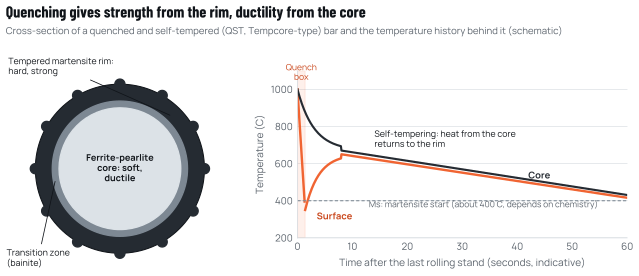
Source: Cameroon Steel schematic after the Tempcore principle [S48]. Temperatures and times are indicative only and vary with bar size, rolling speed and water flow.
QST is economical because it uses no alloying additions, but it is demanding. The depth of the martensitic rim, and therefore the yield strength, depends on the finishing temperature, the rolling speed, the bar diameter and the water flow and pressure in the quench box. If any of these drifts, properties drift with them, sometimes along the length of a single bar. A well-run QST mill measures these parameters continuously; a poorly run one produces bars whose strength varies from one bundle to the next. Research has also examined how the hard rim behaves when bars corrode or are cycled under load, which is one reason why some specifiers distinguish QST bars from microalloyed ones in demanding applications [S49].
Microalloying. Small additions of vanadium (often with nitrogen) or niobium refine the grain and form fine precipitates that strengthen the steel without extra carbon. Microalloyed bars have uniform properties through the section, tolerate welding and hot bending well, and are commonly used for large diameters, for coils and for class C (seismic) grades. Their cost is the alloy addition.
Cold working. Stretching or twisting a bar, or cold-rolling ribs onto wire rod, raises its yield strength at the expense of ductility. Cold-worked products typically fall into ductility class A and are mainly used in welded mesh and small diameters [S33].
The fourth route is the one this paper is about. It consists of reaching an apparent grade by raising carbon and manganese well beyond the limits, or simply by labelling a bar with a grade it does not have. High-carbon bars can show a high yield strength in a test, but they bend poorly, weld badly and break at low strain. Re-rolled bars, made by reheating and rolling down old rails, plate offcuts or scrap bars without remelting them, inherit whatever chemistry and internal defects the feed contained. Neither can be made consistent, because nothing in the process measures or controls what goes in.
2.3 Nine control points turn a recipe into a guaranteed product
Making rebar in an electric arc furnace mini-mill is a sequence of nine steps, and each one has a quality control point. The melt shop decides the grade by chemistry; the rolling mill fixes the geometry and the mechanical properties; release testing and tagging make the result provable.
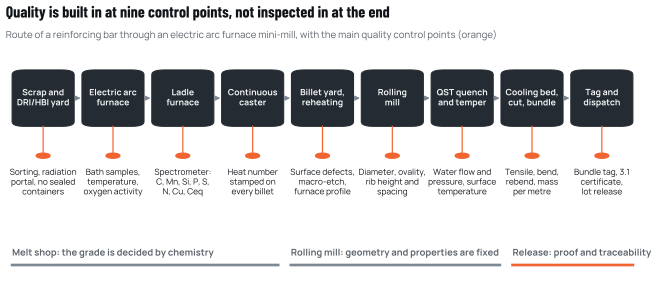
Source: Cameroon Steel schematic of a scrap and DRI based electric arc furnace route; control points reflect common factory production control practice under certification schemes [S31][S38].
Three of these points deserve emphasis because they are the ones most often missing in small mills.
The spectrometer. An optical emission spectrometer analyses a sample from each heat in a few minutes and reports carbon, manganese, silicon, phosphorus, sulphur, nitrogen, copper and the other residuals. Without it, a melt shop does not know its carbon equivalent, cannot correct a heat before casting, and cannot write a truthful certificate.
The heat number. Every cast receives a unique number that follows its billets through reheating and rolling and appears on the bundle tag and the inspection certificate. This is the backbone of traceability: when a bar fails a test on site, the heat number leads back to the chemistry, the casting date and every other bundle made from the same steel.
The quench line. In a QST mill, water flow, pressure and the bar’s surface temperature after quenching should be logged for every bar size and speed. These records explain variations in yield strength long before they produce a failed test.
2.4 Billets and rolling decide surface quality, dimensions and mass
A bar is only as sound as the billet it was rolled from. Continuous casting can leave porosity and segregation of carbon and sulphur along the axis of the billet, surface cracks and deep oscillation marks; rolled down, these become internal discontinuities, laps and seams that open when the bar is bent. Mills therefore inspect billets visually, cut and etch sample cross-sections to reveal internal soundness, and reject or condition defective billets before reheating. A re-roller that buys billets on the open market should demand the same evidence from its supplier, heat by heat.
Reheating sets the temperature at which rolling starts. Too cold, and mill loads rise while the finishing temperature, which drives the result of the quench, falls; too hot or too long, and the billet loses metal to thick scale and its grain coarsens. Scale that is not removed by descaling is rolled into the surface as pits and scabs.
The rolling mill then reduces the billet through a sequence of passes to the finished diameter. Two properties that a buyer can later measure are decided here: the diameter and ovality of the bar, which together set its mass per metre, and the rib geometry, which is cut into the finishing rolls. Both drift as rolls wear. A mill that redresses or changes its finishing rolls on schedule, and measures mass per metre and rib height at every roll change and every shift, holds its product near nominal; a mill that runs its rolls until they are visibly worn produces bars that become progressively lighter and less ribbed. Mass is also money: a mill that is paid per bar gains from every gram it does not roll, which is why the price regime discussed in the chapter on the quality infrastructure matters for quality.
Finally, bars are cooled on the cooling bed, straightened, cut to length (usually 12 m in Cameroon) and bundled, and each bundle receives a tag carrying the heat number, grade, diameter and date. This is the point at which traceability is preserved or lost. Bundles that mix bars from different heats, or tags printed without reference to a heat, break the chain that links a bar to its test results.
2.5 The carbon equivalent is the single best predictor of weldability
On Cameroonian sites, reinforcement cages are often tack-welded for convenience, and bars are sometimes lap-welded or welded to embedded plates. Whether this is safe depends on the steel’s hardenability, summarised by the carbon equivalent. The formula used by the European standards, derived from the International Institute of Welding expression, is:
Ceq = C + Mn/6 + (Cr + Mo + V)/5 + (Ni + Cu)/15
with all contents in per cent by mass [S31]. A Ceq of 0.50% or lower on the cast analysis is the condition for a reinforcing steel to be declared weldable under EN 10080 and its national versions [S31][S32][S38]. The American standard for weldable bars, ASTM A706, uses a different formula and caps the carbon equivalent at 0.55% [S41], while the general-purpose American bar standard, ASTM A615, sets no carbon-equivalent limit at all, which is why A615 bars are not assumed to be weldable without specific procedures [S40][S41]. Welding of reinforcing steel is itself governed by its own standard, EN ISO 17660-1, which assumes a weldable steel to begin with [S71].
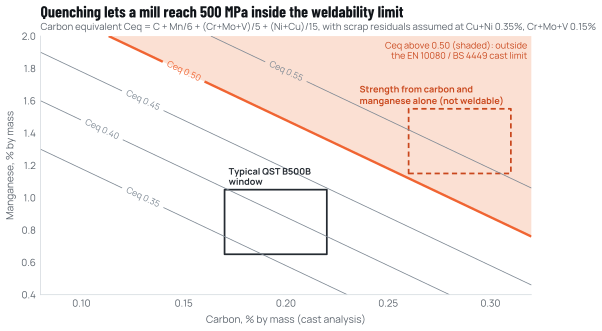
Source: Cameroon Steel calculation of the Ceq formula [S31] with assumed scrap residuals (Cu + Ni 0.35%, Cr + Mo + V 0.15%); limit from [S31][S32]. Windows are indicative.
The figure makes the trade-off visible. With typical scrap residuals, a QST bar at 0.17% to 0.22% carbon and 0.65% to 1.05% manganese sits between Ceq 0.35 and 0.47. A mill that tries to reach the same strength by air cooling alone needs much more carbon and manganese, and ends up above 0.55. Its bars may pass a tensile test and still produce brittle, cracked tack welds and heat-affected zones. For a buyer, the Ceq printed on an inspection certificate is therefore not a technicality: it says whether the bar was made by an honest route.
2.6 A small-mill industry is only as good as its scrap and its laboratory
Cameroon’s steel industry is a cluster of re-rollers and small melt shops, mostly in Douala, that convert imported billets and local scrap into rebar, wire rod, light sections and wire; installed rebar capacity was reported at 627 kt per year against domestic demand of about 180 kt [S53]. This structure has two consequences for quality.
First, the quality of a bar made from purchased billets depends on the billet supplier’s chemistry and on the re-roller’s reheating, rolling and cooling control. A re-roller that does not test incoming billets, or that mixes billets of different heats in one rolling campaign, loses traceability at the first step.
Second, mills that melt local scrap depend on its sorting. Mixed scrap brings copper wire, tinned cans, galvanised sheet, alloy steels and non-metallic contamination. Without sorting at the yard, a radiation portal and a spectrometer on every heat, residuals drift and the carbon equivalent with them. Cameroonian engineers have publicly linked poor bars to the use of informally collected scrap [S10]; whatever the merits of that claim for any individual producer, the metallurgical risk it describes is real and measurable.
The remedy is not exotic. It is a ladle furnace to refine and adjust each heat, a spectrometer to prove it, clean metallics such as DRI or hot briquetted iron to dilute residuals, a controlled quench line or microalloying practice, and a laboratory able to test every lot. These are the elements that certification schemes audit, as the chapter on testing describes.
2.7 Five questions reveal how a bar was made
A buyer cannot audit a melt shop, but five questions, put to a merchant or producer and answered with documents, reveal most of what matters about the route by which a bar was made:
- How was the steel melted and refined? An electric arc furnace followed by a ladle furnace can remove phosphorus and sulphur and adjust each heat; a furnace that only melts cannot. Re-rolled bars were not melted at all.
- Is every heat analysed, and is the carbon equivalent reported? A certificate that gives a full cast analysis and a Ceq for each heat shows that a spectrometer is in use; a certificate without chemistry shows nothing.
- How is grade 500 reached? Quenching and self-tempering or microalloying are honest routes; a carbon content above 0.22% combined with a high manganese content is not.
- Where do the billets come from? A re-roller should name its billet suppliers and hold their certificates by heat; billets of unknown origin make every downstream test less meaningful.
- Can a bundle be traced to its heat? A tag with a heat number that appears on a certificate, and a rolled-in mark on every bar, show that traceability is maintained to the end.
A producer who can answer all five with documents is running a controlled process. One who cannot answer the first three is asking the buyer to trust a label. The chapter on specification and acceptance turns these questions into contract clauses.
Sources cited in this chapter
Bracketed markers refer to these sources; the full list is in the annex. Full list of sources
- S31Certificat N° B03/176 rév. 16, aciers pour béton armé, NF A 35-080-1 nuance B500B (fiche descriptive and caractéristiques certifiées). Association Française de Certification des Armatures du Béton (AFCAB), AFNOR Certification, 6 Jun 2025.feralpi-stahl.com/sites/default/files/media/certifications/NF%20AFCAB-…
- S32Technical specification SPF400 rev. 12, Rebars B500 (chemical, mechanical and dimensional requirements under EN 10080 and national standards). Ferriere Nord S.p.A. (Pittini group), 14 Sep 2021.pittini.it/wp-content/uploads/Pittini-Group-Reinforcing-Steel-Bars-B50…
- S38BS 4449:2005+A3:2016 Steel for the reinforcement of concrete. Weldable reinforcing steel. Bar, coil and decoiled product. Specification. British Standards Institution (BSI), 2016.boutique.afnor.org/en-gb/standard/bs-44492005-a32016/steel-for-the-rei…
- S39EN 10080:2005 Steel for the reinforcement of concrete. Weldable reinforcing steel. General. CEN, 2005.standards.cencenelec.eu
- S48Tempcore: a new process for the production of high-quality reinforcing bars. Iron and Steel Engineer 61(3), pp. 53 to 57. P. Simon, M. Economopoulos, P. Nilles, 1984.openalex.org/W3176967943
- S49Corroded TempCore vs dual-phase steel reinforcing bars. Construction and Building Materials. S. Caprili, W. Salvatore, R. Valentini; Elsevier, 2021.doi.org/10.1016/j.conbuildmat.2021.122301
- S33Standards for reinforcement. The Concrete Centre (UK).concretecentre.com/Codes/European-standards-for-reinforcement.aspx
- S41ASTM A706/A706M Standard specification for deformed and plain low-alloy steel bars for concrete reinforcement. ASTM International, current edition.store.astm.org
- S40ASTM A615/A615M Standard specification for deformed and plain carbon-steel bars for concrete reinforcement. ASTM International, current edition.store.astm.org
- S71ISO 17660-1:2006 Welding, Welding of reinforcing steel, Part 1: Load-bearing welded joints (EN ISO 17660-1). ISO; CEN, 2006.iso.org
- S53Production: les acteurs en présence. Cameroon Tribune, 11 May 2026.cameroon-tribune.cm/article.html/76600/fr.html/details_2
- S10Interdiction des importations du fer à béton: les consommateurs dénoncent la mauvaise qualité de la production locale. EcoMatin, 13 Apr 2023.ecomatin.net/interdiction-des-importations-du-fer-a-beton-les-consomma…
- S01Kribi: le Premier ministre, chef du gouvernement est là. Cameroon Tribune, 30 Dec 2024.cameroon-tribune.cm/article.html/68499/fr.html/details_2
- S02Cameroun: complexe moderne de sidérurgie de Kribi, le PM Joseph Dion Ngute effectue la pose de la première pierre. Camer.be, 5 Jan 2025.camer.be/87795/12:1/cameroun-complexe-moderne-de-siderurgie-de-kribi-l…
- S03Industrialisation: la voie royale de l’émergence. Cameroon Tribune, 2 Jan 2025.cameroon-tribune.cm/article.html/68558/fr.html/details_2
Cite this chapter
Cameroon Steel (2026). Safer buildings need rebar that meets its declared grade. White paper 10, chapter 2: Good rebar is designed in the melt shop and fixed in the rolling mill. CS-WP-10. https://www.cameroon-steel.com/en/library/quality-steel/metallurgy-of-rebar/
Source