White paper 10 · Chapter 7
Specify the full grade, demand the proof and verify every delivery
Designers and contractors control the last two gates before steel disappears into concrete: the specification and the acceptance of deliveries. A specification that names the national grade, the ductility class, the weldability limit, the tolerances and the form of proof, and a contract that pays for steel by weight only after acceptance checks, will exclude most substandard bars at negligible cost. Public works contracts are the natural place to start, because the State is the largest single buyer of construction in Cameroon and can make certified steel a condition of payment.
In this chapter (8)
- 7.1 The specification is the designer’s first quality control
- 7.2 Read the mill certificate before the lorry is unloaded
- 7.3 Buy by weight and pay on acceptance
- 7.4 Good steel performs only if it is detailed and fixed correctly
- 7.5 Use third-party testing where it adds information
- 7.6 Public procurement can move the whole market
- 7.7 Masons and foremen make the last decision
- 7.8 A one-page acceptance record makes the routine stick
7.1 The specification is the designer’s first quality control
A structural design is a set of assumptions about materials. When an engineer designs a slab to Eurocode 2 with class B reinforcement, the calculation assumes a characteristic yield of 500 MPa, a strength ratio of at least 1.08, a strain at maximum force of at least 5%, adequate bond and, if the bars are to be welded, a weldable chemistry [S30][S36]. None of these assumptions reaches the site unless it is written into the specification and the contract. A drawing note that reads "steel: Fe500" transmits only the first.
The table below proposes model clauses that a Cameroonian specification can adopt. They combine the mandatory national grade with the properties that a Eurocode-based design relies on, and they define the evidence that the contractor must produce. They are a starting point for project-specific drafting, not a substitute for it.
Table 7.1 Model specification clauses for reinforcing steel in Cameroonian projects
| No. | Subject | Clause (summary) | Evidence required |
|---|---|---|---|
| 1 | Grade and standard | Ribbed bars to NC 236 grade Fe500, having in addition the properties of ductility class B of EN 1992-1-1 Annex C (B500B of BS 4449 or NF A 35-080-1) | ANOR conformity certificate; inspection certificate per heat |
| 2 | Ductility | Characteristic Agt ≥ 5.0% and Rm/Re ≥ 1.08; no test below the individual minima of the reference standard; class C where the engineer requires enhanced ductility | Tensile results per heat, with Agt measured to EN ISO 15630-1 |
| 3 | Overstrength | Ratio of actual to nominal yield not above 1.30 (characteristic) | Tensile results per heat |
| 4 | Weldability | Cast Ceq ≤ 0.50% where any welding, including tack welding, is permitted; otherwise no welding without the engineer’s written approval; welding to EN ISO 17660-1 | Cast analysis and Ceq on the certificate |
| 5 | Section | Mass per metre within ±4.5% (bars above 8 mm) or ±6.0% (8 mm and below) | Mass deviation per heat; site weighing |
| 6 | Bond | Relative rib area not less than the Eurocode 2 minimum, or rib geometry as certified | Certified rib geometry; site rib measurement |
| 7 | Marking and traceability | Rolled-in mill mark on every bar; bundle tags with heat numbers; type 3.1 inspection certificate to EN 10204 for every heat delivered | Tags, certificate and delivery note with matching heat numbers |
| 8 | Certification | Supplier’s ANOR certificate valid on the delivery date; third-party product certification preferred where available | Copy of certificate; validity confirmed |
| 9 | Acceptance on site | Paperwork, marking, weighing, measuring and bend checks on each delivery; laboratory tests on samples taken by the engineer where any check fails, for uncertified supply and for critical works | Site acceptance record; laboratory reports |
| 10 | Non-conformity | Non-conforming lots quarantined, removed and replaced at the supplier’s cost; report to the engineer and to ANOR | Non-conformity record |
| 11 | Measurement and payment | Steel measured and paid by mass (kg), at nominal mass for accepted bars; no payment for rejected lots | Weighbridge tickets; reconciled schedules |
| 12 | Bending and fixing | Cold bending only, to the mandrel diameters of the design code and BS 8666 or equivalent; no heating; no rebending of bent bars without approval | Bar schedules; inspection before concreting |
| 13 | Substitution | No change of size, grade or standard without the engineer’s written approval; equivalence must be shown property by property (Agt, Rm/Re, Ceq, mass) | Comparison sheet with certificates |
| 14 | Storage | Bars stored off the ground, covered, segregated by size and grade, protected from sea spray | Site inspection |
Source: Cameroon Steel proposal, based on [S04][S05][S30][S31][S36][S38][S44][S46][S67][S71]. Model wording for adaptation by the project engineer; not legal advice.
Three of these clauses deserve a comment because they change behaviour rather than paperwork.
Clause 4 (weldability) addresses a practice that is common and rarely specified: tack-welding cages for convenience. A tack weld on a high-carbon or high-Ceq bar creates a hard, brittle spot that can crack under load or during bending, at exactly the point where the bar must later carry tension. Either the steel is certified weldable and the welding is controlled, or there is no welding.
Clause 11 (payment by mass) aligns the contractor’s and the owner’s interests with the quality of the product. A contractor paid per tonne of accepted steel has no incentive to buy light bars, because the measurement of his payment is the mass that the bars actually have.
Clause 13 (substitution) prevents the most common route by which a carefully specified grade is lost: a supplier or contractor proposes an "equivalent" product late in the job, under time pressure. The comparison table in the standards chapter shows why equivalence must be demonstrated property by property.
7.2 Read the mill certificate before the lorry is unloaded
The inspection certificate is the document that links a delivery to the evidence of its quality. Under EN 10204, a type 3.1 certificate reports the results of specific tests on the products supplied, validated by the manufacturer’s inspection representative who is independent of production [S46]. Six checks take less time than unloading the lorry.
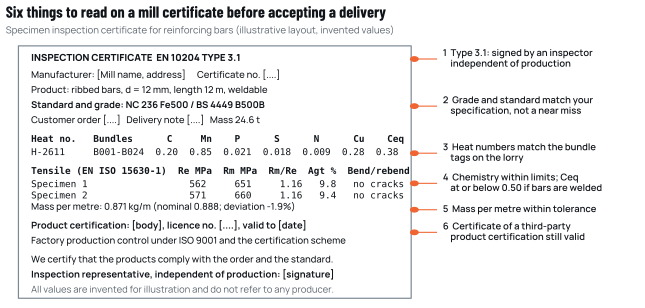
Source: Cameroon Steel illustrative layout, after the content requirements of EN 10204 [S46] and the European product standards [S31][S38]. All names and values are invented.
First, the type of document. A type 2.2 test report gives results for similar production, not for the steel delivered, and is not sufficient for structural reinforcement [S46]. A type 3.1 certificate is the minimum; a 3.2, countersigned by a third party, can be required for critical works.
Second, the standard and grade. The certificate must name the grade specified, not a near miss. "Fe450", "Fe500 type" or a foreign grade without demonstrated equivalence are not the grade specified. The Fe450 episode of 2024 showed that grades outside the national catalogue can reach the market [S04][S05].
Third, the heat numbers. Each heat on the certificate must match a tag on the bundles delivered, and every bundle’s tag must appear on the certificate. Bundles whose heat numbers do not appear are, in effect, uncertified.
Fourth, the chemistry. The cast analysis should show carbon, phosphorus, sulphur, nitrogen and copper within the limits of the reference standard, and a carbon equivalent of 0.50% or below if any welding is permitted [S31][S32].
Fifth, the mechanical results and mass. Each heat should show Re, Rm, Rm/Re and Agt, the bend or rebend result and the mass deviation. Results that sit just above every minimum, heat after heat, deserve a closer look; real production shows scatter.
Sixth, the certification. The certificate should cite the product certificate (ANOR, and any third-party scheme) by number, and the buyer should confirm that it is current. Certification bodies such as AFCAB publish the validity of their certificates online so that any buyer can check them [S31].
A certificate is a document, and documents can be copied or altered. Photocopied certificates with handwritten heat numbers, certificates whose results are identical for every heat, or certificates from a producer whose rolled-in mark does not appear on the bars should all trigger laboratory testing.
7.3 Buy by weight and pay on acceptance
The chapter on the quality infrastructure showed that homologated prices are set per bar. On site, many purchases are also made per bar. The figure below shows what this means for the buyer.
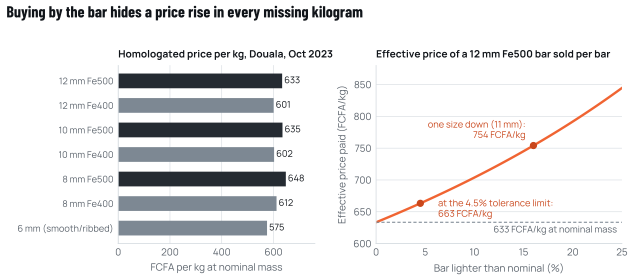
Source: homologated prices [S11]; price per kilogram derived by Cameroon Steel from nominal masses (Annex A).
A contractor who buys light bars therefore pays more per kilogram of steel, and gets less steel in the structure. The arithmetic gives the owner a simple defence: specify, measure and pay for reinforcement by mass, as bills of quantities normally do, and reconcile the mass delivered (from weighbridge tickets or from weighing on site) with the number of bars and their nominal mass. A delivery of 1,000 bars of 12 mm should weigh about 10.66 t; if it weighs 9.5 t, either the count or the bars are wrong (derived).
7.4 Good steel performs only if it is detailed and fixed correctly
Certified bars can still be wasted by poor detailing and fixing. Four points are worth enforcing on every site. Bending: bars must be bent cold round formers of adequate diameter; BS 8666, the British standard for scheduling and bending reinforcement, sets minimum former diameters that increase with bar size, of the order of four bar diameters for the common sizes [S67]. Bending a bar round a nail or a sharp edge concentrates strain and can crack even a good bar. Laps and anchorages: the lap and anchorage lengths of design codes assume bars of the specified bond and concrete of the specified strength; shortened laps, laps all placed at the same section, or laps in zones of high tension are common causes of distress. Links: column and beam links confine the concrete and restrain the main bars from buckling; they must be closed with hooks bent far enough to anchor into the core, and spaced as drawn, especially near joints. Cleanliness and position: bars must be free of loose rust, mud and oil, tied so that they do not move during concreting, and held at the specified cover by spacers.
A short inspection of the reinforcement before each pour, against the drawings and bar schedules, catches most of these errors while they are still cheap to correct. The engineer’s inspection record, signed before concrete is ordered, is the counterpart for fixing of the acceptance record for delivery.
7.5 Use third-party testing where it adds information
Laboratory testing of rebar on behalf of the owner is most valuable in five situations: when the supplier is not certified; on the first delivery from a new supplier; when any site check has failed or any document is missing; for critical buildings such as schools, hospitals and buildings of several storeys; and on a sample basis throughout a large project to keep the supply honest.
The value of a test depends on how the sample is taken. Samples should be selected and cut by the engineer’s representative, not by the supplier, from bars chosen at random in the delivery, labelled with the heat number, sealed and transported with a simple chain-of-custody record to a competent laboratory, preferably accredited to ISO/IEC 17025 [S55]. The laboratory should test to EN ISO 15630-1 or the method of the specified standard [S44] and report every result, not only a pass or fail.
Interpreting a small number of tests also needs care. Three tensile results cannot prove a characteristic value, which is a statement about a whole production and requires statistical evidence (see the testing chapter). A practical acceptance rule for a lot is that every result must meet the individual minimum values of the reference standard, and that the mean of the results should comfortably exceed the characteristic values. A lot that meets the individual minima only narrowly, with a low mean, should be treated as suspect and investigated further, typically with more samples.
7.6 Public procurement can move the whole market
The State is the largest buyer of construction in Cameroon. The 2026 State budget allocates 2,026.3 billion FCFA to public investment [S80], a large share of which becomes concrete buildings, bridges, culverts and drainage works. Public works are procured under the public procurement code set by Decree No. 2018/366 of 20 June 2018 [S54], with standard bidding documents published by the Ministry of Public Contracts.
Three changes in public procurement would raise the floor for the whole market:
- A standard clause in the technical specifications of every public works contract requiring certified NC 236 bars with the properties of ductility class B, type 3.1 inspection certificates and site acceptance checks, along the lines of the table above.
- Payment conditions that make certified steel a condition of payment: interim certificates for reinforced concrete work would require the acceptance records and certificates for the steel used.
- Supervision that includes materials: the supervising engineer’s terms of reference would include rebar acceptance checks and a sampling plan for laboratory testing.
Projects financed by development banks already follow international standards and supervision rules. Aligning national procurement with that practice would create a large, stable demand for certified steel, which in turn rewards the producers who invest in quality control. Private buyers would follow, particularly where lenders and insurers ask for evidence of material quality before financing or covering a building.
7.7 Masons and foremen make the last decision
Specifications and certificates are read in offices; bars are accepted, cut and bent on site by foremen and masons. In most Cameroonian building, and especially in owner-built housing, there is no engineer present when steel is delivered. The quality of the steel actually built into a house therefore depends on what the person unloading it knows.
Five habits make the difference and can be taught in a day: refuse bars without a rolled-in mark; weigh three bars of each size; bend a sample cold; never heat a bar to bend it; and store bars off the ground and under cover. A sixth, ensuring the specified concrete cover with proper spacers, belongs to durability and is discussed in the next chapter. Before concrete is poured, the reinforcement should be inspected against the drawings: bar sizes and numbers, spacing, laps, links, cover and cleanliness.
7.8 A one-page acceptance record makes the routine stick
Routines survive on paper. A one-page acceptance record, completed for every delivery and kept with the site diary, makes the checks described above auditable and links them to payment. It needs only ten entries:
- Date, supplier and delivery note number.
- Diameters and number of bars or bundles delivered, and the delivered mass from the weighbridge ticket.
- Heat numbers read on the tags.
- Inspection certificate numbers and type (3.1 or 3.2), and whether every heat on the tags appears on a certificate.
- Product certificate (ANOR, and any third-party scheme) and its validity on the day.
- Rolled-in mark observed on the bars, and whether it matches the certificate.
- Masses and lengths of the bars weighed, and the computed kg/m against the minimum allowed.
- Rib spacing and height measured on one bar per diameter.
- Result of the bend test on one sample per diameter.
- Decision (accept, quarantine for testing, reject), with the name and signature of the person responsible.
Kept consistently, these records do more than protect a single building. They give the owner evidence for payment, the engineer evidence for sign-off and the supplier feedback on its product; shared with ANOR when a delivery fails, they give the market surveillance system the information it needs to target its sampling.
Sources cited in this chapter
Bracketed markers refer to these sources; the full list is in the annex. Full list of sources
- S30EN 1992 Eurocode 2: Design of concrete structures (J. Walraven), workshop "Eurocodes: background and applications", Brussels, 18 to 20 Feb 2008. European Commission (DG Enterprise and Industry, Joint Research Centre), Feb 2008.eurocodes.fi/wp-content/uploads/1992/sahkoinen1992/EN-1992.pdf
- S36EN 1992-1-1:2004 Eurocode 2: Design of concrete structures, Part 1-1: General rules and rules for buildings (with corrigenda). European Committee for Standardization (CEN), 2004.eurocodes.jrc.ec.europa.eu/EN-Eurocodes/eurocode-2-design-concrete-str…
- S04Cameroun: pour non-respect des normes, le fer à béton de la société […] retiré du marché (name of the producer omitted here). EcoMatin, 21 Oct 2024.Cited by title and date
- S05Cameroon revokes […] compliance certificate for rebar, orders recall of products (name of the producer omitted here). Business in Cameroon, 17 Oct 2024.Cited by title and date
- S31Certificat N° B03/176 rév. 16, aciers pour béton armé, NF A 35-080-1 nuance B500B (fiche descriptive and caractéristiques certifiées). Association Française de Certification des Armatures du Béton (AFCAB), AFNOR Certification, 6 Jun 2025.feralpi-stahl.com/sites/default/files/media/certifications/NF%20AFCAB-…
- S38BS 4449:2005+A3:2016 Steel for the reinforcement of concrete. Weldable reinforcing steel. Bar, coil and decoiled product. Specification. British Standards Institution (BSI), 2016.boutique.afnor.org/en-gb/standard/bs-44492005-a32016/steel-for-the-rei…
- S44ISO 15630-1:2019 Steel for the reinforcement and prestressing of concrete, Test methods, Part 1: Reinforcing bars, rods and wire (EN ISO 15630-1). ISO; CEN, 2019.iso.org
- S46EN 10204:2004 Metallic products, Types of inspection documents. CEN, 2004.standards.cencenelec.eu
- S67BS 8666:2020 Scheduling, dimensioning, cutting and bending of steel reinforcement for concrete. Specification. BSI, 2020.knowledge.bsigroup.com
- S71ISO 17660-1:2006 Welding, Welding of reinforcing steel, Part 1: Load-bearing welded joints (EN ISO 17660-1). ISO; CEN, 2006.iso.org
- S32Technical specification SPF400 rev. 12, Rebars B500 (chemical, mechanical and dimensional requirements under EN 10080 and national standards). Ferriere Nord S.p.A. (Pittini group), 14 Sep 2021.pittini.it/wp-content/uploads/Pittini-Group-Reinforcing-Steel-Bars-B50…
- S11Fer à béton: les producteurs acceptent une baisse des prix. EcoMatin, 23 Oct 2023.ecomatin.net/fer-a-beton-les-producteurs-acceptent-une-baisse-des-prix
- S55ISO/IEC 17025:2017 General requirements for the competence of testing and calibration laboratories. ISO; IEC, 2017.iso.org
- S80Budget 2026: 8 816,4 milliards FCFA pour consolider la stabilité et accélérer le développement du Cameroun. Ministry of Finance (MINFI), 26 Nov 2025.minfi.gov.cm/budget-2026-8-8164-milliards-fcfa-pour-consolider-la-stab…
- S54Agence de Régulation des Marchés Publics, website (references to Decree No. 2018/366 of 20 June 2018 on the public procurement code). ARMP.armp.cm
Cite this chapter
Cameroon Steel (2026). Safer buildings need rebar that meets its declared grade. White paper 10, chapter 7: Specify the full grade, demand the proof and verify every delivery. CS-WP-10. https://www.cameroon-steel.com/en/library/quality-steel/specifying-and-accepting/
Source