White paper 10 · Chapter 8
On the coast, cover and concrete protect the bar more than the steel itself
In Douala and Kribi, mean relative humidity stays above 80% in every month and averages close to 90%, rainfall at Kribi exceeds 2,800 mm a year, and sea spray carries chlorides inland. Corrosion of reinforcement is therefore the main long-term threat to concrete buildings on the coast. A bar is protected by the alkalinity of sound concrete and by the thickness of the cover, not by its own chemistry; coatings and stainless steel help only where exposure is severe. The decisive measures are cover, concrete quality and curing, which Eurocode 2 and EN 206 set by exposure class, and which have to be enforced on site with spacers and inspection.
In this chapter (7)
- 8.1 Steel in concrete is protected by chemistry until the cover is breached
- 8.2 The coastal climate is aggressive in every month
- 8.3 Eurocode 2 and EN 206 set cover and concrete quality by exposure class
- 8.4 Cover is lost on site, not in the design office
- 8.5 Six practical rules protect reinforcement on coastal sites
- 8.6 Coatings and stainless steel are for the most severe exposures
- 8.7 Rebar quality and durability interact in three ways
8.1 Steel in concrete is protected by chemistry until the cover is breached
Fresh concrete is strongly alkaline. In that environment a thin, stable oxide film forms on the steel surface and protects it: the bar is passive. Two processes destroy this protection. Carbonation: carbon dioxide from the air diffuses into the concrete and gradually lowers its alkalinity; when the carbonated front reaches the bar, the passive film is lost over a wide area. Chlorides, from sea spray, sea water, contaminated sand or aggregates, or some admixtures, diffuse inwards and, once their concentration at the bar exceeds a threshold, break the passive film locally, causing pitting.
Once the film is lost and moisture and oxygen are present, the steel corrodes. Rust occupies several times the volume of the steel it replaces, so it pushes the cover off: first a crack along the bar, then spalling, then exposed and thinning bars. The service life of a reinforced concrete element is usually described in two stages, after the model proposed by Tuutti: an initiation period, during which carbonation or chlorides travel through the cover to the bar, and a propagation period, during which corrosion progresses until cracking, spalling and loss of section become unacceptable [S65].
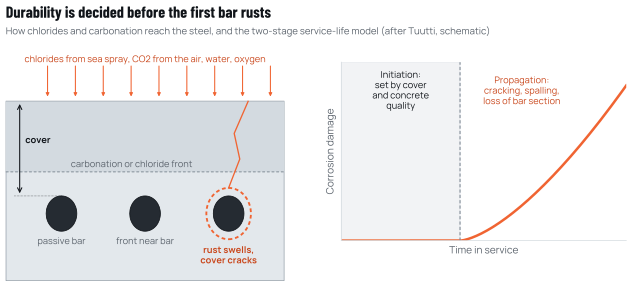
Source: Cameroon Steel schematic, after the two-stage service-life model of Tuutti [S65].
This model explains why durability is decided long before any rust appears. The length of the initiation period depends almost entirely on two things the designer and the builder control: how thick the cover is, and how hard it is for carbon dioxide and chlorides to move through the concrete. The steel’s own quality matters too, but mostly in a different way: a bar that is light or brittle to begin with has less margin to lose when corrosion starts.
8.2 The coastal climate is aggressive in every month
Steel corrodes fastest when its surface is wet. International practice, codified in ISO 9223, counts the "time of wetness" as the time during which relative humidity exceeds 80% at temperatures above freezing [S47]. On that measure the Cameroonian coast is wet almost all year. Modelled climatology for 1991 to 2020 gives mean relative humidity of 89% at Kribi and 88% at Douala, with no month below 80% at Kribi; Yaoundé averages 86%, while Garoua, in the dry north, averages 53% with a long dry season [S50]. Station records at Kribi show daily maxima of 92% to 96%, daily minima of 70% to 78% and annual rainfall of about 2,836 mm [S51]. Mean temperatures of about 26 °C in both coastal cities [S50] accelerate every chemical process involved.
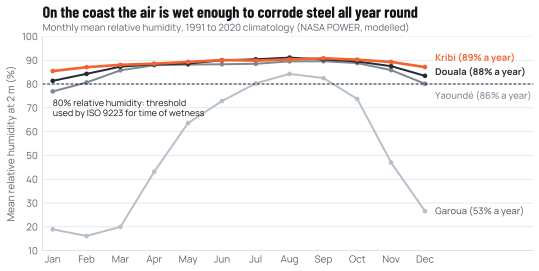
Source: NASA POWER climatology 1991 to 2020, modelled at the location of each city [S50]; threshold from ISO 9223 [S47].
ISO 9223 classifies the corrosivity of atmospheres from C1 (very low) to CX (extreme) on the basis of the first-year corrosion loss of reference metal samples; for carbon steel the bands rise from below about 1.3 µm per year in C1 to 50 to 80 µm in C4 and 80 to 200 µm in C5 [S47]. Coastal sites exposed to salt spray commonly fall in the high categories. No published measured corrosivity map exists for the Cameroonian coast, and this paper does not assign a category to any location (see the evidence-gaps chapter). What can be said is that the combination of permanent humidity, warmth and airborne salt places buildings within reach of the sea in the most demanding exposure classes of the design codes.
The atmospheric category matters for exposed steel, such as bars left waiting on site or starter bars protruding from a slab for months. For bars inside concrete, the relevant classification is the exposure class of the concrete, discussed next.
8.3 Eurocode 2 and EN 206 set cover and concrete quality by exposure class
European practice links durability to a small number of exposure classes defined in EN 206 and used by Eurocode 2 [S36][S37]. For reinforcement corrosion the important ones are XC (corrosion induced by carbonation, in four levels from dry to cyclically wet), XD (chlorides other than from sea water) and XS (chlorides from sea water): XS1 for structures exposed to airborne salt but not in direct contact with sea water, XS2 for permanently submerged parts and XS3 for tidal, splash and spray zones [S36][S37].
For each class, Eurocode 2 gives a minimum cover for durability and EN 206 recommends limiting values for the concrete. The table summarises the recommended values for a 50-year design life (structural class S4); national annexes may modify them, and the status of a Cameroonian national annex to Eurocode 2 could not be confirmed from public sources (see the evidence-gaps chapter).
Table 8.1 Recommended minimum cover and concrete limits by exposure class (Eurocode 2 and EN 206, recommended values)
| Exposure class | Typical situation in Cameroon | Minimum cover for durability, cmin,dur (mm) | Nominal cover with 10 mm tolerance (mm) | Maximum water/cement ratio | Minimum strength class | Minimum cement content (kg/m³) |
|---|---|---|---|---|---|---|
| XC1 | Interiors of dry or air-conditioned buildings | 15 | 25 | 0.65 | C20/25 | 260 |
| XC2 | Foundations, permanently wet | 25 | 35 | 0.60 | C25/30 | 280 |
| XC3 | Sheltered exterior, humid interiors (kitchens, bathrooms) | 25 | 35 | 0.55 | C30/37 | 280 |
| XC4 | Facades, balconies and columns exposed to rain | 30 | 40 | 0.50 | C30/37 | 300 |
| XS1 | Buildings near the coast exposed to airborne salt | 35 | 45 | 0.50 | C30/37 | 300 |
| XS2 | Parts permanently submerged in sea water | 40 | 50 | 0.45 | C35/45 | 320 |
| XS3 | Tidal, splash and spray zones: quays, sea walls, beach fronts | 45 | 55 | 0.45 | C35/45 | 340 |
Source: EN 1992-1-1 Table 4.4N (structural class S4) and recommended allowance for deviation of 10 mm [S36]; EN 206 Annex F recommended limiting values [S37]. Recommended values; the cover must also be at least the bar diameter for bond, and national provisions may differ.
The older French rules for reinforced concrete, BAEL 91, which shaped the training of many engineers in francophone Africa, set the same order of magnitude: 5 cm of cover for works exposed to the sea or to salt spray, 3 cm for faces exposed to weather or condensation [S82]. Whatever code is used, the message is consistent: within reach of the sea, structural concrete needs about 45 mm or more of cover and a dense concrete with a low water/cement ratio.
8.4 Cover is lost on site, not in the design office
Durability failures in coastal buildings rarely start with a wrong number on a drawing. They start on site, in five ways:
- No spacers. Bars laid on the formwork or on stones end up with 10 mm of cover or less, whatever the drawing says. Purpose-made concrete or plastic spacers, fixed at close centres, are the cheapest durability measure available.
- Water added for workability. Site-batched concrete is often made wetter so that it can be placed by hand. Every litre of extra water raises the water/cement ratio and the permeability of the cover.
- Poor compaction. Honeycombed concrete around bars offers almost no protection.
- No curing. In hot, windy conditions the surface layer dries before the cement has hydrated, leaving the outer 20 to 30 mm, the cover itself, the most porous part of the element.
- Contaminated materials. Unwashed beach sand or sea water used in mixing brings chlorides directly to the bar from the first day.
The effect of cover and concrete quality on the time before corrosion can start is strongly non-linear. A simple diffusion model, with assumed but plausible parameters, shows the pattern: the time to initiation grows with the square of the cover, so doubling the cover roughly quadruples it, and a dense concrete with supplementary cementitious materials can multiply it again by a factor of three or more compared with ordinary concrete.
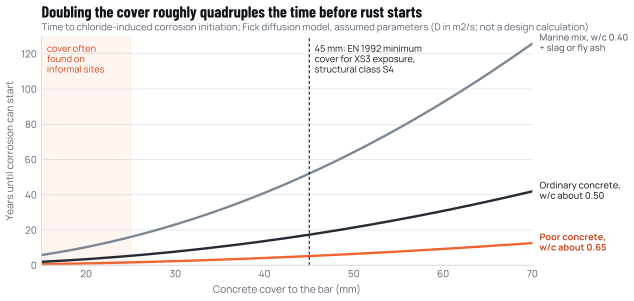
Source: Cameroon Steel calculation with Fick’s second law, constant diffusion coefficients and surface chloride content of 1.5% and threshold of 0.4% by mass of binder (assumptions, Annex A). Illustrative of trends only; not a design method.
The absolute numbers in the figure depend on assumptions and should not be used for design; real diffusion coefficients fall over time as concrete matures, which lengthens the times shown. The relative effects are robust, and they are large. They also explain an observation made after the July 2023 collapse in Douala, where residents described exposed and rusted reinforcing rods on the building before it fell [S20]: rust staining and spalling are the visible end of a process that began, years earlier, with insufficient cover or permeable concrete.
8.5 Six practical rules protect reinforcement on coastal sites
Translated into site practice, the durability requirements reduce to six rules that any contractor can follow:
- Fix spacers of concrete or plastic, of the thickness of the specified cover, at close centres under bottom bars and against side forms, and tie them so that they stay in place during concreting.
- Check the cover before every pour with a rule at a sample of points, and correct any bar that sits on the formwork; after striking, a cover meter can confirm the result on critical elements.
- Hold the water/cement ratio: batch or order concrete to the specified mix and do not add water at the pour; where workability is needed, use a plasticising admixture instead of water.
- Use clean materials: washed sand and fresh water only, never sea water or unwashed beach sand, which bring chlorides straight to the bar.
- Cure the concrete: keep exposed surfaces wet or covered for several days after casting, longer in hot and windy weather, so that the cover, the outer layer that protects the steel, is not the most porous part of the element.
- Protect waiting steel: starter bars and bars stored near the sea should be protected or cleaned of loose rust before they are cast in, and stockpiles kept off the ground and under cover.
Maintenance completes the picture. Cracks along bars, rust stains and spalling are early warnings; repairing them promptly, by removing contaminated or carbonated concrete around the bar, cleaning the steel and restoring the cover with a suitable repair mortar, costs far less than replacing a corroded element later.
8.6 Coatings and stainless steel are for the most severe exposures
Where cover and concrete quality cannot provide enough protection on their own, or where the consequences of corrosion are severe, the bar itself can be protected. Each option has costs and conditions.
Table 8.2 Options for protecting reinforcement in aggressive exposures
| Option | Standard | How it protects | Conditions and limitations | Where it makes sense in Cameroon |
|---|---|---|---|---|
| Uncoated carbon steel with adequate cover and dense concrete | EN 1992-1-1, EN 206 | Alkalinity of the concrete; slow ingress through thick, low-permeability cover | Depends entirely on site execution: spacers, compaction, curing | The default for all buildings, including coastal ones |
| Low-permeability concrete with slag or fly ash | EN 206 | Reduces chloride diffusion and binds chlorides | Needs mix design, supply of materials and longer curing | Coastal buildings, marine structures, foundations in saline ground |
| Hot-dip galvanised bars | ASTM A767 | Zinc layer, sacrificial to steel | Bending before galvanising or controlled after; damaged areas need repair; less effective at high chloride levels | Facades and balconies near the sea, architectural concrete |
| Epoxy-coated bars | ASTM A775, ASTM A934 | Barrier coating isolates steel | Coating easily damaged in handling and bending; longer anchorage lengths; site repair of damage essential | Marine and industrial structures with controlled handling |
| Stainless steel bars | BS 6744 | Corrosion-resistant alloy | High material cost; used selectively in the most exposed zones; check compatibility with carbon-steel bars | Splash zones of quays, sea walls, critical elements |
| Corrosion inhibitors, coatings on concrete, cathodic protection | Various | Slow corrosion chemically or electrically | Specialist design and maintenance | Port and marine structures, repairs |
Source: [S36][S37] for cover and concrete; [S58][S59][S60] for coated and stainless bars. Qualitative summary.
For most buildings the first two rows are the right answer. Coated and stainless bars are expensive tools for specific problems, and a coated bar placed with 15 mm of cover in a porous concrete gives little more protection than a plain one.
8.7 Rebar quality and durability interact in three ways
The steel’s own quality still matters for durability, for three reasons.
Section reserve. Corrosion removes steel. A bar that was 10% light on delivery reaches any critical loss of section 10% sooner. Durability margins and mass tolerances are the same margin, seen from two ends of a building’s life.
Ductility after corrosion. Pitting does not only remove section; it concentrates strain at the pits, so corroded bars lose ductility faster than they lose strength. Research on corroded bars, including quenched and self-tempered bars, has documented this behaviour and compared steel types [S49]. A bar that starts with good ductility retains a useful margin after some corrosion; a bar that starts with little may become brittle.
Condition on arrival. Bars that arrive heavily rusted or pitted, or that have been stored for months near the sea, start life with damage. The wire-brush and weighing check described in the chapter on defects applies here, and storage rules in specifications matter more on the coast than anywhere else.
Sources cited in this chapter
Bracketed markers refer to these sources; the full list is in the annex. Full list of sources
- S65Corrosion of steel in concrete. CBI Research Report 4:82. K. Tuutti; Swedish Cement and Concrete Research Institute, Stockholm, 1982.Cited by title and date
- S47ISO 9223:2012 Corrosion of metals and alloys, Corrosivity of atmospheres, Classification, determination and estimation. ISO, 2012.iso.org
- S50POWER climatology API, parameters T2M, RH2M, PRECTOTCORR, 1991 to 2020, at Douala, Kribi, Yaoundé and Garoua. NASA Langley Research Center.power.larc.nasa.gov/api/temporal/climatology/point?parameters=T2M,RH2M…
- S51Monographie du Nyong et des fleuves côtiers, tome 1 (climate records for Kribi). J.-C. Olivry; ORSTOM and IRGM, Jul 1979.horizon.documentation.ird.fr/exl-doc/pleins_textes/divers11-03/01948.p…
- S36EN 1992-1-1:2004 Eurocode 2: Design of concrete structures, Part 1-1: General rules and rules for buildings (with corrigenda). European Committee for Standardization (CEN), 2004.eurocodes.jrc.ec.europa.eu/EN-Eurocodes/eurocode-2-design-concrete-str…
- S37EN 206:2013+A2:2021 Concrete: specification, performance, production and conformity. CEN, 2021.standards.cencenelec.eu
- S82BAEL 91 révisé 99: Règles techniques de conception et de calcul des ouvrages et constructions en béton armé suivant la méthode des états limites. CSTB; Eyrolles (Fascicule 62, titre I, section I), 2000.Cited by title and date
- S20Officials to Investigate After Cameroon Building Collapse Kills Over 30. VOA Africa, 24 Jul 2023.voaafrica.com/a/cameroon-building-collapse-kills-over-30-/7193868.html
- S58ASTM A775/A775M Epoxy-coated steel reinforcing bars; ASTM A934/A934M Epoxy-coated prefabricated steel reinforcing bars. ASTM International, current editions.store.astm.org
- S59ASTM A767/A767M Zinc-coated (galvanized) steel bars for concrete reinforcement. ASTM International, current edition.store.astm.org
- S60BS 6744:2016 Stainless steel bars for the reinforcement of and use in concrete. BSI, 2016.knowledge.bsigroup.com
- S49Corroded TempCore vs dual-phase steel reinforcing bars. Construction and Building Materials. S. Caprili, W. Salvatore, R. Valentini; Elsevier, 2021.doi.org/10.1016/j.conbuildmat.2021.122301
Cite this chapter
Cameroon Steel (2026). Safer buildings need rebar that meets its declared grade. White paper 10, chapter 8: On the coast, cover and concrete protect the bar more than the steel itself. CS-WP-10. https://www.cameroon-steel.com/en/library/quality-steel/corrosion-and-durability/
Source