White paper 10 · Chapter 4
Cameroon has the legal tools for rebar quality; surveillance and testing are the gaps
Cameroon already has a law on standardisation, a standards agency that writes standards, certifies products and checks imports, a mandatory rebar standard, an import ban that channels demand to domestic mills and a price-homologation regime. Since 2021 these rules have tightened quickly, and between 2024 and 2026 the State showed that it would enforce the rebar standard and refuse to dilute it. What remains weak is the layer between the mill gate and the building: routine sampling at merchants, published results, accredited testing capacity in every main city, and acceptance checks on site.
In this chapter (7)
- 4.1 A complete legal chain runs from the 1996 law to a mandatory rebar standard
- 4.2 The State has enforced the standard and refused to dilute it
- 4.3 The import ban and PECAE decide where the quality risk sits
- 4.4 Overcapacity sharpens price competition and raises the stakes of enforcement
- 4.5 Prices are homologated per bar, which quietly rewards light bars
- 4.6 The weak links are surveillance, testing capacity and the site
- 4.7 Neighbouring markets are moving in the same direction
4.1 A complete legal chain runs from the 1996 law to a mandatory rebar standard
The foundation is Law No. 96/11 of 5 August 1996 on standardisation. Decree No. 2009/296 of 17 September 2009 organises the Agence des Normes et de la Qualité (ANOR), and a Prime Minister’s circular of 12 November 2010 frames the national standardisation programmes [S14]. By October 2024 Cameroon had enacted about 3,000 national standards (normes camerounaises, NC) [S14]. As in most countries, a standard is voluntary unless a regulatory text makes it mandatory [S14].
ANOR describes its mission in three parts: standardisation (drafting, homologating and revising Cameroonian standards with technical committees), certification (of products and systems, including the conformity assessment of imports before shipment), and quality control and market surveillance, including the withdrawal of products that do not conform to the standards in force [S16]. Its standards are drafted in technical committees following ISO/IEC procedures and are put to public enquiry before homologation; two enquiries on draft standards were open on 10 October 2026 [S74][S75]. ANOR also relays the work of the African Organisation for Standardisation (ARSO) [S74].
For reinforcing steel, the decisive step was taken on 20 April 2022, when an order of the Ministry of Mines, Industry and Technological Development (MINMIDT) made the national rebar standard NC 236 mandatory, among other standards made mandatory that day [S04][S09]. The standard recognises ribbed bars of grades Fe400 and Fe500 and smooth bars of grades Fe215 and Fe235; other grades cannot lawfully be placed on the market as conforming rebar [S05].
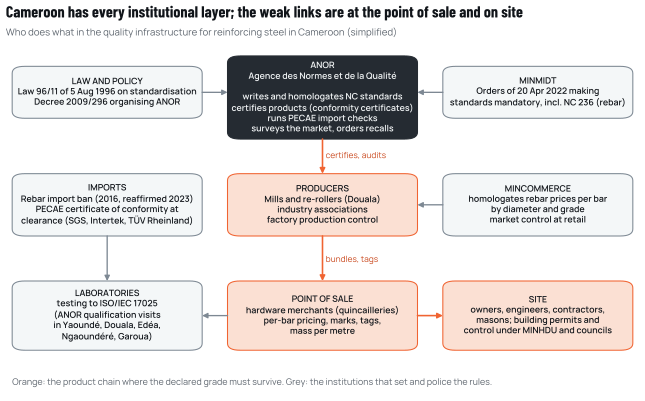
Source: Cameroon Steel, from [S04][S05][S09][S11][S12][S14][S15][S16][S18][S20]. Simplified; not an organisational chart of any institution.
4.2 The State has enforced the standard and refused to dilute it
Three episodes between 2023 and 2026 show how the system behaves under pressure.
Counterfeit and substandard bars, 2023. In June 2023 an industry body of steel processors and a consumer foundation publicly denounced rebar sold as grade 500 that reportedly did not even meet the requirements of grade 400; ANOR was among the authorities they contacted [S09]. Two months earlier, after the import ban was reaffirmed, engineers and property developers had complained in the press about the quality of some locally produced bars, which producers disputed [S10].
A certificate withdrawn, 2024. On 15 January 2024 ANOR had issued a conformity certificate to a Douala producer covering bars of grades Fe400, Fe450 and Fe500. After the steel processors’ organisation reported on 9 October 2024 that a product was being sold under a certificate that did not exist for it, and after the Minister of Commerce wrote on 15 October, ANOR’s Director General withdrew the certificate on 16 October 2024 and ordered the recall of all Fe450 bars on the market, because NC 236 does not provide for that grade [S04][S05]. The Minister of Commerce had expressed concern that unapproved bars could endanger building safety [S05].
A revision refused, 2026. On 28 November 2025 a second industry association asked for the standard to be revised. On 19 January 2026 the Prime Minister’s office replied that a revision appeared inappropriate in the current context of a fast-growing sector; the press linked the decision to deadly collapses and to the State’s effort to clean up and structure the industry [S06][S07][S08].
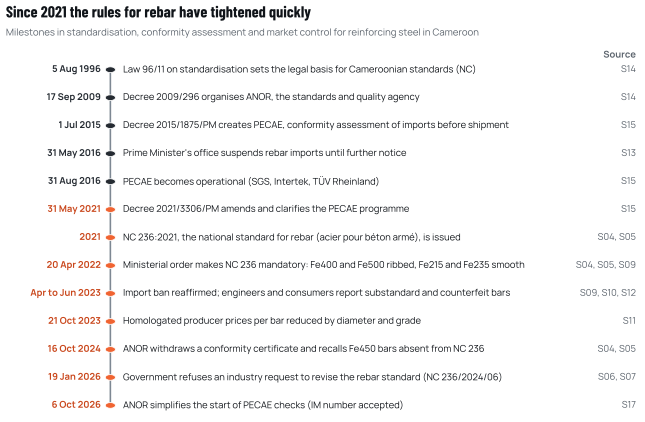
Source: as listed in the figure; Annex C.
The lesson of the Fe450 episode is not about one producer. It is that a grade catalogue only protects buyers if labels mean one thing. An intermediate grade that the standard does not recognise cannot be designed with, because no design code gives its properties, and it confuses buyers who read "450" as "almost 500". By holding the catalogue to Fe400 and Fe500, and by recalling bars outside it, the authorities protected the meaning of the label. The next step is to make sure that every bar carrying the label actually meets it.
4.3 The import ban and PECAE decide where the quality risk sits
Since 31 May 2016, when the Prime Minister’s office suspended rebar imports "until further notice", almost all rebar used in Cameroon has been produced domestically [S13]. In December 2020 the authorities sealed more than 7,300 t imported by a construction contractor, and on 3 April 2023 the Director General of Customs confirmed that rebar imports remained prohibited [S12][S13]. Recorded imports of bars (HS 7214) fell to US$3.3 million in 2023 [S52]. Cameroon is, in fact, a modest exporter: about 31,000 t of bars a year, mainly to Chad [S52][S76].
The consequence for quality is direct. With imports closed, the quality of rebar in Cameroonian buildings is almost entirely the quality of domestic production and of its distribution. The ban protects mills from dumping; it also removes the competitive pressure that imported certified bars would exert. That makes domestic certification and market surveillance more important, not less.
For steel products that are still imported, such as wire, mesh and sections, the relevant control is the Programme d’Évaluation de la Conformité Avant Embarquement (PECAE), which applies to goods imported into Cameroon; how far it covers industrial inputs such as billets for re-rolling is not clear from public documents. Created by Decree No. 2015/1875/PM of 1 July 2015, operational since 31 August 2016 and amended by Decree No. 2021/3306/PM of 31 May 2021, it requires a certificate of conformity issued before shipment by one of three inspection bodies mandated by ANOR (SGS, Intertek or TÜV Rheinland) [S15]. Shipments follow one of three routes, from full physical inspection and laboratory testing of every consignment (route A) to documentary verification for registered products (route C), with inspection fees of 0.45%, 0.40% or 0.27% of the FOB value, between 196,787 and 4,591,699 FCFA per shipment [S15]. On 6 October 2026 ANOR simplified the start of the procedure by accepting the single-window import reference [S17].
Table 4.1 The instruments that govern reinforcing steel quality and supply in Cameroon
| Instrument | Reference and date | What it does for reinforcing steel | Source |
|---|---|---|---|
| Law on standardisation | Law No. 96/11 of 5 Aug 1996 | Legal basis for Cameroonian standards and their mandatory application | [S14] |
| ANOR organisation | Decree No. 2009/296 of 17 Sep 2009 | Creates the agency that drafts standards, certifies products, surveys the market | [S14][S16] |
| Rebar standard | NC 236:2021, later edition NC 236/2024/06 | Defines Fe400 and Fe500 ribbed, Fe215 and Fe235 smooth bars | [S04][S05][S06] |
| Mandatory status | MINMIDT order of 20 Apr 2022 | Makes NC 236 compulsory for products placed on the market | [S04][S09] |
| Product certification | ANOR conformity certificates | Attests that a producer’s bars conform; can be withdrawn with a recall | [S04][S05] |
| Import ban | PM’s office, 31 May 2016; Customs note, 3 Apr 2023 | Suspends rebar imports until further notice | [S12][S13] |
| PECAE | Decree 2015/1875/PM; Decree 2021/3306/PM | Certificate of conformity before shipment for imported goods | [S15][S17] |
| Price homologation | MINCOMMERCE, list made public on 21 Oct 2023 | Sets producer prices per bar by diameter and grade | [S11] |
| Environmental tax | Finance Law 2026, from 1 Jan 2026 | 5,000 FCFA per tonne of reinforcing bar (fer à béton), paid by local producers and importers | [S66][S89] |
| Public procurement code | Decree No. 2018/366 of 20 Jun 2018 | Governs public works contracts, the natural vehicle for certified-steel clauses | [S54] |
Source: as listed.
4.4 Overcapacity sharpens price competition and raises the stakes of enforcement
The domestic industry is large relative to its market. In May 2026 the steel processors’ industry body reported installed rebar capacity of about 627 kt a year against domestic demand of about 180 kt, and capacity of roughly twice demand for wire rod and nails, sheets and tubes [S53].
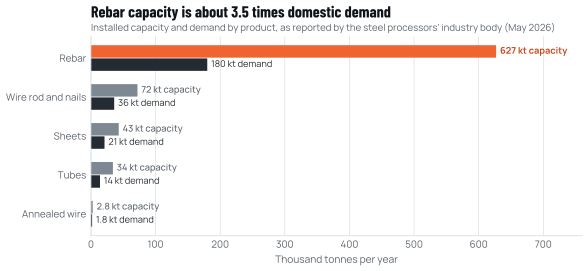
Source: industry figures reported by Cameroon Tribune, 11 May 2026 [S53]; the rebar capacity, printed as "627 tonnes", is read as 627 thousand tonnes in line with the other figures in the article.
Overcapacity is not in itself a quality problem; it can drive efficiency. But in a market where prices are capped by homologation [S11], imports of the product are banned [S12][S13] and few buyers test what they buy, competition for a limited demand is fought on cost. The cheapest ways to cut the cost of rebar are precisely the ones that reduce its quality: rolling at or below the lower edge of the mass tolerance, buying cheaper and dirtier scrap, bypassing the ladle furnace or the laboratory, and running worn rolls. A producer who invests in quality control then competes, at the same homologated price per bar, against one who does not.
This is why enforcement matters more, not less, in a market with spare capacity. The industry’s own organisations have recognised it: it was the steel processors’ body that reported the uncertified Fe450 product to the authorities in October 2024 [S04]. Producers who have invested in compliance have a direct interest in visible surveillance of the market. Spare capacity also points towards exports: Cameroon already sells bars to Chad and other neighbours [S52][S76], and certified quality is an asset in any market where buyers ask for proof.
4.5 Prices are homologated per bar, which quietly rewards light bars
Rebar is a price-controlled product. The Ministry of Commerce homologates producer prices for each diameter and grade, expressed per bar. The published list does not state the bar length; this paper assumes 12 m, the standard commercial length. In October 2023, after negotiation, producers accepted reductions that brought the 12 mm Fe500 bar from 6,900 to 6,750 FCFA, with a street price for the same bar reported at 7,500 FCFA [S11].
Converting these prices to a price per kilogram, using the nominal mass of each bar, shows two things (table below). First, the homologated prices are internally consistent: about 600 to 650 FCFA/kg across diameters, with a premium for Fe500 over Fe400 of 5% to 6% per kilogram (derived). Second, and more important for quality, pricing per bar makes the mass of the bar invisible to the price. A bar rolled at the bottom of the 4.5% tolerance sells for the same price as a bar of nominal mass, which is a hidden price rise of 4.7% per kilogram; a bar rolled one millimetre undersize, illegally, delivers 16% less steel for the same money (derived). A producer who aims his rolling at nominal mass is penalised against one who aims light.
Table 4.2 Homologated rebar prices in Douala made public on 21 October 2023, converted to price per kilogram at nominal mass
| Diameter and grade | Homologated price (FCFA per 12 m bar) | Nominal mass of a 12 m bar (kg) | Price per kg at nominal mass (FCFA) | Price per kg if the bar is 4.5% light (FCFA) |
|---|---|---|---|---|
| 6 mm | 1,532 | 2.66 | 575 | 602 |
| 8 mm Fe400 | 2,900 | 4.74 | 612 | 641 |
| 8 mm Fe500 | 3,070 | 4.74 | 648 | 678 |
| 10 mm Fe400 | 4,460 | 7.40 | 602 | 631 |
| 10 mm Fe500 | 4,700 | 7.40 | 635 | 665 |
| 12 mm Fe400 | 6,400 | 10.66 | 601 | 629 |
| 12 mm Fe500 | 6,750 | 10.66 | 633 | 663 |
Source: homologated prices [S11]; bar length of 12 m assumed; nominal masses and prices per kilogram derived by Cameroon Steel (Annex A). The 8 mm bar’s tolerance is 6.0%; the 4.5% column is shown for comparison across sizes.
The remedy is simple and does not require any change to the level of prices: homologate and display prices per tonne, with the per-bar price derived from the nominal mass, and require merchants to sell by weight or to display the nominal mass per bar. A buyer who pays for kilograms has an incentive to weigh, and a producer who sells kilograms has no incentive to roll light. Cameroon already taxes steel by the tonne: the environmental tax introduced by the 2026 Finance Law charges 5,000 FCFA per tonne of reinforcing bar (fer à béton) to producers and importers alike [S66][S89]. The administrative logic of a tonnage basis therefore already exists.
4.6 The weak links are surveillance, testing capacity and the site
The institutional map has every layer, but three of them are thin.
Market surveillance at merchants. ANOR offers an online channel for reporting non-conforming products [S74], and its recall of Fe450 bars shows it can act. What is not visible in the public record is a routine programme of sampling rebar at hardware merchants (quincailleries), testing it and publishing the results by brand and diameter. Such a programme is the single most effective deterrent to light and mislabelled bars, because it makes non-conformity visible to buyers.
Testing capacity. Certification and surveillance depend on laboratories that can perform tensile, bend and mass tests to recognised methods with calibrated machines. In September 2024 ANOR began inspection visits to laboratories in Yaoundé, Douala, Edéa, Ngaoundéré and Garoua, with the aim of building a platform of qualified laboratories against the requirements of ISO/IEC 17025 for testing laboratories and ISO/IEC 17065 for product certification bodies [S18][S55][S56]. The number of laboratories able to test reinforcing bars to these requirements, and their locations, are not public.
The site. Building permits and their control fall to municipalities under the Ministry of Housing and Urban Development (MINHDU). After the July 2023 collapse the Minister noted that the building had no permit [S20], and in July 2026 the Douala urban community had sealed the building that later collapsed at Bonamoussadi [S22]. What is missing, as far as the public record shows, is a routine link between the permit and the materials used: a requirement that structural steel on permitted sites be certified and that deliveries be checked.
4.7 Neighbouring markets are moving in the same direction
Cameroon’s choices are being made alongside those of its neighbours. They matter because Cameroonian mills already export bars, mainly to Chad [S52][S76], and because regional trade is opening under the African Continental Free Trade Area. In Gabon, the rectified finance law for 2026, published on 17 July 2026, cut the value-added tax on locally produced rebar from 10% to 3% to accelerate the development of the steel industry, while a Cameroonian group began building a rebar plant in the Nkok special economic zone [S87]. In September 2026 another group opened a scrap-based steel unit of 2,500 t a month at Port-Gentil, producing reinforcing bars mainly for the Gabonese market [S88]. In Nigeria, the national standards body sealed thirteen steel plants in 2020 after market surveillance found bars failing their minimum diameter and mass per metre [S25].
Two lessons follow for Cameroon. First, as neighbouring countries build and protect their own mills, Cameroonian exports will increasingly compete on proven quality rather than on availability; a certificate recognised beyond the border is a commercial asset. Second, regional harmonisation of standards, promoted by the African Organisation for Standardisation whose work ANOR relays [S74], will tend towards the international grade families described in the previous chapter. A national standard and a certification system already aligned with those families, in their ductility requirements, tolerances and proof of conformity, would make that transition easy rather than disruptive.
Sources cited in this chapter
Bracketed markers refer to these sources; the full list is in the annex. Full list of sources
- S14Normes sur les produits de grande consommation: quel impact sur la qualité. Cameroon Tribune, 10 Oct 2024.cameroon-tribune.cm/article.html/67368/fr.html/details_2
- S16Nos missions. ANOR.anor.cm/articles/nos-missions
- S74Home page, communiqués and online reporting service (Dénonciation). ANOR.anor.cm
- S75Enquêtes publiques: draft Cameroonian standards under public enquiry. ANOR.anor.cm/enquetes-publiques
- S04Cameroun: pour non-respect des normes, le fer à béton de la société […] retiré du marché (name of the producer omitted here). EcoMatin, 21 Oct 2024.Cited by title and date
- S09Métallurgie: les industriels du secteur dénoncent la présence du fer à béton contrefait sur le marché camerounais. EcoMatin, 22 Jun 2023.ecomatin.net/metallurgie-les-industriels-du-secteur-denoncent-la-prese…
- S05Cameroon revokes […] compliance certificate for rebar, orders recall of products (name of the producer omitted here). Business in Cameroon, 17 Oct 2024.Cited by title and date
- S11Fer à béton: les producteurs acceptent une baisse des prix. EcoMatin, 23 Oct 2023.ecomatin.net/fer-a-beton-les-producteurs-acceptent-une-baisse-des-prix
- S12Métallurgie: les importations du fer à béton interdites jusqu’à nouvel ordre. EcoMatin, 10 Apr 2023.ecomatin.net/metallurgie-les-importations-du-fer-a-beton-interdites-ju…
- S15Informations sur le PECAE (cadre légal, procédure, routes, frais, partenaires, questions fréquentes). Agence des Normes et de la Qualité (ANOR).anor.cm/projet-pecae/informations
- S18L’ANOR et les laboratoires camerounais renforcent leur collaboration: une plateforme d’échanges et de conformité voit le jour. ANOR, 17 Sep 2024.anor.cm/articles/lanor-et-les-laboratoires-camerounais-renforcent-leur…
- S20Officials to Investigate After Cameroon Building Collapse Kills Over 30. VOA Africa, 24 Jul 2023.voaafrica.com/a/cameroon-building-collapse-kills-over-30-/7193868.html
- S10Interdiction des importations du fer à béton: les consommateurs dénoncent la mauvaise qualité de la production locale. EcoMatin, 13 Apr 2023.ecomatin.net/interdiction-des-importations-du-fer-a-beton-les-consomma…
- S06Cameroun: le gouvernement rejette une demande de révision de la norme du fer à béton. EcoMatin, 5 Feb 2026.ecomatin.net/cameroun-le-gouvernement-rejette-une-demande-de-revision-…
- S07Cameroon rejects fresh push to revise rebar standard. Business in Cameroon, 26 Jan 2026.businessincameroon.com/construction/2601-15657-cameroon-rejects-fresh-…
- S08Fer à béton: le gouvernement ferme la porte à toute révision de la norme et recadre la filière sidérurgique. Cameroun24, Jan 2026.cameroun24.net/article/72504-fer-a-beton-le-gouvernement-ferme-la-port…
- S13Press report of the sealing by customs of more than 7,300 t of imported reinforcing bar, December 2020 (headline and address not reproduced: they name the importer). Business in Cameroon, 16 Dec 2020.Cited by title and date
- S52UN Comtrade public API, Cameroon (reporter 120), imports and exports by HS line, chapters 72 and 73, 2019 to 2023. United Nations Statistics Division.comtradeapi.un.org/public/v1/preview/C/A/HS?reporterCode=120&period=20…
- S76Évolution du commerce extérieur en 2025 (version provisoire). Institut National de la Statistique (INS), Cameroon, Feb 2026.ins-cameroun.cm/wp-content/uploads/2026/04/Note-sur-le-commerce-exteri…
- S17Communiqué portant modification de la procédure d’initiation du PECAE. ANOR, 6 Oct 2026.anor.cm/articles/communique-portant-modification-de-la-procedure-dinit…
- S66Cameroon, Republic of: Corporate, Other taxes (environmental tax under the 2026 Finance Law). PwC Worldwide Tax Summaries, reviewed 14 Aug 2026.taxsummaries.pwc.com/republic-of-cameroon/corporate/other-taxes
- S89Projet de loi portant loi de finances de la République du Cameroun pour l’exercice 2026, article 23 (articles 228 septies to 228 decies of the General Tax Code: environmental tax on cement, fer à béton, tiles and ceramics; rate per tonne of iron). Ministry of Finance, Directorate General of the Budget (DGB), 26 Nov 2025 (bill as tabled; final wording to be checked against the Official Gazette).dgb.cm/wp-content/uploads/2025/11/PROJET-DE-LOI-FINANCES-2026_FR_26112…
- S54Agence de Régulation des Marchés Publics, website (references to Decree No. 2018/366 of 20 June 2018 on the public procurement code). ARMP.armp.cm
- S53Production: les acteurs en présence. Cameroon Tribune, 11 May 2026.cameroon-tribune.cm/article.html/76600/fr.html/details_2
- S55ISO/IEC 17025:2017 General requirements for the competence of testing and calibration laboratories. ISO; IEC, 2017.iso.org
- S56ISO/IEC 17065:2012 Conformity assessment, Requirements for bodies certifying products, processes and services. ISO; IEC, 2012.iso.org
- S22Cameroun: Douala, 6 morts dans l’effondrement d’un immeuble à Bonamoussadi. Camer.be, republished by AllAfrica, 11 Jul 2026.fr.allafrica.com/stories/202607130741.html
- S87Le Gabon réduit la TVA sur le fer à béton local pour stimuler son industrie sidérurgique. EcoMatin, 4 Aug 2026.ecomatin.net/le-gabon-reduit-la-tva-sur-le-fer-a-beton-local-pour-stim…
- S88Gabon: le groupe Fokou lance une nouvelle unité d’acier à Port-Gentil. EcoMatin, 18 Sep 2026.ecomatin.net/gabon-le-groupe-fokou-lance-une-nouvelle-unite-dacier-a-p…
- S25SON seals 13 steel firms for standards infractions. Economic Confidential, 11 Feb 2020.economicconfidential.com/son-seals-firms-standards-infractions/
Cite this chapter
Cameroon Steel (2026). Safer buildings need rebar that meets its declared grade. White paper 10, chapter 4: Cameroon has the legal tools for rebar quality; surveillance and testing are the gaps. CS-WP-10. https://www.cameroon-steel.com/en/library/quality-steel/cameroon-quality-infrastructure/
Source