White paper 10 · Chapter 9
Wire rod, mesh and sections need the same discipline, with their own tests
The arguments made for rebar apply to the other long products that hold buildings together. Wire rod is converted into binding wire, nails and the cold-worked wire used in welded mesh, whose ductility is lower by nature and must be declared and controlled; welded mesh adds the strength of its welds to the list of properties; and structural sections are governed by a different family of standards with their own grades, tolerances and toughness requirements. Wire rod is now largely rolled in Cameroon, while sections are still imported, which places the quality burden on domestic mills for the first and on import controls and buyers for the second.
In this chapter (8)
- 9.1 The product mix is shifting from imports to domestic production
- 9.2 Wire rod: the quality of every wire product starts in the rod
- 9.3 Welded mesh: declared ductility and strong welds
- 9.4 Structural sections belong to a different family of standards
- 9.5 Hollow sections and fabricated steelwork deserve the same scrutiny
- 9.6 Imported long products need checks matched to their risk
- 9.7 Domestic production of sections will need its own certification
- 9.8 One quality system can serve all long products
9.1 The product mix is shifting from imports to domestic production
Customs data show how quickly the supply of long products has changed. Recorded imports of wire rod (HS 7213) peaked at US$74.0 million in 2021 and fell to US$8.1 million in 2023, from about 58 kt to under 8 kt, as domestic rolling replaced them [S52]. Imports of bars including rebar (HS 7214) were already marginal because of the 2016 ban. Imports of sections (HS 7216), by contrast, held steady at around US$26 million a year between 2020 and 2023, and imports of fabricated structures (HS 7308) reached US$58.0 million in 2023 [S52]. The domestic industry reports capacity of about 72 kt a year for wire rod and nails against demand of about 36 kt [S53].
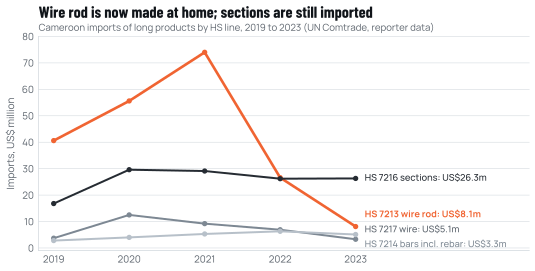
Source: UN Comtrade public API, Cameroon reporter data, HS 7213, 7214, 7216 and 7217, 2019 to 2023 [S52]. Values in current US dollars; later years not yet reported.
For quality, the shift has a simple meaning. For wire rod and the products made from it, the controls that matter are those of domestic mills, ANOR certification and market surveillance, exactly as for rebar. For sections and fabricated steelwork, the controls that matter are import conformity assessment under PECAE [S15], the inspection certificates that accompany imported steel, and the checks made by fabricators and site engineers.
9.2 Wire rod: the quality of every wire product starts in the rod
Wire rod is hot-rolled in coils, typically 5.5 to 12 mm in diameter, and is the feedstock for drawing into wire. Its quality is defined less by its own strength than by its drawability: the ability to be drawn through successive dies into fine wire without breaking. Drawability depends on chemistry (low residual elements and low nitrogen, which otherwise cause strain-ageing and breakage), on surface quality (laps, seams and scale pits become breaks in the drawn wire), on dimensional accuracy and ovality, and on microstructure, which is set by controlled cooling of the coil after the last stand. The European and international reference for non-alloy steel wire rod intended for drawing is the EN ISO 16120 series [S62].
Three wire products made from rod matter for building safety:
- Binding (tying) wire, an annealed soft wire used to tie cages. It carries no structural load, but brittle or undersize tying wire lets cages deform during concreting, moving bars out of position and reducing cover.
- Cold-drawn or cold-ribbed wire for welded mesh and for small-diameter reinforcement. Cold working raises strength but lowers ductility; such wire typically falls into ductility class A [S33].
- Nails and fixings for formwork, whose quality affects formwork stability and therefore the geometry of the finished concrete.
A mill rolling wire rod controls it with the same tools as rebar: heat chemistry, surface inspection, dimensional checks, tensile tests and, for drawing grades, tests that reflect drawability. A merchant or user can check diameter with a caliper, and coil mass against the label.
9.3 Welded mesh: declared ductility and strong welds
Welded mesh (welded fabric) is a grid of longitudinal and transverse wires or bars welded at every intersection. It is widely used in slabs, ground-bearing floors, walls and precast elements because it is fast to place and holds bar spacing accurately. Two properties distinguish it from loose bars.
Ductility class. Mesh is often made from cold-worked wire, which is usually class A. Eurocode 2 defines the same three ductility classes for fabric as for bars, with the same limits on the strength ratio and strain at maximum force, and a lower fatigue stress range for fabric (100 MPa against 150 MPa for bars) [S30]. In the United Kingdom, fabric to BS 4483 is made from BS 4449 material, apart from two light wrapping fabrics [S33][S63], and below 8 mm diameter BS 4449 steel does not conform to the Eurocode 2 ductility requirements [S33]. The practical consequence is that a slab designed with moment redistribution that assumes class B behaviour should not be built with class A mesh unless the designer has checked it.
Weld strength. The welds must be strong enough to anchor the transverse wires, because in many uses the transverse wires provide anchorage of the main wires. Test methods for welded fabric, including the shear test of welded joints, are given in EN ISO 15630-2 [S84]. A mesh whose welds break when the sheet is handled, or whose wires are burned through at the welds, has a hidden weakness at every intersection.
On site, mesh can be checked by measuring wire diameters and spacing, weighing a sheet against its nominal mass, inspecting welds for burn-through and broken joints, and reading the label for the producer, the standard, the wire grade and the ductility class.
Table 9.1 Quality requirements and checks for long products other than rebar (summary)
| Product | Examples of governing standards | Key quality parameters | Typical defects | Practical checks |
|---|---|---|---|---|
| Wire rod for drawing | EN ISO 16120 series | Chemistry (residuals, N), surface, diameter and ovality, microstructure | Laps and seams, high residuals, poor coil cooling | Diameter, coil mass, mill certificate |
| Binding wire | Producer specification | Softness (annealed), diameter | Brittle or undersize wire | Twist and bend by hand, diameter |
| Cold-worked wire and bars | BS 4449 (B500A), ISO 6935 family | Strength, Agt (class A), rib geometry | Low Agt, cracking at bends | Bend test, certificate showing Agt |
| Welded mesh | BS 4483; EN 1992 Annex C (fabric classes); EN ISO 15630-2 (tests) | Wire grade and class, mesh geometry, weld shear strength | Class A mesh where class B is assumed; weak or burned welds | Spacing, diameter, sheet mass, weld inspection, label |
| Light and medium sections (angles, channels, flats) | EN 10025-2 grades S235, S275, S355; ASTM A36 | Yield, tensile, elongation, impact toughness grade, thickness tolerance | Undersize thickness, wrong grade, lamination | Thickness by caliper, mass per metre, inspection certificate |
| Heavy sections (I and H beams) | EN 10025-2; ASTM A992 | As above, plus flatness and straightness | Wrong grade, poor toughness for welded connections | Inspection certificate 3.1, PECAE certificate, dimensions |
| Fabricated structures | Execution standards for steel structures | Welding procedure and welder qualification, coating | Poor welds, corrosion protection | Fabrication records, weld inspection |
Source: [S30][S33][S61][S62][S63][S84]; summary for orientation only.
9.4 Structural sections belong to a different family of standards
Angles, channels, I and H sections and flats used in steel frames, roofs, mezzanines and composite construction are governed not by rebar standards but by structural steel standards. In the European family, EN 10025-2 defines non-alloy structural steels by minimum yield strength (S235, S275, S355) and by impact toughness sub-grade (JR, J0 and J2, tested at plus 20 °C, 0 °C and minus 20 °C respectively), with chemistry and carbon-equivalent limits that ensure weldability [S61]. American practice uses ASTM A36 for general sections and ASTM A992 for wide-flange beams. Chinese suppliers use their own national grades, such as Q235 and Q355.
For sections, three quality issues recur in import markets:
- Thickness and mass. A section rolled thinner than its nominal dimensions carries less load and buckles sooner. Mass per metre, again, is the simplest check: a channel or angle weighed and compared with the producer’s table reveals undersize rolling.
- Grade. S235 and S355 look identical. Only the inspection certificate, matched to markings on the product, distinguishes them, and the difference in yield strength is 50%.
- Toughness for welded and exposed structures. Welded connections in thick sections, and structures exposed to impact or fatigue, need a toughness sub-grade appropriate to their use; a JR grade where J0 or J2 is specified is a hidden defect.
Because sections are imported, the first line of control is PECAE, under which consignments are verified against Cameroonian or equivalent international standards before shipment, with physical inspection and laboratory tests depending on the verification route [S15]. The second line is the buyer: a type 3.1 inspection certificate per heat, matched to markings, and a check of dimensions and mass on delivery. Fabricators who cut and weld sections should also keep the heat traceability through fabrication, so that each member of a finished structure can be linked to its certificate.
9.5 Hollow sections and fabricated steelwork deserve the same scrutiny
Tubes and hollow sections are used for columns, trusses, canopies, handrails and scaffolding. Cameroon imported US$26.0 million of welded tubes and hollow sections (HS 7306, about 9.5 kt) in 2023, while domestic capacity for tubes was reported at 34 kt against demand of 14 kt [S52][S53]. For structural hollow sections, the European references are EN 10219 for cold-formed sections and EN 10210 for hot-finished ones [S86]. The common defects are a wall thicker on the drawing than in the tube, a weld seam that is incomplete or brittle, and a grade lower than specified. Wall thickness is measurable with a caliper at the tube ends; mass per metre, again, confirms it.
Fabricated steel structures, which Cameroon imported to a value of US$58.0 million in 2023 (HS 7308) [S52], add the quality of fabrication to that of the steel: welding procedures, welder qualification, bolt grades and corrosion protection. A buyer should ask for the inspection certificates of the steel used, the welding procedure records and, for important structures, independent inspection of welds. The heat traceability of members, from mill certificate to fabrication drawing, is the equivalent for sections of the bundle tag for rebar.
On delivery, the checks are as simple as for bars. For mesh, count and measure the wire spacing, measure wire diameters, weigh a sheet against its nominal mass, and inspect welds for burn-through and broken joints. For sections and tubes, measure flange, web and wall thicknesses at several points, weigh a length against the producer’s table, read the markings and match them to the certificate.
9.6 Imported long products need checks matched to their risk
Because sections, tubes and much of the mesh used in Cameroon are imported, the decisive question for buyers is how much to rely on the documents that accompany them. PECAE offers three verification routes, from inspection and laboratory testing of every consignment to documentary checks for registered products from regular exporters [S15]. A buyer of structural steel should know which route a consignment followed, keep its certificate of conformity with the mill’s inspection certificates, and match both to the markings on the steel. Where the steel will carry significant loads, as in the frames of warehouses, schools and markets, an independent check of thickness, mass and, if in doubt, tensile properties on a few samples is inexpensive insurance.
9.7 Domestic production of sections will need its own certification
Several producers in the region, including Cameroon Steel in its indicative later phases, plan to roll angles, channels and eventually heavier sections. When sections are made in Cameroon rather than imported, the quality burden will shift from import controls to domestic certification, exactly as it did for rebar after 2016. It is worth preparing for that shift now, for three reasons.
First, structural sections are certified against different properties. In addition to yield and tensile strength and elongation, structural steels are graded by impact toughness, measured with a Charpy pendulum on notched specimens at a specified temperature, and their chemistry is limited for weldability [S61]. A mill rolling sections needs an impact-testing machine, notch-cutting equipment and the ability to cool specimens to the test temperature, none of which a rebar laboratory requires.
Second, dimensional tolerances are more complex. Sections are checked for flange and web thickness, depth, width, out-of-square, straightness and mass per metre, and each of these affects buckling and connection design. Rolling sections to tolerance requires roll design, roll-change discipline and measurement routines that go beyond those of a bar mill.
Third, there is no Cameroonian standard yet in the public record for structural sections comparable to NC 236 for rebar, and this paper did not find one. If domestic production grows, ANOR and the industry will need to decide whether to adopt an international reference, such as the EN 10025 family, as a national standard, whether to make it mandatory, and how to certify producers against it. Doing so before the first domestic sections reach the market would avoid repeating the experience of rebar, where a mandatory standard arrived in 2022, years after the import ban had made the market almost entirely domestic.
For buyers in the meantime, the rule is the one applied throughout this paper: name the grade and toughness sub-grade, ask for the inspection certificate tied to the heat, and check thickness and mass on delivery.
9.8 One quality system can serve all long products
The disciplines that make good rebar are the same for every long product, which is why mills and regulators can extend them at little extra cost:
- Heat traceability from the furnace to the bundle, coil or section.
- Chemistry on every heat, with the carbon equivalent reported.
- Mechanical and dimensional tests by standard methods, in a laboratory whose competence is demonstrated.
- Inspection certificates of type 3.1 tied to heat numbers.
- Third-party certification, by ANOR and, where available, by an independent product certification body.
- Simple checks by the user: dimensions, mass, markings and certificates.
For a country whose domestic industry now covers rebar and wire rod and whose sections are imported, this means two things in practice. ANOR’s certification and market surveillance should extend from rebar to wire rod and mesh as domestic production of these products grows, and import controls and buyers’ checks on sections should be applied with the same rigour as for domestic bars. A rebar standard enforced in isolation leaves the rest of the structure unguarded.
Sources cited in this chapter
Bracketed markers refer to these sources; the full list is in the annex. Full list of sources
- S52UN Comtrade public API, Cameroon (reporter 120), imports and exports by HS line, chapters 72 and 73, 2019 to 2023. United Nations Statistics Division.comtradeapi.un.org/public/v1/preview/C/A/HS?reporterCode=120&period=20…
- S53Production: les acteurs en présence. Cameroon Tribune, 11 May 2026.cameroon-tribune.cm/article.html/76600/fr.html/details_2
- S15Informations sur le PECAE (cadre légal, procédure, routes, frais, partenaires, questions fréquentes). Agence des Normes et de la Qualité (ANOR).anor.cm/projet-pecae/informations
- S62ISO 16120 series Non-alloy steel wire rod for conversion to wire (EN ISO 16120-1 to 16120-4). ISO; CEN, current editions.iso.org
- S33Standards for reinforcement. The Concrete Centre (UK).concretecentre.com/Codes/European-standards-for-reinforcement.aspx
- S30EN 1992 Eurocode 2: Design of concrete structures (J. Walraven), workshop "Eurocodes: background and applications", Brussels, 18 to 20 Feb 2008. European Commission (DG Enterprise and Industry, Joint Research Centre), Feb 2008.eurocodes.fi/wp-content/uploads/1992/sahkoinen1992/EN-1992.pdf
- S63BS 4483:2005 Steel fabric for the reinforcement of concrete. BSI, 2005.knowledge.bsigroup.com
- S84ISO 15630-2:2019 Steel for the reinforcement and prestressing of concrete, Test methods, Part 2: Welded fabrics and lattice girders (EN ISO 15630-2). ISO; CEN, 2019.iso.org
- S61EN 10025-2:2019 Hot rolled products of structural steels, Part 2: Technical delivery conditions for non-alloy structural steels. CEN, 2019.standards.cencenelec.eu
- S86EN 10219-1:2006 Cold formed welded structural hollow sections of non-alloy and fine grain steels; EN 10210-1:2006 Hot finished structural hollow sections. CEN, 2006.standards.cencenelec.eu
- S01Kribi: le Premier ministre, chef du gouvernement est là. Cameroon Tribune, 30 Dec 2024.cameroon-tribune.cm/article.html/68499/fr.html/details_2
- S02Cameroun: complexe moderne de sidérurgie de Kribi, le PM Joseph Dion Ngute effectue la pose de la première pierre. Camer.be, 5 Jan 2025.camer.be/87795/12:1/cameroun-complexe-moderne-de-siderurgie-de-kribi-l…
Cite this chapter
Cameroon Steel (2026). Safer buildings need rebar that meets its declared grade. White paper 10, chapter 9: Wire rod, mesh and sections need the same discipline, with their own tests. CS-WP-10. https://www.cameroon-steel.com/en/library/quality-steel/wire-rod-mesh-sections/
Source