White paper 10 · Summary
Executive summary: safer buildings start with bars that meet their grade
Building safety in Cameroon depends on reinforcing steel that actually has the strength, cross-section, ductility and bond its label declares. The national rebar standard is mandatory and the State has shown it will enforce it, but the evidence from building sites and from neighbouring markets suggests that a material share of the bars sampled on sites fall short, and that unmarked bars are the worst. Certified domestic production with traceable quality control, combined with enforcement at the point of sale and simple acceptance checks on site, is the most effective and least costly way to raise the floor.
In this chapter (5)
ES.1 Ten findings
- Rebar quality has become a public-safety question in Cameroon. Building collapses in Douala in July 2023 (33 to about 40 deaths reported) and July 2026 (six deaths) had several reported causes, including the absence of a building permit and a building already declared unsafe [S20][S21][S22]. Practitioners have linked collapses to poor bars [S10], and when the Government refused in January 2026 to revise the rebar standard, the press reported that it cited deadly collapses linked to substandard materials [S06][S08]. This paper attributes no collapse to steel, but treats rebar as the one cause that can be verified cheaply before construction.
- A grade is a bundle of four properties, and the market discusses only one. "Fe500" promises a yield strength, but a design also assumes a cross-section (checked by mass per metre), ductility (strain at maximum force Agt and strength ratio Rm/Re) and bond (rib geometry). Ductility and section are the properties most often missing and least visible to the buyer.
- One defect is enough to consume the steel’s safety margin. A nominal 12 mm grade 500 bar is designed to carry 49.2 kN at yield. Rolled one millimetre undersize it yields at 47.5 kN; made of grade 400 steel at 45.2 kN; with both defects at 38.0 kN, 23% below the design value (derived, Figure ES.1). These bars show no distress in everyday use; they remove the reserve that covers overloads, poor concrete and the extra floors owners often add.
- Good rebar is made by an honest route that can be audited. Grade 500 within the weldability limit (carbon equivalent of 0.50% or less) is reached by quenching and self-tempering the bar or by microalloying, in a melt shop that refines each heat and analyses it by spectrometer [S31][S48]. Bars made strong by excess carbon, or re-rolled from scrap of unknown composition, are brittle, weld badly and vary from bundle to bundle.
- The main standards agree on strength but differ on ductility, bond and proof. European-family grades (B500B under BS 4449 or NF A 35-080-1, Eurocode 2 class B) guarantee Agt of at least 5% and Rm/Re of at least 1.08, cap overstrength and are normally proven by third-party certification [S30][S31][S38]. ASTM A615 Grade 60 guarantees a lower yield, elongation after fracture and no carbon-equivalent limit [S34][S35]. Specifiers should name "NC 236 Fe500 with class B ductility", the weldability limit and the proof required, never "Fe500" alone.
- Cameroon’s legal chain is complete and has been enforced. Law 96/11 (1996), ANOR (2009), the PECAE import-conformity programme (2015, operational 2016), the rebar import ban (2016, reaffirmed 2023) and the mandatory NC 236 standard (2022) form a coherent system [S04][S12][S13][S14][S15]. ANOR withdrew a certificate and recalled bars of a grade absent from the standard in October 2024, and the Government refused to revise the standard in January 2026 [S04][S05][S06][S07].
- Pricing per bar rewards light bars. Homologated prices are set per bar, taken here as the standard commercial length of 12 m (assumed): about 600 to 650 FCFA per kg at nominal mass in October 2023 [S11]. A bar at the edge of the 4.5% tolerance costs the buyer 4.7% more per kilogram; a bar one size light, 19% more (derived). Pricing and payment per tonne would remove the incentive to roll light without changing price levels.
- The regional evidence points to unmarked and uncontrolled bars. In a 2023 study of 24 bars sampled on building sites in Bamenda, Douala, Maroua and Yaoundé, 11 had yield stresses below 400 MPa (the study reports 52%; its own counts give 46%; sampling years are not stated), and bars without a manufacturer’s mark failed every test [S19]. Nigeria’s standards body sealed 13 plants in 2020 after most samples failed diameter and mass per metre [S25]; an Ethiopian market study found yield scatter two to three times that of controlled production [S28][S29].
- Five site checks catch most defective bars before they reach a column. Checking paperwork, reading the rolled-in mark, weighing three bars per diameter, measuring ribs and bending a sample cold take less than an hour per delivery. Bars without a legible mill mark should not be used in structural members. Laboratory tests settle the remaining doubts, especially on strength.
- On the coast, cover and concrete decide durability. Kribi and Douala stay above 80% relative humidity in every month [S50]. Eurocode 2 recommends at least 35 mm of cover for durability against airborne salt and 45 mm in splash zones, plus a 10 mm execution allowance, with dense concrete [S36][S37]. Spacers, low water/cement ratios and curing protect bars more than any coating.
ES.2 A defective bar looks exactly like a good one once it is cast
The central quantitative point of this paper is shown in Figure ES.1. The engineer designs on the assumption that a grade 500 bar of 12 mm yields at no less than 435 MPa over its nominal area, after the partial factor of 1.15 that Eurocode 2 applies to reinforcing steel [S36]. A certified bar from a well-controlled mill typically yields well above that, because good production carries a mean yield around two standard deviations above the characteristic value [S29]. A defective bar does not.
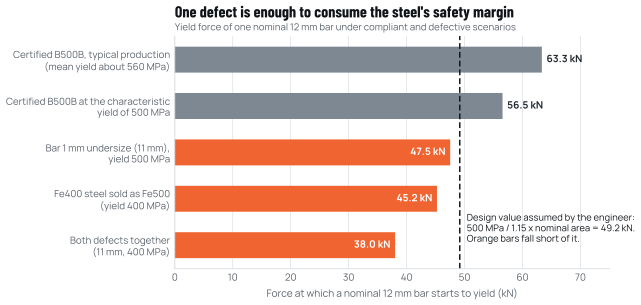
Source: Cameroon Steel calculation; partial factor from EN 1992-1-1 [S36]; mean yield of controlled production from the JCSS Probabilistic Model Code [S29]. Method in Annex A.
None of these defects would be visible to the owner of a building under normal use, because service stresses in reinforcement are kept well below yield [S36]. That is precisely why they matter: they consume the reserve that is meant for the unexpected, and ductility defects remove the warning that a well-designed building gives before it fails.
ES.3 Domestic certified production is the lever, because domestic production is the market
Since imports of rebar were suspended in 2016, the bars in Cameroonian buildings have been made almost entirely in Cameroon [S13][S52]. Whatever view one takes of the ban, it settles where quality must be won: in Cameroonian melt shops and rolling mills, and in the distribution chain that connects them to building sites. Three features of domestic production make it the most effective place to raise the floor.
First, quality can be built in only at the mill. Chemistry, quench, rolling and testing decide the properties of a bar; no merchant or site can add them later. A melt shop with a ladle furnace and a spectrometer, a controlled quench and a laboratory that tests every heat is the only reliable source of bars that meet their grade.
Second, traceability starts at the mill. Heat numbers, rolled-in marks, bundle tags and type 3.1 inspection certificates link every bar to its chemistry and its tests, and make recalls possible. Certification by ANOR, and by independent schemes where producers seek them, turns a producer’s own testing into a guarantee that buyers can check.
Third, enforcement works best on identifiable producers. With imports closed, surveillance means checking the products of a limited number of domestic mills and their distribution. Unmarked or untraceable bars are, by definition, outside the certified system and can simply be refused.
What the evidence does not show matters as much. It does not show that domestic bars are generally poor, nor that any producer mentioned in the press made unsafe bars. It shows that bars of unknown origin and quality circulate, that enforcement has worked when it was applied, and that the market lacks the information and the price signals that would let compliant producers win on quality.
ES.4 What should change, and who should act
The paper’s recommendations (Chapter 10) are designed to make good bars easy to recognise and bad bars risky to sell, without relaxing the standard or creating new institutions.
For ANOR and the Ministry of Commerce. Publish the essential requirements of NC 236 and a register of certified producers with their rolled-in marks; strengthen certification with surveillance audits, independent sampling and statistical evaluation; sample bars at merchants in the main cities and publish the results by brand and diameter; homologate prices per tonne and require the nominal mass of each bar to be displayed; and report annually on conformity and enforcement.
For the Ministry of Public Contracts and contracting authorities. Put a standard clause in every public works contract requiring certified NC 236 bars with class B ductility, type 3.1 inspection certificates tied to heat numbers and site acceptance checks, and pay only for accepted steel measured by mass. With 2,026.3 billion FCFA of public investment budgeted in 2026 [S80], public procurement can shift the whole market.
For the Ministry of Housing and Urban Development and municipalities. Link building permits for multi-storey and public buildings to certified steel, delivery acceptance records and inspection of reinforcement before concrete is poured; publish durability guidance for coastal construction.
For engineers and contractors. Specify the full grade, read the mill certificate in six checks before unloading, weigh and bend on delivery, refuse unmarked bars, never heat a bar to bend it, and enforce cover with spacers.
For producers. Roll every bar with a legible mill mark, aim at nominal mass, report ductility and carbon equivalent on every certificate, invite independent sampling and support training of masons and foremen.
ES.5 How the paper is built
The paper follows the life of a bar. Chapter 1 explains why rebar quality decides how a concrete building behaves when it is overloaded, and sets recent collapses in the region in context without attributing causes. Chapter 2 explains the metallurgy of rebar: chemistry, the routes to grade 500, quenching and self-tempering, and the carbon equivalent. Chapter 3 compares the European, American, international and Cameroonian standards property by property, with tables of bar masses, tolerances and bond requirements. Chapter 4 maps Cameroon’s quality infrastructure, from the 1996 standardisation law to price homologation. Chapter 5 describes how a mill proves quality through testing, statistics and traceability. Chapter 6 catalogues what goes wrong and how a site can detect it. Chapter 7 proposes specification clauses and acceptance practice for designers, contractors and public buyers. Chapter 8 addresses corrosion and durability in the humid coastal climate. Chapter 9 extends the argument to wire rod, mesh and sections. Chapter 10 sets out ten recommendations with an indicative calendar, and Chapter 11 lists the evidence gaps that remain.
The evidence base combines four kinds of source: the standards themselves and certificates that summarise them; official Cameroonian sources, notably ANOR’s published programme documents and communiqués; peer-reviewed studies of rebar bought on markets or sampled on sites in Cameroon, Nigeria and Ethiopia; and press reports of regulatory decisions and building collapses, which are cited for the facts they report and attributed in the text. Where press reports are the only public record, as for the 2024 certificate withdrawal and the 2026 refusal to revise the standard, the paper relies on more than one outlet. The paper uses only public information about Cameroon Steel’s project and describes its quality commitments as objectives.
Every number carries its source in Annex C, and every derived number is explained in Annex A. Standards are summarised for orientation only; their current editions govern. Where the public record is silent, notably on the full technical content of NC 236, on official findings into recent collapses and on the testing capacity of Cameroonian laboratories, the paper says so rather than filling the gap.
Statement of interest. This paper is published by Cameroon Steel, which is developing a steelworks at Kribi. It is written to inform public debate; its analysis is independent of any commercial offer, and every figure is sourced or labelled with its status.
Sources cited in this chapter
Bracketed markers refer to these sources; the full list is in the annex. Full list of sources
- S04Cameroun: pour non-respect des normes, le fer à béton de la société […] retiré du marché (name of the producer omitted here). EcoMatin, 21 Oct 2024.Cited by title and date
- S50POWER climatology API, parameters T2M, RH2M, PRECTOTCORR, 1991 to 2020, at Douala, Kribi, Yaoundé and Garoua. NASA Langley Research Center.power.larc.nasa.gov/api/temporal/climatology/point?parameters=T2M,RH2M…
- S20Officials to Investigate After Cameroon Building Collapse Kills Over 30. VOA Africa, 24 Jul 2023.voaafrica.com/a/cameroon-building-collapse-kills-over-30-/7193868.html
- S21Cameroon: death toll rises to 40 in building collapse. Africanews, 27 Jul 2023.africanews.com/2023/07/27/cameroon-death-toll-rises-to-40-in-building-…
- S22Cameroun: Douala, 6 morts dans l’effondrement d’un immeuble à Bonamoussadi. Camer.be, republished by AllAfrica, 11 Jul 2026.fr.allafrica.com/stories/202607130741.html
- S10Interdiction des importations du fer à béton: les consommateurs dénoncent la mauvaise qualité de la production locale. EcoMatin, 13 Apr 2023.ecomatin.net/interdiction-des-importations-du-fer-a-beton-les-consomma…
- S06Cameroun: le gouvernement rejette une demande de révision de la norme du fer à béton. EcoMatin, 5 Feb 2026.ecomatin.net/cameroun-le-gouvernement-rejette-une-demande-de-revision-…
- S08Fer à béton: le gouvernement ferme la porte à toute révision de la norme et recadre la filière sidérurgique. Cameroun24, Jan 2026.cameroun24.net/article/72504-fer-a-beton-le-gouvernement-ferme-la-port…
- S31Certificat N° B03/176 rév. 16, aciers pour béton armé, NF A 35-080-1 nuance B500B (fiche descriptive and caractéristiques certifiées). Association Française de Certification des Armatures du Béton (AFCAB), AFNOR Certification, 6 Jun 2025.feralpi-stahl.com/sites/default/files/media/certifications/NF%20AFCAB-…
- S48Tempcore: a new process for the production of high-quality reinforcing bars. Iron and Steel Engineer 61(3), pp. 53 to 57. P. Simon, M. Economopoulos, P. Nilles, 1984.openalex.org/W3176967943
- S30EN 1992 Eurocode 2: Design of concrete structures (J. Walraven), workshop "Eurocodes: background and applications", Brussels, 18 to 20 Feb 2008. European Commission (DG Enterprise and Industry, Joint Research Centre), Feb 2008.eurocodes.fi/wp-content/uploads/1992/sahkoinen1992/EN-1992.pdf
- S38BS 4449:2005+A3:2016 Steel for the reinforcement of concrete. Weldable reinforcing steel. Bar, coil and decoiled product. Specification. British Standards Institution (BSI), 2016.boutique.afnor.org/en-gb/standard/bs-44492005-a32016/steel-for-the-rei…
- S34Rebar 101 (presentation: ASTM bar specifications, tensile and elongation tables, permissible variation in weight, marking). Concrete Reinforcing Steel Institute (CRSI), hosted by New Jersey Institute of Technology, n.d..web.njit.edu/~washd/cim101/download/notes/CRSI/Rebar101_University%20%…
- S35Engineering Bulletin #1: Mechanical properties, ChromX (ASTM A1035) compared with ASTM A615 Grades 60, 80 and 100. Commercial Metals Company (CMC), 12 May 2021.cmc.com/getmedia/83bc1448-b2ed-47b1-9b4e-56951d4b7212/1_Mechanical_Pro…
- S12Métallurgie: les importations du fer à béton interdites jusqu’à nouvel ordre. EcoMatin, 10 Apr 2023.ecomatin.net/metallurgie-les-importations-du-fer-a-beton-interdites-ju…
- S13Press report of the sealing by customs of more than 7,300 t of imported reinforcing bar, December 2020 (headline and address not reproduced: they name the importer). Business in Cameroon, 16 Dec 2020.Cited by title and date
- S14Normes sur les produits de grande consommation: quel impact sur la qualité. Cameroon Tribune, 10 Oct 2024.cameroon-tribune.cm/article.html/67368/fr.html/details_2
- S15Informations sur le PECAE (cadre légal, procédure, routes, frais, partenaires, questions fréquentes). Agence des Normes et de la Qualité (ANOR).anor.cm/projet-pecae/informations
- S05Cameroon revokes […] compliance certificate for rebar, orders recall of products (name of the producer omitted here). Business in Cameroon, 17 Oct 2024.Cited by title and date
- S07Cameroon rejects fresh push to revise rebar standard. Business in Cameroon, 26 Jan 2026.businessincameroon.com/construction/2601-15657-cameroon-rejects-fresh-…
- S11Fer à béton: les producteurs acceptent une baisse des prix. EcoMatin, 23 Oct 2023.ecomatin.net/fer-a-beton-les-producteurs-acceptent-une-baisse-des-prix
- S19Assessment of Deviation in Quality of Steel Reinforcing Bars Used in Some Building Sites in Cameroon. World Journal of Engineering and Technology, 11(4), pp. 917 to 931. P. C. Bame, B. E. Yamb, B. Ndigui; Scientific Research Publishing, 2023.doi.org/10.4236/wjet.2023.114061
- S25SON seals 13 steel firms for standards infractions. Economic Confidential, 11 Feb 2020.economicconfidential.com/son-seals-firms-standards-infractions/
- S28Mechanical strength variability of deformed reinforcing steel bars for concrete structures in Ethiopia. Scientific Reports 12, 2600. T. Achamyeleh, H. Çamur, M. A. Savaş, A. Evcil; Nature Portfolio, 2022.doi.org/10.1038/s41598-022-06654-1
- S29Probabilistic Model Code, Part 3: Resistance models, 3.2 Static properties of reinforcing steel. Joint Committee on Structural Safety (JCSS), 2001 edition.jcss-lc.org/publications/jcsspmc/rebar.pdf
- S36EN 1992-1-1:2004 Eurocode 2: Design of concrete structures, Part 1-1: General rules and rules for buildings (with corrigenda). European Committee for Standardization (CEN), 2004.eurocodes.jrc.ec.europa.eu/EN-Eurocodes/eurocode-2-design-concrete-str…
- S37EN 206:2013+A2:2021 Concrete: specification, performance, production and conformity. CEN, 2021.standards.cencenelec.eu
- S52UN Comtrade public API, Cameroon (reporter 120), imports and exports by HS line, chapters 72 and 73, 2019 to 2023. United Nations Statistics Division.comtradeapi.un.org/public/v1/preview/C/A/HS?reporterCode=120&period=20…
- S80Budget 2026: 8 816,4 milliards FCFA pour consolider la stabilité et accélérer le développement du Cameroun. Ministry of Finance (MINFI), 26 Nov 2025.minfi.gov.cm/budget-2026-8-8164-milliards-fcfa-pour-consolider-la-stab…
- S01Kribi: le Premier ministre, chef du gouvernement est là. Cameroon Tribune, 30 Dec 2024.cameroon-tribune.cm/article.html/68499/fr.html/details_2
- S02Cameroun: complexe moderne de sidérurgie de Kribi, le PM Joseph Dion Ngute effectue la pose de la première pierre. Camer.be, 5 Jan 2025.camer.be/87795/12:1/cameroun-complexe-moderne-de-siderurgie-de-kribi-l…
- S03Industrialisation: la voie royale de l’émergence. Cameroon Tribune, 2 Jan 2025.cameroon-tribune.cm/article.html/68558/fr.html/details_2
- S53Production: les acteurs en présence. Cameroon Tribune, 11 May 2026.cameroon-tribune.cm/article.html/76600/fr.html/details_2
Cite this chapter
Cameroon Steel (2026). Safer buildings need rebar that meets its declared grade. White paper 10, Executive summary: safer buildings start with bars that meet their grade. CS-WP-10. https://www.cameroon-steel.com/en/library/quality-steel/executive-summary/
Source