白皮书10 · 摘要 · 中文摘要
执行摘要:更安全的建筑始于符合标称牌号的钢筋
喀麦隆的建筑安全取决于钢筋(螺纹钢)是否真正具备其标签所标称的强度、截面、延性和粘结性能。国家钢筋标准为强制性标准,国家也已表明将予以执行,但来自施工工地和周边市场的证据提示,工地抽样的钢筋中有相当一部分不达标,其中无标识钢筋问题最为严重。经过认证、具有可追溯质量控制的国内生产,辅以在销售点执行标准和在工地开展简单的进场验收,是提高质量底线最有效、成本最低的途径。
本页为本章中文摘要;英文全文附于其后,可展开阅读。
本章目录(6)
ES.1 十项结论
- 钢筋质量已成为喀麦隆的公共安全问题。2023年7月(据报道33至约40人死亡)和2026年7月(6人死亡)杜阿拉发生的建筑倒塌事故,据报道有多重原因,包括未取得建筑许可,以及建筑物此前已被认定为危房[S20][S21][S22]。业内人士曾将倒塌事故与劣质钢筋联系起来[S10];2026年1月政府拒绝修订钢筋标准时,据媒体报道,政府援引了与不合格材料有关的致命倒塌事故[S06][S08]。本白皮书不将任何倒塌事故归咎于钢材,但认为钢筋是唯一能够在施工前以低成本加以核查的因素。
- 牌号是四项性能的组合,而市场只讨论其中一项。“Fe500”承诺的是屈服强度,但设计还假定了截面(通过每米质量核查)、延性(最大力总延伸率Agt和强屈比Rm/Re)和粘结性能(肋的几何形状)。延性和截面是最常缺失、买方最难察觉的性能。
- 一个缺陷就足以耗尽钢材的安全裕度。公称直径12 mm的500级钢筋按屈服时承受49.2 kN设计。若轧制时直径偏小1毫米,其屈服力为47.5 kN;若以400级钢材制成,为45.2 kN;两种缺陷叠加时为38.0 kN,比设计值低23%(推算,图ES.1)。这些钢筋在日常使用中不会出现任何损伤迹象;它们消耗的是用于应对超载、劣质混凝土以及业主常常加建楼层的储备。
- 优质钢筋来自诚实且可审核的生产路线。在可焊性限值(碳当量不超过0.50%)内达到500级,可通过对钢筋进行淬火自回火或微合金化实现,并须在对每一炉次进行精炼、以光谱仪分析成分的炼钢车间生产[S31][S48]。依靠过量碳获得强度的钢筋,或以成分不明的废钢再轧而成的钢筋,性脆、焊接性差,且捆与捆之间性能波动。
- 主要标准在强度上一致,但在延性、粘结和合格证明上存在差异。欧洲体系牌号(BS 4449或NF A 35-080-1中的B500B,即欧洲规范2的B级)保证Agt不低于5%、Rm/Re不低于1.08,限制超强,且通常通过第三方认证加以证明[S30][S31][S38]。ASTM A615 Grade 60保证的屈服强度较低,规定的是断后伸长率,且不设碳当量限值[S34][S35]。编制技术规格的单位应写明“NC 236 Fe500,B级延性”、可焊性限值和所要求的证明,而不应只写“Fe500”。
- 喀麦隆的法律链条完整,且已得到执行。1996年第96/11号法律、喀麦隆标准与质量局(ANOR,2009年)、装运前合格评定计划(PECAE,2015年设立,2016年实施)、钢筋进口禁令(2016年,2023年重申)以及强制性标准NC 236(2022年)构成了一个协调一致的体系[S04][S12][S13][S14][S15]。2024年10月,ANOR撤销了一份证书,并召回了标准中未列入牌号的钢筋;2026年1月,政府拒绝修订该标准[S04][S05][S06][S07]。
- 按根定价变相奖励偏轻钢筋。核定价格按根确定,本文按通行的12米商品长度计(假设):2023年10月,按公称质量折算约为每千克600至650中非法郎[S11]。处于4.5%允许偏差边缘的钢筋,买方每千克多付4.7%;偏轻一个规格的钢筋,多付19%(推算)。按吨定价和按吨付款可在不改变价格水平的情况下消除轧轻的动机。
- 区域证据指向无标识、无管控的钢筋。2023年一项研究在巴门达、杜阿拉、马鲁阿和雅温得的工地抽取了24根钢筋,其中11根屈服强度低于400 MPa(该研究报告为52%,按其自身计数为46%;未说明抽样年份),无制造商标识的钢筋在所有试验中均不合格[S19]。2020年,尼日利亚标准机构在大多数样品的直径和每米质量不合格后查封了13家工厂[S25];埃塞俄比亚的一项市场研究发现,屈服强度的离散程度为受控生产的两到三倍[S28][S29]。
- 五项工地检查可在大多数缺陷钢筋进入柱子之前将其拦截。核对文件、识读轧制标识、每种直径称重三根、测量钢筋的肋、对样品进行冷弯,每批交货所需时间不到一小时。没有清晰轧制标识的钢筋不应用于结构构件。其余疑问,尤其是强度方面的疑问,由实验室试验解决。
- 在沿海地区,保护层和混凝土决定耐久性。克里比和杜阿拉每个月的相对湿度均高于80%[S50]。欧洲规范2建议,在受空气中盐分影响的环境下,耐久性所需保护层厚度至少为35 mm,在浪溅区至少为45 mm,另加10 mm施工允许偏差,并采用密实混凝土[S36][S37]。垫块、低水灰比和养护对钢筋的保护作用超过任何涂层。
ES.2 缺陷钢筋一旦浇入混凝土,外观与合格钢筋毫无二致
本白皮书的核心定量结论见图ES.1。工程师在设计时假定,12 mm的500级钢筋在其公称截面上的屈服强度不低于435 MPa,这是欧洲规范2对钢筋采用1.15分项系数后的数值[S36]。管理良好的钢厂生产的认证钢筋,其实际屈服强度通常远高于该值,因为良好生产的平均屈服强度比特征值高出约两个标准差[S29]。缺陷钢筋则不然。
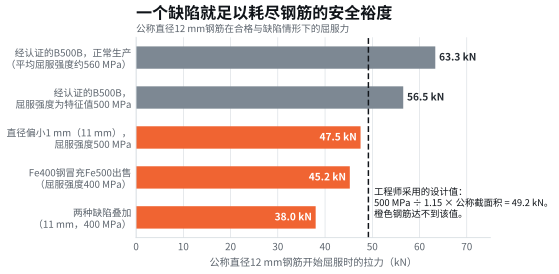
来源:Cameroon Steel计算;分项系数取自EN 1992-1-1[S36];受控生产的平均屈服强度取自JCSS《概率模型规范》[S29]。方法见全文版附录A。
在正常使用条件下,建筑物业主看不到上述任何缺陷,因为钢筋的使用应力被控制在远低于屈服强度的水平[S36]。这正是问题所在:这些缺陷消耗的是为意外情况预留的储备,而延性缺陷则消除了设计良好的建筑在破坏前发出的预警。
ES.3 经认证的国内生产是关键杠杆,因为国内生产就是整个市场
自2016年暂停钢筋进口以来,喀麦隆建筑中使用的钢筋几乎全部为本国生产[S13][S52]。无论对这项禁令持何种看法,它都决定了质量必须在何处取得:在喀麦隆的炼钢车间和轧钢厂,以及将其与施工工地相连的分销链中。国内生产的三个特点,使其成为提高质量底线最有效的环节。
第一,质量只能在钢厂内形成。化学成分、淬火、轧制和检验决定钢筋的性能;任何经销商或工地都无法在事后补上这些性能。配备钢包精炼炉和光谱仪的炼钢车间、受控的淬火工艺以及对每一炉次进行检验的实验室,是符合牌号的钢筋唯一可靠的来源。
第二,可追溯性始于钢厂。炉号、轧制标识、捆标签和3.1型检验证书将每根钢筋与其化学成分和检验结果联系起来,并使召回成为可能。ANOR的认证,以及生产商自愿申请的独立认证,可将生产商的自检转化为买方能够核查的保证。
第三,对可识别的生产商执法最为有效。在进口关闭的情况下,监督意味着检查数量有限的国内钢厂的产品及其分销。无标识或无法追溯的钢筋,按定义处于认证体系之外,可直接拒收。
证据未能表明的内容同样重要。证据并未表明国产钢筋普遍质量低劣,也未表明媒体提及的任何生产商生产了不安全的钢筋。证据表明的是:来源和质量不明的钢筋在市场上流通;执法在实施时是有效的;市场缺乏使合规生产商能够凭质量胜出的信息和价格信号。
ES.4 应当改变什么,由谁行动
本白皮书的建议(第10章)旨在使合格钢筋易于识别、使劣质钢筋难以销售,同时不放宽标准,也不新设机构。
对ANOR和商务部(MINCOMMERCE)。公布NC 236的基本要求以及经认证生产商及其轧制标识的名录;通过监督审核、独立抽样和统计评估强化认证;在主要城市的经销商处抽取钢筋样品,并按品牌和直径公布结果;按吨核定价格,并要求标示每根钢筋的公称质量;每年报告合规和执法情况。
对公共采购部(MINMAP)和各采购单位。在每份公共工程合同中加入标准条款,要求使用经认证、B级延性的NC 236钢筋,要求提供与炉号对应的3.1型检验证书并开展进场验收,且仅对验收合格、按质量计量的钢材付款。2026年预算安排的公共投资达20263亿中非法郎[S80],公共采购可以带动整个市场转变。
对住房和城市发展部(MINHDU)及各市镇。将多层建筑和公共建筑的建筑许可与使用认证钢材、交货验收记录以及浇筑混凝土前的钢筋检查挂钩;发布沿海建筑耐久性指南。
对工程师和承包商。完整规定牌号,卸货前按六项要点核查质量证明书,交货时称重并做弯曲检查,拒收无标识钢筋,绝不加热钢筋进行弯折,并使用垫块确保保护层厚度。
对生产商。在每根钢筋上轧制清晰的标识,以公称质量为目标,在每份证书上报告延性和碳当量,接受独立抽样,并支持对泥瓦工和工长的培训。
ES.5 本白皮书的结构
本白皮书沿着一根钢筋的生命周期展开。第1章说明为何钢筋质量决定混凝土建筑在超载时的表现,并在不归因的前提下介绍区域内近期的倒塌事故。第2章阐述钢筋冶金:化学成分、达到500级的工艺路线、淬火自回火以及碳当量。第3章逐项比较欧洲、美国、国际和喀麦隆标准的性能要求,并列出钢筋质量、允许偏差和粘结要求表。第4章梳理喀麦隆的质量基础设施,从1996年标准化法律到价格核定。第5章说明钢厂如何通过检验、统计和可追溯性证明质量。第6章列举可能出现的问题以及工地如何发现这些问题。第7章为设计单位、承包商和公共采购方提出技术规格条款和验收做法。第8章讨论潮湿沿海气候下的锈蚀与耐久性。第9章将分析延伸至线材、焊接钢筋网和型材。第10章提出十项建议并附指示性时间表,第11章列出仍存在的证据缺口。
证据基础包括四类来源:标准本身以及概述标准内容的认证证书;喀麦隆官方来源,尤其是ANOR公布的计划文件和公告;对在喀麦隆、尼日利亚和埃塞俄比亚市场购买或工地抽取的钢筋所作的同行评审研究;以及关于监管决定和建筑倒塌事故的新闻报道,这些报道仅就其所报道的事实加以引用,并在正文中注明出处。当新闻报道是唯一的公开记录时,例如2024年的证书撤销和2026年拒绝修订标准,本白皮书依据不止一家媒体的报道。本白皮书仅使用有关Cameroon Steel项目的公开信息,并将其质量承诺表述为目标。
每个数字的来源均列于全文版附录C,每个推算数字的计算方法均在全文版附录A中说明。标准内容的概述仅供参考,以现行有效版本为准。在公开记录缺失之处,特别是NC 236的完整技术内容、近期倒塌事故的官方调查结论以及喀麦隆实验室的检测能力,本白皮书如实说明,而不作填补。
利益声明。本文由正在克里比筹建钢铁厂的Cameroon Steel发布,旨在为公共讨论提供参考;其分析独立于任何商业要约,所有数据均注明来源或标注其状态。
英文全文 10分钟 · 2376词Executive summary: safer buildings start with bars that meet their grade
Building safety in Cameroon depends on reinforcing steel that actually has the strength, cross-section, ductility and bond its label declares. The national rebar standard is mandatory and the State has shown it will enforce it, but the evidence from building sites and from neighbouring markets suggests that a material share of the bars sampled on sites fall short, and that unmarked bars are the worst. Certified domestic production with traceable quality control, combined with enforcement at the point of sale and simple acceptance checks on site, is the most effective and least costly way to raise the floor.
ES.1 Ten findings
- Rebar quality has become a public-safety question in Cameroon. Building collapses in Douala in July 2023 (33 to about 40 deaths reported) and July 2026 (six deaths) had several reported causes, including the absence of a building permit and a building already declared unsafe [S20][S21][S22]. Practitioners have linked collapses to poor bars [S10], and when the Government refused in January 2026 to revise the rebar standard, the press reported that it cited deadly collapses linked to substandard materials [S06][S08]. This paper attributes no collapse to steel, but treats rebar as the one cause that can be verified cheaply before construction.
- A grade is a bundle of four properties, and the market discusses only one. "Fe500" promises a yield strength, but a design also assumes a cross-section (checked by mass per metre), ductility (strain at maximum force Agt and strength ratio Rm/Re) and bond (rib geometry). Ductility and section are the properties most often missing and least visible to the buyer.
- One defect is enough to consume the steel’s safety margin. A nominal 12 mm grade 500 bar is designed to carry 49.2 kN at yield. Rolled one millimetre undersize it yields at 47.5 kN; made of grade 400 steel at 45.2 kN; with both defects at 38.0 kN, 23% below the design value (derived, Figure ES.1). These bars show no distress in everyday use; they remove the reserve that covers overloads, poor concrete and the extra floors owners often add.
- Good rebar is made by an honest route that can be audited. Grade 500 within the weldability limit (carbon equivalent of 0.50% or less) is reached by quenching and self-tempering the bar or by microalloying, in a melt shop that refines each heat and analyses it by spectrometer [S31][S48]. Bars made strong by excess carbon, or re-rolled from scrap of unknown composition, are brittle, weld badly and vary from bundle to bundle.
- The main standards agree on strength but differ on ductility, bond and proof. European-family grades (B500B under BS 4449 or NF A 35-080-1, Eurocode 2 class B) guarantee Agt of at least 5% and Rm/Re of at least 1.08, cap overstrength and are normally proven by third-party certification [S30][S31][S38]. ASTM A615 Grade 60 guarantees a lower yield, elongation after fracture and no carbon-equivalent limit [S34][S35]. Specifiers should name "NC 236 Fe500 with class B ductility", the weldability limit and the proof required, never "Fe500" alone.
- Cameroon’s legal chain is complete and has been enforced. Law 96/11 (1996), ANOR (2009), the PECAE import-conformity programme (2015, operational 2016), the rebar import ban (2016, reaffirmed 2023) and the mandatory NC 236 standard (2022) form a coherent system [S04][S12][S13][S14][S15]. ANOR withdrew a certificate and recalled bars of a grade absent from the standard in October 2024, and the Government refused to revise the standard in January 2026 [S04][S05][S06][S07].
- Pricing per bar rewards light bars. Homologated prices are set per bar, taken here as the standard commercial length of 12 m (assumed): about 600 to 650 FCFA per kg at nominal mass in October 2023 [S11]. A bar at the edge of the 4.5% tolerance costs the buyer 4.7% more per kilogram; a bar one size light, 19% more (derived). Pricing and payment per tonne would remove the incentive to roll light without changing price levels.
- The regional evidence points to unmarked and uncontrolled bars. In a 2023 study of 24 bars sampled on building sites in Bamenda, Douala, Maroua and Yaoundé, 11 had yield stresses below 400 MPa (the study reports 52%; its own counts give 46%; sampling years are not stated), and bars without a manufacturer’s mark failed every test [S19]. Nigeria’s standards body sealed 13 plants in 2020 after most samples failed diameter and mass per metre [S25]; an Ethiopian market study found yield scatter two to three times that of controlled production [S28][S29].
- Five site checks catch most defective bars before they reach a column. Checking paperwork, reading the rolled-in mark, weighing three bars per diameter, measuring ribs and bending a sample cold take less than an hour per delivery. Bars without a legible mill mark should not be used in structural members. Laboratory tests settle the remaining doubts, especially on strength.
- On the coast, cover and concrete decide durability. Kribi and Douala stay above 80% relative humidity in every month [S50]. Eurocode 2 recommends at least 35 mm of cover for durability against airborne salt and 45 mm in splash zones, plus a 10 mm execution allowance, with dense concrete [S36][S37]. Spacers, low water/cement ratios and curing protect bars more than any coating.
ES.2 A defective bar looks exactly like a good one once it is cast
The central quantitative point of this paper is shown in Figure ES.1. The engineer designs on the assumption that a grade 500 bar of 12 mm yields at no less than 435 MPa over its nominal area, after the partial factor of 1.15 that Eurocode 2 applies to reinforcing steel [S36]. A certified bar from a well-controlled mill typically yields well above that, because good production carries a mean yield around two standard deviations above the characteristic value [S29]. A defective bar does not.
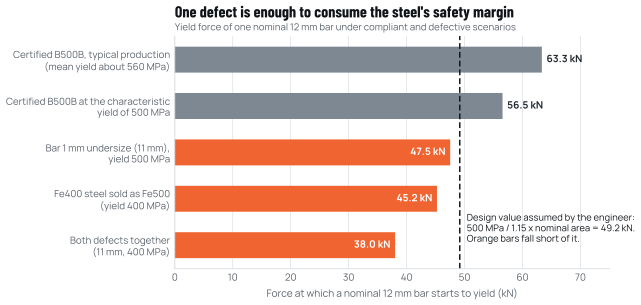
Source: Cameroon Steel calculation; partial factor from EN 1992-1-1 [S36]; mean yield of controlled production from the JCSS Probabilistic Model Code [S29]. Method in Annex A.
None of these defects would be visible to the owner of a building under normal use, because service stresses in reinforcement are kept well below yield [S36]. That is precisely why they matter: they consume the reserve that is meant for the unexpected, and ductility defects remove the warning that a well-designed building gives before it fails.
ES.3 Domestic certified production is the lever, because domestic production is the market
Since imports of rebar were suspended in 2016, the bars in Cameroonian buildings have been made almost entirely in Cameroon [S13][S52]. Whatever view one takes of the ban, it settles where quality must be won: in Cameroonian melt shops and rolling mills, and in the distribution chain that connects them to building sites. Three features of domestic production make it the most effective place to raise the floor.
First, quality can be built in only at the mill. Chemistry, quench, rolling and testing decide the properties of a bar; no merchant or site can add them later. A melt shop with a ladle furnace and a spectrometer, a controlled quench and a laboratory that tests every heat is the only reliable source of bars that meet their grade.
Second, traceability starts at the mill. Heat numbers, rolled-in marks, bundle tags and type 3.1 inspection certificates link every bar to its chemistry and its tests, and make recalls possible. Certification by ANOR, and by independent schemes where producers seek them, turns a producer’s own testing into a guarantee that buyers can check.
Third, enforcement works best on identifiable producers. With imports closed, surveillance means checking the products of a limited number of domestic mills and their distribution. Unmarked or untraceable bars are, by definition, outside the certified system and can simply be refused.
What the evidence does not show matters as much. It does not show that domestic bars are generally poor, nor that any producer mentioned in the press made unsafe bars. It shows that bars of unknown origin and quality circulate, that enforcement has worked when it was applied, and that the market lacks the information and the price signals that would let compliant producers win on quality.
ES.4 What should change, and who should act
The paper’s recommendations (Chapter 10) are designed to make good bars easy to recognise and bad bars risky to sell, without relaxing the standard or creating new institutions.
For ANOR and the Ministry of Commerce. Publish the essential requirements of NC 236 and a register of certified producers with their rolled-in marks; strengthen certification with surveillance audits, independent sampling and statistical evaluation; sample bars at merchants in the main cities and publish the results by brand and diameter; homologate prices per tonne and require the nominal mass of each bar to be displayed; and report annually on conformity and enforcement.
For the Ministry of Public Contracts and contracting authorities. Put a standard clause in every public works contract requiring certified NC 236 bars with class B ductility, type 3.1 inspection certificates tied to heat numbers and site acceptance checks, and pay only for accepted steel measured by mass. With 2,026.3 billion FCFA of public investment budgeted in 2026 [S80], public procurement can shift the whole market.
For the Ministry of Housing and Urban Development and municipalities. Link building permits for multi-storey and public buildings to certified steel, delivery acceptance records and inspection of reinforcement before concrete is poured; publish durability guidance for coastal construction.
For engineers and contractors. Specify the full grade, read the mill certificate in six checks before unloading, weigh and bend on delivery, refuse unmarked bars, never heat a bar to bend it, and enforce cover with spacers.
For producers. Roll every bar with a legible mill mark, aim at nominal mass, report ductility and carbon equivalent on every certificate, invite independent sampling and support training of masons and foremen.
ES.5 How the paper is built
The paper follows the life of a bar. Chapter 1 explains why rebar quality decides how a concrete building behaves when it is overloaded, and sets recent collapses in the region in context without attributing causes. Chapter 2 explains the metallurgy of rebar: chemistry, the routes to grade 500, quenching and self-tempering, and the carbon equivalent. Chapter 3 compares the European, American, international and Cameroonian standards property by property, with tables of bar masses, tolerances and bond requirements. Chapter 4 maps Cameroon’s quality infrastructure, from the 1996 standardisation law to price homologation. Chapter 5 describes how a mill proves quality through testing, statistics and traceability. Chapter 6 catalogues what goes wrong and how a site can detect it. Chapter 7 proposes specification clauses and acceptance practice for designers, contractors and public buyers. Chapter 8 addresses corrosion and durability in the humid coastal climate. Chapter 9 extends the argument to wire rod, mesh and sections. Chapter 10 sets out ten recommendations with an indicative calendar, and Chapter 11 lists the evidence gaps that remain.
The evidence base combines four kinds of source: the standards themselves and certificates that summarise them; official Cameroonian sources, notably ANOR’s published programme documents and communiqués; peer-reviewed studies of rebar bought on markets or sampled on sites in Cameroon, Nigeria and Ethiopia; and press reports of regulatory decisions and building collapses, which are cited for the facts they report and attributed in the text. Where press reports are the only public record, as for the 2024 certificate withdrawal and the 2026 refusal to revise the standard, the paper relies on more than one outlet. The paper uses only public information about Cameroon Steel’s project and describes its quality commitments as objectives.
Every number carries its source in Annex C, and every derived number is explained in Annex A. Standards are summarised for orientation only; their current editions govern. Where the public record is silent, notably on the full technical content of NC 236, on official findings into recent collapses and on the testing capacity of Cameroonian laboratories, the paper says so rather than filling the gap.
Statement of interest. This paper is published by Cameroon Steel, which is developing a steelworks at Kribi. It is written to inform public debate; its analysis is independent of any commercial offer, and every figure is sourced or labelled with its status.
本章引用的资料来源
方括号内的标记对应以下来源(按原文语言列出),完整列表见附录。 完整来源列表
- S04Cameroun: pour non-respect des normes, le fer à béton de la société […] retiré du marché (name of the producer omitted here). EcoMatin,2024年10月21日.按标题和日期引用
- S50POWER climatology API, parameters T2M, RH2M, PRECTOTCORR, 1991 to 2020, at Douala, Kribi, Yaoundé and Garoua. NASA Langley Research Center.power.larc.nasa.gov/api/temporal/climatology/point?parameters=T2M,RH2M…
- S20Officials to Investigate After Cameroon Building Collapse Kills Over 30. VOA Africa,2023年7月24日.voaafrica.com/a/cameroon-building-collapse-kills-over-30-/7193868.html
- S21Cameroon: death toll rises to 40 in building collapse. Africanews,2023年7月27日.africanews.com/2023/07/27/cameroon-death-toll-rises-to-40-in-building-…
- S22Cameroun: Douala, 6 morts dans l’effondrement d’un immeuble à Bonamoussadi. Camer.be, republished by AllAfrica,2026年7月11日.fr.allafrica.com/stories/202607130741.html
- S10Interdiction des importations du fer à béton: les consommateurs dénoncent la mauvaise qualité de la production locale. EcoMatin,2023年4月13日.ecomatin.net/interdiction-des-importations-du-fer-a-beton-les-consomma…
- S06Cameroun: le gouvernement rejette une demande de révision de la norme du fer à béton. EcoMatin,2026年2月5日.ecomatin.net/cameroun-le-gouvernement-rejette-une-demande-de-revision-…
- S08Fer à béton: le gouvernement ferme la porte à toute révision de la norme et recadre la filière sidérurgique. Cameroun24,2026年1月.cameroun24.net/article/72504-fer-a-beton-le-gouvernement-ferme-la-port…
- S31Certificat N° B03/176 rév. 16, aciers pour béton armé, NF A 35-080-1 nuance B500B (fiche descriptive and caractéristiques certifiées). Association Française de Certification des Armatures du Béton (AFCAB), AFNOR Certification,2025年6月6日.feralpi-stahl.com/sites/default/files/media/certifications/NF%20AFCAB-…
- S48Tempcore: a new process for the production of high-quality reinforcing bars. Iron and Steel Engineer 61(3), pp. 53 to 57. P. Simon, M. Economopoulos, P. Nilles,1984年.openalex.org/W3176967943
- S30EN 1992 Eurocode 2: Design of concrete structures (J. Walraven), workshop "Eurocodes: background and applications", Brussels, 18 to 20 Feb 2008. European Commission (DG Enterprise and Industry, Joint Research Centre),2008年2月.eurocodes.fi/wp-content/uploads/1992/sahkoinen1992/EN-1992.pdf
- S38BS 4449:2005+A3:2016 Steel for the reinforcement of concrete. Weldable reinforcing steel. Bar, coil and decoiled product. Specification. British Standards Institution (BSI),2016年.boutique.afnor.org/en-gb/standard/bs-44492005-a32016/steel-for-the-rei…
- S34Rebar 101 (presentation: ASTM bar specifications, tensile and elongation tables, permissible variation in weight, marking). Concrete Reinforcing Steel Institute (CRSI), hosted by New Jersey Institute of Technology,n.d..web.njit.edu/~washd/cim101/download/notes/CRSI/Rebar101_University%20%…
- S35Engineering Bulletin #1: Mechanical properties, ChromX (ASTM A1035) compared with ASTM A615 Grades 60, 80 and 100. Commercial Metals Company (CMC),2021年5月12日.cmc.com/getmedia/83bc1448-b2ed-47b1-9b4e-56951d4b7212/1_Mechanical_Pro…
- S12Métallurgie: les importations du fer à béton interdites jusqu’à nouvel ordre. EcoMatin,2023年4月10日.ecomatin.net/metallurgie-les-importations-du-fer-a-beton-interdites-ju…
- S13Press report of the sealing by customs of more than 7,300 t of imported reinforcing bar, December 2020 (headline and address not reproduced: they name the importer). Business in Cameroon,2020年12月16日.按标题和日期引用
- S14Normes sur les produits de grande consommation: quel impact sur la qualité. Cameroon Tribune,2024年10月10日.cameroon-tribune.cm/article.html/67368/fr.html/details_2
- S15Informations sur le PECAE (cadre légal, procédure, routes, frais, partenaires, questions fréquentes). Agence des Normes et de la Qualité (ANOR).anor.cm/projet-pecae/informations
- S05Cameroon revokes […] compliance certificate for rebar, orders recall of products (name of the producer omitted here). Business in Cameroon,2024年10月17日.按标题和日期引用
- S07Cameroon rejects fresh push to revise rebar standard. Business in Cameroon,2026年1月26日.businessincameroon.com/construction/2601-15657-cameroon-rejects-fresh-…
- S11Fer à béton: les producteurs acceptent une baisse des prix. EcoMatin,2023年10月23日.ecomatin.net/fer-a-beton-les-producteurs-acceptent-une-baisse-des-prix
- S19Assessment of Deviation in Quality of Steel Reinforcing Bars Used in Some Building Sites in Cameroon. World Journal of Engineering and Technology, 11(4), pp. 917 to 931. P. C. Bame, B. E. Yamb, B. Ndigui;Scientific Research Publishing,2023年.doi.org/10.4236/wjet.2023.114061
- S25SON seals 13 steel firms for standards infractions. Economic Confidential,2020年2月11日.economicconfidential.com/son-seals-firms-standards-infractions/
- S28Mechanical strength variability of deformed reinforcing steel bars for concrete structures in Ethiopia. Scientific Reports 12, 2600. T. Achamyeleh, H. Çamur, M. A. Savaş, A. Evcil;Nature Portfolio,2022年.doi.org/10.1038/s41598-022-06654-1
- S29Probabilistic Model Code, Part 3: Resistance models, 3.2 Static properties of reinforcing steel. Joint Committee on Structural Safety (JCSS),2001年版.jcss-lc.org/publications/jcsspmc/rebar.pdf
- S36EN 1992-1-1:2004 Eurocode 2: Design of concrete structures, Part 1-1: General rules and rules for buildings (with corrigenda). European Committee for Standardization (CEN),2004年.eurocodes.jrc.ec.europa.eu/EN-Eurocodes/eurocode-2-design-concrete-str…
- S37EN 206:2013+A2:2021 Concrete: specification, performance, production and conformity. CEN,2021年.standards.cencenelec.eu
- S52UN Comtrade public API, Cameroon (reporter 120), imports and exports by HS line, chapters 72 and 73, 2019 to 2023. United Nations Statistics Division.comtradeapi.un.org/public/v1/preview/C/A/HS?reporterCode=120&period=20…
- S80Budget 2026: 8 816,4 milliards FCFA pour consolider la stabilité et accélérer le développement du Cameroun. Ministry of Finance (MINFI),2025年11月26日.minfi.gov.cm/budget-2026-8-8164-milliards-fcfa-pour-consolider-la-stab…
- S01Kribi: le Premier ministre, chef du gouvernement est là. Cameroon Tribune,2024年12月30日.cameroon-tribune.cm/article.html/68499/fr.html/details_2
- S02Cameroun: complexe moderne de sidérurgie de Kribi, le PM Joseph Dion Ngute effectue la pose de la première pierre. Camer.be,2025年1月5日.camer.be/87795/12:1/cameroun-complexe-moderne-de-siderurgie-de-kribi-l…
- S03Industrialisation: la voie royale de l’émergence. Cameroon Tribune,2025年1月2日.cameroon-tribune.cm/article.html/68558/fr.html/details_2
- S53Production: les acteurs en présence. Cameroon Tribune,2026年5月11日.cameroon-tribune.cm/article.html/76600/fr.html/details_2
引用本章
Cameroon Steel(2026)。更安全的建筑需要符合标称牌号的钢筋(中文摘要版)。白皮书10,摘要:执行摘要:更安全的建筑始于符合标称牌号的钢筋。CS-WP-10。https://www.cameroon-steel.com/zh/library/quality-steel/executive-summary/
来源