白皮书10 · 第1章 · 中文摘要
钢筋质量决定混凝土建筑在破坏前能否发出预警
在钢筋混凝土中,钢筋承担混凝土无法承担的拉力,并提供使超载表现为可见损伤而非突然倒塌的延性;一旦钢筋缺少标称的强度、截面、延性或粘结性能,安全裕度便会在无声中被耗尽。
本页为本章中文摘要;英文全文附于其后,可展开阅读。
按照欧洲规范2(EN 1992-1-1),钢筋设计强度为特征屈服强度除以分项系数1.15,500级钢筋即取500/1.15 = 435 MPa[S36]。该系数用于覆盖受控钢材的正常统计离散,而不是用于吸收以400级冒充500级或偏轻一个规格的钢筋。以公称直径12 mm的500级钢筋为例,设计屈服力为49.2 kN;直径偏小1毫米时为47.5 kN,400级时为45.2 kN,两种缺陷叠加时为38.0 kN,比设计值低23%(推算)。由于欧洲规范2将使用状态下的钢筋应力限制在特征屈服强度的80%以内[S36],这些钢筋在日常荷载下不会显现损伤,但为意外超载、局部混凝土缺陷和业主日后加建楼层预留的储备已被耗尽。
延性缺陷更为严重,因为它在消耗裕度的同时也消除了预警。欧洲规范2附录C规定了三个延性等级:A级Rm/Re不低于1.05、Agt不低于2.5%;B级分别不低于1.08和5.0%;C级Rm/Re在1.15至1.35之间、Agt不低于7.5%[S30][S36]。按B级钢筋设计的结构默认钢筋能够转动并重分布荷载,若交付的是A级或更差的钢筋,这一假定即告失效。
区域内的倒塌事故通常有多重原因,本白皮书不将任何一起归咎于钢材。但2023年7月杜阿拉倒塌事故据报道33至约40人死亡,住房和城市发展部部长指出该建筑未取得建筑许可[S20][S21];2026年1月政府拒绝修订钢筋标准时,也援引了致命倒塌事故[S06][S08]。钢筋质量是少数能在施工前以低成本核查的因素之一,只需一杆秤、一把卷尺、一次弯曲试验和一份证书。
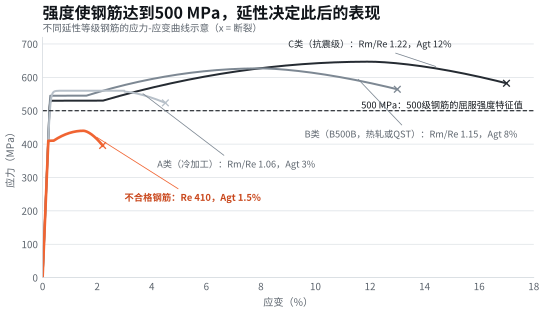
来源:Cameroon Steel示意图。延性等级限值取自EN 1992-1-1附录C[S30][S36];曲线形状仅为示意。
英文全文 11分钟 · 2583词Rebar quality decides whether a concrete building warns before it fails
Reinforced concrete is a partnership: concrete resists compression, steel resists tension, holds cracks closed and supplies the ductility that turns an overload into visible distress rather than sudden collapse. Every structural calculation assumes that the bar on site has its declared yield strength, its declared cross-section, enough ductility and adequate bond. When one of these is missing, the safety margin is consumed silently, and the failure, if it comes, comes with little warning.
1.1 Steel carries the tension that concrete cannot
Concrete is strong in compression and weak in tension. A beam or slab under load bends: its top fibres shorten and its bottom fibres lengthen. The bottom of the section cracks almost as soon as the building is loaded, and from that moment the only thing holding the two faces of each crack together is the reinforcing bar crossing it. The bar is therefore not an accessory. In a beam it is the tension chord of the internal lever arm; in a column the longitudinal bars share the axial load and the links (stirrups) confine the concrete core and stop the bars from buckling; in a slab the bars spread load and control cracking; at every joint the bars must be anchored and lapped so that force passes from one member to the next.
Design codes translate this role into a single number the engineer can use. Under Eurocode 2 (EN 1992-1-1), the design strength of reinforcement is its characteristic yield strength divided by a partial factor of 1.15 for persistent and transient situations [S36]. For a grade 500 bar the engineer therefore works with 500 / 1.15 = 435 MPa (derived). The partial factor exists to cover the normal statistical scatter of a controlled steel population and small geometric deviations. It was never intended to absorb a grade 400 bar sold as grade 500, or a bar that is one size lighter than its label.
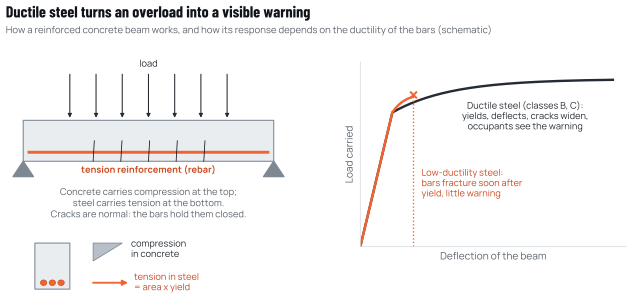
Source: Cameroon Steel schematic based on the design principles of EN 1992-1-1 [S36]. Not test data.
The same logic applies to the concrete itself, which carries its own partial factor of 1.5 [S36]. But concrete quality is at least partly visible on site: a mason can see a weak, honeycombed or badly compacted pour. A rebar defect is invisible once the bar is tied into a cage and covered. That is why the quality of reinforcing steel has to be proven before it is built in, and why the burden of proof should sit with the producer, the merchant and the site, in that order.
1.2 Four properties make up the promise of a grade
When a merchant sells a bar marked "Fe500" or "B500B", the label is a promise about four properties. Each has a distinct structural role, and each can fail independently.
Strength. The yield strength (symbol Re or fy) is the stress at which the steel stops behaving elastically. It sets the force a bar can carry before it stretches permanently. Standards specify a characteristic yield strength, the value that at least 95% of production must exceed, and many also cap the maximum, because a bar that is much stronger than declared changes the way a structure fails [S31][S38].
Section. The force a bar carries is its yield strength multiplied by its cross-sectional area. Because bars are not perfectly round (they carry ribs), standards define the area through the mass per metre: a 12 mm bar must weigh 0.888 kg/m within a tolerance of 4.5% [S31][S32]. A bar that is lighter than allowed has less steel in it, whatever its label says.
Ductility. Ductility is the ability to stretch well beyond yield before breaking. It is measured by the total elongation at maximum force (Agt) and by the ratio of tensile strength to yield strength (Rm/Re), which shows how much the steel hardens as it stretches. These two numbers define the ductility classes A, B and C of Eurocode 2 [S30][S36].
Bond. A bar works only if it cannot slip through the concrete. Bond comes mainly from the transverse ribs rolled onto the surface, and is specified through rib geometry and a parameter called the relative rib area, fR [S36].
Behind these four sit three further properties that matter on real sites: bendability (a bar must bend to a hook or a link without cracking, and in some cases be straightened again), weldability (controlled by chemistry, summarised in the carbon equivalent) and, for bridges and industrial floors, fatigue resistance [S31][S38]. The chapters that follow treat each in turn. The essential point here is that a grade is a bundle of properties, and that the market tends to talk about only one of them, strength, while ductility and section are the properties most often missing.
1.3 Ductility is what gives occupants time to leave
Most reinforced concrete buildings are designed so that, if they are ever overloaded, the steel yields before the concrete crushes. Yielding steel stretches; the beam sags; cracks open wide enough to see; plaster falls; doors jam. These are warnings. A building that gives them can be evacuated and propped. That behaviour depends entirely on the steel being able to stretch, which is what Agt and Rm/Re measure.
Eurocode 2 makes this explicit in two ways. First, its Annex C defines three classes of reinforcing steel: class A with Rm/Re of at least 1.05 and Agt of at least 2.5%, class B with at least 1.08 and 5.0%, and class C with Rm/Re between 1.15 and 1.35 and Agt of at least 7.5% [S30][S36]. Second, the code ties the designer’s freedom to the class of steel: the redistribution of bending moments in continuous beams and slabs is limited more tightly for class A than for classes B and C, and plastic methods of analysis assume class B or C [S36]. In other words, a design prepared for class B steel quietly assumes that the bars can rotate and redistribute load. If class A or worse is delivered, that assumption fails.
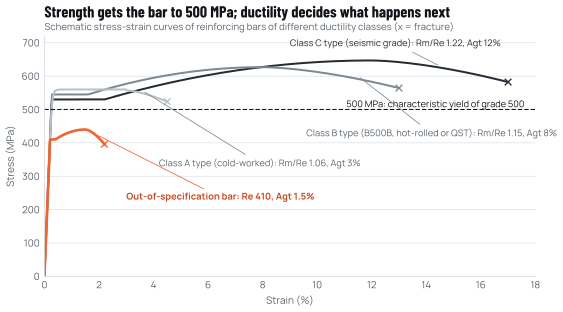
Source: Cameroon Steel schematic. Class limits from EN 1992-1-1 Annex C [S30][S36]; curve shapes are indicative.
Ductility also underpins robustness: the capacity of a building to survive the loss of a column, a gas explosion, a vehicle impact or a local overload without progressive collapse. Robustness rules rely on continuous ties that can stretch and hang the damaged part of the structure from the undamaged part. A tie made of brittle bars, or of bars that crack at their bends, cannot do this. In seismic regions this is the decisive property, which is why seismic codes demand class C or equivalent steel; Cameroon is not a high-seismicity country, but the same argument applies to accidental actions, poor construction and the extra floors that owners frequently add.
1.4 Collapses in the region show what is at stake, not a single cause
Building collapses in Douala, Yaoundé, Lagos and other West and Central African cities are reported every year. Their causes are almost always multiple: no building permit, floors added without design, weak concrete, poor detailing, inadequate supervision, heavy rain on structures already damaged, and sometimes substandard reinforcement. Official investigations are rarely published in full, and the paper does not attribute any particular collapse to steel quality. The table below lists cases for which an official statement or an investigation finding has been reported by credible media, to show the setting in which rebar quality is discussed.
Table 1.1 Selected building collapses in Cameroon and Nigeria with officially reported facts (neutral summary)
| Date | Place | Building | Reported toll | Official statement or finding | Source |
|---|---|---|---|---|---|
| 2016 | Douala | Building collapse | 5 deaths | Local authorities had identified 500 buildings in danger of collapse in Douala in June 2016 | [S20] |
| 12 Sep 2014 | Lagos, Nigeria | Six-storey church guesthouse | 116 deaths | Coroner attributed the collapse to structural failures; the building had no planning permission | [S24] |
| 1 Nov 2021 | Ikoyi, Lagos | 21-storey tower under construction | At least 44 deaths | Investigative tribunal: collapse rooted in an "erosion of professional ethics and due diligence" | [S23] |
| 23 Jul 2023 | North Douala | Four-storey residential block, fell on a neighbouring house | 33 reported on 24 Jul; about 40 provisional | Minister of Housing and Urban Development: no building permit; residents reported cracks and exposed, rusted reinforcing rods; presidential order for an investigation | [S20][S21] |
| 10 to 11 Jul 2026 | Bonamoussadi, Douala | Two-storey building | 6 deaths, 4 injured | Building had been declared at risk of ruin, evacuated and sealed by the urban community, then reoccupied; heavy rain | [S22] |
Source: as listed; tolls as reported at the time. No public technical finding on the cause of the July 2023 Douala collapse was found (see the evidence-gaps chapter).
Two features of the Cameroonian debate stand out. First, practitioners link collapses to steel quality explicitly: in April 2023, after the import ban was reaffirmed, an engineer quoted in the Cameroonian press attributed "several building collapses" to the "approximate quality" of some locally produced bars and to the use of informally collected scrap [S10]. Producers rejected the charge, and one stated that it held ISO 9001 certification and met international standards [S10]. Second, the Government itself invoked collapses when it refused, in January 2026, an industry request to revise the national rebar standard; the press reported that the refusal referred to deadly collapses linked to substandard construction materials and to the State’s effort to clean up and structure the sector [S06][S08].
Neither statement proves that steel caused a particular failure. Together they show that the question of rebar quality is now a public-safety question in Cameroon, and that the policy answer chosen so far is to hold the standard, not to relax it.
1.5 A light or weak bar consumes the safety margin silently
How much does a defective bar matter? The arithmetic is simple and is shown in full in Annex A. Take a 12 mm grade 500 bar. Its nominal area is 113.1 mm². At the characteristic yield of 500 MPa it starts to yield at 56.5 kN; the designer counts on 435 MPa, or 49.2 kN; and a typical bar from a controlled mill, with a mean yield around 560 MPa (the mean of a well-controlled population is about two standard deviations of 30 MPa above the nominal value [S29]), yields at about 63.3 kN (all derived).
Now take three common defects:
- One size light. A "12 mm" bar that is in fact 11 mm has 16% less area. Even at 500 MPa it yields at 47.5 kN, 3% below the design value.
- One grade weak. A grade 400 bar sold as grade 500 yields at 45.2 kN, 8% below the design value.
- Both. An 11 mm bar of grade 400 yields at 38.0 kN, 23% below what the engineer assumed.
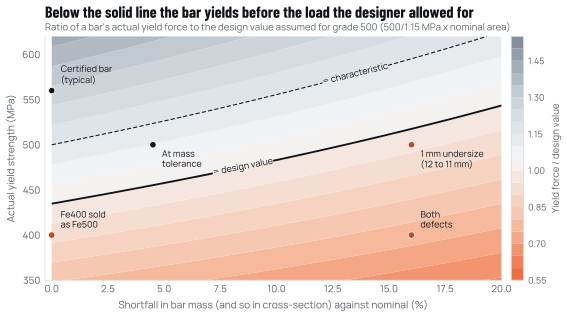
Source: Cameroon Steel calculation; partial factor from EN 1992-1-1 [S36]; mass tolerance from EN 10080 / NF A 35-080-1 [S31][S32]. Method in Annex A.
None of these bars will show distress in a building under its everyday loads. Eurocode 2 limits the steel stress under the characteristic load combination to 80% of the characteristic yield strength [S36], so even a substandard bar is usually far from yield in service. The danger is in the reserve. The margin that was meant to cover an unforeseen overload, a section of poorly compacted concrete, a missing link, a column cast slightly out of plumb, or the third floor that the owner adds five years later, has already been spent at the hardware merchant’s counter. Errors that would each be harmless on their own then combine.
The ductility defect is worse, because it removes the warning as well as the margin. A brittle bar may meet its yield strength in a tensile test and still crack when the mason bends it into a link, leaving a fractured hook hidden in a column. It may fracture at small strain in a structure that is redistributing load after damage. Of the four properties, ductility is the one least visible to the buyer and least discussed in the market, and the one that most separates a structure that bends from one that breaks.
1.6 Quality failures compound, so the cheapest control comes first
The practical consequence is about sequence. In the chain of decisions that produces a building, the reinforcing bar is the component whose quality is cheapest to verify and most expensive to correct. A mill can test every cast for chemistry and every lot for tensile properties at a cost that is small against the value of the steel. A merchant can weigh a bar. A site can bend a sample and check a certificate. Once concrete has been poured, the only ways to know what is inside are destructive coring, scanning and load testing, at many times the cost.
This paper therefore argues for raising the floor of rebar quality in Cameroon through three layers of control that reinforce each other:
- At the mill, certified production with traceable quality control, so that every bundle can be linked to a heat number, a chemical analysis and a set of mechanical tests (chapters on metallurgy and testing).
- At the point of sale, enforcement of the mandatory national standard through market surveillance, visible marking and pricing by weight, so that a light or unmarked bar cannot compete with a compliant one on price (chapters on the quality infrastructure and on defects).
- On site, simple acceptance checks by contractors and supervising engineers, backed by laboratory testing when in doubt and by public procurement rules that make certified steel a condition of payment (chapters on specification and acceptance, and on recommendations).
Each layer is imperfect alone. Together they make the substandard bar both risky to sell and likely to be caught. The following chapters set out the metallurgy that makes good rebar, the standards that define it, the Cameroonian institutions that police it, and the practical checks that any site can apply.
Other sources cited in the English text
- S31Certificat N° B03/176 rév. 16, aciers pour béton armé, NF A 35-080-1 nuance B500B (fiche descriptive and caractéristiques certifiées). Association Française de Certification des Armatures du Béton (AFCAB), AFNOR Certification, 6 Jun 2025.feralpi-stahl.com/sites/default/files/media/certifications/NF%20AFCAB-…
- S38BS 4449:2005+A3:2016 Steel for the reinforcement of concrete. Weldable reinforcing steel. Bar, coil and decoiled product. Specification. British Standards Institution (BSI), 2016.boutique.afnor.org/en-gb/standard/bs-44492005-a32016/steel-for-the-rei…
- S32Technical specification SPF400 rev. 12, Rebars B500 (chemical, mechanical and dimensional requirements under EN 10080 and national standards). Ferriere Nord S.p.A. (Pittini group), 14 Sep 2021.pittini.it/wp-content/uploads/Pittini-Group-Reinforcing-Steel-Bars-B50…
- S24Nigerian preacher TB Joshua skips trial as judge adjourns case. Nation (Nation Media Group), 30 Nov 2015, updated 3 Jul 2020.nation.africa/kenya/news/africa/nigerian-preacher-tb-joshua-skips-tria…
- S23Why 21-storey Ikoyi building collapsed, panel reveals after submitting report. Sahara Reporters, 5 Jan 2022.saharareporters.com/2022/01/05/why-21-storey-ikoyi-building-collapsed-…
- S22Cameroun: Douala, 6 morts dans l’effondrement d’un immeuble à Bonamoussadi. Camer.be, republished by AllAfrica, 11 Jul 2026.fr.allafrica.com/stories/202607130741.html
- S10Interdiction des importations du fer à béton: les consommateurs dénoncent la mauvaise qualité de la production locale. EcoMatin, 13 Apr 2023.ecomatin.net/interdiction-des-importations-du-fer-a-beton-les-consomma…
- S29Probabilistic Model Code, Part 3: Resistance models, 3.2 Static properties of reinforcing steel. Joint Committee on Structural Safety (JCSS), 2001 edition.jcss-lc.org/publications/jcsspmc/rebar.pdf
本章引用的资料来源
方括号内的标记对应以下来源(按原文语言列出),完整列表见附录。 完整来源列表
- S36EN 1992-1-1:2004 Eurocode 2: Design of concrete structures, Part 1-1: General rules and rules for buildings (with corrigenda). European Committee for Standardization (CEN),2004年.eurocodes.jrc.ec.europa.eu/EN-Eurocodes/eurocode-2-design-concrete-str…
- S30EN 1992 Eurocode 2: Design of concrete structures (J. Walraven), workshop "Eurocodes: background and applications", Brussels, 18 to 20 Feb 2008. European Commission (DG Enterprise and Industry, Joint Research Centre),2008年2月.eurocodes.fi/wp-content/uploads/1992/sahkoinen1992/EN-1992.pdf
- S20Officials to Investigate After Cameroon Building Collapse Kills Over 30. VOA Africa,2023年7月24日.voaafrica.com/a/cameroon-building-collapse-kills-over-30-/7193868.html
- S21Cameroon: death toll rises to 40 in building collapse. Africanews,2023年7月27日.africanews.com/2023/07/27/cameroon-death-toll-rises-to-40-in-building-…
- S06Cameroun: le gouvernement rejette une demande de révision de la norme du fer à béton. EcoMatin,2026年2月5日.ecomatin.net/cameroun-le-gouvernement-rejette-une-demande-de-revision-…
- S08Fer à béton: le gouvernement ferme la porte à toute révision de la norme et recadre la filière sidérurgique. Cameroun24,2026年1月.cameroun24.net/article/72504-fer-a-beton-le-gouvernement-ferme-la-port…
引用本章
Cameroon Steel(2026)。更安全的建筑需要符合标称牌号的钢筋(中文摘要版)。白皮书10,第1章:钢筋质量决定混凝土建筑在破坏前能否发出预警。CS-WP-10。https://www.cameroon-steel.com/zh/library/quality-steel/why-rebar-quality-matters/
来源