White paper 02 · Site and logistics
Kribi can become Central Africa’s steel platform if infrastructure keeps pace
Deep water, an organised zone, a 225 kV link and rail plans: Kribi has what heavy industry needs, if sequencing keeps pace.
Derived Counted from the English manuscript when the site was generated; print equivalent = words ÷ 350.
You are reading the full English edition. Also online: Édition française complète中文摘要版
Executive summary
What the study shows
Read the full executive summaryPort, power, land and logistics at the Kribi industrial-port zone, what heavy industry needs from them, and the sequence in which they must arrive, 2026 to 2040.
Source: white paper 02, executive summary; bracketed markers refer to the list of sources in the annex.
Main findings
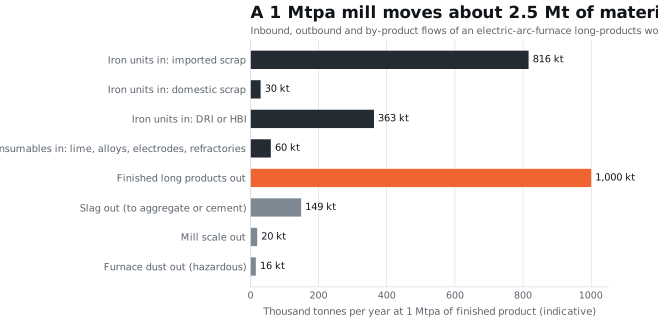
- Location fixes most of a steel mill’s non-metallic costs. Two of the three iron sources open to a Central African steelmaker, imported DRI or HBI and imported scrap, arrive by sea, and the third, Cameroonian ore, arrives at the same coast for export. A works of 1 Mtpa needs about 1.24 Mt a year of port-linked inbound cargo, and a first phase of 0.3 Mtpa about 351,000 t [S112]. The cheapest place to make steel in the region is beside a deep-water quay with dry-bulk handling (Chapter 1).
- Kribi has the deepest quay in Cameroon and a record of filling new capacity. With 16 m at the quay, the port handled 12.7 Mt and 555,398 TEU in 2025, and container volumes rose by 82% in the year after a second terminal opened in May 2025 [S22][S28][S52]. Vessel waiting times were about two days at Kribi against about nine at Douala in 2025 [S54] (Chapter 2).
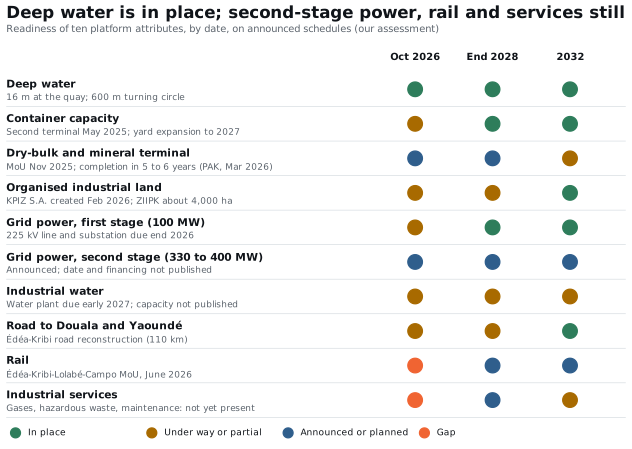
- Dry bulk is the port’s missing link for heavy industry. Existing terminals can serve a first steel phase of a few hundred thousand tonnes a year. A cluster needs a dry-bulk berth with covered storage for iron units. The 125 Mt a year mineral terminal, agreed in a memorandum of understanding on 4 November 2025 and expected by PAK’s Director General in March 2026 to be completed within five to six years, should be designed with one [S32][S33][S03] (Chapter 2).
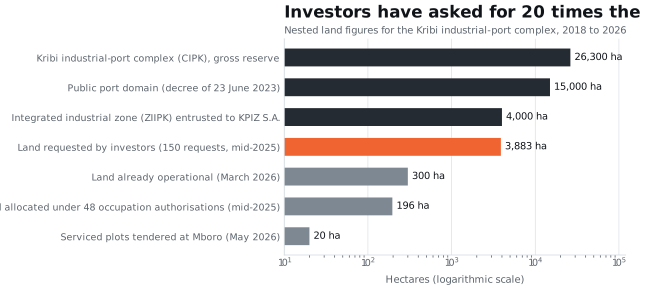
- A dedicated zone company now holds the land. KPIZ S.A., created on 26 February 2026 by PAK, AGL, Arise IIP and Belmont Investments, is mandated to design, finance, develop, operate and maintain an integrated zone of about 4,000 ha, with a €795 million plan over fifteen years [S02][S04][S01] (Chapter 3).
- Demand for land is twenty times what has been allocated. By mid-2025 investors had requested about 3,883 ha against 196 ha allocated under 48 occupation authorisations [S17]. The constraint is converting reserve into serviced, contracted plots, which requires KPIZ to publish its contractual framework and a tariff suited to heavy industry, without a levy on turnover [S11][S114]. As a prospective tenant, Cameroon Steel has an interest in these terms (Chapter 3).
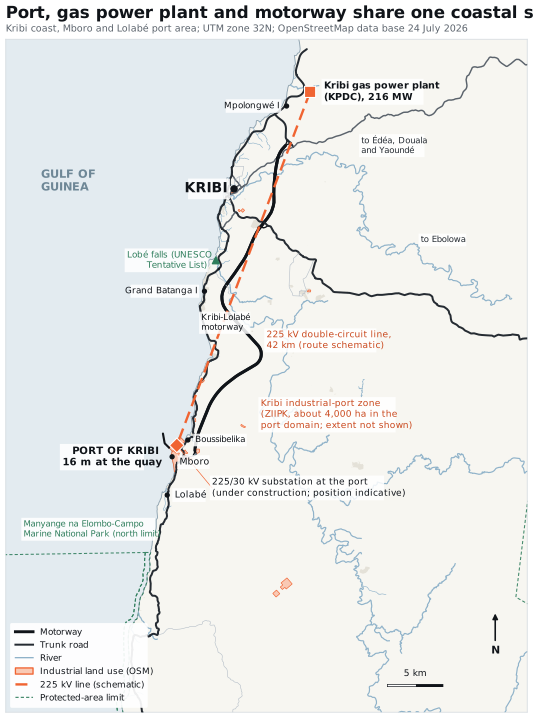
- The 225 kV link makes heavy industry possible; a second stage makes a cluster possible. The KPDC-port line and substation will provide about 100 MW from the end of 2026 and 330 to 400 MW later [S25]. The first stage can carry a first steel phase averaging about 36 MW; a 1 Mtpa works alone averages about 94 MW [S112]. On a steel-led path, the first stage is fully used by about 2032, so the second must be financed and scheduled now; neither its date nor its financing has been published (Chapter 4).
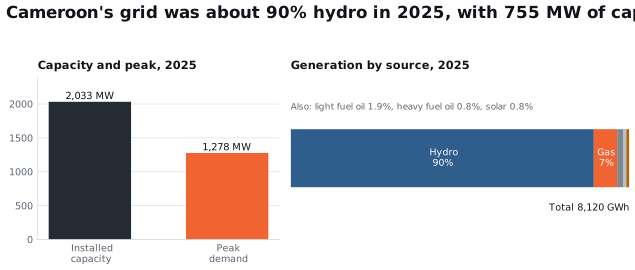
- Firmness, power quality and price need rules, not just megawatts. Cameroon’s grid was about 90% hydro in 2025, 150 MW of industrial demand was unmet in October 2026, no regulated tariff exists above 10 MW, and arc furnaces disturb weak networks [S60][S61][S72]. A published power-quality code, a second high-voltage source and a long-term tariff structure are preconditions for a cluster (Chapter 4).
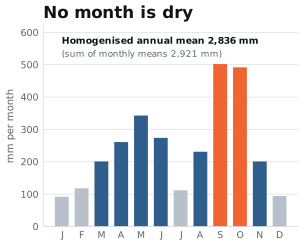
- Water is abundant; treatment and hazardous waste are the gaps. Kribi receives about 2,836 mm of rain a year and a port-platform water plant is due in early 2027 [S79][S26]. Closed-loop cooling holds a mill’s make-up near 2 m³ per tonne, but no licensed route has been identified for the 10 to 20 kg of hazardous furnace dust produced per tonne of steel [S76][S112] (Chapter 5).
- Kribi reaches its markets; rail would make it the region’s steel hinge. Six cities lie within about 300 km and the CEMAC region imports about US$500 million a year of iron and steel [S110][S94]. A 1 Mtpa works would generate about 245 truck movements a day if every flow went by road. Most of the inbound flow would stay inside the port domain, between quay and plant; about 110 to 120 loads a day would use the public road to Édéa, or about 55 to 60 if half the output ships by sea. That is the traffic the Édéa-Kribi road must carry until it is rebuilt and the June 2026 railway agreement becomes a funded line [S27][S41][S112] (Chapter 6).
- A steel anchor creates a cluster. One 1 Mtpa works yields about 185,000 t a year of slag, scale and dust and needs about 37 million Nm³ of oxygen; Kribi already hosts a 1 Mt a year cement plant and a second is planned [S112][S35][S37]. Adjacency in the master plan, pipe and conveyor corridors and shared services decide whether those exchanges happen (Chapter 7).
- Successful port-industrial zones built infrastructure ahead of demand and organised around anchors. Tanger Med, Jebel Ali, Jurong and Lekki share four traits: one authority for port and zone, utilities built ahead of or with the first tenants, anchor industries that pull suppliers in, and policy that pushes raw materials into local processing. Sohar and Pecém show steel organised at deep-water ports; Sohar also shows that where gas was not planned for industry, downstream growth stalled [S127] (Chapter 8).
- Sequence is the strategy. A first steel phase can rely on infrastructure already under construction. A cluster needs, in order, a financed second power stage and power-quality code, a zone strategic environmental assessment that allocates the coast’s carrying capacity, a heavy-industry land framework, waste and gas services, and a dedicated bulk berth and rail (Chapters 9 and 10).
Contents
12 chapters, 4 annexes
Every chapter opens with its conclusion. The annexes set out the method, the glossary and the list of sources.
- SummaryExecutive summary: Kribi has what heavy industry cannot build for itself; the next two years decide the rest11 min · 1 fig.
- Chapter 1Location fixes a steel mill’s costs before the first heat12 min · 3 fig.
- Chapter 2The Port of Kribi gives Central Africa its deepest quay, and it is filling fast12 min · 2 fig.
- Chapter 3A dedicated zone company now holds Kribi’s 4,000 ha, and steel is one of its named clusters12 min · 1 fig.
- Chapter 4The 225 kV link makes heavy industry possible at Kribi; a second stage makes a cluster possible11 min · 3 fig.
- Chapter 5Water is plentiful at Kribi; treatment, wastewater and hazardous waste are the real utility gaps11 min · 3 fig.
- Chapter 6Kribi reaches six cities, three of them capitals, within 300 km; rail would make it the region’s steel hinge11 min · 4 fig.
- Chapter 7A steel anchor turns Kribi’s industrial zone into a cluster that feeds itself11 min · 2 fig.
- Chapter 8Successful port-industrial zones built infrastructure ahead of demand and organised around anchors10 min · 1 fig.
- Chapter 9The risk at Kribi is sequence: each step must arrive before the industry that depends on it11 min · 2 fig.
- Chapter 10A three-step roadmap can make Kribi a steel and metals platform by 204011 min · 2 fig.
- Chapter 11Twelve facts would change this assessment; most can be settled within a year4 min
Annexes
Go further
Related white papers
- WP05Cameroon’s hydro grid can power low-carbon steel if large users get firm supply, clear tariffs and gasEnergy · 2.9 h
- WP07Building responsibly in Kribi: a steelworks can meet international standards on four conditionsEnvironment and society · 2.8 h
- WP01From ore to steel: Cameroon’s missing link is ironmaking, not rollingValue chain · 3 h
Related Labs tools
- Logistics simulator
How many ships, trucks and trains does the plant need?
- Power demand
How much electricity does an electric steelworks need, hour by hour?
- Project timeline
What is verified, what is planned, and when?
Cite this white paper
CS-WP-02
Cameroon Steel (2026). Kribi can become Central Africa’s steel platform if infrastructure keeps pace. White paper 02, CS-WP-02. https://www.cameroon-steel.com/en/library/kribi-steel-platform/
- Reference
- CS-WP-02
- Edition
- 10 October 2026
- Status
- First edition
- Classification
- Public