White paper 02 · Chapter 1
Location fixes a steel mill’s costs before the first heat
A steel mill is a machine for moving heavy, low-value material and for drawing large, uneven blocks of electricity. An electric-arc-furnace works making 1 million tonnes a year (Mtpa) of long products handles about 2.5 Mt of material a year and draws an average of about 94 MW, with peaks well above 100 MVA [S112][S75]. Those two facts decide where such a plant can succeed. The site must sit next to deep water for inbound iron units, close to the markets that buy bars and sections, inside a power system strong enough to absorb a furnace, and on land that is organised, serviced and accepted by its neighbours. This chapter sets out each requirement in numbers, so that the chapters that follow can test Kribi against them rather than against slogans.
In this chapter (7)
- 1.1 A steel mill moves about 2.5 tonnes of material for every tonne it sells
- 1.2 Iron units arrive by sea, so the quay sets the cost floor
- 1.3 Products leave by road and coastal shipping, so distance to customers matters as much
- 1.4 Electricity: a mill is a grid-scale customer with a difficult load
- 1.5 Land, water and neighbours: the quiet conditions
- 1.6 A scoring frame for steel locations
- 1.7 Why the hard attributes come first
1.1 A steel mill moves about 2.5 tonnes of material for every tonne it sells
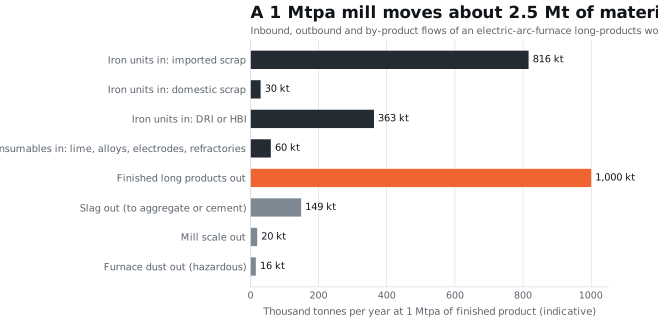
The physical arithmetic of steelmaking is unforgiving. An electric arc furnace (EAF) melts a charge of scrap and direct-reduced iron (DRI, or its compacted form, hot-briquetted iron, HBI). Some of the charge is lost as slag, dust and scale, and some liquid steel is lost again between the caster and the rolling mill. On published benchmarks, about 1.2 t of metallic charge is needed for each tonne of finished bar, rod or section [S112][S75]. Lime, ferro-alloys, graphite electrodes and refractories add inbound tonnage equal to about 6% of finished output, and every tonne of liquid steel generates 110 to 180 kg of solid residue, mostly slag [S75], of which 10 to 20 kg is furnace dust (a planning range; the European reference document reports 10 to 30 kg [S76]), and all of it must leave the site again.
Figure 1.1 applies these benchmarks to a works of 1 Mtpa of finished product, using the balance of the Cameroon Steel reference configuration RC-1 (planning estimate). It is a planning balance, not a design, but it illustrates the scale: about 1.2 Mt of iron units and 0.06 Mt of consumables come in, 1.0 Mt of products and about 0.19 Mt of by-products go out. A mill of this size is, in logistics terms, a medium-sized port terminal with a furnace attached.
Source: Cameroon Steel reference configuration RC-1 (planning estimate), edition 10 October 2026 [S112]; solid-waste benchmark from IFC, Environmental, Health and Safety Guidelines for Integrated Steel Mills, 2007 [S75]; dust: planning range, European reference document 10 to 30 kg [S76].
The point of the figure is not the precision of each bar but the ratio. Because steel is cheap per tonne relative to its weight, transport costs are a large share of delivered cost, and every avoidable kilometre between quay, furnace and customer is margin lost. In 2025 Cameroon imported 412,049 t of iron and steel under customs chapter 72 at an average declared value of about 413 FCFA per kilogram, roughly €630 per tonne [S93]. At values of that order, a few thousand francs per tonne of avoidable haulage on each inbound and outbound leg is the difference between a plant that competes with imports and one that does not. The series’ indicative comparison of the cost of a Kribi billet with a delivered import is set out in White paper 04, section 8.6.
1.2 Iron units arrive by sea, so the quay sets the cost floor
The first locational test is where the iron comes from. Three sources are possible for a Central African EAF works, and two of them arrive by sea.
Scrap is the cheapest charge where it exists in volume, but Central Africa generates little of it. Cameroon’s existing re-rolling mills already depend on imports: in September 2026 the country’s largest steel group secured a €40 million revolving facility from Afreximbank specifically to import billets, and press reporting of the deal noted that local scrap covers only about 40% of the sector’s needs [S98]. The only national estimate of scrap arising, made in 2006, put it at 53,000 to 62,000 t a year [S168], and most of what is collected already feeds the existing mills. A new melt shop cannot assume that domestic scrap will grow fast enough to feed it: Cameroon Steel’s reference configuration assumes about 30,000 t a year of domestic scrap, within a range of zero to 60,000 t, and imports the rest of its charge [S112].
Imported DRI or HBI is the main alternative. World DRI output reached about 151 Mt in 2025, but on Midrex’s plant statistics, which cover gas-based plants, Sub-Saharan Africa produced only 0.09 Mt of it, because the region’s gas-based plants are idle [S101]. worldsteel also estimates about 2.7 Mt of mostly coal-based DRI made in East Africa, in Uganda, Kenya and Tanzania [S95]; none of it is made on the Gulf of Guinea. DRI and HBI are traded in bulk carriers between the Middle East, India, Russia and the Americas, and they are moisture-sensitive: they need covered handling and dry storage at the quay. A plant that relies on them for a third of its charge at 1 Mtpa would import roughly 0.36 Mt a year in bulk, which only a deep-water port with a dry-bulk berth can receive economically [S112].
Domestic iron ore, reduced locally to DRI, is the long-term prize. Cameroon accounts for about 64 Mtpa, or 9%, of the world’s iron-ore mine capacity in development [S102], and the 2023 Mining Code requires that mining conventions set out how at least 15% of production is made available for local transformation [S24]. Ore from the Mbalam deposit in the East Region, from Bipindi-Grand Zambi and from the Lobé deposit near Kribi is planned to move to the coast for export [S43][S42]. A steel platform that sits where that ore reaches the sea can take its share without a second inland journey.
1.3 Products leave by road and coastal shipping, so distance to customers matters as much
The second test runs in the other direction. Long products such as reinforcing bar, wire rod, angles and channels are sold to builders, fabricators and public-works contractors. In Central Africa they move mostly by road, with some coastal shipping to neighbouring ports. Cameroon already exports about 31,000 t a year of bars, mostly to Chad [S93], and the six members of the Central African Economic and Monetary Community (CEMAC) imported about US$500 million of chapter 72 products in 2023 [S94]. A mill that wants that regional market must reach Douala, Yaoundé and the CEMAC transit corridors as cheaply as it reaches its own quay.
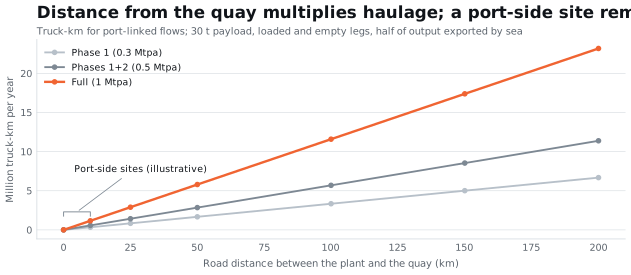
Distance compounds quickly. Figure 1.2 shows how truck movements scale with the road distance between a mill and its port, for the port-linked flows of a works at three stages of growth. A site 100 km from the quay would generate about 12 million truck-kilometres a year at 1 Mtpa, with the road wear, fuel, accident risk and community impact that come with them. A port-side site removes most of that burden and leaves trucking for the final delivery to customers.
Source: Cameroon Steel reference configuration RC-1 (planning estimate), logistics balance [S112]; arithmetic in Annex A.
1.4 Electricity: a mill is a grid-scale customer with a difficult load
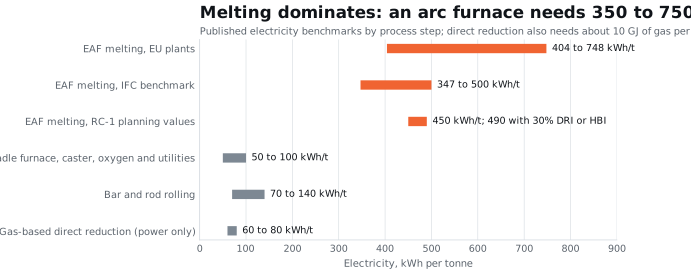
The third test is energy. Melting steel in an arc furnace takes between about 350 and 750 kWh per tonne of liquid steel, depending on the charge, the furnace and how well it is operated; the European Union’s reference document for the sector reports 404 to 748 kWh/t across EU plants, and the IFC benchmark is 347 to 500 kWh/t [S76][S75]. Cameroon Steel’s reference configuration plans on 450 kWh per tonne of liquid steel, the RC-1 planning value, within the IFC range of 347 to 500 kWh/t; with 30% DRI or HBI in the charge, about 490 kWh/t is the upper planning value [S112][S75]. Rolling adds 70 to 140 kWh per tonne of product, and the ladle furnace, caster, oxygen plant and utilities add more [S75][S112]. A gas-based direct-reduction plant, if one is added later, needs about 10 GJ of natural gas and some 60 to 80 kWh of electricity for each tonne of DRI [S116].
Source: European Commission JRC, Best Available Techniques Reference Document for Iron and Steel Production, 2013 [S76]; IFC, EHS Guidelines for Integrated Steel Mills, 2007 [S75]; Cameroon Steel indicative planning ranges for auxiliaries and direct reduction [S112].
Three features of this demand matter for location. First, the quantity: at 1 Mtpa, total consumption is of the order of 0.75 TWh a year, an average load of about 94 MW [S112]. Cameroon’s whole power system served a peak of 1,278 MW in 2025 [S60], so a single mill at full output is a customer the size of a medium town. Second, the shape: an arc furnace draws power in violent, rapidly fluctuating bursts that cause voltage flicker and harmonics on weak networks, so the furnace needs a connection point with high short-circuit strength or dedicated compensation equipment (Chapter 4). Its load is schedulable rather than interruptible: an operator can time melting around grid peaks, but cannot cut power in the middle of a heat without losing it. Third, the price: electricity is typically the largest conversion cost after the metallic charge, so a difference of a few francs per kilowatt-hour moves the plant’s competitiveness against imports. Cameroon’s power system and tariffs are analysed in White paper 05, Chapters 2 and 3.
These features favour a site close to a large generating plant or a high-voltage substation, inside an industrial zone that can plan its network for heavy users. They penalise a site at the end of a long medium-voltage line, however good its other attributes.
1.5 Land, water and neighbours: the quiet conditions
The fourth group of requirements is less visible but just as decisive.
Land. A modern long-products works needs a compact core for the melt shop and mills, but also stockyards for scrap and iron units, covered stores for DRI and HBI, a finished-products yard, a high-voltage substation, water treatment, a slag yard and a buffer from its neighbours. Expansion space matters as much as the first phase: mills grow by adding lines, and a site that cannot take a second melt shop or a direct-reduction module will strand capital later. The land must also be legally secure, serviced with roads, drainage and utilities, and free of unresolved claims.
Water. Steel plants are not the thirstiest industry when they recycle, but they need reliable make-up water for cooling towers and rolling-mill circuits. The world steel sector withdrew an average of 8.5 m³ of fresh water per tonne of steel in 2024 and consumed 2.3 m³/t [S77]; closed-loop designs can hold make-up water near 2 m³ per tonne of product [S112]. At 1 Mtpa that is 2 to 8.5 million m³ a year depending on practice (Chapter 5).
Neighbours and environment. A steel works produces dust, noise, traffic and a large carbon footprint; it also creates skilled jobs and supplier contracts. Cameroonian law classifies metal production as an activity requiring a detailed environmental and social impact assessment, and requires a strategic environmental assessment for industrial zones and industrial-port complexes [S87]. A zone that has already studied and planned for heavy industry, and that keeps it at a distance from sensitive coasts and communities, lowers the risk for every tenant.
1.6 A scoring frame for steel locations
Table 1.1 derivedWhat a 1 Mtpa electric-arc-furnace long-products works needs from its location
| Requirement | Why it matters | Indicative quantity at 1 Mtpa | Where this paper tests Kribi |
|---|---|---|---|
| Deep-water quay with dry-bulk handling | Iron units (DRI, HBI, scrap) and consumables arrive in bulk carriers | About 1.24 Mt a year of port-linked inbound cargo [S112] | Chapter 2 |
| Container and break-bulk capacity | Spares, alloys, refractories in; some products out | Tens of thousands of tonnes a year | Chapter 2 |
| Organised, serviced industrial land | Secure tenure, roads, drainage, utilities, buffers, room for later phases | A core plant site plus buffers and expansion reserve | Chapter 3 |
| Firm high-voltage power | Average load and furnace peaks; power quality | About 94 MW average; 130 to 190 MVA maximum demand [S112] | Chapter 4 |
| Reliable industrial water and waste services | Cooling make-up, rolling circuits, hazardous dust disposal | 2 to 8.5 Mm³ a year; about 16 kt a year of furnace dust [S112][S77] | Chapter 5 |
| Road and rail to markets and ore | Regional sales, ore supply, workforce access | About 245 truck movements a day if every flow went by road, of which about 110 to 120 on public roads [S112] | Chapter 6 |
| Suppliers and customers nearby | Gases, maintenance, slag users, fabricators | Oxygen of about 37 million Nm³ a year; 149 kt of slag [S112] | Chapter 7 |
| Environmental carrying capacity | Air, water, coast, biodiversity, communities | Cumulative assessment at zone level | Chapter 9 |
Source: Cameroon Steel analysis; quantities are indicative planning figures for one tenant [S112], with benchmarks from [S75], [S76] and [S77].
The table is deliberately demanding. Few locations in Sub-Saharan Africa can tick every row today, and none could do so without public infrastructure arriving on time. The question for Kribi is therefore not whether it is perfect, but whether it has the hard attributes that cannot be built elsewhere, chiefly deep water and space, and whether the attributes that can be built, chiefly power, rail and services, are on a credible schedule.
1.7 Why the hard attributes come first
Some locational advantages can be bought; others cannot. A mill can build its own substation, water-treatment plant and rail siding, and it can contract for gases and maintenance. It cannot dredge a natural harbour, create a protected deep-water coast or assemble thousands of hectares of contiguous land in an organised legal regime. These are the attributes that public authorities create once, over decades, and that private investors then rent.
Kribi’s deep-water port, opened in 2018, and its land reserve, delimited by presidential decree in 2023, fall into that second category [S117][S16]. They are the reason the Kribi industrial-port zone has been chosen as the site for a steel and metals cluster in the plans of its new management company, which lists "steelmaking linked to mineral exports" among its development clusters [S03]. They are also why Cameroon Steel, whose foundation stone was laid at Mboro on 30 December 2024 by the Prime Minister on behalf of the Head of State, chose to develop its steel complex within the zone [S39].
The chapters that follow test the remaining rows of the table one by one. The test is applied as a lender or an independent engineer would apply it: by asking what exists today, what is under construction with a date, what is only announced, and what must still be organised.
Sources cited in this chapter
Bracketed markers refer to these sources; the full list is in the annex. Full list of sources
- S112Cameroon Steel reference configuration RC-1 (planning estimate), edition 10 October 2026. Cameroon Steel, 10 October 2026.Cited by title and date
- S75Environmental, Health, and Safety Guidelines for Integrated Steel Mills. IFC, World Bank Group, 30 April 2007.ifc.org/content/dam/ifc/doc/2000/2007-integrated-steel-mills-ehs-guide…
- S76Best Available Techniques Reference Document for Iron and Steel Production (EUR 25521). European Commission, Joint Research Centre, 2013.bureau-industrial-transformation.jrc.ec.europa.eu/sites/default/files/…
- S93Évolution du commerce extérieur en 2025 (version provisoire). Institut National de la Statistique (INS), Cameroon, February 2026.ins-cameroun.cm/wp-content/uploads/2026/04/Note-sur-le-commerce-exteri…
- S98Cameroun: le groupe Prometal décroche 26 milliards FCFA auprès d’Afreximbank pour renforcer sa production d’acier. Sikafinance, 30 September 2026.sikafinance.com/marches/cameroun-le-groupe-prometal-decroche-26-millia…
- S168La récupération et le recyclage des déchets ferromagnétiques: analyse de la situation au Cameroun (Déchets, Revue francophone d’écologie industrielle n°48). Bidoung J., Fomethe A., Yantio G., Melo U. (ENSP Yaoundé / MIPROMALO), 2007.eid.episciences.org/7942/pdf
- S1012025 World Direct Reduction Statistics. Midrex Technologies, September 2026.midrex.com/world-dri-statistics/
- S95World Steel in Figures 2026. worldsteel, 4 June 2026.worldsteel.org/data/world-steel-in-figures/world-steel-in-figures-2026…
- S102Pedal to the Metal 2026. Global Energy Monitor, May 2026.globalenergymonitor.org/report/pedal-to-the-metal-2026/
- S24Loi n° 2023/014 du 19 décembre 2023 portant Code minier (Article 40(4), local transformation). Republic of Cameroon (FAOLEX), 19 December 2023.faolex.fao.org/docs/pdf/cmr223180.pdf
- S43Cameroon plans $3.1B iron ore push starting 2026. Daba Finance, 14 February 2026.dabafinance.com/en/news/cameroon-mining-investment-2026-2030
- S42Grand Zambi: le fer de Bipindi au service de l’essor du PAK. Port Autonome de Kribi, 17 January 2025.Cited by title and date
- S94UN Comtrade public API: Cameroon and CEMAC members, HS 72 and 73 imports, 2019 to 2024. United Nations Statistics Division.comtradeapi.un.org/public/v1/preview/C/A/HS
- S116ENERGIRON technology: DRI-EAF production route using natural gas or hydrogen. European Commission, Innovation Centre for Industrial Transformation, February 2026.innovation-centre-for-industrial-transformation.ec.europa.eu/innovativ…
- S60Rapport d’activités 2025 de l’ARSEL. Agence de Régulation du Secteur de l’Électricité (ARSEL), 7 September 2026.arsel-cm.org/wp-content/uploads/2026/09/Rapport-ARSEL-2025.pdf
- S77Sustainability Indicators 2025 report. worldsteel, November 2025 (updated February 2026).worldsteel.org/wider-sustainability/sustainability-indicators/
- S87Arrêté n° 00001/MINEPDED fixant les catégories d’opérations soumises à évaluation environnementale stratégique ou à étude d’impact environnemental et social. MINEPDED (FAOLEX), 8 February 2016.faolex.fao.org/docs/pdf/cmr172054.pdf
- S117Cameroun: malgré un bond de son activité, les bénéfices du port de Kribi chutent de 38% en 2023. EcoMatin, 2 July 2024.ecomatin.net/cameroun-malgre-un-bond-de-son-activite-les-benefices-du-…
- S16Le PAK tient enfin son titre foncier. Port Autonome de Kribi, 26 June 2023.Cited by title and date
- S03Zone industrialo-portuaire de Kribi (KPIZ): jusqu’à +8 points de croissance et 150 000 emplois attendus sur 15 ans. Investir au Cameroun, 4 March 2026.investiraucameroun.com/gestion-publique/0403-23163-zone-industrialo-po…
- S39Kribi: le Premier ministre, chef du gouvernement est là. Cameroon Tribune, 30 December 2024.cameroon-tribune.cm/article.html/68499/fr.html/details_2
Cite this chapter
Cameroon Steel (2026). Kribi can become Central Africa’s steel platform if infrastructure keeps pace. White paper 02, chapter 1: Location fixes a steel mill’s costs before the first heat. CS-WP-02. https://www.cameroon-steel.com/en/library/kribi-steel-platform/why-location-decides/
Source