White paper 02 · Chapter 3
A dedicated zone company now holds Kribi’s 4,000 ha, and steel is one of its named clusters
The creation of Kribi Port Industrial Zone S.A. (KPIZ) on 26 February 2026 changed the question from whether Kribi will have an organised industrial zone to how fast it will be delivered. KPIZ is a company owned by the Port Autonome de Kribi and three private partners, mandated to design, finance, develop, operate and maintain an integrated industrial zone of about 4,000 ha, backed by a €795 million, fifteen-year investment plan with support from the African Development Bank, the European Union and the IFC [S01][S04][S07]. Its development clusters include "steelmaking linked to mineral exports" [S03]. The zone’s constraint is not ambition but conversion: investors had asked for about 3,883 ha by mid-2025, while only 196 ha had been allocated and about 300 ha were operational by March 2026 [S17][S03]. Serviced land, a clear contractual framework and a working one-stop shop are what turn a land reserve into a platform.
In this chapter (6)
- 3.1 Five names, one land system
- 3.2 KPIZ S.A.: who owns it, what it must do
- 3.3 Steel is a named cluster, and the policy frame supports it
- 3.4 From reserve to platform: allocation, servicing and the transition to KPIZ
- 3.5 What the published tariff book implies for heavy industry
- 3.6 What the zone means for a steel platform
3.1 Five names, one land system
Readers of Cameroonian and international sources meet several overlapping names for the land around the port. They describe nested areas with different legal status, and confusing them leads to errors of scale.
Table 3.1 sourcedThe names of Kribi’s port and industrial land, from largest to smallest
| Name | What it designates | Size | Status and source |
|---|---|---|---|
| Kribi industrial-port complex (CIPK) | The land reserve originally classified for the port and its industrial hinterland, about 30 km of coast by 10 km inland | About 26,300 ha gross (PAK brochure, 2018) | Planning reserve [S21] |
| Public port domain | The legally delimited domain managed by PAK, carved out of the complex | 15,000 ha 29 a 80 ca | Presidential decree of 23 June 2023 [S16] |
| Industrial-port zone (ZIPK) | PAK’s usual name for the industrial and logistics area inside the port domain | Not precisely bounded in public sources | In use since 2018 [S20] |
| Integrated industrial zone of the Port of Kribi (ZIIPK) | The zone that KPIZ is mandated to develop | About 4,000 ha, described as extensible | Launched 26 February 2026 [S02][S15] |
| Kribi Port Industrial Zone S.A. (KPIZ) | The company that develops and manages the ZIIPK; the acronym is also used loosely for the zone | About 300 ha operational, more than 60 companies installed or installing (March 2026) | Société anonyme, PAK subsidiary [S03][S13] |
Source: as listed.
Figure 3.1 places these areas side by side on a logarithmic scale, together with the land that investors have asked for and the land actually allocated. Two numbers stand out. First, the integrated zone of 4,000 ha is large by international standards: KPIZ’s Director General has compared it with an international average of about 500 ha for comparable zones [S15]. Second, demand has run far ahead of delivery. A PAK procurement notice published in January 2026 recorded about 150 requests for occupation covering 3,883 ha, against 48 occupation authorisations covering 196 ha [S17].
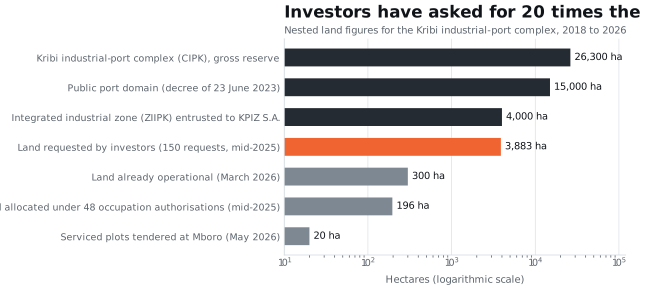
Source: PAK brochure, 2018 [S21]; PAK, 26 June 2023 [S16]; PAK, 26 February 2026 [S02]; ARMP notice AMI n°013/AMI/PAK/2026, 30 January 2026 [S17]; Investir au Cameroun, 4 March 2026 [S03]; EcoMatin, 11 May 2026 [S18].
The gap between requests and allocations is not necessarily a failure. Some requests are speculative, and a port authority is right to be selective about who occupies scarce coastal land. But the ratio of about twenty to one shows that the binding constraint is the conversion of reserve land into serviced, contracted plots, not the availability of land itself.
3.2 KPIZ S.A.: who owns it, what it must do
KPIZ was set up at a constitutive general assembly and first board meeting held in Yaoundé on 26 February 2026 [S02][S08]. Its shareholders are PAK, Africa Global Logistics (AGL, part of the MSC group), Arise Integrated Industrial Platforms (Arise IIP) and Belmont Investments; the individual stakes have not been published [S04][S06]. PAK describes KPIZ as its subsidiary and as the special-purpose company that will design, finance, develop, operate and maintain the zone, promote it internationally and attract foreign direct investment [S01][S13]. The same day, PAK and KPIZ signed a shareholders’ pact and a delegation agreement setting out the missions entrusted to the subsidiary and how they are to be monitored; the text of the delegation agreement is not public [S03].
The shareholding brings complementary skills. PAK holds the land and the public-domain powers. AGL operates container terminals and logistics across Africa, including at Kribi itself [S30]. Arise IIP develops and operates industrial zones in Gabon, Benin and Togo (Chapter 8), and brings a model of zone delivery that has attracted processing industries in wood and agriculture. Morocco’s Tanger Med Special Agency had been part of an earlier consortium and withdrew before launch [S04], but the Tanger Med model remains an explicit reference for KPIZ’s management [S134].
Table 3.2 sourcedKribi Port Industrial Zone S.A.: fact sheet, October 2026
| Item | Detail | Source |
|---|---|---|
| Legal form | Société anonyme; subsidiary of the Port Autonome de Kribi | [S01][S13] |
| Created | 26 February 2026, Yaoundé (constitutive general assembly and first board) | [S02][S08] |
| Shareholders | PAK, AGL (MSC group), Arise IIP, Belmont Investments (stakes not published) | [S04][S06] |
| Mandate | Design, finance, develop, operate and maintain the integrated industrial zone; promote it and attract investment | [S01] |
| Area | About 4,000 ha, described as extensible | [S02][S15] |
| Investment plan | €795 million (about 521 bn FCFA) over 15 years; phase 1 €400 million | [S04] |
| Development finance | AfDB to mobilise about €411 million of public finance to catalyse about €384 million of private investment; EU Global Gateway and IFC also named | [S07][S04] |
| Targets | Up to 150,000 direct and indirect jobs in 15 years; 5 to 8 points of additional growth | [S03][S05] |
| Offer to investors | Internal roads; power, water, sanitation and telecoms networks; logistics complex with modular warehouses; business and conference centre; one-stop shop | [S03][S06] |
| Clusters | Wood processing and logistics; steelmaking linked to mineral exports; petrochemicals; agro-industry; construction materials | [S03] |
| First-year priorities | Upgrade existing infrastructure and services; finalise technical and environmental studies for new phases; mobilise finance | [S03] |
| Status | Described by PAK as operational in June 2026; management of existing occupants in transition from PAK | [S14][S10] |
Source: as listed.
The investment plan is modest per hectare for heavy industry: €795 million over fifteen years for 4,000 ha is about €200,000 per hectare, which suggests that KPIZ will provide trunk infrastructure and expect large tenants to build their own plot-level utilities. That is normal for heavy-industry zones internationally, but it should be said plainly to steel investors, who will need to budget for their own substations, water treatment and internal roads.
The development-finance package matters for more than its size. The AfDB statement describes a public contribution of about €411 million intended to catalyse about €384 million of private investment, and links the project to Cameroon’s industrialisation master plan and national development strategy [S07]. Lenders of this kind bring standards with them: environmental and social safeguards, procurement rules and disclosure. A zone financed on those terms is more likely to be acceptable to the international lenders that a steel project will itself need.
The targets are ambitious. Up to 150,000 direct and indirect jobs over fifteen years, and 5 to 8 points of additional growth, imply a zone that hosts several large anchor industries, not only logistics and light processing [S03][S05]. Steel and metals are among the few activities large enough to anchor such a zone on their own.
3.3 Steel is a named cluster, and the policy frame supports it
KPIZ’s published development plan names five clusters to be developed in phases: wood processing and logistics; steelmaking linked to mineral exports; petrochemicals; agro-industry; and construction materials [S03]. Areas are set aside for heavy and medium industries [S04]. The partners’ own list of priority industries puts "steel and processing" first, followed by timber, aluminium and metallurgy, ceramics and building materials, and cocoa processing [S09].
The cluster label is significant. "Steelmaking linked to mineral exports" ties the zone’s steel ambition to the iron-ore projects whose exports will pass through Kribi, and to the Mining Code’s requirement that mining conventions provide for at least 15% of production to be made available for local transformation [S24]. It also fits the national strategy. Cameroon’s national development strategy for 2020 to 2030 (SND30) lists mines, metallurgy and steelmaking among its priority industrial sub-sectors and sets an objective of raising manufacturing to 25% of GDP by 2030 [S99]. In December 2025 the Prime Minister set up a strategic committee on the integration of mining and metallurgy whose mandate includes securing iron-ore supply for local steelmakers; its review of the metals industry in April 2026 found that domestic re-rolling capacity already exceeds local demand and began preparing exports of Cameroonian steel to markets of the African Continental Free Trade Area [S44][S45].
That last finding is a useful discipline for the zone’s steel cluster. Cameroon’s rebar market is saturated: rolling capacity of about 627,000 t a year faces demand of about 180,000 t [S97]. The country’s existing re-rollers already import about 60% of their charge as billets [S98], and billets were its largest steel import in 2023, at about 161,000 t [S94]. The value of Kribi therefore lies less in re-rolling imported billets, which the Douala mills already do, or in adding rebar capacity, which alone would close no gap, than in making steel from the iron units that arrive at its quay. A first melt shop makes billets; its output can be split between rolled products (wire rod and rebar) and merchant billets sold to the existing re-rollers, so that its tonnage displaces imports of billets and wire rod and supplies exports to CEMAC markets. Heavier sections that are not made in the region, iron from Cameroonian ore in later phases and further exports follow. The series’ market analysis is set out in White paper 04, Chapter 9. The cluster’s design, and the services the zone provides, should be built around those flows.
The investment framework adds incentives. The 2025 investment ordinance, which replaced the 2013 incentives law, brings economic zones and public-private partnerships into a single framework, extends the operating phase of incentives to seven years for projects located in economic zones, and requires investors to provide a programme of local skills, technology transfer and local hiring, together with proof of financing [S23]. The US State Department’s investment climate statement records that the ports of Douala and Kribi have been classified as economic zones under the 2013 economic-zones law and its 2019 implementing decree [S100].
3.4 From reserve to platform: allocation, servicing and the transition to KPIZ
Land becomes useful to industry only when three things are in place: a clear right to occupy it, services to the plot boundary, and a predictable administration. Kribi is working on all three, but none is finished.
The right to occupy. Land in the public port domain is not sold. Occupants receive temporary occupation authorisations or occupation agreements from the port authority, with a schedule of conditions and a development programme; heavy users negotiate longer agreements [S114][S19]. The most recent published example is the agro-industrial terminal agreed on 9 October 2026, which received a twenty-year renewable authorisation over 9.2 ha [S19]. Under the transition announced on 25 May 2026, PAK remains the administrative and contractual counterpart of existing occupants while KPIZ teams progressively take over operations; occupancy titles are being reviewed to build a reliable database before a new contractual framework under KPIZ is introduced [S10][S11]. At a meeting with occupants on 26 August 2026, PAK and KPIZ presented the classification of existing rights, the takeover plan and how the transfer of rights will be formalised, and committed to transparency and legal certainty during the transition [S12].
Services to the plot. In May 2026 PAK tendered about 3.5 bn FCFA of works to service 20 ha at Mboro over one year, financed from its 2026 to 2028 budget: a 30 kV network and substation, potable water, fibre, roads, drainage, wastewater treatment and solar lighting [S18]. At about 175 million FCFA per hectare this is a standard of servicing suited to logistics and light industry. Heavy industry needs more (Chapters 4 and 5), but the tender shows that the port authority is servicing land ahead of tenants, which is the right sequence.
Predictable administration. KPIZ’s offer includes a one-stop shop for investor set-up [S06][S09], and the 2025 investment ordinance creates a national one-stop shop for investment incentives, with existing bodies remaining competent until it is set up [S23]. For a steel investor the practical test is whether a single counterpart can bring together the land agreement, the environmental assessment, the connection to the 225 kV network, water supply, customs facilities for imported iron units and the incentive approval, on one timetable.
3.5 What the published tariff book implies for heavy industry
PAK’s general tariff book, homologated by the national port authority in 2018 and still published, sets the terms for occupation of the port domain [S114]. Its structure illustrates the issues a heavy-industry tenant will raise in negotiation with KPIZ:
- Land rent per square metre, with a base rate for serviced land, surcharges for proximity to the port and for environmental hazard, and a reduction of up to half for unserviced land where the occupant pre-finances the servicing works [S114].
- A commercial levy of 3% of turnover, excluding tax, for every occupant carrying on a lucrative activity in the domain [S114].
- A works levy of 0.5% of the validated estimate of works carried out in the domain [S114].
For a logistics operator these terms are manageable. For a steel mill, which has high turnover and low margins, a 3% levy on turnover would be equivalent to a large share of operating profit, and rent charged per square metre on large stockyards and buffers would penalise exactly the land uses that make a heavy plant safe and expandable. KPIZ may set its own pricing under its new contractual framework [S11]. A tariff schedule designed for heavy industry, with rent per hectare for buffers and stockyards, credit for tenant-funded servicing and a levy structure based on throughput or value added rather than turnover, would remove one obstacle to financing a steel plant, provided that it is fixed for a term longer than the plant’s debt. Cameroon Steel, as a prospective tenant, has a direct interest in these terms; the statement of interest on the document-control page applies.
3.6 What the zone means for a steel platform
The zone has the scale, the mandate, the shareholders and the development finance to host a steel and metals cluster. What it must now demonstrate is speed and fit:
- Speed in converting reserve land into serviced plots under a published contractual framework, and in completing the transition from PAK to KPIZ without leaving investors uncertain about who signs.
- Fit between what heavy industry needs and what the zone provides: larger plots with buffers and expansion reserve, a high-voltage connection policy, industrial water, hazardous-waste solutions and a tariff schedule that does not tax turnover.
- Discipline in organising the steel cluster around iron units, heavier products and exports rather than duplicating existing rebar capacity.
Sources cited in this chapter
Bracketed markers refer to these sources; the full list is in the annex. Full list of sources
- S21Présentation du Port Autonome de Kribi (brochure). Port Autonome de Kribi, October 2018.Cited by title and date
- S16Le PAK tient enfin son titre foncier. Port Autonome de Kribi, 26 June 2023.Cited by title and date
- S20Zone industrielle Kribi: 400 milliards FCFA investis et 53 entreprises autorisées à s’implanter depuis 2018. Investir au Cameroun, 20 May 2025.investiraucameroun.com/gestion-publique/2005-22033-zone-industrielle-k…
- S02Lancement de la Kribi Port Industrial Zone: l’avenir a commencé. Port Autonome de Kribi, 26 February 2026.Cited by title and date
- S15Zone industrielle intégrée de Kribi: les atouts dévoilés. Cameroon Tribune, 17 June 2026.cameroon-tribune.cm/article.html/77752/en.html/zone-industrielle-integ…
- S03Zone industrialo-portuaire de Kribi (KPIZ): jusqu’à +8 points de croissance et 150 000 emplois attendus sur 15 ans. Investir au Cameroun, 4 March 2026.investiraucameroun.com/gestion-publique/0403-23163-zone-industrialo-po…
- S13Africa CEO Forum 2026: PAK and KPIZ showcase Kribi’s industrial vision. Port Autonome de Kribi, 15 May 2026.Cited by title and date
- S17AMI n°013/AMI/PAK/2026 (Port Workers’ City). Agence de Régulation des Marchés Publics (ARMP), 30 January 2026.armp.cm/details?type_publication=AMI&id_publication=6073
- S18Cameroun: le port de Kribi engage 3,5 milliards FCFA pour préparer l’arrivée de nouveaux industriels. EcoMatin, 11 May 2026.ecomatin.net/cameroun-le-port-de-kribi-engage-35-milliards-fcfa-pour-p…
- S08Cérémonie officielle de lancement de Kribi Port Industrial Zone. Autorité Portuaire Nationale (APN), 3 March 2026.apn.cm/en/2026/03/03/ceremonie-officielle-de-lancement-de-kribi-port-i…
- S04Port de Kribi: AGL, Arise IIP et Belmont s’allient au PAK pour une zone industrielle de 521 milliards FCFA sur 4 000 ha. Investir au Cameroun, 20 February 2026.investiraucameroun.com/gestion-publique/2002-23123-port-de-kribi-agl-a…
- S06KPIZ officially launched: a new economic hub for Cameroon and CEMAC. AGL (press release), February 2026.aglgroup.com/en/News/lancement-KPIZ
- S01La Lettre du PAK n°264: Lancement de Kribi Port Industrial Zone, l’avenir a commencé. Port Autonome de Kribi (newsletter), February 2026.Cited by title and date
- S30Port de Kribi: 21,5 milliards de FCFA pour accroître de 30% les capacités du terminal à conteneurs. Investir au Cameroun, 8 October 2026.investiraucameroun.com/infrastructures/0810-23934-port-de-kribi-21-5-m…
- S134Yves Roger Melingui, l’homme qui veut répliquer le succès de Tanger Med au Cameroun. Jeune Afrique, 25 March 2026.jeuneafrique.com/1775106/economie-entreprises/yves-roger-melingui-lhom…
- S07Cameroon: African Development Bank Group supports development of integrated industrial zone at the Port of Kribi. African Development Bank (via AllAfrica), 2 March 2026.allafrica.com/stories/202603100682.html
- S05Kribi KPIZ seen lifting Cameroon’s growth by 5 to 8 points, adding 150,000 jobs. Business in Cameroon, 3 March 2026.businessincameroon.com/public-management/0303-15837-kribi-kpiz-seen-li…
- S14PROMOTE 2026: le Port Autonome de Kribi confirme son ambition industrialo-portuaire. Port Autonome de Kribi, 18 June 2026.Cited by title and date
- S10Gestion de la zone industrielle du Port de Kribi: une nouvelle organisation mise en place. Cameroon Tribune, 28 May 2026.cameroon-tribune.cm/article.html/77128/fr.html/details_2
- S09Official launch of the Kribi Port Industrial Zone (KPIZ): driving the economic transformation of Cameroon and the CEMAC sub-region. Ports Africa, 2026.portsafrica.com/official-launch-of-the-kribi-port-industrial-zone-kpiz…
- S24Loi n° 2023/014 du 19 décembre 2023 portant Code minier (Article 40(4), local transformation). Republic of Cameroon (FAOLEX), 19 December 2023.faolex.fao.org/docs/pdf/cmr223180.pdf
- S99Stratégie Nationale de Développement 2020 à 2030 (SND30). Republic of Cameroon, MINEPAT (FAOLEX), 2020.faolex.fao.org/docs/pdf/cmr211554.pdf
- S44Cameroon reviews metals industry to address supply and energy constraints. Business in Cameroon, 29 April 2026.businessincameroon.com/public-management/2904-16094-cameroon-reviews-m…
- S45Le Cameroun prépare l’exportation de son acier vers les marchés de la ZLECAf. EcoMatin, 16 April 2026.ecomatin.net/le-cameroun-prepare-lexportation-de-son-acier-vers-les-ma…
- S97Production: les acteurs en présence. Cameroon Tribune, 11 May 2026.cameroon-tribune.cm/article.html/76600/fr.html/details_2
- S98Cameroun: le groupe Prometal décroche 26 milliards FCFA auprès d’Afreximbank pour renforcer sa production d’acier. Sikafinance, 30 September 2026.sikafinance.com/marches/cameroun-le-groupe-prometal-decroche-26-millia…
- S94UN Comtrade public API: Cameroon and CEMAC members, HS 72 and 73 imports, 2019 to 2024. United Nations Statistics Division.comtradeapi.un.org/public/v1/preview/C/A/HS
- S23Ordonnance n° 2025/002 du 18 juillet 2025 fixant les incitations à l’investissement en République du Cameroun. Presidency of the Republic (copy published by GECAM), 18 July 2025.legecam.cm/wp-content/uploads/2025/08/ordonnance_n_2025_002_du_18_07_2…
- S1002024 Investment Climate Statements: Cameroon. US Department of State, 2024.state.gov/reports/2024-investment-climate-statements/cameroon/
- S39Kribi: le Premier ministre, chef du gouvernement est là. Cameroon Tribune, 30 December 2024.cameroon-tribune.cm/article.html/68499/fr.html/details_2
- S40Industrialisation: la voie royale de l’émergence. Cameroon Tribune, 2 January 2025.cameroon-tribune.cm/article.html/68558/fr.html/details_2
- S38À Kribi, Patrice Melom, DG du PAK, conduit une tournée d’inspection de trois jours dans les chantiers relevant du domaine portuaire. Bougna, 8 April 2026.bougna.net/2026/04/08/contact/a-kribi-patrice-melom-dg-du-pak-conduit-…
- S114Recueil général des tarifs applicables aux prestations rendues par le Port Autonome de Kribi (homologated by the APN, 2018). Port Autonome de Kribi / Autorité Portuaire Nationale, 2018.Cited by title and date
- S19Port de Kribi: un protocole d’accord signé pour un terminal agro-industriel de 50 milliards de FCFA. Investir au Cameroun, 9 October 2026.investiraucameroun.com/gestion-publique/0910-23942-port-de-kribi-un-pr…
- S11Kribi Port unveils new management framework for industrial-zone transition. Business in Cameroon, 1 June 2026.businessincameroon.com/public-management/0106-16249-kribi-port-unveils…
- S12Le PAK et la KPIZ renforcent le dialogue avec leurs amodiataires. Port Autonome de Kribi, 26 August 2026.Cited by title and date
Cite this chapter
Cameroon Steel (2026). Kribi can become Central Africa’s steel platform if infrastructure keeps pace. White paper 02, chapter 3: A dedicated zone company now holds Kribi’s 4,000 ha, and steel is one of its named clusters. CS-WP-02. https://www.cameroon-steel.com/en/library/kribi-steel-platform/industrial-port-zone/
Source