White paper 02 · Chapter 10
A three-step roadmap can make Kribi a steel and metals platform by 2040
The roadmap in this chapter is illustrative: it is Cameroon Steel’s view of the order in which things need to happen, not a plan adopted by any authority. It has three steps, an analytical sequence distinct from the phases of any one project. Enable, 2026 to 2028: commission the power and water already under construction, publish the zone’s heavy-industry framework and codes, and permit and finance a first melt shop and rolling mill that can run on existing port facilities. Anchor, 2028 to 2032: bring the first melt shop into production, bring the second power stage, the first stage of the mineral terminal, industrial gases, slag processing and a second heavy tenant into service, and finance the railway. Integrate, 2032 to 2040: make iron from Cameroonian ore at the coast, connect the zone to the national railway and the interior, and export steel and iron units into regional and carbon-regulated markets. Each step has measurable milestones, and each can be reached only if the previous one is financed.
In this chapter (8)
10.1 Five principles
The roadmap rests on five principles drawn from the previous chapters.
- Build on what exists. Each industrial step should rely on infrastructure that is already in service or under construction when it is committed, so that public delays do not strand private capital (Chapter 9).
- Plan the cluster, not the tenant. Power stages, berths, water, waste and corridors should be sized for the zone’s heavy-industry load, not for the first applicant (Chapters 4 to 7).
- Publish the rules. A heavy-industry land framework, a power-quality code, an industrial water tariff and a zone environmental plan reduce every investor’s risk and every lender’s diligence (Chapters 3 to 5).
- Finance the enablers together. The zone’s development-finance package from the AfDB, the EU and the IFC [S07] is the natural vehicle for the shared enablers: the second power stage, the bulk berth design, the strategic environmental assessment and the waste facility.
- Measure and report. Milestones should be public and dated, so that investors can see the platform advancing and authorities can see where it stalls.
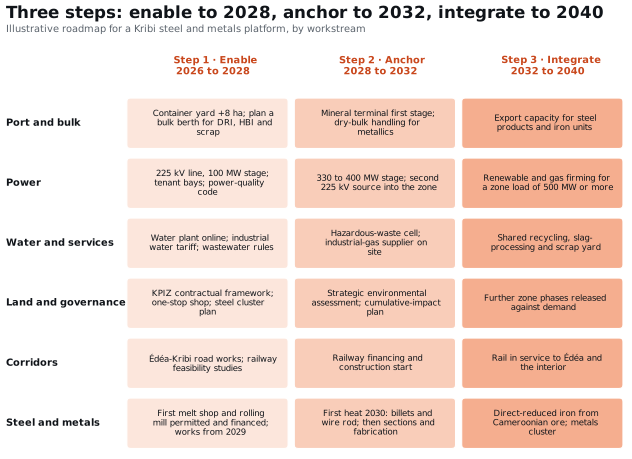
Source: Cameroon Steel analysis. Not a plan adopted by any authority.
10.2 Step 1, enable (2026 to 2028)
The first step converts infrastructure already under way into a working platform for one heavy tenant and prepares the cluster.
Power. Commission the 225 kV KPDC-port line and the 225/30 kV substation, due at the end of 2026 [S25], with a heavy-tenant bay and published short-circuit levels at the 225 kV and 30 kV busbars. Adopt a power-quality code for arc furnaces and other fluctuating loads, based on international practice [S74]. Agree a long-term tariff structure for loads above 10 MW with the regulator, the utility and the generator.
Water and services. Bring the port-platform water plant into production in early 2027 [S26], with capacity reserved for industry and an industrial tariff. Identify a licensed route for hazardous furnace dust before the first heat: a secure cell in the zone or a contracted export route for recycling.
Land and governance. Complete the transition from PAK to KPIZ and publish KPIZ’s contractual framework for new tenants, including a heavy-industry template with a long term, renewal rights, a tariff based on hectares and throughput rather than turnover, and compensation on early termination (Chapter 3). Launch the strategic environmental assessment of the zone required for industrial-port complexes [S87], with a baseline air-quality and coastal monitoring network.
Port. Complete the container yard expansion due by the end of 2027 [S30]. Agree berth windows and covered storage for steel inputs at the multipurpose terminal. Write a steel-cluster berth, or an allocation of berth time and covered storage, into the design of the mineral terminal agreed in November 2025 [S32].
Corridors. Advance the reconstruction of the Édéa-Kribi road [S27] with heavy-axle specifications and a truck staging area; complete the feasibility study for the Édéa-Kribi-Lolabé-Campo railway agreed in June 2026 [S41], including sidings to the heavy-industry area.
Steel. Permit, finance and design a first melt shop and rolling mill sized to the first power stage. Cameroon Steel’s complex at Mboro is one example: in its reference configuration, Phase 1 works start in the first quarter of 2029, after the environmental certificate, with a first heat in the second half of 2030, ramp-up in 2031 and an expected sustained output of 270,000 to 300,000 t a year from a 0.3 Mtpa nameplate [S112]. Its melt shop makes billets, with output flexible between wire rod, rebar and merchant billets for existing re-rollers (White paper 03, Chapter 9).
10.3 Step 2, anchor (2028 to 2032)
The second step brings the first melt shop into production and turns one heavy tenant into a cluster.
Power. Bring the second stage of the 225 kV system, 330 to 400 MW [S25], into service by about 2031, before the first stage is fully used in a steel-led scenario, which happens by about 2032 (Figure 10.2), together with a second high-voltage source into the port substation for N-2 security. Decide how Kribi’s gas will be used by industry, whether for an extension of the Kribi gas plant, captive generation or direct reduction, now that the floating liquefaction vessel has left [S68].
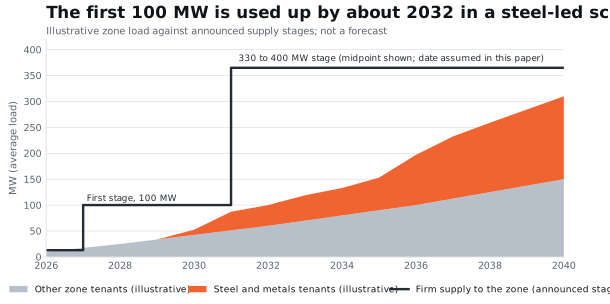
Source: supply stages from PAK, 6 August 2025 [S25], with the 330 to 400 MW stage drawn from 2031 (date assumed in this paper; none is published); steel load from the Cameroon Steel reference configuration RC-1 (planning estimate), with a first heat in the second half of 2030, Phase 2 indicatively 2032 to 2034 and Phase 3 after 2034 [S112]; other tenants illustrative. Not a forecast.
Port. Bring into service the first stage of the mineral terminal, agreed in a memorandum of understanding on 4 November 2025 and expected by PAK’s Director General in March 2026 to be completed within five to six years [S32][S03], with dry-bulk handling for iron units and covered storage.
Services. Attract an industrial-gas supplier with an on-site air-separation unit beside the steel cluster; establish a slag-processing yard producing certified aggregate for the zone and the Édéa-Kribi road; open a shared testing laboratory and a training centre with universities and equipment vendors (Chapter 7).
Corridors. Reach financial close and start construction of the Édéa-Kribi-Lolabé-Campo railway.
Steel. Direct the first melt shop’s tonnage at imports of billets and wire rod and at CEMAC exports (White paper 04, Chapter 9); then add a second melt line or second heavy tenant, a sections mill for the angles, channels and beams the region imports, and downstream fabrication: cut-and-bend, mesh, wire drawing and structural steel (Chapter 7).
10.4 Step 3, integrate (2032 to 2040)
The third step links the platform to Cameroon’s iron ore and to wider markets.
Iron from Cameroonian ore. Direct reduction is the route by which Cameroonian ore can become iron for the steel cluster, and by which the Mining Code’s requirement that at least 15% of production be made available for local transformation can be met at scale [S24]. It requires three things not yet in place: direct-reduction-grade feed, because current direct-reduction processes need high-grade ore, typically at least 64% iron, which is under 20% of global supply [S159]; a pellet plant or a supply of pellets; and about 10 GJ of gas per tonne of DRI, or, in time, hydrogen [S116]. The government’s 2026 to 2030 iron-ore programme for Mbalam, Bipindi-Grand Zambi and Kribi-Lobé [S43] and the mineral terminal at Kribi together create the conditions for a concentration and pelletising step at the coast, from which a direct-reduction module could draw.
Carbon-competitive exports. Steel and iron units exported to the European Union are now subject to the carbon border adjustment mechanism, with a certificate price of €82.32 per tonne of CO₂ in the third quarter of 2026 [S103] (see White paper 06, Chapter 5). Iron made with gas, and later with hydrogen produced from Cameroon’s hydropower, on a grid that was about 90% hydro in 2025 [S60], could become a competitive low-carbon export as well as a domestic input.
Rail and the interior. With the railway in service to Édéa, steel from Kribi can reach the interior and the CEMAC corridors by rail, and scrap and other inputs can return.
Zone expansion. Release further phases of the zone against demonstrated demand, using the extensible character of the 4,000 ha integrated zone [S15].
10.5 Financing the enablers
The enabling infrastructure is not cheap, but it is small relative to the industry it would make possible, and most of it has an identifiable payer. Published costs give a sense of scale: about 35 bn FCFA for the 225 kV line and substation [S25], about 21.5 bn FCFA for the container yard expansion [S30], about 3.5 bn FCFA to service 20 ha of plots at Mboro [S18], about US$2 billion reported for the mineral terminal at full scale [S33], and €795 million for KPIZ’s fifteen-year zone plan [S04].
Three financing principles fit Cameroon’s situation. Users should pay where a user is identifiable. A tenant’s own high-voltage bay, compensation equipment, siding or covered berth section can be financed by the tenant or recovered through a dedicated tariff. Shared public goods should be financed by the zone and its development partners. The strategic environmental assessment, the stormwater system, the hazardous-waste facility and the transmission reinforcements for the second power stage benefit every tenant and are suited to the AfDB-led package, which is designed to mobilise about €411 million of public finance to catalyse about €384 million of private investment [S07]. Anchor tenants should commit early to de-risk the shared assets. Long-term take-or-pay commitments for power capacity, water and berth time give lenders to the shared infrastructure the revenue certainty they need.
Fiscal space is limited. In October 2026 the IMF described Cameroon as at high overall risk of debt distress [S167]. That argues for structures in which the State’s direct contribution is concentrated on land, regulation and coordination, while infrastructure is financed through concessions, development-finance loans and user charges. The 2025 investment ordinance already conditions incentives on proof of financing, local skills programmes and job creation [S23], which aligns private commitments with the zone’s public objectives.
10.6 Milestones and indicators
Table 10.1 illustrativeIllustrative milestones and indicators for a Kribi steel platform
| Step | Milestone | Indicator | Indicative date | Lead |
|---|---|---|---|---|
| Enable | 225 kV substation commissioned | Energised; 100 MW available to the zone | End 2026 [S25] | PAK, SONATREL |
| Enable | Port-platform water plant in production | Production started; industrial tariff published | Early 2027 [S26] | PAK, KPIZ |
| Enable | KPIZ heavy-industry framework published | Template agreement and tariff schedule public | 2027 | KPIZ |
| Enable | Power-quality code in force | Short-circuit levels and emission limits published | 2027 | KPIZ, SONATREL, ARSEL |
| Enable | Container yard expansion complete | Static storage 34,000 TEU | End 2027 [S30] | KCT |
| Enable | Zone strategic environmental assessment launched | Terms of reference approved; monitoring network operating | 2027 | KPIZ, MINEPDED |
| Enable | First melt shop and rolling mill permitted and financed | Environmental certificate; land agreement; financing | End 2028 (illustrative) | Tenant |
| Anchor | First melt shop and rolling mill in production | Works from 2029; first heat; ramp-up | First heat second half of 2030; ramp-up 2031 (planning estimate) [S112] | Tenant |
| Anchor | Second power stage in service | 330 to 400 MW available; second 225 kV source | By about 2031 | MINEE, SONATREL, PAK |
| Anchor | Mineral terminal first stage | First dry-bulk vessel handled | Completion within five to six years of March 2026 [S03] | Terminal consortium, PAK |
| Anchor | Gas and slag services | Air-separation unit and slag yard operating | 2029 to 2031 | Suppliers, KPIZ |
| Anchor | Railway financed | Financial close; construction started | 2030 to 2032 | Government, promoters |
| Integrate | Direct-reduction module | First DRI from Cameroonian or imported pellets | After 2032 (illustrative) | Tenants, SNH |
| Integrate | Rail in service | First freight train Kribi to Édéa | 2033 to 2036 (illustrative) | Railway operator |
| Integrate | Regional exports | Share of cluster output sold in CEMAC and AfCFTA markets | 2032 to 2040 | Tenants |
Source: dated milestones from the sources cited; other dates are illustrative and reflect the sequencing logic of Chapter 9.
10.7 Who does what
Table 10.2 derivedRoles in building the Kribi steel platform
| Actor | Role in the roadmap |
|---|---|
| Port Autonome de Kribi (PAK) | Owner of the port domain; port infrastructure; terminal concessions; 225 kV line and substation; water plant; transition to KPIZ [S25][S26][S10] |
| Kribi Port Industrial Zone S.A. (KPIZ) | Zone master plan; contractual framework; servicing; one-stop shop; shared services; strategic environmental assessment [S01][S03] |
| Ministry of Water and Energy, SONATREL and the electricity regulator ARSEL | Second power stage; transmission reinforcements; connection and power-quality rules; tariff framework above 10 MW [S26][S60] |
| Ministries of Transport and Public Works | Édéa-Kribi road; railway agreement and concession [S27][S41] |
| Ministry of Environment (MINEPDED) | Strategic environmental assessment; impact assessments; monitoring [S87][S88] |
| Ministry of Mines and the mines-metallurgy integration committee | Local-transformation obligations; ore supply to local steelmakers [S24][S44] |
| SNH and gas producers | Gas reserves, allocation and long-term supply to industry [S67][S69] |
| AfDB, EU, IFC and other lenders | Finance for shared enablers; environmental and social standards [S07][S90] |
| Steel and metals tenants | Plants, plot-level utilities, power-quality equipment, skills programmes, reporting [S23] |
Source: Cameroon Steel analysis of mandates described in the sources cited.
10.8 What a platform would look like in 2040
If the three steps are delivered, Kribi in 2040 would host several melt shops and rolling mills, a direct-reduction module using Cameroonian ore, a sections mill, and a ring of suppliers and fabricators, served by a dedicated bulk berth, a firm high-voltage supply of several hundred megawatts, a railway to Édéa and the interior, and shared water, waste and gas services. It would supply Cameroon’s and its neighbours’ construction with steel made in the region, replace a large part of the region’s imports of billets and sections, and export iron units and steel along the Gulf of Guinea and to carbon-regulated markets. It would also be the place where a share of Cameroon’s iron ore is transformed at home, as the Mining Code intends.
None of this is assured. But each step has a precedent in the port-industrial zones that have succeeded elsewhere (Chapter 8), and each depends on decisions that can be taken in the next two years.
Sources cited in this chapter
Bracketed markers refer to these sources; the full list is in the annex. Full list of sources
- S07Cameroon: African Development Bank Group supports development of integrated industrial zone at the Port of Kribi. African Development Bank (via AllAfrica), 2 March 2026.allafrica.com/stories/202603100682.html
- S25Kribi franchit la ligne électrique 225 kV. Port Autonome de Kribi, 6 August 2025.Cited by title and date
- S74IEC TR 61000-3-7, Ed. 2.0: Assessment of emission limits for the connection of fluctuating installations to MV, HV and EHV power systems. International Electrotechnical Commission, February 2008.webstore.iec.ch/en/publication/4155
- S26Énergie et infrastructures: un nouvel élan pour la compétitivité du Port de Kribi. Port Autonome de Kribi, 19 August 2026.Cited by title and date
- S87Arrêté n° 00001/MINEPDED fixant les catégories d’opérations soumises à évaluation environnementale stratégique ou à étude d’impact environnemental et social. MINEPDED (FAOLEX), 8 February 2016.faolex.fao.org/docs/pdf/cmr172054.pdf
- S30Port de Kribi: 21,5 milliards de FCFA pour accroître de 30% les capacités du terminal à conteneurs. Investir au Cameroun, 8 October 2026.investiraucameroun.com/infrastructures/0810-23934-port-de-kribi-21-5-m…
- S32Port de Kribi: un terminal minéralier d’avenir. Port Autonome de Kribi, 4 November 2025.Cited by title and date
- S27Bilan et perspectives: les voyants sont au vert. Port Autonome de Kribi, 13 March 2025.Cited by title and date
- S41Ligne ferroviaire Édéa-Kribi-Lolabé-Campo: une nouvelle étape pour la connectivité du Port de Kribi. Port Autonome de Kribi, 4 June 2026.Cited by title and date
- S112Cameroon Steel reference configuration RC-1 (planning estimate), edition 10 October 2026. Cameroon Steel, 10 October 2026.Cited by title and date
- S68Cameroon FLNG Terminal. Global Energy Monitor (GEM.wiki; tertiary), October 2026.gem.wiki/Cameroon_FLNG_Terminal
- S03Zone industrialo-portuaire de Kribi (KPIZ): jusqu’à +8 points de croissance et 150 000 emplois attendus sur 15 ans. Investir au Cameroun, 4 March 2026.investiraucameroun.com/gestion-publique/0403-23163-zone-industrialo-po…
- S24Loi n° 2023/014 du 19 décembre 2023 portant Code minier (Article 40(4), local transformation). Republic of Cameroon (FAOLEX), 19 December 2023.faolex.fao.org/docs/pdf/cmr223180.pdf
- S159Climate change and the production of iron and steel (policy paper). worldsteel.worldsteel.org/climate-action/climate-change-and-the-production-of-iro…
- S116ENERGIRON technology: DRI-EAF production route using natural gas or hydrogen. European Commission, Innovation Centre for Industrial Transformation, February 2026.innovation-centre-for-industrial-transformation.ec.europa.eu/innovativ…
- S43Cameroon plans $3.1B iron ore push starting 2026. Daba Finance, 14 February 2026.dabafinance.com/en/news/cameroon-mining-investment-2026-2030
- S103Price of CBAM certificates. European Commission, DG TAXUD, 5 October 2026.taxation-customs.ec.europa.eu/carbon-border-adjustment-mechanism/price…
- S60Rapport d’activités 2025 de l’ARSEL. Agence de Régulation du Secteur de l’Électricité (ARSEL), 7 September 2026.arsel-cm.org/wp-content/uploads/2026/09/Rapport-ARSEL-2025.pdf
- S15Zone industrielle intégrée de Kribi: les atouts dévoilés. Cameroon Tribune, 17 June 2026.cameroon-tribune.cm/article.html/77752/en.html/zone-industrielle-integ…
- S18Cameroun: le port de Kribi engage 3,5 milliards FCFA pour préparer l’arrivée de nouveaux industriels. EcoMatin, 11 May 2026.ecomatin.net/cameroun-le-port-de-kribi-engage-35-milliards-fcfa-pour-p…
- S33Kribi Deep Sea Port, investors partner to construct 125-million-tonne mineral terminal worth $2 billion. Business in Cameroon, 5 November 2025.businessincameroon.com/transport/0511-15300-kribi-deep-sea-port-invest…
- S04Port de Kribi: AGL, Arise IIP et Belmont s’allient au PAK pour une zone industrielle de 521 milliards FCFA sur 4 000 ha. Investir au Cameroun, 20 February 2026.investiraucameroun.com/gestion-publique/2002-23123-port-de-kribi-agl-a…
- S167IMF staff concludes Post-Financing Assessment mission to Cameroon (press release 26/314). International Monetary Fund, 1 October 2026.imf.org/en/news/articles/2026/10/01/pr26314-imf-staff-concludes-assesm…
- S23Ordonnance n° 2025/002 du 18 juillet 2025 fixant les incitations à l’investissement en République du Cameroun. Presidency of the Republic (copy published by GECAM), 18 July 2025.legecam.cm/wp-content/uploads/2025/08/ordonnance_n_2025_002_du_18_07_2…
- S10Gestion de la zone industrielle du Port de Kribi: une nouvelle organisation mise en place. Cameroon Tribune, 28 May 2026.cameroon-tribune.cm/article.html/77128/fr.html/details_2
- S01La Lettre du PAK n°264: Lancement de Kribi Port Industrial Zone, l’avenir a commencé. Port Autonome de Kribi (newsletter), February 2026.Cited by title and date
- S88Décret n° 2013/0171/PM fixant les modalités de réalisation des études d’impact environnemental et social. Prime Minister’s Office (FAOLEX), 14 February 2013.faolex.fao.org/docs/pdf/cmr179401.pdf
- S44Cameroon reviews metals industry to address supply and energy constraints. Business in Cameroon, 29 April 2026.businessincameroon.com/public-management/2904-16094-cameroon-reviews-m…
- S67Données pétrolières 2025. Société Nationale des Hydrocarbures (SNH), June 2026.snh.cm/wp-content/uploads/2026/06/Donnees-petrolieres-2025.pdf
- S69Cameroon’s SNH eyes Yoyo-Yolanda and new exploration blocks to sustain gas growth. Business in Cameroon, 6 July 2026.businessincameroon.com/energy/0607-16422-cameroon-s-snh-eyes-yoyo-yola…
- S90IFC Performance Standards on Environmental and Social Sustainability. IFC, 1 January 2012.ifc.org/en/insights-reports/2012/ifc-performance-standards
Cite this chapter
Cameroon Steel (2026). Kribi can become Central Africa’s steel platform if infrastructure keeps pace. White paper 02, chapter 10: A three-step roadmap can make Kribi a steel and metals platform by 2040. CS-WP-02. https://www.cameroon-steel.com/en/library/kribi-steel-platform/roadmap/
Source