White paper 02 · Chapter 9
The risk at Kribi is sequence: each step must arrive before the industry that depends on it
Kribi does not lack any attribute that cannot be supplied. Its risk is that the attributes arrive in the wrong order: a melt shop ready before the substation, a cluster growing before the second power stage, a direct-reduction plan before gas and a bulk berth, or industrial growth before the zone has assessed what its coast, air and communities can carry. Four constraints need active management: the timing of public infrastructure, which has slipped on comparable projects in Cameroon; the environmental carrying capacity of a coast with a marine national park about 11 km south of the port; the transition of land governance from the port authority to KPIZ; and the industrial services that do not yet exist. None is a reason to delay. Each is a reason to plan the platform as a sequence with explicit preconditions for every step.
In this chapter (6)
9.1 Sequence is the strategy
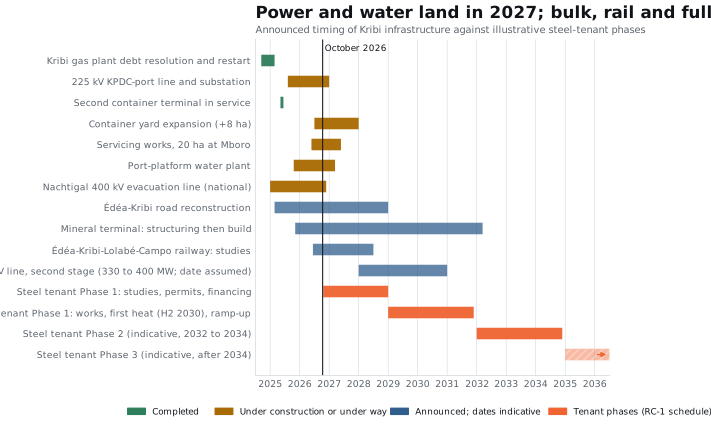
Heavy industry has hard dependencies. A melt shop cannot be commissioned without a firm high-voltage supply and a power-quality solution. A direct-reduction module cannot run without a long-term gas contract and a dry-bulk berth for pellets. A cluster of several heavy tenants cannot grow on a first power stage of about 100 MW. Rail is valuable but not a precondition for a first phase; firm power is. Figure 9.1 sets the announced timing of Kribi’s main infrastructure projects against illustrative phases for a steel tenant.
Source: Business in Cameroon, 27 February 2025 [S71]; PAK, 6 August 2025 and 19 August 2026 [S25][S26]; Business in Cameroon, 12 May 2025 and 18 May 2026 [S57][S52]; Investir au Cameroun, 8 October 2026 [S30]; EcoMatin, 11 May 2026 [S18]; Business in Cameroon, 9 October 2026 [S61]; PAK, 13 March 2025 [S27]; PAK, 4 November 2025 [S32]; Investir au Cameroun, 4 March 2026 [S03]; PAK, 4 June 2026 [S41]. Steel-tenant phases follow the schedule of the Cameroon Steel reference configuration RC-1 (planning estimate) [S112] and are illustrative.
The figure shows a favourable window. The two utilities that a first steel phase needs, the 225 kV supply and the port-platform water plant, are under construction and due in late 2026 and early 2027 [S25][S26]. The utilities and corridors that a cluster needs, the second power stage, the mineral terminal and rail, are announced but not yet funded or scheduled in detail. A first steel phase whose works start in 2029, with a first heat in the second half of 2030 and ramp-up in 2031 as in Cameroon Steel’s reference configuration [S112], can therefore rely on infrastructure that is already being built, while the larger investments are prepared in parallel.
9.2 Infrastructure timing: plan for slippage
Large public infrastructure in Cameroon has a mixed record on timing, as it does in most countries. The evacuation line from the Nachtigal hydro plant has left about 150 MW of industrial demand unmet while it waits for completion, now expected in November 2026 [S61]. The first exports of iron ore from Mbalam were moved from the end of 2025 to early 2026 [S46], and the developer of the Lobé deposit near Kribi has deferred its first exports to 2027 [S154]. The Kribi gas plant was offline for five months from September 2024 over unpaid invoices [S71]. The mineral-terminal partners gave themselves four to six months from November 2025 to complete structuring [S32]; by October 2026 no financial close had been reported in the sources reviewed for this paper, and PAK’s Director General expected completion within five to six years of March 2026 [S03]. The Édéa-Kribi road has no published completion date [S27].
None of this is unusual for projects of this scale, but it has a clear implication for a steel platform: each phase of industrial investment should be designed to work on the infrastructure that exists, or is under construction, when the phase is committed, with the next public step treated as an upside rather than a precondition. In practice:
- a first melt shop and rolling mill should be sized to the first 100 MW stage and to the existing multipurpose and container terminals, with a power-quality solution of its own;
- a second phase should be committed only when the second power stage has a financing agreement and a construction contract;
- a direct-reduction module should be committed only when a long-term gas contract backed by audited reserves, a bulk berth for pellets and a supply of direct-reduction-grade feed are all in place.
9.3 Environmental carrying capacity
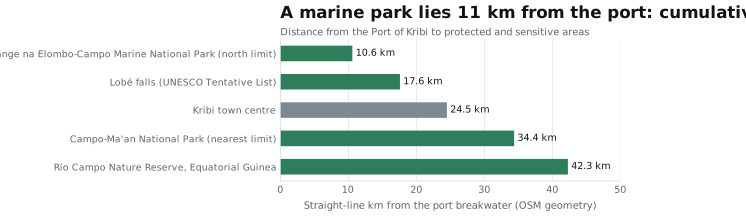
The Kribi coast is not an empty industrial site. It combines a deep-water port and a growing town with a marine national park, nesting beaches, a cultural landscape on UNESCO’s Tentative List and one of the largest forest national parks in Central Africa. Figure 9.2 shows the distances from the port to the main protected and sensitive areas.
Source: Cameroon Steel calculation from OpenStreetMap geometry [S111]; Décret n° 2021/4804/PM (marine national park) [S84]; Décret n° 2000/004/PM (Campo-Ma’an) [S85]; UNESCO Tentative List, ref. 6330 [S86].
Four pressures need to be assessed at the level of the zone, not plant by plant:
The coast. Studies of the Kribi shoreline find that it moved from slight accretion before 2000 to average retreat of about 0.9 m a year in 2000 to 2015 and about 2 m a year in 2015 to 2020, with local retreat of 45 to 70 m a year near Lolabé in 2013 to 2017, a change the authors link to sediment trapping by port structures [S80]. A 2025 study rated about 68% of the 31.5 km Kribi coast as highly vulnerable [S81]. Global sea level is projected to rise by 0.44 to 0.76 m by 2100 under an intermediate emissions scenario [S82]. Plant platforms on the coastal plateau are not exposed, but jetties, conveyors, intakes and outfalls are, and must be designed for a moving shoreline.
Air. Modelled background concentrations of fine particles (PM2.5) around the port were about 10 µg/m³ in 2024 to 2025, already above the World Health Organization’s 2021 annual guideline of 5 µg/m³, largely because of seasonal Saharan dust and biomass smoke [S92][S113]. If confirmed by monitoring, this would make the airshed "degraded" in lender terms and tighten the emissions allowed to each new source. A zone-wide air-quality monitoring network, started before the first furnace, would establish the baseline and allocate the remaining headroom fairly.
Biodiversity and the sea. The northern limit of the Manyange na Elombo-Campo Marine National Park, created in 2021, lies about 11 km south of the port [S84]. Its beaches are used by nesting marine turtles, and communities and conservationists have raised concerns about cumulative pressure from port and industrial development on the park and its fishing villages [S91]. Effluent, lighting, dredging and ship traffic from the industrial zone all reach this coast.
Carbon. An arc-furnace works on Cameroon’s hydro-dominated grid has a low carbon intensity by world standards. Cameroon Steel’s reference configuration puts its Scope 1 emissions and its Scope 2 emissions from purchased electricity at an estimated 0.32 t of CO₂ per tonne of product in Phase 1 (about 0.33 t at full build-out) [S112], on a narrower boundary that excludes the upstream emissions of imported iron units, against world averages of 1.47 t per tonne of crude steel for the DRI-EAF route and 2.34 t for the blast-furnace route [S77]. That advantage has commercial value: steel exported to the European Union now carries a carbon-border charge, with a certificate price of €82.32 per tonne of CO₂ in the third quarter of 2026 [S103]; the mechanism and its effect on Cameroonian steel are analysed in White paper 06, Chapter 5. But a cluster at full scale would still emit hundreds of thousands of tonnes a year, and any project above 100,000 t of CO₂ equivalent a year must, under the Equator Principles, carry out a climate risk assessment and report its emissions publicly [S89].
The legal framework already points to a zone-level approach. A 2016 order of the environment ministry requires a strategic environmental assessment for industrial zones and industrial-port complexes, and a detailed environmental and social impact assessment for metal production [S87]. The 2013 decree on impact assessment sets out the procedure, including public consultations and hearings, and provides that the certificate of environmental compliance lapses if a project has not started within three years [S88]. International lenders will apply the IFC Performance Standards in full, including those on community health, land acquisition, indigenous peoples and biodiversity [S90]. A strategic environmental assessment of the whole zone, with a cumulative-impact plan that allocates air, water and coastal capacity among future tenants, is the single most useful step the zone could take to accelerate every heavy-industry permit within it.
9.4 Land governance in transition
The second structural constraint is institutional. Responsibility for the zone is moving from PAK to KPIZ, and with it the contractual framework under which tenants occupy land. Under the arrangements announced in May 2026, PAK remains the administrative and contractual counterpart of existing occupants while KPIZ takes over operations, and occupancy titles are being reviewed before a new framework under KPIZ is introduced [S10][S11]. PAK and KPIZ have committed to transparency and legal certainty during the transition [S12].
For a new heavy-industry tenant, the questions are practical: which entity signs, on what template, for what term, at what price, and with what protection if the authority needs the land back. The most recent published agreement in the port domain gave a twenty-year renewable authorisation over 9.2 ha for an agro-industrial terminal [S19]. Steel plants are financed over fifteen to twenty years and operate for forty or more; lenders will look for terms that outlast the debt by a comfortable margin, renewal rights and compensation on early termination.
Land governance also has a history. The port land was declared of public utility in 2009 and compensation for those affected was set by decree in 2010 [S157]. Lenders applying the IFC Performance Standards will ask how that process treated the people who used the land, including any indigenous Bagyeli communities of the Océan department, and whether any residual claims remain [S90]. A zone-level review of land history, completed once by KPIZ and shared with tenants, would answer those questions faster and more consistently than separate reviews by each investor.
9.5 Services and social infrastructure
The third constraint is the absence of services that a heavy-industry cluster takes for granted elsewhere: a hazardous-waste facility (Chapter 5), an industrial-gas supplier (Chapter 7), a zone fire and emergency service equipped for molten metal and industrial gases, accredited testing laboratories and a training centre. The fourth is social infrastructure for a growing workforce: housing, schools and health care. The South Region has the highest HIV prevalence among adults in Cameroon, 5.8% in the latest demographic and health survey, and high malaria prevalence among young children [S158]. A construction workforce of hundreds per project, and permanent workforces of thousands across the zone, need worker accommodation, health services and community programmes planned at zone scale.
Table 9.1 derivedConstraint register for a Kribi steel platform
| Constraint | Evidence | Consequence if unmanaged | Primary owner | Mitigation | Rating |
|---|---|---|---|---|---|
| Second power stage late | First stage 100 MW; second stage 330 to 400 MW not yet scheduled [S25] | Cluster growth capped at one heavy tenant | MINEE, SONATREL, PAK, KPIZ | Fix financing and date for the second stage now; second 225 kV source | High |
| Power quality | Arc furnaces need strong connection points; no published short-circuit levels [S72][S74] | First furnace consumes network tolerance | KPIZ, SONATREL, tenants | Power-quality code; compensation at each tenant | High |
| Bulk berth not dedicated | Mineral terminal at MoU stage (4 November 2025); completion within five to six years of March 2026; designed for ore exports [S32][S03] | Steel imports compete with ore for berth time | PAK, terminal consortium | Steel-cluster berth or berth-time allocation in terminal design | Medium |
| Road capacity | Édéa-Kribi reconstruction without published completion date [S27] | Congestion and road safety risk as traffic grows | MINTP | Heavy-axle design; truck staging; rail | Medium |
| Environmental capacity | Marine park about 11 km from the port; coast eroding; PM2.5 above WHO guideline [S84][S80][S92] | Permits delayed or refused; lender withdrawal | KPIZ, MINEPDED | Zone strategic environmental assessment; cumulative-impact plan; monitoring | High |
| Land contractual framework | Transition from PAK to KPIZ; titles under review [S10][S11] | Uncertainty over signatory, term and price | PAK, KPIZ | Publish heavy-industry framework and template agreements | Medium |
| Hazardous waste | No facility identified in public sources | Stockpiling; reputational damage | KPIZ, licensed operator | Shared secure cell or export route before first heat | High |
| Gas availability | Hilli departure frees gas; reserves not publicly certified [S67][S68][S69] | Direct reduction or captive power cannot be financed | SNH, MINEE | Reserve audit; long-term gas allocation policy for industry | Medium |
| Social infrastructure | High HIV and malaria burden in the South Region [S158] | Workforce health and community tension | KPIZ, ministries, tenants | Zone health and housing plan; influx management | Medium |
Source: Cameroon Steel assessment from the sources listed. Ratings combine likelihood and impact for a steel cluster.
9.6 Preconditions for each step
The register translates into a short list of preconditions. Table 9.2 sets them out as a checklist that a zone authority, a lender or an investor can use to decide whether the next step is ready.
Table 9.2 derivedPreconditions for each step of a Kribi steel platform
| Step | Must be true before commitment | Evidence that it is true |
|---|---|---|
| First melt shop and rolling mill | 225 kV substation commissioned; tenant bay and connection study agreed; power-quality solution designed; water supply contracted; hazardous-waste route identified; land agreement signed | Commissioning certificate; connection agreement; water contract; waste licence |
| Second heavy tenant or second melt line | Second power stage financed and under construction; zone power-quality code in force; slag and gas services contracted | Financing agreement; published code; supply contracts |
| Direct-reduction module | Long-term gas contract backed by audited reserves; bulk berth for pellets; DR-grade pellet supply secured; carbon strategy agreed with lenders | Gas sales agreement; terminal agreement; offtake and supply contracts |
| Cluster at scale | Zone strategic environmental assessment approved; rail to Édéa financed; shared services operating | Assessment approval; rail financing; service contracts |
Source: Cameroon Steel analysis.
Sources cited in this chapter
Bracketed markers refer to these sources; the full list is in the annex. Full list of sources
- S71Kribi gas power plant resumes operations after debt resolution. Business in Cameroon, 27 February 2025.businessincameroon.com/energy/2702-14501-kribi-gas-power-plant-resumes…
- S25Kribi franchit la ligne électrique 225 kV. Port Autonome de Kribi, 6 August 2025.Cited by title and date
- S26Énergie et infrastructures: un nouvel élan pour la compétitivité du Port de Kribi. Port Autonome de Kribi, 19 August 2026.Cited by title and date
- S57Cameroon’s Kribi port triples capacity with launch of second container terminal. Business in Cameroon, 12 May 2025.businessincameroon.com/infrastructures/1205-14650-cameroon-s-kribi-por…
- S52Kribi port plans 8-hectare expansion to raise container capacity to 34,000 TEUs. Business in Cameroon, 18 May 2026.businessincameroon.com/public-management/1805-16177-kribi-port-plans-8…
- S30Port de Kribi: 21,5 milliards de FCFA pour accroître de 30% les capacités du terminal à conteneurs. Investir au Cameroun, 8 October 2026.investiraucameroun.com/infrastructures/0810-23934-port-de-kribi-21-5-m…
- S18Cameroun: le port de Kribi engage 3,5 milliards FCFA pour préparer l’arrivée de nouveaux industriels. EcoMatin, 11 May 2026.ecomatin.net/cameroun-le-port-de-kribi-engage-35-milliards-fcfa-pour-p…
- S61Nachtigal power line delays leave 150 MW of industrial demand unmet. Business in Cameroon, 9 October 2026.businessincameroon.com/public-management/0910-16939-nachtigal-power-li…
- S27Bilan et perspectives: les voyants sont au vert. Port Autonome de Kribi, 13 March 2025.Cited by title and date
- S32Port de Kribi: un terminal minéralier d’avenir. Port Autonome de Kribi, 4 November 2025.Cited by title and date
- S03Zone industrialo-portuaire de Kribi (KPIZ): jusqu’à +8 points de croissance et 150 000 emplois attendus sur 15 ans. Investir au Cameroun, 4 March 2026.investiraucameroun.com/gestion-publique/0403-23163-zone-industrialo-po…
- S41Ligne ferroviaire Édéa-Kribi-Lolabé-Campo: une nouvelle étape pour la connectivité du Port de Kribi. Port Autonome de Kribi, 4 June 2026.Cited by title and date
- S112Cameroon Steel reference configuration RC-1 (planning estimate), edition 10 October 2026. Cameroon Steel, 10 October 2026.Cited by title and date
- S46Mbalam iron ore mine delays first exports to early 2026. Business in Cameroon, 13 December 2025.businessincameroon.com/public-management/1312-15495-mbalam-iron-ore-mi…
- S154Cameroun: Sinosteel reporte les exportations du fer de Kribi-Lobé à 2027. EcoMatin, 11 March 2026.ecomatin.net/cameroun-sinosteel-reporte-les-exportations-du-fer-de-kri…
- S111OpenStreetMap extract for the Kribi area (Overpass API, data base 24 July 2026), © OpenStreetMap contributors, ODbL. OpenStreetMap Foundation, 24 July 2026.openstreetmap.org/copyright
- S84Décret n° 2021/4804/PM portant création du Parc National Marin Manyange na Elombo-Campo. Prime Minister’s Office (FAOLEX), 9 July 2021.faolex.fao.org/docs/pdf/cmr220623.pdf
- S85Décret n° 2000/004/PM portant création du Parc National de Campo-Ma’an. Prime Minister’s Office (FAOLEX), 6 January 2000.faolex.fao.org/docs/pdf/cmr26727.pdf
- S86Le paysage culturel des chutes de la Lobé (Tentative List, ref. 6330). UNESCO World Heritage Centre, 2018.whc.unesco.org/fr/listesindicatives/6330/
- S80Weakening of coastlines and coastal erosion in the Gulf of Guinea: the case of the Kribi coast (Fendoung, Tchindjang and Hubert-Ferrari), Land 11:1557. MDPI, 2022.doi.org/10.3390/land11091557
- S81Geomatics-based assessment of coastal vulnerability in Kribi (Perabi et al.), Urban Resilience and Sustainability 3(4). AIMS Press, November 2025.aimspress.com/aimspress-data/urs/2025/4/PDF/urs-03-04-012.pdf
- S82Climate Change 2021: The Physical Science Basis, Summary for Policymakers. IPCC, 2021.ipcc.ch/report/ar6/wg1/downloads/report/IPCC_AR6_WGI_SPM.pdf
- S92Copernicus Atmosphere Monitoring Service global reanalysis, PM2.5 for the grid cell nearest the Port of Kribi, 2024 to 2025 (via the Open-Meteo air-quality API). ECMWF Copernicus / Open-Meteo.air-quality-api.open-meteo.com/v1/air-quality
- S113WHO global air quality guidelines: particulate matter (PM2.5 and PM10), ozone, nitrogen dioxide, sulfur dioxide and carbon monoxide. World Health Organization, 22 September 2021.who.int/publications/i/item/9789240034228
- S91Unchecked development threatens Cameroon’s Manyange na Elombo-Campo marine park. Global Voices, 22 November 2025.globalvoices.org/2025/11/22/unchecked-development-threatens-cameroons-…
- S77Sustainability Indicators 2025 report. worldsteel, November 2025 (updated February 2026).worldsteel.org/wider-sustainability/sustainability-indicators/
- S103Price of CBAM certificates. European Commission, DG TAXUD, 5 October 2026.taxation-customs.ec.europa.eu/carbon-border-adjustment-mechanism/price…
- S89The Equator Principles EP4. Equator Principles Association, July 2020.equator-principles.com/app/uploads/The-Equator-Principles_EP4_July2020…
- S87Arrêté n° 00001/MINEPDED fixant les catégories d’opérations soumises à évaluation environnementale stratégique ou à étude d’impact environnemental et social. MINEPDED (FAOLEX), 8 February 2016.faolex.fao.org/docs/pdf/cmr172054.pdf
- S88Décret n° 2013/0171/PM fixant les modalités de réalisation des études d’impact environnemental et social. Prime Minister’s Office (FAOLEX), 14 February 2013.faolex.fao.org/docs/pdf/cmr179401.pdf
- S90IFC Performance Standards on Environmental and Social Sustainability. IFC, 1 January 2012.ifc.org/en/insights-reports/2012/ifc-performance-standards
- S10Gestion de la zone industrielle du Port de Kribi: une nouvelle organisation mise en place. Cameroon Tribune, 28 May 2026.cameroon-tribune.cm/article.html/77128/fr.html/details_2
- S11Kribi Port unveils new management framework for industrial-zone transition. Business in Cameroon, 1 June 2026.businessincameroon.com/public-management/0106-16249-kribi-port-unveils…
- S12Le PAK et la KPIZ renforcent le dialogue avec leurs amodiataires. Port Autonome de Kribi, 26 August 2026.Cited by title and date
- S19Port de Kribi: un protocole d’accord signé pour un terminal agro-industriel de 50 milliards de FCFA. Investir au Cameroun, 9 October 2026.investiraucameroun.com/gestion-publique/0910-23942-port-de-kribi-un-pr…
- S157Le port de Kribi: force ou menace pour la proposition d’inscription des chutes de la Lobé sur la liste du patrimoine mondial (dissertation; cites Arrêté n° 156/MINDAF of 6 February 2009 and Décret n° 2010/3312/PM of 30 November 2010). Mémoire Online, 2021.memoireonline.com/12/21/12599/m_Le-port-de-Kribi-Force-ou-menace-pour-…
- S158Enquête Démographique et de Santé du Cameroun 2018 (EDSC-V), final report FR360. Institut National de la Statistique and ICF (DHS Program), 2020.dhsprogram.com/pubs/pdf/FR360/FR360.pdf
- S72Electric arc furnace modeling for voltage flicker evaluation (PQSoft case study, document PQS0313). Electrotek Concepts, Inc. (copy published by PowerQuality.blog, 28 February 2022), 16 April 2003.powerquality.blog/2022/02/28/electric-arc-furnace-modeling-for-voltage…
- S74IEC TR 61000-3-7, Ed. 2.0: Assessment of emission limits for the connection of fluctuating installations to MV, HV and EHV power systems. International Electrotechnical Commission, February 2008.webstore.iec.ch/en/publication/4155
- S67Données pétrolières 2025. Société Nationale des Hydrocarbures (SNH), June 2026.snh.cm/wp-content/uploads/2026/06/Donnees-petrolieres-2025.pdf
- S68Cameroon FLNG Terminal. Global Energy Monitor (GEM.wiki; tertiary), October 2026.gem.wiki/Cameroon_FLNG_Terminal
- S69Cameroon’s SNH eyes Yoyo-Yolanda and new exploration blocks to sustain gas growth. Business in Cameroon, 6 July 2026.businessincameroon.com/energy/0607-16422-cameroon-s-snh-eyes-yoyo-yola…
Cite this chapter
Cameroon Steel (2026). Kribi can become Central Africa’s steel platform if infrastructure keeps pace. White paper 02, chapter 9: The risk at Kribi is sequence: each step must arrive before the industry that depends on it. CS-WP-02. https://www.cameroon-steel.com/en/library/kribi-steel-platform/constraints-sequencing/
Source