White paper 03 · Chapter 4
Direct reduction and ore quality: Cameroonian iron needs a concentrator and a pellet plant first
Direct reduction can turn Cameroonian ore into clean iron at Kribi, but only once the ore has been upgraded to direct-reduction grade. worldsteel states that direct-reduction processes need ore of at least 64% iron [S16], and traded DR-grade pellets typically carry 67 to 68% iron with little gangue [S17]. The published Mbalam reserve grades 62.2% iron with 7.3% silica and alumina [S18], which is blast-furnace grade; metallurgical testwork on Mbalam itabirite produced a 68% iron concentrate with 2.0% silica and alumina [S19], which is DR grade. Between the two stands a concentrator and a pellet plant. A 1 Mtpa DRI module would also need about 9 billion cubic feet (bcf) of natural gas a year, about 12% of Cameroon’s 2025 gas output (derived). Hydrogen-ready shaft furnaces allow that gas to be replaced progressively. Domestic DRI is therefore a later phase with clear preconditions, not a starting point.
In this chapter (9)
- 4.1 A shaft furnace removes oxygen from solid pellets
- 4.2 DR-grade feed is scarce and becoming scarcer
- 4.3 What the published data say about Cameroonian ore
- 4.4 From ore to pellet: three plants before the steelworks
- 4.5 Gas is the second precondition
- 4.6 Hydrogen-ready shaft furnaces keep the decarbonisation option open
- 4.7 What Africa’s existing DR plants teach
- 4.8 Sizing the direct-reduction module
- 4.9 What must be true before Kribi makes its own iron
4.1 A shaft furnace removes oxygen from solid pellets
A gas-based direct-reduction plant is built around a vertical shaft furnace (Figure 4.1). Oxide pellets or lump ore are charged at the top through a gas seal and descend by gravity. A hot reducing gas, made by reforming natural gas into a mixture of hydrogen and carbon monoxide, enters through a bustle pipe at the base of the reduction zone and rises against the burden. As it passes, it strips the oxygen from the iron oxide, leaving as water vapour and carbon dioxide. The spent "top gas" is cleaned, recycled to the reformer and partly burned as fuel. Below the reduction zone, the iron either cools in a cooling zone and leaves as cold DRI, or is discharged hot and briquetted into HBI or carried directly to an adjacent electric furnace as hot DRI.
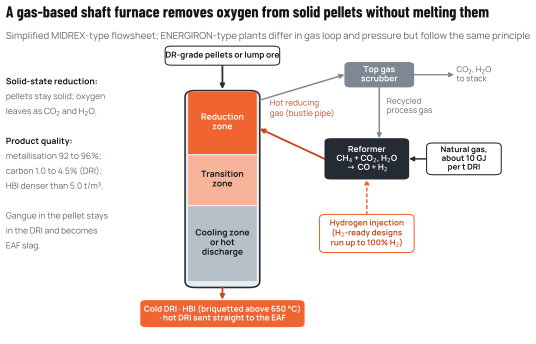
Source: Cameroon Steel, after Midrex [S22] and ENERGIRON [S20] process descriptions; product properties from IIMA [S14, S15].
Two features make the process attractive for Cameroon. It uses natural gas rather than coking coal; and the reducing gas of a natural-gas plant is already rich in hydrogen. In Midrex laboratory tests representing natural-gas operation, the reducing gas contained about 55% hydrogen, 36% carbon monoxide, 5% carbon dioxide and 4% methane [S22]. Moving towards hydrogen is therefore a change of degree, not of kind.
The product’s quality is fixed by the feed. A modern shaft furnace delivers DRI that is 92 to 96% metallised [S14], but it cannot remove gangue. DRI made from ore of 65.5 to 68% iron contains 3.9 to 8.4% gangue [S14]. That gangue becomes slag in the electric furnace, where it costs electricity, lime, refractory and yield.
4.2 DR-grade feed is scarce and becoming scarcer
worldsteel’s climate policy paper notes that current direct-reduction processes require high-grade ore, of 64% iron or more [S16]. In practice the seaborne DR-grade market trades at higher grades: the main DR-grade materials described by IEEFA carry about 67 to 68% iron, with low silica and alumina [S17]. Only about 31% of the world’s DR-grade pellet supply was sourced from the seaborne market in 2024; the rest was produced and consumed regionally [S17].
Demand for that material is rising faster than supply. IEEFA reports that BloombergNEF expects a seaborne DR-grade pellet deficit of 15 Mt a year by 2030, widening to 133 Mt a year by 2040, and that Midrex has flagged a possible shortfall of up to 16.4 Mt a year by 2034 [S17]. Agora Industry reached a similar conclusion in 2023, warning that DR-grade ore supply would lag demand by 2030 [S78]. For Cameroon Steel this cuts two ways. It means that imported DR pellets may become expensive and contested, so a plan that relies on them for decades is fragile. It also means that a Cameroonian source of DR-grade concentrate would be valuable in its own right, both to the Kribi plant and as an export.
4.3 What the published data say about Cameroonian ore
Cameroon has several iron-ore deposits at different stages. The most studied is Mbalam, whose exploitation permit is held by Cameroon Mining Company, Cameroon Steel’s sister company [S77]. The only code-compliant dataset for Mbalam was published under the JORC Code by the permit’s previous holder in 2015. It gives a probable ore reserve of 517 Mt grading 62.2% iron, 4.46% silica, 2.80% alumina and 0.09% phosphorus, of direct-shipping hematite; a further high-grade hematite resource of 805.7 Mt at 57.3% iron; and an itabirite resource of 5,638 Mt at 33.4% iron [S18]. Itabirite is a banded iron formation in which fine hematite or magnetite is interlayered with silica; it must be ground and concentrated before use.
Metallurgical testwork on Mbalam itabirite, published in 2014, produced two concentrates: a blast-furnace-grade product of 66.6% iron and 3.5% silica, and a DR-grade product of 68% iron, 1.8% silica, 0.2% alumina and 0.03% phosphorus, after grinding to a P80 of 53 µm, with a mass yield of 45% and an iron recovery of 81% [S19]. Figure 4.2 places these products against the DR-grade thresholds.
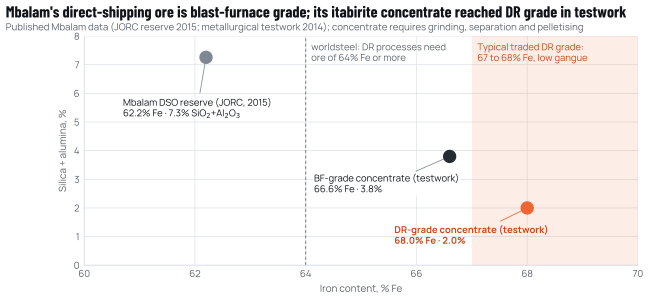
Source: JORC reserve statement, 2015 [S18]; metallurgical testwork, 2014 [S19]; worldsteel threshold [S16]; typical traded DR grade [S17].
The figure makes the central point plainly. Mbalam’s direct-shipping ore, the material that the current mining plan will export first, is a good blast-furnace and sinter feed, but it is not DR grade: its iron content is below even worldsteel’s minimum and its gangue is three to four times that of DR pellets. The DR-grade product exists only at testwork scale, from a different ore type that requires a concentrator.
The current state of Cameroon’s other projects points the same way. Cameroon Mining Company reported in December 2025 that its processing plant would have a capacity of 3.6 Mt a year, rising to 10 Mt by 2027, with first exports then expected in early 2026 [S36, S79]; in May 2026 Cameroon Tribune reported that uncertainties could push the start to 2027 [S80]. The Kribi-Lobé magnetite project plans a concentrate above 60% iron, and its exports have been postponed to July 2027 [S81]. Neither plan, as published, includes DR-grade concentrate or a pellet plant.
Table 4.1 Cameroonian iron-ore products against direct-reduction requirements
| Product | Iron,% | Silica + alumina,% | Status | DR grade? |
|---|---|---|---|---|
| Typical traded DR pellet | 67 to 68 | Low | Commercial | Benchmark [S17] |
| worldsteel minimum for DR processes | 64 | Not stated | Policy statement | Threshold [S16] |
| Mbalam direct-shipping ore (JORC probable reserve, 2015) | 62.2 | 7.26 | Mining start expected 2026 to 2027 | No: blast-furnace and sinter grade [S18, S80] |
| Mbalam itabirite, blast-furnace concentrate (testwork, 2014) | 66.6 | 3.8 | Testwork only | Marginal: gangue too high [S19] |
| Mbalam itabirite, DR concentrate (testwork, 2014) | 68.0 | 2.0 | Testwork only; no concentrator or pellet plant planned | Yes, on specification [S19] |
| Kribi-Lobé magnetite concentrate (planned) | Above 60 | Not published | Exports postponed to July 2027 | Not as planned [S81] |
Source: as cited; Cameroon Steel assessment in the last column.
4.4 From ore to pellet: three plants before the steelworks
Turning itabirite into DRI takes three industrial steps before the shaft furnace (Figure 4.3).
Mining and crushing. Itabirite at about 33% iron is mined, crushed and milled. Because so much of the rock is silica, large tonnages must be moved: at the testwork’s 45% mass yield, about 2.2 t of ore are needed for each tonne of concentrate (derived) [S19].
Concentration. The milled ore, ground to a P80 of 53 µm in the Mbalam testwork, is separated into an iron-rich concentrate and a silica-rich tailing [S19]. Fine grinding consumes a great deal of electricity and the tailings require engineered storage. These costs are borne by the mining side of the chain and must be agreed between the mine and the steelworks.
Pelletising. Fine concentrate cannot be charged to a shaft furnace as powder. It is mixed with a binder, rolled into green balls about the size of a marble and hardened by firing (induration) into pellets strong enough to survive the shaft. A DR plant consumes roughly 1.45 t of pellets per tonne of DRI, as implied by the BloombergNEF pellet and DRI figures cited by IEEFA (derived) [S17].
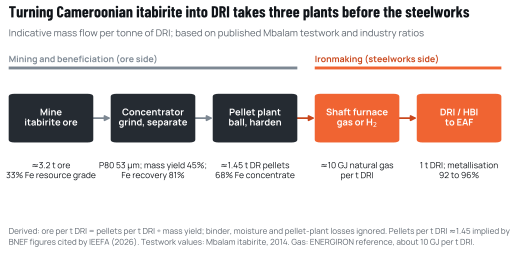
Source: Cameroon Steel, from Mbalam testwork [S19], pellet ratio implied by [S17], gas consumption [S20] and DRI metallisation [S14]. Binder, moisture and pellet-plant losses ignored; Annex A.
At the scale of the RC-1 reserve, about 1 Mt of DRI a year [S03], the chain would need roughly 1.45 Mt of DR pellets and, from itabirite, of the order of 3.2 Mt of ore a year (derived). Those quantities are small next to the export volumes planned for Mbalam, which is why the 15% local-transformation clause in Cameroon Mining Company’s convention [S36] could in principle cover them several times over. The difficulty is not volume; it is the investment and the technical proof needed for a concentrator and a pellet plant producing DR-grade product.
4.5 Gas is the second precondition
A gas-based DR plant consumes about 10 GJ of natural gas per tonne of DRI on the ENERGIRON reference [S20]; the best sustained performance reported, at Suez Steel in Egypt, is about 9.2 GJ [S48]. At 10 GJ per tonne, a 1 Mtpa module would use about 10 PJ of gas a year, or about 9.1 bcf; a 0.5 Mt module about 4.6 bcf (derived; conversion in Annex A).
Cameroon produced 75.5 bcf of natural gas in 2025, almost all of it from the Sanaga Sud field off Kribi; about 95% was sold as feed to a floating liquefaction vessel, 4.9 bcf went to the Kribi power plant at about 1,810 to 1,858 FCFA per thousand cubic feet and 3.1 bcf to an industrial buyer at 3,135 FCFA [S21]. The liquefaction vessel left Cameroon in July 2026 at the end of its charter [S82]; White paper 05 (Chapters 6 and 7) analyses what its departure means for gas supply to industry. At first sight this leaves gas available near Kribi. But remaining certified reserves of the producing field are not public, and the main undeveloped resource, the cross-border Yoyo-Yolanda discovery of about 2.5 trillion cubic feet, would need about US$4 billion of development and had no final investment decision in July 2026 [S35].
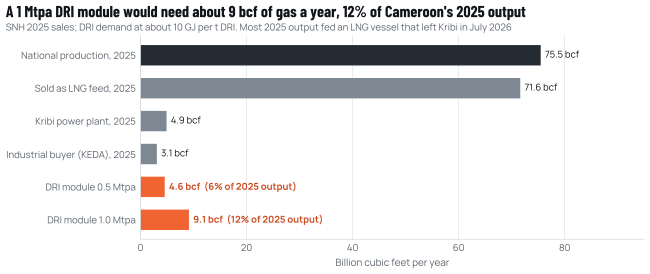
Source: SNH, Données pétrolières 2025 [S21]; DRI gas demand at about 10 GJ per tonne [S20]; departure of the FLNG vessel [S82]. Annex A gives the conversion.
At the 2025 prices paid by SNH’s industrial buyer and by the power plant, gas would cost about US$27 to 51 per tonne of DRI (derived in White paper 05, Chapter 7, for 9.2 to 10 GJ per tonne at SNH’s quarterly exchange rates; at 10 GJ and a planning rate of 600 FCFA per US dollar, roughly 17,000 to 29,000 FCFA, or US$28 to 48, Annex A) [S03, S21]. That is competitive internationally, but only if it can be contracted for the life of the plant. A DR module therefore requires an audited reserve, a long-term gas sales agreement and clarity on gas taxation before a final investment decision.
4.6 Hydrogen-ready shaft furnaces keep the decarbonisation option open
The direct-reduction route is the only ore-based route whose emissions can be cut progressively without rebuilding the plant. Midrex designs its MIDREX Flex plants to run on any mix from 100% natural gas to 100% hydrogen; hydrogen is added downstream of the reformer for most of the range, and the shaft furnace itself needs no fundamental changes, with existing refractory suitable for hydrogen operation [S22]. In June 2025 a Malaysian developer selected the technology for a 2.0 Mtpa HBI plant due to start in 2029, planning to begin on a gas and hydrogen blend [S83]. ENERGIRON reports CO2 reductions of about 86% against the blast-furnace route when running on 100% hydrogen [S20]. In Germany, the Power4Steel project at Saarstahl and Dillinger expects emissions to fall from 1.921 t CO2e per tonne on the blast-furnace route to 1.098 t with gas-based DRI-EAF and 0.339 t with green hydrogen and green power [S84].
The limit is hydrogen supply. Reducing one tonne of DRI with hydrogen alone needs about 54 kg of hydrogen [S85]. At an electrolyser consumption of about 50 MWh per tonne of hydrogen (an assumption within published ranges; Annex A), a 1 Mtpa module running on 100% hydrogen would need about 2.7 TWh of electricity a year, about a third of Cameroon’s total generation of 8.12 TWh in 2025 [S51] (derived). That is not a near-term option. Cameroon’s hydropower potential is large, about 115 TWh a year with about 4% developed according to the US International Trade Administration [S86], and Africa’s first renewables-powered green-iron plant opened in Namibia in April 2025 [S87]. A sensible path is to specify a hydrogen-ready shaft furnace, start on natural gas, and blend hydrogen as low-carbon electricity becomes available.
4.7 What Africa’s existing DR plants teach
Africa is not new to direct reduction. On worldsteel figures, the continent produced 16.3 Mt of DRI in 2025, led by Egypt (6.6 Mt) and Algeria (about 5.0 Mt), followed by Libya (1.7 Mt) and, on worldsteel estimates, Uganda (1.5 Mt), Kenya (1.0 Mt) and Tanzania (0.2 Mt) [S41]. Midrex plant statistics, which cover the plants in its survey, rank Algeria first (6.70 Mt) ahead of Egypt (6.06 Mt) and give the Middle East and North Africa together 67.7 Mt [S04]. The two series differ in coverage and in how they estimate unreported plants, so this paper states the basis each time it quotes a national figure. The North African plants are gas-based shaft furnaces that run on imported or domestic DR pellets and feed adjacent electric melt shops, which is exactly the configuration envisaged for Kribi in its later phase.
The record also contains warnings. At the end of 2025, three large African DR plants were idle: Delta Steel at Warri in Nigeria (1.02 Mt a year, built in 1982), ArcelorMittal South Africa’s Saldanha plant (0.80 Mt) and ESISCO in Egypt (1.76 Mt) [S04]. A shaft furnace is a continuous process that needs a steady supply of pellets and gas, a melt shop or export market that takes its output every day, and the skills to keep it running. Where any of these fail, the plant stops, and restarting an idle module is costly. The lesson for Cameroon is not to avoid direct reduction but to build it only when its supply chain, its gas contract and its downstream melt shop are already secure, which is the logic of the gate described in Chapter 10.
4.8 Sizing the direct-reduction module
Direct-reduction modules have grown steadily: the first MIDREX MEGAMOD module, of 1.0 Mt a year, was built for JSW at Dolvi in India, and the largest single module, of 2.5 Mt a year, started at Tosyali Algérie in 2018 [S88]. Modules are now offered from 0.25 Mt a year (the ENERGIRON ZR micro-module at Mutún, Bolivia, commissioned in October 2025) to 2.5 Mt a year in a single shaft, with African modules between 0.65 and 2.5 Mt [S04]. RC-1 keeps a reserve for a module of about 1 Mt of DRI a year, within a range of 0.8 to 1.1 Mt, sized to the melt shop’s iron-unit needs at 1 Mtpa and subject to ore quality and gas supply [S03]. A smaller first module, of about 0.5 Mt, would halve the gas requirement and could be justified if the pellet supply or the gas contract is initially limited. Either way, the module would be placed next to the melt shop so that hot DRI can be charged directly to the furnace, which saves electricity and avoids the re-oxidation risk of storing cold DRI.
4.9 What must be true before Kribi makes its own iron
Four conditions, tested at the gate described in Chapter 10, determine when the direct-reduction module can proceed:
- DR-grade concentrate proven at pilot scale. A Cameroonian concentrate of at least 67% iron with low silica and alumina, produced continuously in a pilot plant from a defined ore body, with pellets tested for strength and reducibility.
- A pellet supply. A pellet plant at the mine, at Kribi or with a third party, contracted for the life of the DR module; or a bridging contract for imported DR pellets.
- Gas for the life of the plant. An independently audited reserve and a long-term gas sales agreement for about 4.6 to 9.1 bcf a year, depending on module size, with agreed pricing and taxation.
- A hydrogen-ready design and a carbon plan. A shaft furnace specified for progressive hydrogen use, and a measurement, reporting and verification system for CO2 from the first day of operation.
None of these conditions is unusual; each is standard for any DR project worldwide. Taken together, they explain why domestic DRI is the right long-term direction for Cameroon Steel and why it should not be a condition for starting.
Sources cited in this chapter
Bracketed markers refer to these sources; the full list is in the annex. Full list of sources
- S22MIDREX Flex: minimizing technology risks in the transition to carbon-free steelmaking (V. Chevrier), worldsteel Breakthrough Technology Conference. Midrex Technologies, hosted by worldsteel, 6 Dec 2023.worldsteel.org/wp-content/uploads/Presentation_Vincent-CHEVRIER-Midrex…
- S20ENERGIRON technology: DRI-EAF production route using natural gas or H2. European Commission, Innovation Centre for Industrial Transformation, Referenced 12 Feb 2026.innovation-centre-for-industrial-transformation.ec.europa.eu/innovativ…
- S14Direct Reduced Iron (DRI): specifications and handling. International Iron Metallics Association, Undated, accessed Oct 2026.metallics.org/dri.html
- S15Hot Briquetted Iron (HBI): specifications and handling. International Iron Metallics Association, Undated, accessed Oct 2026.metallics.org/hbi.html
- S16Climate change and the production of iron and steel (policy paper). worldsteel.worldsteel.org/climate-action/climate-change-and-the-production-of-iro…
- S17Global high-grade iron ore market is set to grow (S. Basirat). Institute for Energy Economics and Financial Analysis (IEEFA), Mar 2026.ieefa.org/sites/default/files/2026-03/IEEFA_Global%20high-grade%20iron…
- S7815 Insights on the Global Steel Transformation. Agora Industry, 15 Jun 2023.agora-industry.org/publications/15-insights-on-the-global-steel-transf…
- S77Kribi: le Premier ministre, chef du gouvernement est là. Cameroon Tribune, 30 Dec 2024.cameroon-tribune.cm/article.html/68499/fr.html/details_2
- S18Mbalam-Nabeba resources and reserves as at 20 May 2015 (JORC Code). Previous holder of the Mbalam permit (ASX-listed company disclosure), 2015.Cited by title and date
- S19Mbalam iron ore project: presentation to Mining Indaba 2014 (metallurgical testwork on itabirite). Previous holder of the Mbalam permit (ASX-listed company disclosure), Feb 2014.Cited by title and date
- S36Cameroon Mining Company confirme l’entrée du projet Mbalam dans sa phase irréversible d’exécution. Camer.be via AllAfrica, 12 Dec 2025.fr.allafrica.com/stories/202512120475.html
- S79Mbalam iron ore mine delays first exports to early 2026. Business in Cameroon, 13 Dec 2025.businessincameroon.com/public-management/1312-15495-mbalam-iron-ore-mi…
- S80Exploitations: la revue des gisements. Cameroon Tribune, 11 May 2026.cameroon-tribune.cm/articles/11125/fr/details_2
- S81Sinosteel reporte les exportations du fer de Kribi-Lobé à 2027 malgré 120 milliards FCFA déjà investis. EcoMatin, 11 Mar 2026.ecomatin.net/cameroun-sinosteel-reporte-les-exportations-du-fer-de-kri…
- S03Cameroon Steel reference configuration RC-1 (planning estimate): phases, benchmarks with ranges and indicative balances for the Kribi steelworks (Class 5), edition 10 October 2026, values as revised on that date. Cameroon Steel, 10 Oct 2026.Cited by title and date
- S48Suez Steel sets new benchmark in energy consumption for DRI production. Danieli, 16 Apr 2026.danieli.com/en/news-media/news/suez-steel-sets-new-benchmark-energy-co…
- S21Données pétrolières 2025. Société Nationale des Hydrocarbures (SNH), Jun 2026.snh.cm/wp-content/uploads/2026/06/Donnees-petrolieres-2025.pdf
- S82Le navire usine quitte le Cameroun, le gaz s’arrête. Camer.be, 9 Jul 2026.camer.be/93911/12:1/le-navire-usine-quitte-le-cameroun-le-gaz-sarrete-…
- S35Cameroon’s SNH eyes Yoyo-Yolanda and new exploration blocks to sustain gas growth. Business in Cameroon, 6 Jul 2026.businessincameroon.com/energy/0607-16422-cameroon-s-snh-eyes-yoyo-yola…
- S83MAEGMA Minerals partners with Primetals Technologies for MIDREX Flex plant. Primetals Technologies, 10 Jun 2025.primetals.com/en/news/maegma-minerals-partners-with-primetals-technolo…
- S84DRI-EAF implementation at Saarstahl and Dillinger steelworks (POWER4STEEL). European Commission, Innovation Centre for Industrial Transformation, Referenced Jul 2025.innovation-centre-for-industrial-transformation.ec.europa.eu/innovativ…
- S85Hydrogen uses in ironmaking (V. Chevrier, Midrex), H2@Scale kick-off. US Department of Energy, 1 Aug 2018.energy.gov/sites/prod/files/2018/08/f54/fcto-h2-scale-kickoff-2018-8-c…
- S51Rapport d’activités 2025. Agence de Régulation du Secteur de l’Électricité (ARSEL), 7 Sep 2026.arsel-cm.org/wp-content/uploads/2026/09/Rapport-ARSEL-2025.pdf
- S86Cameroon: Energy (Country Commercial Guide). US International Trade Administration, 13 Apr 2026.trade.gov/country-commercial-guides/cameroon-energy
- S87Global Gateway: Namibia becomes pioneer for Africa’s green transition. European Commission, DG INTPA, 11 Apr 2025.international-partnerships.ec.europa.eu/news-and-events/news/global-ga…
- S41World Steel in Figures 2026. worldsteel, 4 Jun 2026.worldsteel.org/data/world-steel-in-figures/world-steel-in-figures-2026…
- S042025 World Direct Reduction Statistics. Midrex Technologies, Sep 2026.midrex.com/world-dri-statistics/world-dri-production-reaches-151-0-mt-…
- S88Midrex history. Midrex Technologies, Undated, accessed Oct 2026.midrex.com/history/
Cite this chapter
Cameroon Steel (2026). Electric steelmaking is the right route for Central Africa. White paper 03, chapter 4: Direct reduction and ore quality: Cameroonian iron needs a concentrator and a pellet plant first. CS-WP-03. https://www.cameroon-steel.com/en/library/technology-routes/direct-reduction-ore/
Source