White paper 03 · Chapter 2
The routes compared: electric routes win on carbon, scale and speed
Of the five ways to make steel, two fit a new producer in Central Africa: the electric arc furnace fed with scrap and purchased iron, and the electric arc furnace fed with gas-based direct-reduced iron. On worldsteel’s 2024 route averages they emit 0.69 and 1.47 t of CO2 per tonne of crude steel, against 2.34 t for the blast furnace and oxygen converter [S01]. On IEA-derived benchmarks in 2019 dollars their indicative capital cost per tonne is of the same order as the blast furnace’s, but they can be built in modules of a few hundred thousand tonnes and started in a fraction of the time. The blast-furnace route belongs to very large works backed by coking coal and sintering plant; induction furnaces and smelting reduction do not meet the quality or maturity bar for structural products.
In this chapter (10)
- 2.1 Five routes, of which three operate at commercial scale worldwide
- 2.2 Energy and CO 2: scrap-EAF steel emits about 30% of the blast furnace’s CO 2
- 2.3 Capital per tonne is of the same order; what differs is the scale at which it is spent
- 2.4 The blast-furnace route suits very large, coal-backed works
- 2.5 Gas-based DRI-EAF is the ore-based route that fits Central Africa
- 2.6 The scrap-fed EAF is the fastest start, but scrap alone cannot feed 1 Mtpa
- 2.7 Induction furnaces and smelting reduction do not meet the bar for structural steel at scale
- 2.8 Africa’s own experience points the same way
- 2.9 The comparison in one table
- 2.10 Why the phased electric route balances the four criteria
2.1 Five routes, of which three operate at commercial scale worldwide
Figure 2.1 sets out the five routes as a decision-maker meets them: what each consumes, which core plant it requires and how much CO2 it emits on average. Three of them (blast furnace and basic oxygen furnace, gas-based direct reduction with an electric arc furnace, and scrap-based electric arc furnace) account for almost all of the world’s crude steel. Induction furnaces are a niche concentrated in South Asia; smelting reduction is commercial at a handful of sites and is otherwise at pilot stage.
The comparison that follows uses four criteria that matter to a new producer in a mid-sized market: energy and CO2 per tonne; capital per tonne of capacity; the minimum economic scale; and the raw materials each route needs. A fifth criterion, flexibility (the ability to change inputs and output as markets and supply chains change), runs through all four.
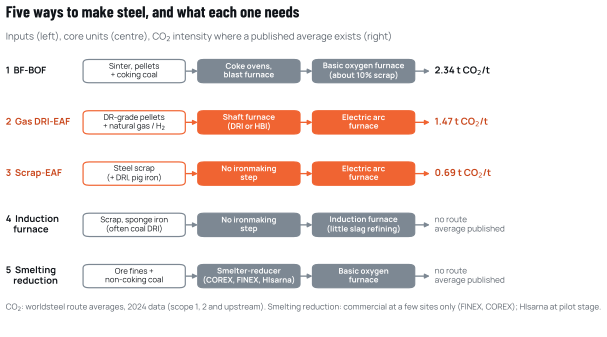
Source: Cameroon Steel; CO2 values from worldsteel Sustainability Indicators 2025 (2024 data) [S01]; status of smelting reduction from [S11, S12].
2.2 Energy and CO2: scrap-EAF steel emits about 30% of the blast furnace’s CO2
worldsteel publishes route averages that include direct emissions, emissions from purchased electricity and the upstream emissions of materials. For 2024 data, the blast furnace and oxygen converter route emitted 2.34 t of CO2 per tonne of crude steel, the DRI-EAF route 1.47 t and the scrap-EAF route 0.69 t; the world average was 1.92 t [S01]. The energy intensities were 23.88, 23.30 and 9.84 GJ per tonne respectively, counting electricity as primary energy [S01]. The IEA, which measures final energy and uses a 2019 world-average grid factor of 538 g CO2/kWh, gives 21.4, 17.1 and 2.1 GJ per tonne, and direct-plus-indirect CO2 of 2.2, 1.4 and 0.3 t per tonne [S02]. The two sources differ in boundary, not in ranking (Figure 2.2).
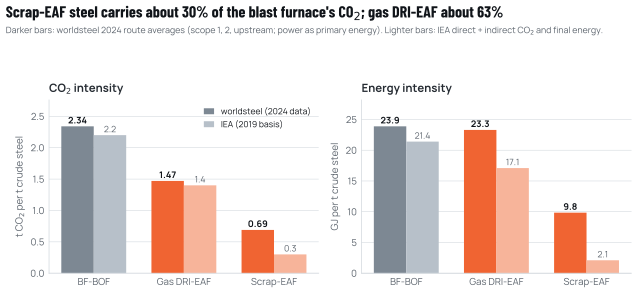
Source: worldsteel Sustainability Indicators 2025, 2024 data [S01]; IEA Iron and Steel Technology Roadmap, 2019 basis [S02].
Three features of these numbers matter for Cameroon.
First, the electric routes’ emissions depend heavily on the grid. Cameroon generated about 90% of its electricity from hydropower in 2025 [S51], and Our World in Data, using Ember data, puts the average carbon intensity of the country’s electricity at about 226 g CO2/kWh in 2024 [S07], well under half the world average used by the IEA. An EAF consuming 450 kWh per tonne on that grid adds about 0.10 t of CO2 per tonne of steel (derived). A gas-based DRI-EAF plant in Cameroon would therefore sit below the worldsteel DRI-EAF average, and closer to the IEA’s direct-emission figure of about 1.0 t [S02].
Second, the DRI-EAF route’s emissions come mostly from the natural gas burned and reformed in the shaft furnace. Replacing part of that gas with hydrogen reduces them in proportion. ENERGIRON reports reductions of about 53% against the blast-furnace route with natural gas and about 86% with 100% hydrogen [S20]. The DRI-EAF route is therefore the only ore-based route with a credible path to near-zero steel; the IEA’s near-zero threshold for steel made entirely from ore is 0.40 t CO2e per tonne [S52].
Third, carbon is becoming a cost at Europe’s border. The EU Carbon Border Adjustment Mechanism (CBAM) entered its definitive phase on 1 January 2026 and covers iron and steel, including DRI, billets, rebar and wire rod, and agglomerated iron ore [S53]. The certificate price for the third quarter of 2026 was €82.32 per tonne of CO2e [S54]. Applied to worldsteel’s route averages, that price would give a gross charge of about €193 per tonne for blast-furnace steel, €121 for DRI-EAF steel and €57 for scrap-EAF steel, before any deductions for EU free allocation (derived). These figures are an upper bound, not an estimate of what an exporter would pay: worldsteel’s averages include purchased electricity and upstream inputs, which CBAM does not price for iron and steel, so they overstate the CBAM-relevant emissions, particularly for the electric routes. White paper 06 (Chapter 5, Table 5.2) computes the charge on the CBAM boundary. Free allocation for EU producers falls from 97.5% in 2026 to zero in 2034 [S55], so the charge that exporters face will rise each year.
2.3 Capital per tonne is of the same order; what differs is the scale at which it is spent
Published capital costs for steel plants are difficult to compare: they differ in scope (with or without rolling mills, utilities, ports and housing), currency year and location. The most consistent public basis is the IEA’s set of annualised capital costs, which converts into indicative overnight costs per tonne of annual capacity of about US$500 to 900 for a new blast furnace and converter, US$510 to 1,310 for a gas DRI-EAF plant and US$330 to 560 for a scrap-EAF melt shop, in about 2019 dollars (derived; method in Annex A) [S02]. These ranges are not escalated to current prices: budgets announced between 2020 and 2026, which also include rolling mills and site works, run from about US$660 to 1,560 per tonne (Figure 2.3), so the ranges are useful to compare routes, not to price a plant. The Mission Possible Partnership puts a new integrated blast-furnace works at about US$1.2 billion per million tonnes [S56].
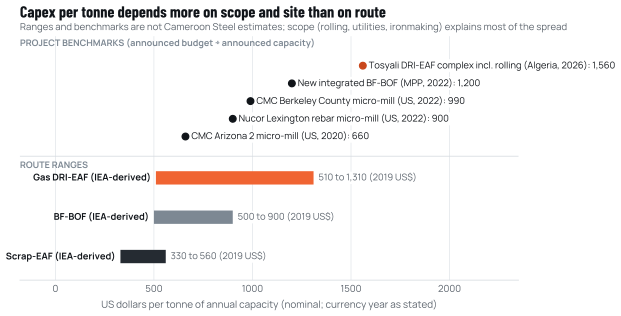
Source: IEA-derived ranges [S02]; Mission Possible Partnership [S56]; Nucor [S57]; CMC projects [S58, S59]; Tosyali Algeria [S60]. Project values are announced budgets divided by announced capacity, with US short tons converted to tonnes, and are not comparable in scope.
The project benchmarks in Figure 2.3 show why route is not the main driver. Three US "micro-mills" that melt scrap and roll bar in a single line were announced between 2020 and 2022 at about US$660, US$900 and US$990 per tonne of announced capacity, once their short tons are converted to tonnes (Annex A) [S57, S58, S59]. A new Algerian complex that combines direct reduction, electric steelmaking and rolling was announced in April 2026 at about US$2.5 billion for 1.6 Mt, or about US$1,560 per tonne [S60]. Hydrogen-based plants are more expensive still: the first phase of Stegra’s hydrogen DRI-EAF plant in Sweden was financed at €6.5 billion for 2.5 Mt a year [S61], and the company was seeking further funding in October 2026 as costs rose [S62].
What separates the routes is the size of the indivisible step. A blast furnace, with its coke ovens, sinter plant and oxygen converter, is economic only at several million tonnes a year; the IEA-derived range assumes that scale. An electric melt shop with its caster is efficient at a few hundred thousand tonnes: US micro-mills are sized at 0.39 to 0.45 Mt a year (430,000 to 500,000 short tons) [S57, S58, S59], and recent African bar and rod mills at about 0.3 Mt [S08, S09]. Direct-reduction modules are available from 0.25 Mt a year, the size of the ENERGIRON ZR micro-module commissioned at Mutún in Bolivia in October 2025, up to 2.5 Mt in a single shaft [S04]. A Central African producer can therefore commit capital in steps that match demand, and add ironmaking when its ore and gas are ready.
2.4 The blast-furnace route suits very large, coal-backed works
The blast furnace remains the world’s main ironmaking technology, and 319 Mtpa of new blast-furnace capacity was under development worldwide in 2026, mostly in India and China [S45]. It suits countries that combine a very large steel market, access to coking coal and an ore and logistics chain designed for tens of millions of tonnes of raw materials. Cameroon’s apparent steel use is about 450,000 t a year by industry estimates [S32], far below the output of a single modern blast furnace. A blast furnace would depend on imported coking coal, because no Cameroonian coking-coal supply is in operation or in development in the sources reviewed for this paper. It would also carry the highest carbon charge of any route into export markets that apply carbon border measures.
The blast furnace is also the least flexible route. It runs continuously for campaigns of many years; stopping it is costly and restarting it slow. When demand falls, an integrated works cannot easily throttle down, whereas an electric melt shop can reduce shifts. For a producer whose market is still forming, that rigidity is a serious risk.
2.5 Gas-based DRI-EAF is the ore-based route that fits Central Africa
Gas-based direct reduction combined with an electric furnace is how North Africa built its steel industry. Algeria, Egypt and Libya together produced about 14.5 Mt of DRI in 2025 on Midrex plant statistics [S04], and Algeria moved from a net steel deficit to a net surplus on the strength of large DRI-EAF complexes [S63]. The route uses natural gas rather than coking coal, accepts DR-grade pellets or lump ore, and its modules can be sized to the market. A modern MIDREX or ENERGIRON plant consumes about 9.2 to 10 GJ of natural gas per tonne of DRI; Suez Steel reported sustained consumption below 2.2 Gcal (about 9.2 GJ) per tonne in 2026 [S48], and the ENERGIRON reference is about 10 GJ and 73 kWh per tonne of DRI [S20].
Sub-Saharan Africa has almost no gas-based direct reduction in operation: on Midrex plant statistics the region produced 0.09 Mt of DRI in 2025, and its two shaft-furnace DR plants, at Warri in Nigeria (1.02 Mtpa) and Saldanha in South Africa (0.80 Mtpa), were idle [S04]. worldsteel, whose figures include estimates for plants outside that survey, puts East African DRI output at about 2.7 Mt in 2025, in Uganda, Kenya and Tanzania (Chapter 4) [S41]. A DRI module at Kribi would therefore be among the first operating gas-based DR plants in the region. It would also face the two preconditions examined in Chapter 4: DR-grade ore and a long-term gas supply.
2.6 The scrap-fed EAF is the fastest start, but scrap alone cannot feed 1 Mtpa
The scrap-fed electric furnace is the lowest-carbon and lowest-capital route and the quickest to build. Its limit is the supply of scrap, which depends on how much steel an economy has accumulated in buildings, vehicles and machinery. Global scrap use in steelmaking is about 630 Mt a year, according to the Bureau of International Recycling [S64], but it is concentrated in mature economies. Africa was a net importer of ferrous scrap in 2025, importing 3.4 Mt and exporting 1.2 Mt [S41]. Chapter 3 shows that Cameroon’s domestic scrap is a fraction of what a 1 Mtpa plant would need. The scrap-EAF is the right way to start, but not a sufficient way to grow.
2.7 Induction furnaces and smelting reduction do not meet the bar for structural steel at scale
Induction furnaces melt scrap and sponge iron cheaply in small units, which explains their popularity in South Asia. Global Energy Monitor counts about 27 Mtpa of tracked induction-furnace capacity, about 1% of operating capacity, mostly in India, Vietnam, Bangladesh and Pakistan; the furnaces it tracks use on average 73% sponge iron (often coal-based) and only 19% scrap [S45]. The IEA describes induction furnaces as typically less energy-efficient than arc furnaces and notes that China closed dozens of illegal induction-furnace plants [S02]. Their metallurgical weakness is refining: without a hot, reactive slag they cannot remove phosphorus and sulphur effectively. India’s National Metallurgical Laboratory reported that about 90% of nearly 15 Mt of induction-furnace steel made from DRI contained 0.08 to 0.11% phosphorus, against the 0.03 to 0.06% allowed by Indian and ASTM standards [S10]. For rebar and sections that must meet ductility and weldability requirements, that is a disqualifying risk unless refining is added in the ladle.
Smelting reduction processes reduce and melt ore in one or two vessels using non-coking coal, avoiding coke ovens and, in some designs, sintering. COREX and FINEX are in commercial use; POSCO built its first commercial FINEX plant for 1.5 Mt of hot metal a year at Pohang [S11]. HIsarna has been piloted in the Netherlands and Tata Steel plans an industrial plant of about 1 Mt a year at Jamshedpur by 2030 [S12]. These processes still produce hot metal for an oxygen converter, still depend on coal and, at commercial scale, still need carbon capture to reach low emissions. They are not an option for a new producer whose ore is not yet upgraded and whose market is measured in hundreds of thousands of tonnes.
2.8 Africa’s own experience points the same way
The continent’s recent history offers a natural experiment in route choice. Africa made 89.0% of its crude steel in electric furnaces in 2025 [S41]. North Africa built its industry on gas-based direct reduction and electric melt shops behind trade protection: Algeria moved from a net steel deficit of about 1 Mt in 2021 to a net surplus of about 1 Mt in 2025, and the share of imports in its steel use fell from 35% to 16% [S63, S65]. South Africa offers a different lesson: in February 2025 ArcelorMittal South Africa confirmed the wind-down of its long-steel business, citing energy costs, logistics, scrap policy and weak protection against imports [S66].
New capacity follows the electric pattern. Global Energy Monitor lists electric arc furnace projects in development in Namibia, Algeria, Nigeria, Libya, Egypt, South Africa, Zimbabwe, Angola and Mozambique, and direct-reduction projects in Libya, Algeria, Egypt, Angola and Mozambique [S45]. The bar and wire-rod mills ordered in Tanzania and Côte d’Ivoire in September 2026 are each about 300,000 t a year [S08, S09]. A Kribi melt shop would join a regional industry that has already chosen electricity; what would distinguish it is the prospect of feeding that furnace, in time, with iron made from the country’s own ore.
2.9 The comparison in one table
Table 2.1 Route comparison for a new long-products producer in Central Africa
| Criterion | BF-BOF | Gas DRI-EAF | Scrap-EAF (with purchased DRI/HBI) | Induction furnace | Smelting reduction |
|---|---|---|---|---|---|
| CO2, t per t crude steel | 2.34 [S01] | 1.47 [S01]; about 1.0 direct [S02] | 0.69 [S01] | No route average published | Not published at commercial scale; needs carbon capture for low emissions [S12] |
| Energy, GJ per t | 23.88 (worldsteel); 21.4 (IEA) [S01, S02] | 23.30; 17.1 [S01, S02] | 9.84; 2.1 [S01, S02] | Typically less efficient than EAF [S02] | n.a. |
| Indicative capex, US$ per t of capacity | 500 to 900 (IEA-derived); about 1,200 (MPP) [S02, S56] | 510 to 1,310 (IEA-derived) [S02] | 330 to 560 (IEA-derived) [S02] | Low, small units | n.a. |
| Economic scale | Several Mt a year | DR modules 0.25 to 2.5 Mt [S04] | 0.3 to 0.45 Mt per melt line [S08, S57, S58] | Below 0.5 Mt [S45] | About 1 to 1.5 Mt per unit [S11, S12] |
| Main raw materials | Sinter or pellets, coking coal | DR-grade pellets, natural gas or hydrogen | Scrap, DRI/HBI, pig iron | Scrap, sponge iron | Ore fines, non-coking coal |
| Flexibility | Low: continuous campaigns | Medium: DR plant continuous, EAF flexible | High: start, stop, change charge | High | Low |
| Fit for a new Central African producer | Poor: scale, coal, carbon | Best long-term fit once DR-grade ore and gas are secured | Best starting point; needs purchased iron units | Not suitable for structural grades at scale | Not mature for this context |
Source: as cited in each cell; Cameroon Steel assessment in the last two rows.
2.10 Why the phased electric route balances the four criteria
The question for Cameroon is not which route is best in the abstract, but which sequence of plants gives the best balance of capital, flexibility, emissions and speed given the market and resources that exist now, and those that may exist in ten years.
On capital, the electric route lets the producer commit in steps of a few hundred thousand tonnes, with each step generating revenue before the next. On flexibility, the electric furnace accepts any mix of scrap, DRI, HBI and pig iron, so the plant can switch suppliers and adjust to prices; and it can be throttled with demand. On emissions, it starts at the scrap-EAF level and rises only as the share of ore-based iron rises, while Cameroon’s hydro-dominated grid keeps the electricity component low. On speed, a melt shop and mill can be built and commissioned without waiting for a mine, a concentrator, a pellet plant and a gas contract to be ready at the same time.
Capital and carbon are not the whole case. A melt shop earns its place only if the billets it casts cost less than billets bought abroad and delivered to Kribi. Its largest cost is the metallic charge: at the RC-1 metallic yield of 0.88, each tonne of billet needs about 1.15 t of scrap, HBI or pig iron [S03]. The spread between the delivered price of an imported billet (free on board, plus freight, port charges and duty) and the cost of that charge is what must pay for 450 to 490 kWh of furnace electricity per tonne, electrodes, refractories, alloys, labour and maintenance. The spread moves with world prices for scrap, HBI and billets and with freight, and it is the variable that a Phase 1 investment decision must test. White paper 04 (Chapter 8) sets out an indicative cost of a Kribi billet against a delivered import, as ranges with their sources and uncertainty; this paper does not repeat those figures.
The direct-reduction step is then added when its preconditions are in place. That is the pathway examined in the rest of this paper: an electric arc furnace fed first with scrap and imported DRI or HBI, and later with direct-reduced iron made at Kribi from concentrated Cameroonian ore.
Sources cited in this chapter
Bracketed markers refer to these sources; the full list is in the annex. Full list of sources
- S01Sustainability Indicators 2025 report (2024 data; route table added Feb 2026). worldsteel, Nov 2025, updated Feb 2026.worldsteel.org/wider-sustainability/sustainability-indicators/
- S11Plaul F. J., Böhm C., Schenk J. L., Fluidized-bed technology for the production of iron products for steelmaking, Journal of the SAIMM 109(2). Southern African Institute of Mining and Metallurgy, Feb 2009.scielo.org.za/pdf/jsaimm/v109n2/05.pdf
- S12Tata Steel invests $1.2 billion in green steel technology in Jharkhand. GMK Center, 20 Jan 2026.gmk.center/en/news/tata-steel-invests-1-2-billion-in-green-steel-techn…
- S02Iron and Steel Technology Roadmap. International Energy Agency, Oct 2020.iea.blob.core.windows.net/assets/eb0c8ec1-3665-4959-97d0-187ceca189a8/…
- S51Rapport d’activités 2025. Agence de Régulation du Secteur de l’Électricité (ARSEL), 7 Sep 2026.arsel-cm.org/wp-content/uploads/2026/09/Rapport-ARSEL-2025.pdf
- S07Carbon intensity of electricity generation (Ember data). Our World in Data, Dataset accessed Oct 2026.ourworldindata.org/grapher/carbon-intensity-electricity
- S20ENERGIRON technology: DRI-EAF production route using natural gas or H2. European Commission, Innovation Centre for Industrial Transformation, Referenced 12 Feb 2026.innovation-centre-for-industrial-transformation.ec.europa.eu/innovativ…
- S52Achieving Net Zero Heavy Industry Sectors in G7 Members. International Energy Agency, 19 May 2022.iea.blob.core.windows.net/assets/c4d96342-f626-4aea-8dac-df1d1e567135/…
- S53Regulation (EU) 2023/956 establishing a carbon border adjustment mechanism, Annex I. EUR-Lex, Official Journal L 130, 16 May 2023.eur-lex.europa.eu/legal-content/EN/TXT/PDF/?uri=CELEX:32023R0956
- S54Price of CBAM certificates. European Commission, DG TAXUD, 5 Oct 2026 (latest quarterly price).taxation-customs.ec.europa.eu/carbon-border-adjustment-mechanism/price…
- S55Directive (EU) 2023/959 amending the EU emissions trading system. EUR-Lex, Official Journal L 130, 16 May 2023.eur-lex.europa.eu/legal-content/EN/TXT/?uri=CELEX:32023L0959
- S56Making Net-Zero Steel Possible. Mission Possible Partnership, Sep 2022.missionpossiblepartnership.org/wp-content/uploads/2026/10/Making-Net-Z…
- S57Nucor to build new rebar micro mill in North Carolina. Nucor Corporation, 7 Apr 2022.nucor.com/news-release/nucor-to-build-new-rebar-micro-mill-in-north-ca…
- S58Commercial Metals Company to invest $300 million in its third micro mill (project announced in August 2020). Steel Technology, Undated, accessed Oct 2026.steel-technology.com/projects/commercial-metals-company-to-invest-300-…
- S59West Virginia announces Commercial Metals Company to build $450 million micro steelmaking mill in Berkeley County. WV Press, 8 Dec 2022.wvpress.org/breaking-news/west-virginia-announces-commercial-metals-co…
- S60Le turc Tosyali va construire un nouveau complexe sidérurgique en Algérie. Managers.tn, 27 Apr 2026.managers.tn/2026/04/27/lalgerie-attire-les-grands-le-turc-tosyali-va-y…
- S61H2 Green Steel secures EUR 6.5 billion. North Sweden Business, 22 Jan 2024.northswedenbusiness.com/news/2024/januari/h2-green-steel-secures-eur-6…
- S62Stegra requires additional funding for the construction of a green plant. GMK Center, 1 Oct 2026.gmk.center/en/news/stegra-requires-additional-funding-for-the-construc…
- S08GSM Tanzania selects Danieli for new rebar and wire-rod mill. Danieli, 14 Sep 2026.danieli.com/en/GSM-Tanzania-selects-Danieli-for-new-rebar-and-wirerod-…
- S09B5Plus Group awards Danieli bar and wire-rod mill project. Danieli, 23 Sep 2026.danieli.com/en/B5Plus-Group-awards-Danieli-bar-and-wirerod-mill-projec…
- S042025 World Direct Reduction Statistics. Midrex Technologies, Sep 2026.midrex.com/world-dri-statistics/world-dri-production-reaches-151-0-mt-…
- S45Pedal to the Metal 2026. Global Energy Monitor, May 2026.globalenergymonitor.org/sites/default/files/2026-05/Pedal%20to%20the%2…
- S32Cameroun: Prometal décroche 26,2 milliards FCFA d’Afreximbank. Camer.be, 1 Oct 2026.camer.be/actualites/economie/cameroun-prometal-decroche-262-milliards-…
- S63Algeria’s steel industry: why is it growing. GMK Center, 28 Jul 2026.gmk.center/en/posts/algeria-s-steel-industry-why-is-it-growing/
- S48Suez Steel sets new benchmark in energy consumption for DRI production. Danieli, 16 Apr 2026.danieli.com/en/news-media/news/suez-steel-sets-new-benchmark-energy-co…
- S41World Steel in Figures 2026. worldsteel, 4 Jun 2026.worldsteel.org/data/world-steel-in-figures/world-steel-in-figures-2026…
- S64Global scrap consumption rose by 4.5% y/y in 2025 (BIR World Steel Recycling in Figures). GMK Center, 4 Jun 2026.gmk.center/en/news/global-scrap-consumption-rose-by-4-5-y-y-in-2025-bi…
- S10Development of synthetic flux and a process for de-phosphorization of steel in induction furnace. CSIR National Metallurgical Laboratory, India, Undated, accessed Oct 2026.nmlindia.org/node/288
- S65Protecting the steel market: how it’s done in North Africa. GMK Center, 2 Sep 2026.gmk.center/en/posts/protecting-the-steel-market-how-it-s-done-in-north…
- S66Update: final wind-down decision relating to the long steel business. ArcelorMittal South Africa, 28 Feb 2025.arcelormittalsa.com/Portals/0/NEWS%20RELEASE%20-%20UPDATE%20-%20FINAL%…
- S03Cameroon Steel reference configuration RC-1 (planning estimate): phases, benchmarks with ranges and indicative balances for the Kribi steelworks (Class 5), edition 10 October 2026, values as revised on that date. Cameroon Steel, 10 Oct 2026.Cited by title and date
Cite this chapter
Cameroon Steel (2026). Electric steelmaking is the right route for Central Africa. White paper 03, chapter 2: The routes compared: electric routes win on carbon, scale and speed. CS-WP-03. https://www.cameroon-steel.com/en/library/technology-routes/routes-compared/
Source