White paper 05 · Summary
Executive summary: the grid is an asset, but heavy industry needs firm supply, a tariff and gas
Cameroon’s hydro-dominated grid, at about 226 g CO₂e per kWh in 2024, gives an electric steelworks a carbon advantage that few competitors can match. But firm, high-quality supply for a load of about 36 to 38 MW rising to about 94 to 99 MW on average does not yet exist on terms a lender can rely on. It needs a dedicated 225 kV connection such as the line and substation being built to the Kribi port, a published tariff for users above 10 MW, and, for any future direct-reduction plant, a gas allocation that reflects the new balance after the Hilli FLNG left Kribi in July 2026.
In this chapter (8)
Source: ARSEL 2025 [S01]; Business in Cameroon, 9 October 2026 [S02]; ARSEL tariff data [S03][S04]; SNH 2025 [S05]; derived.
ES.1 The answer in brief
This paper asks what an electric steelworks needs from Cameroon’s energy system, and whether the system can provide it. It sets out the energy evidence behind Cameroon Steel’s own project, a steel complex at Mboro, in the Kribi industrial-port zone, and uses it as a worked example. The complex has a design capacity of 1 Mtpa [S06], to be built in phases, with a first phase focused on reinforcing bar and wire rod from an electric arc furnace melt shop [S07]; its foundation stone was laid on 30 December 2024 by the Prime Minister representing the Head of State [S08]. Its melt shop makes billets, sold as such to re-rollers that import about 60% of their charge or rolled into bars and rod; with rebar capacity well above demand, the tonnage is aimed at replacing imports and at exports to the Central African Economic and Monetary Community (CEMAC) (White papers 04 and 09). Its reference configuration, RC-1, provides planned and indicative energy figures, which are labelled as such throughout.
The short answer is that Cameroon has the physical ingredients for low-carbon electric steel but not yet the rules that would make supply firm, priced and financeable. Ten findings support that conclusion.
- Energy decides the competitiveness of electric steel. RC-1 Phase 1 would use about 0.96 MWh of electricity per tonne of bars and rod at the planning value of 450 kWh per tonne of liquid steel in the furnace, and about 1.0 MWh at the upper planning value of about 490 kWh with 30% direct-reduced iron in the charge. Across the price benchmarks observed in Cameroon, that is US$30 to US$170 a tonne, a spread of about US$140, equal to about a fifth of the export price of rebar (US$620 to US$630 FOB on 3 October 2026) [S07][S09].
- The grid is low-carbon and hydro-based. Hydro produced 89.6% of Cameroon’s 8,119.9 GWh in 2025 [S01]. At about 226 g CO₂e/kWh in 2024, the grid emits less than half the world average (471 g) and about a third of Indonesia’s (680 g), the origin of 78% of Cameroon’s billet imports in 2023 [S10][S11].
- Capacity is not firm supply. Cameroon had 2,033 MW installed against a 1,278 MW peak in 2025 [S01], yet 150 MW of industrial demand is unmet until the 400 kV Nachtigal evacuation line is completed, now due in November 2026 [S02]. The Kribi gas plant ran at about 30% of capacity, and Nachtigal delivered 28% below plan because of hydrology [S01].
- There is no published tariff for large users. Regulated tariffs stop at 10 MW [S03]. Legacy high-voltage contracts averaged 18.4 FCFA/kWh in 2025, the top medium-voltage band costs about 43.7 FCFA/kWh all-in in 2026, and the regulator’s cost-reflective average is 105.46 FCFA/kWh [S01][S03][S04]. A cost-based price for a firm high-voltage baseload would sit at roughly half the system average before the cost of firmness (derived).
- Tariff structure matters as much as level. Under a capacity-plus-energy structure, an arc-furnace load with RC-1 Phase 1’s shape would pay about 32% more per kWh than a flat load of the same energy (derived from [S03]). Measurement intervals, rewards for scheduling load around peaks and reactive-energy rules must be explicit.
- An arc furnace needs a strong connection and its own compensation. A simplified screening suggests that a furnace with a transformer of the 30 to 33 MVA class needs about 4,000 to 7,000 MVA of short-circuit power at the connection point to keep flicker within the high-voltage planning level, or about 2,000 to 3,500 MVA with a static var compensator (derived; inputs from [S12][S13]). A 30 kV feeder would be too weak; a dedicated 225 kV bay is needed.
- Kribi’s new 225 kV supply can carry Phase 1. The 42 km double-circuit line from the Kribi gas plant and the 225/30 kV substation (3 x 60 MVA) at the port will offer 100 MW at first and 330 to 400 MW later, with commissioning planned for the end of 2026 [S14][S15]. The first 100 MW is shared by every user of the port platform. Phase 1, at 55 MVA maximum demand, would take about half of it; the 1 Mtpa works, at about 160 MVA, needs the later stage [S07].
- The FLNG’s departure changed the gas balance. About 95% of Cameroon’s 75.5 bcf of gas went to LNG in 2025 [S05]. With the vessel gone since July 2026 [S16], plausible domestic uses at Kribi add up to about 20 to 36 bcf a year (derived). The binding unknown is the remaining certified reserve of the Sanaga Sud field, which is not public [S17].
- Gas for direct reduction is affordable but not yet available on financeable terms. A 1 Mtpa DRI module would need about 8.4 to 9.1 bcf a year, nearly twice what the Kribi power plant used in 2025. At 2025 prices of about US$3.2/Mscf (power) and US$5.0 to 5.6/Mscf (industry) [S05], gas would cost US$27 to US$51 per tonne of DRI, against traded HBI at US$340 to US$370 a tonne in March 2026 [S18] (derived). Reserves, a price formula and DR-grade pellets are the constraints.
- Hydro, not solar, is the renewable that matters for steel. A solar plant at Kribi would yield about 1,335 kWh per kWp a year [S19]; 50 MWp would cover about 23% of Phase 1’s electricity but none of its night-time load. A contracted hydro supply, reported under the market-based method, could bring Scope 2 emissions close to zero and the plant close to low-emission steel thresholds (derived from [S20]).
ES.2 What the steelworks would need, and what exists today
Figure ES.1 sets the indicative electricity demand of RC-1 against the supply being built at Kribi. Table ES.1 summarises, for each requirement, what exists today and what is missing.
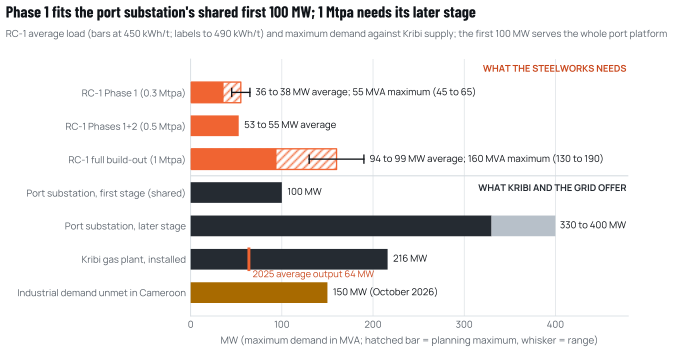
Source: Cameroon Steel reference configuration RC-1 (planning estimate) [S07]; PAK, 6 August 2025 and 19 August 2026 [S14][S15]; ARSEL 2025 [S01]; Business in Cameroon, 9 October 2026 [S02]. Kribi gas plant average output = 559.67 GWh / 8,760 h (derived).
Table ES.1 What an electric steelworks needs from Cameroon’s energy system, what exists and what is missing
| Requirement | What RC-1 indicates (planned) | What exists or is under way | What is missing |
|---|---|---|---|
| Electricity | 289 to 302 GWh/yr in Phase 1; 753 to 796 GWh/yr at 1 Mtpa (450 to 490 kWh/t in the furnace) | 8,119.9 GWh national generation, 89.6% hydro (2025) | Firm delivery to Kribi; 150 MW of industrial demand already unserved |
| Capacity and connection | 55 MVA in Phase 1; about 160 MVA at 1 Mtpa | 225 kV line and 225/30 kV substation, 100 MW shared by the port platform, then 330 to 400 MW, due end-2026 | A dedicated 225 kV bay; a dated plan for the later stage |
| Power quality | Dynamic compensation for a furnace of the 30 to 33 MVA class | International standards; one domestic arc-furnace precedent | Published fault levels at Kribi; a grid code for fluctuating loads |
| Price | A predictable, cost-based contract for 10 to 20 years | MV tariff up to 10 MW; legacy HV contracts; transmission tariff | A published large-user framework above 10 MW |
| Contract route | Utility contract or independent producer with wheeling | Law No. 2011/022 allows sales to eligible customers | Published balancing, back-up and certificate rules |
| Gas for reheating | None in Phase 1; up to about 0.83 bcf/yr at 1 Mtpa | Kribi gas plant supply; 2025 industrial price about US$5.0 to 5.6/Mscf | A gas allocation and pipeline to the zone |
| Gas for DRI (reserve) | About 8.4 to 9.1 bcf/yr for 1 Mtpa DRI | Sanaga Sud production 74.3 bcf (2025); FLNG gone | Certified reserves, price formula, DR-grade pellets |
| Low-carbon attribute | Scope 2 near zero on contracted hydro | Grid at about 226 g/kWh (2024) | Wheeling and certificates of origin |
Source: Chapters 1 to 9 of this paper; RC-1 values are planned and indicative [S07].
ES.3 Why Phase 1 is planned without gas
RC-1 heats billets for its first mills by induction rather than in a gas-fired furnace [S07]. The choice adds about 90 GWh a year to Phase 1’s electricity demand but removes any need for a gas contract until Phase 2. Given the uncertainty created by the FLNG’s departure, that sequencing insulates the first phase from the gas question, and concentrates its energy needs on two things that can be settled by the end of 2027: a large-user power contract and a dedicated 225 kV connection with on-site compensation.
The later phases are different. Phases 2 and 3 would add gas-fired reheating, at up to about 0.83 bcf a year, and, more importantly, would need firm capacity to cover dry seasons and transmission outages. The natural source is the Kribi gas plant, through a dedicated part of its output or an extension within its 330 MW licence [S21][S22]. A direct-reduction module for Cameroonian ore, held in reserve for after 2034, would need about ten times as much gas as the reheating furnaces [S07].
ES.4 The furnace can move its load in time, not give it up
A single furnace must run for about 7,300 to 7,900 hours a year to cast Phase 1’s nameplate tonnage (White paper 03, Chapter 5). Its flexibility is therefore schedulable, not interruptible: heats can be timed around the evening peak and maintenance placed in the tightest weeks, but each hour of curtailment costs about one heat (about 40 t), some 4,000 t of liquid steel per 100 hours, that cannot be recovered. Contracts should reward scheduling and cap emergency load-shedding (Chapter 9).
ES.5 Five policy steps
The paper’s recommendations are rules that would serve every large user, not concessions to a single project (Chapter 10):
- A large-user tariff framework above 10 MW, published by ARSEL, based on the cost of serving a high-voltage, high-load-factor customer, with a two-part structure, a reward for load scheduled away from the system peak, explicit reactive-energy rules, indexation by formula and terms of 10 to 20 years.
- A grid code for fluctuating loads, adopting the IEC TR 61000-3-7 approach to flicker and a recognised harmonic standard, with published fault levels at major nodes, mandatory connection studies and shared monitoring.
- A domestic gas allocation and price framework, starting with an independent audit of the Sanaga Sud reserves, priorities and price formulas by class of user, tax clarity on industrial gas, and responsibility for a pipeline to the industrial zone.
- Workable wheeling and third-party access, implementing the existing law with balancing rules, back-up tariffs and certificates of origin for hydro and solar.
- Integrated planning for the Kribi zone, with a demand register, capacity reservation against milestones, shallow connection charges, firm capacity at Kribi and industrial offtake for new hydro.
ES.6 Why this matters beyond one plant
The questions this paper asks of Cameroon’s energy system are not specific to steel. Any large industrial load considering the Kribi industrial-port zone, whose development clusters include steelmaking linked to mineral exports [S23], will ask the same ones: how firm is the supply, at what price, under what contract, with what power quality, and with what gas. The 53 companies authorised to settle in the port’s industrial and logistics zone between 2018 and 2025 [S24], the bitumen plant that received its refining licence in 2026 [S25] and the industrial buyer that began taking gas at Kribi in 2025 [S05] all depend on the same infrastructure and the same rules.
The policy steps proposed here therefore serve Cameroon’s wider industrial strategy. The national development strategy to 2030 names mining, metallurgy and steel among its priority sub-sectors [S26], and the 2023 Mining Code provides for local transformation of part of the country’s mineral output [S27]. An energy framework that makes one electric steelworks bankable would make the next large user bankable too.
There is also a timing argument. The FLNG’s departure, the State’s buy-back of the utility and its pending acquisition of the Kribi and Dibamba thermal plants [S28][S29], the commissioning of Nachtigal and of the new Kribi transmission line, and the entry into force of the EU’s carbon border mechanism [S30] all fall within 2025 to 2027. The rules written in this window will shape Cameroon’s industrial energy system for a generation.
ES.7 What remains uncertain
The paper’s main conclusions are robust to the evidence gaps listed in Chapter 11, but several sizes and dates depend on data not yet public: the fault level at the Kribi 225 kV node, the furnace’s guaranteed electricity per tonne (planned within 450 to 490 kWh), the remaining gas reserves of Sanaga Sud, the terms of existing high-voltage contracts, the text of the connection and market codes, and the schedule of the port substation’s later stage. Most of these can be closed by data that public institutions already hold. Cameroon Steel’s own front-end engineering will replace RC-1’s benchmark-based figures with supplier guarantees.
ES.8 How this paper is organised
Chapters 1 to 5 cover energy in steel economics, Cameroon’s power system, tariffs and contracting, the power quality an arc furnace needs and Kribi’s new power infrastructure. Chapters 6 and 7 turn to natural gas after the FLNG and to gas for direct reduction, Chapter 8 to renewables and storage, Chapter 9 to an indicative energy plan and Chapter 10 to the policy recommendations. Chapter 11 lists the evidence gaps; the annexes give the method, a glossary, the sources and the data behind every chart.
Statement of interest. This paper is published by Cameroon Steel, which is developing a steelworks at Kribi. It is written to inform public debate; its analysis is independent of any commercial offer, and every figure is sourced or labelled with its status.
Sources cited in this chapter
Bracketed markers refer to these sources; the full list is in the annex. Full list of sources
- S01Rapport d’activités 2025 de l’ARSEL. ARSEL (electricity regulator), 7 Sep 2026.arsel-cm.org/wp-content/uploads/2026/09/Rapport-ARSEL-2025.pdf
- S02Nachtigal power line delays leave 150 MW of industrial demand unmet. Business in Cameroon, 9 Oct 2026.businessincameroon.com/public-management/0910-16939-nachtigal-power-li…
- S03Tableaux tarifaires, Décision ARSEL N°00000427 (MT 2023-2025). ARSEL, uploaded Jan 2026.arsel-cm.org/wp-content/uploads/2026/01/TABLEAUX-TARIFAIRES-decision-M…
- S04Décision fixant le montant de la RMA ENEO au titre de l’exercice 2025 (réajustée). ARSEL, 19 Dec 2025.arsel-cm.org/wp-content/uploads/2026/01/Decision-fixant-le-Montant-de-…
- S05Données pétrolières 2025. SNH, posted Jun 2026.snh.cm/wp-content/uploads/2026/06/Donnees-petrolieres-2025.pdf
- S06Industrialisation: la voie royale de l’émergence. Cameroon Tribune, 2 Jan 2025.cameroon-tribune.cm/article.html/68558/fr.html/details_2
- S07Cameroon Steel reference configuration RC-1 (planning estimate), edition 10 October 2026 (RC-1.1): phases, benchmarks with ranges, indicative balances and schedule. Cameroon Steel, 10 Oct 2026.Cited by title and date
- S08Kribi: le Premier ministre, chef du gouvernement est là. Cameroon Tribune, 30 Dec 2024.cameroon-tribune.cm/article.html/68499/fr.html/details_2
- S09Weekly steel prices (archive 40468). Arab Iron & Steel Union (AISU), 3 Oct 2026.aisusteel.org/en/archives/40468
- S10Carbon intensity of electricity generation (Ember data). Our World in Data, Dataset accessed Oct 2026.ourworldindata.org/grapher/carbon-intensity-electricity
- S11UN Comtrade public API, Cameroon (reporter 120), HS 72/73 and 6-digit lines, 2019-2023. UN Statistics Division.comtradeapi.un.org/public/v1/preview/C/A/HS?reporterCode=120&period=20…
- S12US Patent 10,145,612: Flicker reduction in electric arc furnaces by means of flicker prediction from the state determination in the initial phase of the smelting process. Siemens (assignee now Siemens Energy Global), Granted 4 Dec 2018.patents.google.com/patent/US10145612
- S13IEC TR 61000-3-7:2008, Electromagnetic compatibility, Part 3-7: Assessment of emission limits for the connection of fluctuating installations to MV, HV and EHV power systems (Ed. 2.0); indicative planning levels for flicker: Table 2 (section 4.2.1). International Electrotechnical Commission (table title read in the preview on the VDE Verlag site; values checked against secondary reproductions), 2008.vde-verlag.de/iec-normen/preview-pdf/info_iectr61000-3-7{ed2.0}en.pdf
- S14Kribi franchit la ligne électrique 225 kV. PAK, 6 Aug 2025.Cited by title and date
- S15Énergie et infrastructures: un nouvel élan pour la compétitivité du Port de Kribi. PAK, 19 Aug 2026.Cited by title and date
- S16Le navire usine quitte le Cameroun, le gaz s’arrête. Camer.be, 9 Jul 2026.camer.be/93911/12:1/le-navire-usine-quitte-le-cameroun-le-gaz-sarrete-…
- S17Cameroon’s SNH eyes Yoyo-Yolanda and new exploration blocks to sustain gas growth. Business in Cameroon, 6 Jul 2026.businessincameroon.com/energy/0607-16422-cameroon-s-snh-eyes-yoyo-yola…
- S18European buyers uninterested in BPI and HBI purchases, prices up nominally due to freight. SteelOrbis, 16 Mar 2026.steelorbis.com/steel-prices/steel-prices-market-analyses/scrap-and-raw…
- S19PVGIS v5.3 web services (PVcalc, DRcalc), Kribi 2.94 N 9.91 E, PVGIS-SARAH3 2005 to 2023. European Commission, Joint Research Centre.re.jrc.ec.europa.eu/api/v5_3/
- S20Achieving Net Zero Heavy Industry Sectors in G7 Members. IEA, 19 May 2022.iea.blob.core.windows.net/assets/c4d96342-f626-4aea-8dac-df1d1e567135/…
- S21Kribi Power Development Corporation. MIGA (World Bank Group), 2014.miga.org/project/kribi-power-development-corporation-0
- S22The AfDB praises the impacts of the planned extension of the Kribi gas-fired power plant. Business in Cameroon, 1 Jul 2020.businessincameroon.com/energy/0107-10486-the-afdb-praises-the-impacts-…
- S23Zone industrialo-portuaire de Kribi (KPIZ): jusqu’à +8 points de croissance et 150 000 emplois…. Investir au Cameroun, 4 Mar 2026.investiraucameroun.com/gestion-publique/0403-23163-zone-industrialo-po…
- S24Zone industrielle Kribi: 400 milliards FCFA investis et 53 entreprises autorisées à s’implanter depuis 2018. Investir au Cameroun, 20 May 2025.investiraucameroun.com/gestion-publique/2005-22033-zone-industrielle-k…
- S25Cameroon speeds up Kribi bitumen plant with tax breaks and refining license. Business in Cameroon, 10 Jun 2026.businessincameroon.com/public-management/1006-16302-cameroon-speeds-up…
- S26Stratégie Nationale de Développement 2020-2030 (SND30). Republic of Cameroon / MINEPAT (hosted by FAOLEX), 2020.faolex.fao.org/docs/pdf/cmr211554.pdf
- S27Loi n° 2023/014 du 19 décembre 2023 portant Code minier (official text, mirror). Rural-info (copy of the official text), 19 Dec 2023.rural-info.net/wp-content/uploads/2024/11/Loi-N°2023-014-du-19-decembr…
- S28Cameroon completes buyback of Eneo in a CFA78 billion deal with Actis. Business in Cameroon, c. 20 Feb 2026.businessincameroon.com/energy/2002-15795-cameroon-completes-buyback-of…
- S29Au Cameroun, l’État veut reprendre les centrales de Kribi et Dibamba à Globeleq. Forbes Afrique, 11 Aug 2026.forbesafrique.com/au-cameroun-letat-veut-reprendre-les-centrales-de-kr…
- S30Carbon Border Adjustment Mechanism. European Commission (DG TAXUD), n.d., accessed Oct 2026.taxation-customs.ec.europa.eu/carbon-border-adjustment-mechanism_en
Cite this chapter
Cameroon Steel (2026). Cameroon’s hydro grid can power low-carbon steel if large users get firm supply, clear tariffs and gas. White paper 05, Executive summary: the grid is an asset, but heavy industry needs firm supply, a tariff and gas. CS-WP-05. https://www.cameroon-steel.com/en/library/energy-for-industry/executive-summary/
Source