White paper 05 · Chapter 2
Cameroon has the capacity on paper, but not yet firm supply where industry needs it
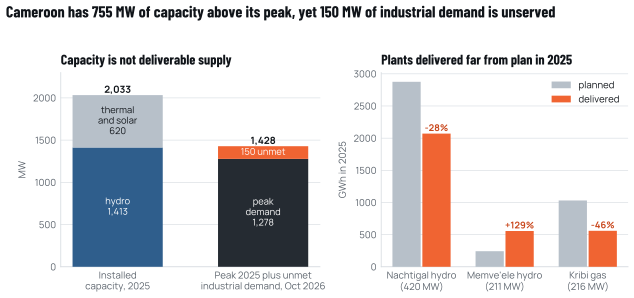
Cameroon had 2,033 MW of installed capacity against a peak demand of 1,278 MW in 2025, and hydro produced nine-tenths of its electricity. Yet 150 MW of industrial demand is waiting for a transmission line, the Kribi gas plant ran at about 30% of its capacity, and the largest new hydro plant delivered 28% less than planned. The system’s constraint is not installed capacity but firm, deliverable supply at the nodes where large loads connect.
In this chapter (10)
- 2.1 Hydro supplied nine-tenths of Cameroon’s electricity in 2025
- 2.2 Two separate grids, one utility back in public hands
- 2.3 The utility’s finances shape what a large user can be offered
- 2.4 The fleet combines a hydro cascade with a small thermal back-up
- 2.5 Capacity is not the same as deliverable supply
- 2.6 Outage statistics describe the distribution network more than the high-voltage grid
- 2.7 Kribi sits at the southern end of the southern grid
- 2.8 A steelworks would be one of the largest loads on the system
- 2.9 The pipeline adds hydro and, possibly, gas
- 2.10 What this means for an electric steelworks at Kribi
2.1 Hydro supplied nine-tenths of Cameroon’s electricity in 2025
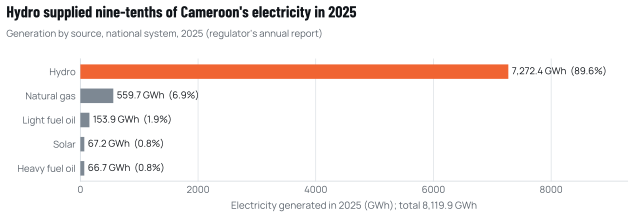
The electricity regulator’s annual report for 2025, published on 7 September 2026, gives the most recent official picture of the system [S01]. Cameroon generated 8,119.9 GWh in 2025. Hydro plants produced 7,272.4 GWh, or 89.6% of the total; natural gas 559.7 GWh (6.9%); light fuel oil 153.9 GWh (1.9%); solar 67.2 GWh (0.8%); and heavy fuel oil 66.7 GWh (0.8%) (Figure 2.1).
Source: ARSEL, Rapport d’activités 2025 (7 September 2026) [S01].
Two features of this mix matter for an electric steelworks. First, the electricity is low-carbon: in the international dataset compiled by Ember and published by Our World in Data, Cameroon’s average grid intensity was about 226 g CO₂e per kWh in 2024, less than half the world average of about 471 g [S10]. Second, the system depends on rainfall. Hydro output varies with river flows, and only part of the hydro fleet is backed by storage, so a dry year or a late rainy season shifts the burden onto the gas and oil plants.
The international dataset and the regulator’s report do not tell exactly the same story. Ember’s figures for 2024 show 7.26 TWh of generation with hydro at about 72%, and a hydro value that is unchanged at 5.23 TWh in every year from 2020 to 2024, which suggests an estimate rather than metered output [S48]. The regulator’s 2025 data show more generation and a much higher hydro share, partly because the 420 MW Nachtigal plant came fully on line in March 2025 [S49] and partly because the Kribi gas plant was offline from September 2024 to February 2025 [S50]. This paper uses the regulator’s data for the structure of the system and the Ember series for international comparison, and flags the difference as an evidence gap (Chapter 11).
Source: ARSEL 2025 [S01].
2.2 Two separate grids, one utility back in public hands
Cameroon’s electricity flows on two grids that are not yet connected. The Southern Interconnected Grid (RIS) carries about 94% of demand and links the Sanaga hydro cascade to Douala, Yaoundé, Edéa and Kribi; the Northern Interconnected Grid (RIN) carries the remaining 6% [S01]. Kribi, and therefore any steelworks in its industrial-port zone, sits on the southern grid.
The sector’s institutions have changed rapidly in 2025 and 2026:
- Distribution and supply. The State bought the 51% stake that Actis held in the national utility ENEO for 78 bn FCFA in February 2026, raising its holding to 95% [S28]; the company was renamed Socadel in May 2026 [S51]. This paper uses "the utility" for both names.
- Transmission. Law No. 2011/022 of 14 December 2011 on the electricity sector provided for a public transmission system operator [S52], and the Société Nationale de Transport de l’Électricité (SONATREL) was incorporated in October 2015 [S52]. SONATREL publishes a regulated transmission tariff (Chapter 3) [S53].
- Generation. About half of installed capacity, 1,030 MW, belongs to independent power producers (IPPs) [S01]. The utility’s purchases from IPPs rose to 254.25 bn FCFA in 2025 [S01]. In August 2026 the State announced it was exercising a pre-emption right to buy Globeleq’s stakes in the Kribi and Dibamba thermal plants, for about 80 bn FCFA with closing expected by the end of 2026, against a background of 137 bn FCFA of unpaid IPP invoices [S29].
- Regulation. ARSEL sets tariffs, approves the utility’s allowed revenue and publishes the regulated tariff grids [S54][S04].
The system serves few large customers. In 2025 the utility had 6 high-voltage customers, 31 "special" medium-voltage customers, 2,526 other MV customers and about 2.19 million low-voltage customers [S01]. National electricity access was 71%, and 25% in rural areas [S55]. A single 1 Mtpa electric steelworks would be one of the very largest loads on this system.
2.3 The utility’s finances shape what a large user can be offered
The financial position of the sector matters to a large user as much as its physical capacity, because it determines what the utility can promise and whether it can keep its promises. Four public figures summarise the position:
- the utility’s purchases from independent producers rose from 156.13 bn FCFA in 2024, itself 17% more than the year before, to 254.25 bn FCFA in 2025 [S56][S01];
- the regulator’s adjusted decision on the utility’s allowed revenue for 2025 recorded a tariff subsidy of 96.99 bn FCFA, the gap between the cost-reflective average of 105.46 FCFA/kWh and the 83.46 FCFA/kWh actually collected from MV and LV customers [S04];
- unpaid invoices owed to independent producers stood at about 137 bn FCFA in 2026 [S29];
- in May 2026 the government cited a sector deficit of about 13 bn FCFA a month when proposing higher tariffs for some business customers [S57].
These numbers explain both the opportunity and the risk for a large industrial customer. The opportunity is that a creditworthy user that pays a cost-based price for a high-load-factor supply improves the utility’s finances rather than worsening them. The risk is that a utility under this pressure may be unable to honour a firm supply commitment in a dry year, or may seek to revise a contract once signed. Both point to the same conclusion: large-user supply should rest on published rules and, where possible, on contracts with identifiable sources of firm capacity, rather than on bespoke arrangements with a utility whose finances are under strain.
2.4 The fleet combines a hydro cascade with a small thermal back-up
Table 2.1 summarises the plants that matter most for a large load on the southern grid.
Table 2.1 Main generating plants on the southern grid, capacity and 2025 performance
| Plant | Type and location | Capacity | 2025 output and remarks | Source |
|---|---|---|---|---|
| Song Loulou | Hydro, Sanaga river | 384 MW (8 units) | The cascade’s largest plant, in service since the 1980s; the utility sought financing for a dam-safety rehabilitation programme in 2025 | [S58][S59] |
| Edéa | Hydro, Sanaga river | 265 to 276 MW (sources differ) | Downstream of Song Loulou; mainly supplies the adjacent aluminium smelter | [S59][S60] |
| Nachtigal | Hydro, Sanaga river, upstream of Yaoundé | 420 MW (7 x 60 MW) | Fully commissioned March 2025; 2,070.68 GWh in 2025, 28% below plan because of hydrology; 3,613,785 MWh injected May 2025 to May 2026 | [S49][S01][S61] |
| Memve’ele | Hydro, Ntem river, south | 211 MW | 557.0 GWh in 2025, 129% above plan; utility purchase price 43.93 FCFA/kWh | [S01][S62] |
| Lom Pangar | Regulating dam, Lom river (upper Sanaga basin) | About 6 bn m3 reservoir; 30 MW plant | Reservoir regulates Sanaga flows; plant islanded on the eastern network; 58.0 GWh in 2025 | [S01][S59] |
| Kribi (KPDC) | Gas, 13 dual-fuel engines, near Kribi | 216 MW (licence 330 MW) | 559.67 GWh against 1,031.24 GWh planned (minus 46%), about 30% capacity factor; guaranteed availability about 180 MW | [S01][S63][S21][S64] |
| Dibamba (DPDC) | Heavy fuel oil, near Douala | 86 MW | Thermal back-up | [S60][S29] |
| Limbé | Heavy fuel oil | 85 MW | Thermal back-up | [S60] |
Source: as listed. Capacities of Dibamba and Limbé as tagged in OpenStreetMap (extract of 10 October 2026); Song Loulou and Edéa from the business press and the World Bank’s 2019 completion report on Lom Pangar, which differ by a few MW for Edéa; regulator’s data used for 2025 output.
The backbone of the southern grid is the Sanaga cascade: Song Loulou and Edéa downstream, Nachtigal upstream, and the Lom Pangar reservoir, which stored about 6.3 bn m3 of water in 2016 to even out the river’s seasonal flow [S59]. Memve’ele, on the Ntem in the far south, is the hydro plant closest to Kribi; its 225 kV evacuation line runs north towards Yaoundé [S65]. The Kribi gas plant, built in 2013 and owned 56% by Globeleq and 44% by the State [S21], is the only significant thermal plant in the south and the only gas-fired plant on the grid in 2025.
2.5 Capacity is not the same as deliverable supply
On paper, Cameroon’s capacity exceeded its 2025 peak by 755 MW, a margin of 59% (derived). In practice, the system could not serve all of its customers. Figure 2.2 shows why the paper margin overstates what a new industrial customer could rely on.
Source: ARSEL 2025 [S01]; Business in Cameroon, 9 October 2026 [S02]. Planned values for Nachtigal and Memve’ele back-calculated from the reported deviations (derived).
Four mechanisms separate installed capacity from firm supply:
- Transmission. On 9 October 2026, Business in Cameroon reported that delays to the evacuation line of the Nachtigal plant leave 150 MW of industrial demand unmet; the 400 kV line is now due in November 2026, the Edéa-Béon substation was 95% built, and the World Bank added US$50m of financing in June 2026 [S02]. The 400 kV Nkolkoumou to Edéa line, with a transfer capacity of 1,500 MW, was about 65% to 66% complete in 2025 [S01]. Generation that cannot reach the load is not supply.
- Hydrology. Nachtigal is a run-of-river plant: it produced 28% less than planned in 2025 because of river flows [S01]. Memve’ele, by contrast, produced 129% more than planned [S01]. Hydro output is real but variable, and only the reservoirs make it partly dispatchable.
- Thermal dispatch and gas. The Kribi gas plant delivered 559.67 GWh against 1,031.24 GWh planned in 2025, a capacity factor of about 30% (derived) [S01][S63]. It had been offline from September 2024 to February 2025 over a debt of 137 bn FCFA [S50]. In May 2025, only about 13 MW of the local thermal capacity was reported as available to the Kribi area, the rest flowing into the southern grid [S24].
- Network losses and reliability. Transmission efficiency was 94.6% and distribution efficiency 72% in 2025 [S01]. The average customer was without power for 147.83 hours in the year, twice the target of 74.1 hours, with an average of 64 interruptions [S01].
For an energy-intensive plant, the lesson is that a supply contract must specify not only energy and price but firmness: how many MW are guaranteed, through which transmission path, with what back-up, and with what compensation when supply fails.
2.6 Outage statistics describe the distribution network more than the high-voltage grid
In 2025 the average customer lost supply for 147.83 hours, about 1.7% of the year, over about 64 interruptions, or about 2.3 hours per interruption on average (derived from [S01]). These averages are dominated by the distribution network, where almost all customers are connected and where most faults occur. A customer supplied directly at 225 kV is exposed only to faults on the transmission system and to shortfalls in generation, so the national figures overstate the number of interruptions a high-voltage steelworks would see.
They understate, however, the risk of the events that matter most to such a plant. The first is a generation shortfall in the dry season, when hydro output falls and the thermal fleet, including the Kribi gas plant, must make up the difference. The second is the loss of a single transmission path, which at the end of a radial branch can interrupt supply to a whole industrial zone at once. For an arc furnace, a short interruption costs the heat in progress and some refractory wear; a long one stops the caster and the mills and puts the plant’s essential services on back-up power.
A supply contract for a large user should therefore distinguish between three things that national statistics blend together: the firm capacity the supplier guarantees, the schedulable load that the plant agrees to move within the day, with any emergency load-shedding capped in hours and events, and planned outages that are notified in advance. It should also oblige the supplier and the transmission operator to report reliability indicators at the plant’s own connection point, so that both sides manage the same numbers. The regulator’s target of 74.1 hours of average outage time per customer [S01] shows the direction of improvement for the system as a whole; a large user needs a target for its own node.
2.7 Kribi sits at the southern end of the southern grid
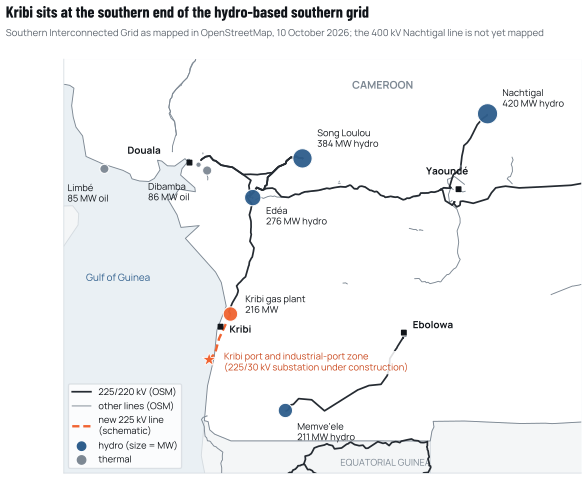
Figure 2.3 shows the southern grid as mapped in OpenStreetMap on 10 October 2026. The Sanaga plants feed a 225 kV ring around Douala, Edéa and Yaoundé. Kribi is connected to Edéa by a 225 kV line from the substation at the Kribi gas plant. Memve’ele connects towards Ebolowa and Yaoundé. The new 225 kV line from the Kribi gas plant to the port, due at the end of 2026, is shown schematically; it is the subject of Chapter 5.
Source: OpenStreetMap contributors (ODbL), power features extracted via the Overpass API on 10 October 2026 [S60]; Natural Earth; PAK communications on the 225 kV line [S14][S15].
Being at the end of a radial branch has two consequences. The fault level (the short-circuit power available at a node, a measure of the network’s electrical stiffness) is usually lower at the end of a branch than in the meshed core, which matters for an arc furnace (Chapter 4). And supply depends on few paths: a fault on the Kribi to Edéa line, or a shortfall at the Kribi gas plant, would be felt directly. The port authority describes the new arrangement as offering N-2 redundancy through the southern grid via Memve’ele, Nachtigal, Song Loulou, Edéa and the Kribi gas plant [S14], a claim that the grid operator’s own studies should confirm for each large connection.
2.8 A steelworks would be one of the largest loads on the system
Set against the national system, an electric steelworks is large but not disproportionate (derived from the RC-1 balances [S07] and ARSEL 2025 [S01]):
- Phase 1 (0.3 Mtpa) would use about 289 to 302 GWh a year at 450 to 490 kWh/t in the furnace, 3.6% to 3.7% of 2025 generation, at an average load of 36 to 38 MW, about 3% of the 2025 peak. That is about 30% of the 969 GWh consumed by all six existing high-voltage customers in 2025.
- Phases 1 and 2 (0.5 Mtpa) would use about 422 to 443 GWh, 5.2% to 5.5% of 2025 generation, at an average of 53 to 55 MW.
- Full build-out (1 Mtpa) would use about 753 to 796 GWh, 9.3% to 9.8% of 2025 generation, at an average of 94 to 99 MW, 7.4% to 7.8% of the peak; its planned maximum demand of about 160 MVA (130 to 190) [S07] would equal about an eighth of the national peak.
A load of this size is visible in national dispatch. It needs to be planned with the grid operator rather than simply connected, and it will influence which new capacity is built.
2.9 The pipeline adds hydro and, possibly, gas
Cameroon’s undeveloped hydro potential is large: the US International Trade Administration estimates it at about 115,000 GWh a year, of which about 4% is developed [S66]. The projects closest to realisation that matter for the south are:
- Kikot-Mbebe, a 500 MW hydro project on the Sanaga developed by EDF and the State, estimated at about 650 bn FCFA (about €990m), with works projected to start in 2027 and commissioning expected between 2031 and 2033 [S67][S68];
- Grand Eweng, a hydro scheme on the Sanaga proposed by the developer Hydromine under a 2019 letter of intent, of about 1,000 MW in a first phase and up to 1,800 MW in all; its current timetable is not in the public record [S69];
- the extension of the Kribi gas plant by 114 MW to its licensed 330 MW, for which the African Development Bank (AfDB) offered financing of 28.5 bn FCFA in 2020, but which has not been built [S22][S01];
- two new gas-fired plants, of 350 MW at Bekoko and 150 MW at Douala, announced in early 2025 subject to confirmation of gas availability by the national hydrocarbons company, SNH [S50].
The hydro projects would deepen the low-carbon character of the grid but add seasonal variability unless backed by storage. The gas projects would add firm capacity but depend on a gas supply that, after July 2026, must be re-planned (Chapter 6). For an electric steelworks the best outcome is both: hydro energy for most of the year and firm gas-fired capacity for dry periods and outages.
2.10 What this means for an electric steelworks at Kribi
Sources cited in this chapter
Bracketed markers refer to these sources; the full list is in the annex. Full list of sources
- S01Rapport d’activités 2025 de l’ARSEL. ARSEL (electricity regulator), 7 Sep 2026.arsel-cm.org/wp-content/uploads/2026/09/Rapport-ARSEL-2025.pdf
- S10Carbon intensity of electricity generation (Ember data). Our World in Data, Dataset accessed Oct 2026.ourworldindata.org/grapher/carbon-intensity-electricity
- S48Electricity production by source (Ember / Energy Institute data). Our World in Data, Dataset accessed Oct 2026.ourworldindata.org/grapher/electricity-prod-source-stacked
- S49Cameroon country profile. International Hydropower Association, n.d., accessed Oct 2026.hydropower.org/country-profiles/cameroon
- S50Kribi gas power plant resumes operations after debt resolution; Cameroon to build two new gas power plants. Business in Cameroon (also Forbes Afrique on pre-emption), Feb to Mar 2025.businessincameroon.com/energy/2702-14501-kribi-gas-power-plant-resumes…
- S28Cameroon completes buyback of Eneo in a CFA78 billion deal with Actis. Business in Cameroon, c. 20 Feb 2026.businessincameroon.com/energy/2002-15795-cameroon-completes-buyback-of…
- S51Cameroon renationalises power company Eneo, renames it Socadel. Enerdata, 11 May 2026.enerdata.net/publications/daily-energy-news/cameroon-renationalises-po…
- S52Reforming Cameroon’s power sector (on Law No. 2011/022 of 14 December 2011). IFLR (Orrick Herrington & Sutcliffe; ENEO), 3 Jun 2016.iflr.com/article/2gjw2n5ocpr2orkj9qxcr/iflr1000/reforming-cameroons-po…
- S53Tarif transport et GRT (Décision 0000017D). ARSEL, 17 Jan 2025.arsel-cm.org/wp-content/uploads/2026/01/TARIF-TRANSPORT-ET-GRT-1.pdf
- S29Au Cameroun, l’État veut reprendre les centrales de Kribi et Dibamba à Globeleq. Forbes Afrique, 11 Aug 2026.forbesafrique.com/au-cameroun-letat-veut-reprendre-les-centrales-de-kr…
- S54Décision N°00000427 fixant les tarifs de vente HT d’électricité des clients MT et seuils minima de négociation "Grands Comptes". ARSEL, 12 Dec 2022.arsel-cm.org/wp-content/uploads/2025/12/2022_decision_n_00000427_d_ars…
- S04Décision fixant le montant de la RMA ENEO au titre de l’exercice 2025 (réajustée). ARSEL, 19 Dec 2025.arsel-cm.org/wp-content/uploads/2026/01/Decision-fixant-le-Montant-de-…
- S55Cameroon’s journey toward affordable, reliable and universal electricity access. World Bank, 16 Jan 2025.banquemondiale.org/fr/news/feature/2025/01/16/cameroon-journey-toward-…
- S56Cameroon’s power purchases from IPPs rise 17% to CFA156.1bn in 2024. Business in Cameroon, 14 Jan 2026.businessincameroon.com/energy/1401-15608-cameroon-s-power-purchases-fr…
- S57Cameroon plans higher electricity rates for some businesses to ease sector strain. Business in Cameroon, 8 May 2026.businessincameroon.com/energy/0805-16144-cameroon-plans-higher-electri…
- S58Eneo seeks CFAF54bln to secure future for vital Songloulou dam. Business in Cameroon, 15 May 2025.businessincameroon.com/public-management/1505-14658-eneo-seeks-cfaf54b…
- S59Cameroon, Lom Pangar Hydropower Project (P114077): Implementation Completion and Results Report (ICR00004891). World Bank, 23 Dec 2019.documents1.worldbank.org/curated/en/625471579097390098/pdf/Cameroon-Lo…
- S60OpenStreetMap power features (lines, substations, plants), southern Cameroon, via the Overpass API; Kribi base extract (coast, roads, land use). OpenStreetMap contributors (ODbL), Extracts 24 Jul and 10 Oct 2026.openstreetmap.org
- S61Énergie: Nachtigal franchit le cap des 3,6 TWh injectés dans le réseau en un an. Journal du Cameroun, 15 Jun 2026.fr.journalducameroun.com/energie-nachtigal-franchit-le-cap-des-36-twh-…
- S62Energy: MINEE announces works to boost the production of Memvé’élé hydroelectric power station (211 MW). Business in Cameroon, 3 Jul 2020.businessincameroon.com/energy/0307-10497-energy-minee-announces-works-…
- S63Décision N°0000018D (prévisionnelle 2025). ARSEL, 17 Jan 2025.arsel-cm.org/wp-content/uploads/2025/12/2025_decision_n0000018d_arsel_…
- S21Kribi Power Development Corporation. MIGA (World Bank Group), 2014.miga.org/project/kribi-power-development-corporation-0
- S64Wärtsilä to upgrade Cameroon-based Kribi power plant to boost reliability. Engineering News, 22 Aug 2022.engineeringnews.co.za/article/wrtsil-to-upgrade-cameroon-based-kribi-p…
- S65Cameroon: Nyambizan to Yaoundé line nears completion. African Energy, 27 May 2022.africa-energy.com/news-centre/article/cameroon-nyambizan-yaounde-line-…
- S02Nachtigal power line delays leave 150 MW of industrial demand unmet. Business in Cameroon, 9 Oct 2026.businessincameroon.com/public-management/0910-16939-nachtigal-power-li…
- S24Zone industrielle Kribi: 400 milliards FCFA investis et 53 entreprises autorisées à s’implanter depuis 2018. Investir au Cameroun, 20 May 2025.investiraucameroun.com/gestion-publique/2005-22033-zone-industrielle-k…
- S14Kribi franchit la ligne électrique 225 kV. PAK, 6 Aug 2025.Cited by title and date
- S15Énergie et infrastructures: un nouvel élan pour la compétitivité du Port de Kribi. PAK, 19 Aug 2026.Cited by title and date
- S07Cameroon Steel reference configuration RC-1 (planning estimate), edition 10 October 2026 (RC-1.1): phases, benchmarks with ranges, indicative balances and schedule. Cameroon Steel, 10 Oct 2026.Cited by title and date
- S66Cameroon: Energy (Country Commercial Guide). US International Trade Administration, 13 Apr 2026.trade.gov/country-commercial-guides/cameroon-energy
- S67Cameroon moves forward on 500MW Kikot-Mbebe dam with land transfer decree. Business in Cameroon, 22 May 2025.businessincameroon.com/public-management/2205-14683-cameroon-moves-for…
- S68Government, EDF push to deliver hydro promises as Cameroon moves to diversify energy sources. Business in Cameroon, 4 Dec 2025.businessincameroon.com/energy/0412-15443-government-edf-push-to-delive…
- S69Cameroon plans to build 1 GW Grand Eweng hydropower project. Enerdata, Jul 2019.enerdata.net/publications/daily-energy-news/cameroon-plans-build-1-gw-…
- S22The AfDB praises the impacts of the planned extension of the Kribi gas-fired power plant. Business in Cameroon, 1 Jul 2020.businessincameroon.com/energy/0107-10486-the-afdb-praises-the-impacts-…
Cite this chapter
Cameroon Steel (2026). Cameroon’s hydro grid can power low-carbon steel if large users get firm supply, clear tariffs and gas. White paper 05, chapter 2: Cameroon has the capacity on paper, but not yet firm supply where industry needs it. CS-WP-05. https://www.cameroon-steel.com/en/library/energy-for-industry/cameroon-power-system/
Source