White paper 05 · Chapter 5
Kribi’s new 225 kV supply can carry a first-phase steelworks; 1 Mtpa needs its later stage and a dedicated bay
The Port Autonome de Kribi (PAK) is building a 42 km double-circuit 225 kV line from the Kribi gas plant to a new 225/30 kV substation on the port platform, rated for 100 MW at first and 330 to 400 MW later, with commissioning planned for the end of 2026. A first-phase steelworks with a 55 MVA maximum demand would fit within the first stage, which the whole port platform shares, but would take about half of it; a 1 Mtpa works, at about 160 MVA, needs the later stage. The arrangement that best protects the zone’s other tenants is a dedicated 225 kV bay feeding the steelworks’ own substation.
In this chapter (7)
- 5.1 The port is bringing high-voltage power to its industrial zone
- 5.2 Phase 1 fits within the shared first stage; the full works needs the later stage
- 5.3 The steelworks would share the substation with a growing industrial zone
- 5.4 Three ways to connect the steelworks, and why a dedicated bay is best
- 5.5 Redundancy must be checked node by node, and essential loads need their own back-up
- 5.6 Connection costs need clear and published rules
- 5.7 The grid will arrive before the steelworks; the risk is in the sequence after that
5.1 The port is bringing high-voltage power to its industrial zone
Until now, the Kribi port platform has depended on a weak local supply. In May 2025, a business daily reported that only about 13 MW of the 176 MW of local thermal capacity was available to the Kribi area, the rest being exported into the southern grid [S24]. That was not enough for heavy industry, and the port authority decided to build its own high-voltage link.
On 6 August 2025, PAK launched the works for a 225 kV double-circuit line, 42 km long, from the Kribi gas plant (KPDC) to the port, with a 225/30 kV substation of three 60 MVA transformers. PAK describes the capacity as 100 MW immediately and 330 to 400 MW at a later stage, at a cost of about 35 bn FCFA, with commissioning planned for the end of 2026, and claims N-2 redundancy through the southern grid via Memve’ele, Nachtigal, Song Loulou, Edéa and the Kribi gas plant [S14]. On 19 August 2026, the Minister of Water and Energy (MINEE) visited the substation, the line and a new water plant that is due to produce from early 2027 [S15]. A planning ministry (MINEPAT) mission in April 2026 also highlighted the substation as a driver of the zone’s industrial development [S74].
Below the substation, PAK tendered 3.5 bn FCFA of servicing works in May 2026 for 20 ha at Mboro: a 30 kV network and substation, potable water, fibre, roads, drainage, wastewater treatment and solar street lighting, to be built over one year from PAK’s 2026 to 2028 budget [S75].
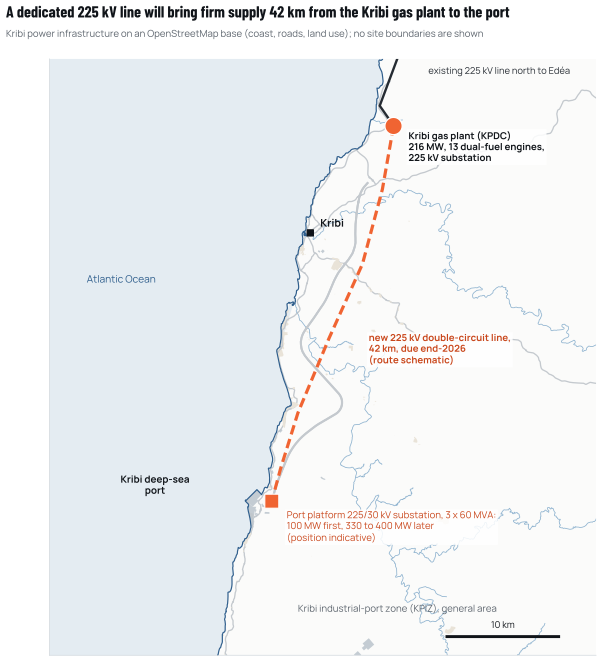
Source: OpenStreetMap contributors (ODbL) [S60]; PAK, "Kribi franchit la ligne électrique 225 kV" (6 August 2025) and "Énergie et infrastructures: un nouvel élan pour la compétitivité du Port de Kribi" (19 August 2026) [S14][S15]; PAK, Guide du Port de Kribi (2020) for the port position [S76]; Engineering News (22 August 2022) for the KPDC engines [S64].
This infrastructure serves a zone with explicit industrial ambitions. The Kribi Port Industrial Zone (KPIZ), managed by KPIZ S.A. with PAK and private partners AGL, Arise IIP and Belmont, was launched in February 2026 over about 4,000 ha [S77][S78]. Its development clusters include "steelmaking linked to mineral exports" (sidérurgie liée aux exportations minières) [S23], and 53 companies had been authorised to settle in the port’s industrial and logistics zone between 2018 and May 2025 [S24]. Cameroon Steel’s steel complex at Mboro, whose foundation stone was laid on 30 December 2024 by the Prime Minister representing the Head of State, is one of the projects that the new supply is meant to serve [S08][S79].
Table 5.1 Kribi power infrastructure relevant to an electric steelworks
| Asset | Key parameters | Status (October 2026) | Source |
|---|---|---|---|
| Kribi gas-fired plant (KPDC) | 216 MW installed, 13 dual-fuel engines; licence 330 MW; owned 56% Globeleq, 44% State (State pre-emption under way) | Operating; 559.67 GWh in 2025 (about 30% capacity factor) | [S21][S64][S01][S29] |
| KPDC to Edéa 225 kV line | Links Kribi to the southern grid | Operating | [S60] |
| KPDC to port 225 kV line | Double circuit, 42 km | Under construction; commissioning planned end-2026 | [S14][S15] |
| Port platform substation | 225/30 kV, 3 x 60 MVA; 100 MW first, 330 to 400 MW later | Under construction | [S14][S15] |
| 30 kV network at Mboro | Network and substation for 20 ha of serviced land | Tendered May 2026; one-year works | [S75] |
| Water plant for the port platform | Intake and treatment | Production planned early 2027 | [S15] |
| KPDC extension to 330 MW | +114 MW within the existing licence | Not built; AfDB financing offered in 2020 | [S22][S01] |
Source: as listed.
5.2 Phase 1 fits within the shared first stage; the full works needs the later stage
Figure ES.1, in the executive summary, sets the steelworks’ demand against this infrastructure. The numbers can be summarised simply (derived from RC-1 [S07] and PAK [S14]):
- Phase 1 (0.3 Mtpa): average load 36 to 38 MW and planned maximum demand 55 MVA (45 to 65). At maximum demand the plant would take about half of the 100 MW first stage. Three 60 MVA transformers give 180 MVA in total and about 120 MVA with one transformer out of service (derived), so Phase 1 could be supplied with transformer redundancy, but would leave limited room for other large tenants in the first stage.
- Phases 1 and 2 (0.5 Mtpa): average load 53 to 55 MW. A second melt line would add a second furnace; maximum demand has not been estimated in RC-1, but it would approach or exceed what the first stage can supply alongside other users.
- Full build-out (1 Mtpa): average load 94 to 99 MW and planned maximum demand 160 MVA (130 to 190), about 40% to 50% of the later 330 to 400 MW stage.
The practical conclusion is that a steelworks should be planned into the substation’s later stage from the start, even if Phase 1 is supplied from the first stage. The sequencing risk is not that the grid arrives too late (the line and substation are due at the end of 2026, before any steelworks could be built) but that the first stage is committed to other tenants and the later stage is not financed in time.
Source: PAK [S14][S15]; Cameroon Steel reference configuration RC-1 (planning estimate) [S07].
5.3 The steelworks would share the substation with a growing industrial zone
The new supply is not built for one customer. The port’s industrial zone already hosts companies such as Atlantic Cocoa, whose contract in 2018 was the first, Cimpor, Cadyst and All Bitumen [S24]. All Bitumen holds about 60 ha for a bitumen plant and received a refining licence and tax incentives in 2026 [S25]. An industrial buyer at Kribi began purchasing natural gas from SNH in the second half of 2025, taking 3.088 bcf in two quarters [S05], which shows that energy-intensive industry is already present. PAK has also signed a memorandum of understanding, on 4 November 2025, for a mineral terminal whose completion its Director General, speaking in March 2026, expected within five to six years [S80][S81] (White paper 02, Chapter 2), and plans an agricultural terminal of about 50 bn FCFA on 9.2 ha, with construction from 2027 and operations from 2029 [S82].
Each of these users will draw on the same 100 MW first stage, and several will add electrical loads that are sensitive to voltage quality, such as process controls, refrigeration and motor drives. That is a further reason to connect an arc furnace at 225 kV rather than through the zone’s 30 kV network, and to plan the substation’s later stage on the basis of a register of all prospective tenants rather than one project at a time.
5.4 Three ways to connect the steelworks, and why a dedicated bay is best
A steelworks at Mboro could connect to the new infrastructure in three ways (Figure 5.2, Table 5.2).
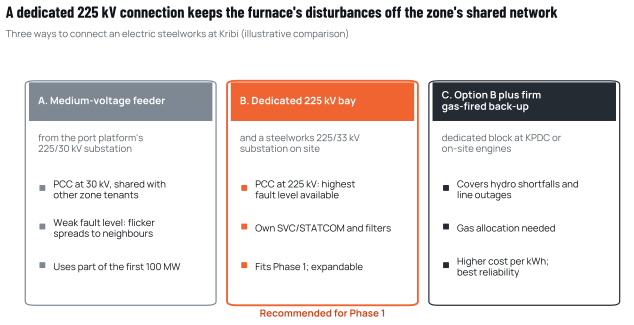
Source: Cameroon Steel analysis; PAK substation parameters [S14].
Option A, a medium-voltage feeder from the port’s 225/30 kV substation, is the cheapest to build, but it places the point of common coupling at 30 kV, where the fault level is lowest and where other tenants are connected. Chapter 4 showed that a 30 kV busbar fed by three 60 MVA transformers would typically offer 1,000 to 1,500 MVA of short-circuit power, below what even a compensated furnace of the 30 to 33 MVA class needs. The flicker and harmonics of the arc furnace would be shared with every other user of the zone’s 30 kV network.
Option B, a dedicated 225 kV bay at the port substation feeding the steelworks’ own 225/33 kV substation, moves the point of common coupling to 225 kV. RC-1 already reserves space for a 225/33 kV substation with reactive compensation [S07]. This option gives the furnace the stiffest available connection, keeps its disturbances off the zone’s distribution network, and lets the steelworks own and operate its compensation. It also lets the steelworks’ load grow into the substation’s later stage without rebuilding the zone’s 30 kV network.
Option C combines B with firm gas-fired capacity: either a contract for a dedicated part of the Kribi gas plant’s output or an extension within its 330 MW licence, or, less efficiently, engines on site. It is the most reliable arrangement, and the one most likely to be needed when the works grows beyond Phase 1, because it covers both dry-season hydro shortfalls and outages on the transmission path.
Table 5.2 Comparison of connection options for an electric steelworks at Kribi
| Criterion | A. 30 kV feeder | B. Dedicated 225 kV bay (recommended for Phase 1) | C. B plus firm gas-fired capacity |
|---|---|---|---|
| Point of common coupling | 30 kV, shared | 225 kV | 225 kV |
| Fault level available | Lowest (of the order of 1,000 to 1,500 MVA) | Highest available at Kribi (to be measured) | As B, plus support from nearby engines |
| Effect on other tenants | Shares flicker and harmonics | Disturbance mitigated at 225 kV | As B |
| Capacity | Limited to part of the first 100 MW | Grows into the 330 to 400 MW stage | As B, plus dedicated firm MW |
| Security of supply | Depends on 30 kV network | N-1 on line and transformers | N-1 plus local generation |
| Gas required | No | No | Yes, for the dedicated capacity |
| Who builds | Zone network | Steelworks substation; bay at port substation | As B; generator for the gas block |
| Fit with RC-1 phases | Unsuitable for an arc furnace | Phase 1 onward | Phases 2 and 3 |
Source: Cameroon Steel analysis; fault levels derived in Chapter 4; PAK [S14]; Cameroon Steel reference configuration RC-1 (planning estimate) [S07].
5.5 Redundancy must be checked node by node, and essential loads need their own back-up
PAK describes the new supply as N-2 secure [S14]. That is a strong claim, and it should be confirmed by the grid operator’s studies for each large connection. The double-circuit line gives redundancy against the loss of one circuit, and three transformers give redundancy against the loss of one transformer. But both circuits share the same towers and corridor, and the upstream supply depends on the Kribi gas plant and on the single 225 kV path from Kribi to Edéa visible in the public map of the network (Figure 2.3). A storm, a tower failure or a fault at the gas plant’s substation could interrupt the port platform’s supply.
For a steelworks, interruptions are expensive. A single furnace needs most of the year to reach Phase 1’s nameplate, so the output of an interrupted heat is hard to recover; that is a reason to secure firm supply rather than to accept interruptions. What must never be lost is the supply to essential loads: cooling water for the furnace panels and caster, cranes holding ladles of liquid steel, fume extraction and emergency lighting. These loads, a small fraction of the total, need a dedicated back-up supply, normally standby generators with automatic start, sized as part of the plant’s safety design.
5.6 Connection costs need clear and published rules
The 225 kV line and substation were initiated by the port authority at a reported cost of about 35 bn FCFA [S14]. How the costs of shared assets are recovered from tenants, and how the costs of dedicated assets (a 225 kV bay, a link line, the plant substation) are allocated between the steelworks, PAK and SONATREL, are not set out in the public record. SONATREL’s tariff includes a charge of 4.48 m FCFA per year per connection point and an annual withdrawal charge of 16.18 m FCFA per MW [S53], but connection charges for new assets are a separate question.
Two principles would help every industrial tenant, not only steel (Chapter 10):
- Shallow connection charges for shared assets. A tenant pays for the dedicated assets that serve only it (its bay, its line, its substation) and pays for shared network assets through the regulated transmission tariff, not through an up-front contribution negotiated case by case.
- Capacity reservation with milestones. A large user can reserve capacity in the substation’s later stage against defined project milestones and a reservation fee, so that the zone can plan its expansion and the user can finance its plant.
5.7 The grid will arrive before the steelworks; the risk is in the sequence after that
The timetables now align better than they did a year ago. The 400 kV Nachtigal evacuation line is due in November 2026 [S02]; the 225 kV Kribi line and substation at the end of 2026 [S14]; the port’s water plant in early 2027 [S15]. Cameroon Steel’s indicative schedule targets front-end engineering and utilities agreements in 2027, the environmental certificate by the end of 2028, the start of Phase 1 works in the first quarter of 2029, a first heat in the second half of 2030 and ramp-up in 2031; Phase 2 would follow in 2032 to 2034 and Phase 3 after 2034, subject to market and financing [S07]. These are targets, not commitments.
The supply will therefore exist before the plant. The risks lie in what happens next: whether the first stage is fully committed before a steelworks connects, whether the later 330 to 400 MW stage is designed and financed in time for the larger phases, and whether gas is available for the firm capacity that the later phases will need. The next two chapters turn to gas.
Sources cited in this chapter
Bracketed markers refer to these sources; the full list is in the annex. Full list of sources
- S24Zone industrielle Kribi: 400 milliards FCFA investis et 53 entreprises autorisées à s’implanter depuis 2018. Investir au Cameroun, 20 May 2025.investiraucameroun.com/gestion-publique/2005-22033-zone-industrielle-k…
- S14Kribi franchit la ligne électrique 225 kV. PAK, 6 Aug 2025.Cited by title and date
- S15Énergie et infrastructures: un nouvel élan pour la compétitivité du Port de Kribi. PAK, 19 Aug 2026.Cited by title and date
- S74Port de Kribi: une dynamique industrielle portée par les financements publics. Journal du Cameroun (D. Mebenga), 20 Apr 2026.fr.journalducameroun.com/port-de-kribi-une-dynamique-industrielle-port…
- S75Le port de Kribi engage 3,5 milliards FCFA pour préparer l’arrivée de nouveaux industriels. Ecomatin (L. Onguene), 11 May 2026.ecomatin.net/cameroun-le-port-de-kribi-engage-35-milliards-fcfa-pour-p…
- S60OpenStreetMap power features (lines, substations, plants), southern Cameroon, via the Overpass API; Kribi base extract (coast, roads, land use). OpenStreetMap contributors (ODbL), Extracts 24 Jul and 10 Oct 2026.openstreetmap.org
- S76Guide du Port de Kribi. Port Autonome de Kribi, Aug 2020.Cited by title and date
- S64Wärtsilä to upgrade Cameroon-based Kribi power plant to boost reliability. Engineering News, 22 Aug 2022.engineeringnews.co.za/article/wrtsil-to-upgrade-cameroon-based-kribi-p…
- S77Cameroon launches $860m Kribi industrial zone; PAK, AGL, Arise IIP and Belmont launch €795m KPIZ. Ecofin Agency; Business in Cameroon, 27 Feb 2026.ecofinagency.com/news/2702-53326-cameroon-launches-860m-kribi-industri…
- S78Bulletin d’information du PAK n° 264. Port Autonome de Kribi, Feb 2026.Cited by title and date
- S23Zone industrialo-portuaire de Kribi (KPIZ): jusqu’à +8 points de croissance et 150 000 emplois…. Investir au Cameroun, 4 Mar 2026.investiraucameroun.com/gestion-publique/0403-23163-zone-industrialo-po…
- S08Kribi: le Premier ministre, chef du gouvernement est là. Cameroon Tribune, 30 Dec 2024.cameroon-tribune.cm/article.html/68499/fr.html/details_2
- S79Cameroun, Complexe moderne de sidérurgie de Kribi: le PM Joseph Dion Ngute effectue la pose de la première pierre. Camer.be, 5 Jan 2025.camer.be/87795/12:1/cameroun-complexe-moderne-de-siderurgie-de-kribi-l…
- S21Kribi Power Development Corporation. MIGA (World Bank Group), 2014.miga.org/project/kribi-power-development-corporation-0
- S01Rapport d’activités 2025 de l’ARSEL. ARSEL (electricity regulator), 7 Sep 2026.arsel-cm.org/wp-content/uploads/2026/09/Rapport-ARSEL-2025.pdf
- S29Au Cameroun, l’État veut reprendre les centrales de Kribi et Dibamba à Globeleq. Forbes Afrique, 11 Aug 2026.forbesafrique.com/au-cameroun-letat-veut-reprendre-les-centrales-de-kr…
- S22The AfDB praises the impacts of the planned extension of the Kribi gas-fired power plant. Business in Cameroon, 1 Jul 2020.businessincameroon.com/energy/0107-10486-the-afdb-praises-the-impacts-…
- S07Cameroon Steel reference configuration RC-1 (planning estimate), edition 10 October 2026 (RC-1.1): phases, benchmarks with ranges, indicative balances and schedule. Cameroon Steel, 10 Oct 2026.Cited by title and date
- S25Cameroon speeds up Kribi bitumen plant with tax breaks and refining license. Business in Cameroon, 10 Jun 2026.businessincameroon.com/public-management/1006-16302-cameroon-speeds-up…
- S05Données pétrolières 2025. SNH, posted Jun 2026.snh.cm/wp-content/uploads/2026/06/Donnees-petrolieres-2025.pdf
- S80Port de Kribi: un terminal minéralier d’avenir (memorandum of understanding for a mineral terminal). Port Autonome de Kribi, 4 Nov 2025.Cited by title and date
- S81Zone industrialo-portuaire de Kribi (KPIZ): jusqu’à +8 points de croissance et 150 000 emplois attendus sur 15 ans. Investir au Cameroun, 4 Mar 2026.investiraucameroun.com/gestion-publique/0403-23163-zone-industrialo-po…
- S82Cameroon’s Kribi port plans CFA50 billion agricultural terminal. Business in Cameroon, 9 Oct 2026.businessincameroon.com/public-management/0910-16938-cameroon-s-kribi-p…
- S53Tarif transport et GRT (Décision 0000017D). ARSEL, 17 Jan 2025.arsel-cm.org/wp-content/uploads/2026/01/TARIF-TRANSPORT-ET-GRT-1.pdf
- S02Nachtigal power line delays leave 150 MW of industrial demand unmet. Business in Cameroon, 9 Oct 2026.businessincameroon.com/public-management/0910-16939-nachtigal-power-li…
Cite this chapter
Cameroon Steel (2026). Cameroon’s hydro grid can power low-carbon steel if large users get firm supply, clear tariffs and gas. White paper 05, chapter 5: Kribi’s new 225 kV supply can carry a first-phase steelworks; 1 Mtpa needs its later stage and a dedicated bay. CS-WP-05. https://www.cameroon-steel.com/en/library/energy-for-industry/kribi-power-infrastructure/
Source