White paper 05 · Chapter 3
Large users have no published tariff, so their price depends on negotiation rather than rules
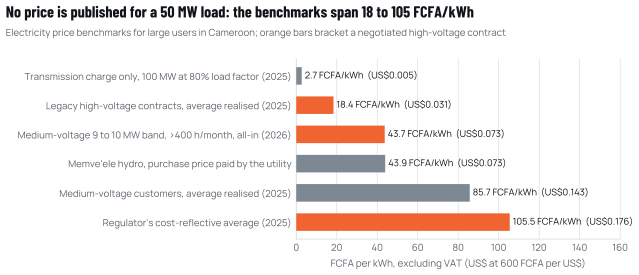
Cameroon’s regulated electricity tariffs stop at 10 MW. The six legacy high-voltage customers paid an average of 18.4 FCFA/kWh in 2025, the highest published medium-voltage band costs about 44 FCFA/kWh all-in in 2026, and the regulator puts the cost-reflective average at 105 FCFA/kWh. A new large user therefore negotiates in the gap between a legacy price the utility cannot afford to extend and a system average that no steelworks could pay. A published large-user framework, built on the cost of serving a high-voltage baseload, would close that gap.
In this chapter (7)
- 3.1 The regulated tariff grid stops at 10 MW
- 3.2 What large users actually pay spans a factor of six
- 3.3 Neither end of the range can be the answer for new industry
- 3.4 The tariff’s structure matters as much as its level
- 3.5 Four ways to contract, and a hybrid that combines them
- 3.6 Closing the gap over time
- 3.7 What lenders will look for in a power contract
3.1 The regulated tariff grid stops at 10 MW
Medium-voltage tariffs are set by ARSEL. Decision No. 00000427 of 12 December 2022 fixed the tariffs, excluding taxes, for MV customers of the utility for 2023 to 2025, and the minimum thresholds for negotiation with "large accounts" (grands comptes) [S54]. The tariff has two parts: a monthly fixed charge per kW of subscribed power, and an energy charge per kWh. Within each band of subscribed power there are two regimes, one for customers who use their subscribed power for up to 400 hours a month and a cheaper one for those who use it longer, which rewards a high load factor [S03].
Table 3.1 Selected bands of the regulated medium-voltage tariff (2023 base) and their escalation
| Subscribed power | Fixed charge (FCFA per kW per month) | Energy charge (FCFA/kWh) | Escalation on 1 January 2024, 2025, 2026 |
|---|---|---|---|
| 0 to 0.05 MW | none | 80 to 95 off-peak; 125 peak | +5% a year |
| 0.5 to 1 MW | 5,500 | 55 to 95 | +5% a year |
| 3 to 4 MW | 8,200 (up to 400 h/month); 7,000 (above) | 35 to 40 | +10% a year |
| 9 to 10 MW (highest published) | 18,090 (up to 400 h/month); 15,500 (above) | 14 (up to 400 h/month); 9 (above) | +10% a year |
Source: ARSEL, tariff tables under Decision No. 00000427, MV 2023 to 2025 [S03]; Decision No. 00000427 of 12 December 2022 [S54].
With the three annual increases of 10% applied, the 9 to 10 MW band in 2026 works out at about 43.7 FCFA/kWh all-in for a customer using its subscribed power 650 hours a month, or about US$0.073/kWh at 600 FCFA per US$ (derived from [S03]). This is the highest published reference price for an industrial customer in Cameroon.
Above 10 MW, there is no published tariff. Supply to such customers is governed by bilateral high-voltage contracts, and the regulator’s 2025 report notes that it revised "certain HT customers’ contracts" during the year [S01]. A steelworks with an average load of 36 to 38 MW in Phase 1, and 94 to 99 MW at full build-out [S07], falls entirely outside the regulated grid.
3.2 What large users actually pay spans a factor of six
Figure 3.1 brings together the price benchmarks that bound a negotiation for a large load.
Source: ARSEL 2025 annual report [S01]; ARSEL MV tariff tables with escalation to 2026 [S03]; ARSEL decision of 19 December 2025 on the utility’s allowed revenue [S04]; SONATREL transmission tariff, ARSEL Decision No. 0000017D [S53]. US$ at 600 FCFA.
- Legacy high-voltage contracts: 18.4 FCFA/kWh. The six HV customers took 969.03 GWh in 2025 and paid 17.80 bn FCFA, an average of 18.4 FCFA/kWh (derived from [S01]). These contracts are old and the price is far below any current estimate of the cost of supply.
- Medium-voltage customers, average realised: 85.7 FCFA/kWh in 2025, and 85.6 for special MV customers (derived from [S01]).
- The regulator’s cost-reflective average: 105.46 FCFA/kWh for 2025, against 83.46 FCFA/kWh actually collected from MV and LV customers; the difference was covered by a tariff subsidy of 96.99 bn FCFA [S04].
- A wholesale reference: 43.93 FCFA/kWh, the price the utility pays for the output of the Memve’ele hydro plant [S01].
- Transmission only: about 2.7 FCFA/kWh. SONATREL’s tariff from 1 January 2025 combines a withdrawal charge of 16.18 m FCFA per MW per year, 0.41 FCFA per kWh and 4.48 m FCFA per connection point; for a 100 MW load at an 80% load factor this comes to about 2.7 FCFA/kWh (derived from [S53]).
The direction of policy is upward. Tariffs had been frozen from 2012 until early 2023, when HV prices rose by 6% to 10%, followed by MV increases from 1 January 2024 [S70]. In May 2026 the government proposed a further 15% rise for low-voltage business customers consuming more than 220 kWh a month, citing a sector deficit of 13 bn FCFA a month [S57].
3.3 Neither end of the range can be the answer for new industry
The legacy HV price cannot simply be extended to new loads. At 18.4 FCFA/kWh it is well below the 43.93 FCFA/kWh the utility pays for Memve’ele’s hydro output [S01], and the sector is already in deficit, with a tariff subsidy of 96.99 bn FCFA in 2025 [S04] and 137 bn FCFA of unpaid invoices to independent producers in 2026 [S29]. Every additional MWh sold at the legacy price would widen that gap.
The cost-reflective average cannot be the answer either. It is an average across all customers, including the 2.19 million low-voltage connections and a distribution network that delivered only 72% of the energy it received in 2025 [S01]. A steelworks connected at 225 kV uses none of the distribution network, takes power around the clock, and can be metered and billed at a single point. Its cost of supply is structurally lower.
This is the core argument for a published large-user framework (Chapter 10). Without one, each large user negotiates alone, the utility has no basis for refusing an uneconomic price or for justifying a high one, and lenders cannot see how the price will evolve.
3.4 The tariff’s structure matters as much as its level
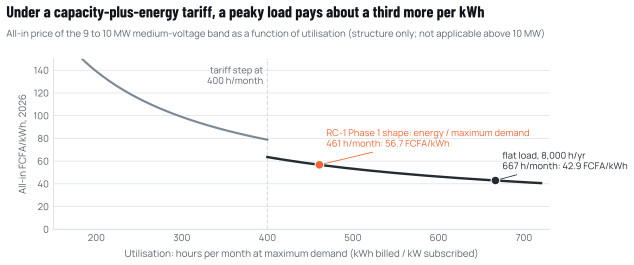
Two customers with the same annual consumption can pay very different average prices under a capacity-plus-energy tariff, because the fixed charge is spread over fewer or more kWh. Figure 3.2 shows this for the structure of the 9 to 10 MW band.
Source: ARSEL tariff tables [S03]; Cameroon Steel reference configuration RC-1 (planning estimate), balances and maximum demand [S07]; power factor 0.95 assumed.
A perfectly flat load of 8,000 hours a year uses its subscribed power about 667 hours a month and would pay about 42.9 FCFA/kWh. An arc-furnace plant is not flat. RC-1 Phase 1 would consume about 289 GWh a year against a planned maximum demand of 55 MVA [S07]; at a power factor of 0.95 that is about 5,530 hours a year at maximum demand, or 461 hours a month, and the same tariff structure would charge about 56.7 FCFA/kWh, some 32% more (derived). At the upper planning value of about 302 GWh, utilisation rises to about 481 hours a month and the premium falls to about 28%.
Three features of tariff design therefore matter to an electric steelworks:
- How maximum demand is measured. A 15-minute averaging window smooths the furnace’s second-by-second swings; a shorter window would penalise them. The window should be stated in the contract.
- Whether scheduled load is rewarded. An arc furnace can time its heats within the day, for example to stay off the evening peak, with little loss of output. It cannot give up hours of melting without losing tonnage, because a single furnace needs most of the year to reach Phase 1’s nameplate (Chapter 9). A tariff that rewards load scheduled away from the peak, through time-of-use energy prices or a lower capacity charge, turns that flexibility into a resource for a hydro-dominated grid; curtailment should be limited to rare, capped emergencies.
- How reactive energy is charged. Arc furnaces draw large amounts of reactive power. Charges for reactive energy, and the obligation to compensate it locally, should be explicit, because they drive the size of the compensation equipment described in Chapter 4.
3.5 Four ways to contract, and a hybrid that combines them
Table 3.2 compares the contracting routes open to a large user in Cameroon.
Table 3.2 Contracting options for a large electricity user in Cameroon
| Option | How it works | Price basis | Firmness | Main risks | Precedent in Cameroon |
|---|---|---|---|---|---|
| Regulated MV supply | Utility supply under the ARSEL grid | Published tariff, escalated yearly | Utility’s normal service | Not available above 10 MW | About 2,500 MV customers [S01] |
| Bilateral HV contract with the utility | Negotiated supply at 225 kV or 90 kV | Negotiated; ARSEL oversight | Depends on contract terms and grid | Revision by the regulator; utility’s finances | Six HV customers, legacy contracts [S01] |
| Power purchase from an independent producer, with transmission access | IPP sells to the user; SONATREL transmits for a regulated fee | Freely negotiated; transmission at the ARSEL tariff | Depends on the plant and back-up arrangements | Balancing and back-up rules; enforceability of access | Law No. 2011/022 allows IPPs to sell to eligible customers [S52]; Prometal moved to HV under a SONATREL access contract [S42][S01] |
| Captive generation | Own plant on site (gas engines, solar) | Own cost of fuel and capital | High for engines, low for solar alone | Gas allocation; licensing; cost | Not documented for steel |
| Hybrid (recommended) | Utility or IPP contract for energy, dedicated firm capacity at the Kribi gas plant, on-site solar | Blend of the above | High | Complexity; needs a framework | None yet |
Source: as listed; Cameroon Steel analysis.
Bilateral utility contracts are the default today. Their weakness is that they are bespoke, and the regulator’s revision of some HV contracts in 2025 [S01] shows that their terms are not immune to change.
Direct purchase from an independent producer has a legal basis. Law No. 2011/022 allows independent producers to sell to eligible customers, mainly industrial companies, at freely negotiated prices, provided their cost structures are submitted to ARSEL [S52]. SONATREL’s published transmission tariff [S53] gives a price for using the network, and Prometal’s high-voltage access contract with SONATREL shows that an industrial user can obtain transmission access [S42][S01]. What is not yet visible in the public record is a complete set of rules for wheeling: how imbalances are settled, who provides back-up when the producer’s plant is unavailable, and how the producer’s sales to the grid and to the industrial user are separated. ARSEL’s website lists orders (arrêtés) establishing a connection code and a market code, but their texts could not be retrieved for this paper [S71], so whether they already cover these points is an open question (Chapter 11).
Captive generation gives the most control but needs gas, a licence and capital. For a steelworks at Kribi, the logical form of firm thermal capacity is not a new plant on site but a dedicated block at the existing Kribi gas plant, which holds a licence for 330 MW but has built 216 MW [S21][S22], or a contract for part of its existing output.
3.6 Closing the gap over time
A large-user framework does not need to resolve every legacy contract at once. A credible transition would work in three steps.
First, new large loads would be priced under the published framework from the start, so that every new investment is made on a cost-based price that the utility can sustain. That stops the gap from widening.
Second, legacy high-voltage contracts would converge to the framework over a published period, at a pace that the customers concerned can absorb. The six legacy contracts consumed 969 GWh in 2025 at about 18.4 FCFA/kWh [S01]; bringing them gradually towards a cost-based level would reduce the need for the tariff subsidy, which reached 96.99 bn FCFA in 2025 [S04], and would put new and existing industrial users on the same footing.
Third, the framework would be reviewed on a fixed cycle, aligned with the regulator’s annual decision on the utility’s allowed revenue [S04]. Each review would update the indices in the price formula and publish the results, so that every large user can see how its price was set.
The framework would also make the system’s cross-subsidies visible. Today, the gap between the cost-reflective average and the prices collected is covered by a single subsidy line [S04]. Separating the cost of serving high-voltage customers from the cost of serving low-voltage households would show who pays for what, which is a precondition for any sustainable reform of the sector’s finances.
3.7 What lenders will look for in a power contract
A steelworks financed with long-term debt will need a power supply that lenders can rely on for the life of the loans. In practice that means:
- Term and indexation: a contract of at least the debt tenor, with a price formula indexed to identifiable costs (hydro purchase prices, gas prices, inflation) rather than revised at discretion.
- Firmness and remedies: a guaranteed capacity, a defined transmission path and compensation for curtailment beyond agreed limits.
- Change in law and tariff revision: protection, or at least predictability, if the regulator revises large-user contracts.
- Counterparty strength: the utility’s capacity to perform. The State’s buy-back of the utility [S28], its pre-emption of the Kribi and Dibamba thermal plants [S29] and the IMF’s assessment of a high risk of debt distress [S72] all bear on how lenders will view a utility contract and whether they will seek State support or a direct contract with a generator.
The 2023 dispute between the steel producers and the regulator is a reminder of what is at stake. When higher tariffs for large accounts were announced, the steel industry feared an increase of about 30%; ARSEL answered that the average MV bill would rise by about 12%, equivalent to about 0.72% of production cost [S44][S45]. Whatever the true figure, the episode showed that large users had no published basis on which to anticipate their costs. A framework with published principles would remove that uncertainty for every large user, not only for steel.
Sources cited in this chapter
Bracketed markers refer to these sources; the full list is in the annex. Full list of sources
- S54Décision N°00000427 fixant les tarifs de vente HT d’électricité des clients MT et seuils minima de négociation "Grands Comptes". ARSEL, 12 Dec 2022.arsel-cm.org/wp-content/uploads/2025/12/2022_decision_n_00000427_d_ars…
- S03Tableaux tarifaires, Décision ARSEL N°00000427 (MT 2023-2025). ARSEL, uploaded Jan 2026.arsel-cm.org/wp-content/uploads/2026/01/TABLEAUX-TARIFAIRES-decision-M…
- S01Rapport d’activités 2025 de l’ARSEL. ARSEL (electricity regulator), 7 Sep 2026.arsel-cm.org/wp-content/uploads/2026/09/Rapport-ARSEL-2025.pdf
- S07Cameroon Steel reference configuration RC-1 (planning estimate), edition 10 October 2026 (RC-1.1): phases, benchmarks with ranges, indicative balances and schedule. Cameroon Steel, 10 Oct 2026.Cited by title and date
- S04Décision fixant le montant de la RMA ENEO au titre de l’exercice 2025 (réajustée). ARSEL, 19 Dec 2025.arsel-cm.org/wp-content/uploads/2026/01/Decision-fixant-le-Montant-de-…
- S53Tarif transport et GRT (Décision 0000017D). ARSEL, 17 Jan 2025.arsel-cm.org/wp-content/uploads/2026/01/TARIF-TRANSPORT-ET-GRT-1.pdf
- S70Cameroon implements new electricity price hike to achieve financial balance. Business in Cameroon, 7 Feb 2024.businessincameroon.com/energy/0702-13622-cameroon-implements-new-elect…
- S57Cameroon plans higher electricity rates for some businesses to ease sector strain. Business in Cameroon, 8 May 2026.businessincameroon.com/energy/0805-16144-cameroon-plans-higher-electri…
- S29Au Cameroun, l’État veut reprendre les centrales de Kribi et Dibamba à Globeleq. Forbes Afrique, 11 Aug 2026.forbesafrique.com/au-cameroun-letat-veut-reprendre-les-centrales-de-kr…
- S52Reforming Cameroon’s power sector (on Law No. 2011/022 of 14 December 2011). IFLR (Orrick Herrington & Sutcliffe; ENEO), 3 Jun 2016.iflr.com/article/2gjw2n5ocpr2orkj9qxcr/iflr1000/reforming-cameroons-po…
- S42Prometal, Acero Metal, Aciéries du Cameroun… qui est le plus gros consommateur d’électricité de la métallurgie camerounaise. EcoMatin, 15 Jul 2026.ecomatin.net/prometal-acero-metal-acieries-du-cameroun-qui-est-le-plus…
- S71Regulatory texts listed on the regulator’s website: orders on the connection code and the market code (files could not be opened on the access date). ARSEL.arsel-cm.org
- S21Kribi Power Development Corporation. MIGA (World Bank Group), 2014.miga.org/project/kribi-power-development-corporation-0
- S22The AfDB praises the impacts of the planned extension of the Kribi gas-fired power plant. Business in Cameroon, 1 Jul 2020.businessincameroon.com/energy/0107-10486-the-afdb-praises-the-impacts-…
- S28Cameroon completes buyback of Eneo in a CFA78 billion deal with Actis. Business in Cameroon, c. 20 Feb 2026.businessincameroon.com/energy/2002-15795-cameroon-completes-buyback-of…
- S72IMF staff concludes Post-Financing Assessment mission to Cameroon (PR 26/314). IMF, 1 Oct 2026.imf.org/en/news/articles/2026/10/01/pr26314-imf-staff-concludes-assesm…
- S44Hausse des tarifs d’électricité: l’ARSEL minimise l’impact sur les entreprises. EcoMatin, 6 Jan 2023.ecomatin.net/hausse-des-tarifs-delectricite-larsel-minimise-limpact-de…
- S45Électricité: les aciéries s’insurgent contre la hausse des tarifs. EcoMatin, 10 Jan 2023.ecomatin.net/electricite-les-acieries-sinsurgent-contre-la-hausse-des-…
Cite this chapter
Cameroon Steel (2026). Cameroon’s hydro grid can power low-carbon steel if large users get firm supply, clear tariffs and gas. White paper 05, chapter 3: Large users have no published tariff, so their price depends on negotiation rather than rules. CS-WP-05. https://www.cameroon-steel.com/en/library/energy-for-industry/tariffs-and-contracting/
Source