White paper 05 · Chapter 6
The Hilli FLNG’s departure makes Cameroon’s gas a domestic question, and reserves are now the binding unknown
Until July 2026, about 95% of Cameroon’s gas output fed the Hilli Episeyo floating liquefaction vessel moored off Kribi. Its departure removes a buyer of about 72 bcf a year, while every plausible domestic use at Kribi, including a 1 Mtpa direct-reduction plant, adds up to about 20 to 36 bcf a year. Gas is physically close to the industrial zone; what industry lacks is a certified view of remaining reserves, a transparent price and published allocation rules.
In this chapter (8)
- 6.1 A small, concentrated gas sector built around one export outlet
- 6.2 The vessel left in July 2026, and with it the main buyer
- 6.3 Domestic industry has been leaving gas, not joining it
- 6.4 The binding unknown is how much gas is left
- 6.5 Prices: power gas at about US$3.2, industrial gas at about US$5.0 to 5.6
- 6.6 Three reference points for a domestic gas price
- 6.7 Firm gas for power at Kribi comes first
- 6.8 What an allocation framework for industrial gas should contain
6.1 A small, concentrated gas sector built around one export outlet
Cameroon’s gas sector is small and concentrated. The national hydrocarbons company, the Société Nationale des Hydrocarbures (SNH), holds the State’s interests and markets its share of production. In 2025 the country produced 75.475 bcf of natural gas, of which 24.069 bcf was the State’s share and 51.406 bcf the partners’ [S05]. Almost all of it, 74.324 bcf or about 98.5%, came from the offshore Sanaga Sud field near Kribi, operated by Perenco [S05]. The onshore Logbaba field near Douala produced 1.150 bcf [S05]. Production had fallen by 6.3% in 2024 to 2,043.27 million m3 [S83].
No recent, field-by-field statement of Cameroon’s gas reserves is public. The volume on the record for the Kribi fields is the 500 bcf of reserves on which Golar LNG’s heads of agreement with SNH and Perenco of December 2014 was premised, to be produced at about 1.2 Mt of LNG a year over about eight years [S84]; an allocation made twelve years ago is not a basis for a supply contract. The industrial gas market in Douala is in difficulty: deliveries by Gaz du Cameroun, which distributes Logbaba gas to Douala industry, fell by 62.9% in 2024, the company was taken over by Cameroon Holdings Ltd in July 2025, and its share capital was cut by 86.4% a year later [S85][S86]. In 2023 the government suspended a 20% increase in its industrial gas price [S87].
The sector was built around one outlet. In June 2018 Golar LNG began commercial operations of the Hilli Episeyo floating LNG (FLNG) vessel off Kribi, with a design capacity of 2.4 Mt a year in four trains [S88][S89]. The project rested on the 500 bcf allocation [S84]; how much of it has been produced is not public (evidence gap 4). Cameroon used about 1.4 Mt of LNG capacity a year, with an option on 1.6 Mt [S89].
6.2 The vessel left in July 2026, and with it the main buyer
In May 2025 Golar and its partners approved the deployment of their first vessel in an Argentine gas export project [S90]. The Perenco charter in Cameroon ended in July 2026 and the vessel left Kribi; press reports projected a loss of gas revenue of about 235 bn FCFA for 2026 and 2027 [S16]. After the departure, the Kribi power plant continues to receive gas through the existing pipelines, but no replacement liquefaction has been announced [S17][S91]. A critical press commentary in June 2026 summed up eight years of the arrangement as "eight years of rental, zero infrastructure" [S91].
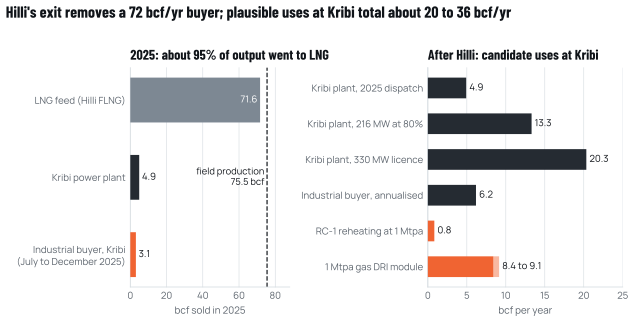
The scale of the change is visible in SNH’s 2025 accounts (Figure 6.1). The State sold 17.905 bcf as LNG feed for US$148.2m and the partners 53.716 bcf for US$448.1m, together about 71.6 bcf, or about 95% of output [S05]. The domestic market took the rest: 4.920 bcf for the Kribi power plant and 3.088 bcf, in the third and fourth quarters only, for an industrial buyer at Kribi [S05]. SNH reports sales by buyer, and their sum (79.6 bcf) exceeds the field production of 75.5 bcf; this paper shows the figures as published and lists the reconciliation as an evidence gap (Chapter 11).
Source: SNH, Données pétrolières 2025 [S05]; ARSEL 2025 [S01]; RC-1 gas balance [S07]; DRI gas use 9.2 to 10 GJ/t [S39][S41]; 1 Mscf = 1.094 GJ.
The right-hand panel of Figure 6.1 lists the candidate domestic uses at Kribi (derived):
- The Kribi power plant used 4.92 bcf in 2025 to generate 559.67 GWh, about 8.8 Mscf per MWh. At an 80% capacity factor, the same 216 MW plant would need about 13.3 bcf a year; extended to its licensed 330 MW, about 20.3 bcf.
- The industrial buyer at Kribi would use about 6.2 bcf over a full year at its 2025 half-year rate.
- Reheating furnaces for a 1 Mtpa steelworks, in RC-1’s Phases 2 and 3, would use about 0.91 PJ a year, about 0.83 bcf [S07]; Phase 1 uses no gas.
- A 1 Mtpa gas-based DRI module would use about 8.4 to 9.1 bcf a year (Chapter 7).
Without a DRI plant, these uses add up to about 20 bcf a year; with the plant extended to 330 MW and a 1 Mtpa DRI module, about 36 bcf. Both totals are well below the 72 bcf a year that went to LNG in 2025. Two further gas-fired plants announced in 2025, of 350 MW at Bekoko and 150 MW at Douala, were subject to SNH confirming gas availability [S50] and would compete for the same resource.
6.3 Domestic industry has been leaving gas, not joining it
The domestic gas market’s recent history is a warning. In Douala, where Gaz du Cameroun has supplied industrial customers from the Logbaba field, deliveries fell by 62.9% in 2024, and press coverage described the city’s industrial users as turning away from natural gas [S85]. The distributor changed hands in July 2025 and cut its share capital by 86.4% a year later [S86]; in 2023 the government had suspended a planned 20% increase in its industrial gas price [S87].
The causes of this decline deserve their own study, and the Douala market is supplied from a different and much smaller field than Kribi. But the lesson for Kribi is clear: industrial users do not take gas because it is nearby. They take it when supply is reliable, the price is predictable and the contract is enforceable. A domestic gas strategy built around the Sanaga Sud field must offer all three to win industrial customers after the FLNG.
6.4 The binding unknown is how much gas is left
On these numbers the near-term physical supply looks ample. The difficulty is that it is not known how long it would last.
The Sanaga Sud reserves developed for the Hilli project were about 600 bcf, of which 500 bcf was allocated to the FLNG, and the field is in natural decline [S17][S84]. Over eight years of LNG operation at rates of the order of the 72 bcf sold in 2025, the cumulative feed would be of the same order as the 500 bcf allocation (derived, an approximation that should be replaced by SNH’s production records). Remaining certified reserves of Sanaga Sud are not public [S17]. A plant that needs gas for twenty years, such as a DRI module, cannot be financed on a field whose remaining life is unknown.
New supply exists on paper. The cross-border Yoyo-Yolanda discovery, shared with Equatorial Guinea, holds about 2.5 Tcf, would cost about US$4bn to develop, and has been associated with a target of an additional 300 MMscf/d through the Bipaga facilities "from 2026", but has no final investment decision [S17][S83]. SNH offered nine exploration blocks in August 2025; five were in production-sharing negotiations in 2026, four of them with Murphy [S17]. None of these will produce gas for industry at Kribi before the end of the decade unless decisions are taken soon.
Table 6.1 Gas resources relevant to Kribi and their degree of certainty
| Resource | Size | Status | Certainty for an industrial contract | Source |
|---|---|---|---|---|
| Sanaga Sud and Ebome, developed for the FLNG | About 600 bcf developed; 500 bcf allocated to the FLNG | Producing; in natural decline | Unknown: remaining certified reserves not public | [S17][S84] |
| Sanaga Sud production, 2025 | 74.324 bcf | Producing | Reported production, not a reserve | [S05] |
| Logbaba (onshore, Douala) | 1.150 bcf produced in 2025 | Producing; operator restructured | Low volume; serves Douala | [S05][S85][S86] |
| Yoyo-Yolanda (cross-border) | About 2.5 Tcf | Discovered; about US$4bn development; no FID | Not available before a decision and several years of works | [S17][S83] |
| 2025 licensing round | 9 blocks offered; 5 in negotiation | Exploration | Speculative | [S17] |
| Etinde and other discoveries | Not found in the public record for this paper | Unknown | Unknown | Chapter 11 |
Source: as listed.
6.5 Prices: power gas at about US$3.2, industrial gas at about US$5.0 to 5.6
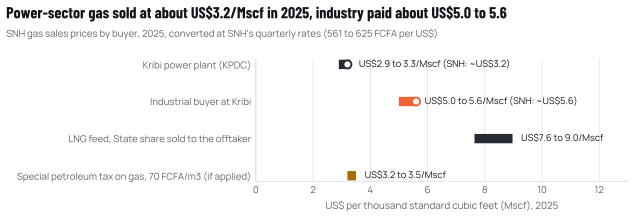
SNH’s 2025 accounts also give the first public set of domestic gas prices by buyer (Figure 6.2). The Kribi power plant paid 1,810 to 1,858 FCFA per thousand standard cubic feet (Mscf), about US$3.2 at SNH’s exchange rates; the industrial buyer at Kribi paid 3,135 FCFA/Mscf, about US$5.0 to 5.6 at the same rates (SNH: about US$5.6); and the State’s share of LNG feed sold for US$7.64 to US$8.97/Mscf [S05][S92]. SNH’s quarterly exchange rates ranged from 624.9 FCFA per US dollar in the first quarter to 561.0 in the fourth [S05]. In energy terms, US$3.2/Mscf is about US$2.9 per GJ and US$5.0 to 5.6/Mscf about US$4.6 to 5.1 per GJ (derived).
Source: SNH, Données pétrolières 2025 [S05]; SNH, key figures 2025 [S92]; Business in Cameroon on gas taxation [S87]; tax converted at 28.317 m3 per Mscf (derived).
Two features of this price structure matter for policy. First, the LNG feed price was well above the domestic prices. With the vessel gone, the upstream partners lose their best-paying outlet, and a domestic price set at the power-sector level may not justify the investment needed to sustain production. Second, taxation is unresolved. A special petroleum tax (STPP) of 70 FCFA per m3 on natural gas has applied since 1 January 2023 [S87]; that is about 1,980 FCFA/Mscf, or US$3.2 to US$3.5 at 2025 exchange rates (derived), roughly equal to the power-sector gas price itself. Whether, and at what rate, it applies to gas sold to industry has not been confirmed in a primary text for this paper. For an industrial project, the difference between paying it and not paying it is the difference between two very different business cases.
6.6 Three reference points for a domestic gas price
Setting a domestic gas price after the FLNG is a policy choice. Three reference points, all available from public data, bound it (derived from [S05] and [S01]):
- The export alternative. The State’s share of LNG feed sold at US$7.64 to US$8.97/Mscf in 2025 [S05]. With no liquefaction at Kribi, this is no longer an available outlet, but it shows the value the upstream partners have lost and the price they would compare any domestic offer against if export capacity returned.
- The power-sector price. The Kribi power plant paid about US$3.2/Mscf [S05]. At its 2025 gas use of about 8.8 Mscf per MWh, that is a fuel cost of about 17 FCFA/kWh.
- The power-equivalent value. Even at the top of the LNG feed price, US$8.97/Mscf, the fuel cost of gas-fired generation at the plant’s 2025 efficiency would be about 47 FCFA/kWh, close to the 43.93 FCFA/kWh the utility pays for Memve’ele’s hydro output [S01]. Gas-fired power remains competitive on fuel cost with recent hydro purchase prices across most of the range of 2025 gas prices, although this comparison excludes the capital costs of both.
The policy implication is that there is room between the current power-sector price and the value of gas as fuel for a domestic price that would sustain upstream investment without making gas-fired power uncompetitive. Where in that range the price is set, and how it is indexed, is exactly what a published framework should determine.
6.7 Firm gas for power at Kribi comes first
For industry at Kribi, the first priority for gas is not a direct-reduction plant but the power plant. A firm electricity supply to the industrial zone depends on the Kribi gas plant being able to run when hydro output is low and when the transmission path from Edéa is interrupted. In 2025 the plant ran at about 30% of its capacity [S01]; running it as firm back-up for a growing industrial load would need more gas, about 13 bcf a year at an 80% capacity factor (derived). A gas allocation that secures the power plant’s supply would therefore benefit every tenant of the zone, and is the natural first step of the framework set out below.
6.8 What an allocation framework for industrial gas should contain
The departure of the FLNG is an opportunity to re-plan Cameroon’s gas as a domestic industrial resource. For an energy-intensive project at Kribi, an allocation framework would need six elements:
For an electric steelworks, the first gas needs are modest and come late: none in Phase 1, under 1 bcf a year for reheating at full build-out [S07]. The larger question, gas for making iron from Cameroonian ore, is examined in the next chapter.
Sources cited in this chapter
Bracketed markers refer to these sources; the full list is in the annex. Full list of sources
- S05Données pétrolières 2025. SNH, posted Jun 2026.snh.cm/wp-content/uploads/2026/06/Donnees-petrolieres-2025.pdf
- S83Gaz: le Cameroun veut doper sa production de 8,5 millions de m³ par jour à partir de 2026. EcoMatin, 7 Feb 2025.ecomatin.net/gaz-le-cameroun-veut-doper-sa-production-de-85-millions-d…
- S84Golar signs Heads of Agreement for the development of a Floating Liquefaction export project in Cameroon (news release, filed with the US Securities and Exchange Commission on Form 6-K). Golar LNG Ltd, 24 Dec 2014.sec.gov/Archives/edgar/data/0001207179/000117184314006037/newsrelease.…
- S85Gaz du Cameroun en chute libre: -62,9% de livraisons en 2024. Cameroun24, c. Apr 2026.cameroun24.net/article/73653-gaz-du-cameroun-en-chute-libre-62-9-de-li…
- S86Cameroon gas operator slashes share capital by 86% a year after takeover. Business in Cameroon, 9 Oct 2026.businessincameroon.com/energy/0910-16932-cameroon-gas-operator-slashes…
- S87Industrial gas: Cameroon suspends GDC’s 20% price hiking plan. Business in Cameroon, 18 Jul 2023.businessincameroon.com/energy/1807-13291-industrial-gas-cameroon-suspe…
- S88Cameroon FLNG Terminal. Global Energy Monitor (GEM.wiki; tertiary), last edit 10 Oct 2026.gem.wiki/Cameroon_FLNG_Terminal
- S89Perenco, SNH to increase utilization of Golar’s Hilli Episeyo FLNG. Offshore Engineer, Jul 2021.oedigital.com/news/489311-perenco-snh-to-increase-utilization-of-golar…
- S90Golar, partners approve first vessel in Argentine gas export project. Rigzone, 6 May 2025.rigzone.com/news/golar_partners_approve_first_vessel_in_argentine_gas_…
- S16Le navire usine quitte le Cameroun, le gaz s’arrête. Camer.be, 9 Jul 2026.camer.be/93911/12:1/le-navire-usine-quitte-le-cameroun-le-gaz-sarrete-…
- S17Cameroon’s SNH eyes Yoyo-Yolanda and new exploration blocks to sustain gas growth. Business in Cameroon, 6 Jul 2026.businessincameroon.com/energy/0607-16422-cameroon-s-snh-eyes-yoyo-yola…
- S91Cameroun: SNH, huit ans de location, zéro infrastructure. AllAfrica (Camer.be), 1 Jun 2026.fr.allafrica.com/stories/202606010513.html
- S01Rapport d’activités 2025 de l’ARSEL. ARSEL (electricity regulator), 7 Sep 2026.arsel-cm.org/wp-content/uploads/2026/09/Rapport-ARSEL-2025.pdf
- S07Cameroon Steel reference configuration RC-1 (planning estimate), edition 10 October 2026 (RC-1.1): phases, benchmarks with ranges, indicative balances and schedule. Cameroon Steel, 10 Oct 2026.Cited by title and date
- S39ENERGIRON technology (DRI-EAF with natural gas or H₂). EC ICIT, ref. 12 Feb 2026.innovation-centre-for-industrial-transformation.ec.europa.eu/innovativ…
- S41Suez Steel sets new benchmark in energy consumption for DRI production. Danieli, 16 Apr 2026.danieli.com/en/news-media/news/suez-steel-sets-new-benchmark-energy-co…
- S50Kribi gas power plant resumes operations after debt resolution; Cameroon to build two new gas power plants. Business in Cameroon (also Forbes Afrique on pre-emption), Feb to Mar 2025.businessincameroon.com/energy/2702-14501-kribi-gas-power-plant-resumes…
- S92Chiffres-clés du 1er janvier au 31 décembre 2025. SNH, 20 Jun 2026.snh.cm/chiffres-cles-du-1er-janvier-au-31-decembre-2025/
Cite this chapter
Cameroon Steel (2026). Cameroon’s hydro grid can power low-carbon steel if large users get firm supply, clear tariffs and gas. White paper 05, chapter 6: The Hilli FLNG’s departure makes Cameroon’s gas a domestic question, and reserves are now the binding unknown. CS-WP-05. https://www.cameroon-steel.com/en/library/energy-for-industry/natural-gas/
Source