白皮书05 · 摘要 · 中文摘要
执行摘要:电网是资产,但重工业需要稳定供电、明确电价和天然气
喀麦隆电网以水电为主,2024年单位电量排放约为226克二氧化碳当量/千瓦时,使电炉钢厂拥有少有竞争对手能够比拟的低碳优势。然而,对于平均负荷由约36至38兆瓦增至约94至99兆瓦的用电大户而言,能让贷款方信赖的稳定、高质量供电条件尚不存在。实现这一点需要:一条专用的225千伏接入通道(例如正在建设、通往克里比港的输电线路和变电站);一套针对10兆瓦以上用户公开发布的电价;以及在Hilli浮式液化天然气装置(FLNG)于2026年7月撤离克里比之后,为未来任何直接还原铁(DRI)装置作出反映新供需格局的天然气配置。
本页为本章中文摘要;英文全文附于其后,可展开阅读。
本章目录(9)
资料来源:ARSEL 2025年报告 [S01];Business in Cameroon,2026年10月9日 [S02];ARSEL电价数据 [S03][S04];SNH 2025年数据 [S05];推算。
ES.1 简要结论
本白皮书探讨电炉钢厂需要喀麦隆能源体系提供什么,以及该体系能否满足这些需求。本文阐述Cameroon Steel自身项目所依据的能源证据,即位于克里比港综合工业区姆博罗(Mboro)的钢铁综合体,并以其为实例。该综合体设计产能为100万吨/年 [S06],分期建设,一期以电弧炉炼钢车间生产钢筋和线材为主 [S07];2024年12月30日,总理代表国家元首为项目奠基 [S08]。其炼钢车间生产钢坯,既可作为商品钢坯出售给目前约60%炉料依赖进口的再轧厂,也可轧制成棒材和线材;由于国内钢筋产能远超需求,产量主要用于替代进口并出口至中部非洲经济与货币共同体(CEMAC)(见白皮书04和白皮书09)。项目参考配置RC-1提供了规划性和指示性的能源数据,全文均作相应标注。
简而言之,喀麦隆具备发展低碳电炉钢的物质条件,但尚缺乏使供电稳定、价格明确、可获融资的规则。以下十项结论支撑这一判断。
- 能源决定电炉钢的竞争力。按电炉每吨钢水450千瓦时的规划值计算,RC-1一期每吨棒材和线材约耗电0.96兆瓦时;按炉料中含30%直接还原铁时约490千瓦时的规划上限值计算,约为1.0兆瓦时。按喀麦隆现有各项电价基准计算,电费为每吨30至170美元,差距约140美元,约相当于钢筋出口价格(2026年10月3日为离岸价620至630美元/吨)的五分之一 [S07][S09]。
- 电网以水电为主、碳排放低。2025年喀麦隆8119.9吉瓦时发电量中,水电占89.6% [S01]。2024年电网排放因子约为226克二氧化碳当量/千瓦时,不到世界平均水平(471克)的一半,约为印度尼西亚(680克)的三分之一;而2023年喀麦隆进口钢坯的78%来自印度尼西亚 [S10][S11]。
- 装机容量不等于稳定供电。2025年喀麦隆装机容量为2033兆瓦,高峰负荷为1278兆瓦 [S01],但在400千伏纳赫蒂加尔(Nachtigal)送出线路建成之前,仍有150兆瓦工业需求无法满足,该线路目前预计于2026年11月完工 [S02]。克里比燃气电厂的运行率约为30%,纳赫蒂加尔水电站因来水原因发电量比计划低28% [S01]。
- 大用户没有公开电价。受监管电价仅覆盖10兆瓦以下用户 [S03]。2025年存量高压合同平均电价为18.4中非法郎/千瓦时,2026年最高中压档综合电价约为43.7中非法郎/千瓦时,监管机构核定的成本反映平均电价为105.46中非法郎/千瓦时 [S01][S03][S04]。在计入供电稳定性成本之前,面向高压基荷稳定供电的成本电价约为系统平均水平的一半(推算)。
- 电价结构与电价水平同样重要。在容量电费加电量电费的两部制电价下,具有RC-1一期负荷特性的电弧炉负荷,每千瓦时电价比同等电量的平稳负荷高约32%(据 [S03] 推算)。需量计量周期、避开高峰的可调度负荷的激励以及无功电量规则都必须明确。
- 电弧炉需要坚强的接入点和自备补偿装置。按简化筛查估算,配备30至33兆伏安级变压器的电弧炉在接入点需要约4000至7000兆伏安的短路容量,才能将闪变控制在高压规划水平以内;配置静止无功补偿器(SVC)时约需2000至3500兆伏安(推算;输入数据见 [S12][S13])。30千伏馈线强度不足,需要一个专用225千伏间隔。
- 克里比新建225千伏供电可满足一期需求。由克里比燃气电厂至港区的42公里225千伏双回线路以及港区225/30千伏变电站(3×60兆伏安),首期可供100兆瓦,后期可达330至400兆瓦,计划于2026年底投运 [S14][S15]。首期100兆瓦由港区平台全体用户共享。一期最大需量55兆伏安,将占用其中约一半;100万吨/年的全部工程约需160兆伏安,有赖于后期扩容 [S07]。
- FLNG撤离改变了天然气供需格局。2025年喀麦隆755亿立方英尺天然气中约95%用于液化天然气 [S05]。该装置已于2026年7月撤离 [S16],克里比合理的国内用气合计约为每年200至360亿立方英尺(推算)。决定性的未知数是萨纳加南(Sanaga Sud)气田的剩余认证储量,该数据尚未公开 [S17]。
- 直接还原用气成本可以承受,但尚无可融资的供气条件。100万吨/年直接还原铁模块每年约需84至91亿立方英尺天然气,接近克里比电厂2025年用气量的两倍。按2025年电力行业约3.2美元/千立方英尺、工业约5.0至5.6美元/千立方英尺的价格 [S05],每吨直接还原铁的燃气成本为27至51美元,而2026年3月热压块铁(HBI)成交价为每吨340至370美元 [S18](推算)。储量、价格公式和直接还原级球团是制约因素。
- 对钢铁而言,关键的可再生能源是水电而非光伏。克里比的光伏电站每千瓦峰值容量年发电约1335千瓦时 [S19];50兆瓦峰值容量可满足一期约23%的用电量,但无法覆盖夜间负荷。按市场法申报的合同水电供应,可使范围二排放接近于零,使工厂接近低排放钢铁的门槛(据 [S20] 推算)。
ES.2 钢厂的需求与现状
图ES.1将RC-1的指示性用电需求与克里比在建供电能力进行对比。表ES.1按需求项目归纳现有条件与缺口。
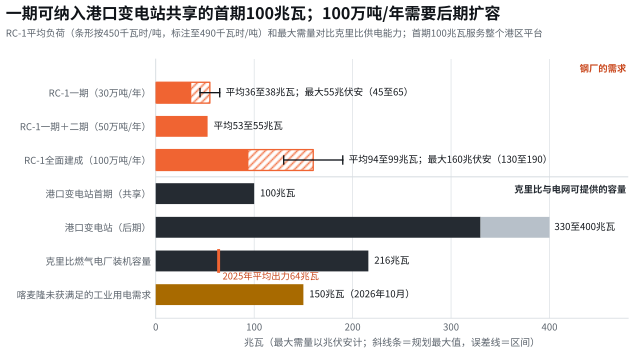
资料来源:Cameroon Steel参考配置RC-1(规划估算) [S07];克里比自治港(PAK),2025年8月6日及2026年8月19日 [S14][S15];ARSEL 2025年报告 [S01];Business in Cameroon,2026年10月9日 [S02]。克里比燃气电厂平均出力=559.67吉瓦时÷8760小时(推算)。
表ES.1 电炉钢厂对喀麦隆能源体系的需求、现有条件与缺口
| 需求 | RC-1显示 |
现有 |
缺口 |
|---|---|---|---|
| 电量 | 一期每年289至302吉瓦时;100万吨/年时每年753至796吉瓦时(电炉每吨450至490千瓦时) | 全国发电量8119.9吉瓦时,水电占89.6%(2025年) | 向克里比稳定送电;已有150兆瓦工业需求未获供电 |
| 容量与接入 | 一期55兆伏安;100万吨/年时约160兆伏安 | 225千伏线路及225/30千伏变电站,首期100兆瓦由港区平台共享,后期330至400兆瓦,预计2026年底投运 | 专用225千伏间隔;后期扩容的明确时间表 |
| 电能质量 | 30至33兆伏安级电弧炉的动态补偿 | 国际标准;国内已有一个电弧炉先例 | 公布克里比短路容量;针对波动负荷的电网规范 |
| 电价 | 可预期、基于成本、期限10至20年的合同 | 10兆瓦以下中压电价;存量高压合同;输电电价 | 公开的10兆瓦以上大用户电价框架 |
| 合同路径 | 与电力公司签约,或通过过网输电向独立发电商购电 | 第2011/022号法律允许向合格用户售电 | 公开的平衡、备用和来源证书规则 |
| 加热用气 | 一期不用气;100万吨/年时每年最多约8.3亿立方英尺 | 克里比燃气电厂供气;2025年工业气价约5.0至5.6美元/千立方英尺 | 天然气配置及通往园区的管道 |
| 直接还原用气(储备方案) | 100万吨/年直接还原铁每年约84至91亿立方英尺 | 萨纳加南气田2025年产量743亿立方英尺;FLNG已撤离 | 认证储量、价格公式、直接还原级球团 |
| 低碳属性 | 采用合同水电时范围二排放接近零 | 电网约226克/千瓦时(2024年) | 过网输电与来源证书 |
资料来源:本白皮书第1至9章;RC-1数值为规划值和指示值 [S07]。
ES.3 一期为何设计为不用天然气
RC-1首批轧机采用感应加热而非燃气加热炉加热钢坯 [S07]。这一选择使一期每年用电量增加约90吉瓦时,但在二期之前完全不需要签订供气合同。鉴于FLNG撤离带来的不确定性,这一安排使一期免受天然气问题影响,并将其能源需求集中于两项可在2027年底前落实的事项:大用户购电合同,以及配有厂内补偿装置的专用225千伏接入。
后续各期则不同。二期和三期将增加燃气加热,每年用气最多约8.3亿立方英尺;更重要的是,需要稳定容量来应对旱季和输电中断。最合适的来源是克里比燃气电厂,可通过其专用部分出力,或在其330兆瓦许可容量内扩建 [S21][S22]。为喀麦隆铁矿石预留、计划于2034年后建设的直接还原模块,用气量约为加热炉的十倍 [S07]。
ES.4 电炉可以调整用电时段,但不能放弃用电
单台电炉每年须运行约7300至7900小时,才能达到一期名义产量(见白皮书03第5章)。因此,其灵活性属于可调度负荷,而非可中断负荷:冶炼可以避开晚高峰,检修可以安排在供电最紧张的时段,但每削减一小时负荷,就损失约一炉钢水(约40吨),每100小时约4000吨,且无法补回。合同应激励错峰调度,并为紧急切负荷设定上限(第9章)。
ES.5 五项政策措施
本白皮书的建议是适用于所有大用户的规则,而非对单一项目的让步(第10章):
- 10兆瓦以上大用户电价框架,由ARSEL发布,以服务高压、高负荷率用户的成本为基础,采用两部制结构,激励避开系统高峰的用电安排,明确无功电量规则,按公式调价,期限10至20年。
- 波动负荷电网规范,采用IEC TR 61000-3-7的闪变评估方法和公认的谐波标准,公布主要节点短路容量,强制开展接入研究并共享监测数据。
- 国内天然气配置与价格框架,首先对萨纳加南气田储量进行独立审计,按用户类别确定优先顺序和价格公式,明确工业用气税收,并落实通往工业区的管道责任方。
- 切实可行的过网输电和第三方准入,以平衡规则、备用电价以及水电和光伏来源证书落实现行法律。
- 克里比园区一体化规划,包括需求登记、按里程碑预留容量、浅接入费用、克里比稳定容量,以及新建水电的工业承购。
ES.6 意义不限于单个工厂
本白皮书向喀麦隆能源体系提出的问题并非钢铁业所独有。任何考虑落户克里比港综合工业区的大型工业负荷(该区发展集群包括与矿产出口相关的钢铁冶炼 [S23])都会提出同样的问题:供电有多稳定,价格多少,合同如何订立,电能质量如何,天然气从何而来。2018年至2025年间获准入驻港口工业物流区的53家企业 [S24]、2026年获得炼化许可的沥青厂 [S25],以及2025年开始在克里比用气的工业买家 [S05],都依赖同样的基础设施和规则。
因此,本文提出的政策措施服务于喀麦隆更广泛的工业战略。国家2030年发展战略将采矿、冶金和钢铁列为优先子行业 [S26],2023年《矿业法》规定国内矿产须有一部分在本地加工 [S27]。一个能让一座电炉钢厂获得融资的能源框架,也将让下一个大用户获得融资。
时间同样关键。FLNG撤离、国家回购电力公司以及正在进行的对克里比和迪班巴(Dibamba)火电厂的收购 [S28][S29]、纳赫蒂加尔水电站和克里比新输电线路投运,以及欧盟碳边境调节机制(CBAM)生效 [S30],均发生在2025年至2027年间。这一窗口期内制定的规则,将塑造喀麦隆此后一代人的工业能源体系。
ES.7 尚存的不确定性
本白皮书的主要结论不受第11章所列证据缺口的影响,但若干规模和时间取决于尚未公开的数据:克里比225千伏节点的短路容量、电炉每吨保证电耗(规划值为450至490千瓦时)、萨纳加南气田剩余天然气储量、现有高压合同条款、接入规范和市场规范文本,以及港口变电站后期扩容的时间表。其中大部分缺口可以利用公共机构已掌握的数据弥补。Cameroon Steel自身的前端工程设计将以供应商保证值取代RC-1基于基准值的数据。
ES.8 本白皮书的结构
第1至5章分别讨论能源在钢铁经济中的作用、喀麦隆电力系统、电价与合同安排、电弧炉的电能质量要求以及克里比新建的电力基础设施。第6章和第7章讨论FLNG撤离后的天然气以及用于直接还原的天然气,第8章讨论可再生能源与储能,第9章提出指示性能源方案,第10章提出政策建议。第11章列出证据缺口;附录介绍研究方法、术语表、来源清单以及每幅图表背后的数据。
本中文摘要版保留全文版的章节编号与图表编号:上述执行摘要为全文翻译;第1至10章各以一页篇幅概述该章结论和关键数据,并收录一幅主要图表;第11章概述证据缺口;附录A为中、英、法三语术语表。研究方法、来源清单和数据表见英文版和法文版全文。
利益声明。本文由正在克里比筹建钢铁厂的Cameroon Steel发布,旨在为公共讨论提供参考;其分析独立于任何商业要约,所有数据均注明来源或标明其状态。
英文全文 11分钟 · 2585词Executive summary: the grid is an asset, but heavy industry needs firm supply, a tariff and gas
Cameroon’s hydro-dominated grid, at about 226 g CO₂e per kWh in 2024, gives an electric steelworks a carbon advantage that few competitors can match. But firm, high-quality supply for a load of about 36 to 38 MW rising to about 94 to 99 MW on average does not yet exist on terms a lender can rely on. It needs a dedicated 225 kV connection such as the line and substation being built to the Kribi port, a published tariff for users above 10 MW, and, for any future direct-reduction plant, a gas allocation that reflects the new balance after the Hilli FLNG left Kribi in July 2026.
Source: ARSEL 2025 [S01]; Business in Cameroon, 9 October 2026 [S02]; ARSEL tariff data [S03][S04]; SNH 2025 [S05]; derived.
ES.1 The answer in brief
This paper asks what an electric steelworks needs from Cameroon’s energy system, and whether the system can provide it. It sets out the energy evidence behind Cameroon Steel’s own project, a steel complex at Mboro, in the Kribi industrial-port zone, and uses it as a worked example. The complex has a design capacity of 1 Mtpa [S06], to be built in phases, with a first phase focused on reinforcing bar and wire rod from an electric arc furnace melt shop [S07]; its foundation stone was laid on 30 December 2024 by the Prime Minister representing the Head of State [S08]. Its melt shop makes billets, sold as such to re-rollers that import about 60% of their charge or rolled into bars and rod; with rebar capacity well above demand, the tonnage is aimed at replacing imports and at exports to the Central African Economic and Monetary Community (CEMAC) (White papers 04 and 09). Its reference configuration, RC-1, provides planned and indicative energy figures, which are labelled as such throughout.
The short answer is that Cameroon has the physical ingredients for low-carbon electric steel but not yet the rules that would make supply firm, priced and financeable. Ten findings support that conclusion.
- Energy decides the competitiveness of electric steel. RC-1 Phase 1 would use about 0.96 MWh of electricity per tonne of bars and rod at the planning value of 450 kWh per tonne of liquid steel in the furnace, and about 1.0 MWh at the upper planning value of about 490 kWh with 30% direct-reduced iron in the charge. Across the price benchmarks observed in Cameroon, that is US$30 to US$170 a tonne, a spread of about US$140, equal to about a fifth of the export price of rebar (US$620 to US$630 FOB on 3 October 2026) [S07][S09].
- The grid is low-carbon and hydro-based. Hydro produced 89.6% of Cameroon’s 8,119.9 GWh in 2025 [S01]. At about 226 g CO₂e/kWh in 2024, the grid emits less than half the world average (471 g) and about a third of Indonesia’s (680 g), the origin of 78% of Cameroon’s billet imports in 2023 [S10][S11].
- Capacity is not firm supply. Cameroon had 2,033 MW installed against a 1,278 MW peak in 2025 [S01], yet 150 MW of industrial demand is unmet until the 400 kV Nachtigal evacuation line is completed, now due in November 2026 [S02]. The Kribi gas plant ran at about 30% of capacity, and Nachtigal delivered 28% below plan because of hydrology [S01].
- There is no published tariff for large users. Regulated tariffs stop at 10 MW [S03]. Legacy high-voltage contracts averaged 18.4 FCFA/kWh in 2025, the top medium-voltage band costs about 43.7 FCFA/kWh all-in in 2026, and the regulator’s cost-reflective average is 105.46 FCFA/kWh [S01][S03][S04]. A cost-based price for a firm high-voltage baseload would sit at roughly half the system average before the cost of firmness (derived).
- Tariff structure matters as much as level. Under a capacity-plus-energy structure, an arc-furnace load with RC-1 Phase 1’s shape would pay about 32% more per kWh than a flat load of the same energy (derived from [S03]). Measurement intervals, rewards for scheduling load around peaks and reactive-energy rules must be explicit.
- An arc furnace needs a strong connection and its own compensation. A simplified screening suggests that a furnace with a transformer of the 30 to 33 MVA class needs about 4,000 to 7,000 MVA of short-circuit power at the connection point to keep flicker within the high-voltage planning level, or about 2,000 to 3,500 MVA with a static var compensator (derived; inputs from [S12][S13]). A 30 kV feeder would be too weak; a dedicated 225 kV bay is needed.
- Kribi’s new 225 kV supply can carry Phase 1. The 42 km double-circuit line from the Kribi gas plant and the 225/30 kV substation (3 x 60 MVA) at the port will offer 100 MW at first and 330 to 400 MW later, with commissioning planned for the end of 2026 [S14][S15]. The first 100 MW is shared by every user of the port platform. Phase 1, at 55 MVA maximum demand, would take about half of it; the 1 Mtpa works, at about 160 MVA, needs the later stage [S07].
- The FLNG’s departure changed the gas balance. About 95% of Cameroon’s 75.5 bcf of gas went to LNG in 2025 [S05]. With the vessel gone since July 2026 [S16], plausible domestic uses at Kribi add up to about 20 to 36 bcf a year (derived). The binding unknown is the remaining certified reserve of the Sanaga Sud field, which is not public [S17].
- Gas for direct reduction is affordable but not yet available on financeable terms. A 1 Mtpa DRI module would need about 8.4 to 9.1 bcf a year, nearly twice what the Kribi power plant used in 2025. At 2025 prices of about US$3.2/Mscf (power) and US$5.0 to 5.6/Mscf (industry) [S05], gas would cost US$27 to US$51 per tonne of DRI, against traded HBI at US$340 to US$370 a tonne in March 2026 [S18] (derived). Reserves, a price formula and DR-grade pellets are the constraints.
- Hydro, not solar, is the renewable that matters for steel. A solar plant at Kribi would yield about 1,335 kWh per kWp a year [S19]; 50 MWp would cover about 23% of Phase 1’s electricity but none of its night-time load. A contracted hydro supply, reported under the market-based method, could bring Scope 2 emissions close to zero and the plant close to low-emission steel thresholds (derived from [S20]).
ES.2 What the steelworks would need, and what exists today
Figure ES.1 sets the indicative electricity demand of RC-1 against the supply being built at Kribi. Table ES.1 summarises, for each requirement, what exists today and what is missing.
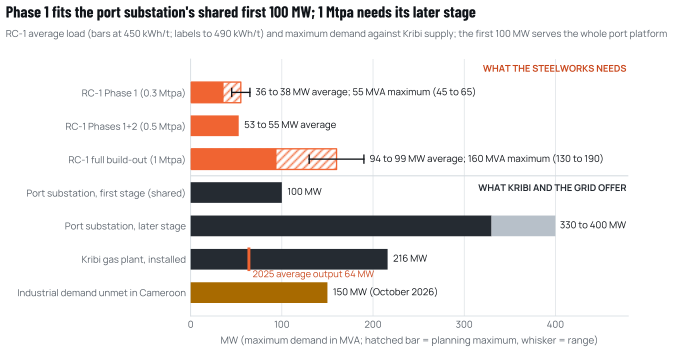
Source: Cameroon Steel reference configuration RC-1 (planning estimate) [S07]; PAK, 6 August 2025 and 19 August 2026 [S14][S15]; ARSEL 2025 [S01]; Business in Cameroon, 9 October 2026 [S02]. Kribi gas plant average output = 559.67 GWh / 8,760 h (derived).
Table ES.1 What an electric steelworks needs from Cameroon’s energy system, what exists and what is missing
| Requirement | What RC-1 indicates (planned) | What exists or is under way | What is missing |
|---|---|---|---|
| Electricity | 289 to 302 GWh/yr in Phase 1; 753 to 796 GWh/yr at 1 Mtpa (450 to 490 kWh/t in the furnace) | 8,119.9 GWh national generation, 89.6% hydro (2025) | Firm delivery to Kribi; 150 MW of industrial demand already unserved |
| Capacity and connection | 55 MVA in Phase 1; about 160 MVA at 1 Mtpa | 225 kV line and 225/30 kV substation, 100 MW shared by the port platform, then 330 to 400 MW, due end-2026 | A dedicated 225 kV bay; a dated plan for the later stage |
| Power quality | Dynamic compensation for a furnace of the 30 to 33 MVA class | International standards; one domestic arc-furnace precedent | Published fault levels at Kribi; a grid code for fluctuating loads |
| Price | A predictable, cost-based contract for 10 to 20 years | MV tariff up to 10 MW; legacy HV contracts; transmission tariff | A published large-user framework above 10 MW |
| Contract route | Utility contract or independent producer with wheeling | Law No. 2011/022 allows sales to eligible customers | Published balancing, back-up and certificate rules |
| Gas for reheating | None in Phase 1; up to about 0.83 bcf/yr at 1 Mtpa | Kribi gas plant supply; 2025 industrial price about US$5.0 to 5.6/Mscf | A gas allocation and pipeline to the zone |
| Gas for DRI (reserve) | About 8.4 to 9.1 bcf/yr for 1 Mtpa DRI | Sanaga Sud production 74.3 bcf (2025); FLNG gone | Certified reserves, price formula, DR-grade pellets |
| Low-carbon attribute | Scope 2 near zero on contracted hydro | Grid at about 226 g/kWh (2024) | Wheeling and certificates of origin |
Source: Chapters 1 to 9 of this paper; RC-1 values are planned and indicative [S07].
ES.3 Why Phase 1 is planned without gas
RC-1 heats billets for its first mills by induction rather than in a gas-fired furnace [S07]. The choice adds about 90 GWh a year to Phase 1’s electricity demand but removes any need for a gas contract until Phase 2. Given the uncertainty created by the FLNG’s departure, that sequencing insulates the first phase from the gas question, and concentrates its energy needs on two things that can be settled by the end of 2027: a large-user power contract and a dedicated 225 kV connection with on-site compensation.
The later phases are different. Phases 2 and 3 would add gas-fired reheating, at up to about 0.83 bcf a year, and, more importantly, would need firm capacity to cover dry seasons and transmission outages. The natural source is the Kribi gas plant, through a dedicated part of its output or an extension within its 330 MW licence [S21][S22]. A direct-reduction module for Cameroonian ore, held in reserve for after 2034, would need about ten times as much gas as the reheating furnaces [S07].
ES.4 The furnace can move its load in time, not give it up
A single furnace must run for about 7,300 to 7,900 hours a year to cast Phase 1’s nameplate tonnage (White paper 03, Chapter 5). Its flexibility is therefore schedulable, not interruptible: heats can be timed around the evening peak and maintenance placed in the tightest weeks, but each hour of curtailment costs about one heat (about 40 t), some 4,000 t of liquid steel per 100 hours, that cannot be recovered. Contracts should reward scheduling and cap emergency load-shedding (Chapter 9).
ES.5 Five policy steps
The paper’s recommendations are rules that would serve every large user, not concessions to a single project (Chapter 10):
- A large-user tariff framework above 10 MW, published by ARSEL, based on the cost of serving a high-voltage, high-load-factor customer, with a two-part structure, a reward for load scheduled away from the system peak, explicit reactive-energy rules, indexation by formula and terms of 10 to 20 years.
- A grid code for fluctuating loads, adopting the IEC TR 61000-3-7 approach to flicker and a recognised harmonic standard, with published fault levels at major nodes, mandatory connection studies and shared monitoring.
- A domestic gas allocation and price framework, starting with an independent audit of the Sanaga Sud reserves, priorities and price formulas by class of user, tax clarity on industrial gas, and responsibility for a pipeline to the industrial zone.
- Workable wheeling and third-party access, implementing the existing law with balancing rules, back-up tariffs and certificates of origin for hydro and solar.
- Integrated planning for the Kribi zone, with a demand register, capacity reservation against milestones, shallow connection charges, firm capacity at Kribi and industrial offtake for new hydro.
ES.6 Why this matters beyond one plant
The questions this paper asks of Cameroon’s energy system are not specific to steel. Any large industrial load considering the Kribi industrial-port zone, whose development clusters include steelmaking linked to mineral exports [S23], will ask the same ones: how firm is the supply, at what price, under what contract, with what power quality, and with what gas. The 53 companies authorised to settle in the port’s industrial and logistics zone between 2018 and 2025 [S24], the bitumen plant that received its refining licence in 2026 [S25] and the industrial buyer that began taking gas at Kribi in 2025 [S05] all depend on the same infrastructure and the same rules.
The policy steps proposed here therefore serve Cameroon’s wider industrial strategy. The national development strategy to 2030 names mining, metallurgy and steel among its priority sub-sectors [S26], and the 2023 Mining Code provides for local transformation of part of the country’s mineral output [S27]. An energy framework that makes one electric steelworks bankable would make the next large user bankable too.
There is also a timing argument. The FLNG’s departure, the State’s buy-back of the utility and its pending acquisition of the Kribi and Dibamba thermal plants [S28][S29], the commissioning of Nachtigal and of the new Kribi transmission line, and the entry into force of the EU’s carbon border mechanism [S30] all fall within 2025 to 2027. The rules written in this window will shape Cameroon’s industrial energy system for a generation.
ES.7 What remains uncertain
The paper’s main conclusions are robust to the evidence gaps listed in Chapter 11, but several sizes and dates depend on data not yet public: the fault level at the Kribi 225 kV node, the furnace’s guaranteed electricity per tonne (planned within 450 to 490 kWh), the remaining gas reserves of Sanaga Sud, the terms of existing high-voltage contracts, the text of the connection and market codes, and the schedule of the port substation’s later stage. Most of these can be closed by data that public institutions already hold. Cameroon Steel’s own front-end engineering will replace RC-1’s benchmark-based figures with supplier guarantees.
ES.8 How this paper is organised
Chapters 1 to 5 cover energy in steel economics, Cameroon’s power system, tariffs and contracting, the power quality an arc furnace needs and Kribi’s new power infrastructure. Chapters 6 and 7 turn to natural gas after the FLNG and to gas for direct reduction, Chapter 8 to renewables and storage, Chapter 9 to an indicative energy plan and Chapter 10 to the policy recommendations. Chapter 11 lists the evidence gaps; the annexes give the method, a glossary, the sources and the data behind every chart.
Statement of interest. This paper is published by Cameroon Steel, which is developing a steelworks at Kribi. It is written to inform public debate; its analysis is independent of any commercial offer, and every figure is sourced or labelled with its status.
本章引用的资料来源
方括号内的标记对应以下来源(按原文语言列出),完整列表见附录。 完整来源列表
- S01Rapport d’activités 2025 de l’ARSEL. ARSEL (electricity regulator),2026年9月7日.arsel-cm.org/wp-content/uploads/2026/09/Rapport-ARSEL-2025.pdf
- S02Nachtigal power line delays leave 150 MW of industrial demand unmet. Business in Cameroon,2026年10月9日.businessincameroon.com/public-management/0910-16939-nachtigal-power-li…
- S03Tableaux tarifaires, Décision ARSEL N°00000427 (MT 2023-2025). ARSEL,上传:2026年1月.arsel-cm.org/wp-content/uploads/2026/01/TABLEAUX-TARIFAIRES-decision-M…
- S04Décision fixant le montant de la RMA ENEO au titre de l’exercice 2025 (réajustée). ARSEL,2025年12月19日.arsel-cm.org/wp-content/uploads/2026/01/Decision-fixant-le-Montant-de-…
- S05Données pétrolières 2025. SNH,发布:2026年6月.snh.cm/wp-content/uploads/2026/06/Donnees-petrolieres-2025.pdf
- S06Industrialisation: la voie royale de l’émergence. Cameroon Tribune,2025年1月2日.cameroon-tribune.cm/article.html/68558/fr.html/details_2
- S07Cameroon Steel reference configuration RC-1 (planning estimate), edition 10 October 2026 (RC-1.1): phases, benchmarks with ranges, indicative balances and schedule. Cameroon Steel,2026年10月10日.按标题和日期引用
- S08Kribi: le Premier ministre, chef du gouvernement est là. Cameroon Tribune,2024年12月30日.cameroon-tribune.cm/article.html/68499/fr.html/details_2
- S09Weekly steel prices (archive 40468). Arab Iron & Steel Union (AISU),2026年10月3日.aisusteel.org/en/archives/40468
- S10Carbon intensity of electricity generation (Ember data). Our World in Data,数据集访问于2026年10月.ourworldindata.org/grapher/carbon-intensity-electricity
- S11UN Comtrade public API, Cameroon (reporter 120), HS 72/73 and 6-digit lines, 2019-2023. UN Statistics Division.comtradeapi.un.org/public/v1/preview/C/A/HS?reporterCode=120&period=20…
- S12US Patent 10,145,612: Flicker reduction in electric arc furnaces by means of flicker prediction from the state determination in the initial phase of the smelting process. Siemens (assignee now Siemens Energy Global),授予:2018年12月4日.patents.google.com/patent/US10145612
- S13IEC TR 61000-3-7:2008, Electromagnetic compatibility, Part 3-7: Assessment of emission limits for the connection of fluctuating installations to MV, HV and EHV power systems (Ed. 2.0); indicative planning levels for flicker: Table 2 (section 4.2.1). International Electrotechnical Commission (table title read in the preview on the VDE Verlag site;values checked against secondary reproductions),2008年.vde-verlag.de/iec-normen/preview-pdf/info_iectr61000-3-7{ed2.0}en.pdf
- S14Kribi franchit la ligne électrique 225 kV. PAK,2025年8月6日.按标题和日期引用
- S15Énergie et infrastructures: un nouvel élan pour la compétitivité du Port de Kribi. PAK,2026年8月19日.按标题和日期引用
- S16Le navire usine quitte le Cameroun, le gaz s’arrête. Camer.be,2026年7月9日.camer.be/93911/12:1/le-navire-usine-quitte-le-cameroun-le-gaz-sarrete-…
- S17Cameroon’s SNH eyes Yoyo-Yolanda and new exploration blocks to sustain gas growth. Business in Cameroon,2026年7月6日.businessincameroon.com/energy/0607-16422-cameroon-s-snh-eyes-yoyo-yola…
- S18European buyers uninterested in BPI and HBI purchases, prices up nominally due to freight. SteelOrbis,2026年3月16日.steelorbis.com/steel-prices/steel-prices-market-analyses/scrap-and-raw…
- S19PVGIS v5.3 web services (PVcalc, DRcalc), Kribi 2.94 N 9.91 E, PVGIS-SARAH3 2005 to 2023. European Commission, Joint Research Centre.re.jrc.ec.europa.eu/api/v5_3/
- S20Achieving Net Zero Heavy Industry Sectors in G7 Members. IEA,2022年5月19日.iea.blob.core.windows.net/assets/c4d96342-f626-4aea-8dac-df1d1e567135/…
- S21Kribi Power Development Corporation. MIGA (World Bank Group),2014年.miga.org/project/kribi-power-development-corporation-0
- S22The AfDB praises the impacts of the planned extension of the Kribi gas-fired power plant. Business in Cameroon,2020年7月1日.businessincameroon.com/energy/0107-10486-the-afdb-praises-the-impacts-…
- S23Zone industrialo-portuaire de Kribi (KPIZ): jusqu’à +8 points de croissance et 150 000 emplois…. Investir au Cameroun,2026年3月4日.investiraucameroun.com/gestion-publique/0403-23163-zone-industrialo-po…
- S24Zone industrielle Kribi: 400 milliards FCFA investis et 53 entreprises autorisées à s’implanter depuis 2018. Investir au Cameroun,2025年5月20日.investiraucameroun.com/gestion-publique/2005-22033-zone-industrielle-k…
- S25Cameroon speeds up Kribi bitumen plant with tax breaks and refining license. Business in Cameroon,2026年6月10日.businessincameroon.com/public-management/1006-16302-cameroon-speeds-up…
- S26Stratégie Nationale de Développement 2020-2030 (SND30). Republic of Cameroon / MINEPAT (hosted by FAOLEX),2020年.faolex.fao.org/docs/pdf/cmr211554.pdf
- S27Loi n° 2023/014 du 19 décembre 2023 portant Code minier (official text, mirror). Rural-info (copy of the official text),2023年12月19日.rural-info.net/wp-content/uploads/2024/11/Loi-N°2023-014-du-19-decembr…
- S28Cameroon completes buyback of Eneo in a CFA78 billion deal with Actis. Business in Cameroon,约2026年2月20日.businessincameroon.com/energy/2002-15795-cameroon-completes-buyback-of…
- S29Au Cameroun, l’État veut reprendre les centrales de Kribi et Dibamba à Globeleq. Forbes Afrique,2026年8月11日.forbesafrique.com/au-cameroun-letat-veut-reprendre-les-centrales-de-kr…
- S30Carbon Border Adjustment Mechanism. European Commission (DG TAXUD),未注明日期,访问于2026年10月.taxation-customs.ec.europa.eu/carbon-border-adjustment-mechanism_en
引用本章
Cameroon Steel(2026)。喀麦隆水电主导的电网可为低碳钢铁供电,前提是大用户获得稳定供电、明确电价和天然气(中文摘要版)。白皮书05,摘要:执行摘要:电网是资产,但重工业需要稳定供电、明确电价和天然气。CS-WP-05。https://www.cameroon-steel.com/zh/library/energy-for-industry/executive-summary/
来源