白皮书05 · 第9章 · 中文摘要
克里比电炉钢厂可分三步供能:先用电网电力,扩产时增加燃气支撑的稳定容量,最后才用天然气炼铁
Cameroon Steel参考配置RC-1显示,能源需求将从一期每年约289至302吉瓦时用电、平均负荷36至38兆瓦且不用天然气,增至100万吨/年时约753至796吉瓦时、94至99兆瓦和0.91拍焦加热用气(不含直接还原模块);区间对应电炉每吨钢水450千瓦时的规划值和约490千瓦时的上限值。这些均为规划值和指示值。三步走的能源方案使增长与克里比基础设施相匹配;管理得当,钢厂围绕电网高峰安排冶炼的可调度负荷可以成为水电电网的有益伙伴,但无法提供长时间中断。
本页为本章中文摘要;英文全文附于其后,可展开阅读。
关键数据。一期名义产能约30万吨/年,预期持续产量27至30万吨/年;所产钢坯可售予再轧厂或自行轧制,主要用于替代进口和出口CEMAC [S07]。一期每吨产品耗电0.96至1.01兆瓦时,一期加二期0.84兆瓦时,全面建成后0.75兆瓦时,因为后续轧机改用燃气加热;加热用气在全面建成时约8.3亿立方英尺/年(图9.1)[S07]。一期电弧炉熔炼约144吉瓦时(50%),感应加热约90吉瓦时(31%);合同应按用电区间订立。示意性负荷曲线显示,一期负荷每小时在约16至51兆瓦之间波动(电弧炉有功功率上限约30兆瓦),15分钟平均最高约47兆瓦。三步为:专用225千伏间隔加厂内补偿,不用天然气;后期扩容并增加燃气稳定容量;储量认证后再建直接还原模块。按三项电价基准,一期年电费约为53亿、126亿(按尖峰负荷特性约164亿)或305亿中非法郎,相差近六倍(按上限值约高4%);作为对比,Prometal 2024年电费约83.7亿中非法郎 [S42]。电弧炉的灵活性属于可调度负荷而非可中断负荷:每削减一小时负荷约损失一炉钢水(约40吨,每100小时约4000吨),无法补回;将20至30兆瓦移出晚高峰约相当于全国高峰的1.6%至2.3%,电价应激励错峰并为紧急切负荷设上限。
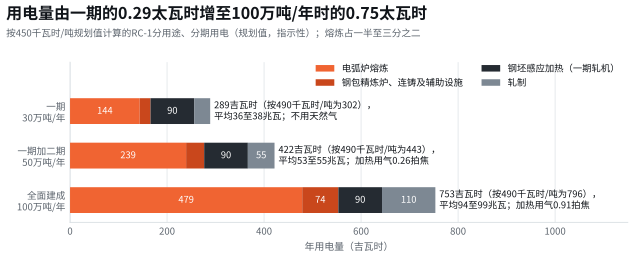
资料来源:Cameroon Steel参考配置RC-1(规划估算):电弧炉每吨钢水450千瓦时(上限值约490千瓦时),钢包精炼炉、连铸及辅助设施每吨钢水70千瓦时,一期轧机感应加热每吨钢坯300千瓦时,轧制每吨产品110千瓦时 [S07]。
英文全文 12分钟 · 2752词An electric steelworks at Kribi can be supplied in three steps: grid power first, firm gas-backed capacity for growth, gas for iron last
Cameroon Steel’s reference configuration RC-1 indicates an energy demand that rises from about 289 to 302 GWh of electricity a year, an average load of 36 to 38 MW and no gas in Phase 1, to about 753 to 796 GWh, 94 to 99 MW and 0.91 PJ of reheating gas at 1 Mtpa, before any direct-reduction module; the ranges run from the planning value of 450 kWh per tonne in the furnace to the upper value of about 490. These are planned, indicative values. A three-step energy plan matches that growth to Kribi’s infrastructure: a dedicated 225 kV connection with on-site compensation for Phase 1; firm, gas-backed capacity in the port substation’s later stage for Phases 2 and 3; and a gas allocation for direct reduction only once reserves are certified. Managed well, the plant’s schedulable load, with melting timed around the grid’s peaks, can make it a useful partner for a hydro-based grid, but it cannot offer sustained interruption.
9.1 RC-1’s indicative demand by phase
RC-1 is the reference configuration Cameroon Steel uses to plan its steel complex at Mboro. It is phased. Phase 1 is a bar and wire-rod works with a nameplate capacity of about 0.3 Mtpa of finished products and an expected sustained output of 270,000 to 300,000 t a year, built around one electric arc furnace of the 40 t class, a ladle furnace, a billet caster, induction billet heating, a rebar mill and a high-speed wire-rod mill. Its melt shop makes billets, and output can be flexed between rolled products and merchant billets for the re-rollers that today import about 60% of their charge (billet imports were 161 kt in 2023) [S32][S11]. Because domestic rebar capacity, about 627 kt, is already three and a half times demand of about 180 kt [S107], Phase 1’s tonnage is aimed at replacing imported billets and wire rod and at CEMAC exports, not at new rebar sales (White papers 04 and 09). Phase 2 adds a second melt line and a light and medium sections mill for about 0.2 Mtpa. Phase 3 adds melt-shop capacity and a heavy-sections and H-beam mill for about 0.5 Mtpa, bringing the complex to about 1 Mtpa. A direct-reduction module for Cameroonian ore is held in reserve [S07]. Table 9.1 gives the energy balance that follows from RC-1’s planning values.
Table 9.1 RC-1 indicative energy and utilities balance by phase (planned and indicative values)
| Indicator | Phase 1 | Phases 1 and 2 | Full build-out | Status |
|---|---|---|---|---|
| Finished products (t/yr), nameplate | 300,000 | 500,000 | 1,000,000 | planned |
| Expected sustained output, Phase 1 (t/yr) | 270,000 to 300,000 | not yet estimated | not yet estimated | derived |
| Liquid steel (t/yr) | 319,149 | 531,915 | 1,063,830 | derived |
| Metallic charge (t/yr) | 362,669 | 604,449 | 1,208,897 | derived |
| of which imported DRI or HBI at a 30% share (t/yr) | 108,801 | 181,335 | 362,669 | assumed share |
| Electricity at 450 kWh/t in the furnace (MWh/yr) | 288,957 | 421,596 | 753,191 | derived |
| Electricity at the upper value of about 490 kWh/t (MWh/yr) | 301,723 | 442,872 | 795,745 | derived |
| Electricity per tonne of product (MWh/t) | 0.96 to 1.01 | 0.84 to 0.89 | 0.75 to 0.80 | derived |
| Average load at 8,000 h/yr (MW) | 36.1 to 37.7 | 52.7 to 55.4 | 94.1 to 99.5 | derived |
| Maximum demand (MVA) | 55 (45 to 65) | about 85 to 110 (derived) | 160 (130 to 190) | assumed |
| Reheating gas (GJ/yr) | 0 | 260,000 | 910,000 | derived |
| Reheating gas (bcf/yr) | 0 | 0.24 | 0.83 | derived |
| Oxygen (million Nm3/yr) | 11.2 | 18.6 | 37.2 | derived |
| Scope 2 emissions at 226 g/kWh (t CO₂/yr) | 65,304 | 95,281 | 170,221 | derived |
| Scope 1 and 2 intensity (t CO₂/t product) | 0.32 | 0.33 | 0.33 | derived |
Source: Cameroon Steel reference configuration RC-1 (planning estimate), edition 10 October 2026: capacities, benchmarks and balances at nameplate [S07]; upper-value rows at about 490 kWh/t in the furnace and the sustained-output range derived (Annex A; White paper 03, Chapter 5); maximum demand for Phases 1 and 2 as interpolated in White paper 03, Chapter 9 (derived); Scope 2 and intensity at 450 kWh/t, about 0.01 t higher at 490; gas converted at 1.094 GJ per Mscf. Values are planned or indicative and will change with front-end engineering.
Three features of this balance shape the energy plan:
- Phase 1 is all-electric. Billets are heated by induction, so Phase 1 needs no gas contract [S07].
- Electricity per tonne falls as the works grows, from 0.96 to 0.75 MWh/t, because the later mills reheat with gas and because induction heating is confined to the Phase 1 mills.
- Gas arrives with Phase 2, at about 0.24 bcf a year, and reaches about 0.83 bcf at full build-out, a small fraction of the 4.9 bcf the Kribi power plant used in 2025 [S05].
9.2 Melting is half to two-thirds of the electricity
Figure 9.1 breaks the electricity demand down by end use.
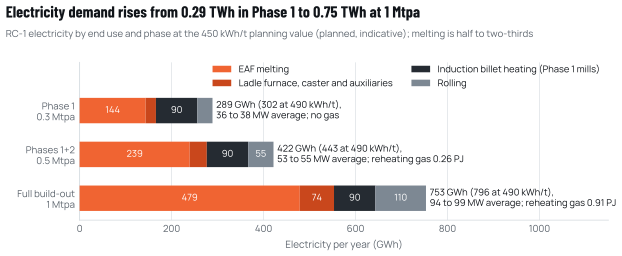
Source: Cameroon Steel reference configuration RC-1 (planning estimate): 450 kWh/t liquid for the EAF (upper value about 490), 70 kWh/t liquid for the ladle furnace, caster and auxiliaries, 300 kWh/t billet for induction heating of the Phase 1 mills, 110 kWh/t product for rolling [S07].
In Phase 1, the arc furnace takes about 144 GWh a year (50%) at the planning value, or about 156 GWh at the upper value, induction heating about 90 GWh (31%), rolling about 33 GWh (11%) and the ladle furnace and auxiliaries about 22 GWh (8%). At full build-out, the arc furnaces take about 479 GWh (64%), rolling about 110 GWh, the ladle furnaces and auxiliaries about 74 GWh and induction heating still about 90 GWh (derived from [S07]).
The planning values carry real uncertainty. Using the low and high ends of RC-1’s benchmark ranges (347 to 500 kWh/t for the furnace, 50 to 100 for auxiliaries, 150 to 400 for induction heating, 70 to 140 for rolling), Phase 1 electricity would range from about 193 to 354 GWh a year (derived). The furnace’s charge also matters. Read as an all-scrap value, the 450 kWh/t planning value rises by about 14.5 kWh/t for each 10% of DRI in the charge [S39], which is why this paper carries about 490 kWh/t, and about 302 GWh a year in Phase 1, as the upper planning value for RC-1’s 30% DRI or HBI [S07]. Raising the DRI share further, to 50%, would add another 29 kWh per tonne, about 9 GWh a year. A supply contract for Phase 1 should therefore be written around a range, with a mechanism to adjust contracted capacity after the first year of operation.
9.3 The load swings by 30 to 35 MW within each hour
Average loads hide the shape that matters for the grid. Figure 9.2 is an illustrative operating day of the Phase 1 works, built from RC-1’s planning values at one-minute resolution.
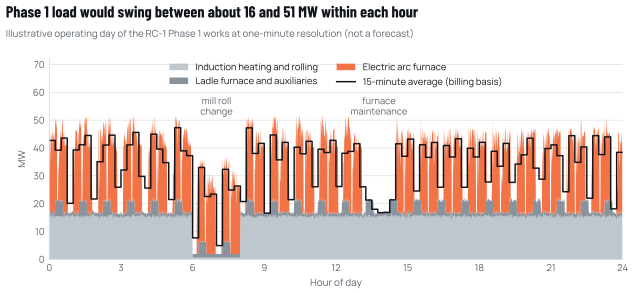
Source: Cameroon Steel illustration from RC-1 benchmarks: heats of about 40 t and about 18 MWh (450 kWh/t) at roughly one per hour; induction heating 11.25 MW and rolling 4.13 MW while the mill runs; auxiliaries 1.3 MW plus ladle-furnace pulses [S07]. Not a forecast.
Three numbers from this illustration are useful for contracting (derived):
- the steady base of about 16 to 18 MW (mill, induction heating and auxiliaries) runs whenever the mill runs;
- the furnace adds 20 to 30 MW for about 45 minutes in every hour, so the instantaneous load moves by about 30 to 35 MW within each cycle;
- the 15-minute average peaks at about 47 MW, against a planned maximum demand of 55 MVA (45 to 65) [S07]. The ratio of average load to maximum demand is about 65% to 70%, which is why the structure of the capacity charge matters (Chapter 3).
The illustration also shows the two kinds of planned stoppage that a supply contract must accommodate: a mill stop, for example for a roll change, which removes the steady base for an hour or two, and a furnace stop for maintenance, which removes the fluctuating component. Each is a step change of 15 to 30 MW that the grid operator should know about in advance.
9.4 A three-step energy plan
Table 9.2 sets out a plan that matches each phase of the steelworks to the energy infrastructure available at Kribi and to the policy steps proposed in Chapter 10.
Table 9.2 A phased energy plan for an electric steelworks at Kribi (indicative)
| Element | Step 1: Phase 1 (works from 2029, first heat H2 2030) | Step 2: Phases 2 and 3 (indicative, from 2032) | Step 3: DRI reserve (after 2034, indicative) |
|---|---|---|---|
| Grid connection | Dedicated 225 kV bay at the port substation; 225/33 kV plant substation | Extension within the substation’s 330 to 400 MW stage | As step 2 |
| Contracted capacity | About 55 MVA (45 to 65) | Up to about 160 MVA (130 to 190) | Plus the DRI module’s load |
| Energy supply | Large-user contract with the utility or an independent producer | Add firm gas-backed capacity at the Kribi gas plant | As step 2; hydro supply for hydrogen blending later |
| Power quality | SVC or STATCOM and filters from a connection study | Extend for further furnaces (cubic flicker summation) | As step 2 |
| Gas | None | 0.24 to 0.83 bcf/yr for reheating, by pipeline from the gas plant | About 8.4 to 9.1 bcf/yr for 1 Mtpa of DRI |
| Renewables | On-site solar where economic; hydro attribute if wheeling rules allow | Long-term hydro contract linked to new capacity | Hydrogen-ready shaft furnace |
| Essential loads | Standby generators and battery ride-through | Extend | Extend |
| Flexibility | Melting scheduled around peaks; capped emergency load-shedding | As step 1, across several furnaces | DRI module can modulate within limits |
| Policy prerequisite | Large-user tariff; grid code for fluctuating loads | Gas allocation; wheeling rules | Certified reserves; DRI gas price formula |
Source: Cameroon Steel analysis; Cameroon Steel reference configuration RC-1 (planning estimate) [S07]; PAK [S14]; gas volumes derived (Chapters 6 and 7).
Step 1 relies only on infrastructure that will exist by the end of 2026: the 225 kV line and substation [S14]. Its critical needs are contractual (a large-user supply contract) and technical (the connection study and compensation). It needs no gas, which insulates the first phase from the uncertainty created by the FLNG’s departure.
Step 2 depends on two things outside the plant: the substation’s later stage of 330 to 400 MW, and firm thermal capacity to cover dry seasons and transmission outages. The natural source of that capacity is the Kribi gas plant, through a dedicated part of its output or an extension within its 330 MW licence [S21][S22], which in turn requires a gas allocation. Reheating gas for the sections mills is small and could be delivered by a pipeline spur from the gas plant.
Step 3 depends on the gas and ore conditions set out in Chapter 7. It should not be a planning assumption until reserves are certified and a DR-grade pellet supply is identified.
9.5 What the electricity would cost in Phase 1
At the three price benchmarks used in this paper, Phase 1’s electricity bill at the planning value of 289 GWh would differ by a factor of almost six (derived from [S07][S01][S03][S04]); at the upper value of about 302 GWh each figure is about 4% higher:
- at the legacy high-voltage average of 18.4 FCFA/kWh, about 5.3 bn FCFA a year;
- at the 2026 all-in price of the 9 to 10 MW MV band, 43.7 FCFA/kWh, about 12.6 bn FCFA a year, and about 16.4 bn FCFA at the 56.7 FCFA/kWh that the same structure would imply for the plant’s peaky load shape;
- at the regulator’s cost-reflective average of 105.46 FCFA/kWh, about 30.5 bn FCFA a year.
For comparison, Cameroon’s largest existing steel group, Prometal, paid about 8.37 bn FCFA for electricity in 2024 for a load of about 40 MW [S42]. These are indicative operating-cost figures based on public price benchmarks, not estimates of any contract. They show why the price framework of Chapter 3 is the single largest energy variable in the plant’s economics, larger than any plausible gain from energy efficiency inside the plant, and why the structure of the capacity charge matters as much as the energy price. White paper 04 (Chapter 8) places this power cost beside the cost of metallics and conversion in an indicative comparison of a Kribi billet with an imported one.
9.6 Schedulable load can make the steelworks a partner for the grid, within limits
An arc-furnace steelworks is often seen as a problem for a grid. On a hydro-based system with seasonal shortfalls, it can also be part of the solution, because part of its load can be moved within the day at low cost.
This flexibility is schedulable, not interruptible. A single furnace needs about 7,300 to 7,900 hours a year to cast Phase 1’s nameplate tonnage (White paper 03, Chapter 5), so each hour of curtailment beyond the planned non-melting hours costs about one heat (about 40 t) that cannot be recovered later: about 4,000 t of liquid steel, some 1.3% of nameplate liquid output, for every 100 hours (derived). On a system with a peak of 1,278 MW [S01], moving the furnace’s 20 to 30 MW out of the evening peak is worth about 1.6% to 2.3% of peak demand, a useful contribution for a grid that left 150 MW of industrial demand unserved in 2026 [S02]. The large-user framework should therefore reward scheduling, through time-of-use energy prices or a capacity charge measured at the system peak, and cap any emergency load-shedding in hours and events a year, with notice that lets the heat in progress be finished safely.
9.7 Energy management inside the plant
The plant’s own practices determine where it falls within the benchmark ranges. The main levers in an electric steelworks are well known:
- Furnace practice. Continuous charging with scrap preheating, as in the Consteel process, has achieved about 321 kWh/t with power savings of 10% to 15% and electrode consumption below 1 kg/t [S38]; good scrap preparation and foamy-slag practice reduce energy and flicker together.
- Hot charging. Synchronising the caster and mill so that billets reach the induction heaters still hot reduces Phase 1’s induction energy towards the low end of its 150 to 400 kWh/t range [S07].
- Metering and monitoring. Sub-metering of every major consumer, with real-time dashboards for kWh per tonne, power-on time, electrode use and power quality at the point of common coupling, turns benchmarks into daily targets.
- Reporting. Publishing energy intensity and Scope 2 emissions annually, on both the location-based and market-based methods, supports the low-emission positioning described in Chapter 8.
Other sources cited in the English text
- S32Cameroun: le groupe Prometal décroche 26 milliards FCFA auprès d’Afreximbank…. Sikafinance, 30 Sep 2026.sikafinance.com/marches/cameroun-le-groupe-prometal-decroche-26-millia…
- S11UN Comtrade public API, Cameroon (reporter 120), HS 72/73 and 6-digit lines, 2019-2023. UN Statistics Division.comtradeapi.un.org/public/v1/preview/C/A/HS?reporterCode=120&period=20…
- S107Production: les acteurs en présence. Cameroon Tribune, 11 May 2026.cameroon-tribune.cm/article.html/76600/fr.html/details_2
- S05Données pétrolières 2025. SNH, posted Jun 2026.snh.cm/wp-content/uploads/2026/06/Donnees-petrolieres-2025.pdf
- S39ENERGIRON technology (DRI-EAF with natural gas or H₂). EC ICIT, ref. 12 Feb 2026.innovation-centre-for-industrial-transformation.ec.europa.eu/innovativ…
- S14Kribi franchit la ligne électrique 225 kV. PAK, 6 Aug 2025.Cited by title and date
- S21Kribi Power Development Corporation. MIGA (World Bank Group), 2014.miga.org/project/kribi-power-development-corporation-0
- S22The AfDB praises the impacts of the planned extension of the Kribi gas-fired power plant. Business in Cameroon, 1 Jul 2020.businessincameroon.com/energy/0107-10486-the-afdb-praises-the-impacts-…
- S01Rapport d’activités 2025 de l’ARSEL. ARSEL (electricity regulator), 7 Sep 2026.arsel-cm.org/wp-content/uploads/2026/09/Rapport-ARSEL-2025.pdf
- S03Tableaux tarifaires, Décision ARSEL N°00000427 (MT 2023-2025). ARSEL, uploaded Jan 2026.arsel-cm.org/wp-content/uploads/2026/01/TABLEAUX-TARIFAIRES-decision-M…
- S04Décision fixant le montant de la RMA ENEO au titre de l’exercice 2025 (réajustée). ARSEL, 19 Dec 2025.arsel-cm.org/wp-content/uploads/2026/01/Decision-fixant-le-Montant-de-…
- S02Nachtigal power line delays leave 150 MW of industrial demand unmet. Business in Cameroon, 9 Oct 2026.businessincameroon.com/public-management/0910-16939-nachtigal-power-li…
- S38Enhanced EAF steelmaking through continuous charging (Consteel). EC ICIT, n.d., accessed Oct 2026.innovation-centre-for-industrial-transformation.ec.europa.eu/innovativ…
本章引用的资料来源
方括号内的标记对应以下来源(按原文语言列出),完整列表见附录。 完整来源列表
- S07Cameroon Steel reference configuration RC-1 (planning estimate), edition 10 October 2026 (RC-1.1): phases, benchmarks with ranges, indicative balances and schedule. Cameroon Steel,2026年10月10日.按标题和日期引用
- S42Prometal, Acero Metal, Aciéries du Cameroun… qui est le plus gros consommateur d’électricité de la métallurgie camerounaise. EcoMatin,2026年7月15日.ecomatin.net/prometal-acero-metal-acieries-du-cameroun-qui-est-le-plus…
引用本章
Cameroon Steel(2026)。喀麦隆水电主导的电网可为低碳钢铁供电,前提是大用户获得稳定供电、明确电价和天然气(中文摘要版)。白皮书05,第9章:克里比电炉钢厂可分三步供能:先用电网电力,扩产时增加燃气支撑的稳定容量,最后才用天然气炼铁。CS-WP-05。https://www.cameroon-steel.com/zh/library/energy-for-industry/energy-plan/
来源