White paper 06 · Chapter 9
Finance and standards: lenders, buyers and certifiers will ask for proof
International lenders and steel buyers have converged on a common set of expectations for a new steelworks: quantify the greenhouse gas footprint, assess climate risk, compare lower-carbon alternatives, report annually and have the figures verified. RC-1 Phase 1 sits at or about the 100,000 t threshold of the Equator Principles, and later phases are well above it, so the strictest of those expectations apply in practice from the start. On the main certification scales, the illustrative RC-1 intensity clears the entry level comfortably but remains far from "near-zero". That position is credible and financeable, provided it is backed by a measured, verified and improving record.
In this chapter (7)
- 9.1 Lenders’ climate thresholds
- 9.2 The alternatives analysis is already largely written
- 9.3 What buyers and certifiers measure
- 9.4 Verification turns an estimate into evidence
- 9.5 Disclosure: from lenders to investors and buyers
- 9.6 Green finance follows verified performance
- 9.7 Implications for Cameroon Steel
9.1 Lenders’ climate thresholds
Three sets of standards frame what development finance institutions and commercial banks will ask of the project.
IFC Performance Standard 3 on resource efficiency and pollution prevention requires projects expected to emit more than 25,000 t CO2e a year to quantify their direct and indirect emissions annually and to consider technically and financially feasible options to reduce them [S21].
The Equator Principles (EP4), the risk-management framework applied by many banks to project finance, add two requirements above 100,000 t CO2e a year of combined Scope 1 and Scope 2 emissions: a climate change risk assessment covering both physical and transition risks, including an alternatives analysis that evaluates lower-GHG technologies, and annual public reporting of emissions during operation [S22]. Climate change risk assessments are also required for all Category A projects, which a steelworks of this size would be. Because Cameroon is a non-designated country under EP4, the IFC Performance Standards and the World Bank Group’s environmental, health and safety guidelines apply in full [S22].
Paris alignment. Multilateral development banks assess new operations against a joint methodology with two building blocks, one for mitigation and one for adaptation [S24]. The IFC committed to align 85% of its new real-sector operations from 1 July 2023 and 100% from 1 July 2025, and reports that it reached full alignment in its 2025 financial year [S23]. In practice, a steel project must show that its technology and emissions are consistent with low-carbon development pathways, that it does not lock in high-emission assets, and that it is resilient to physical climate risk.
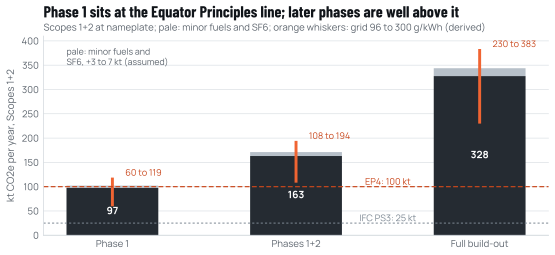
Figure 9.1 sets the RC-1 footprint against these thresholds.
Source: WP06 model on the Cameroon Steel reference configuration RC-1 (planning estimate) [S90]; IFC Performance Standard 3 [S21]; Equator Principles EP4 [S22].
At the planning grid factor of 226 g/kWh, Phase 1 process emissions and purchased electricity come to about 97,000 t a year on the RC-1 model. Diesel for mobile plant, LPG and leakage of SF6 from switchgear, which the model omits, would add about 3,000 to 7,000 t (assumed; Chapter 4), taking Phase 1 Scopes 1 and 2 to about 100,000 to 104,000 t. Phase 1 therefore sits at or about the EP4 threshold, not below it. On the model alone the threshold is crossed at a grid factor of about 236 g/kWh; with the minor sources it is crossed at about 219 g/kWh, below the 2024 average. At the expected sustained output of 270,000 to 300,000 t a year, the total would be about 90,000 to 104,000 t, on either side of the threshold. With Phase 2 the footprint reaches about 163,000 t and at 1 Mtpa about 328,000 t before the minor sources (derived). The practical conclusion is that Cameroon Steel should apply the above-100,000 t requirements from Phase 1, rather than plan around a threshold that the project’s own estimate straddles.
Table 9.1 Lender climate requirements and the RC-1 response
| Requirement | Trigger | What it asks | RC-1 status | Planned response |
|---|---|---|---|---|
| GHG quantification (IFC PS3) | Above 25,000 t CO2e/yr | Annual quantification of Scope 1 and 2; feasible reduction options | Applies in every phase | Inventory from first heat (Chapter 2) |
| Climate change risk assessment (EP4) | Category A, or above 100,000 t Scopes 1+2 | Physical and transition risk, aligned with recognised disclosure frameworks | Applies (Category A; Phase 1 at or about the threshold) | Completed within the environmental and social impact assessment (Chapter 7) |
| Alternatives analysis (EP4) | Above 100,000 t Scopes 1+2 | Comparison of technically and financially feasible lower-GHG alternatives | Applies from Phase 1, which sits at or about the threshold; well exceeded from Phase 2 | Route, power, iron-unit and reheating alternatives (Chapters 1, 3, 4, 6) |
| Public GHG reporting (EP4) | Above 100,000 t Scopes 1+2 (encouraged above 25,000 t) | Annual public reporting of emissions and intensity | Adopted from Phase 1 | Annual verified report |
| Paris alignment (MDBs) | All new operations | Consistency with low-carbon pathways; no lock-in; adaptation | Applies | Evidence in this paper; stepwise pathway (Chapter 10) |
Source: IFC Performance Standards [S21]; Equator Principles EP4 [S22]; joint MDB methodology [S24]; IFC [S23].
9.2 The alternatives analysis is already largely written
The EP4 alternatives analysis asks a project to compare lower-GHG technologies used in the same industry. For a steelworks, the first and largest alternative is the route itself. By choosing an electric-arc furnace and excluding a blast furnace, RC-1 avoids about 1.8 t of CO2 per tonne compared with the blast-furnace average: about 0.54 to 0.58 t against 2.34 t (Chapters 1 and 4). Within the electric route, the analysis must then compare the alternatives that remain open: sources and contracts for electricity (Chapter 3), the share and carbon content of DRI and HBI (Chapter 4), induction against gas reheating, scrap-preheating or continuous-charging furnace designs, and the timing and configuration of a domestic direct-reduction module (Chapter 6). This paper provides the desk-level analysis; the environmental and social impact assessment will complete it with supplier data.
9.3 What buyers and certifiers measure
Buyers of steel increasingly ask for evidence of low emissions, either for their own Scope 3 reporting, for public procurement rules or to meet commitments made through buyers’ clubs. Several definitions and certification schemes now compete. They share a boundary (Scopes 1 and 2 plus upstream emissions of purchased intermediates) but differ in how they treat scrap.
- The IEA’s near-zero definition, proposed for G7 discussions in 2022, sets a threshold that slides with the scrap share of the metallic input: 0.40 t CO2e per tonne of crude steel at 0% scrap, falling linearly to 0.05 t at 100% scrap [S06].
- ResponsibleSteel, a multi-stakeholder standard for site certification, defines four decarbonisation progress levels on a similar sliding scale. Progress Level 1 corresponds to about 2.34 t CO2e per tonne at 20% scrap and 0.96 t at 80% scrap; Progress Level 4 aligns with the IEA near-zero threshold [S37][S38]. Sites that reach at least Level 1 for decarbonisation and materials sourcing may market their products as "Certified Steel" [S37].
- The Global Steel Climate Council’s Steel Climate Standard takes a technology-neutral approach, applying the same threshold to all producers regardless of scrap content, combined with company-level science-based targets [S39].
- Germany’s Low Emission Steel Standard (LESS), launched in April 2024, classifies steel products into classes according to their product carbon footprint, documented in an EPD, and their scrap content [S40].
- The European Union announced a voluntary low-carbon steel label in its Action Plan for Steel and Metals of March 2025, intended to be referenced in public procurement and support schemes; its design was still under negotiation in 2026 [S36].
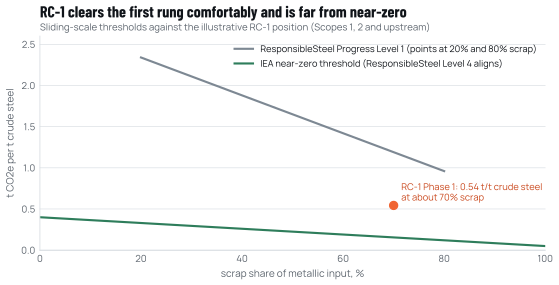
Figure 9.2 places the illustrative RC-1 Phase 1 intensity on the two published sliding scales.
Source: IEA (2022) [S06]; ResponsibleSteel, Decarbonisation Progress Levels (2024) [S37]; WP06 model on the Cameroon Steel reference configuration RC-1 (planning estimate) [S90].
At about 70% scrap, the IEA near-zero threshold is about 0.155 t CO2e per tonne of crude steel, and the ResponsibleSteel Level 1 threshold, interpolated between its published points, about 1.19 t (derived). RC-1’s illustrative 0.54 t per tonne of crude steel sits well inside Level 1 and about three and a half times the near-zero threshold. The sliding-scale approach is itself debated: recyclers have argued that it rewards ore-based production relative to scrap-based production [S100], while its proponents argue that scrap is limited and that the scale rewards progress where progress is hardest. Cameroon Steel’s position is to report against both kinds of scale, transparently.
Table 9.2 Low-emission steel standards and labels compared
| Standard or label | Owner | Unit assessed | Boundary | Treatment of scrap | Where RC-1 would stand (illustrative) |
|---|---|---|---|---|---|
| IEA near-zero definition | IEA (for G7) | Crude steel | Scopes 1, 2 and upstream | Sliding: 0.40 to 0.05 t CO2e/t | About 3.5 times the threshold at 70% scrap |
| ResponsibleSteel progress levels | ResponsibleSteel | Site | Scopes 1, 2 and upstream Scope 3 | Sliding; Level 4 aligned with IEA | Within Level 1; higher levels need lower-carbon iron and power |
| Steel Climate Standard | Global Steel Climate Council | Product and company | Scopes 1, 2 and 3 | Technology-neutral, single threshold | To be assessed against the published trajectory |
| Low Emission Steel Standard (LESS) | German steel federation | Product (via EPD) | Product carbon footprint | Classes by footprint and scrap content | To be assessed once EPDs exist |
| EU low-carbon steel label | European Commission | Product | Under development | Under negotiation | Not yet applicable |
Source: [S06][S37][S38][S39][S40][S36]. RC-1 positions derived by Cameroon Steel from the illustrative footprint.
9.4 Verification turns an estimate into evidence
Every requirement above assumes that the reported figures can be checked. Verification of greenhouse gas statements follows ISO 14064-3, which distinguishes reasonable assurance, a positive opinion comparable to a financial audit, from limited assurance, a statement that nothing has come to the verifier’s attention to suggest a material misstatement [S101]. Lenders and buyers increasingly expect reasonable assurance for Scopes 1 and 2, where the works controls the data, and accept limited assurance for upstream emissions in the first years, while supplier data mature. CBAM adds its own layer: actual embedded emissions declared by an EU importer must be verified by an accredited verifier, or the importer falls back on default values [S27]. A works that plans one monitoring system and one verification cycle to serve all of these users avoids paying several times for the same evidence.
For RC-1 the practical sequence is a monitoring plan approved before commissioning, metering of the minor fuels and of the switchgear SF6 inventory as well as of the main inputs, a first verified inventory for the first full year of operation, and annual verification thereafter, with the verifier’s statement published alongside the climate report (Chapter 10). Until then, every figure in this paper remains an estimate, and the statement of each figure’s status is part of what a lender will check.
9.5 Disclosure: from lenders to investors and buyers
Lenders are not the only audience. The International Sustainability Standards Board’s IFRS S2 standard on climate-related disclosures, issued in June 2023 and being adopted in a growing number of jurisdictions, requires reporting entities to disclose their Scope 1, Scope 2 and Scope 3 emissions and their climate-related risks and opportunities, building on the recommendations of the Task Force on Climate-related Financial Disclosures [S102]. Steel buyers that report under such rules will need their suppliers’ emissions data to complete their own Scope 3 inventories, and will prefer suppliers who can provide it in a verified, standard form. Buyers’ initiatives have reinforced the same message: the procurement thresholds used by the SteelZero initiative, as reported by the IEA, range from about 400 to 500 kg CO2e per tonne for steel made entirely from ore to about 50 to 100 kg for steel made entirely from scrap [S06].
For Cameroon Steel this means that its climate data will be used by three different audiences (lenders testing thresholds, buyers completing their own inventories and certifiers assessing progress) and must satisfy all three. The questions a lender’s climate due diligence is likely to ask, and where this paper begins to answer them, are summarised below.
Table 9.3 Questions a lender’s climate due diligence is likely to ask
| Question | Where this paper answers it | Evidence still needed |
|---|---|---|
| What are the expected Scope 1 and Scope 2 emissions, by phase, with ranges? | Chapter 4; Annex A | Supplier guarantees; contracted power |
| Which lower-carbon alternatives were considered, and why was the chosen design preferred? | Chapters 1, 3, 4 and 6 | Formal alternatives analysis in the impact assessment |
| How exposed is the project to carbon pricing and border measures? | Chapter 5 | Long-product benchmarks; default values by product |
| How exposed is the site to physical climate hazards, and how will it adapt? | Chapter 7 | Site data; design basis |
| Is the project consistent with a low-carbon pathway, without lock-in? | Chapters 6 and 10 | Ore and gas studies; power strategy |
| How will emissions be measured, verified and reported? | Chapters 2 and 10 | Monitoring plan; verifier appointment |
Source: Cameroon Steel, based on EP4 [S22], IFC Performance Standard 3 [S21] and the joint MDB methodology [S24].
9.6 Green finance follows verified performance
Green loans, green bonds and sustainability-linked loans are increasingly available for industrial decarbonisation, but steel is a sector where lenders and investors are wary of claims that cannot be checked. A use-of-proceeds instrument would need to show that the financed assets meet a recognised eligibility test; a sustainability-linked instrument would tie its margin to key performance indicators such as verified carbon intensity, the share of low-carbon electricity, the scrap share or the carbon content of purchased iron units, against an ambitious and pre-agreed trajectory. In either case, the foundation is the same: a robust inventory, third-party verification and annual public reporting.
9.7 Implications for Cameroon Steel
The standards reviewed here point to a consistent set of commitments that a credible low-carbon steelworks should be ready to make, and that Cameroon Steel intends to pursue as the project advances: an EP4-grade climate change risk assessment and alternatives analysis in the environmental and social impact assessment; an inventory designed to the GHG Protocol, ISO 14404 and CBAM rules from the first heat; annual verified public reporting from Phase 1; EPDs for its main products; and, after the first years of stable operation, certification against a recognised site standard such as ResponsibleSteel. Chapter 10 sets these alongside the operational and supply-chain levers in a single pathway.
Sources cited in this chapter
Bracketed markers refer to these sources; the full list is in the annex. Full list of sources
- S21Performance Standards on Environmental and Social Sustainability. IFC, 1 Jan 2012.ifc.org/en/insights-reports/2012/ifc-performance-standards
- S22The Equator Principles EP4. Equator Principles Association, Jul 2020 (effective 1 Oct 2020).equator-principles.com/app/uploads/The-Equator-Principles_EP4_July2020…
- S24Joint MDB methodological principles for assessment of Paris alignment of new operations (presentation). Multilateral development banks (hosted by EIB), 5 Dec 2023.trad.eib.org/attachments/press/05-12-2023-joint-mdb-paris-alignment-pr…
- S23Paris alignment at IFC. IFC.ifc.org/en/what-we-do/sector-expertise/climate-business/paris-alignmen…
- S90Cameroon Steel reference configuration RC-1 (planning estimate): phases, planning values, balances and indicative schedule, edition 10 October 2026. Cameroon Steel, 10 Oct 2026.Cited by title and date
- S06Achieving Net Zero Heavy Industry Sectors in G7 Members. International Energy Agency, 19 May 2022.iea.blob.core.windows.net/assets/c4d96342-f626-4aea-8dac-df1d1e567135/…
- S37The Decarbonisation Progress Levels. ResponsibleSteel, 23 Sep 2024.responsiblesteel.org/resources/the-decarbonisation-progress-levels
- S38Revisions to ResponsibleSteel’s Principle 10: Greenhouse Gas Emissions and Climate Change. ResponsibleSteel, 23 Apr 2024.responsiblesteel.org/news/revisions-to-responsiblesteels-principle-10-…
- S39The Steel Climate Standard. Global Steel Climate Council.globalsteelclimatecouncil.org/the-standard/
- S40Germany introduces new green steel certification standard (Low Emission Steel Standard). EUROMETAL, Apr 2024.eurometal.net/germany-introduces-new-green-steel-certification-standar…
- S36Factsheet: Action Plan on Steel and Metals. European Commission, Mar 2025.ec.europa.eu/commission/presscorner/api/files/attachment/880887/Factsh…
- S100BIR warns against sliding-scale steel green standards. EUROMETAL.eurometal.net/bir-warns-against-sliding-scale-steel-green-standards/
- S101ISO 14064-3:2019, Greenhouse gases: specification for the verification and validation of GHG statements. International Organization for Standardization, 2019.iso.org/standard/66455.html
- S27Regulation (EU) 2023/956 establishing a carbon border adjustment mechanism, Annexes I and II. Official Journal of the EU, L 130, 16 May 2023.eur-lex.europa.eu/legal-content/EN/TXT/PDF/?uri=CELEX:32023R0956
- S102IFRS S2 Climate-related Disclosures. IFRS Foundation, International Sustainability Standards Board, Jun 2023.ifrs.org/issued-standards/ifrs-sustainability-standards-navigator/ifrs…
Cite this chapter
Cameroon Steel (2026). Lower-carbon steel from Cameroon: it could reach a third of the world’s carbon intensity. White paper 06, chapter 9: Finance and standards: lenders, buyers and certifiers will ask for proof. CS-WP-06. https://www.cameroon-steel.com/en/library/lower-carbon-steel/finance-and-standards/
Source