White paper 06 · Chapter 8
Circularity: scrap is the cleanest input, and slag and dust are resources
Circularity is not a side topic for a steelworks; it is one of its main carbon levers. Each tonne of scrap melted in place of ore-based iron avoids about 1.5 t of CO2, and for RC-1 each extra 10 points of scrap in the charge removes about 0.09 t of CO2 per tonne of product. Cameroon, however, generates little scrap: the only published estimate is 53,000 to 62,000 t a year, most of it already used by existing mills, against an RC-1 need of about 254,000 t in Phase 1. RC-1 therefore plans on about 30,000 t a year of domestic scrap and imports the rest. On the output side, the works would produce about 45,000 t of slag and about 4,800 t of zinc-bearing furnace dust a year in Phase 1. Both can be valorised, the first as aggregate for roads, the second as a source of recovered zinc, if the outlets are prepared before the first heat.
In this chapter (7)
8.1 Scrap is the most powerful lever the industry already has
worldsteel estimates that each tonne of scrap used to make steel avoids about 1.5 t of CO2 [S02]. Around 630 Mt of scrap is used in global steelmaking each year, avoiding nearly 950 Mt of CO2, according to the Bureau of International Recycling; consumption reported by its tracked countries rose by 4.5% to 480 Mt in 2025 [S68]. Under the accounting conventions described in Chapter 2, scrap enters a steelworks with no upstream emissions, and ferrous scrap (CN 7204) is outside the scope of the EU CBAM [S27].
For RC-1, the scrap share is the second-largest lever after the carbon content of purchased DRI. Figure 8.1 shows that, at the Phase 1 configuration and a grid factor of 226 g/kWh, raising the scrap share of the charge by 10 points (and lowering the DRI share accordingly) reduces the total intensity by about 0.09 t per tonne. A works melting 90% scrap would emit about 0.40 t per tonne including upstream iron units; one melting 50% would emit about 0.75 t.
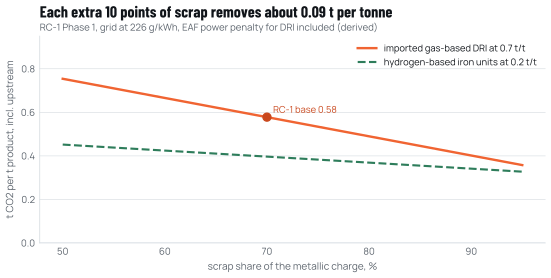
Source: WP06 model on the Cameroon Steel reference configuration RC-1 (planning estimate) [S90]; DRI power penalty [S15].
8.2 Cameroon is short of scrap
Scrap availability depends on how much steel a country put into use decades ago. Cameroon’s stock of steel in use is small by international standards, and its scrap arisings are correspondingly limited. The only quantified study, by researchers at the national polytechnic school and the local materials research centre, estimated arisings of 53,000 to 61,833 t a year using 2006 data, of which about 53% was collected by recyclers, 29% by informal dismantlers and 15% by exporters [S88]. More recent industry statements indicate that local scrap covers only about 40% of the needs of Cameroon’s existing mills, the balance coming from imported billets [S89]. Africa as a whole is a net importer of ferrous scrap, with exports of about 1.2 Mt and imports of about 3.4 Mt in 2025 [S03].
Figure 8.2 sets RC-1’s scrap need against that evidence. Even allowing for growth in arisings since 2006, domestic scrap could supply only part of Phase 1 and a small share of the full build-out, and most of what is collected already feeds existing mills. The RC-1 planning case therefore assumes about 30,000 t a year of domestic scrap, with a range of 0 to 60,000 t [S90]. The balance would have to be imported scrap or a higher share of DRI or HBI, which, as Chapter 4 showed, raises the footprint.
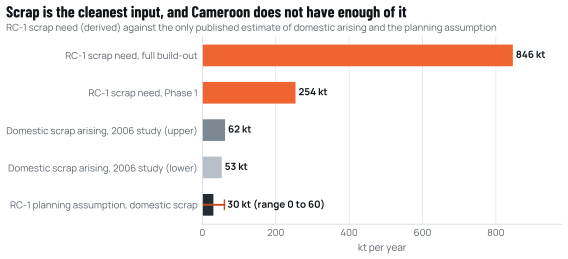
Source: WP06 model on the Cameroon Steel reference configuration RC-1 (planning estimate) [S90]; Bidoung et al. (2007), 2006 data [S88].
Table 8.1 Scrap in Cameroon and in the RC-1 balance
| Indicator | Value | Year | Status | Source |
|---|---|---|---|---|
| Domestic scrap arising (only published estimate) | 53,000 to 61,833 t/yr | 2006 data | sourced | [S88] |
| Share of domestic scrap collected by formal recyclers | about 53% | 2006 data | sourced | [S88] |
| Local scrap coverage of existing mills’ needs | about 40% | 2026 | sourced | [S89] |
| Africa ferrous scrap exports / imports | about 1.2 Mt / 3.4 Mt | 2025 | sourced | [S03] |
| RC-1 scrap need, Phase 1 | about 254,000 t/yr | at nameplate | derived | [S90] |
| RC-1 planning assumption for domestic scrap | about 30,000 t/yr (range 0 to 60,000) | Phase 1 | assumed | [S90] |
| Imported scrap and DRI/HBI, Phase 1 | about 224,000 t and 109,000 t/yr; port receipts with consumables about 351,000 t/yr | at nameplate | derived | [S90] |
| RC-1 scrap need, full build-out | about 846,000 t/yr | at nameplate | derived | [S90] |
| Effect of 10 more points of scrap in the charge | about −0.09 t CO2 per t product | Phase 1 | derived | [S90] |
Source: as listed.
Three implications follow. First, RC-1 will be a scrap importer as well as a buyer of domestic scrap, and its carbon performance depends on its ability to secure scrap of suitable quality on the international market. Second, a well-organised domestic collection system is worth developing for both carbon and economic reasons: it creates local jobs, keeps value in the country and lowers the works’ footprint. That system must meet international labour and safety standards, including checks against child labour in informal collection, which lenders will require under IFC Performance Standard 2 [S21]. Third, domestic scrap supply will grow over time as Cameroon builds: the reinforcing bar and sections that RC-1 and other mills supply to the country’s buildings and infrastructure today will be part of its scrap stock in the second half of the century.
A domestic scrap programme for RC-1 would draw on several streams: demolition and construction waste, end-of-life vehicles and machinery, industrial offcuts and turnings, and end-of-life public assets sold through tender. It would work through licensed collectors and dealers rather than through informal purchases at the gate, with weighbridges, traceable payments, safety training and personal protective equipment for collection partners. It would also need safeguards against the purchase of stolen material, such as power cables, rail fittings or road furniture, which is a recurrent problem wherever scrap prices rise. A programme of this kind takes years to build, and its benefits accumulate: each additional tonne of domestic scrap replaces an imported tonne of scrap or DRI, reducing both freight and the works’ footprint.
Scrap quality matters as well as quantity. Copper and tin from wiring and coatings cannot be removed in an electric furnace and accumulate in the steel; wire rod for drawing is particularly sensitive to them. A scrap-sorting and quality-control system at the yard, with radiation detection at the gate, is a standard requirement for an electric-arc works.
8.3 Importing scrap: the other half of the charge
On the planning case, Phase 1 would import about 224,000 t of scrap a year, in addition to about 109,000 t of DRI or HBI (derived). With consumables, port receipts would come to about 351,000 t a year [S90]. Africa as a whole is already a net importer of ferrous scrap [S03], and the world market is large: the countries tracked by the Bureau of International Recycling used about 480 Mt in 2025 [S68]. Buying a few hundred thousand tonnes a year is therefore feasible, but it has three consequences for carbon. First, ocean freight and handling of imported scrap add Scope 3 emissions that this paper does not count (Chapter 4); they are small per tonne but should be reported. Second, imported scrap competes with buyers whose own decarbonisation plans depend on scrap, so the price and availability of low-residual grades may tighten as electric steelmaking grows (Chapter 1). Third, ferrous scrap is not a CBAM good and enters the CBAM calculation with no embedded emissions [S27], so every tonne of scrap that replaces a tonne of DRI lowers the CBAM charge on an EU-bound tonne as well as the total footprint, by about €7 per tonne of product for every 10 points of charge (Chapter 5).
The planning case is deliberately cautious. If domestic collection reached the upper end of the 2006 estimate, about 60,000 t a year, the works would still import about three-quarters of its Phase 1 scrap; if it found none, port receipts would rise by about 30,000 t. Either way, the carbon result depends on the share of scrap in the charge, not on where the scrap comes from. That is why the pathway in Chapter 10 treats more scrap in the charge, domestic or imported, as a single lever, and why a domestic collection programme is worth building for economic and social reasons as much as for carbon.
8.4 Slag: from residue to road aggregate
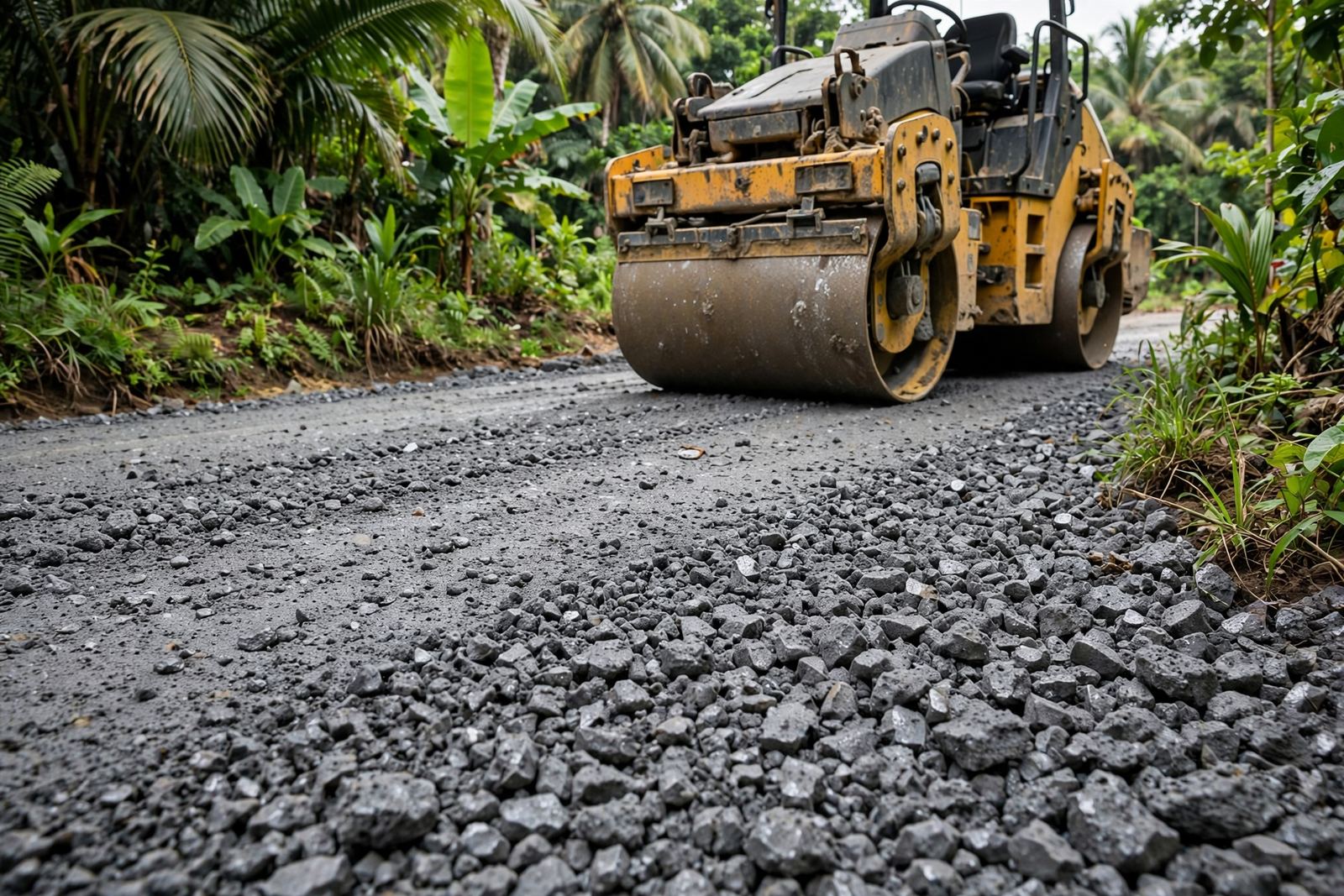
An electric-arc furnace leaves about 110 to 180 kg of solid residue, mostly slag, per tonne of product, according to the IFC’s guidelines for steel mills [S20]; RC-1 uses 140 kg of slag per tonne of liquid steel. That gives about 45,000 t a year in Phase 1 and about 149,000 t at full build-out (Figure 8.3). EAF slag is a hard, dense, angular material that, after crushing, metal recovery and weathering to stabilise free lime, is widely used as road base, asphalt aggregate and fill. The IFC guidelines note that slag from iron and steel making is sold as a by-product for civil engineering, road construction and cement [S20].
European practice shows what is possible. In 2024, of about 16.5 Mt of steelmaking slag produced in the EU, about 13.5 Mt (82%) was used, including about 9 Mt in road construction; including blast-furnace slag, 92% of ferrous slag was used, avoiding the extraction of about 40 Mt of natural stone [S67].
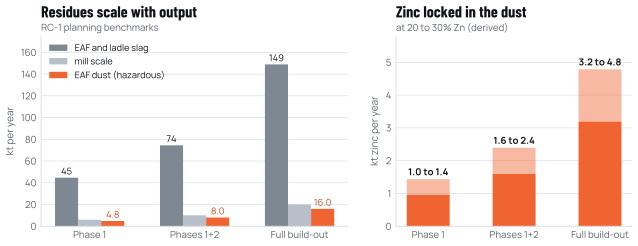
Source: Cameroon Steel reference configuration RC-1 (planning estimate): slag 140 kg/t, dust 15 kg/t, mill scale 20 kg/t [S90]; IFC benchmark for solid residue [S20]; zinc content range [S69]. Derived by Cameroon Steel.
The Kribi area offers a local market. Motorway, port and industrial-zone construction all need aggregate, and every tonne of slag used replaces a tonne of quarried stone. The condition is quality assurance: each slag product must be tested for volume stability and for the leaching of metals such as chromium and vanadium under recognised test methods, and approved by the road authority for its intended use. Cameroon Steel would seek a slag-product approval with the public works authorities before the first heat, so that slag leaves the site as a product rather than accumulating as a waste.
8.5 Furnace dust: a hazardous waste that contains zinc
The dust captured by an electric-arc furnace’s fume-extraction system carries zinc, lead and cadmium from the scrap [S20] and has to be managed as a hazardous waste. The planning range is 10 to 20 kg per tonne of liquid steel (the European reference document reports 10 to 30 kg) [S19]; RC-1 uses 15 kg/t, giving about 4,800 t a year in Phase 1 and about 16,000 t at full build-out. Its zinc comes mainly from galvanised scrap, and zinc contents above about 15% make recovery economically viable; typical dusts are at or above that level [S69]. At 20% to 30% zinc, RC-1’s dust would contain about 1,000 to 1,400 t of zinc a year in Phase 1 and about 3,200 to 4,800 t at full build-out (derived).
The established recovery route is the Waelz kiln, which volatilises zinc from the dust and recovers it as a zinc oxide concentrate for zinc smelting. About 98% of the EAF dust produced by European steelmakers is recycled [S69], and the largest operator alone processed more than 1.2 Mt of dust in 2024 [S70]. There is no Waelz plant in Central Africa. In Phase 1, RC-1’s dust would therefore be stored in a secure, covered facility and shipped to a licensed recovery plant abroad, following the prior-informed-consent procedures of the Basel Convention for transboundary movements of hazardous wastes [S71]. As volumes grow, or if other electric-arc works in the region generate dust, a regional recovery facility could become viable. Landfilling untreated dust is not an option a modern works should plan for.
Table 8.2 Main residues and co-products of the RC-1 works
| Stream | Benchmark | Phase 1, t/yr | Full build-out, t/yr | Classification | Preferred route | Evidence needed |
|---|---|---|---|---|---|---|
| EAF and ladle slag | 140 kg/t liquid (range 110 to 180) | about 45,000 | about 149,000 | Non-hazardous after testing | Crushing, metal recovery, weathering; road base and asphalt aggregate | Leaching and volume-stability tests; road-authority approval; local market |
| EAF dust | 15 kg/t liquid (range 10 to 20) | about 4,800 | about 16,000 | Hazardous | Zinc recovery (Waelz) abroad under the Basel Convention; regional option later | Dust analysis; recycler contract; export permits |
| Mill scale | 20 kg/t product (range 15 to 25) | about 6,000 | about 20,000 | Non-hazardous, oily fraction treated | Iron-bearing feed for sinter, pellet or cement makers | Oil content; buyer |
| Refractories, oily wastes, sludges | not benchmarked here | to be measured | to be measured | Mixed | Reuse of refractories where possible; licensed treatment | Waste inventory at design stage |
Source: Cameroon Steel reference configuration RC-1 (planning estimate) [S90]; IFC EHS Guidelines for Integrated Steel Mills [S20]; EAF dust recovery practice [S69][S70]; Basel Convention [S71].
8.6 Water and energy loops
Circularity also applies to water and heat. RC-1 plans closed-loop cooling with a make-up of about 2.0 m³ per tonne of product (range 1.5 to 3.0) [S90], against worldsteel’s 2024 sector averages of 2.3 m³ consumed and 8.5 m³ withdrawn per tonne [S01]. With about 2,836 mm of rain a year, roof-water harvesting for cooling make-up is an obvious measure. Hot charging of billets from the caster to the mill reduces reheating energy; heat recovery from furnace off-gas and from reheating-furnace flue gas becomes worthwhile at the larger scale of Phases 2 and 3.
8.7 Circular by design
The principles that follow for RC-1 are straightforward:
- Maximise scrap within quality limits, through domestic collection partnerships and a disciplined import strategy, and report the scrap share every year alongside the carbon intensity.
- Sell slag as a product, with tests, approvals and a local market prepared before commissioning.
- Recover the zinc in the dust, through a contract with a licensed recycler from the first year and a regional solution as volumes grow.
- Close the water loop and harvest rainfall.
- Design products for long life and recovery. Steel reinforcing bar and sections are fully recyclable; worldsteel’s life cycle data assume a 95% end-of-life recycling rate for the credits reported in module D of an EPD [S44].
The next chapter turns from materials to money: what lenders, buyers and certifiers will ask a low-carbon steelworks to prove.
Sources cited in this chapter
Bracketed markers refer to these sources; the full list is in the annex. Full list of sources
- S02Climate change and the production of iron and steel (policy paper). worldsteel.worldsteel.org/climate-action/climate-change-and-the-production-of-iro…
- S68Global recycled steel use reaches 630 million tonnes (BIR, World Steel Recycling in Figures). Recycling Product News, 2026.recyclingproductnews.com/article/43829/global-recycled-steel-use-reach…
- S27Regulation (EU) 2023/956 establishing a carbon border adjustment mechanism, Annexes I and II. Official Journal of the EU, L 130, 16 May 2023.eur-lex.europa.eu/legal-content/EN/TXT/PDF/?uri=CELEX:32023R0956
- S90Cameroon Steel reference configuration RC-1 (planning estimate): phases, planning values, balances and indicative schedule, edition 10 October 2026. Cameroon Steel, 10 Oct 2026.Cited by title and date
- S15ENERGIRON technology: DRI-EAF production route using natural gas or H2. European Commission, Innovation Centre for Industrial Transformation, ref. 12 Feb 2026.innovation-centre-for-industrial-transformation.ec.europa.eu/innovativ…
- S88La récupération et le recyclage des déchets ferromagnétiques: analyse de la situation au Cameroun (Bidoung, Fomethe, Yantio, Melo), Déchets: revue francophone d’écologie industrielle no. 48. ENSP Yaoundé / MIPROMALO (Episciences), Q4 2007.eid.episciences.org/7942/pdf
- S89Cameroun: le groupe Prometal décroche 26 milliards FCFA auprès d’Afreximbank. Sikafinance, 30 Sep 2026.sikafinance.com/marches/cameroun-le-groupe-prometal-decroche-26-millia…
- S03World Steel in Figures 2026. worldsteel, 4 Jun 2026.worldsteel.org/data/world-steel-in-figures/world-steel-in-figures-2026…
- S21Performance Standards on Environmental and Social Sustainability. IFC, 1 Jan 2012.ifc.org/en/insights-reports/2012/ifc-performance-standards
- S20Environmental, Health, and Safety Guidelines for Integrated Steel Mills. IFC / World Bank Group, 30 Apr 2007.ifc.org/content/dam/ifc/doc/2000/2007-integrated-steel-mills-ehs-guide…
- S67EU recycled 92% of steel slag in 2024 (EUROSLAG figures). GMK Center, 1 Dec 2025.gmk.center/en/news/eu-recycled-92-of-steel-slag-in-2024-euroslag/
- S69Recycling of electric arc furnace dust (zinc recovery, Waelz process). Galvanizers Association, n.d., accessed 10 Oct 2026.galvanizing.org.uk/?p=32698
- S19Best Available Techniques Reference Document for Iron and Steel Production (EUR 25521). European Commission, Joint Research Centre, 2013.bureau-industrial-transformation.jrc.ec.europa.eu/sites/default/files/…
- S70Befesa: steel dust and aluminium by-products recycling results 2024. Recycling Today, 2025.recyclingtoday.com/news/befesa-steel-aluminum-byproducts-recycling-ear…
- S71Basel Convention on the Control of Transboundary Movements of Hazardous Wastes and their Disposal (text). UNEP, Secretariat of the Basel Convention, 1989, as amended.basel.int/TheConvention/Overview/TextoftheConvention/tabid/1275/Defaul…
- S01Sustainability Indicators 2025 report (2024 data; route table added February 2026). worldsteel, Nov 2025; upd. Feb 2026.worldsteel.org/wider-sustainability/sustainability-indicators/
- S44Life cycle inventory data and eco-profiles. worldsteel.worldsteel.org/steel-topics/life-cycle-thinking/life-cycle-inventory-d…
Cite this chapter
Cameroon Steel (2026). Lower-carbon steel from Cameroon: it could reach a third of the world’s carbon intensity. White paper 06, chapter 8: Circularity: scrap is the cleanest input, and slag and dust are resources. CS-WP-06. https://www.cameroon-steel.com/en/library/lower-carbon-steel/circularity/
Source