White paper 06 · Chapter 5
Carbon border measures: verified low intensity becomes a price advantage
The European Union’s Carbon Border Adjustment Mechanism (CBAM) has charged for the carbon embedded in imported steel since 1 January 2026, and the United Kingdom’s follows on 1 January 2027. Both cover every product an electric-arc works in Cameroon could export: iron-ore pellets, DRI and HBI, billets, reinforcing bar, wire rod and sections. For steel, the EU mechanism counts direct emissions and the direct emissions embedded in precursors such as DRI, but not the emissions of purchased electricity. At the third-quarter 2026 certificate price of €82.32 per tonne of CO2, RC-1 product would carry about €30 per tonne once the protection of EU producers has been phased out, about 70% of it from the imported DRI, against about €82 to €121 for gas-based DRI-EAF steel and €99 to €193 for blast-furnace steel. An all-scrap furnace would pay less than RC-1, and Cameroon’s low-carbon grid earns no credit. The advantage is real against ore-based steel, and it is available only to exporters that can prove their numbers.
In this chapter (6)
5.1 How the EU mechanism works
CBAM applies to imports into the EU of goods in six sectors: iron and steel, aluminium, cement, fertilisers, hydrogen and electricity [S27]. After a transitional period of reporting only, which began in October 2023, the definitive regime has applied since 1 January 2026 [S25]. Importers must be authorised CBAM declarants, buy CBAM certificates corresponding to the embedded emissions of the goods they import, and surrender them once a year.
The simplification regulation adopted in October 2025, Regulation (EU) 2025/2083, made several changes that matter to exporters [S29]:
- a single de minimis threshold of 50 t a year per importer across iron and steel, aluminium, fertilisers and cement, below which no obligation arises;
- applications for declarant authorisation by 31 March 2026, certificate sales from 1 February 2027 and the first annual declaration and surrender, covering 2026 imports, by 30 September 2027;
- a quarterly holding requirement reduced from 80% to 50% of the estimated annual obligation.
The certificate price follows the EU Emissions Trading System. In 2026 it is set quarterly from average auction prices: €75.36 for the first quarter, €75.28 for the second and €82.32 for the third, published on 5 October 2026; from 2027 it will be set weekly [S26]. For context, the EU ETS average auction price in 2025 was €73.43 per tonne [S82].
Table 5.1 The CBAM regime as it applies to steel, at 10 October 2026
| Element | Provision | Source |
|---|---|---|
| Legal basis | Regulation (EU) 2023/956, as amended by Regulation (EU) 2025/2083 | [S27][S29] |
| Definitive regime | From 1 January 2026; first declaration and surrender of certificates for 2026 imports by 30 September 2027 | [S25][S29] |
| Goods covered (iron and steel) | CN chapter 72 except listed ferroalloys and ferrous scrap (7204), including DRI and HBI (7203), semi-finished products (7206, 7207), wire rod (7213), bars and rods (7214, 7215), sections (7216); articles in 7301 to 7311, 7318 and 7326; agglomerated iron ore, including pellets (2601 12 00) | [S27] |
| Emissions counted for steel | Direct emissions, including those embedded in precursors (for example DRI, pig iron); electricity emissions reported but not priced (Annex II) | [S27] |
| Certificate price | Quarterly in 2026: €75.36, €75.28, €82.32 per t CO2 (Q1 to Q3); weekly from 2027 | [S26] |
| De minimis | 50 t per importer per year, across covered sectors | [S29] |
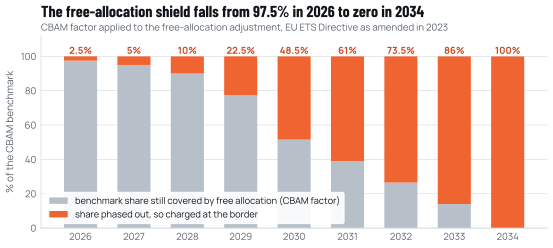
| Free-allocation adjustment | Certificates reduced by a CBAM benchmark times a CBAM factor that falls from 97.5% (2026) to 0% (2034) | [S28][S31] |
| Default values | Country-specific, with mark-ups of 10% (2026), 20% (2027) and 30% (from 2028); where no reliable country data exist, the average of the ten exporting countries with the highest emission intensities | [S31][S30] |
| Carbon price paid at origin | Deductible, if effectively paid and documented | [S27] |
| Proposed extension | About 180 downstream steel- and aluminium-intensive goods, plus anti-circumvention rules, from 1 January 2028 (proposal COM(2025) 989) | [S33][S32] |
Source: as listed.
5.2 The free-allocation shield falls to zero by 2034
EU steelmakers have long received most of their emission allowances free of charge, to limit "carbon leakage" to countries without carbon pricing. CBAM replaces that protection gradually. Each year, the number of certificates an importer must surrender is reduced by an amount reflecting the free allocation EU producers of the same good still receive: a CBAM benchmark, multiplied by a CBAM factor that follows the phase-out of free allocation in the revised EU ETS Directive [S28][S31]. Figure 5.1 shows that schedule.
The benchmarks matter as much as the factor. Implementing Regulation (EU) 2025/2620, adopted in December 2025, sets route-specific benchmark values for steel products [S104]. We have not extracted its values for wire rod and bars (CN 7213 and 7214). As reported by the trade press for hot-rolled coil, the values are 1.370 t CO2e per tonne for the blast-furnace route, 0.481 t for DRI-EAF and 0.072 t for scrap-based EAF, with a dedicated benchmark for gas-based DRI so that its imports are not adjusted below zero [S31][S32]. This paper uses those hot-rolled-coil values as a proxy for long products. The proxy affects only the free-allocation adjustment: for RC-1 it is worth about €6 per tonne in 2026 and nothing from 2034. The benchmark that applies to a given import depends on its production route; according to a published compliance guide, a product whose crude steel comes more than half from scrap is classified as scrap-EAF [S93]. With about 70% scrap in its charge, RC-1 product would fall in the scrap-EAF category, where the benchmark, and therefore the adjustment, is small. In practice, RC-1 product would carry almost its full embedded emissions as a CBAM liability from the start. At about 0.36 t, those emissions are low against ore-based routes but more than three times those of an all-scrap furnace, because the DRI precursor counts in full.
Source: Directive (EU) 2023/959 amending the EU ETS Directive, free-allocation phase-out schedule [S28]; CBAM implementing rules [S31].
5.3 Illustrative exposure: what a tonne would pay
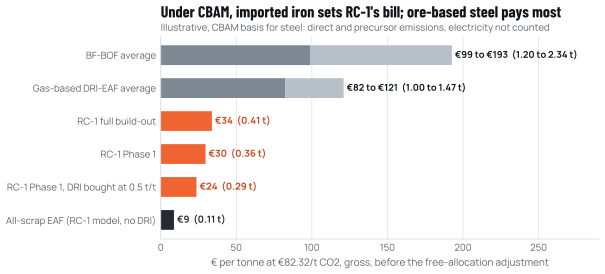
Figure 5.2 shows the gross exposure, before the free-allocation adjustment, of a tonne of product at the third-quarter 2026 price. Every bar is on the CBAM basis for steel: direct emissions plus the direct emissions of precursors, without purchased electricity [S27]. For RC-1 and for an all-scrap furnace, the values come from the WP06 model; the all-scrap case is RC-1 with no DRI in its charge. Published averages for the ore-based routes are not reported on the CBAM basis, so the figure shows them as ranges. The lower end is the IEA’s estimate of direct emissions by route, which leaves out the precursors a plant buys in [S05]; the upper end is worldsteel’s 2024 route average, which also counts electricity and other upstream inputs [S01]. The CBAM-relevant emissions of an average ore-based plant lie between the two.
Source: European Commission, price of CBAM certificates [S26]; Regulation (EU) 2023/956, Annex II [S27]; IEA [S05]; worldsteel [S01]; WP06 model on the Cameroon Steel reference configuration RC-1 (planning estimate) [S90].
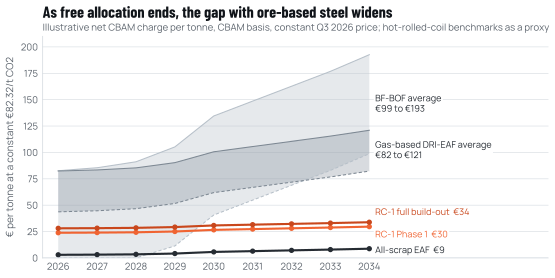
On the CBAM basis, a tonne of RC-1 Phase 1 product embeds about 0.36 t of CO2 (0.11 t direct and 0.25 t in the purchased DRI), which at €82.32 is about €30 gross. At full build-out, gas-fired reheating raises the direct share and the figure to about 0.41 t and €34. Each 10 points of DRI in the charge add about 0.085 t, or about €7 gross (derived). An all-scrap furnace would embed only its direct emissions, about 0.11 t, or €9: under CBAM, RC-1 product would pay more than scrap-based steel, not less. Applying the free-allocation adjustment at the scrap-EAF benchmark reduces the 2026 charge to about €24 for Phase 1, €28 for the full works and €3 for an all-scrap furnace, rising to the gross figures by 2034 (Figure 5.3 and Table 5.2).
Source: as Figure 5.2; benchmarks as reported for hot-rolled coil, used as a proxy for long products [S31][S104]; CBAM factor [S28].
Table 5.2 Illustrative CBAM arithmetic per tonne of product on the CBAM basis for steel (constant €82.32/t CO2)
| Product | Embedded emissions used, t CO2/t | Benchmark applied, t/t (hot-rolled-coil proxy) | Net charge 2026, €/t | Net charge 2030, €/t | Net charge 2034, €/t | Status |
|---|---|---|---|---|---|---|
| All-scrap EAF (WP06 model, no DRI) | 0.11 | 0.072 (scrap-EAF) | 3 | 6 | 9 | illustrative |
| RC-1 Phase 1, DRI bought at 0.5 t/t | 0.29 | 0.072 (scrap-EAF) | 18 | 21 | 24 | illustrative |
| RC-1 Phase 1 (DRI at 0.7 t/t) | 0.36 | 0.072 (scrap-EAF) | 24 | 27 | 30 | illustrative |
| RC-1 full build-out | 0.41 | 0.072 (scrap-EAF) | 28 | 31 | 34 | illustrative |
| Gas-based DRI-EAF (IEA direct to worldsteel all-scope) | 1.00 to 1.47 | 0.481 (DRI-EAF) | 44 to 82 | 62 to 101 | 82 to 121 | illustrative |
| BF-BOF (IEA direct to worldsteel all-scope) | 1.20 to 2.34 | 1.370 (BF-BOF) | 0 to 83 | 41 to 135 | 99 to 193 | illustrative |
Source: WP06 model (Annex A); price [S26]; CBAM basis [S27]; benchmarks as reported for hot-rolled coil [S31]; CBAM factor [S28]; IEA [S05]; worldsteel [S01]. Net charge = (embedded emissions − benchmark × CBAM factor) × price, floored at zero. Not a forecast: prices, the long-product benchmarks of Implementing Regulation (EU) 2025/2620 [S104] and the route classification must be checked before any EU sale.
Three observations follow. First, RC-1’s CBAM advantage is against ore-based steel. By 2034, at today’s price, an average blast-furnace product would pay about €70 to €160 more per tonne than RC-1 product, and an average gas-based DRI-EAF product about €50 to €90 more. Against export reinforcing-bar prices of about US$620 to US$630 per tonne FOB Türkiye in early October 2026 [S96], those are large numbers. Second, an all-scrap furnace would pay about €21 per tonne less than RC-1 by 2034. CBAM prices the DRI precursor in full and ignores the electricity in which Cameroon’s grid gives RC-1 its lower total footprint, so the clean grid earns nothing at the EU border. RC-1’s CBAM lever is the carbon content of its DRI: each 0.1 t CO2 per tonne of DRI is worth about €3 per tonne of product, and DRI bought at 0.5 rather than 0.7 t would save about €6. Third, the free-allocation adjustment protects high-carbon routes most in the early years, so the competitive effect of CBAM against ore-based steel grows steadily to 2034.
5.4 Default values punish the unmeasured
An importer that cannot document actual embedded emissions, verified under the CBAM rules, must use default values. These are set per country and product where reliable data exist, with mark-ups that rise from 10% in 2026 to 20% in 2027 and 30% from 2028 [S31]. Where no reliable data exist for a country, the default is the average emission intensity of the ten exporting countries with the highest emission intensities for that type of good [S30]. For a country with little steel export history, such as Cameroon, that rule could assign a product made in a clean electric works an intensity typical of the world’s most carbon-intensive producers.
The arithmetic is unforgiving. At €82.32, each tonne of CO2 per tonne of steel by which a default exceeds the verified actual value costs about €82 per tonne of product. A producer whose verified embedded emissions are 0.36 t, but whose buyer must use a default of, say, 2 t, would hand that buyer a cost difference of more than €130 per tonne. Measurement is therefore not a reporting chore; it is the condition for monetising the plant’s low intensity.
5.5 Other carbon border measures are following
The EU is not alone. The United Kingdom’s CBAM applies from 1 January 2027 to imports of iron and steel, among other goods, with a registration threshold of GBP 50,000 of covered imports a year [S34]. Australia’s carbon leakage review, whose final report was released in February 2026, identified a border carbon adjustment as the preferred response for certain high-risk commodities and recommended a staged introduction starting with cement and clinker and extending later to other goods including steel [S35]. Other jurisdictions are considering similar instruments or product carbon standards. Table 5.3 summarises the measures relevant to a Cameroonian exporter.
Table 5.3 Carbon border measures relevant to Cameroonian steel, at 10 October 2026
| Jurisdiction | Instrument | Status | Steel covered | Relevance for Cameroon Steel |
|---|---|---|---|---|
| European Union | CBAM, Regulation (EU) 2023/956 | Definitive since 1 January 2026; certificates on sale from February 2027 | Yes, including DRI/HBI, semis, bars, wire rod, pellets | Applies to any EU-bound tonne; verified actual data decisive |
| European Union | Proposed extension to downstream goods, COM(2025) 989 | Proposal; intended from 1 January 2028 | Fabricated steel products | Would extend coverage to mesh, fabricated reinforcement and structures |
| United Kingdom | UK CBAM | From 1 January 2027 | Yes | Similar logic; separate registration and reporting |
| Australia | Border carbon adjustment recommended by the carbon leakage review | Recommendation; staged, cement first | Later stage | Signal of a wider trend |
| CEMAC and West Africa | None | No border carbon measure identified | No | RC-1’s main markets carry no carbon charge |
Source: [S27][S33][S34][S35]. Market access to the EU is also limited by the steel tariff-rate quota that replaced the EU safeguard from 1 July 2026, with a 50% out-of-quota duty [S95].
5.6 What CBAM means, and does not mean, for RC-1
It would be easy to overstate the importance of CBAM for a works whose planned markets are mainly domestic and regional. Cameroon’s own demand for steel is supplied largely by imports of iron units and finished products, and the CEMAC region applies no carbon charge. RC-1 does not depend on European sales, and EU market access for steel is constrained by quotas as much as by carbon [S95].
CBAM nevertheless matters for three reasons. First, it creates an option: semi-finished products, sections or, later, HBI from a low-carbon Cameroonian works would be competitive in a market where ore-based competitors pay more, and that option is worth preserving. Second, it sets the template that buyers, lenders and other governments are adopting: the CBAM monitoring rules are becoming the de facto international standard for installation-level embedded emissions, and complying with them is the cheapest way to answer every other request. Third, it applies to iron-ore pellets and DRI, so any future export of Cameroonian iron units to Europe, discussed in Chapter 6, will be priced on its carbon content from the outset.
The next chapter looks further ahead: if verified low-carbon iron is becoming valuable, can Central Africa make it?
Sources cited in this chapter
Bracketed markers refer to these sources; the full list is in the annex. Full list of sources
- S27Regulation (EU) 2023/956 establishing a carbon border adjustment mechanism, Annexes I and II. Official Journal of the EU, L 130, 16 May 2023.eur-lex.europa.eu/legal-content/EN/TXT/PDF/?uri=CELEX:32023R0956
- S25Carbon Border Adjustment Mechanism. European Commission, DG TAXUD.taxation-customs.ec.europa.eu/carbon-border-adjustment-mechanism_en
- S29EU adopts CBAM Omnibus Regulation (Regulation (EU) 2025/2083). EY, 22 Oct 2025.ey.com/en_gl/technical/tax-alerts/eu-adopts-cbam-omnibus-regulation
- S26Price of CBAM certificates. European Commission, DG TAXUD, latest 5 Oct 2026.taxation-customs.ec.europa.eu/carbon-border-adjustment-mechanism/price…
- S82EU Emissions Trading System (factsheet). International Carbon Action Partnership (ICAP), 2026.icapcarbonaction.com/en/ets/eu-emissions-trading-system-eu-ets
- S28Directive (EU) 2023/959 amending the EU Emissions Trading System Directive. Official Journal of the EU, L 130, 16 May 2023.eur-lex.europa.eu/legal-content/EN/TXT/?uri=CELEX:32023L0959
- S31EU Commission finalizes CBAM benchmarks, default values ahead of January 2026 launch. EUROMETAL, Dec 2025.eurometal.net/eu-commission-finalizes-cbam-benchmarks-default-values-a…
- S30Annexes to the Proposal amending Regulation (EU) 2023/956 as regards simplifying and strengthening the CBAM, COM(2025) 87 (Council document 6609/25 ADD 1). European Commission / Council of the EU, 27 Feb 2025.data.consilium.europa.eu/doc/document/ST-6609-2025-ADD-1/en/pdf
- S33COM(2025) 989: proposal extending the CBAM to downstream goods. European Commission (EUR-Lex), 17 Dec 2025.eur-lex.europa.eu/legal-content/EN/TXT/?uri=CELEX%3A52025PC0989
- S32European Commission issues CBAM operational rules and proposes downstream extension of the CBAM scope. Mayer Brown, Dec 2025.mayerbrown.com/ja/insights/publications/2025/12/european-commission-is…
- S104CBAM legislation and guidance: implementing acts, including Implementing Regulation (EU) 2025/2620 (benchmarks) and Implementing Regulation (EU) 2025/2621 (default values). European Commission, DG TAXUD.taxation-customs.ec.europa.eu/carbon-border-adjustment-mechanism/cbam-…
- S93CBAM steel 2026: CN codes, emission factors, costs and compliance guide (route classification), secondary source. CBAMguide.cbamguide.com/sectors/steel/
- S05Iron and Steel Technology Roadmap. International Energy Agency, Oct 2020.iea.blob.core.windows.net/assets/eb0c8ec1-3665-4959-97d0-187ceca189a8/…
- S01Sustainability Indicators 2025 report (2024 data; route table added February 2026). worldsteel, Nov 2025; upd. Feb 2026.worldsteel.org/wider-sustainability/sustainability-indicators/
- S90Cameroon Steel reference configuration RC-1 (planning estimate): phases, planning values, balances and indicative schedule, edition 10 October 2026. Cameroon Steel, 10 Oct 2026.Cited by title and date
- S96Weekly steel prices (archive 40468). Arab Iron and Steel Union (AISU), 3 Oct 2026.aisusteel.org/en/archives/40468
- S34Carbon Border Adjustment Mechanism (CBAM): guidance collection. HM Revenue and Customs, GOV.UK, updated Jul to Sep 2026.gov.uk/government/collections/carbon-border-adjustment-mechanism
- S35Final report from the Australian Carbon Leakage Review. PwC Australia, 2026.pwc.com.au/tax/tax-alerts/final-report-from-the-australian-carbon-leak…
- S95Regulation (EU) 2026/1384 (steel tariff-rate quota replacing the safeguard). Official Journal of the EU, 24 Jun 2026.eur-lex.europa.eu/eli/reg/2026/1384/oj/eng
Cite this chapter
Cameroon Steel (2026). Lower-carbon steel from Cameroon: it could reach a third of the world’s carbon intensity. White paper 06, chapter 5: Carbon border measures: verified low intensity becomes a price advantage. CS-WP-06. https://www.cameroon-steel.com/en/library/lower-carbon-steel/carbon-border-measures/
Source