白皮书06 · 摘要 · 中文摘要
执行摘要:低碳起点,唯有计量才能转化为优势
位于姆博罗(Mboro)、由喀麦隆以水电为主的电网供电的电弧炉钢厂,生产钢坯、线材和钢筋的碳强度有望降至全球平均水平的三分之一左右。我们对参考配置(RC-1)一期的示意性估算为:范围一和范围二(厂内直接排放和外购电力)约为每吨产品0.32吨二氧化碳,计入进口直接还原铁(DRI)的排放后约为0.58吨,而2024年全球平均水平为1.92吨。这些是估算值,而非实测值。这一优势真实存在,但有前提条件:它取决于稳定可靠的低碳电力、电弧炉所熔炼含铁原料的碳含量,以及足以接受核查的计量水平。以欧盟机制为首的碳边境调节措施(欧盟机制自2026年1月1日起进入正式实施阶段)正将经核查的低碳强度转化为相对矿石基钢材的价格优势;中部非洲的铁矿和水电资源则为喀麦隆提供了长期自行生产低碳铁的选项。
本页为本章中文摘要;英文全文附于其后,可展开阅读。
本章目录(5)
ES.1 十二项主要结论
- 决定钢铁碳强度的是工艺路线,而非边际上的努力。钢铁约占全球温室气体排放的7%至8%[S02]。根据世界钢铁协会2024年数据,高炉-转炉工艺每吨粗钢排放2.34吨二氧化碳,气基直接还原加电弧炉为1.47吨,废钢电弧炉为0.69吨,全球平均为1.92吨[S01]。非洲89%的粗钢已由电弧炉生产[S03]。
- 喀麦隆电网的碳强度约为全球平均的一半。2024年喀麦隆电力平均碳强度约为226克二氧化碳当量/千瓦时,全球为471克,南非为717克[S48]。按Ember数据,2024年水电约占发电量的72%;按监管机构数据,420兆瓦的纳赫蒂加尔(Nachtigal)水电站全面投运后,2025年这一比例约为90%[S49][S50],两套数据的覆盖范围不同。将2024年化石发电排放率应用于2025年电源结构,平均值约为74至96克/千瓦时(推算,指示性)。因此,226克/千瓦时相对于平均值是保守的,但相对于边际排放因子并不保守:在纳赫蒂加尔送出线路和南部电网完成加强之前,克里比的新增负荷可能由约770克/千瓦时的燃气或燃油电厂在边际上供电,在火电处于边际的时段每吨最多可增加约0.5吨(推算)。
- 一期示意性碳足迹为范围一和范围二每年约9.7万吨二氧化碳。按30万吨/年名义产能计,RC-1一期厂内直接排放(范围一)约3.19万吨,外购电网电力在电厂产生的排放(范围二)约6.53万吨。模型未计入的少量排放源(移动设备柴油、液化石油气和开关设备六氟化硫)将另增约0.3万至0.7万吨(假设)。进口直接还原铁或热压块铁(HBI)另带来约7.62万吨上游排放。按预期持续产量每年27万至30万吨计,年排放总量最多低10%,碳强度不变。按100万吨/年设计产能计,范围一+二约为32.8万吨,计入上游含铁原料后约为58.2万吨;碳强度基本保持在每吨0.33吨和0.58吨左右。若电弧炉电耗取含30%直接还原铁炉料的规划上限值约490千瓦时/吨而非450千瓦时/吨,各项碳强度约增加0.01吨(据RC-1参考配置推算)。
- 电弧炉所熔炼的含铁原料比任何其他单项选择都更重要。将炉料中进口直接还原铁的比例从30%提高到50%,每吨约增加0.18吨;降至20%则约减少0.09吨。该直接还原铁的上游强度(每吨直接还原铁0.5至0.9吨)使结果上下变动约0.07吨,电网排放因子(200至300克/千瓦时)的影响为−0.03至+0.07吨。逐项考察时,一期碳强度保持在每吨约0.49至0.75吨之间;各项同时取极值时,区间约为0.42至0.95吨(推算)。
- 优势既来自电弧炉,也来自电网。同一炼钢车间若接入全球平均电网,计入上游含铁原料后每吨约排放0.81吨,接入南非电网则约为1.05吨。按此全口径碳足迹,当电网排放因子约为340克/千瓦时,它将失去相对于废钢电弧炉平均水平的领先优势(推算)。因此,签约获得稳定的低碳电力既是能源决策,也是碳决策。
- 同一工厂可以如实报告七个不同的数字。根据核算边界不同,同一吨一期产品的碳强度约为0.11吨(仅范围一)、0.11吨(范围一+二,按市场法计入水电供电合同)、0.20吨(范围一+二,按2025年校核值96克/千瓦时)、0.32吨(范围一+二,按2024年电网平均值)、0.36吨(欧盟碳边境调节机制口径,对钢铁计入直接排放和前体排放,但不计外购电力)、0.54吨(按ISO 14404和世界钢铁协会口径,每吨粗钢)或0.58吨(同一口径,每吨成品)。可信度取决于每次都说明核算边界,并接受第三方核查。
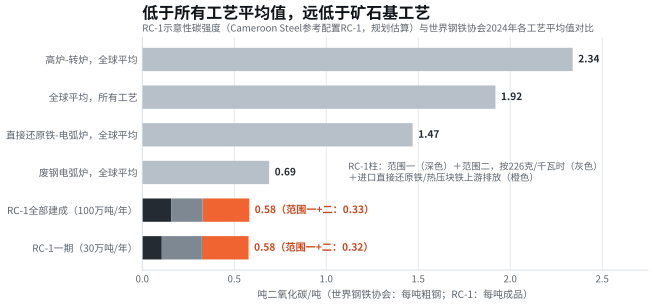
资料来源:世界钢铁协会,Sustainability Indicators 2025(2024年数据)[S01];Cameroon Steel参考配置RC-1(规划估算),2026年10月10日版[S90];WP06模型(全文版附录A)。
- 碳边境调节措施使经核查的低碳强度相对矿石基钢材成为竞争资产,其计价对象是RC-1的进口铁,而非其电网。欧盟碳边境调节机制(CBAM)覆盖铁矿球团、直接还原铁、钢坯、钢筋和线材[S27]。对钢铁而言,该机制计入直接排放以及直接还原铁等前体所含的直接排放,但不计外购电力,因此喀麦隆的低碳电网在该机制下不带来任何抵扣[S27]。2026年第三季度其证书价格为每吨二氧化碳82.32欧元[S26];保护欧盟生产商的免费配额将从2026年基准值的97.5%降至2034年的零[S28]。举例而言,按2026年价格不变计,并以热轧卷基准值作为长材的近似,一吨销往欧盟的RC-1一期产品(按该机制口径为0.36吨,其中约70%来自进口直接还原铁)2026年约承担24欧元,2034年升至30欧元;到2034年,气基直接还原铁-电弧炉钢材约承担82至121欧元,高炉钢材约99至193欧元。全废钢电弧炉的费用低于RC-1,约为3至9欧元,因为废钢不含前体排放。缺乏经核查数据的出口商将适用默认值,并在2026年、2027年和2028年起分别加成10%、20%和30%[S31]。
- 绿色铁是中部非洲的长期选项,而非近期产品。按Midrex工厂统计,2025年撒哈拉以南非洲生产直接还原铁9万吨,全球总量为1.51亿吨,该地区的气基工厂均处于停产状态[S13];世界钢铁协会的数据包含对该统计未覆盖工厂的估算,其对乌干达、肯尼亚和坦桑尼亚产量的估计约为270万吨[S03]。适合直接还原的矿石十分稀缺(据IEEFA 2022年评估,海运贸易中铁品位超过66%的仅约3%[S75]),而姆巴拉姆(Mbalam)公布的直运矿品位略高于62%[S72],属于高炉级。国内直接还原模块需要选矿和球团、天然气供应合同,若使用氢气,还需要相当于一座大型水电站规模的电力:仅满足RC-1自身含铁原料需求每年约需0.9至1.0太瓦时,100万吨/年的模块需2.4至2.8太瓦时,而纳赫蒂加尔水电站十二个月的供电量为3.6太瓦时(推算)[S52]。
- 厂区平台不受海洋影响,港口接口和排水系统则不然。厂址地面海拔约40至100米(取整值,待测量确认)[S106],距海岸约3至4公里(白皮书07表D.1)。设计重点包括极端降雨(克里比站百年一遇日降雨量为264毫米[S60],按每升温1°C增加约7%[S59]计将升至约280至300毫米)、炼钢车间工人面临的高温高湿,以及2015年至2020年平均每年后退约2米的海岸线[S62]。
- 循环利用始于废钢,而喀麦隆废钢不足。RC-1一期满负荷时每年需要约25.4万吨废钢;唯一公开的国内废钢产生量估算为每年5.3万至6.2万吨(2006年数据)[S88],现有钢厂已大量进口原料[S89]。因此,RC-1按每年约3万吨国内废钢规划(区间0至6万吨,假设),其余进口,一期港口金属料和辅料到港量约为每年35.1万吨(推算)。钢厂每年还将产生约4.5万吨钢渣(经检测后可用于道路),以及约4800吨危险电弧炉粉尘,其中每年含锌约1000至1400吨(推算),欧洲的做法几乎将其全部回收[S69]。
- 贷款机构将从一期起适用最严格的气候规则。按226克/千瓦时计,一期工艺排放和外购电力排放约为每年9.7万吨;计入柴油、液化石油气和六氟化硫后约为10万至10.4万吨。因此,一期范围一+二处于赤道原则10万吨阈值的水平或其附近,后续各期则明显超过[S22]。因此,Cameroon Steel应从一期起安排气候变化风险评估、替代方案分析和年度公开报告。按ResponsibleSteel的浮动标准,RC-1示意性碳强度远优于第1级进展水平,但距国际能源署的近零排放阈值仍很远[S37][S06]。
- 已知措施可使碳足迹降低约40%,绿色铁可进一步降低。提高能效、降低直接排放、电网降至约100克/千瓦时、提高炉料中的废钢比例(国内或进口)和使用经认证的低碳直接还原铁,可使100万吨/年钢厂的碳强度从约0.58吨降至约0.35吨;采用氢基含铁原料可降至约0.26吨(示意)。我们提出十项建议,首要的是签订稳定的低碳电力合同、为每批含铁原料制定碳规格、从第一炉起进行经核查的报告,以及尽早开展直接还原级精矿研究。
ES.2 本文是什么,不是什么
本文是Cameroon Steel十份公开白皮书中的第六份,旨在阐明其位于克里比港综合工业区姆博罗项目背后的证据。本文的主题是碳:喀麦隆一座现代化电弧炉长材钢厂会排放多少,应如何计量和报告,碳边境调节措施对其意味着什么,应如何管理其面对气候变化的风险,以及钢厂如何在二十年内逐步迈向极低碳钢铁。
本文中的项目数字来自Cameroon Steel参考配置RC-1,这是为公众讨论和监管沟通而编制的规划估算。RC-1描述的是一座分期建设、设计产能100万吨/年的钢厂(已于2025年1月公开报道[S73]):首先建设电弧炉炼钢车间、钢包精炼炉和钢坯连铸机(一期,名义产能30万吨/年,预期持续产量每年27万至30万吨),随后建设型材轧机和新增熔炼能力,并为将来可加工喀麦隆矿石的直接还原模块预留用地。目标进度为2029年第一季度开工、2030年下半年首炉出钢、2031年爬坡。一期炼钢车间生产钢坯,其产出可在轧材(线材和钢筋)与供应现有轧钢企业的商品钢坯之间灵活调配,这些轧钢企业目前大量进口原料[S89]。一期产量的目标是替代进口钢坯和线材并出口至中部非洲经济与货币共同体(CEMAC),而非国内钢筋市场,后者的产能已超过需求(白皮书04)。碳足迹按全部轧制产出计算,即将RC-1的产量乘以已公布或假设的消耗基准和排放因子,并逐项给出区间;以钢坯形式销售的每吨产品排放更低(第4章)。这是前端工程设计之前的估算,而非实测值或保证。
ES.3 本文的结构
表ES.1 各章回答的问题
| 章 | 问题 | 主要 |
|---|---|---|
| 1钢铁与气候 | 为什么工艺路线比其他任何因素都重要? | 各工艺碳强度;工艺占比;国际能源署排放构成 |
| 2钢铁碳核算 | 应计入什么,依据哪项标准? | 标准矩阵;同一工厂,七个数字 |
| 3电网排放因子 | 优势有多少来自喀麦隆电力系统? | 电源结构;各国电网强度;敏感性曲线 |
| 4示意性碳足迹 | RC-1各期排放多少,什么因素影响结果? | 分期碳足迹;瀑布图;龙卷风图;热力图 |
| 5碳边境调节措施 | 欧盟和英国的边境收费实际意味着什么? | 逐步实施;总额与净额 |
| 6绿色铁 | 中部非洲能否生产低碳铁,条件是什么? | 直接还原铁产量;工艺阶梯;氢气用电需求;逐步路径 |
| 7气候风险与适应 | 气候变化对沿海钢厂意味着什么? | 降雨;极端值;海平面与岸线 |
| 8循环利用 | 废钢、钢渣和粉尘如何处理? | 残余物;废钢需求;废钢比例 |
| 9融资与标准 | 贷款方、买方和认证机构会要求什么? | 贷款机构阈值;浮动标准 |
| 10路径与建议 | 应做什么,由谁做,何时做? | 路径瀑布图;轨迹;十项建议 |
| 11证据缺口 | 哪些尚属未知,如何解决? | 缺口清单 |
ES.4 Cameroon Steel打算如何落实这些结论
上述结论指向少数几项将在数十年内决定钢厂碳绩效的决策,这些决策最好在订购设备之前作出。第一是电力:电弧炉钢厂的清洁程度取决于其所用电力,因此,以明确的低碳电源为支撑的稳定供电合同,加上能在旱季保持电弧炉使用水电的电网接入,是继工艺路线选择之后最有价值的碳决策。第二是含铁原料:每批直接还原铁或热压块铁都应附有经核查的碳数据和合同规定的强度上限,因为在碳边境调节机制下,决定销往欧盟产品大部分费用的是直接还原铁而非电力;炉料中的废钢比例应随国内回收和进口合同条件的改善而提高。第三是计量:钢厂应从一开始就配备计量仪表,并按温室气体核算体系(GHG Protocol)、ISO 14404和欧盟碳边境调节机制的口径设计排放清单,由经认可的第三方核查,使买方能够使用实际值而非默认值。第四是保留选择权:应为将来的直接还原模块保留土地、公用设施和许可,同时尽早研究关键未知因素,即喀麦隆矿石能否经济地提质为直接还原级球团。
这一切并不能使喀麦隆钢铁在今天就成为“绿色”钢铁,但能使一座新钢厂从第一炉钢起就站在碳分界线的正确一侧,并随着电力、含铁原料和融资条件的改善,拥有一条可信、可计量的进一步减排路径。第10章详细阐述各项建议,第11章列出在本文中的示意性数字成为实测数字之前必须填补的证据缺口。本系列其他白皮书分别论述电力系统(白皮书05)、工艺路线选择(白皮书03)以及一期产品的市场,包括克里比生产钢坯与进口钢坯的成本比较(白皮书04第8章)。
利益声明。本文由Cameroon Steel发布,该公司正在克里比筹建一座钢铁厂。本文旨在为公共讨论提供参考;其分析独立于任何商业要约,所有数据均注明来源或标明其状态。
英文全文 13分钟 · 2896词Executive summary: a low-carbon start that only measurement can turn into an asset
An electric-arc steelworks at Mboro, drawing power from Cameroon’s hydro-dominated grid, could make billets, wire rod and reinforcing bar at roughly a third of the world’s average carbon intensity. Our illustrative estimate for the first phase of the reference configuration (RC-1) is about 0.32 tonnes of CO2 per tonne of product within Scopes 1 and 2 (direct emissions on site and purchased electricity) and about 0.58 tonnes once the emissions of imported direct-reduced iron are included, against a 2024 world average of 1.92 tonnes. These are estimates, not measurements. That advantage is real but conditional: it depends on firm low-carbon power, on the carbon content of the iron units the furnace melts, and on measurement good enough to be verified. Carbon border measures, led by the European Union’s mechanism in its definitive phase since 1 January 2026, are turning verified low intensity into a price advantage over ore-based steel, and Central Africa’s iron ore and hydropower give Cameroon a long-term option to make low-carbon iron itself.
ES.1 Twelve findings
- Route choice, not effort at the margin, sets the carbon intensity of steel. Steel accounts for about 7% to 8% of global greenhouse gas emissions [S02]. On worldsteel’s 2024 data, the blast-furnace route emits 2.34 t CO2 per tonne of crude steel, gas-based direct reduction with an electric furnace 1.47 t and scrap-based electric furnaces 0.69 t, for a world average of 1.92 t [S01]. Africa already makes 89% of its crude steel in electric furnaces [S03].
- Cameroon’s grid is about half as carbon-intensive as the world’s. The average intensity of Cameroon’s electricity was about 226 g CO2e/kWh in 2024, against 471 g for the world and 717 g for South Africa [S48]. Hydropower supplied about 72% of generation in 2024 on the Ember dataset and, on the regulator’s dataset, about 90% in 2025 after the 420 MW Nachtigal plant was fully commissioned [S49][S50]; the two datasets differ in coverage. Applying the 2024 fossil emission rate to the 2025 mix suggests an average of about 74 to 96 g/kWh (derived, indicative). 226 g/kWh is therefore conservative against the average, but not against the marginal factor: until the Nachtigal evacuation line and the southern grid are reinforced, new load at Kribi may be served at the margin by gas or oil plants at about 770 g/kWh, which would add up to about 0.5 t per tonne in the hours when thermal plants are on the margin (derived).
- The illustrative footprint of the first phase is about 97,000 t of CO2 a year within Scopes 1 and 2. At its nameplate of 0.3 Mtpa, RC-1 Phase 1 would emit about 31,900 t directly on site (Scope 1) and about 65,300 t through purchased grid electricity, emitted at the power plants (Scope 2). Minor sources outside the model (diesel for mobile plant, LPG and SF6 in switchgear) would add about 3,000 to 7,000 t (assumed). Imported direct-reduced iron or hot-briquetted iron (DRI/HBI) adds about 76,200 t upstream. At the expected sustained output of 270,000 to 300,000 t a year, the annual totals are up to 10% lower and the intensities unchanged. At the 1 Mtpa design capacity the figures are about 328,000 t (Scopes 1+2) and 582,000 t including upstream iron units; intensity stays close to 0.33 and 0.58 t per tonne. With the furnace at the upper planning value of about 490 kWh per tonne for a charge with 30% DRI, rather than 450, each intensity rises by about 0.01 t (derived from the RC-1 reference configuration).
- The iron units the furnace melts matter more than any other single choice. Moving the imported DRI share of the charge from 30% to 50% adds about 0.18 t per tonne; cutting it to 20% saves about 0.09 t. The upstream intensity of that DRI (0.5 to 0.9 t per tonne of DRI) moves the result by about 0.07 t either way, and the grid factor (200 to 300 g/kWh) by −0.03 to +0.07 t. Taken one at a time, these ranges keep the Phase 1 intensity between about 0.49 and 0.75 t per tonne; at their joint extremes it spans about 0.42 to 0.95 t (derived).
- The advantage belongs to the grid as much as to the furnace. The same melt shop on a world-average grid would emit about 0.81 t per tonne including upstream iron units, and about 1.05 t on South Africa’s grid. On this full-footprint basis it would lose its lead over the average scrap-based electric furnace at a grid factor of about 340 g/kWh (derived). Firm, contracted low-carbon power is therefore a carbon decision, not only an energy decision.
- One plant can honestly report seven different numbers. Depending on the perimeter, the same Phase 1 tonne carries about 0.11 t (Scope 1 only), 0.11 t (Scopes 1+2 with a market-based hydro supply contract), 0.20 t (Scopes 1+2 at the 2025 grid cross-check of 96 g/kWh), 0.32 t (Scopes 1+2 at the 2024 grid average), 0.36 t (EU CBAM basis, which for steel counts direct and precursor emissions but not purchased electricity), 0.54 t (per tonne of crude steel on the ISO 14404 and worldsteel basis) or 0.58 t (the same, per tonne of product). Credibility depends on stating the perimeter every time and on third-party verification.
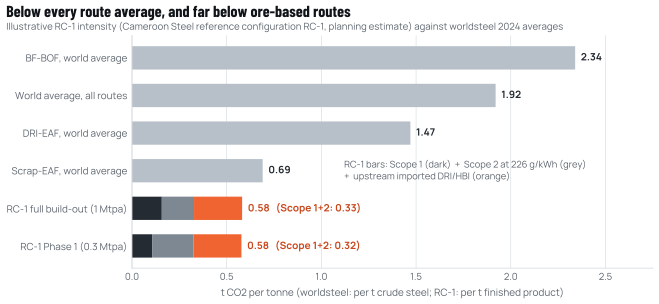
Source: worldsteel Sustainability Indicators 2025 (2024 data) [S01]; Cameroon Steel reference configuration RC-1 (planning estimate), edition 10 October 2026 [S90]; WP06 model (Annex A).
- Carbon border measures reward verified low intensity against ore-based steel, and they price RC-1’s imported iron, not its grid. The EU Carbon Border Adjustment Mechanism (CBAM) covers iron-ore pellets, DRI, billets, reinforcing bar and wire rod [S27]. For steel it counts direct emissions and the direct emissions embedded in precursors such as DRI, but not purchased electricity, so Cameroon’s low-carbon grid earns no CBAM credit [S27]. The certificate price was €82.32/t CO2 for the third quarter of 2026 [S26], and the free allocation that shields EU producers falls from 97.5% of the benchmark in 2026 to zero in 2034 [S28]. For illustration, at a constant 2026 price and with the hot-rolled-coil benchmark used as a proxy for long products, an EU-bound tonne of RC-1 Phase 1 product (0.36 t on the CBAM basis, about 70% of it from the imported DRI) would carry about €24 of CBAM cost in 2026, rising to €30 in 2034; by 2034 gas-based DRI-EAF steel would carry about €82 to €121 and blast-furnace steel about €99 to €193. An all-scrap furnace would pay less than RC-1, about €3 to €9, because scrap carries no precursor emissions. Exporters without verified data face default values with mark-ups of 10% in 2026, 20% in 2027 and 30% from 2028 [S31].
- Green iron is a long-term option for Central Africa, not a near-term product. On Midrex plant statistics, Sub-Saharan Africa produced 0.09 Mt of DRI in 2025 out of a world total of 151 Mt, with the region’s gas-based plants idle [S13]; worldsteel, whose figures include estimates for plants outside that survey, puts output in Uganda, Kenya and Tanzania at about 2.7 Mt [S03]. DR-grade ore is scarce (about 3% of seaborne trade exceeded 66% Fe in IEEFA’s 2022 assessment [S75]), and the direct-shipping ore reported for Mbalam grades a little above 62% Fe [S72], which is blast-furnace grade. A domestic direct-reduction module would need concentration and pelletising, a gas contract and, for hydrogen, electricity on the scale of a large hydro plant: about 0.9 to 1.0 TWh a year for RC-1’s own iron units and 2.4 to 2.8 TWh for a 1 Mt/yr module, against 3.6 TWh delivered by Nachtigal in twelve months (derived) [S52].
- The plant platform is safe from the sea; the port interface and the drainage system are not. The site sits about 40 to 100 m above sea level (rounded; to be confirmed by survey) [S106] and about 3 to 4 km inland (White paper 07, Table D.1). The design issues are extreme rainfall (a 100-year one-day total of 264 mm at Kribi station [S60], which an uplift of about 7% per degree of warming [S59] would take to about 280 to 300 mm), heat and humidity for melt-shop workers, and a coastline that retreated by about 2 m a year on average between 2015 and 2020 [S62].
- Circularity starts with scrap, and Cameroon is short of it. RC-1 Phase 1 needs about 254,000 t of scrap a year at nameplate; the only published estimate of domestic scrap arising is 53,000 to 62,000 t a year (2006 data) [S88], and existing mills already import much of their feed [S89]. RC-1 therefore plans on about 30,000 t a year of domestic scrap (range 0 to 60,000 t, assumed) and imports the balance, which brings Phase 1 port receipts of metallics and consumables to about 351,000 t a year (derived). The works would also produce about 45,000 t of slag, suitable for roads after testing, and about 4,800 t of hazardous furnace dust containing roughly 1,000 to 1,400 t of zinc a year (derived), which European practice recycles almost entirely [S69].
- Lenders will apply their strongest climate rules from the first phase. At 226 g/kWh, Phase 1 process emissions and purchased electricity come to about 97,000 t a year; with diesel, LPG and SF6 the total is about 100,000 to 104,000 t. Phase 1 therefore sits at or about the 100,000 t threshold of the Equator Principles for Scopes 1+2, and later phases are well above it [S22]. Cameroon Steel should therefore plan for a climate change risk assessment, an alternatives analysis and annual public reporting from Phase 1. On ResponsibleSteel’s sliding scale, the illustrative RC-1 intensity clears Progress Level 1 by a wide margin but is far from the IEA’s near-zero threshold [S37][S06].
- Known levers cut the footprint by about 40%; green iron takes it further. Efficiency, lower direct emissions, a grid at about 100 g/kWh, more scrap in the charge (domestic or imported) and certified lower-carbon DRI would bring the 1 Mtpa intensity from about 0.58 to about 0.35 t per tonne; hydrogen-based iron units would take it to about 0.26 t (illustrative). We recommend ten actions, led by a firm low-carbon power contract, a carbon specification for every cargo of iron units, verified reporting from the first heat and an early study of DR-grade concentrate.
ES.2 What this paper is, and what it is not
This is the sixth of ten public white papers in which Cameroon Steel sets out the evidence behind its project at Mboro, in the Kribi industrial-port zone. Its subject is carbon: how much a modern electric-arc long-products works in Cameroon would emit, how that should be measured and reported, what carbon border measures mean for it, how its exposure to a changing climate should be managed, and how the works could move, over two decades, towards very low-carbon steel.
The project figures in this paper come from the Cameroon Steel reference configuration RC-1, a planning estimate prepared for public and regulatory discussion. RC-1 describes a phased works with a design capacity of 1 Mtpa, as reported publicly in January 2025 [S73], starting with an electric-arc melt shop, a ladle furnace and a billet caster (Phase 1, nameplate 0.3 Mtpa, expected sustained output 270,000 to 300,000 t a year), followed by sections mills and additional melting capacity, with a reserve for a future direct-reduction module that could process Cameroonian ore. Works are targeted to start in the first quarter of 2029, with a first heat in the second half of 2030 and ramp-up through 2031. Phase 1’s melt shop makes billets, and its output can move between rolled products (wire rod and reinforcing bar) and merchant billets for existing re-rollers, which today import much of their charge [S89]. Its tonnage is aimed at replacing imported billets and wire rod and at CEMAC exports, not at the domestic reinforcing-bar market, where capacity already exceeds demand (White paper 04). The footprint is computed for fully rolled output by multiplying RC-1 volumes by published or assumed consumption benchmarks and emission factors, each with a range; a tonne sold as billet carries less (Chapter 4). It is an estimate made before front-end engineering, not a measurement or a guarantee.
ES.3 How the paper is organised
Table ES.1 The questions each chapter answers
| Chapter | Question | Main exhibits |
|---|---|---|
| 1 Steel and climate | Why does the route matter more than anything else? | Route intensities; route shares; IEA anatomy of emissions |
| 2 Accounting carbon in steel | What should be counted, and by which standard? | Framework matrix; one plant, seven numbers |
| 3 The grid factor | How much of the advantage comes from Cameroon’s power system? | Generation mix; grid intensities; sensitivity line |
| 4 An illustrative footprint | What would RC-1 emit, phase by phase, and what moves the result? | Footprint by phase; waterfall; tornado; heat map |
| 5 Carbon border measures | What would EU and UK border charges mean in practice? | Phase-in; gross and net exposure |
| 6 Green iron | Can Central Africa make low-carbon iron, and on what conditions? | DRI output; route ladder; hydrogen power need; stepwise route |
| 7 Climate risk and adaptation | What does a changing climate mean for a coastal steelworks? | Rainfall; extremes; sea level and shoreline |
| 8 Circularity | What happens to scrap, slag and dust? | Residues; scrap need; scrap share |
| 9 Finance and standards | What will lenders, buyers and certifiers ask for? | Lender thresholds; sliding scales |
| 10 Pathway and recommendations | What should be done, by whom and when? | Pathway waterfall; trajectory; ten recommendations |
| 11 Evidence gaps | What is not yet known, and how will it be resolved? | Gap register |
Source: Cameroon Steel, this paper.
ES.4 What Cameroon Steel intends to do with these findings
The findings point to a short list of decisions that fix the carbon performance of the works for decades, and that are best taken before the equipment is ordered. The first is power: an electric-arc works is only as clean as the electricity it draws, so a firm supply contract backed by identified low-carbon generation, and a connection that keeps the furnace on hydro power through the dry season, is the single most valuable carbon decision after the choice of route. The second is iron units: every cargo of DRI or HBI should come with verified carbon data and a contractual intensity ceiling, since under CBAM the DRI, not the electricity, sets most of the charge on an EU-bound tonne; and the share of scrap in the charge should rise as domestic collection and import contracts allow. The third is measurement: the works should be instrumented and its inventory designed from the outset to report on the GHG Protocol, ISO 14404 and EU CBAM bases, verified by an accredited third party, so that buyers can use actual rather than default values. The fourth is optionality: the land, utilities and permits for a future direct-reduction module should be preserved, while the critical unknown, whether Cameroonian ore can be upgraded economically to DR-grade pellets, is studied early.
None of this makes Cameroonian steel "green" today. What it does is place a new works on the right side of the carbon divide from its first heat, with a credible and measurable route to go further as power, iron units and finance allow. Chapter 10 sets out the recommendations in detail, and Chapter 11 lists the evidence gaps that must close before any of the illustrative figures in this paper can become measured ones. Companion papers treat the power system (White paper 05), the route choice (White paper 03) and the market for Phase 1 output, including the cost of a Kribi billet against an imported one (White paper 04, Chapter 8).
Statement of interest. This paper is published by Cameroon Steel, which is developing a steelworks at Kribi. It is written to inform public debate; its analysis is independent of any commercial offer, and every figure is sourced or labelled with its status.
本章引用的资料来源
方括号内的标记对应以下来源(按原文语言列出),完整列表见附录。 完整来源列表
- S02Climate change and the production of iron and steel (policy paper). worldsteel.worldsteel.org/climate-action/climate-change-and-the-production-of-iro…
- S01Sustainability Indicators 2025 report (2024 data; route table added February 2026). worldsteel,2025年11月;更新:2026年2月.worldsteel.org/wider-sustainability/sustainability-indicators/
- S03World Steel in Figures 2026. worldsteel,2026年6月4日.worldsteel.org/data/world-steel-in-figures/world-steel-in-figures-2026…
- S48Carbon intensity of electricity generation (Ember data). Our World in Data,数据集访问于2026年10月10日.ourworldindata.org/grapher/carbon-intensity-electricity
- S49Electricity production by source (Ember and Energy Institute data). Our World in Data,数据集访问于2026年10月10日.ourworldindata.org/grapher/electricity-prod-source-stacked
- S50Rapport d’activités 2025 de l’ARSEL. ARSEL (electricity regulator, Cameroon),2026年9月7日.arsel-cm.org/wp-content/uploads/2026/09/Rapport-ARSEL-2025.pdf
- S90Cameroon Steel reference configuration RC-1 (planning estimate): phases, planning values, balances and indicative schedule, edition 10 October 2026. Cameroon Steel,2026年10月10日.按标题和日期引用
- S27Regulation (EU) 2023/956 establishing a carbon border adjustment mechanism, Annexes I and II. Official Journal of the EU, L 130,2023年5月16日.eur-lex.europa.eu/legal-content/EN/TXT/PDF/?uri=CELEX:32023R0956
- S26Price of CBAM certificates. European Commission, DG TAXUD,最近更新:2026年10月5日.taxation-customs.ec.europa.eu/carbon-border-adjustment-mechanism/price…
- S28Directive (EU) 2023/959 amending the EU Emissions Trading System Directive. Official Journal of the EU, L 130,2023年5月16日.eur-lex.europa.eu/legal-content/EN/TXT/?uri=CELEX:32023L0959
- S31EU Commission finalizes CBAM benchmarks, default values ahead of January 2026 launch. EUROMETAL,2025年12月.eurometal.net/eu-commission-finalizes-cbam-benchmarks-default-values-a…
- S132025 World Direct Reduction Statistics. Midrex Technologies,2026年9月.midrex.com/world-dri-statistics/world-dri-production-reaches-151-0-mt-…
- S75Iron Ore Quality a Potential Headwind to Green Steelmaking. Institute for Energy Economics and Financial Analysis (IEEFA),2022年6月.ieefa.org/sites/default/files/2022-06/Iron%20Ore%20Quality%20a%20Poten…
- S72Kribi: le Premier ministre, chef du gouvernement est là (foundation stone of the Kribi steel complex). Cameroon Tribune,2024年12月30日.cameroon-tribune.cm/article.html/68499/fr.html/details_2
- S52Énergie: Nachtigal franchit le cap des 3,6 TWh injectés dans le réseau en un an. Journal du Cameroun,2026年6月15日.fr.journalducameroun.com/energie-nachtigal-franchit-le-cap-des-36-twh-…
- S106SRTM 30 m digital surface model, accessed through the OpenTopoData API. NASA;OpenTopoData.opentopodata.org/datasets/srtm/
- S60Monographie du Nyong et des fleuves côtiers, Tome 1 (J.-C. Olivry). ORSTOM,1979年7月.horizon.documentation.ird.fr/exl-doc/pleins_textes/divers11-03/01948.p…
- S59Climate Change 2021: The Physical Science Basis, Summary for Policymakers. IPCC Working Group I,2021年.ipcc.ch/report/ar6/wg1/downloads/report/IPCC_AR6_WGI_SPM.pdf
- S62Weakening of coastlines and coastal erosion in the Gulf of Guinea: the case of the Kribi coast (Fendoung, Tchindjang and Hubert-Ferrari), Land 11:1557. MDPI,2022年.doi.org/10.3390/land11091557
- S88La récupération et le recyclage des déchets ferromagnétiques: analyse de la situation au Cameroun (Bidoung, Fomethe, Yantio, Melo), Déchets: revue francophone d’écologie industrielle no. 48. ENSP Yaoundé / MIPROMALO (Episciences),2007年第四季度.eid.episciences.org/7942/pdf
- S89Cameroun: le groupe Prometal décroche 26 milliards FCFA auprès d’Afreximbank. Sikafinance,2026年9月30日.sikafinance.com/marches/cameroun-le-groupe-prometal-decroche-26-millia…
- S69Recycling of electric arc furnace dust (zinc recovery, Waelz process). Galvanizers Association,未注明日期,访问于2026年10月10日.galvanizing.org.uk/?p=32698
- S22The Equator Principles EP4. Equator Principles Association,2020年7月(生效:2020年10月1日).equator-principles.com/app/uploads/The-Equator-Principles_EP4_July2020…
- S37The Decarbonisation Progress Levels. ResponsibleSteel,2024年9月23日.responsiblesteel.org/resources/the-decarbonisation-progress-levels
- S06Achieving Net Zero Heavy Industry Sectors in G7 Members. International Energy Agency,2022年5月19日.iea.blob.core.windows.net/assets/c4d96342-f626-4aea-8dac-df1d1e567135/…
- S73Industrialisation: la voie royale de l’émergence. Cameroon Tribune,2025年1月2日.cameroon-tribune.cm/article.html/68558/fr.html/details_2
引用本章
Cameroon Steel(2026)。喀麦隆低碳钢铁:碳强度有望降至全球平均的三分之一左右(中文摘要版)。白皮书06,摘要:执行摘要:低碳起点,唯有计量才能转化为优势。CS-WP-06。https://www.cameroon-steel.com/zh/library/lower-carbon-steel/executive-summary/
来源