白皮书06 · 第7章 · 中文摘要
气候风险与适应:高地厂址、湿热升温的气候与受侵蚀的港口海岸
本章结论:约2030年建成的钢厂将运行到2070年代,所面对的气候比工程设计通常依据的历史记录更热,克里比的极端降雨也更强。姆博罗(Mboro)厂址位于海拔约40至100米(取整值,待测量确认)、距海岸约3至4公里的台地,不受沿海洪水影响;其实质性风险在于大面积硬化地面上的极端降雨、电弧炉前工人的高温高湿、雷电、枯水年水电供应的可靠性,以及海岸线持续后退的港口接口。
本页为本章中文摘要;英文全文附于其后,可展开阅读。
克里比站1937年至1976年年均降雨量约2836毫米,9月和10月各约500毫米[S60]。站点记录的日降雨量2年一遇约144毫米,100年一遇约264毫米[S60];政府间气候变化专门委员会(IPCC)第六次评估报告认为每升温1°C极端日降水增强约7%[S59],百年一遇值将升至约283毫米(升温1°C)和302毫米(升温2°C)。到2100年全球海平面预计上升0.44至0.76米(SSP2-4.5)或0.63至1.01米(SSP5-8.5)[S59];克里比海岸2015年至2020年平均每年后退约2米[S62]。
应对之策在设计阶段成本最低:按百年一遇降雨加升温余量设计排水与滞留设施,使水远离钢水区域;依据ISO 7243湿球黑球温度制定热应激管理计划;为直接还原铁和热压块铁设置有顶棚的储存设施;签订稳定供电合同;施工开始即在厂区设立气象站。
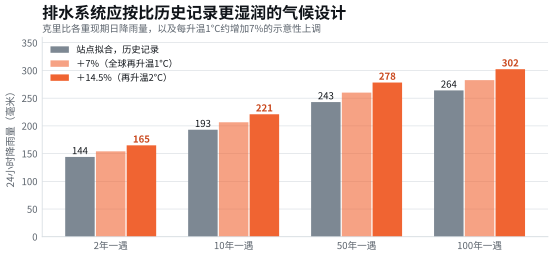
资料来源:克里比站皮尔逊III型拟合[S60];IPCC AR6第一工作组,极端日降水随升温的变化[S59]。上调由Cameroon Steel计算。
英文全文 11分钟 · 2614词Climate risk and adaptation: a plateau site with a wet, warming climate and an eroding port coast
A steelworks built around 2030 will operate into the 2070s, in a climate that will be warmer and, at Kribi, wetter in its extremes than the records on which engineers usually design. The Mboro site sits on a plateau about 40 to 100 m above sea level and about 3 to 4 km inland, so it is not exposed to coastal flooding. Its material risks are elsewhere: extreme rainfall on large paved and roofed areas, heat and humidity for workers in front of an arc furnace, lightning, the reliability of hydro-based power in dry years, and a port interface on a coastline that has been retreating since the deep-water port was built. All of these can be managed by design if they are designed for now.
7.1 The site and its climate
The Kribi coast has an equatorial climate with two wet seasons and no truly dry month: even the driest months receive about 90 mm of rain [S60]. The homogenised record of Kribi station gives a mean annual rainfall of about 2,836 mm for 1937 to 1976, with the main wet season in September and October at about 500 mm a month and a relatively drier spell in July [S60]. Other sources give similar means, between about 2,800 and 2,900 mm [S60][S64]. On the ERA5 reanalysis for the Kribi grid cell, mean daily maximum temperatures range from about 26 °C in August to about 30 °C in March, and minimum temperatures from about 23 to 25 °C (1991 to 2020) [S64]; reanalysis tends to understate coastal maxima, which site measurements will confirm (Chapter 11); relative humidity ranges from about 70% to 78% in the afternoon to 92% to 96% at night [S60]. Squall lines bring short, violent gusts of up to about 20 m/s [S60][S62]. The US Geological Survey catalogue records no earthquake of magnitude 4.6 or more within about 170 km of Kribi since 1900 [S97]; a site-specific seismic hazard assessment is part of the geotechnical studies.
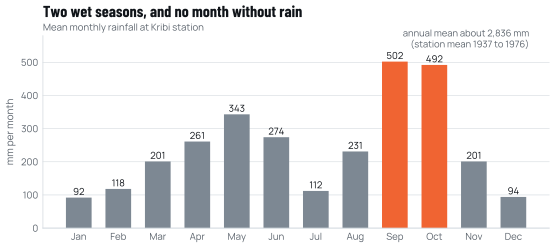
Source: Olivry, Monographie du Nyong et des fleuves côtiers, ORSTOM (1979), homogenised Kribi station record, 1937 to 1976 [S60].
The RC-1 site lies on the coastal plateau; satellite surface models give roughly 50 to 120 m across the wider area, and allowing for the forest canopy they include puts the ground at about 40 to 100 m above sea level (rounded; to be confirmed by survey) [S106]. The site is about 3 to 4 km from the coastline at the port frontage, measured from the centre of the indicative area (White paper 07, Table D.1). No river or marine flooding can reach the plant platforms at that elevation. The flood question on site is therefore one of stormwater: how much rain falls on the roofs, roads and stockyards of a large works, and where it goes.
7.2 Extreme rainfall is the main physical design load
The station record gives one-day rainfall totals of about 144 mm with a two-year return period, 193 mm at ten years, 243 mm at fifty years and 264 mm at one hundred years, from a Pearson type III fit to 33 years of data; the largest observed one-day total was 205.3 mm [S60]. Reanalysis datasets such as ERA5 smooth these extremes heavily (their mean annual maximum is about 76 mm [S64]) and should not be used for drainage design.
A warming climate intensifies heavy rainfall. The IPCC’s Sixth Assessment Report concludes that extreme daily precipitation events intensify by about 7% for each additional 1 °C of global warming [S59]. Applying that rate to the station values gives an illustrative allowance: about 283 mm for the 100-year day with one more degree of warming and about 302 mm with two (Figure 7.2). The station fit itself rests on mid-twentieth-century data, so part of that uplift may already have occurred.
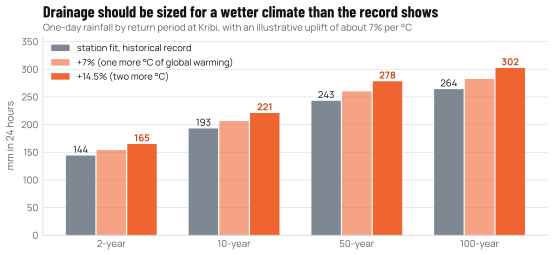
Source: Kribi station Pearson III fit [S60]; IPCC AR6 WGI, scaling of extreme daily precipitation with warming [S59]. Uplift applied by Cameroon Steel.
For a steelworks, the consequences of under-designed drainage are not only nuisance flooding. Water entering a melt shop can cause steam explosions on contact with liquid steel or slag; flooded cable trenches and substations stop production; wet scrap raises furnace energy use and, if it carries trapped water into the furnace, is a safety hazard; and runoff from stockyards and slag areas must be collected and treated before discharge. Short-duration intensity-duration-frequency curves for Kribi, which govern the sizing of roof drainage and channels, are not available in the public record and are an evidence gap (Chapter 11).
7.3 Heat and humidity: a worker-safety issue first
Steelworks expose workers to radiant heat from liquid steel, slag and hot product, in addition to the ambient climate. In Kribi’s hot, humid conditions the body’s ability to cool by sweating is limited, so the combination is more demanding than either alone. The International Labour Organization estimated in 2019 that heat stress would cost 2.2% of total working hours worldwide by 2030, about 5% in western Africa, with central Africa among the most affected regions [S65]. Heat-stress management for RC-1 should be based on the wet-bulb globe temperature index defined in ISO 7243 [S66], with work-rest regimes, cooled refuges and pulpits, hydration, acclimatisation and monitoring, and with equipment specified for ambient conditions that include margins for warming.
Heat also affects equipment. Transformer, motor and drive ratings, the capacity of cooling towers (which depends on the wet-bulb temperature), and the performance of air-conditioned control rooms and electrical rooms should all be specified for hotter and more humid conditions than today’s averages.
7.4 Sea-level rise and shoreline retreat at the port interface
Globally, the IPCC projects sea-level rise by 2100, relative to 1995 to 2014, of about 0.44 to 0.76 m under an intermediate emissions scenario (SSP2-4.5) and 0.63 to 1.01 m under a very high one (SSP5-8.5), with a low-likelihood, high-impact outcome of up to about 2 m that cannot be ruled out [S59]. Kribi-specific projections were not obtained for this paper.
On the Kribi coast, sea-level rise adds to a more immediate process. Shoreline studies show that the coast was accreting by about 0.4 m a year on average between 1973 and 2000, retreated by about 0.9 m a year between 2000 and 2015 and by about 2 m a year between 2015 and 2020, with local rates far higher: about 32 m a year at the Lobé falls in 2015 to 2020 and 45 to 70 m a year near Lolabé in 2013 to 2017, while more than 15 m a year accumulated updrift of the port breakwater [S62]. A 2025 assessment rated 68.3% of the 31.5 km Kribi coast as highly vulnerable and linked part of the change to sediment trapping by the breakwater [S63].
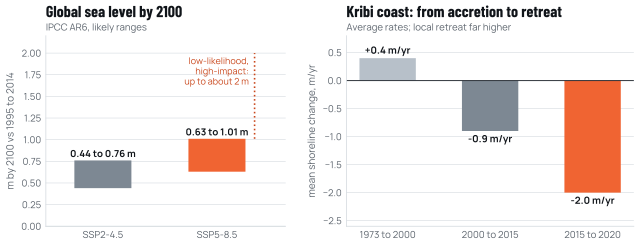
Source: IPCC AR6 WGI Summary for Policymakers [S59]; Fendoung, Tchindjang and Hubert-Ferrari (2022) [S62].
RC-1 depends on the port in both directions. In Phase 1 the works would bring in about 351,000 t a year of imported metallics and consumables and ship up to 300,000 t of products, rising to about 1.24 Mt and 1 Mt at full build-out [S90]. Port infrastructure is the port authority’s responsibility. A mineral terminal at Kribi was the subject of a memorandum of understanding signed on 4 November 2025, and the port’s Director General said in March 2026 that it should be completed within five to six years [S87][S61][S74]; until then, iron units would pass through the existing terminals (White paper 02). Cameroon Steel’s own exposure lies in any jetty, conveyor or pipeline landfall it might build, in access roads near the coast and in the storage of imported iron units.
DRI deserves particular care. Freshly made DRI reacts with water and air, releasing heat and hydrogen; it is regulated as a hazardous bulk cargo under the International Maritime Solid Bulk Cargoes Code, which sets strict conditions for its carriage [S99]. HBI, compacted while hot, is more stable but must still be kept dry. In a climate with about 2,836 mm of rain a year, covered storage for DRI and HBI, both at the port and on site, is a safety requirement as well as a quality one. The RC-1 layout reserves a covered DRI/HBI store in the metallics yard [S90].
7.5 Climate risk to the power supply is also a carbon risk
Physical climate risk reaches the works through its power supply. Cameroon’s southern grid is about 90% hydro, and hydro output varies with rainfall: Nachtigal delivered about 28% less than planned in 2025 because of hydrology [S50]. Drier years, or longer dry seasons, would push more thermal generation onto the margin, raising both the cost and the carbon content of electricity at the time the works needs it (Chapter 3). Conversely, wetter extremes raise flood and sediment risks at hydro plants and along transmission corridors. For an electric-arc works, the climate resilience of the power system is therefore part of its own adaptation case, and a reason to contract for firmness rather than for energy alone.
7.6 Transition risks: the other half of a climate risk assessment
A climate change risk assessment under the Equator Principles covers transition risks as well as physical ones: the policy, legal, technology, market and reputational changes that a shift to a low-carbon economy brings [S22]. For an electric-arc works on a hydro-dominated grid, most of these are smaller than for a conventional steel plant, and several are opportunities. They are not negligible, however, and they belong in the same register as the physical hazards.
The policy channel runs mainly through export markets. Carbon border measures in the EU and the United Kingdom already price embedded emissions (Chapter 5), and buyers’ procurement rules increasingly do the same through product declarations. At home, Cameroon’s updated nationally determined contribution and its Plan National Climat set the direction of national policy [S80][S81]; a future domestic reporting obligation or carbon price cannot be excluded over a forty-year asset life. The technology channel concerns iron units: if ironmaking moves towards hydrogen and DR-grade ore stays scarce, the price and availability of the DRI and HBI that RC-1 buys could change materially [S11]. The market channel cuts both ways: low-carbon steel may earn a premium in some markets, but competing imports will also advertise low-carbon credentials, and unverifiable claims will not survive scrutiny.
Table 7.1 Transition risk screening for the RC-1 works
| Driver | Channel | Effect on RC-1 | Horizon | Response |
|---|---|---|---|---|
| Carbon border measures (EU, UK, possibly others) | Cost of exports; buyer requirements | Opportunity if verified; risk if default values apply | Now to 2034 | CBAM-grade monitoring from the first heat (Chapter 5) |
| Domestic climate policy | Reporting duties; possible carbon price | Moderate risk; low intensity limits exposure | Medium term | Voluntary verified reporting ahead of any obligation |
| Lender and investor standards | Access to and cost of finance | Requirements apply from Phase 1 | Now | EP4-grade assessment and annual reporting (Chapter 9) |
| Shift of ironmaking to hydrogen; DR-grade ore scarcity | Price and carbon content of purchased DRI/HBI | Risk to cost; opportunity for a Cameroonian green-iron option | 2030s | Diversified iron-unit sourcing; ore and gas studies (Chapter 6) |
| Buyer demand for low-carbon products | Price premium; market access | Opportunity, conditional on EPDs and certification | Now to 2040 | EPDs and site certification (Chapters 2 and 9) |
| Credibility of claims | Reputation | Risk if claims outrun evidence | Continuous | State perimeters; verify; publish (Chapter 2) |
Source: Cameroon Steel screening; requirement from Equator Principles EP4 [S22].
7.7 A hazard screening for the Mboro works
Table 7.2 summarises the hazards, their relevance to the plant platform and the port interface, and the design responses that follow. It is a screening, not the full climate change risk assessment required by the Equator Principles for a project of this size [S22], which will be completed within the environmental and social impact assessment with site-specific data.
Table 7.2 Physical climate hazard screening (desk level)
| Hazard | Plant platform | Port interface and access | Trend with warming | Design response |
|---|---|---|---|---|
| Extreme rainfall and flash flooding | High: large impermeable areas, melt-shop water hazard | High | Increasing (about 7% per °C for daily extremes) | Size drainage and retention to the 100-year day plus an uplift; keep water away from liquid metal areas; covered scrap and DRI/HBI storage |
| Heat and humidity | High for workers; moderate for equipment | Moderate | Increasing | WBGT-based heat-stress plan; cooled refuges and pulpits; equipment rated with margins |
| Sea-level rise and coastal erosion | None at about 40 to 100 m elevation | High near the shoreline | Increasing | No critical assets near the shore; coastal setbacks for any jetty or conveyor landfall |
| Squall-line winds | Moderate (cladding, cranes, stacks) | Moderate (ship-to-shore operations) | Uncertain | Wind loads with margins; crane wind interlocks |
| Lightning | High but unquantified | High | Uncertain | Lightning protection and earthing designed to the IEC 62305 series |
| Drought in the hydro catchments | Indirect: power reliability and carbon | Not applicable | Uncertain | Firm power contract; melting scheduled around system peaks; on-site power quality |
| Earthquakes | Not rated at desk level: no event of magnitude 4.6 or more within about 170 km since 1900 (USGS catalogue) [S97] | Not rated | Not applicable | Site-specific seismic hazard assessment in the geotechnical studies; design to its result and the applicable code |
Source: Kribi station data [S60]; IPCC AR6 [S59]; shoreline studies [S62][S63]; USGS catalogue [S97]; ILO [S65]; ISO 7243 [S66]; IEC 62305 [S98]. Screening by Cameroon Steel.
7.8 Adaptation is cheapest at the design stage
Most adaptation measures for a new works cost little if they are built into the design and a great deal if they are retrofitted. The main principles for RC-1 are:
- Design to the future climate, not the record. Use the station extremes with an explicit warming allowance for drainage, retention and roof design, and specify cooling systems and electrical equipment for hotter and more humid conditions.
- Keep water away from liquid metal. Melt-shop floors, pits and slag areas need positive drainage, raised thresholds and dry storage of charge materials.
- Separate clean and contaminated runoff. Roof water can be harvested for cooling-water make-up; runoff from scrap, slag and stockyards must be collected and treated.
- Protect people first. Heat-stress management, lightning protection and emergency plans for extreme weather should be in place before the first heat.
- Contract for firm power. The climate resilience of the grid is part of the plant’s own.
- Monitor and revise. A weather station on site from the start of construction, and a review of design assumptions at each phase, will keep the adaptation case current.
Physical risk and decarbonisation meet at one more point: the materials the works consumes and produces. The next chapter turns to circularity.
Other sources cited in the English text
- S64ERA5 reanalysis, daily series 1991 to 2020 for the Kribi grid cell (rainfall and temperature), via the Open-Meteo archive API. ECMWF / Open-Meteo.archive-api.open-meteo.com/v1/archive?latitude=2.75&longitude=10.00&st…
- S97Earthquake catalogue search, 400 km radius around Kribi, magnitude 3 and above, 1900 onwards. US Geological Survey.earthquake.usgs.gov/fdsnws/event/1/query?format=csv&latitude=2.75&long…
- S106SRTM 30 m digital surface model, accessed through the OpenTopoData API. NASA; OpenTopoData.opentopodata.org/datasets/srtm/
- S65Working on a warmer planet: the impact of heat stress on labour productivity and decent work (as reported by UN News). International Labour Organization, 1 Jul 2019.news.un.org/en/story/2019/07/1041652
- S66ISO 7243:2017, Ergonomics of the thermal environment: assessment of heat stress using the WBGT index. International Organization for Standardization, 2017.iso.org/standard/67188.html
- S63Geomatics-based assessment of coastal vulnerability in Kribi (Perabi et al.), Urban Resilience and Sustainability 3(4). AIMS Press, Nov 2025.aimspress.com/aimspress-data/urs/2025/4/PDF/urs-03-04-012.pdf
- S90Cameroon Steel reference configuration RC-1 (planning estimate): phases, planning values, balances and indicative schedule, edition 10 October 2026. Cameroon Steel, 10 Oct 2026.Cited by title and date
- S87Port de Kribi: un terminal minéralier d’avenir (memorandum of understanding for a mineral terminal). Port Autonome de Kribi, 4 Nov 2025.Cited by title and date
- S61Kribi Deep Sea Port, investors partner to construct 125-million-tonne mineral terminal worth $2 billion. Business in Cameroon, 5 Nov 2025.businessincameroon.com/transport/0511-15300-kribi-deep-sea-port-invest…
- S74Zone industrialo-portuaire de Kribi (KPIZ): jusqu’à +8 points de croissance et 150 000 emplois attendus sur 15 ans. Investir au Cameroun, 4 Mar 2026.investiraucameroun.com/gestion-publique/0403-23163-zone-industrialo-po…
- S99International Maritime Solid Bulk Cargoes (IMSBC) Code. International Maritime Organization.imo.org/en/OurWork/Safety/Pages/BulkCarriers-Default.aspx
- S50Rapport d’activités 2025 de l’ARSEL. ARSEL (electricity regulator, Cameroon), 7 Sep 2026.arsel-cm.org/wp-content/uploads/2026/09/Rapport-ARSEL-2025.pdf
- S22The Equator Principles EP4. Equator Principles Association, Jul 2020 (effective 1 Oct 2020).equator-principles.com/app/uploads/The-Equator-Principles_EP4_July2020…
- S80Cameroon’s updated NDC sets 35% conditional emission cut target for 2030. Enerdata, 2021.enerdata.net/publications/daily-energy-news/cameroons-updated-ndc-sets…
- S81Arrêté n° 106/PM du 11 juillet 2025 portant approbation du Plan National Climat. Prime Minister of Cameroon (MINEPDED), 11 Jul 2025.minepded.gov.cm/wp-content/uploads/2025/08/decret-PM-plan-climat-1.pdf
- S1115 Insights on the Global Steel Transformation. Agora Industry, 15 Jun 2023.agora-industry.org/publications/15-insights-on-the-global-steel-transf…
- S98IEC 62305 series, Protection against lightning. International Electrotechnical Commission, 2010 onwards.webstore.iec.ch/en/publication/6793
本章引用的资料来源
方括号内的标记对应以下来源(按原文语言列出),完整列表见附录。 完整来源列表
- S60Monographie du Nyong et des fleuves côtiers, Tome 1 (J.-C. Olivry). ORSTOM,1979年7月.horizon.documentation.ird.fr/exl-doc/pleins_textes/divers11-03/01948.p…
- S59Climate Change 2021: The Physical Science Basis, Summary for Policymakers. IPCC Working Group I,2021年.ipcc.ch/report/ar6/wg1/downloads/report/IPCC_AR6_WGI_SPM.pdf
- S62Weakening of coastlines and coastal erosion in the Gulf of Guinea: the case of the Kribi coast (Fendoung, Tchindjang and Hubert-Ferrari), Land 11:1557. MDPI,2022年.doi.org/10.3390/land11091557
引用本章
Cameroon Steel(2026)。喀麦隆低碳钢铁:碳强度有望降至全球平均的三分之一左右(中文摘要版)。白皮书06,第7章:气候风险与适应:高地厂址、湿热升温的气候与受侵蚀的港口海岸。CS-WP-06。https://www.cameroon-steel.com/zh/library/lower-carbon-steel/climate-risk-adaptation/
来源