白皮书06 · 第10章 · 中文摘要
脱碳路径:已知措施可降低约40%,绿色铁可进一步降低
本章结论:从100万吨/年钢厂计入上游含铁原料后约每吨0.58吨二氧化碳的示意性碳足迹出发,已知措施可将其降至约0.35吨(一期2030年下半年首炉出钢,全部建成在2034年之后);以氢基含铁原料替代气基直接还原铁可进一步降至约0.26吨。这些步骤都不会自动实现,其中影响最大的几项取决于电力系统、含铁原料供应商和氢能经济性。
本页为本章中文摘要;英文全文附于其后,可展开阅读。
各项措施依次叠加(图10.1)合计约−0.232吨,其中电网降至100克/千瓦时(约−0.088吨)和经认证的低碳直接还原铁(上游0.5吨/吨,约−0.060吨)影响最大;氢基含铁原料(0.2吨/吨)再减少约0.091吨。厂内运营措施合计仅约0.04吨,最重要的电网和含铁原料两项大多在厂外,取决于合同和供应商。
十项建议的要点为:签订明确低碳电源的稳定电力合同;为每批含铁原料规定碳规格和强度上限;国内回收与进口并举,提高废钢比例;在设计中消除直接排放和能源浪费;从第一炉起计量并按年核查和公布;为钢坯、线材和钢筋发布经核查的产品环境声明;从一期起适用最严格的贷款机构要求;在设计中落实气候适应;为钢渣和粉尘建立出路;以证据为基础保留绿色铁选项,自2027年起开展精矿与球团研究。
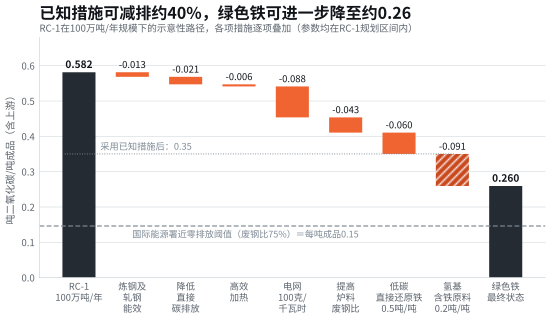
资料来源:WP06模型,基于Cameroon Steel参考配置RC-1(规划估算)[S90];直接还原铁电耗增量[S15];氢基铁强度由[S15]推算;国际能源署近零阈值[S06]。
英文全文 11分钟 · 2493词A decarbonisation pathway: about 40% lower with known levers, further with green iron
Starting from the illustrative 1 Mtpa footprint of about 0.58 t CO2 per tonne including upstream iron units, known levers could bring the RC-1 works to about 0.35 t: a little furnace and mill efficiency, lower direct emissions, a grid closer to the 2025 mix, more scrap in the charge (domestic or imported) and certified lower-carbon DRI. Replacing gas-based DRI with hydrogen-based iron units would take it to about 0.26 t. None of these steps is automatic, and the largest depend on others: the power system, suppliers of iron units and the economics of hydrogen. The ten recommendations at the end of this chapter set out what Cameroon Steel would do, and what it would ask of its partners, to keep the works on that path.
10.1 The levers, in order of size
Figure 10.1 applies a sequence of levers cumulatively to the full build-out. Each parameter stays within the range in the RC-1 reference configuration, except the hydrogen-based iron step, which is derived from published process data (Chapter 6). The sequence is illustrative; levers can be pursued in parallel and their order does not imply timing.
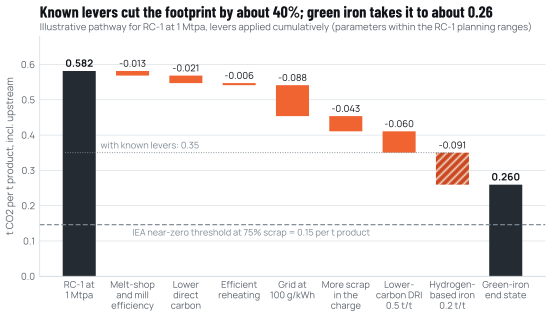
Source: WP06 model on the Cameroon Steel reference configuration RC-1 (planning estimate) [S90]; DRI power penalty [S15]; hydrogen-based iron intensity derived from [S15]; IEA near-zero threshold [S06].
Table 10.1 Pathway levers and their illustrative effect at 1 Mtpa
| Lever | Parameter change | Effect, t CO2 per t product | Cumulative intensity | Annual effect at 1 Mtpa, kt CO2 | Who controls it |
|---|---|---|---|---|---|
| Starting point: RC-1 full build-out | As in Chapter 4 | 0.582 | |||
| Melt-shop and mill efficiency | Furnace 450 to 420 kWh/t; auxiliaries 70 to 60; rolling 110 to 95 | −0.013 | 0.569 | −13 | Operations, technology supplier |
| Lower direct carbon | Furnace direct factor 0.10 to 0.08 t/t liquid | −0.021 | 0.547 | −21 | Operations |
| Efficient reheating | Gas 1.3 to 1.15 GJ/t (hot charging, recuperation) | −0.006 | 0.541 | −6 | Design, operations |
| Lower-carbon grid supply | 226 to 100 g/kWh (2025 mix level or contracted supply) | −0.088 | 0.454 | −88 | Power system, contract |
| More scrap in the charge (domestic or imported) | DRI share 30% to 25% | −0.043 | 0.411 | −43 | Scrap collection, import contracts, purchasing |
| Certified lower-carbon DRI/HBI | Upstream factor 0.7 to 0.5 t/t DRI | −0.060 | 0.350 | −60 | Purchasing, suppliers |
| With known levers | −0.232 | 0.350 | −232 | ||
| Hydrogen-based iron units | Upstream factor 0.5 to 0.2 t/t DRI | −0.091 | 0.260 | −91 | Long term: green-iron option (Chapter 6) |
Source: WP06 model on the Cameroon Steel reference configuration RC-1 (planning estimate) [S90] (Annex A). Values are illustrative; annual effects at nameplate output.
Three features stand out. First, the operational levers inside the works (efficiency, direct carbon, reheating) are real but small, about 0.04 t per tonne together. They should be pursued because they also save money, but they do not change the plant’s carbon position. Second, the two levers that matter most in the medium term, the grid and the iron units, are largely outside the works’ fence: they depend on contracts and on suppliers. Third, the step from 0.35 to 0.26 t requires a change in how iron is made, which is why green iron, not furnace practice, is the long-term frontier.
Even the end state does not reach near-zero. At about 75% scrap, the IEA’s threshold corresponds to about 0.15 t per tonne of product [S06]. Closing the remaining gap would require a grid closer to zero, hydrogen-based reheating or electrification of reheating, and furnace direct emissions reduced further, for example with biogenic carbon in place of fossil charge carbon. These are options for the 2040s, not plans.
10.2 What the levers cost, and who pays
The levers differ as much in cost as in size. The operational levers (furnace and mill efficiency, lower electrode and carbon consumption, hot charging) usually pay for themselves through lower energy and consumable costs, which is why they are standard practice in well-run electric-arc works. The grid lever depends on the terms of the power contract: in Cameroon, realised high-voltage prices in 2025 ranged from about 18.4 FCFA per kWh under legacy contracts to a regulatory estimate of about 105 FCFA per kWh for the cost-reflective average across all customers [S50][S54], so firm, identified low-carbon supply may carry a premium over the cheapest available energy. The iron-unit levers depend on the market for low-carbon DRI and HBI, which is still thin and which analysts expect to tighten as demand for DR-grade feed outstrips supply [S11].
The hydrogen step is the expensive one. The Energy Transitions Commission estimated that fully decarbonising steel would cost about US$60 per tonne of CO2 abated, adding about US$115 to a tonne of steel, falling to about US$25 per tonne of CO2 and US$50 per tonne of steel where very cheap clean electricity is available [S09]. The Mission Possible Partnership estimated a premium of about US$175 per tonne, about 40%, for near-zero primary steel around 2030, adding about 2% to the price of a building [S08]. Carbon border measures will cover part of that gap for exported products: Chapter 5 showed an illustrative CBAM differential of about €70 to €160 per tonne between RC-1 product and an average blast-furnace product by 2034 at today’s certificate price; because CBAM prices the DRI in RC-1’s charge, hydrogen-based iron units at 0.2 t per tonne would also cut RC-1’s own charge by about €15 per tonne (derived). For the domestic and regional market, where no carbon price applies, the hydrogen step would need either a buyer’s premium, concessional climate finance or very low-cost hydro, and probably all three.
The practical conclusion is a sequence: pursue the operational levers immediately because they pay; secure the grid and iron-unit levers through contracts because they are where most of the carbon is; and develop the hydrogen option as evidence and economics allow.
10.3 An indicative trajectory
Figure 10.2 places the pathway on an indicative timeline. Phase 1 would operate at about 0.58 t per tonne from its first heat, targeted for the second half of 2030, and through its ramp-up in 2031; the full build-out, if it proceeds after 2034, would hold that level; the known levers could bring it to about 0.35 t in the late 2030s; and hydrogen-based iron units could bring it to about 0.26 t in the 2040s. Scopes 1 and 2 would fall from about 0.32 t per tonne in Phase 1 (about 0.33 t at full build-out) to about 0.20 t, mostly through the grid.
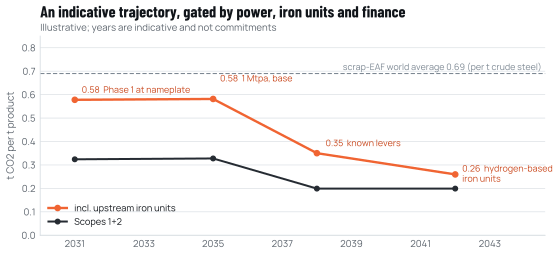
Source: WP06 model on the Cameroon Steel reference configuration RC-1 (planning estimate) [S90]; phasing from the RC-1 indicative schedule [S90]; worldsteel scrap-EAF average [S01].
The trajectory is gated at each step. The grid lever needs the transmission reinforcements and supply contracts discussed in Chapter 3. The iron-unit levers need suppliers willing to certify their carbon content and, for hydrogen-based iron, firm low-carbon electricity at a cost that a carbon price or a buyer’s premium can bridge. The scrap lever needs a collection system that does not yet exist at scale. Cameroon Steel would report progress against each lever annually, so that the trajectory can be tested against evidence rather than intentions.
10.4 Measurement, reporting and verification from the first heat
The pathway is only as credible as the measurement behind it. The monitoring plan for RC-1 would rest on four principles:
- One dataset, several reports. A single, metered dataset of carbon inputs (electrodes, charge carbon, fluxes, gas), electricity by consumer, purchased iron units with their supplier data, and production by product feeds every report: the GHG Protocol corporate inventory, the ISO 14404 site intensity, CBAM embedded emissions and EPDs (Chapter 2).
- Supplier data for iron units. Every cargo of DRI or HBI comes with verified carbon data from its producer, prepared on the CBAM or ISO 14404 basis.
- Independent verification. An accredited third party verifies the annual inventory against ISO 14064-3 [S101] and the CBAM rules, and verifies EPDs under the applicable programme.
- Public disclosure. An annual climate report publishes the inventory, the key performance indicators in Table 10.2 and progress against the pathway.
Table 10.2 Key performance indicators for the RC-1 climate report
| Indicator | Unit | Basis | Why it matters |
|---|---|---|---|
| Scope 1, Scope 2 (location- and market-based), Scopes 1+2 | t CO2e/yr | GHG Protocol | Lender thresholds; corporate inventory |
| Upstream emissions of purchased iron units | t CO2e/yr | ISO 14404; supplier data | The largest block of the footprint |
| Site intensity | t CO2e per t crude steel | ISO 14404 | Comparison with route averages and certification scales |
| Product intensity and CBAM embedded emissions | t CO2e per t of each product | ISO 14067; CBAM | Buyers, EPDs, border charges |
| Scrap share and DRI/HBI share of the charge | % | Material balance | The main controllable carbon levers |
| Carbon intensity of purchased DRI/HBI | t CO2e per t DRI | Supplier data, verified | Purchasing specification |
| Electricity use and grid factor, monthly | kWh/t; g CO2/kWh | Metering; utility data | Seasonal power and carbon risk |
| Electrode and charge-carbon consumption | kg/t liquid steel | Material balance | Direct emissions |
| Slag used as product; dust sent to zinc recovery | % of arisings | Waste register | Circularity |
| Water make-up | m³/t product | Metering | Resource efficiency |
Source: Cameroon Steel, monitoring design principles; standards as cited in Chapter 2.
10.5 Ten recommendations
Table 10.3 sets out the ten actions that follow from this paper, with the party that leads each and an indicative timing. They are written as Cameroon Steel’s intentions and requests; they are not contractual commitments.
Table 10.3 Ten recommendations
| # | Recommendation | Lead | Indicative timing |
|---|---|---|---|
| 1 | Contract firm, identified low-carbon power. Negotiate a bilateral supply with identified hydro or other low-carbon generation and firmness through the dry season; support the transmission reinforcements that bring hydro to Kribi; report location- and market-based Scope 2 monthly. | Cameroon Steel with the utility, the transmission operator and the regulator | Before the Phase 1 investment decision |
| 2 | Specify the carbon content of every iron unit bought. Require verified carbon data for each DRI or HBI cargo, set a contractual intensity ceiling that falls over time, and prefer suppliers with lower-carbon processes; under CBAM the DRI sets most of the charge on an EU-bound tonne. | Cameroon Steel purchasing | Phase 1 procurement |
| 3 | Raise the scrap share, at home and abroad. Develop domestic collection partnerships, with quality control, radiation screening and labour standards consistent with IFC Performance Standard 2, and secure import contracts for low-residual scrap for the balance. | Cameroon Steel with collectors and authorities | From construction |
| 4 | Design out direct emissions and energy waste. Evaluate scrap preheating or continuous charging in furnace selection, maximise hot charging, specify efficient fume extraction and hydrogen-ready burners for the Phase 2 and 3 reheating furnaces. | Cameroon Steel with the technology supplier | Front-end engineering |
| 5 | Measure from the first heat. Design the inventory to the GHG Protocol, ISO 14404 and CBAM rules, including minor fuels and switchgear SF6; meter electricity by consumer; verify annually; publish an annual climate report. | Cameroon Steel | Commissioning |
| 6 | Document products. Publish verified EPDs for billets, wire rod and reinforcing bar within the first two years of operation and seek site certification against a recognised standard once operations are stable. | Cameroon Steel | Years 1 to 3 of operation |
| 7 | Apply the strongest lender requirements from Phase 1. Complete an EP4-grade climate change risk assessment and alternatives analysis within the environmental and social impact assessment, regardless of where Phase 1 falls relative to the 100,000 t threshold. | Cameroon Steel and its impact-assessment consultants | Impact assessment |
| 8 | Adapt by design. Size drainage and retention to the 100-year storm with a warming allowance; implement a heat-stress plan; provide covered DRI/HBI storage; install a site weather station at the start of construction. | Cameroon Steel with designers | Design and construction |
| 9 | Create outlets for co-products. Obtain approval for slag aggregates with the public works authorities; contract EAF dust recovery with a licensed recycler; close the water loop and harvest rainfall. | Cameroon Steel | Before commissioning |
| 10 | Keep the green-iron option open, on evidence. Commission a concentrate and pelletising study on Cameroonian ore, assess gas supply and reserves for a direct-reduction module, keep the reserve land and utilities corridor, and engage with green-iron corridor initiatives and partners. | Cameroon Steel with the sister mining company, the gas sector and partners | Studies from 2027 |
Source: this paper, Chapters 1 to 9.
10.6 What government and partners can do
Several of the levers sit with public institutions. Cameroon Steel would welcome progress in five areas, which would benefit every industrial electricity user and not only the steel sector:
- Grid reinforcement and firm supply for industrial zones, including completion of the transmission links that deliver hydro output to the coast [S51][S55].
- A registry for electricity attribute certificates or an equivalent mechanism, so that contracted low-carbon supply can be evidenced and not double-counted.
- A national framework for industrial greenhouse gas reporting and verification, consistent with international methods, which would also strengthen Cameroon’s ability to document carbon prices or emissions for export markets.
- Standards for recycled aggregates, so that steel slag and other secondary materials can be used in public works with confidence.
- Support for ore beneficiation studies, consistent with the local-transformation objectives of the Mining Code [S86] and the KPIZ steel cluster [S74], so that the DR-grade question is answered with public data.
10.7 Conclusion
Cameroon has an unusual combination of assets for low-carbon steel: a hydro-dominated grid, large undeveloped hydro potential, iron ore under development and a deep-water port with an industrial zone that names steel among its clusters. An electric-arc works at Mboro could use the first of these from its first heat to make steel at about a third of the world’s average carbon intensity. The others could, over two decades and under conditions this paper has set out, allow Central Africa to make its own low-carbon iron.
The difference between that possibility and a claim is measurement. A works that measures, verifies and publishes its carbon performance, and that contracts for low-carbon power and iron units with the same care it gives to cost and quality, will be able to turn Cameroon’s natural advantages into a competitive one. That is the course this paper recommends.
Other sources cited in the English text
- S50Rapport d’activités 2025 de l’ARSEL. ARSEL (electricity regulator, Cameroon), 7 Sep 2026.arsel-cm.org/wp-content/uploads/2026/09/Rapport-ARSEL-2025.pdf
- S54Décision fixant le montant de la RMA ENEO au titre de l’exercice 2025 (réajustée). ARSEL, 19 Dec 2025.arsel-cm.org/wp-content/uploads/2026/01/Decision-fixant-le-Montant-de-…
- S1115 Insights on the Global Steel Transformation. Agora Industry, 15 Jun 2023.agora-industry.org/publications/15-insights-on-the-global-steel-transf…
- S09Mission Possible sectoral focus: Steel. Energy Transitions Commission, 2019 (Mission Possible, Nov 2018).energy-transitions.org/wp-content/uploads/2020/08/ETC-sectoral-focus-S…
- S08Making Net-Zero Steel Possible. Mission Possible Partnership, Sep 2022.missionpossiblepartnership.org/action-sectors/steel
- S01Sustainability Indicators 2025 report (2024 data; route table added February 2026). worldsteel, Nov 2025; upd. Feb 2026.worldsteel.org/wider-sustainability/sustainability-indicators/
- S101ISO 14064-3:2019, Greenhouse gases: specification for the verification and validation of GHG statements. International Organization for Standardization, 2019.iso.org/standard/66455.html
- S51Nachtigal power line delays leave 150 MW of industrial demand unmet. Business in Cameroon, 9 Oct 2026.businessincameroon.com/public-management/0910-16939-nachtigal-power-li…
- S55Kribi franchit la ligne électrique 225 kV (communiqué). Port Autonome de Kribi, 6 Aug 2025.Cited by title and date
- S86Loi n° 2023/014 du 19 décembre 2023 portant Code minier. Republic of Cameroon (FAOLEX), 19 Dec 2023.faolex.fao.org/docs/pdf/cmr223180.pdf
- S74Zone industrialo-portuaire de Kribi (KPIZ): jusqu’à +8 points de croissance et 150 000 emplois attendus sur 15 ans. Investir au Cameroun, 4 Mar 2026.investiraucameroun.com/gestion-publique/0403-23163-zone-industrialo-po…
本章引用的资料来源
方括号内的标记对应以下来源(按原文语言列出),完整列表见附录。 完整来源列表
- S90Cameroon Steel reference configuration RC-1 (planning estimate): phases, planning values, balances and indicative schedule, edition 10 October 2026. Cameroon Steel,2026年10月10日.按标题和日期引用
- S15ENERGIRON technology: DRI-EAF production route using natural gas or H2. European Commission, Innovation Centre for Industrial Transformation,引用:2026年2月12日.innovation-centre-for-industrial-transformation.ec.europa.eu/innovativ…
- S06Achieving Net Zero Heavy Industry Sectors in G7 Members. International Energy Agency,2022年5月19日.iea.blob.core.windows.net/assets/c4d96342-f626-4aea-8dac-df1d1e567135/…
引用本章
Cameroon Steel(2026)。喀麦隆低碳钢铁:碳强度有望降至全球平均的三分之一左右(中文摘要版)。白皮书06,第10章:脱碳路径:已知措施可降低约40%,绿色铁可进一步降低。CS-WP-06。https://www.cameroon-steel.com/zh/library/lower-carbon-steel/pathway-recommendations/
来源