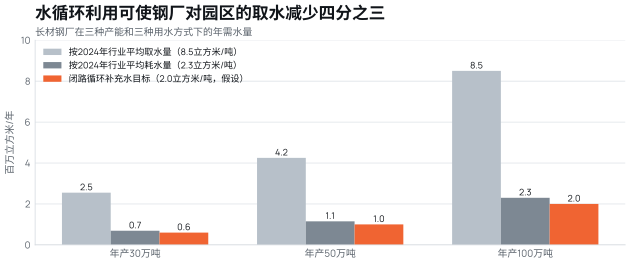
ORSTOM资料显示,克里比站1937年至1976年经均一化处理的年均降雨量为2835.8毫米,百年一遇日降雨量为264毫米[S79]。洛贝河最小实测流量为每秒3.5立方米,折合每年约1.1亿立方米,是采用闭路循环冷却、年产100万吨钢铁厂补充水需求的50倍[S79]。按世界钢铁协会2024年行业平均水平,每吨钢取用淡水8.5立方米[S77];年产100万吨的工厂按此每年取水约850万立方米,而采用闭路循环冷却、补充水约每吨2立方米时仅约200万立方米[S112]。10公顷屋顶和硬化场地每年可收集雨水约23万立方米,超过年产30万吨一期指示性补充水需求的三分之一[S79][S112]。港务局唯一公开的供水价格为2018年每立方米400中非法郎[S114]。最大的缺口是危险废物:电弧炉每吨钢产生约10至20公斤含锌、铅的粉尘(规划取值;欧盟参考文件为10至30公斤)[S76],年产100万吨的工厂每年约产生1.6万吨[S112],而公开资料未发现海洋省有工程化危险废物设施,中部非洲也没有锌回收厂。
对KPIZ S.A.和主管部门而言,应集中建设统一的许可取水、中央工业污水处理厂、按百年一遇暴雨设计的全区雨水系统和危险废物设施,并将闭路循环冷却作为向重工业企业供水的条件;要求闭路循环冷却和雨水收集,可使这些企业对园区的取水量减少约四分之三。对贷款方而言,这类公共设施正是园区开发融资方案可以支持的对象[S07]。
英文全文 11分钟 · 2523词Water is plentiful at Kribi; treatment, wastewater and hazardous waste are the real utility gaps
Kribi receives about 2,836 mm of rain a year, no month is dry, and two substantial rivers reach the sea within a few kilometres of the port [S79]. A dedicated water plant for the port platform is due to start production in early 2027 [S26]. Quantity is therefore not the constraint for a steel platform. A long-products works with closed-loop cooling needs make-up water of about 2 m³ per tonne, 0.6 to 2 million m³ a year depending on its size, and could cover a third or more of a first phase’s need from rain falling on its own roofs and yards [S112][S77]. The gaps lie elsewhere: industrial-grade supply and tariffs, wastewater treatment to lender standards, stormwater design for a 264 mm rain day, and, above all, a solution for hazardous furnace dust, for which no treatment or secure disposal facility has been identified in the region. These are the utilities that a zone, rather than each tenant, should provide.
5.1 A wet coast with a long rainy season
The meteorological station at Kribi has one of the longest records on the Cameroonian coast. The hydrological monograph of the Nyong and coastal rivers, published by ORSTOM in 1979, gives a homogenised mean annual rainfall of 2,835.8 mm for 1937 to 1976, with half of all years between about 2,540 and 3,100 mm [S79]. Modern reanalysis data for the grid cell around Kribi give a similar figure for 1991 to 2020, about 2,836 mm, although reanalysis smooths the extremes [S83]. The coast has an equatorial four-season regime moderated by the ocean: a main dry season from December to February that still brings about 90 to 120 mm a month, first rains from March to June, a short and weak relative dry spell in July, and a main wet season in September and October with about 500 mm a month (Figure 5.1) [S79].
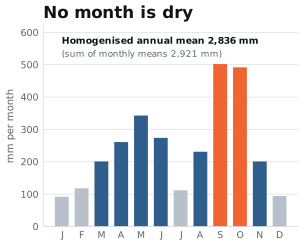
For a steel plant, three consequences follow. Stormwater, not water supply, sets the drainage design. The same monograph estimates a 1-day rainfall of 193 mm with a 10-year return period and 264 mm with a 100-year return period, and records a maximum observed 24-hour fall of 205 mm [S79]. Stockyards for scrap, DRI and slag, which can release suspended solids, oil and metals in run-off, need first-flush retention and treatment sized for these events. Humidity and rain affect materials handling. DRI and HBI re-oxidise and can heat when wet, so covered storage and conveyors are not optional at Kribi. The rain is also a resource, which can be harvested from roofs and paved yards to reduce the plant’s draw on the zone’s supply (below).
5.2 Rivers, groundwater and the limits of local abstraction
Two rivers drain the coastal plateau around the port. The Lobé, which reaches the sea at the Lobé falls north of the port, has a catchment of about 2,305 km² and a mean flow of about 102 m³/s, with a median annual low flow of about 8.4 m³/s and a recorded minimum of 3.5 m³/s [S79]. The Kienké, which reaches the sea at Kribi town, has a mean flow of about 49 m³/s and a low flow of about 6.9 m³/s [S79]. Smaller streams drain the plateau directly to the sea near the port.
In volume, these rivers dwarf any industrial demand: the Lobé’s minimum recorded flow, 3.5 m³/s, is about 110 million m³ a year, fifty times the make-up need of a 1 Mtpa works with closed-loop cooling. Abstraction is nonetheless sensitive. The Lobé falls are on UNESCO’s Tentative List as a cultural landscape [S86], the lower rivers are habitat for species of conservation concern, and the plateau’s small streams, which would receive any treated effluent, have no published flow or quality records. Groundwater is used locally, including by the Kribi gas plant, which is supplied from boreholes [S151], but no public data exist on aquifer yields or quality at the zone.
The sensible approach is therefore a zone-level water system with a single, licensed abstraction designed for the whole platform, rather than a scatter of private intakes and boreholes. That is what PAK has begun to build.
5.3 The port-platform water plant
During his inspection on 19 August 2026, the Minister of Water and Energy visited the works of a dedicated water supply project for the port platform, with an intake and treatment plant whose production is planned for early 2027 [S26]. The plant’s capacity has not been published. Separately, the 20 ha of serviced plots tendered at Mboro in May 2026 include potable-water networks, drainage and a wastewater treatment unit [S18], and KPIZ’s offer to investors includes water and sanitation networks [S03].
These are the right first steps. For heavy industry, three further specifications will matter: the capacity reserved for industrial users and how it grows; whether the zone will supply raw or partially treated industrial water separately from potable water, which is cheaper for cooling make-up; and the tariff. The only published reference for water supplied by the port authority is a 2018 tariff of 400 FCFA per m³ for water delivered to port users [S114]; KPIZ may set its own industrial tariff.
5.4 How much water a steel works needs
Water use in steelmaking varies widely with design. The world steel association’s 2024 sector averages are 8.5 m³ of fresh water withdrawn and 2.3 m³ consumed per tonne of steel [S77]. The difference is returned, usually after treatment, to rivers or the sea. IFC benchmarks for an EAF works are about 3 m³ per tonne for the melt shop, with 1 to 15 m³ per tonne for rolling depending on whether cooling is once-through or recirculated [S75]. A modern closed-loop plant, recirculating more than 95% of its cooling water and treating its scale-pit water for reuse, can hold make-up near 2 m³ per tonne of product, which Cameroon Steel uses as a planning assumption [S112].
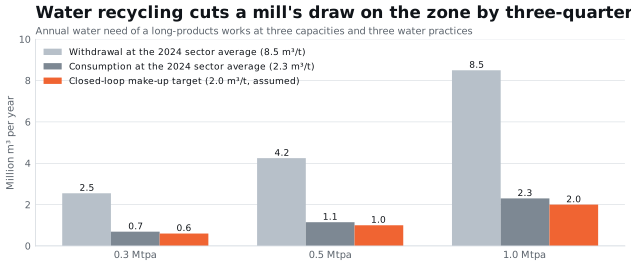
Source: worldsteel, Sustainability Indicators 2025 report (2024 data) [S77]; closed-loop make-up target is a Cameroon Steel planning assumption [S112]. Arithmetic in Annex A.
Figure 5.2 shows what the choice of practice means at three sizes. At 1 Mtpa, a plant at the sector-average withdrawal would draw about 8.5 million m³ a year, the equivalent of the domestic consumption of a town of more than 150,000 people at 150 litres per person per day. A closed-loop plant would draw about 2 million m³. The zone should require closed-loop cooling from heavy tenants as a condition of supply, both to protect the shared system and because it simplifies effluent treatment.
5.5 Rain as a resource
Because no month at Kribi is dry, rainwater harvesting is more reliable than in most of the world’s steel regions. A steel works has large roof areas over its melt shop, mills and covered stores, and large paved yards. At the station’s mean rainfall and a run-off coefficient of 0.8, harvesting from 5, 10 and 20 ha of roofs and paved surfaces would yield about 0.11, 0.23 and 0.45 million m³ a year [S79] (Annex A).
Ten hectares of collecting surface would yield about 0.23 million m³ a year, more than a third of the indicative make-up need of a first phase of 0.3 Mtpa [S112]. Storage is the limiting factor, because the wet-season surplus must carry the plant through the drier months, but the cooling-water basins and stormwater retention ponds that a plant needs anyway can serve as storage. Harvested rainwater is also soft and low in chlorides, which suits cooling circuits.
The broader point is that Kribi’s climate rewards integrated water design: the same infrastructure that manages a 264 mm storm can store the water that reduces a plant’s draw on the zone’s supply.
5.6 Wastewater, stormwater and the coast
A steel works produces several distinct water streams: cooling-tower blowdown, scale-pit water from the rolling mill containing oil and suspended solids, water from gas cleaning, sanitary wastewater, and stormwater from stockyards. International lenders apply the IFC effluent guidelines for integrated steel mills, which set limits for suspended solids, oil, metals and other parameters at the point of discharge [S75].
Two local factors raise the stakes. First, the receiving waters are small: the streams that drain the plateau around the port have low dry-season flows and no published baseline. Second, the coast south of the port is protected. The northern limit of the Manyange na Elombo-Campo Marine National Park, created by decree in 2021, lies about 11 km south of the port (Chapter 9) [S84], and the beaches beyond it are used by nesting sea turtles [S91]. Any effluent that reaches the sea near the port must be treated to standards that protect that coast.
For these reasons the zone would benefit from three shared facilities: a central industrial wastewater treatment plant that accepts pre-treated effluent from tenants, a stormwater master plan for the whole zone with retention basins sized for the 100-year storm, and a monitoring network on the receiving streams and the coast. The 20 ha servicing tender’s wastewater unit is a start at plot scale [S18].
5.7 Shared or private utilities: where the line should fall
Every heavy-industry zone has to decide which utilities it provides centrally and which it leaves to tenants. The answer at Kribi follows from scale and risk.
Utilities with strong economies of scale and shared environmental risk should be central. Raw-water abstraction from a single licensed source, a central industrial wastewater plant, a zone stormwater system and a hazardous-waste facility all fall into this category. Each is cheaper per cubic metre or per tonne when built once for the whole zone; each protects the shared rivers and coast; and each is easier to permit once than many times. They are also the kind of public-good infrastructure that the zone’s development-finance package can fund [S07].
Utilities that depend on a tenant’s process should be private, built to zone standards. Cooling towers, scale pits, oil separators, pre-treatment of process effluent and rainwater harvesting belong inside the plant fence, because only the operator can run them with the process. The zone’s role is to set the standards they must meet at the fence: maximum make-up per tonne, effluent quality at the connection to the central plant, and minimum on-site retention for stormwater.
Some services can start private and become shared. A first steel tenant may have to build its own secure cell for furnace dust, or contract an export route, because no shared facility yet exists. If the zone agrees in advance that the cell can later be transferred to, or replaced by, a shared facility, the first tenant’s investment becomes the seed of the zone’s service rather than a stranded asset.
The same logic applies to climate risk. The plateau on which the zone’s industrial plots sit is well above the level of coastal flooding, but intakes, outfalls and any pipelines that cross the shoreline must be designed for a coast that is retreating in places by about 2 m a year and for sea-level rise later in the century [S80][S82]. Designing those crossings once, at zone level, is cheaper and safer than leaving each tenant to engineer its own.
5.8 Hazardous waste: the gap that must be closed first
The most important utility gap for a steel cluster is hazardous waste. An electric arc furnace generates about 10 to 20 kg of dust per tonne of steel, collected in its bag filters (a planning range; the European reference document reports 10 to 30 kg) [S76]. The dust contains zinc and lead, mostly from galvanised and coated scrap, and is classified as hazardous. At 1 Mtpa, one works would produce about 16,000 t a year [S112]. Furnace refractories, oily mill sludge and spent filter media add smaller hazardous streams.
There are three ways to manage furnace dust: recycling in a dedicated zinc-recovery plant, usually a Waelz kiln, which needs a large regional dust supply to be economic; export to such a plant abroad under the Basel and Bamako conventions on transboundary movements of hazardous waste; or stabilisation and disposal in an engineered secure cell. Cameroon’s 2012 decree on waste management sets the conditions for the collection, transport, treatment and final disposal of waste, including hazardous waste [S152]. Our review of public sources did not identify an engineered hazardous-waste facility in the Océan department or a zinc-recovery plant in Central Africa.
For a single first-phase plant, export for recycling or an on-site secure cell is workable. For a cluster, a shared hazardous-waste facility in the zone, licensed and operated to international standards, would lower every tenant’s cost and risk. It also matters to the zone’s reputation: a platform marketed to international lenders cannot have its first heavy tenant stockpiling hazardous dust.
Table 5.1 sourcedUtilities and services a steel platform needs from the Kribi zone: status in October 2026
| Service | What heavy industry needs | Status at Kribi, October 2026 | Who could provide it | Source |
|---|---|---|---|---|
| Raw water | Licensed bulk supply with capacity reserved for industry | Port-platform water plant: production planned early 2027; capacity not published | PAK and KPIZ | [S26] |
| Potable water and sanitation | Networks to plot boundaries | Included in the 20 ha servicing works at Mboro | PAK, KPIZ | [S18] |
| Industrial wastewater | Central treatment accepting pre-treated effluent | Plot-scale unit in the 20 ha works; no central plant announced | KPIZ or concessionaire | [S18] |
| Stormwater | Zone master plan sized for a 264 mm storm | Drainage in the 20 ha works; no zone-wide plan published | KPIZ | [S18][S79] |
| Hazardous waste | Licensed secure cell or export route; possible zinc recovery | No facility identified in public sources | Specialist operator under KPIZ | [S152] |
| Industrial gases | Oxygen, nitrogen and argon by pipeline or on-site plant | No supplier identified at the zone | Gas companies, on tenant demand | Chapter 7 |
| Telecommunications | Fibre to the plot | Included in the 20 ha works | PAK, operators | [S18] |
| Fire and emergency response | Zone fire service, mutual-aid plan for molten-metal and gas risks | Not described in public sources | KPIZ with civil protection | Evidence gap |
Source: as listed.
Other sources cited in the English text
- S83ERA5 reanalysis, daily precipitation 1991 to 2020 for the ERA5 grid cell nearest Kribi (via the Open-Meteo archive API). ECMWF Copernicus / Open-Meteo.archive-api.open-meteo.com/v1/archive
- S86Le paysage culturel des chutes de la Lobé (Tentative List, ref. 6330). UNESCO World Heritage Centre, 2018.whc.unesco.org/fr/listesindicatives/6330/
- S151Environmental and Social Review Summary, Kribi power project (project 25978). IFC, 2010.disclosures.ifc.org/project-detail/ESRS/25978/kribi
- S18Cameroun: le port de Kribi engage 3,5 milliards FCFA pour préparer l’arrivée de nouveaux industriels. EcoMatin, 11 May 2026.ecomatin.net/cameroun-le-port-de-kribi-engage-35-milliards-fcfa-pour-p…
- S03Zone industrialo-portuaire de Kribi (KPIZ): jusqu’à +8 points de croissance et 150 000 emplois attendus sur 15 ans. Investir au Cameroun, 4 March 2026.investiraucameroun.com/gestion-publique/0403-23163-zone-industrialo-po…
- S75Environmental, Health, and Safety Guidelines for Integrated Steel Mills. IFC, World Bank Group, 30 April 2007.ifc.org/content/dam/ifc/doc/2000/2007-integrated-steel-mills-ehs-guide…
- S84Décret n° 2021/4804/PM portant création du Parc National Marin Manyange na Elombo-Campo. Prime Minister’s Office (FAOLEX), 9 July 2021.faolex.fao.org/docs/pdf/cmr220623.pdf
- S91Unchecked development threatens Cameroon’s Manyange na Elombo-Campo marine park. Global Voices, 22 November 2025.globalvoices.org/2025/11/22/unchecked-development-threatens-cameroons-…
- S80Weakening of coastlines and coastal erosion in the Gulf of Guinea: the case of the Kribi coast (Fendoung, Tchindjang and Hubert-Ferrari), Land 11:1557. MDPI, 2022.doi.org/10.3390/land11091557
- S82Climate Change 2021: The Physical Science Basis, Summary for Policymakers. IPCC, 2021.ipcc.ch/report/ar6/wg1/downloads/report/IPCC_AR6_WGI_SPM.pdf
- S152Décret n° 2012/2809/PM fixant les conditions de tri, de collecte, de stockage, de transport, de récupération, de recyclage, de traitement et d’élimination finale des déchets. Prime Minister’s Office (FAOLEX), 26 September 2012.faolex.fao.org/docs/pdf/cmr195749.pdf
本章引用的资料来源
方括号内的标记对应以下来源(按原文语言列出),完整列表见附录。 完整来源列表
- S79Monographie du Nyong et des fleuves côtiers, Tome 1 (J.-C. Olivry). ORSTOM,1979年7月.horizon.documentation.ird.fr/exl-doc/pleins_textes/divers11-03/01948.p…
- S77Sustainability Indicators 2025 report. worldsteel,2025年11月(更新:2026年2月).worldsteel.org/wider-sustainability/sustainability-indicators/
- S112Cameroon Steel reference configuration RC-1 (planning estimate), edition 10 October 2026. Cameroon Steel,2026年10月10日.按标题和日期引用
- S114Recueil général des tarifs applicables aux prestations rendues par le Port Autonome de Kribi (homologated by the APN, 2018). Port Autonome de Kribi / Autorité Portuaire Nationale,2018年.按标题和日期引用
- S76Best Available Techniques Reference Document for Iron and Steel Production (EUR 25521). European Commission, Joint Research Centre,2013年.bureau-industrial-transformation.jrc.ec.europa.eu/sites/default/files/…
- S07Cameroon: African Development Bank Group supports development of integrated industrial zone at the Port of Kribi. African Development Bank (via AllAfrica),2026年3月2日.allafrica.com/stories/202603100682.html
- S26Énergie et infrastructures: un nouvel élan pour la compétitivité du Port de Kribi. Port Autonome de Kribi,2026年8月19日.按标题和日期引用
引用本章
Cameroon Steel(2026)。基础设施若能同步跟进,克里比可成为中部非洲的钢铁平台(中文摘要版)。白皮书02,第5章:克里比水资源充足,真正的公用设施缺口在于水处理、污水和危险废物。CS-WP-02。https://www.cameroon-steel.com/zh/library/kribi-steel-platform/water-utilities/
来源