白皮书02 · 摘要 · 中文摘要
执行摘要:克里比拥有重工业无法自行创造的条件,未来两年将决定其余一切
克里比具备几内亚湾重工业所需、且企业无法自行创造的条件:开敞海岸上码头前沿水深16米;已划定的15000公顷港口用地,其中约4000公顷的克里比港综合工业区现由专门公司管理;以及一条计划于2026年底投运、来自现有克里比燃气电厂的高压输电线路[S22][S16][S02][S25]。规划中的铁路和年吞吐能力1.25亿吨的矿石码头(已于2025年11月4日签署谅解备忘录),将把克里比与喀麦隆铁矿及内陆地区连接起来[S41][S32]。据此判断,克里比有条件成为中部非洲的钢铁与金属平台。能否实现,与其说取决于某一项投资,不如说取决于先后次序:分两期到位的稳定电力、电能质量规范、在清晰合同框架下的配套地块、工业用水与废物处理服务、干散货泊位和铁路,每一项都须先于依赖它的产业到位。
本页为本章中文摘要;英文全文附于其后,可展开阅读。
本章目录(7)
ES.1 简要结论
钢铁厂是物流量大、用电负荷复杂的产业。年产100万吨长材的电弧炉钢厂每年物料吞吐量约250万吨,平均负荷约94兆瓦,最大需量130至190兆伏安[S112]。钢厂的成功取决于:含铁原料能够以低成本经海路运抵;在坚强的接入点可获得稳定的高压电力;配套完善、可扩展的土地有可靠的合同保障;客户可经公路、铁路和沿海航运送达。
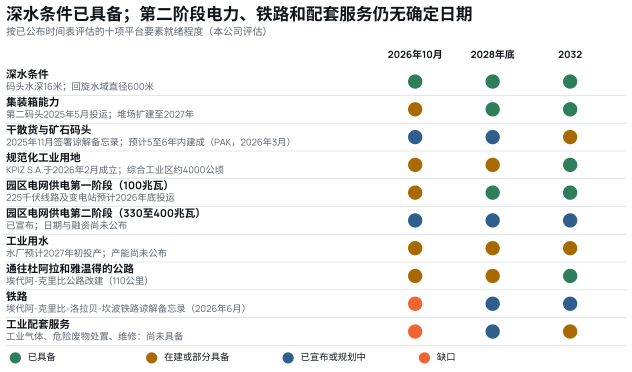
克里比已具备只有公共部门才能、且须历经数十年才能创造的两项条件:深水港和依法划定的大型储备用地。它正在建设下一层条件:225千伏线路和225/30千伏变电站、港口平台水厂、新地块配套工程、集装箱堆场扩建,以及一家拥有15年7.95亿欧元投资计划、获非洲开发银行、欧盟和国际金融公司支持的园区公司[S25][S26][S18][S30][S04][S07]。园区的发展集群包括“与矿产出口相关的钢铁冶炼”[S03]。它尚不具备的,是使首家入驻企业发展为产业集群的条件:第二阶段供电、专用干散货泊位、铁路、工业气体、危险废物处置服务以及适用于重工业的合同框架。
图ES.1汇总了本公司按已公布时间表对平台各项要素的评估,其中电力按已宣布的两期分别列示。
ES.2 为何是克里比,为何是现在
三个事实使2026年成为转折点。第一,机构已经到位:港口当局拥有已划定的港口用地[S16],一家由私人股东参股、获开发性金融支持的专门园区公司现已负责管理综合工业区[S02][S07]。第二,首家重工业企业所需的配套基础设施正在建设,且有明确时间:225千伏供电于2026年底、水厂于2027年初投运[S25][S26]。第三,政策框架方向一致:国家发展战略将矿业、冶金和钢铁列为优先子行业[S99];《矿业法》要求至少15%的矿产产量用于本地加工[S24];政府矿业与冶金委员会正筹备喀麦隆钢材出口非洲市场[S45]。
区域形势更添紧迫性。2025年非洲钢材消费量增长约10%,达4500万吨,同期非洲进口钢材3290万吨,大部分来自非洲以外[S95]。仅喀麦隆一国2025年即进口HS第72章钢铁412049吨[S93]。一个能够将进口含铁原料、日后再将喀麦隆本国含铁原料转化为区域建设所需钢材的沿海平台,市场是存在的;问题在于,当投资者准备就绪时,平台是否已准备就绪。
ES.3 对各类读者的含义
对政府部门和克里比港工业区股份有限公司(KPIZ S.A.)而言,重点在于次序:落实第二阶段供电,发布重工业合同框架和电能质量规范,并在首批企业仍处于设计阶段时启动园区战略环境评价。对投资者而言,克里比现已具备硬性条件,配套条件也有清晰的时间表;一期规模应与投产时实际具备的条件相匹配。对贷款机构和发展伙伴而言,从第二阶段供电到危险废物处置服务等共享配套设施,是公共资金撬动私人投资效果最大的领域。对社区和民间社会而言,在产业扩张之前就海岸环境承载力开展并商定园区层面的评估,是对海洋公园、洛贝瀑布和当地生计的最好保护。
ES.4 十二项主要结论
- 区位决定了钢厂大部分非金属料成本。中部非洲钢厂可获得的三种含铁原料来源中,进口直接还原铁(DRI)或热压块铁(HBI)与进口废钢均经海路到达,第三种即喀麦隆铁矿也将运抵同一海岸出口。年产100万吨的钢厂每年需要约124万吨与港口相关的输入货物,年产30万吨的一期约需35.1万吨[S112]。区域内炼钢成本最低的地点,是具备干散货装卸能力的深水码头旁(第1章)。
- 克里比拥有喀麦隆最深的码头,且有迅速填满新增能力的记录。码头水深16米,2025年货物吞吐量1270万吨、集装箱555398标准箱;2025年5月第二码头投运后一年内,集装箱量增长82%[S22][S28][S52]。2025年船舶等泊时间克里比约2天,杜阿拉约9天[S54](第2章)。
- 干散货是港口服务重工业的缺失环节。现有码头可满足年产数十万吨的钢铁一期。产业集群则需要配有含铁原料有盖仓储的干散货泊位。年1.25亿吨的矿石码头已于2025年11月4日签署谅解备忘录,克里比自治港总经理2026年3月表示预计在五至六年内建成,其设计应纳入此类泊位[S32][S33][S03](第2章)。
- 专门的园区公司现已掌管土地。KPIZ S.A.由克里比自治港(PAK)、AGL、Arise IIP和Belmont Investments于2026年2月26日设立,受托设计、融资、开发、运营和维护约4000公顷的综合工业区,15年计划投资7.95亿欧元[S02][S04][S01](第3章)。
- 土地需求是已分配面积的20倍。截至2025年年中,投资者申请用地约3883公顷,而依48项占用许可分配的仅196公顷[S17]。约束在于将储备用地转化为配套完善、签约的地块,这要求KPIZ S.A.发布其合同框架和适合重工业、不按营业额计费的收费标准[S11][S114]。作为未来入驻企业,Cameroon Steel与上述条件存在利益关系(第3章)。
- 225千伏线路使重工业成为可能;第二阶段供电使产业集群成为可能。KPDC至港口线路及变电站将自2026年底起提供约100兆瓦,后期达330至400兆瓦[S25]。第一阶段供电可承载平均负荷约36兆瓦的钢铁一期;年产100万吨的钢厂单独平均负荷即约94兆瓦[S112]。在钢铁主导的情景下,第一阶段容量约在2032年用尽,因此须立即为第二阶段落实融资和时间表,而其日期和融资方案均尚未公布(第4章)。
- 供电稳定性、电能质量和电价需要规则,而不仅是兆瓦数。2025年喀麦隆电网约90%为水电,2026年10月有150兆瓦工业需求未获满足,10兆瓦以上用户没有受监管电价,而电弧炉会扰动薄弱电网[S60][S61][S72]。发布电能质量规范、建设第二个高压电源和长期电价结构,是形成产业集群的前提(第4章)。
- 水资源充足;水处理和危险废物是短板。克里比年降雨量约2836毫米,港口平台水厂预计2027年初投产[S79][S26]。闭路循环冷却可使钢厂补充水保持在每吨约2立方米,但每吨钢产生的10至20公斤危险电炉粉尘尚无获许可的处置途径[S76][S112](第5章)。
- 克里比可通达其市场;铁路将使其成为区域钢铁枢纽。约300公里范围内有六座城市,CEMAC地区每年进口钢铁约5亿美元[S110][S94]。若全部经公路运输,一座年产100万吨的钢厂每天将产生约245车次卡车运输;其中大部分输入运输在港区内部的码头与工厂之间完成,经公共道路前往埃代阿的约为每天110至120车次,若一半产品经海运则约为55至60车次。在埃代阿-克里比公路完成改建、2026年6月的铁路协议成为获得融资的线路之前,这条公路须承担上述运量[S27][S41][S112](第6章)。
- 钢铁龙头企业可形成产业集群。一座年产100万吨的钢厂每年产生约18.5万吨钢渣、氧化铁皮和粉尘,需要约3700万标准立方米氧气;克里比已有一座年产100万吨的水泥厂,另一座正在规划中[S112][S35][S37]。总体规划中的相邻布局、管道和输送带走廊以及共享服务,决定这些交换能否实现(第7章)。
- 成功的港口工业区都超前于需求建设基础设施,并围绕龙头产业组织。丹吉尔地中海港、杰贝阿里、裕廊和莱基有四个共同点:港口与园区由同一机构管理;公用设施先于或与首批企业同步建设;龙头产业吸引供应商入驻;政策推动原材料就地加工。苏哈尔和佩森展示了在深水港组织钢铁生产的模式;苏哈尔也表明,若未为工业规划天然气,下游增长就会停滞[S127](第8章)。
- 次序就是战略。钢铁一期可依托已在建的基础设施。产业集群则依次需要:已落实融资的第二阶段供电和电能质量规范、分配海岸环境承载力的园区战略环境评价、重工业用地框架、废物处理和工业气体服务,以及专用散货泊位和铁路(第9章和第10章)。
ES.5 须采取的行动及时间
第10章的路线图分为三个步骤,这是分析性的先后次序,并非任何主管部门通过的规划;最重要的行动集中在第一步。
步骤一:奠基(2026至2028年)。投运设有重工业专用间隔并公布短路容量的225千伏变电站;通过适用于电弧炉的电能质量规范;水厂投产并实行工业水价;发布KPIZ S.A.重工业合同框架和收费标准;启动园区战略环境评价和基线监测;确定获许可的危险电炉粉尘处置途径;完成集装箱堆场扩建;在矿石码头设计中纳入钢铁集群泊位;为与第一阶段供电相匹配的首座炼钢车间和轧钢厂完成审批、融资和设计,以便2029年开工。
步骤二:锚定(2028至2032年)。首座炼钢车间投产,按Cameroon Steel规划估算于2030年下半年首炉出钢、2031年爬坡达产[S112];约在2031年前投运330至400兆瓦的第二阶段供电和第二个高压电源;在2026年3月宣布的五至六年期限内建成矿石码头第一阶段[S03];引进工业气体供应商和钢渣加工企业;为埃代阿-克里比-洛拉贝-坎波铁路落实融资;引入第二家重工业企业,发展型材和下游深加工。
步骤三:整合(2032至2040年)。按照《矿业法》本地加工要求的本意,在沿海以直接还原工艺利用喀麦隆铁矿生产铁[S24];以铁路连接园区与埃代阿及内陆地区;向区域市场和实行碳监管的市场出口钢材和含铁原料。
ES.6 关于本摘要版
本文是Cameroon Steel关于中部非洲钢铁业公开系列白皮书的第二份,研究克里比港综合工业区作为钢铁和金属产业区位的条件,涵盖港口、园区及其管理公司、电力、供水与公用设施、物流走廊、集群效应、国际对标、制约因素以及至2040年的路线图。本中文版为摘要版:完整翻译了执行摘要,并对第1至第10章及证据缺口逐章作出摘要;完整正文(含方法、术语、来源和数据附录)以英文和法文发布。本文依据截至2026年10月10日的公开资料编写;克里比自治港的文件按标题和日期引用。有关钢铁企业的规划数据取自Cameroon Steel参考配置RC-1(规划估算),并注明其状态。
Cameroon Steel正在园区内的姆博罗(Mboro)筹建钢铁综合体,总理代表国家元首于2024年12月30日为其奠基[S39]。本文以该项目作为重工业入驻企业的实例,所用资料为公开记录中的事实和已注明状态的规划估算。其一期规划为生产钢坯的电弧炉炼钢车间,产品可在轧材(线材和钢筋)与供应喀麦隆现有轧钢企业的商品钢坯之间灵活分配(第3章及白皮书04第9章)。本文仅供参考,不构成要约或承诺。
利益声明。本白皮书由Cameroon Steel发布,该公司正在克里比筹建一座钢铁厂。本文旨在为公共讨论提供信息;其分析独立于任何商业要约,每个数字均注明来源或标明状态。
英文全文 11分钟 · 2465词Executive summary: Kribi has what heavy industry cannot build for itself; the next two years decide the rest
Kribi combines the attributes that heavy industry needs on the Gulf of Guinea and cannot create for itself: 16 m of water at the quay on an open coast, a delimited port domain of 15,000 ha within which an integrated industrial zone of about 4,000 ha is now managed by a dedicated company, and a high-voltage link, due in service at the end of 2026, from the existing Kribi gas power plant [S22][S16][S02][S25]. Plans for rail and a 125 Mt a year mineral terminal, the subject of a memorandum of understanding signed on 4 November 2025, would connect it to Cameroon’s iron ore and to the interior [S41][S32]. On this evidence Kribi can become Central Africa’s steel and metals platform. Whether it does depends less on any single investment than on sequence: firm power in two stages, a power-quality code, serviced land under a clear contractual framework, industrial water and waste services, a dry-bulk berth and rail, each arriving before the industry that depends on it.
ES.1 The answer in brief
A steel works is a heavy-flow business with a difficult electrical load. An arc-furnace works making 1 Mtpa of long products moves about 2.5 Mt of material a year and draws an average of about 94 MW, with maximum demand of 130 to 190 MVA [S112]. It succeeds where iron units can arrive cheaply by sea, where firm high-voltage power is available at a strong connection point, where serviced and expandable land is held under a secure contract, and where customers can be reached by road, rail and coastal shipping.
Kribi already has the two attributes that only public authorities can create over decades: a deep-water port and a large, legally delimited land reserve. It is acquiring the next layer now: a 225 kV line and 225/30 kV substation, a water plant for the port platform, servicing works on new plots, a container yard expansion and a zone company with a fifteen-year, €795 million investment plan backed by the African Development Bank, the European Union and the IFC [S25][S26][S18][S30][S04][S07]. Its development clusters include "steelmaking linked to mineral exports" [S03]. What it does not yet have are the attributes that turn a first tenant into a cluster: a second power stage, a dedicated dry-bulk berth, rail, industrial gases, hazardous-waste services and a heavy-industry contractual framework.
Figure ES.1 summarises our assessment of the platform’s attributes on announced schedules, with power shown in its two announced stages.
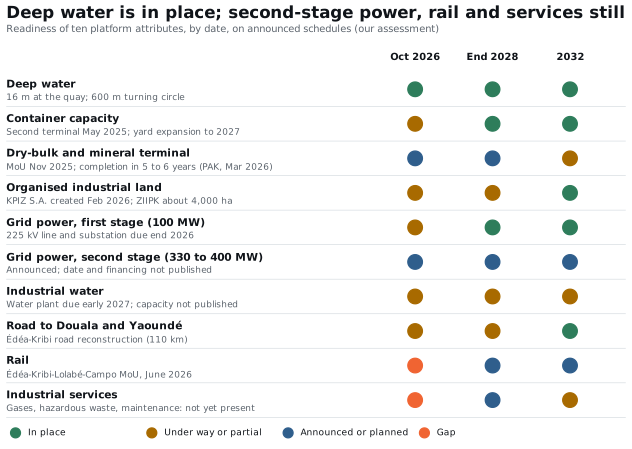
Source: Cameroon Steel assessment based on PAK port guide, 2020 [S22]; Business in Cameroon, 12 May 2025 and 18 May 2026 [S57][S52]; PAK, 4 November 2025 [S32]; Investir au Cameroun, 4 March 2026 [S03]; PAK, 26 February 2026 [S02]; PAK, 6 August 2025 and 19 August 2026 [S25][S26]; PAK, 13 March 2025 [S27]; PAK, 4 June 2026 [S41]; EcoMatin, 11 May 2026 [S18].
ES.2 Why Kribi, and why now
Three facts make 2026 a turning point. First, the institutions are in place: the port authority has a delimited domain [S16], and a dedicated zone company with private shareholders and development-finance backing now manages the integrated zone [S02][S07]. Second, the enabling infrastructure for a first heavy tenant is under construction with dates: the 225 kV supply at the end of 2026 and the water plant in early 2027 [S25][S26]. Third, the policy frame points the same way: the national development strategy names mines, metallurgy and steelmaking as a priority sub-sector [S99], the Mining Code requires that at least 15% of mine production be made available for local transformation [S24], and the government’s committee on mining and metallurgy is preparing exports of Cameroonian steel to African markets [S45].
The regional context adds urgency. Africa’s steel use grew by about 10% in 2025 to 45 Mt while the continent imported 32.9 Mt, most of it from outside Africa [S95]. Cameroon alone imported 412,049 t of iron and steel under customs chapter 72 in 2025 [S93]. A coastal platform that can turn imported and, later, Cameroonian iron units into the steel the region builds with has a market; the question is whether the platform will be ready when investors are.
ES.3 What it means for each reader
For the authorities and KPIZ, the priority is sequence: commit the second power stage, publish the heavy-industry framework and power-quality code, and launch the zone’s strategic environmental assessment while the first tenants are still designing their plants. For investors, Kribi offers the hard attributes now and the enabling ones on a visible schedule; a first phase should be sized to what will exist at commissioning. For lenders and development partners, the shared enablers, from the second power stage to hazardous-waste services, are where public finance brings in the most private investment. For communities and civil society, a zone-level assessment of the coast’s carrying capacity, agreed before industry scales up, is the best protection of the marine park, the Lobé falls and local livelihoods.
ES.4 Twelve findings
- Location fixes most of a steel mill’s non-metallic costs. Two of the three iron sources open to a Central African steelmaker, imported DRI or HBI and imported scrap, arrive by sea, and the third, Cameroonian ore, arrives at the same coast for export. A works of 1 Mtpa needs about 1.24 Mt a year of port-linked inbound cargo, and a first phase of 0.3 Mtpa about 351,000 t [S112]. The cheapest place to make steel in the region is beside a deep-water quay with dry-bulk handling (Chapter 1).
- Kribi has the deepest quay in Cameroon and a record of filling new capacity. With 16 m at the quay, the port handled 12.7 Mt and 555,398 TEU in 2025, and container volumes rose by 82% in the year after a second terminal opened in May 2025 [S22][S28][S52]. Vessel waiting times were about two days at Kribi against about nine at Douala in 2025 [S54] (Chapter 2).
- Dry bulk is the port’s missing link for heavy industry. Existing terminals can serve a first steel phase of a few hundred thousand tonnes a year. A cluster needs a dry-bulk berth with covered storage for iron units. The 125 Mt a year mineral terminal, agreed in a memorandum of understanding on 4 November 2025 and expected by PAK’s Director General in March 2026 to be completed within five to six years, should be designed with one [S32][S33][S03] (Chapter 2).
- A dedicated zone company now holds the land. KPIZ S.A., created on 26 February 2026 by PAK, AGL, Arise IIP and Belmont Investments, is mandated to design, finance, develop, operate and maintain an integrated zone of about 4,000 ha, with a €795 million plan over fifteen years [S02][S04][S01] (Chapter 3).
- Demand for land is twenty times what has been allocated. By mid-2025 investors had requested about 3,883 ha against 196 ha allocated under 48 occupation authorisations [S17]. The constraint is converting reserve into serviced, contracted plots, which requires KPIZ to publish its contractual framework and a tariff suited to heavy industry, without a levy on turnover [S11][S114]. As a prospective tenant, Cameroon Steel has an interest in these terms (Chapter 3).
- The 225 kV link makes heavy industry possible; a second stage makes a cluster possible. The KPDC-port line and substation will provide about 100 MW from the end of 2026 and 330 to 400 MW later [S25]. The first stage can carry a first steel phase averaging about 36 MW; a 1 Mtpa works alone averages about 94 MW [S112]. On a steel-led path, the first stage is fully used by about 2032, so the second must be financed and scheduled now; neither its date nor its financing has been published (Chapter 4).
- Firmness, power quality and price need rules, not just megawatts. Cameroon’s grid was about 90% hydro in 2025, 150 MW of industrial demand was unmet in October 2026, no regulated tariff exists above 10 MW, and arc furnaces disturb weak networks [S60][S61][S72]. A published power-quality code, a second high-voltage source and a long-term tariff structure are preconditions for a cluster (Chapter 4).
- Water is abundant; treatment and hazardous waste are the gaps. Kribi receives about 2,836 mm of rain a year and a port-platform water plant is due in early 2027 [S79][S26]. Closed-loop cooling holds a mill’s make-up near 2 m³ per tonne, but no licensed route has been identified for the 10 to 20 kg of hazardous furnace dust produced per tonne of steel [S76][S112] (Chapter 5).
- Kribi reaches its markets; rail would make it the region’s steel hinge. Six cities lie within about 300 km and the CEMAC region imports about US$500 million a year of iron and steel [S110][S94]. A 1 Mtpa works would generate about 245 truck movements a day if every flow went by road. Most of the inbound flow would stay inside the port domain, between quay and plant; about 110 to 120 loads a day would use the public road to Édéa, or about 55 to 60 if half the output ships by sea. That is the traffic the Édéa-Kribi road must carry until it is rebuilt and the June 2026 railway agreement becomes a funded line [S27][S41][S112] (Chapter 6).
- A steel anchor creates a cluster. One 1 Mtpa works yields about 185,000 t a year of slag, scale and dust and needs about 37 million Nm³ of oxygen; Kribi already hosts a 1 Mt a year cement plant and a second is planned [S112][S35][S37]. Adjacency in the master plan, pipe and conveyor corridors and shared services decide whether those exchanges happen (Chapter 7).
- Successful port-industrial zones built infrastructure ahead of demand and organised around anchors. Tanger Med, Jebel Ali, Jurong and Lekki share four traits: one authority for port and zone, utilities built ahead of or with the first tenants, anchor industries that pull suppliers in, and policy that pushes raw materials into local processing. Sohar and Pecém show steel organised at deep-water ports; Sohar also shows that where gas was not planned for industry, downstream growth stalled [S127] (Chapter 8).
- Sequence is the strategy. A first steel phase can rely on infrastructure already under construction. A cluster needs, in order, a financed second power stage and power-quality code, a zone strategic environmental assessment that allocates the coast’s carrying capacity, a heavy-industry land framework, waste and gas services, and a dedicated bulk berth and rail (Chapters 9 and 10).
ES.5 What must happen, and when
The roadmap in Chapter 10 is organised in three steps, an analytical sequence rather than a plan adopted by any authority. The actions that matter most fall in the first.
Enable, 2026 to 2028. Commission the 225 kV substation with a heavy-tenant bay and published short-circuit levels; adopt a power-quality code for arc furnaces; bring the water plant into production with an industrial tariff; publish KPIZ’s heavy-industry contractual framework and tariff; launch the zone’s strategic environmental assessment and baseline monitoring; identify a licensed route for hazardous furnace dust; complete the container yard expansion; write a steel-cluster berth into the mineral-terminal design; and permit, finance and design a first melt shop and rolling mill sized to the first power stage, so that works can start in 2029.
Anchor, 2028 to 2032. Bring the first melt shop into production, with a first heat in the second half of 2030 and ramp-up in 2031 on Cameroon Steel’s planning estimate [S112]; bring the second power stage of 330 to 400 MW and a second high-voltage source into service by about 2031; bring the mineral terminal’s first stage into service within the five to six years announced in March 2026 [S03]; attract an industrial-gas supplier and a slag processor; finance the Édéa-Kribi-Lolabé-Campo railway; add a second heavy tenant, sections and downstream fabrication.
Integrate, 2032 to 2040. Make iron from Cameroonian ore at the coast through direct reduction, as the Mining Code’s local-transformation requirement intends [S24]; connect the zone by rail to Édéa and the interior; and export steel and iron units into regional and carbon-regulated markets.
ES.6 About this paper
This is the second paper in Cameroon Steel’s public series on steel in Central Africa. It examines the Kribi industrial-port zone as a location for steel and metals industries: the port, the zone and its management company, power, water and utilities, logistics corridors, cluster effects, international benchmarks, constraints and a roadmap to 2040. It is based on public sources available on 10 October 2026, listed in Annex C, and Annex D gives the data behind every figure; documents of the Port Autonome de Kribi are cited by title and date. Planning figures for a steel tenant come from the Cameroon Steel reference configuration RC-1 (planning estimate) and are labelled with their status.
Cameroon Steel is developing a steel complex at Mboro, within the zone; its foundation stone was laid on 30 December 2024 by the Prime Minister, representing the Head of State [S39]. The paper draws on the project as a worked example of a heavy-industry tenant, using public-record facts and planning estimates labelled with their status. Its first phase is planned around an arc-furnace melt shop making billets, with output flexible between rolled products (wire rod and reinforcing bar) and merchant billets for Cameroon’s existing re-rollers (Chapter 3 and White paper 04, Chapter 9). The paper is published for information and does not constitute an offer or a commitment.
Statement of interest. This paper is published by Cameroon Steel, which is developing a steelworks at Kribi. It is written to inform public debate; its analysis is independent of any commercial offer, and every figure is sourced or labelled with its status.
本章引用的资料来源
方括号内的标记对应以下来源(按原文语言列出),完整列表见附录。 完整来源列表
- S22Guide du Port de Kribi. Port Autonome de Kribi,2020年8月.按标题和日期引用
- S28Port de Kribi: la performance au service de la Nation (opinion article by the Director General). Port Autonome de Kribi,2026年4月21日.按标题和日期引用
- S02Lancement de la Kribi Port Industrial Zone: l’avenir a commencé. Port Autonome de Kribi,2026年2月26日.按标题和日期引用
- S25Kribi franchit la ligne électrique 225 kV. Port Autonome de Kribi,2025年8月6日.按标题和日期引用
- S112Cameroon Steel reference configuration RC-1 (planning estimate), edition 10 October 2026. Cameroon Steel,2026年10月10日.按标题和日期引用
- S26Énergie et infrastructures: un nouvel élan pour la compétitivité du Port de Kribi. Port Autonome de Kribi,2026年8月19日.按标题和日期引用
- S18Cameroun: le port de Kribi engage 3,5 milliards FCFA pour préparer l’arrivée de nouveaux industriels. EcoMatin,2026年5月11日.ecomatin.net/cameroun-le-port-de-kribi-engage-35-milliards-fcfa-pour-p…
- S30Port de Kribi: 21,5 milliards de FCFA pour accroître de 30% les capacités du terminal à conteneurs. Investir au Cameroun,2026年10月8日.investiraucameroun.com/infrastructures/0810-23934-port-de-kribi-21-5-m…
- S04Port de Kribi: AGL, Arise IIP et Belmont s’allient au PAK pour une zone industrielle de 521 milliards FCFA sur 4 000 ha. Investir au Cameroun,2026年2月20日.investiraucameroun.com/gestion-publique/2002-23123-port-de-kribi-agl-a…
- S07Cameroon: African Development Bank Group supports development of integrated industrial zone at the Port of Kribi. African Development Bank (via AllAfrica),2026年3月2日.allafrica.com/stories/202603100682.html
- S03Zone industrialo-portuaire de Kribi (KPIZ): jusqu’à +8 points de croissance et 150 000 emplois attendus sur 15 ans. Investir au Cameroun,2026年3月4日.investiraucameroun.com/gestion-publique/0403-23163-zone-industrialo-po…
- S57Cameroon’s Kribi port triples capacity with launch of second container terminal. Business in Cameroon,2025年5月12日.businessincameroon.com/infrastructures/1205-14650-cameroon-s-kribi-por…
- S52Kribi port plans 8-hectare expansion to raise container capacity to 34,000 TEUs. Business in Cameroon,2026年5月18日.businessincameroon.com/public-management/1805-16177-kribi-port-plans-8…
- S32Port de Kribi: un terminal minéralier d’avenir. Port Autonome de Kribi,2025年11月4日.按标题和日期引用
- S27Bilan et perspectives: les voyants sont au vert. Port Autonome de Kribi,2025年3月13日.按标题和日期引用
- S41Ligne ferroviaire Édéa-Kribi-Lolabé-Campo: une nouvelle étape pour la connectivité du Port de Kribi. Port Autonome de Kribi,2026年6月4日.按标题和日期引用
- S16Le PAK tient enfin son titre foncier. Port Autonome de Kribi,2023年6月26日.按标题和日期引用
- S99Stratégie Nationale de Développement 2020 à 2030 (SND30). Republic of Cameroon, MINEPAT (FAOLEX),2020年.faolex.fao.org/docs/pdf/cmr211554.pdf
- S24Loi n° 2023/014 du 19 décembre 2023 portant Code minier (Article 40(4), local transformation). Republic of Cameroon (FAOLEX),2023年12月19日.faolex.fao.org/docs/pdf/cmr223180.pdf
- S45Le Cameroun prépare l’exportation de son acier vers les marchés de la ZLECAf. EcoMatin,2026年4月16日.ecomatin.net/le-cameroun-prepare-lexportation-de-son-acier-vers-les-ma…
- S95World Steel in Figures 2026. worldsteel,2026年6月4日.worldsteel.org/data/world-steel-in-figures/world-steel-in-figures-2026…
- S93Évolution du commerce extérieur en 2025 (version provisoire). Institut National de la Statistique (INS), Cameroon,2026年2月.ins-cameroun.cm/wp-content/uploads/2026/04/Note-sur-le-commerce-exteri…
- S54Douala port faces severe congestion, impacting West African trade. Business in Cameroon,2025年9月1日.businessincameroon.com/public-management/0109-14940-douala-port-faces-…
- S33Kribi Deep Sea Port, investors partner to construct 125-million-tonne mineral terminal worth $2 billion. Business in Cameroon,2025年11月5日.businessincameroon.com/transport/0511-15300-kribi-deep-sea-port-invest…
- S01La Lettre du PAK n°264: Lancement de Kribi Port Industrial Zone, l’avenir a commencé. Port Autonome de Kribi (newsletter),2026年2月.按标题和日期引用
- S17AMI n°013/AMI/PAK/2026 (Port Workers’ City). Agence de Régulation des Marchés Publics (ARMP),2026年1月30日.armp.cm/details?type_publication=AMI&id_publication=6073
- S11Kribi Port unveils new management framework for industrial-zone transition. Business in Cameroon,2026年6月1日.businessincameroon.com/public-management/0106-16249-kribi-port-unveils…
- S114Recueil général des tarifs applicables aux prestations rendues par le Port Autonome de Kribi (homologated by the APN, 2018). Port Autonome de Kribi / Autorité Portuaire Nationale,2018年.按标题和日期引用
- S60Rapport d’activités 2025 de l’ARSEL. Agence de Régulation du Secteur de l’Électricité (ARSEL),2026年9月7日.arsel-cm.org/wp-content/uploads/2026/09/Rapport-ARSEL-2025.pdf
- S61Nachtigal power line delays leave 150 MW of industrial demand unmet. Business in Cameroon,2026年10月9日.businessincameroon.com/public-management/0910-16939-nachtigal-power-li…
- S72Electric arc furnace modeling for voltage flicker evaluation (PQSoft case study, document PQS0313). Electrotek Concepts, Inc.(copy published by PowerQuality.blog,2022年2月28日),2003年4月16日.powerquality.blog/2022/02/28/electric-arc-furnace-modeling-for-voltage…
- S79Monographie du Nyong et des fleuves côtiers, Tome 1 (J.-C. Olivry). ORSTOM,1979年7月.horizon.documentation.ird.fr/exl-doc/pleins_textes/divers11-03/01948.p…
- S76Best Available Techniques Reference Document for Iron and Steel Production (EUR 25521). European Commission, Joint Research Centre,2013年.bureau-industrial-transformation.jrc.ec.europa.eu/sites/default/files/…
- S110Natural Earth 1:50m Cultural Vectors, Admin 0 countries (version 5). Natural Earth.naturalearthdata.com/
- S94UN Comtrade public API: Cameroon and CEMAC members, HS 72 and 73 imports, 2019 to 2024. United Nations Statistics Division.comtradeapi.un.org/public/v1/preview/C/A/HS
- S35La ZIPK rayonne avec l’inauguration de la cimenterie CIMPOR. Port Autonome de Kribi,2024年7月19日.按标题和日期引用
- S37Cameroon: Atlantic Group amends investment agreement for 1-million-tonne Kribi cement plant. Ecofin Agency,2026年2月27日.ecofinagency.com/news-industry/2702-53339-cameroon-atlantic-group-amen…
- S127Downstream beneficiation case study: Oman (J. Talkin), CCSI policy paper. Columbia Center on Sustainable Investment,2016年3月.ccsi.columbia.edu/sites/default/files/content/docs/our%20focus/Oman_Ir…
- S39Kribi: le Premier ministre, chef du gouvernement est là. Cameroon Tribune,2024年12月30日.cameroon-tribune.cm/article.html/68499/fr.html/details_2
引用本章
Cameroon Steel(2026)。基础设施若能同步跟进,克里比可成为中部非洲的钢铁平台(中文摘要版)。白皮书02,摘要:执行摘要:克里比拥有重工业无法自行创造的条件,未来两年将决定其余一切。CS-WP-02。https://www.cameroon-steel.com/zh/library/kribi-steel-platform/executive-summary/
来源