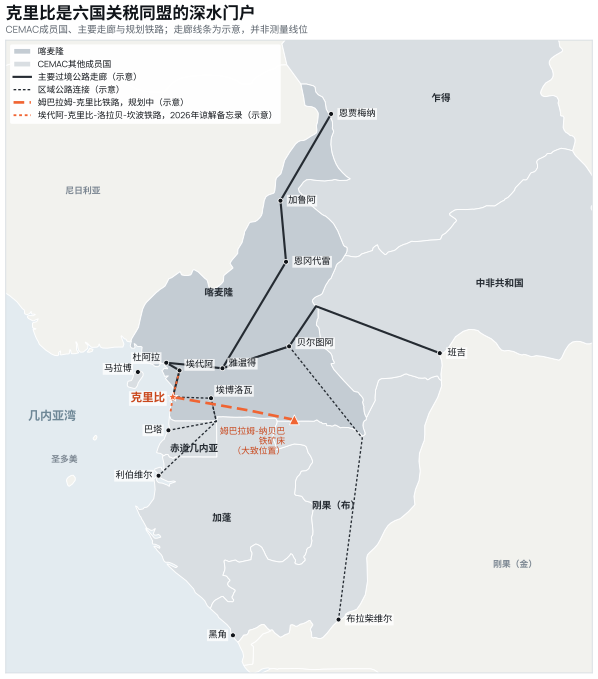
克里比直线距离约300公里范围内有巴塔、杜阿拉、埃博洛瓦、马拉博、雅温得和利伯维尔六座城市[S110]。喀麦隆是中部非洲经济与货币共同体(CEMAC)最大的市场,2023年在该地区约5亿美元的HS第72章钢铁产品进口中约占3.1亿美元[S94];喀麦隆每年已出口约3.1万吨棒材,主要销往乍得[S93]。若全部经公路运输,年产30万吨的一期每天约产生74车次货运,年产100万吨的工厂约245车次,但其中过半为港区内部码头至工厂的进口含铁原料运输;经公共道路前往埃代阿的约为一期37车次、满产110至120车次,若一半产品经海运则约为20车次和55至60车次[S112],而通往埃代阿的110公里公路改造国际招标于2025年2月24日签署,尚未公布完工日期[S27]。约185公里的埃代阿-克里比-洛拉贝-坎波铁路谅解备忘录于2026年6月4日签署[S41];年产100万吨时,一座工厂的公共道路运量相当于每天2列多1500吨列车。姆巴拉姆-克里比矿石铁路已于2022年2月签订公私合作合同[S34];据报道该铁路走廊全长659公里,其中喀麦隆境内540公里[S170],2011年可行性研究测算的线路为510公里[S171]。区域竞争正在加剧:2025年非洲进口钢材约3290万吨,其中约1940万吨来自中国[S95];2026年10月3日,中国和俄罗斯钢坯离岸价约为每吨465至480美元(中国465至470美元,俄罗斯470至480美元)[S165]。钢筋市场已饱和(产能约62.7万吨,需求约18万吨)[S97],一期产量应替代钢坯和线材进口并出口CEMAC市场(白皮书04第9章);克里比钢坯与进口钢坯到岸成本的指示性比较见白皮书04第8.6节。
对KPIZ S.A.和主管部门而言,应在分配地块前预留港区内的私人运输道路或封闭输送带走廊;铁路应设计通往园区重工业企业的专用支线,并能与矿石铁路联运或在共用站场转运;公路改造应按重轴载标准建设并设置卡车待运区;还应与海关合作简化CEMAC区内货物的通关程序。对投资者而言,送达成本将决定市场份额,区域尚未生产的半成品钢、较重型材和含铁原料面临的竞争最小。矿石铁路、矿石码头和钢铁集群应作为一个系统统一设计。
英文全文 11分钟 · 2543词Kribi reaches six cities, three of them capitals, within 300 km; rail would make it the region’s steel hinge
Kribi sits within about 300 km, by straight line, of six cities that matter for steel demand: Bata, Douala, Ebolowa, Malabo, Yaoundé and Libreville [S110]. By sea it reaches every coastal market of the Gulf of Guinea, and by road it connects through Édéa to the transit corridors that serve Chad and the Central African Republic. Those links are good enough for a first steel phase. They are not good enough for a cluster. At full output a single 1 Mtpa works would generate about 245 truck movements a day if every flow went by road; most inbound movements would stay inside the port domain, but about 110 to 120 loads a day would use the public road to Édéa, or about 55 to 60 if half the output ships by sea [S112]. That road is being reconstructed. The railway agreed in principle in June 2026, linking Édéa, Kribi, Lolabé and Campo, and the planned ore railway from the Mbalam deposit in the east are what would turn Kribi from a port with an industrial zone into the hinge of a regional steel system [S41][S34].
6.1 Where the customers are
Steel demand in Central Africa follows construction: cities, roads, bridges, power lines and housing. Africa’s apparent steel use rose by about 10% to 45.0 Mt in 2025, and the world steel association forecasts further growth of 3.8% in 2026 and 4.6% in 2027 [S95][S96]. Use per head is still low, about 29 kg in Africa as a whole and 22.5 kg outside Egypt and South Africa, against about 209 kg worldwide [S95]. Cameroon is the largest market in the CEMAC region: in 2023 it accounted for about US$310 million of the region’s roughly US$500 million of imports of iron and steel products under chapter 72 [S94].
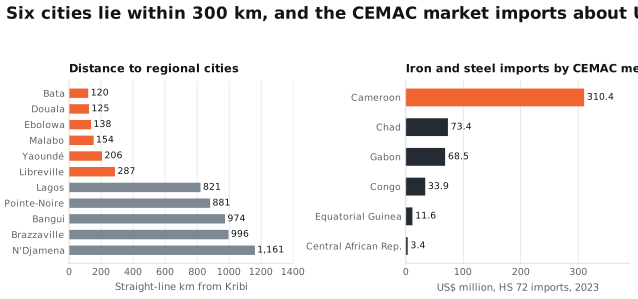
Source: geodesic calculation by Cameroon Steel from city-centre positions [S110]; UN Comtrade public API [S94].
The neighbours buy finished products and semi-finished steel from outside the region and, to a lesser extent, from Cameroon. Cameroon already exports about 31,000 t a year of bars, mostly to Chad [S93], and in 2026 the government’s committee on mining and metallurgy began preparing exports of Cameroonian steel to markets of the African Continental Free Trade Area, which Cameroon has ratified [S45][S108].
For a Kribi platform, the geography of demand points two ways. Inland, the large markets are Douala and Yaoundé, reached through Édéa, and the transit corridors from Douala to N’Djamena and Bangui, which carry most of the landlocked countries’ imports. Along the coast, the markets of Equatorial Guinea, Gabon, Congo and São Tomé are closer to Kribi by sea than to most of their other suppliers, and can be served by coastal shipping or, for Equatorial Guinea and northern Gabon, by road through Ebolowa and the southern border crossings.
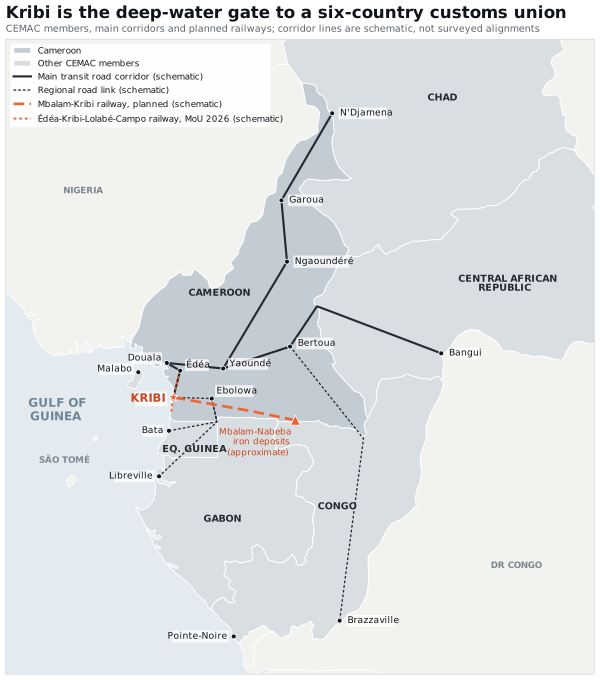
Source: Drawn by Cameroon Steel from Natural Earth admin-0 boundaries [S110]; railway projects from PAK, 25 February 2022 and 4 June 2026 [S34][S41]; deposit position approximate.
6.2 Distance: close to the coastal capitals, far from the interior
Figure 6.1 also sets out straight-line distances from Kribi to the region’s main cities. They are not road distances, which are longer, but they show the structure of the market. Six cities, including three capitals, lie within 300 km. The interior capitals, N’Djamena and Bangui, lie about 1,000 to 1,200 km away, as does Brazzaville. Lagos, the largest market in the Gulf of Guinea, is about 820 km by straight line and is served by its own ports.
The implication is that Kribi’s natural steel market is the coastal belt from Douala to Libreville plus Yaoundé, a population of several million in fast-growing cities, with the landlocked interior reached through the existing corridors on the same terms as Douala’s suppliers. A Kribi mill does not need to beat Douala’s re-rollers in N’Djamena; it needs to supply what the region imports, at a delivered cost below imports, along the corridors that already exist.
Coastal shipping is underused in the region and deserves attention. A coaster or barge service from Kribi to Bata, Malabo, Libreville, Port-Gentil and Pointe-Noire could carry bars, coils of wire rod and sections in parcels of a few thousand tonnes. The deep-water quay matters less for this trade than berth availability and simple customs procedures for intra-CEMAC goods, which travel duty-free when they meet the community’s rules of origin.
6.3 Roads: one motorway, one trunk road under reconstruction
Kribi’s road links are shown in Figure 2.1. A motorway connects Kribi town with the port at Lolabé [S111]. From Kribi, the national trunk road runs north to Édéa, on the main Douala-Yaoundé axis, and a second trunk road runs east to Ebolowa and the south of the country [S111].
The road to Édéa is the critical link. The international tender for the reconstruction of the Édéa-Kribi road, 110 km long, was signed on 24 February 2025 [S27]. The African Development Bank had urged priority for the Édéa-Kribi and Lolabé-Campo roads during a visit to the port in September 2024 [S48], and PAK listed the acceleration of road projects, starting with Édéa-Kribi, among its challenges for 2026 [S29]. No completion date has been published. Until the road is rebuilt, all heavy traffic between Kribi and Douala or Yaoundé shares an older two-lane road with passenger traffic.
Figure 6.3 shows why this matters for a steel cluster, and which part of the traffic matters. If every flow moved by road, a first phase of 0.3 Mtpa would generate about 74 truck movements a day and a full works of 1 Mtpa about 245 [S112]. More than half of these movements carry imported iron units over the short distance from the quay to a plant inside the port domain, and could move on private haul roads or covered conveyors. The public road to Édéa would carry the products sold to Douala, Yaoundé and the interior, plus a small flow of domestic scrap: about 37 loads a day for a first phase and about 110 to 120 at 1 Mtpa, falling to about 20 and 55 to 60 if half the output ships by sea. A cluster of several heavy tenants would multiply these numbers.
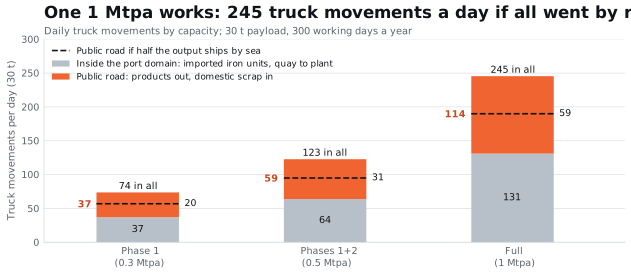
Source: Cameroon Steel reference configuration RC-1 (planning estimate), logistics balance; 30 t payload, 300 working days a year [S112]. Split and train equivalents are Cameroon Steel arithmetic (Annex A).
6.4 Rail: an agreement in principle and an ore railway in planning
Kribi is not yet connected to Cameroon’s railway network. Two projects would change that.
The first is the Édéa-Kribi-Lolabé-Campo railway, about 185 km long. On 4 June 2026 the Government, AGL, the aluminium company CAMALCO and other partners signed a memorandum of understanding covering feasibility, design, financing, construction and operation, under the chairmanship of the Minister of Transport [S41]. By linking the port to Édéa, the line would connect Kribi to the existing metre-gauge network that serves Douala, Yaoundé and the north, and through it to the corridor towards Chad. For a steel cluster it would carry outbound products to Douala and Yaoundé and inbound scrap collected inland, and it would take most of the cluster’s heavy traffic off the public road: at 1 Mtpa, the public-road flows of one works, about 110 to 120 truck loads a day, are equivalent to more than two trains of 1,500 t a day (Annex A).
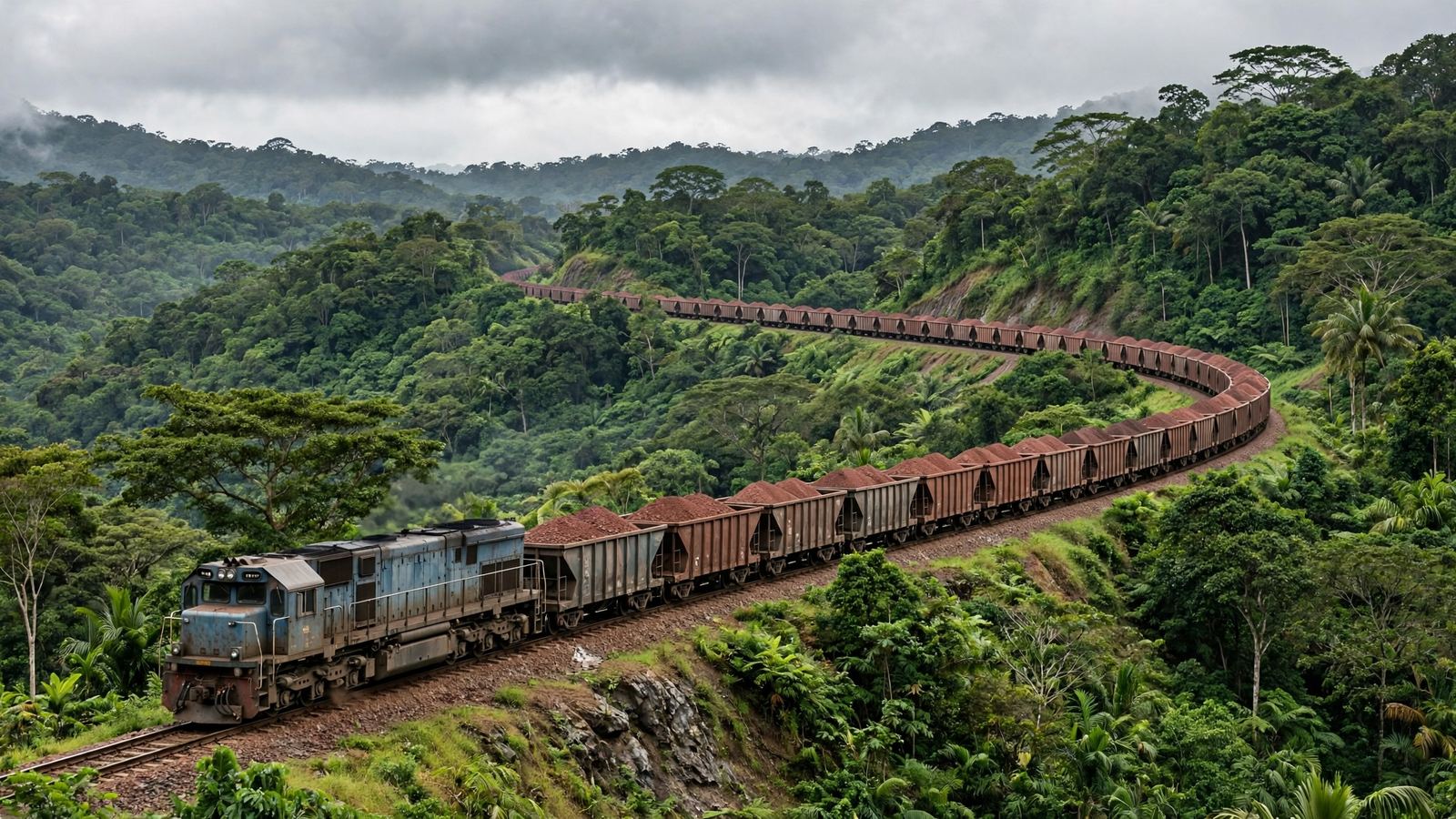
The second is the Mbalam-Kribi ore railway. In February 2022 PAK announced the signature of a public-private partnership contract for a railway from the Mbalam iron-ore deposit in the East Region to Kribi, together with a concession for a multimodal mineral terminal [S34]. The railway corridor is reported at 659 km, 540 km of it in Cameroon [S170]; the 2011 feasibility study had costed a 510 km line [S171]. The mine’s developers have described a plan to export up to 10 Mt a year by road in 2026 to 2029 and up to 25 Mt a year by rail from 2030 [S46]. The government’s 2026 to 2030 iron-ore programme covers three projects whose ore would reach the coast at or near Kribi: Mbalam, Bipindi-Grand Zambi and Kribi-Lobé, with a combined investment of about 1,748 bn FCFA [S43]. The Lobé deposit lies close to the port; its developer has planned a short road link to the port and has deferred first exports to 2027 [S153][S154].
For the steel platform, the ore railway matters less for the tonnage of ore it would carry, most of which would be exported, than for the fact that it would make Kribi the point where Cameroonian iron reaches the sea. The Mining Code’s requirement that at least 15% of production be made available for local transformation [S24], and the cluster label "steelmaking linked to mineral exports" [S03], both assume that ore and steel meet at the coast.
Table 6.1 sourcedKribi’s corridor projects relevant to a steel platform, October 2026
| Project | Scope | Latest public milestone | Relevance to steel | Source |
|---|---|---|---|---|
| Kribi-Lolabé motorway | Motorway between Kribi town and the port | In service | Workforce and local access to the zone | [S111] |
| Édéa-Kribi road | Reconstruction of 110 km of trunk road to the Douala-Yaoundé axis | International tender signed 24 February 2025; completion date not published | Outbound products to Douala and Yaoundé; inbound scrap | [S27][S48] |
| Lolabé-Campo road | Coastal road south towards Campo and Equatorial Guinea | Named as a priority by the AfDB, September 2024 | Southern market access | [S48] |
| Édéa-Kribi-Lolabé-Campo railway | About 185 km; feasibility to operation | MoU signed 4 June 2026 | Heavy outbound and inbound flows by rail | [S41] |
| Mbalam-Kribi railway and mineral terminal | Ore railway, corridor reported at 659 km (540 km in Cameroon; 510 km in the 2011 study); multimodal mineral terminal | PPP contract and terminal concession, 25 February 2022; terminal MoU 4 November 2025 | Ore to the coast; bulk berth for the steel cluster | [S34][S32][S170][S171] |
| Mineral terminal at Kribi | 125 Mt a year on about 330 ha, phased | MoU 4 November 2025; structuring in 4 to 6 months; completion within five to six years (PAK, March 2026) | Dry-bulk capacity for iron units and ore | [S32][S33][S03] |
| Iron-ore programme 2026 to 2030 | Mbalam, Bipindi-Grand Zambi, Kribi-Lobé | Programme of about 1,748 bn FCFA announced February 2026 | Future local feed for direct reduction | [S43] |
Source: as listed; status as of 10 October 2026.
6.5 A more contested regional market
Logistics advantages matter more because the regional market is becoming more competitive. Africa imported about 32.9 Mt of steel in 2025, of which about 19.4 Mt came from China [S95], and billets from China and Russia were offered at about US$465 to 480 per tonne free on board on 3 October 2026 (China 465 to 470, Russia 470 to 480) [S165]. Within the region, new capacity is arriving. The Douala group Prometal has opened a rebar plant in Gabon’s Nkok special economic zone, reported at between 120,000 and 170,000 t a year [S166]; the Fokou group has launched a new steel unit at Port-Gentil [S162]; and Gabon has cut value-added tax on locally made rebar from 10 to 3% to support local producers [S161]. Further afield, new bar and wire-rod mills of about 300,000 t a year each have been ordered for Tanzania and Côte d’Ivoire [S163][S164].
Three conclusions follow for a Kribi platform. First, delivered cost will decide market share, and delivered cost is where a port-side location pays: iron units arrive without an inland leg, and coastal customers can be served by sea. Second, the products that face the least regional competition are those the region does not yet make: semi-finished steel to feed existing re-rollers, heavier sections, and iron units. Rebar is not among them: Cameroon’s rebar capacity of about 627,000 t a year already exceeds demand of about 180,000 t [S97], so a first melt shop’s tonnage has to displace imports of billets and wire rod and reach CEMAC export markets (White paper 04, Chapter 9). Whether a Kribi billet can be made below the delivered cost of an import is assessed, with its uncertainty, in White paper 04, section 8.6, and competitiveness more broadly in White paper 09, Chapter 7. Third, regional integration cuts both ways: CEMAC’s internal market and the African Continental Free Trade Area open neighbouring markets to Kribi, and open Kribi’s home market to neighbours. A platform that combines a deep-water quay, firm power and short coastal routes is better placed than most to compete on those terms.
6.6 Designing logistics for a cluster, not a tenant
The corridor projects are being prepared by different promoters on different timetables. A steel cluster needs them to fit together at four points.
Inside the port domain. The quay, the mineral terminal and the steel plants should be linked by private haul roads or covered conveyors that keep bulk traffic off public roads. Reserving these corridors now, before plots are allocated around them, costs little; retrofitting them later is expensive.
At the rail interface. The Édéa-Kribi-Lolabé-Campo railway should be designed with sidings that can serve heavy tenants in the zone, and with a gauge and axle load that allow interchange with the ore railway, or at least transhipment at a shared yard.
At the road interface. The Édéa-Kribi road reconstruction should be specified for heavy axle loads and include a truck staging area near the zone, so that steel traffic does not queue on the public road.
At the border. Exports to Equatorial Guinea, Gabon and the interior depend on simple and predictable treatment of intra-CEMAC goods. The steel cluster should work with the customs administration on procedures for products that meet the community’s rules of origin.
Other sources cited in the English text
- S96worldsteel Short Range Outlook April 2026. worldsteel, 14 April 2026.worldsteel.org/media/press-releases/2026/worldsteel-short-range-outloo…
- S45Le Cameroun prépare l’exportation de son acier vers les marchés de la ZLECAf. EcoMatin, 16 April 2026.ecomatin.net/le-cameroun-prepare-lexportation-de-son-acier-vers-les-ma…
- S108Status of AfCFTA ratification. tralac, 7 September 2026.tralac.org/resources/infographic/13795-status-of-afcfta-ratification.h…
- S111OpenStreetMap extract for the Kribi area (Overpass API, data base 24 July 2026), © OpenStreetMap contributors, ODbL. OpenStreetMap Foundation, 24 July 2026.openstreetmap.org/copyright
- S48Coopération financière: la BAD soutient le développement du Port de Kribi. Port Autonome de Kribi, 13 September 2024.Cited by title and date
- S29Le Port affine sa feuille de route pour 2026. Port Autonome de Kribi, 9 September 2025.Cited by title and date
- S46Mbalam iron ore mine delays first exports to early 2026. Business in Cameroon, 13 December 2025.businessincameroon.com/public-management/1312-15495-mbalam-iron-ore-mi…
- S43Cameroon plans $3.1B iron ore push starting 2026. Daba Finance, 14 February 2026.dabafinance.com/en/news/cameroon-mining-investment-2026-2030
- S153Kribi-Lobé: les travaux préparatoires lancés. Cameroon Tribune, 25 October 2023.cameroon-tribune.cm/article.html/61036/fr.html/details_2
- S154Cameroun: Sinosteel reporte les exportations du fer de Kribi-Lobé à 2027. EcoMatin, 11 March 2026.ecomatin.net/cameroun-sinosteel-reporte-les-exportations-du-fer-de-kri…
- S24Loi n° 2023/014 du 19 décembre 2023 portant Code minier (Article 40(4), local transformation). Republic of Cameroon (FAOLEX), 19 December 2023.faolex.fao.org/docs/pdf/cmr223180.pdf
- S03Zone industrialo-portuaire de Kribi (KPIZ): jusqu’à +8 points de croissance et 150 000 emplois attendus sur 15 ans. Investir au Cameroun, 4 March 2026.investiraucameroun.com/gestion-publique/0403-23163-zone-industrialo-po…
- S32Port de Kribi: un terminal minéralier d’avenir. Port Autonome de Kribi, 4 November 2025.Cited by title and date
- S33Kribi Deep Sea Port, investors partner to construct 125-million-tonne mineral terminal worth $2 billion. Business in Cameroon, 5 November 2025.businessincameroon.com/transport/0511-15300-kribi-deep-sea-port-invest…
- S166Prometal obtient 26 milliards FCFA d’Afreximbank pour soutenir son expansion industrielle. EcoMatin, 30 September 2026.ecomatin.net/prometal-obtient-26-milliards-fcfa-dafreximbank-pour-sout…
- S162Gabon: le groupe Fokou lance une nouvelle unité d’acier à Port-Gentil. EcoMatin, 18 September 2026.ecomatin.net/gabon-le-groupe-fokou-lance-une-nouvelle-unite-dacier-a-p…
- S161Le Gabon réduit la TVA sur le fer à béton local pour stimuler son industrie sidérurgique. EcoMatin, 4 August 2026.ecomatin.net/le-gabon-reduit-la-tva-sur-le-fer-a-beton-local-pour-stim…
- S163GSM Tanzania selects Danieli for new rebar and wire-rod mill. Danieli, 14 September 2026.danieli.com/en/GSM-Tanzania-selects-Danieli-for-new-rebar-and-wirerod-…
- S164B5Plus Group awards Danieli bar and wire-rod mill project. Danieli, 23 September 2026.danieli.com/en/B5Plus-Group-awards-Danieli-bar-and-wirerod-mill-projec…
本章引用的资料来源
方括号内的标记对应以下来源(按原文语言列出),完整列表见附录。 完整来源列表
- S110Natural Earth 1:50m Cultural Vectors, Admin 0 countries (version 5). Natural Earth.naturalearthdata.com/
- S94UN Comtrade public API: Cameroon and CEMAC members, HS 72 and 73 imports, 2019 to 2024. United Nations Statistics Division.comtradeapi.un.org/public/v1/preview/C/A/HS
- S93Évolution du commerce extérieur en 2025 (version provisoire). Institut National de la Statistique (INS), Cameroon,2026年2月.ins-cameroun.cm/wp-content/uploads/2026/04/Note-sur-le-commerce-exteri…
- S112Cameroon Steel reference configuration RC-1 (planning estimate), edition 10 October 2026. Cameroon Steel,2026年10月10日.按标题和日期引用
- S27Bilan et perspectives: les voyants sont au vert. Port Autonome de Kribi,2025年3月13日.按标题和日期引用
- S41Ligne ferroviaire Édéa-Kribi-Lolabé-Campo: une nouvelle étape pour la connectivité du Port de Kribi. Port Autonome de Kribi,2026年6月4日.按标题和日期引用
- S34Chemin de fer Mbalam-Kribi et terminal minéralier: un tournant pour l’intégration régionale. Port Autonome de Kribi,2022年2月25日.按标题和日期引用
- S170Mbalam-Nabeba: production de fer lancée, exportations retardées en 2026. Afrik.com,2026年4月7日.afrik.com/mbalam-nabeba-production-de-fer-lancee-exportations-retardee…
- S171Mbalam Iron Ore Project: Stage 1 definitive feasibility study and Stage 2 pre-feasibility study (ASX release). Former holder of the Mbalam-Nabeba project (ASX-listed),2011年4月6日.sdl.live.irmau.com/irm/PDF/2074_0/SDLDeliversPositiveFeasibilityStudie…
- S95World Steel in Figures 2026. worldsteel,2026年6月4日.worldsteel.org/data/world-steel-in-figures/world-steel-in-figures-2026…
- S165Weekly steel prices (archive 40468). Arab Iron and Steel Union (AISU),2026年10月3日.aisusteel.org/en/archives/40468
- S97Production: les acteurs en présence. Cameroon Tribune,2026年5月11日.cameroon-tribune.cm/article.html/76600/fr.html/details_2
引用本章
Cameroon Steel(2026)。基础设施若能同步跟进,克里比可成为中部非洲的钢铁平台(中文摘要版)。白皮书02,第6章:克里比300公里范围内有六座城市,其中三座为首都;铁路将使其成为地区钢铁枢纽。CS-WP-02。https://www.cameroon-steel.com/zh/library/kribi-steel-platform/logistics-corridors/
来源