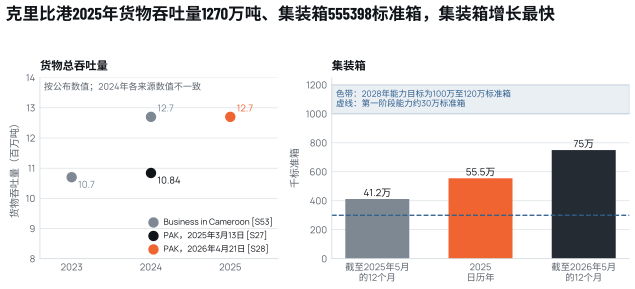
第二集装箱码头(岸线715米)于2025年5月9日投运,投运后12个月处理约75万标准箱,较此前12个月的412087标准箱增长82%[S57][S52][S115]。2025年船舶平均等泊时间克里比约2天,杜阿拉约9天[S54]。集装箱堆场正趋饱和,KCT投资215亿中非法郎扩建8公顷堆场,计划至2028年年处理能力达100万至120万标准箱[S30][S52]。
年产100万吨的钢厂每年需接收约124万吨与港口相关的输入货物,主要为直接还原铁或热压块铁、废钢、石灰和合金[S112]。直接还原铁遇水会发热并释放氢气,须在干燥条件下装卸并有盖储存[S160],而克里比9月和10月月降雨量超过400毫米[S79]。现有多用途码头可满足年产30万吨的钢铁一期(约35.1万吨输入货物)。年1.25亿吨矿石码头(约330公顷)已于2025年11月4日签署谅解备忘录,克里比自治港总经理2026年3月表示预计在五至六年内建成[S32][S33][S03],本文以此作为码头时间的依据;该码头应从设计之初即为钢铁集群预留带有盖仓储的专用泊位或有保障的泊位时段。
英文全文 12分钟 · 2668词The Port of Kribi gives Central Africa its deepest quay, and it is filling fast
Kribi offers what no other Cameroonian port can: 16 m of water at the quay, a 600 m turning basin and a coast with room to grow [S22]. Since it opened in March 2018 [S117] the port has become the country’s leading container gateway, handling 12.7 Mt of cargo and 555,398 twenty-foot equivalent units (TEU) in 2025 [S28]. For heavy industry the strength is depth and space; the gap is dry bulk. Today’s general cargo and container terminals were not designed for the regular bulk flows of iron units, ore and slag that a steel platform generates, and the mineral terminal that would provide them, agreed in a memorandum of understanding on 4 November 2025, is expected to be completed within five to six years of March 2026 [S32][S03]. The port is an asset to build on, not yet a finished bulk platform.
2.1 A deep-water port in the right place
The Port of Kribi lies on the Atlantic coast of the South Region, at Mboro and Lolabé, about 24 km south of Kribi town by straight line (Figure 2.1). It is reached by a buoyed access channel 650 m long and 200 m wide, with 16 m of water at the foot of the quays and a turning circle 600 m in diameter dredged to 15 m [S22]. The port guide published by the Port Autonome de Kribi (PAK) in August 2020 gives about 70,000 deadweight tonnes (DWT) as the design vessel for the general port and up to 350,000 DWT for future industrial terminals in deeper water [S22]. The offshore terminals for oil and gas loading, including the Komé-Kribi 1 export terminal of the Chad-Cameroon pipeline, are also under PAK’s management [S22].
Depth is the attribute that matters most for heavy industry, because bulk freight rates fall steeply with ship size. Douala, the country’s historic port, sits on the Wouri estuary at the end of a long dredged channel; mariners are advised to take particular care with vessels drawing more than about 8 m, and the channel needs constant dredging [S55][S54]. Kribi has roughly twice that draught at the quay. It is also on open coast, with deep water close inshore, which allows further berths to be built without the estuarine siltation that constrains Douala.
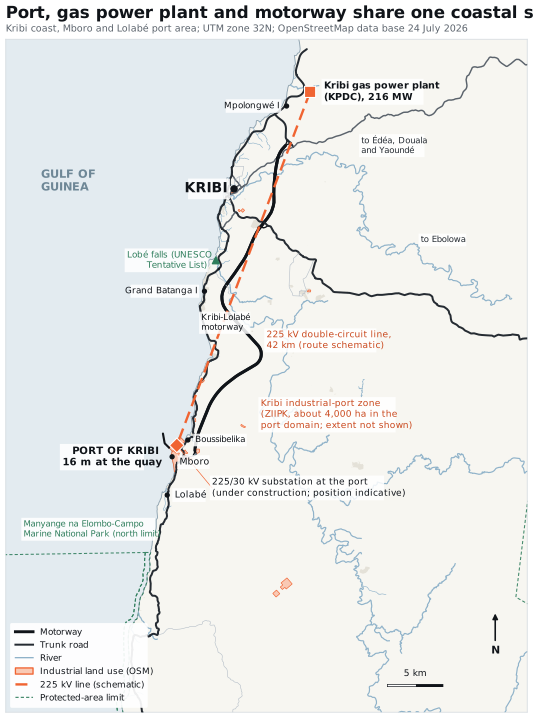
Source: Drawn by Cameroon Steel from OpenStreetMap data, base 24 July 2026, © OpenStreetMap contributors, ODbL [S111]; 225 kV line from PAK, 6 August 2025 and 19 August 2026 [S25][S26]. The line route is schematic; the substation position is indicative.
Waiting times tell the same story from the shipping side. In September 2025 Business in Cameroon reported average vessel waiting times of about nine days at Douala against about two days at Kribi, while noting that Douala still handled 75 to 85% of Cameroon’s freight [S54]. Kribi’s advantage is not only the water: it is a modern port with spare marine capacity, in a country whose main port is congested.
The location also places Kribi within reach of Central Africa’s coastal capitals. By straight line, Bata in Equatorial Guinea is about 120 km away, Douala 125 km, Malabo 154 km, Yaoundé 206 km and Libreville 287 km (Chapter 6). For bulk iron units arriving by sea, and for coastal shipment of steel products to neighbouring ports, Kribi is well placed at the hinge of the Gulf of Guinea.
2.2 Containers: rapid growth and a yard that is filling
The container business shows how quickly Kribi can scale when capacity is provided. The first container terminal, operated by Kribi Conteneurs Terminal (KCT), opened with a 350 m quay [S30]. A second terminal with a 715 m quay entered service on 9 May 2025, bringing the combined quay length of the container and multipurpose terminals to 1,330 m and design capacity to more than one million TEU a year [S57]. The second phase cost about 400 bn FCFA, mostly financed by China Eximbank, and added quay cranes and an extension of the main breakwater [S57].
Traffic followed. In the twelve months after the second terminal opened, KCT handled about 750,000 TEU against 412,087 TEU in the previous twelve months, an increase of 82% [S52][S115]. Over calendar 2025 the port handled 555,398 TEU, which PAK presents as 37.5% of national container traffic, making Kribi Cameroon’s first container port [S28]. About 70% of KCT’s volume is regional transhipment [S52].
Growth is now pressing on the yard. In October 2026 EcoMatin reported average dwell times for import containers of about 25 days and quay productivity of about 33 moves an hour, and described the terminal as beginning to saturate [S56]. KCT is responding with a 21.5 bn FCFA expansion that adds 8 ha of yard and raises static storage from 24,000 to 34,000 TEU by the end of 2027, with annual handling capacity targeted at 1.0 to 1.2 million TEU by 2028 [S30][S52].
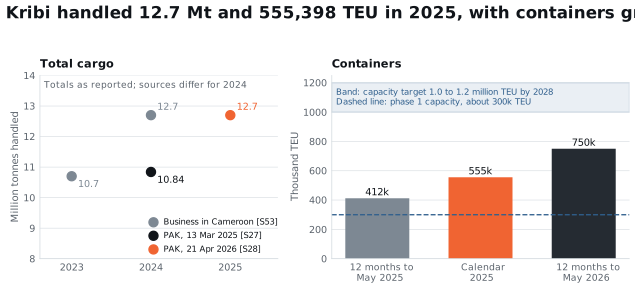
Source: PAK, Bilan et perspectives, 13 March 2025 [S27]; PAK, opinion article by the Director General, 21 April 2026 [S28]; Business in Cameroon, 1 July 2025 and 18 May 2026 [S53][S52]; Business in Cameroon, 12 May 2025 [S57].
For a steel platform the container business matters in two ways. It brings regular liner services that connect Kribi to Asia, Europe and West Africa, which is how spares, alloys, refractories and electrodes arrive. And it is evidence of execution: a second terminal was built, opened and filled within a year, and an expansion was financed within eighteen months. That is the kind of delivery record a heavy-industry investor looks for.
2.3 General cargo and dry bulk: the missing link for heavy industry
The steel question is not containers but bulk. A works of 1 Mtpa would need to receive about 1.24 Mt a year of port-linked inbound cargo, mostly DRI or HBI, scrap, lime and alloys, and would ship a share of its products and by-products by sea [S112]. These flows need a dry-bulk berth with grab cranes or continuous unloaders, covered conveyors or trucks to the plant, and, for DRI and HBI, covered and dry storage because the material reacts with water.
Kribi’s multipurpose terminal handles break-bulk and dry-bulk cargo, and PAK planned to use it for the first shipments of iron ore from the Bipindi-Grand Zambi deposit [S42]. It is a general-purpose facility, however, shared between many users, and it was not designed for the continuous, high-tonnage flows of a steel plant.
The structural answer is the mineral terminal. On 4 November 2025 PAK, the national social insurance fund (CNPS), a consortium of the mining developers Bestway and AustSino, and the iron-ore developer G-Stones signed a memorandum of understanding for a mineral terminal with a capacity of 125 Mt a year on about 330 ha, to be built in phases [S32][S47]. Business in Cameroon reported a cost of about US$2 billion and a first stage built around a 30 Mt a year jetty, and linked the terminal to a dedicated steel cluster in the industrial zone [S33]. The parties gave themselves four to six months to complete the technical, legal and financial structuring [S32]. In March 2026 PAK’s Director General said the mineral and hydrocarbon terminals should be completed within five to six years in partnership with their developers [S03]. This paper uses that dated statement as its reference for the terminal’s timing: a memorandum of understanding of 4 November 2025, structuring in four to six months, and completion within five to six years, that is around 2031 to 2032.
Table 2.1 sourcedPort of Kribi: facilities in service and announced, October 2026
| Facility | Main characteristics | Status | Relevance to a steel platform | Source |
|---|---|---|---|---|
| Access channel and basin | 650 m by 200 m channel; 16 m at the quay; 600 m turning circle at 15 m | In service | Allows Supramax and Panamax bulk carriers | [S22] |
| Container terminals (KCT) | Quays of 350 m and 715 m; capacity above 1 million TEU; second terminal from 9 May 2025 | In service | Spares, alloys, electrodes, refractories; some product exports | [S57] |
| Container yard expansion | +8 ha; static storage 24,000 to 34,000 TEU; 21.5 bn FCFA | Works to end 2027 | Relieves congestion that would delay inbound consumables | [S30][S52] |
| Multipurpose terminal | Break-bulk and dry bulk; planned first ore shipments | In service | Can serve a first steel phase at modest volumes | [S42] |
| Mineral terminal | 125 Mt a year on about 330 ha; phased, first stage around a 30 Mt a year jetty | MoU 4 November 2025; completion within five to six years (PAK, March 2026) | The natural berth for iron units, ore and HBI | [S32][S33][S03] |
| Hydrocarbon terminal | Liquid bulk for the zone’s refining and petrochemical projects | Announced; five to six years | Fuels and, potentially, gas for industry | [S03] |
| Agro-industrial terminal | Grain and oil terminal on 9.2 ha; 50 bn FCFA; 20-year renewable occupation | MoU 9 October 2026 | Shows the model for single-user terminals in the domain | [S19] |
| Offshore terminals | Oil export (Komé-Kribi 1) and other offshore loading points | In service | Not directly relevant to steel | [S22] |
Source: as listed; status as of 10 October 2026.
2.4 Handling iron units on a wet coast
The choice of berth for iron units is not only a question of capacity. DRI and HBI are classified under the International Maritime Solid Bulk Cargoes Code as cargoes that can react with water, generating heat and flammable hydrogen. A guideline published by the shipowners’ mutual insurer Skuld in March 2025 summarises the precautions: cargo must be dry and clean, it must not be loaded or handled in the rain, its temperature must stay below 65 °C, and holds must be ventilated during the voyage to keep hydrogen below 1% by volume [S160]. Hot-briquetted iron is the most robust form; DRI pellets and fines need more care.
At Kribi this matters more than at most ports, because rain falls in every month of the year and exceeds 400 mm a month in September and October (Chapter 5) [S79]. A berth where iron units are discharged in the open will lose working days to rain and expose cargo to water. The practical answers are well known: discharge with enclosed grabs or continuous unloaders into covered conveyors, store the material in covered sheds at the plant rather than on open quay stockpiles, and schedule vessels around the wettest months where possible. Each of these has a cost, which is lower when it is designed into a terminal from the start than when it is added later.
The same reasoning applies to export cargoes. Bars, wire rod and sections tolerate rain better than iron units, but coils of wire rod and finished products for export are usually stored under cover to avoid rust staining that buyers may reject. A steel cluster therefore needs covered storage at both ends of its sea leg.
Two further points follow for the design of the mineral terminal. First, its ore-export berth, built for very large vessels and open-air stockpiles, is not automatically suitable for iron-unit imports. Second, a smaller covered berth or a covered section of the multipurpose terminal, built for parcels of tens of thousands of tonnes, may serve the steel cluster better and sooner than a share of a very large ore berth. Either way, the requirement should be specified now, while the terminal’s design is still open.
2.5 How the port is governed and financed
The port is owned and managed by the Port Autonome de Kribi, a public-capital company whose sole shareholder is the State; its organic decree of 5 May 2020 allows it to create subsidiaries and to concede industrial and logistics activities under specific agreements [S118]. Terminals are operated by private concessionaires: KCT’s shareholders include AGL, CMA CGM, China Harbour Engineering Company and Cameroonian investors [S115][S30]. The port authority itself reported a net profit of more than 4 bn FCFA for 2025, and PAK’s Director General stated that customs revenue collected at the port reached a record of about 350 bn FCFA in 2025 [S31][S28].
This structure matters for steel because the dry-bulk capacity a steel platform needs will most likely be delivered in the same way: by a concessionaire or a consortium of users, on land in the public port domain, under a long-term agreement with the port authority. The model has been used for the container terminals, for cement plants and for the agro-industrial terminal [S57][S35][S19]. The open question is whether the mineral terminal will be designed from the start with a berth, or a share of berth time, dedicated to the steel cluster’s imports and exports, rather than optimised only for very large ore exports.
2.6 What the port means for a steel platform
Four conclusions follow.
The water is in place. Kribi’s 16 m quay and open-coast setting are the platform’s single largest advantage, and they cannot be replicated elsewhere in Cameroon. For a steelmaker importing DRI or HBI in parcels of tens of thousands of tonnes, the difference between a 16 m port and an 8 m estuary port is the difference between economic bulk freight and part-loaded ships or lighterage.
The first steel phase can start on existing facilities. A first melt shop and rolling mill of 0.3 Mtpa would need about 351,000 t of port-linked inbound cargo a year, almost all of it imported scrap, DRI or HBI and consumables [S112]. That is within the reach of the multipurpose terminal and the container terminals, provided berth windows and covered storage are agreed in advance.
Scale needs a bulk berth. Beyond the first phase, and certainly at 1 Mtpa with a direct-reduction module, a steel cluster needs dedicated dry-bulk capacity. The mineral terminal is the right vehicle, but its first priority is likely to be very large ore exports. A steel-cluster berth, or a guaranteed share of berth time and covered storage, should be written into its design now.
Containers must keep pace. Congestion in the container yard is a real if temporary constraint. Spares and consumables arrive in containers, and a melt shop cannot wait three weeks for electrodes. The yard expansion due by the end of 2027 is therefore relevant to steel as well as to trade.
Other sources cited in the English text
- S55Douala memories: salvage expert from gateway to Central Africa. Gard, 6 May 2015.gard.no/insights/douala-memories-salvage-expert-from-gateway-to-centra…
- S111OpenStreetMap extract for the Kribi area (Overpass API, data base 24 July 2026), © OpenStreetMap contributors, ODbL. OpenStreetMap Foundation, 24 July 2026.openstreetmap.org/copyright
- S25Kribi franchit la ligne électrique 225 kV. Port Autonome de Kribi, 6 August 2025.Cited by title and date
- S26Énergie et infrastructures: un nouvel élan pour la compétitivité du Port de Kribi. Port Autonome de Kribi, 19 August 2026.Cited by title and date
- S56Port de Kribi: l’explosion du trafic commence à saturer le terminal à conteneurs. EcoMatin, 5 October 2026.ecomatin.net/port-de-kribi-lexplosion-du-trafic-commence-a-saturer-le-…
- S42Grand Zambi: le fer de Bipindi au service de l’essor du PAK. Port Autonome de Kribi, 17 January 2025.Cited by title and date
- S47CNPS, G-Stones join Kribi port mineral terminal project. Business in Cameroon, 7 November 2025.businessincameroon.com/mining/0711-15312-cnps-g-stones-join-kribi-port…
- S19Port de Kribi: un protocole d’accord signé pour un terminal agro-industriel de 50 milliards de FCFA. Investir au Cameroun, 9 October 2026.investiraucameroun.com/gestion-publique/0910-23942-port-de-kribi-un-pr…
- S118Décret n° 2020/251 du 5 mai 2020 portant réorganisation et fonctionnement du Port Autonome de Kribi. Presidency of the Republic of Cameroon, 5 May 2020.Cited by title and date
- S31Kribi Port’s net profit exceeds CFA4 billion after strong year for cargo traffic. Business in Cameroon, 29 June 2026.businessincameroon.com/transport/2906-16378-kribi-port-s-net-profit-ex…
- S35La ZIPK rayonne avec l’inauguration de la cimenterie CIMPOR. Port Autonome de Kribi, 19 July 2024.Cited by title and date
本章引用的资料来源
方括号内的标记对应以下来源(按原文语言列出),完整列表见附录。 完整来源列表
- S57Cameroon’s Kribi port triples capacity with launch of second container terminal. Business in Cameroon,2025年5月12日.businessincameroon.com/infrastructures/1205-14650-cameroon-s-kribi-por…
- S52Kribi port plans 8-hectare expansion to raise container capacity to 34,000 TEUs. Business in Cameroon,2026年5月18日.businessincameroon.com/public-management/1805-16177-kribi-port-plans-8…
- S115Port de Kribi: le trafic conteneurisé bondit de 82% un an après la mise en service du 2e terminal. EcoMatin,2026年5月14日.ecomatin.net/port-de-kribi-le-trafic-conteneurise-bondit-de-82-un-an-a…
- S54Douala port faces severe congestion, impacting West African trade. Business in Cameroon,2025年9月1日.businessincameroon.com/public-management/0109-14940-douala-port-faces-…
- S30Port de Kribi: 21,5 milliards de FCFA pour accroître de 30% les capacités du terminal à conteneurs. Investir au Cameroun,2026年10月8日.investiraucameroun.com/infrastructures/0810-23934-port-de-kribi-21-5-m…
- S112Cameroon Steel reference configuration RC-1 (planning estimate), edition 10 October 2026. Cameroon Steel,2026年10月10日.按标题和日期引用
- S160Guideline on carriage of direct reduced iron (DRI). Skuld (P&I club),2025年3月26日.skuld.com/topics/cargo/dangerous/guideline-on-carriage-of-direct-reduc…
- S79Monographie du Nyong et des fleuves côtiers, Tome 1 (J.-C. Olivry). ORSTOM,1979年7月.horizon.documentation.ird.fr/exl-doc/pleins_textes/divers11-03/01948.p…
- S32Port de Kribi: un terminal minéralier d’avenir. Port Autonome de Kribi,2025年11月4日.按标题和日期引用
- S33Kribi Deep Sea Port, investors partner to construct 125-million-tonne mineral terminal worth $2 billion. Business in Cameroon,2025年11月5日.businessincameroon.com/transport/0511-15300-kribi-deep-sea-port-invest…
- S03Zone industrialo-portuaire de Kribi (KPIZ): jusqu’à +8 points de croissance et 150 000 emplois attendus sur 15 ans. Investir au Cameroun,2026年3月4日.investiraucameroun.com/gestion-publique/0403-23163-zone-industrialo-po…
- S27Bilan et perspectives: les voyants sont au vert. Port Autonome de Kribi,2025年3月13日.按标题和日期引用
- S28Port de Kribi: la performance au service de la Nation (opinion article by the Director General). Port Autonome de Kribi,2026年4月21日.按标题和日期引用
- S53Kribi port revenue up 24% as cargo traffic reaches 12.7mln tons in 2024. Business in Cameroon,2025年7月1日.businessincameroon.com/public-management/0107-14810-kribi-port-revenue…
- S22Guide du Port de Kribi. Port Autonome de Kribi,2020年8月.按标题和日期引用
- S117Cameroun: malgré un bond de son activité, les bénéfices du port de Kribi chutent de 38% en 2023. EcoMatin,2024年7月2日.ecomatin.net/cameroun-malgre-un-bond-de-son-activite-les-benefices-du-…
引用本章
Cameroon Steel(2026)。基础设施若能同步跟进,克里比可成为中部非洲的钢铁平台(中文摘要版)。白皮书02,第2章:克里比港为中部非洲提供了最深的码头,且利用率增长迅速。CS-WP-02。https://www.cameroon-steel.com/zh/library/kribi-steel-platform/port-of-kribi/
来源