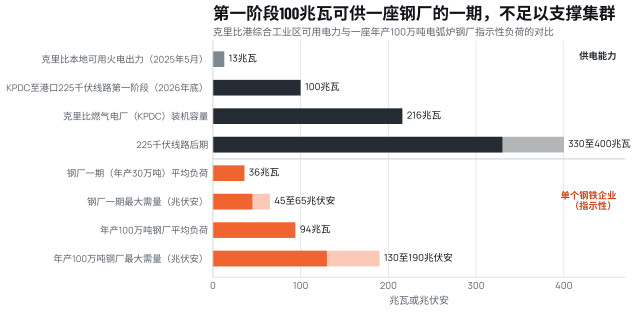
按Cameroon Steel的指示性测算,年产30万吨的一期电弧炉长材钢铁厂平均负荷约36兆瓦,最大需量45至65兆伏安;年产100万吨时平均负荷约94兆瓦,最大需量130至190兆伏安[S112]。容量之外,另有三项同等重要的条件(喀麦隆电力系统和电价详见白皮书05第2章和第3章)。一是供电稳定性:2025年喀麦隆装机容量2033兆瓦,高峰需求1278兆瓦,水电约占发电量的90%[S60];2026年10月,约150兆瓦工业需求因纳赫蒂加尔水电站送出线路延误而无法满足[S61];装机216兆瓦的克里比燃气电厂2025年仅发电约560吉瓦时,容量系数约30%[S60]。二是电能质量:电弧炉会引起闪变、谐波和三相不平衡,单台约80兆伏安的电弧炉在短路容量约14000兆伏安时闪变即会令人难以接受[S72],因此须在接入点配置静止无功补偿器(SVC)或静止同步补偿器(STATCOM);电弧炉负荷可调度(可避开高峰安排熔炼),但不可中断。三是电价:10兆瓦以上负荷没有受监管电价,现有参考价从每千瓦时约18.4中非法郎到约105中非法郎不等[S60][S62]。
对主管部门和KPIZ S.A.而言,在以钢铁为龙头的情景下,第一阶段约在2032年用满,因此应立即确定第二阶段供电的时间表和融资,规划第二个225千伏电源,并在首台电弧炉接入前出台电能质量规范。对投资者和贷款方而言,贷款方可以接受的结构应是含容量电费、透明调价公式和付款保障机制的长期供电合同(钢坯成本比较见白皮书04第8.6节)。2026年7月Hilli浮式液化船离开喀麦隆后[S68],克里比天然气有多少可用于工业,值得及早明确(天然气平衡详见白皮书05第6章)。
英文全文 11分钟 · 2638词The 225 kV link makes heavy industry possible at Kribi; a second stage makes a cluster possible
Power is the attribute on which a Kribi steel platform will stand or fall. The 42 km double-circuit 225 kV line from the Kribi gas power plant to a new 225/30 kV substation at the port, due for commissioning at the end of 2026, will make about 100 MW available to the zone at first and 330 to 400 MW later [S25][S26]. One electric-arc-furnace works of 1 Mtpa would draw an average of about 94 MW, with maximum demand of 130 to 190 MVA [S112]. The first stage can therefore carry a first steel phase but not a cluster. Three further conditions matter as much as capacity: firmness, because Cameroon’s grid was about 90% hydro in 2025 and its Kribi gas plant ran well below its capability that year; power quality, because arc furnaces disturb weak networks; and price, because no regulated tariff exists for loads above 10 MW [S60]. Each can be solved, but only if planned now.
4.1 Cameroon’s grid: abundant hydro, thin firm margins
Cameroon’s power system, its tariffs and its cost of supply are analysed in White paper 05, Chapters 2 and 3; this chapter keeps to what matters for heavy industry at Kribi. The system had 2,033 MW of installed capacity in 2025 against a peak demand of 1,278 MW, according to the electricity regulator ARSEL [S60]. Hydropower supplied about 90% of the 8,120 GWh generated that year, gas about 7% and oil and solar the rest (Figure 4.1) [S60]. The latest published emission factor for the grid is older: about 226 g of CO₂ per kWh for 2024, a year in which the same Ember dataset puts hydropower at about 72% of generation [S78][S169]. No emission factor has yet been published for 2025; the papers of this series keep 226 g as a conservative planning value.
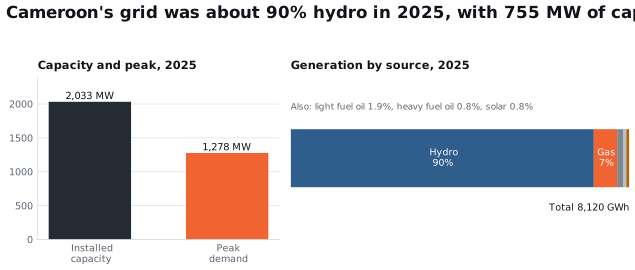
Source: ARSEL, Rapport d’activités 2025, 7 September 2026 [S60].
The capacity margin of about 755 MW on paper overstates what industry can rely on. Hydro output depends on river flows and reservoir management, and new plants depend on transmission lines that have lagged behind generation. In October 2026 Business in Cameroon reported that about 150 MW of industrial demand remained unmet because the 400 kV line that will evacuate power from the 420 MW Nachtigal hydro plant had been delayed, with completion now expected in November 2026 [S61]. ARSEL’s 2025 report records an average interruption duration of about 148 hours per customer, and only six customers in the whole country are supplied at high voltage [S60].
For a steel investor the lesson is that national capacity is necessary but not sufficient. What matters is firm capacity delivered to the plant’s connection point, with redundancy, at a voltage and short-circuit strength that the furnace can use.
4.2 Kribi has a gas power plant 30 to 40 km north, but it feeds the grid
The Kribi gas-fired power plant, operated by the Kribi Power Development Corporation (KPDC), has an installed capacity of 216 MW and has been in service since 2013 [S64]. It was developed by Globeleq with the State as minority partner and with World Bank Group guarantees [S64]. It sits at Mpolongwe, north of Kribi town, about 35 km from the port by straight line (Figure 2.1), and burns gas from offshore fields operated with the national hydrocarbons company SNH [S67].
The plant’s record in recent years shows why proximity is not the same as availability. It was offline from September 2024 to February 2025 during a dispute over about 137 bn FCFA of unpaid invoices [S71]. In 2025 it delivered about 560 GWh against about 1,031 GWh planned, which implies a capacity factor of about 30% [S60]. In August 2026 Forbes Afrique reported that the State was exercising pre-emption rights to acquire Globeleq’s stakes in the Kribi and Dibamba plants [S66]. A planned extension of 114 MW, to the plant’s licensed 330 MW, was discussed with AfDB support in 2020 but has not been built [S65]. And the plant’s output is dispatched into the southern interconnected grid: in May 2025 only about 13 MW of local thermal output was reported to be available to the port area [S20].
Gas supply is changing. In 2025 almost all of Cameroon’s gas came from the Sanaga Sud system offshore Kribi, and about 95% of it fed the Hilli Episeyo floating liquefaction vessel, while KPDC took about 4.9 billion cubic feet (bcf) [S67]. The vessel left Cameroon in July 2026 at the end of its charter [S68]. That frees gas for power and industry at Kribi, but its quantity and duration depend on reserves that are not publicly certified, and the larger Yoyo-Yolanda resource has not reached a final investment decision [S69]. The gas balance after the vessel’s departure is analysed in White paper 05, Chapter 6.
4.3 The 225 kV KPDC-port line and substation
The project that changes the picture is a 42 km double-circuit 225 kV line from the KPDC plant to a new 225/30 kV substation at the port, equipped with three 60 MVA transformers [S25]. Works were launched on 6 August 2025 at a cost of about 35 bn FCFA, with commissioning planned for the end of 2026 [S25]. PAK states that the substation will make about 100 MW available to the port and its zone immediately, rising to 330 to 400 MW at a later stage, and that supply will benefit from N-2 redundancy through the southern interconnected grid, which links the Memve’ele, Nachtigal, Song Loulou and Édéa hydro plants and KPDC [S25]. The Minister of Water and Energy inspected the substation and line on 19 August 2026 [S26], and a planning ministry mission in April 2026 singled out the substation as a key public investment for the zone’s industrial development [S49]. The supply is examined from a steelworks’ side in White paper 05, Chapter 5.
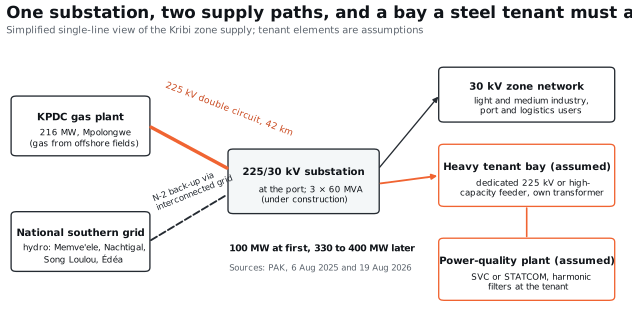
Source: PAK, 6 August 2025 and 19 August 2026 [S25][S26]; tenant elements are Cameroon Steel assumptions.
Two features of the design deserve emphasis. The 30 kV distribution voltage is well suited to logistics, light industry and medium industry, and to the 20 ha of serviced plots being prepared at Mboro [S18]. An arc furnace of the size used in modern long-products plants, however, is normally connected through its own furnace transformer from a high-voltage bus, so a steel tenant will want either its own 225 kV bay at the substation or a dedicated high-capacity feeder. And the two supply paths, from KPDC directly and from the national grid, are what make the supply firm. The value of the line for heavy industry depends on both paths being available at the capacity the tenants need, including when KPDC is out of service.
4.4 What one steel tenant needs: quantity, firmness, quality
Figure 4.3 compares the supply stages announced for the zone with the indicative demand of one electric-arc-furnace long-products works. A first phase of 0.3 Mtpa would draw an average of about 36 MW, with maximum demand of 45 to 65 MVA; at 1 Mtpa, the average rises to about 94 MW and maximum demand to 130 to 190 MVA [S112]. The first 100 MW stage can carry a first phase with headroom for other tenants. It cannot carry a full-size works and the zone’s other industries together. The second stage, 330 to 400 MW, can.
Firmness. A melt shop cannot tolerate frequent interruptions: an unplanned outage during a heat freezes steel in ladles and tundishes, damages refractories and costs a shift of production. Firmness at Kribi will depend on the availability of KPDC, on the N-2 grid backup and on the operating rules for the substation. Large steel tenants elsewhere secure firmness through a combination of contracted firm capacity, a second supply source and, where the grid is weak, captive generation. In return, a melt shop can offer the grid schedulable load: melting can be timed around peaks under a scheduling agreement. It is not an interruptible load, because a heat cannot be stopped midway without loss.
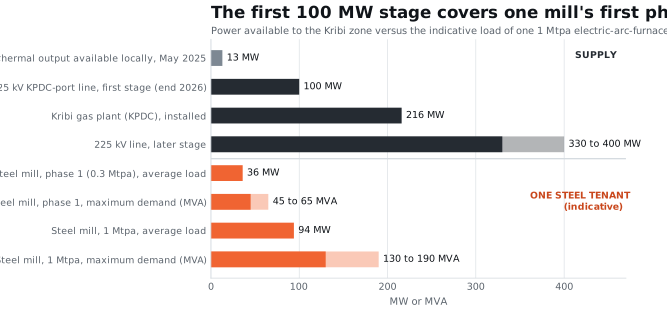
Source: Investir au Cameroun, 20 May 2025 [S20]; PAK, 6 August 2025 [S25]; MIGA, 2014 [S64]; Cameroon Steel indicative planning figures [S112].
Power quality. An arc furnace is among the most disturbing loads a network can host. The arc between electrodes and scrap fluctuates rapidly, causing voltage flicker, harmonics, unbalance between phases and large swings in reactive power. International standards set planning levels for flicker on medium, high and extra-high-voltage networks and guide how a utility allocates emission limits to a fluctuating installation such as a furnace [S74]. How much flicker a furnace causes depends on the short-circuit strength of the network at the point of connection: an engineering note on furnace flicker found that, for a single furnace of about 80 MVA, flicker would become objectionable at a short-circuit capacity of about 14,000 MVA and could be noticeable even at 25,000 MVA [S72]. Networks in Central Africa are far weaker than that, so a steel plant at Kribi will need dynamic compensation, a static var compensator (SVC) or a STATCOM, at its own connection. One reference installation in North America used an SVC rated 0 to 80 Mvar for a melt shop with one arc furnace and one ladle furnace, to reduce flicker, correct power factor, filter harmonics and keep the plant within the utility’s power-quality standards [S73].
The practical conclusion is that the zone needs a power-quality code for heavy tenants before the first furnace is connected: a published short-circuit level at the 225 kV and 30 kV busbars, emission limits for flicker and harmonics allocated to each tenant, and a requirement for compensation equipment sized by a connection study. Without one, the first furnace to connect will consume the network’s tolerance and leave none for the second.
4.5 Price: no regulated tariff above 10 MW
Electricity is usually the largest conversion cost of an arc-furnace works after the metallic charge, so the tariff is as important as the capacity. At the planning value of 450 kWh per tonne of liquid steel, or about 490 kWh/t with 30% DRI or HBI in the charge, a difference of 10 FCFA per kWh moves the cost of a tonne of liquid steel by about 4,500 to 4,900 FCFA for melting alone [S112]. Cameroon has no published regulated tariff for loads above 10 MW; large consumers negotiate bilateral high-voltage contracts [S60]. The reference points that do exist are wide apart (Table 4.1); White paper 05, Chapter 3, analyses them in detail.
Table 4.1 derivedElectricity price reference points for a large industrial consumer in Cameroon
| Reference | Value | Basis | Status | Source |
|---|---|---|---|---|
| Average price realised on legacy high-voltage contracts | About 18.4 FCFA/kWh | 969 GWh sold to 6 HT customers for 17.8 bn FCFA, 2025 | Derived | [S60] |
| All-in price for the top published medium-voltage band (9 to 10 MW) | About 44 FCFA/kWh | Demand and energy charges, more than 400 hours a month, after scheduled escalations, 2026 | Derived | [S63] |
| Average realised medium-voltage price | About 86 FCFA/kWh | All MV customers, 2025 | Derived | [S60] |
| Cost-reflective average tariff set by the regulator | About 105 FCFA/kWh | Required average revenue against about 83 FCFA/kWh collected, 2025 | Sourced | [S62] |
| Transmission use-of-system charge | About 2.7 FCFA/kWh | Withdrawal tariff applied to 100 MW at an 80% load factor | Derived | [S119] |
Source: as listed; arithmetic in Annex A. At the 2026 planning rate of 600 FCFA to the US dollar, 44 FCFA/kWh is about US$0.073 per kWh.
The spread between legacy industrial contracts and the regulator’s cost-reflective average shows the risk on both sides. A steel investor needs a price low enough and stable enough to compete with imported billets and products (the series’ indicative cost comparison is in White paper 04, section 8.6); the utility and the State need a price that covers the cost of supply, including the gas and hydro investments on which firmness depends. A structure that lenders can finance would combine a long-term contract with a capacity charge that rewards a high load factor, a transparent indexation formula and payment-security arrangements that protect the generator, so that the price agreed in year one is still honoured in year ten.
4.6 Planning the zone’s load, not one tenant’s
The decisive planning issue is cumulative. KPIZ is designed to host several heavy industries: cement, refining, petrochemicals, metals and wood processing, as well as logistics. An illustrative scenario in which steel and metals tenants grow alongside other users is set out in Chapter 10 (Figure 10.2). It is not a forecast, but it shows the shape of the problem: on any plausible path in which steel is an anchor, the first 100 MW stage is fully used by about 2032, and the second stage must be in service by then.
Three actions follow. First, the timing and financing of the second stage, from 100 MW to 330 to 400 MW, should be fixed now, with the transmission reinforcements it needs. Second, the zone should plan a second 225 kV source into the port substation, so that N-2 security does not depend on a single line. Third, the use of Kribi’s gas should be planned with industry in mind, whether as fuel for an extension of KPDC, for captive generation at the zone or for direct reduction, because the departure of the floating liquefaction vessel has, for the first time, made that choice available.
Other sources cited in the English text
- S78Carbon intensity of electricity generation (Ember data). Our World in Data.ourworldindata.org/grapher/carbon-intensity-electricity
- S169Electricity production by source (Ember and Energy Institute data), Cameroon. Our World in Data.ourworldindata.org/grapher/electricity-prod-source-stacked
- S67Données pétrolières 2025. Société Nationale des Hydrocarbures (SNH), June 2026.snh.cm/wp-content/uploads/2026/06/Donnees-petrolieres-2025.pdf
- S71Kribi gas power plant resumes operations after debt resolution. Business in Cameroon, 27 February 2025.businessincameroon.com/energy/2702-14501-kribi-gas-power-plant-resumes…
- S66Au Cameroun, l’État veut reprendre les centrales de Kribi et Dibamba à Globeleq. Forbes Afrique, 11 August 2026.forbesafrique.com/au-cameroun-letat-veut-reprendre-les-centrales-de-kr…
- S65The AfDB praises the impacts of the planned extension of the Kribi gas-fired power plant. Business in Cameroon, 1 July 2020.businessincameroon.com/energy/0107-10486-the-afdb-praises-the-impacts-…
- S69Cameroon’s SNH eyes Yoyo-Yolanda and new exploration blocks to sustain gas growth. Business in Cameroon, 6 July 2026.businessincameroon.com/energy/0607-16422-cameroon-s-snh-eyes-yoyo-yola…
- S116ENERGIRON technology: DRI-EAF production route using natural gas or hydrogen. European Commission, Innovation Centre for Industrial Transformation, February 2026.innovation-centre-for-industrial-transformation.ec.europa.eu/innovativ…
- S49Port de Kribi: une dynamique industrielle portée par les financements publics. Journal du Cameroun, 20 April 2026.fr.journalducameroun.com/port-de-kribi-une-dynamique-industrielle-port…
- S18Cameroun: le port de Kribi engage 3,5 milliards FCFA pour préparer l’arrivée de nouveaux industriels. EcoMatin, 11 May 2026.ecomatin.net/cameroun-le-port-de-kribi-engage-35-milliards-fcfa-pour-p…
- S74IEC TR 61000-3-7, Ed. 2.0: Assessment of emission limits for the connection of fluctuating installations to MV, HV and EHV power systems. International Electrotechnical Commission, February 2008.webstore.iec.ch/en/publication/4155
- S73Gerdau Steel: static var compensator for arc furnace operation (customer reference). Hitachi Energy, n.d. (project 2007).hitachienergy.com/in/en/news-and-events/customer-stories/reference-ger…
- S63Tableaux tarifaires, Décision ARSEL N°00000427 (clients MT 2023 à 2025). ARSEL, January 2026.arsel-cm.org/wp-content/uploads/2026/01/TABLEAUX-TARIFAIRES-decision-M…
- S119Tarif de transport et du gestionnaire du réseau de transport (Décision 0000017D). ARSEL, 17 January 2025.arsel-cm.org/wp-content/uploads/2026/01/TARIF-TRANSPORT-ET-GRT-1.pdf
本章引用的资料来源
方括号内的标记对应以下来源(按原文语言列出),完整列表见附录。 完整来源列表
- S112Cameroon Steel reference configuration RC-1 (planning estimate), edition 10 October 2026. Cameroon Steel,2026年10月10日.按标题和日期引用
- S60Rapport d’activités 2025 de l’ARSEL. Agence de Régulation du Secteur de l’Électricité (ARSEL),2026年9月7日.arsel-cm.org/wp-content/uploads/2026/09/Rapport-ARSEL-2025.pdf
- S61Nachtigal power line delays leave 150 MW of industrial demand unmet. Business in Cameroon,2026年10月9日.businessincameroon.com/public-management/0910-16939-nachtigal-power-li…
- S72Electric arc furnace modeling for voltage flicker evaluation (PQSoft case study, document PQS0313). Electrotek Concepts, Inc.(copy published by PowerQuality.blog,2022年2月28日),2003年4月16日.powerquality.blog/2022/02/28/electric-arc-furnace-modeling-for-voltage…
- S62Décision fixant le montant de la RMA ENEO au titre de l’exercice 2025 (réajustée). ARSEL,2025年12月19日.arsel-cm.org/wp-content/uploads/2026/01/Decision-fixant-le-Montant-de-…
- S68Cameroon FLNG Terminal. Global Energy Monitor (GEM.wiki;tertiary),2026年10月.gem.wiki/Cameroon_FLNG_Terminal
- S20Zone industrielle Kribi: 400 milliards FCFA investis et 53 entreprises autorisées à s’implanter depuis 2018. Investir au Cameroun,2025年5月20日.investiraucameroun.com/gestion-publique/2005-22033-zone-industrielle-k…
- S25Kribi franchit la ligne électrique 225 kV. Port Autonome de Kribi,2025年8月6日.按标题和日期引用
- S64Kribi Power Development Corporation (project summary). MIGA, World Bank Group,2014年.miga.org/project/kribi-power-development-corporation-0
- S26Énergie et infrastructures: un nouvel élan pour la compétitivité du Port de Kribi. Port Autonome de Kribi,2026年8月19日.按标题和日期引用
引用本章
Cameroon Steel(2026)。基础设施若能同步跟进,克里比可成为中部非洲的钢铁平台(中文摘要版)。白皮书02,第4章:225千伏线路使克里比具备发展重工业的条件,第二阶段供电才能支撑产业集群。CS-WP-02。https://www.cameroon-steel.com/zh/library/kribi-steel-platform/power/
来源