白皮书08 · 第4章 · 中文摘要
关键缺口在炼钢车间、连铸和班组督导,认证是最薄弱的环节
章节摘要。对照喀麦隆现有供给,钢厂所需技能可分为三类。现场工种、物流和起重机操作经短期培训即可在本地解决;维修、焊接、电气和自动化技能国内已有,但需要提升到工业标准,尤其需要公认的认证;电弧炉和钢包精炼炉操作、连铸、炼钢冶金以及24小时连续生产的班组督导在本地几乎没有基础,需要两到十年才能培养出来。
本页为本章中文摘要;英文全文附于其后,可展开阅读。
Cameroon Steel按十个职业族群和四个维度(有经验人员供给、培训能力、认证、胜任时间)进行了评估。喀麦隆钢铁企业以轧钢为主、只有少数小型炼钢车间[S08],国内也没有这些职业的国家证书。焊接是最易迁移、也最容易认证的技能:ISO 9606-1规定了焊工资格考试[S59],但本研究未发现喀麦隆有定期按该标准开展焊工认证的机构。督导人员只能逐步成长:操作工通常需要6至10年才能成为值班督导。与此同时,提供正式培训的企业比例从2016年的37.6%降至2024年的24.0%[S15]。认证是成本最低的杠杆:应由雇主与MINEFOP共同制定钢铁职业能力标准,并建立考核中心,在国家学历之上增加一层由雇主主导的能力认证。
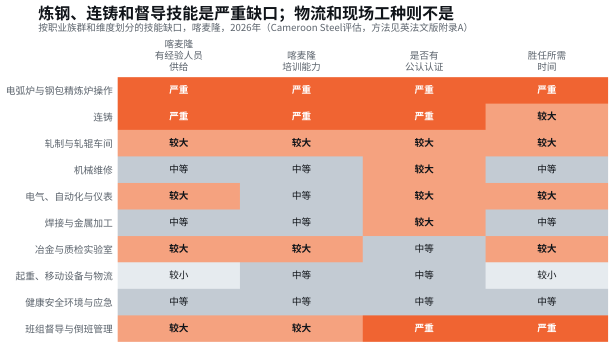
资料来源:Cameroon Steel评估(方法见英法文版附录A),依据国家统计局(INS)EESI3调查[S12]、第3章院校资料及世界银行企业调查[S15]。
英文全文 11分钟 · 2589词The critical gaps are in the melt shop, the caster and supervision, and certification is the weakest link
The skills a steelworks needs fall into three groups when set against what Cameroon can supply today. Site trades, logistics and crane operation can be sourced locally with short training. Maintenance, welding, electrical and automation skills exist in the country but need upgrading to industrial standards and, above all, recognised certification. Melt-shop, ladle-furnace and casting operation, steelmaking metallurgy and the supervision of a continuous 24-hour process have almost no local base and take two to ten years to form. A skills plan for steel should therefore concentrate scarce training resources on the last group, start it first, and use certification to turn the second group’s informal competence into recognised qualifications.
4.1 Where the gaps are: an assessment by occupational family
Figure 4.1 summarises Cameroon Steel’s assessment of the gap between what a phased EAF works needs and what Cameroon can supply, for ten occupational families and four dimensions: the stock of experienced workers in Cameroon, the capacity of Cameroonian institutions to train new ones, the availability of a recognised certification, and the time needed to reach independent competence. Scores are judgements on a four-step scale, informed by the evidence in Chapters 2 and 3 and by the training durations in Chapter 5; the method is set out in Annex A. They are meant to set priorities, not to rank people or institutions.
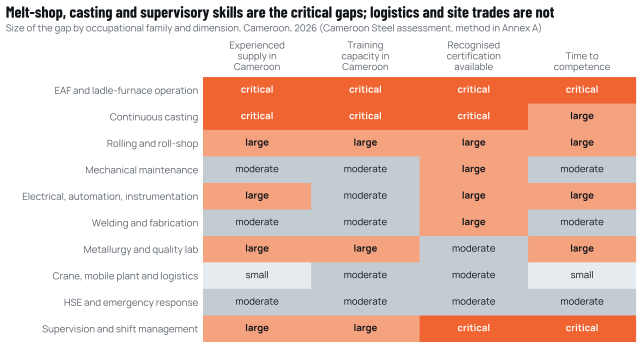
Source: Cameroon Steel assessment (method and scoring rules in Annex A), drawing on INS, EESI3 [S12], institutional sources in Chapter 3 [S18][S21][S22][S24][S25] and World Bank Enterprise Surveys [S15].
Three groups emerge.
Critical gaps: steelmaking process and supervision. Electric arc furnace and ladle-furnace operation, continuous casting and the supervision of a continuous process are rated critical on most dimensions. Cameroon’s steel industry is made up mainly of re-rollers with a few small melt shops [S08], so the pool of experienced melters and casters is small and already employed; no Cameroonian programme teaches steelmaking (Chapter 3); and no national certificate exists for these occupations. Forming a competent melter takes two to three years after initial training; forming a shift manager who can run a melt shop and caster through the night takes much longer (Chapter 5).
Large gaps: rolling, automation and metallurgy. Rolling-mill operation and roll-shop machining, electrical and automation work, and laboratory metallurgy have a partial local base. Douala’s rolling mills employ experienced operators and roll-shop machinists, and the ISTD and IUTs train electrical and mechanical technicians [S07][S21][S22]. But the base is small relative to demand from a growing cluster, much of it is already employed, and the step from a teaching laboratory to a modern mill’s drives, programmable logic controllers (PLCs) and spectrometers is large.
Moderate or small gaps: maintenance, welding, HSE, logistics. Mechanical maintenance and welding draw on a wide base of technicians and tradespeople trained formally or on the job; health, safety and environment (HSE) officers are trained for other industries; crane operation, driving and logistics are common skills. Here the gap lies less in competence than in proof of competence: recognised certificates, documented experience and familiarity with the procedures and permit systems of a heavy-industry site.
4.2 A skills matrix for a phased EAF works
Table 4.1 translates the assessment into a matrix of the main roles, the competences that define them, the entry qualification that fits Cameroon’s education system, the certification or standard that demonstrates competence, and the training route. It is the basis for the workforce plan in Chapter 9 and for curriculum co-design with schools (Chapter 10).
Table 4.1 Skills matrix for the main roles of a phased EAF long-products works
| Role | Critical competences | Entry qualification in Cameroon | Certification or standard | Main training route | Time to competence |
|---|---|---|---|---|---|
| EAF and ladle-furnace operator (melter) | Furnace programme and power control; oxygen and carbon injection; slag practice; tapping; sampling; molten-metal safety | Technical baccalaureate or DUT (chemistry, mechanics, electrical) | Employer competence card; vendor training certificate | Simulator, vendor training, placement in an operating melt shop, mentored shifts | 24 to 42 months |
| Caster operator | Tundish and mould operation; casting speed and cooling; breakout prevention; billet cutting and quality | Technical baccalaureate or DUT | Employer competence card; vendor certificate | Simulator, vendor training, mentored shifts | 18 to 30 months |
| Rolling-mill operator and roll changer | Pass schedules; guides and stands; roll change; cobble prevention; product tolerances | CAP, technical baccalaureate or DUT (mechanics) | Employer competence card | On-the-job with experienced operators; vendor modules | 9 to 24 months |
| Roll-shop machinist | Lathe and CNC work on rolls and guides; groove profiles; inspection | CAP or BTS (machining) | National trade certificate; employer card | Dual apprenticeship; vendor modules | 18 to 36 months |
| Mechanical maintenance technician | Hydraulics, lubrication, bearings, gearboxes; condition monitoring; planned maintenance | DUT or BTS (industrial maintenance, mechanics) | National diploma; employer card | Dual apprenticeship or conversion programme | 30 to 42 months from school entry |
| Electrical and automation technician | Medium and high-voltage switching; drives; PLC and instrumentation; electrical safety | DUT or BTS (electrical, industrial computing) | National diploma; electrical authorisation; vendor PLC certificates | IUT plus vendor training; mentored authorisations | 36 to 48 months from school entry |
| Certified welder | Fusion welding of carbon steel in several positions and processes; reading procedures | CAP or CQP (welding) | ISO 9606-1 welder qualification | Test and coding on site; refresher | 12 to 18 months |
| Crane and mobile-plant operator | Overhead and mobile crane operation; rigging signals; load charts | Driving licence; trade certificate | Operator licence; employer authorisation | Short course and supervised hours | 6 to 12 months |
| Laboratory analyst and quality inspector | Spectrometry; tensile and bend testing; sampling; product certification to the national rebar standard | Licence or DUT (chemistry, materials, mechanics) | Laboratory quality system; standard test methods | On-the-job; external laboratory courses | 12 to 24 months |
| Process metallurgist | Steelmaking thermodynamics; alloying; defect analysis; process optimisation | Engineering degree (mechanical, chemical, materials) | Professional record; internal qualification | Specialisation module; placement abroad; mentoring | 72 to 84 months from school entry |
| HSE officer | Risk assessment; permits; incident investigation; emergency response | Degree or DUT in HSE or engineering | ISO 45001 lead auditor or equivalent; first aid; fire | External courses; mentoring | 12 to 24 months |
| Shift supervisor and shift manager | Leading crews through a 24-hour cycle; production and safety decisions; coordination across areas | Experienced operator, technician or engineer | Internal leadership programme | Progression, leadership training, rotations | 6 to 10 years of experience |
Source: Cameroon Steel analysis. Times to competence are planning assumptions (Annex A; Figure 5.2). Standards: ISO 9606-1 [S59]; ISO 45001 [S58]; mandatory national rebar standard NC 236/2024/06 [S67].
4.3 Welding is the most portable skill, and the easiest to certify
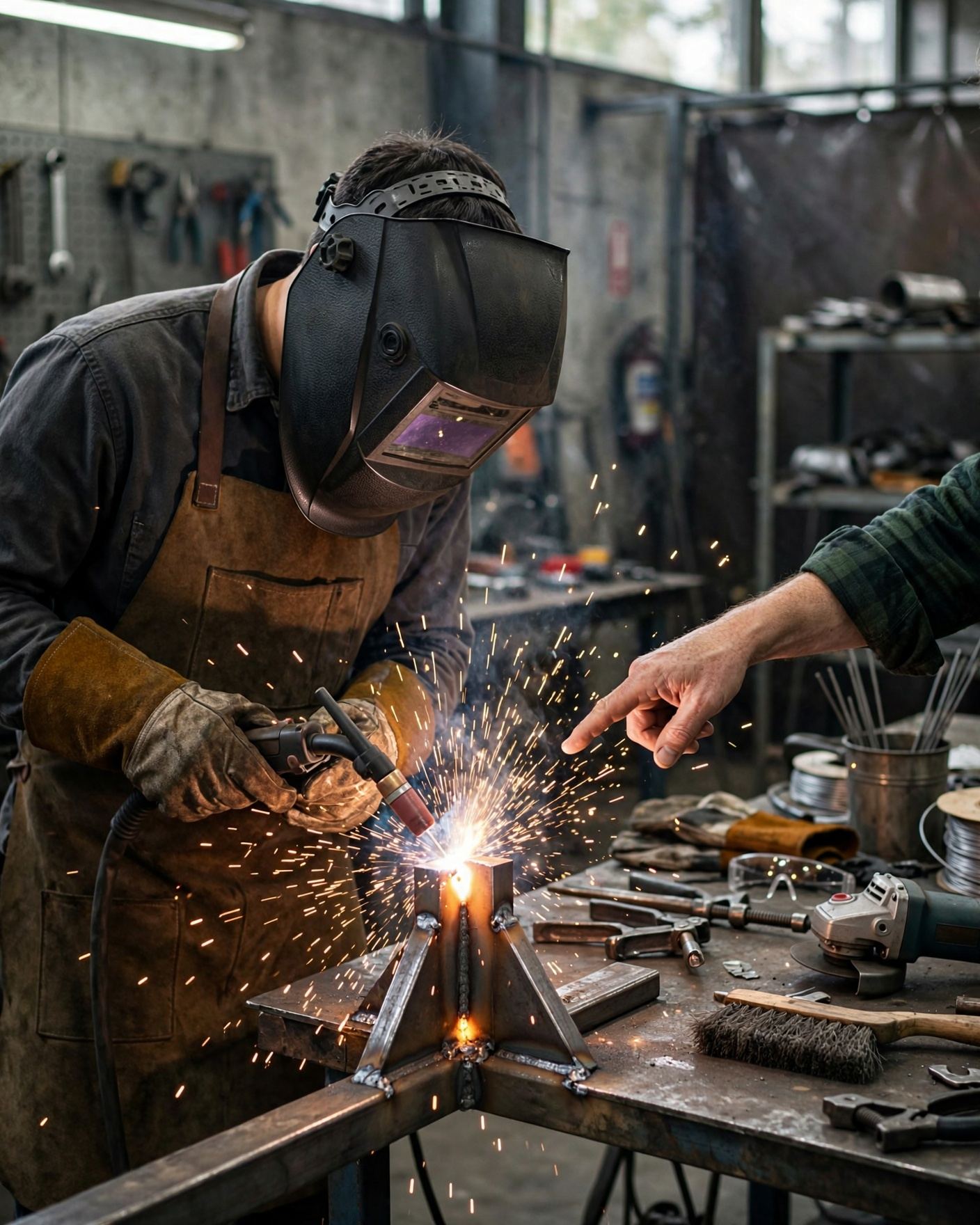
Welding deserves particular attention because it is needed throughout a plant’s life, from construction to maintenance, and because its competence can be tested objectively. The international standard ISO 9606-1 specifies the qualification testing of welders for fusion welding of steels: a welder is tested on a specific process, material, joint type and position, and receives a certificate valid for a defined period if the test piece passes visual and destructive or radiographic examination [S59]. The International Institute of Welding, launched in June 1948 and counting 59 member countries at its 2015 peak, runs a harmonised qualification system, coordinated with the European Federation for Welding, Joining and Cutting since 2009. Authorised Nominated Bodies administer its examinations, issue diplomas and authorise Approved Training Bodies; where a country has no IIW member, organisations can work with an Authorised Nominated Body of another country [S60][S78].
Cameroon has a large population of welders trained informally in workshops, but few of them hold a certificate that a heavy-industry employer or a foreign equipment supplier will accept. For this paper we did not identify a body in Cameroon that tests and certifies welders to ISO 9606-1 on a regular basis; this is listed as an evidence gap (Chapter 11). The opportunity is straightforward: a welding test centre, run with an accredited international certification body, could test workshop-trained welders, certify those who pass and train those who do not. During construction, each phase of a steelworks will need hundreds of welders; making certification a contractual requirement, with testing on site, would leave the Kribi cluster with a certified workforce after each peak (Chapter 9).
Electrical and automation technicians present a similar but harder case. A modern EAF draws power through a dedicated furnace transformer fed at high voltage, and the rolling mill runs on variable-speed drives controlled by PLCs. Working on such systems requires formal electrical authorisations, issued by the employer under a written procedure, and familiarity with specific control platforms that vendors teach on their own equipment. Cameroonian IUT graduates in electrical engineering and industrial computing (GEII) have the theoretical base [S21]; what they lack is supervised practice on industrial equipment, which can only be gained in a plant, at a vendor’s facility or on industrial-grade training benches.
Metallurgy and quality control carry a regulatory dimension. Reinforcing bar sold in Cameroon must conform to the mandatory national standard NC 236/2024/06; in January 2026 the government refused an industry request to revise it [S67][S68]. Each heat and each batch has to be analysed and tested, and the results certified. Laboratory analysts and quality inspectors therefore need training in standard test methods and in a documented quality system, which a laboratory can later have accredited.
4.4 Supervision is the slowest skill to build
The most underestimated gap is supervisory. A steelworks runs 24 hours a day in rotating shifts. At three in the morning, a shift supervisor in the melt shop decides whether a furnace with a suspected water leak keeps melting, whether a ladle with a worn lining is used once more, and whether a crew that has been short-handed for two shifts continues. Those decisions combine technical judgement, safety leadership and authority over experienced workers. They cannot be taught in a classroom, and they are the decisions most often at the root of serious accidents in heavy industry (Chapter 8).
Supervisors are grown, not hired. The career ladders in Figure 4.2 show the typical path: an operator becomes a senior operator after three to six years, a shift supervisor after six to ten, and a production manager after more than ten. Maintenance and engineering ladders are similar. A new works in a country with no steelmaking base must therefore accept that its first supervisors will be expatriates or experienced Cameroonians recruited from other heavy industries (cement, aluminium, power, oil and gas), and must name and develop their Cameroonian successors from the first day.
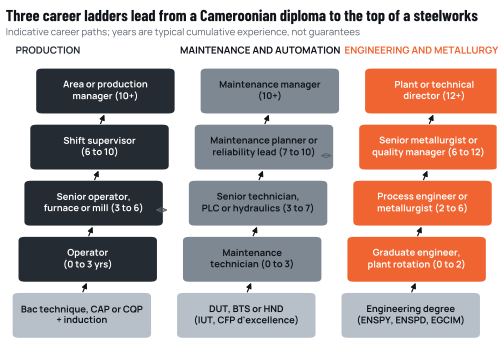
Source: Cameroon Steel analysis of typical career progression in EAF long-products works; diplomas as awarded by Cameroonian institutions [S18][S21][S24].
The ladders also show where lateral moves are possible: a senior operator with an aptitude for equipment can move into maintenance, and a senior technician can move into engineering with further study. Making those bridges explicit, and financing the study that some of them require, is one of the most effective retention tools available to an employer in a tight labour market.
4.5 Employers train less than they did, which makes the gap self-perpetuating
Skills gaps persist where employers do not train. The World Bank’s Enterprise Surveys show that the share of Cameroonian firms offering formal training to their permanent full-time employees fell from 37.6% in 2016 to 24.0% in 2024, below the latest Sub-Saharan African average of 27.8% (Figure 4.3) [S15]. Formal firms that do not train cannot supply experienced workers to newcomers; newcomers who cannot recruit experienced workers must train from scratch; and firms that train risk losing their trainees to those that do not. This is the classic case for a shared, sector-level training effort financed by all employers who benefit (Chapter 10).
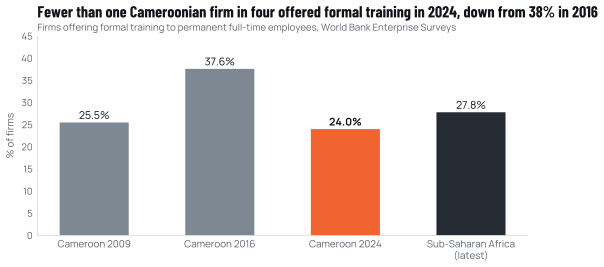
Source: World Bank, Enterprise Surveys, indicator "Firms offering formal training (% of firms)", via the World Development Indicators API, updated 8 October 2026 [S15].
4.6 Language, numeracy and digital skills underpin everything else
Three foundation skills cut across every role in the matrix and deserve explicit attention in any training plan.
Language. Cameroon has two official languages, and Law No. 2018/010 commits the State to equal access to vocational training in both [S26]. Most technical secondary schools and vocational centres teach in French, while much equipment documentation, control-system software and vendor training is produced in English. A steelworks recruiting nationally will employ francophone and anglophone Cameroonians side by side, and will receive manuals, alarms and training material in at least one language that part of its workforce does not read fluently. Procedures, safety signs and permits should therefore be bilingual, and technical English for operators and technicians should be part of the training programme, not an assumption.
Numeracy and process thinking. Running a furnace or a caster means reading trends, interpreting set points and tolerances, and understanding cause and effect in a continuous process. These skills vary widely among holders of the same diploma, which is why aptitude testing at selection and a foundation module at the start of training are recommended (Chapter 3).
Digital skills. Modern melt shops and rolling mills are run from control rooms through process-automation systems, and maintenance is planned in computerised systems. Operators and technicians need to be comfortable with screens, data and simple software before they learn plant-specific systems. Simulators, discussed in Chapter 5, train these skills and the process at the same time.
Cameroon has a full set of national diplomas, from the CAP and the technical baccalaureate to the BTS, the DUT and the engineering degree, and Law No. 2018/010 adds the validation of acquired experience as a right [S26]. What it lacks for heavy industry is a set of competence standards that describe what a melter, a caster, a roll changer or an electrical authorisation holder must be able to do, and a certification process that tests it. Without them, three problems arise:
- Employers cannot trust informal competence. A welder or mechanic trained in a workshop may be excellent, but without a certificate the employer must test every candidate itself.
- Workers cannot carry their competence. A melter trained by one employer has no document that another employer, or a training centre, will recognise.
- Schools cannot align curricula. Without occupational standards co-written with industry, training centres teach to their own syllabus.
The answer is not to create new diplomas, but to build an employer-led layer of competence standards and assessments on top of the national ones: international certificates where they exist (ISO 9606-1 for welders [S59], ISO 45001-based management for HSE [S58]), vendor certificates for equipment, and employer competence cards for process roles, all mapped to the national diplomas so that a worker’s progress is recorded and portable. Chapter 10 proposes that MINEFOP and the employers of the Kribi cluster develop these standards together and recognise them nationally.
Other sources cited in the English text
- S18École nationale supérieure polytechnique de Yaoundé: presentation (created in 1971), departments and 2026 to 2027 entrance competition (Meyomessala annex). ENSPY.polytechnique.cm/
- S21Institut supérieur de technologie de Douala (ISTD): departments and key figures. ISTD, Université de Douala.iut-dla.cm/
- S22Établissements; Institut universitaire de technologie (identification sheet). Université de Ngaoundéré.univ-ndere.cm/fr/etablissements/
- S24Cameroon inaugurates 3 excellence training centres of FCFA 24 billion built by South Korea. Business in Cameroon, 20 Dec 2016.businessincameroon.com/cooperation/2012-6783-cameroon-inaugurates-3-ex…
- S25Former des ouvriers et techniciens qualifiés dans des métiers porteurs (project page). Agence française de développement.afd.fr/fr/projets/former-des-ouvriers-et-techniciens-qualifies-dans-de…
- S07Prometal inaugure deux usines évaluées à 57 milliards F. Journal du Cameroun, 19 Jan 2024.fr.journalducameroun.com/prometal-inaugure-deux-usines-evaluees-a-57-m…
- S58ISO 45001:2018, Occupational health and safety management systems: requirements with guidance for use. International Organization for Standardization, Mar 2018.iso.org/standard/63787.html
- S67Cameroon rejects fresh push to revise rebar standard. Business in Cameroon, 26 Jan 2026.businessincameroon.com/construction/2601-15657-cameroon-rejects-fresh-…
- S60IIW history. International Institute of Welding (IIW).iiwelding.org/about-iiw/iiw-history/
- S78Become an IIW authorised body (Authorised Nominated Bodies and Approved Training Bodies). International Institute of Welding (IIW).iiwelding.org/become-an-iiw-authorised-body/
- S68Cameroun: le gouvernement rejette une demande de révision de la norme du fer à béton. EcoMatin, 5 Feb 2026.ecomatin.net/cameroun-le-gouvernement-rejette-une-demande-de-revision-…
- S26Loi n° 2018/010 du 11 juillet 2018 régissant la formation professionnelle au Cameroun (text). Republic of Cameroon (reproduced by Cameroun24), 11 Jul 2018.cameroun24.net/article/46391-loi-n2018-010-du-11-juillet-2018-regissan…
本章引用的资料来源
方括号内的标记对应以下来源(按原文语言列出),完整列表见附录。 完整来源列表
- S08Production: les acteurs en présence. Cameroon Tribune,2026年5月11日.cameroon-tribune.cm/article.html/76600/fr.html/details_2
- S59ISO 9606-1:2012, Qualification testing of welders: fusion welding, Part 1: Steels. International Organization for Standardization,2012年.iso.org/standard/54936.html
- S15Enterprise Surveys indicator: firms offering formal training (% of firms), Cameroon and Sub-Saharan Africa. World Bank,更新:2026年10月8日.api.worldbank.org/v2/country/CMR/indicator/IC.FRM.TRNG.ZS?format=json
- S12Troisième enquête sur l’emploi et le secteur informel (EESI3), phase 1: enquête emploi, rapport principal (2021 data; Tables 2.9, 3.7, 3.24 and 4.1 are cited). Institut national de la statistique (INS), Cameroon,2023年11月(文件:2025年7月).ins-cameroun.cm/wp-content/uploads/2025/07/EESI3_Rapport-principal_Emp…
引用本章
Cameroon Steel(2026)。只要培训先于炼钢炉启动,喀麦隆就能为本国钢铁工业培养所需人才(中文摘要版)。白皮书08,第4章:关键缺口在炼钢车间、连铸和班组督导,认证是最薄弱的环节。CS-WP-08。https://www.cameroon-steel.com/zh/library/skills-for-steel/skills-gaps-and-certification/
来源