白皮书08 · 第1章 · 中文摘要
钢厂创造数以百计的高技能稳定岗位,其供应链规模更大数倍
章节摘要。按员工人数计算,电弧炉钢厂并不是大雇主,但它是要求格外高、存续格外久的雇主。美国、欧洲和非洲的案例显示,直接就业为每百万吨年产能约500至5000个岗位,差异取决于自动化程度、产品范围以及维修和物流外包的比重[S03][S04][S02][S05]。Cameroon Steel在姆博罗(Mboro)的规划值为一期(额定产能30万吨/年,预计持续产量27万至30万吨/年)约500个直接岗位(计划),100万吨/年全厂900至1300个(指示性)[S11],即一期约每百万吨1670个、满产约1100个,位于国际区间中部。
本页为本章中文摘要;英文全文附于其后,可展开阅读。
钢厂由六个工艺区域(原料堆场、电弧炉炼钢、钢包精炼炉、连铸、加热与轧制、精整与发运)和五项支持职能(机械维修,电气、自动化与仪表,质量与冶金,健康安全环境,物流与行政)组成,共十一个职业族群;一期计划配置约300名操作工、100名技术员、50名工程师和50名行政支持人员[S11]。约四分之一的岗位技能可迁移至水泥、铝业、能源、港口和采矿业。建设期与运营期的需求截然不同:一期建设高峰约800人(600至1000人,假设),运营期约500个长期岗位。按国际经验,每个直接岗位可带动多个间接岗位,但在喀麦隆该倍数取决于供应商培育;一期规划的间接就业约为1000个(800至1500个)[S01][S02][S11]。钢厂岗位属于正规、领取工资的技术岗位,而喀麦隆86.6%的就业属于非正规部门[S12]。
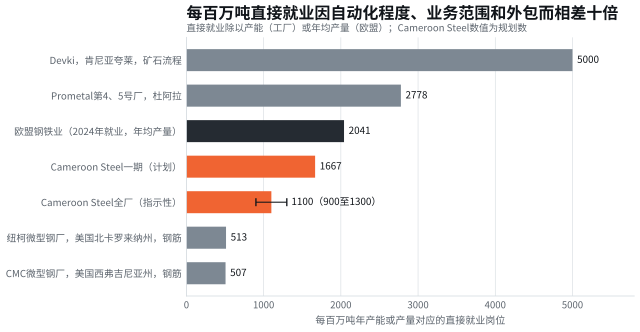
资料来源:各企业和机构公开资料[S02][S03][S04][S05][S07];Cameroon Steel公开规划数据[S11];比值由Cameroon Steel计算。
英文全文 12分钟 · 2727词A steelworks creates hundreds of skilled, durable jobs and a supply chain several times larger
An electric arc furnace (EAF) steelworks is not a large employer by headcount, but it is an unusually demanding and durable one. Benchmarks from plants in the United States, Europe and Africa put direct employment at roughly 500 to 5,000 jobs per million tonnes of annual capacity, depending on automation, product scope and how much maintenance and logistics are contracted out [S03][S04][S02][S05]. Cameroon Steel’s public planning figures for its phased works at Mboro, in the Kribi industrial-port zone, are about 500 direct jobs for the first phase (planned) and 900 to 1,300 for the full 1 Mtpa works (indicative) [S11]. Almost all of these posts are formal, salaried and technical, and each one sits inside a supply chain that, on international evidence, supports several further jobs. This chapter maps the occupations a steelworks needs, sets the employment numbers against benchmarks, and separates the temporary construction peak from the permanent operating workforce, because the two call for different skills policies.
1.1 An EAF works is a chain of process areas, each with its own trades
A long-products EAF works turns a cold metallic charge into finished bars and coils in six steps, and every step has its own crew. In the raw-materials yard, scrap and direct-reduced iron (DRI, iron ore from which the oxygen has been removed with gas) are unloaded, sorted, weighed and loaded into charging baskets by overhead cranes. In the melt shop, an electric arc between graphite electrodes and the charge melts it; the melter and furnace operators control power input, oxygen and carbon injection, slag and temperature, and take samples for chemical analysis. The liquid steel is tapped into a ladle and moved to the ladle furnace, where its chemistry and temperature are adjusted by alloy additions. At the continuous caster it solidifies in water-cooled copper moulds into square billets. The billets are reheated and passed through a rolling mill, a line of stands that reduce them step by step to reinforcing bar or wire rod. Finally the product is cooled, cut, bundled, tagged and dispatched.
Around this chain run five support functions that employ as many skilled people as production itself: mechanical maintenance; electrical, automation and instrumentation; quality and metallurgy; health, safety and environment (HSE); and logistics and administration. Figure 1.1 shows the map. The furnace-orange boxes, the melt shop, the ladle furnace and the caster, are where Cameroon has the thinnest pool of experienced workers, a point developed in Chapter 4.
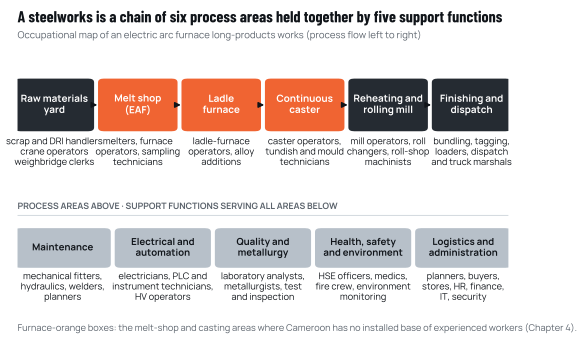
Source: Cameroon Steel analysis of a generic EAF, ladle-furnace, billet-caster and bar-and-rod-mill configuration; process description consistent with IFC, EHS Guidelines for Integrated Steel Mills, 2007 [S55].
The map matters for policy because it shows that a steelworks recruits across the whole spectrum of technical education. A crane operator or a bundling-line operator can be trained from a technical baccalaureate or a vocational certificate in months. An electrical and automation technician needs a two- to three-year higher technical diploma before plant training starts. A process metallurgist or a melt-shop engineer needs an engineering degree and several years of plant experience. A national skills strategy for steel therefore has to work at three levels at once: secondary technical schools and vocational centres, university institutes of technology (IUTs) and engineering schools.
1.2 The occupational map: eleven families, one plant
Table 1.1 groups the roles into eleven occupational families, with the entry route that would typically apply in Cameroon. The share of each family in the workforce varies with automation and outsourcing, but the planned first-phase mix published by Cameroon Steel gives an order of magnitude: about 300 operators, 100 technicians, 50 engineers and 50 administrative and support staff, out of about 500 direct jobs [S11].
Table 1.1 Occupational families of an EAF long-products works, typical roles and entry routes in Cameroon
| Occupational family | Typical roles | Core tasks | Typical entry route in Cameroon |
|---|---|---|---|
| Raw materials and yard | Scrap and DRI handlers, crane operators, weighbridge clerks | Receive, sort, store and charge metallics; inspect for hazardous items | Technical baccalaureate, CAP or CQP; crane licence |
| Melt shop (EAF) | Melter, furnace operator, sampler | Run the furnace programme, oxygen and carbon injection, slag control, tapping | Technical baccalaureate or DUT, then long in-plant training |
| Secondary metallurgy | Ladle-furnace operator, alloy controller | Adjust chemistry and temperature; argon stirring; additions | DUT or BTS (chemistry, process), in-plant training |
| Continuous casting | Caster operator, tundish and mould technicians | Control casting speed, cooling, mould level; cut billets | Technical baccalaureate or DUT, in-plant training |
| Reheating and rolling | Mill operator, roll changer, roll-shop machinist | Run reheating furnace and stands; change rolls and guides; machine grooves | CAP or DUT (mechanics), in-plant training |
| Finishing and dispatch | Bundling and tagging operators, loaders, dispatch clerks | Cut, count, bundle, label, load trucks and wagons | Vocational certificate, short induction |
| Mechanical maintenance | Fitters, hydraulics technicians, welders, planners | Preventive and breakdown maintenance; lubrication; repairs | DUT or BTS (mechanical, industrial maintenance); welder certification |
| Electrical, automation and instrumentation | Electricians, PLC technicians, instrument technicians, high-voltage operators | Maintain drives, transformers, control systems, sensors | DUT or BTS (electrical, industrial IT); engineering degree for leads |
| Quality and metallurgy | Laboratory analysts, metallurgists, testers, inspectors | Spectrometry, tensile and bend tests, certification to standards | Licence or engineering degree (chemistry, materials, mechanical) |
| Health, safety and environment | HSE officers, medical staff, fire crew, environmental monitors | Permits, inspections, emergency response, monitoring | Degree or diploma in HSE; first-aid and fire certificates |
| Logistics and administration | Planners, buyers, storekeepers, HR, finance, IT, security | Supply, stores, payroll, compliance, systems | Commercial, management and IT diplomas |
Source: Cameroon Steel analysis. Diploma names follow Cameroonian usage: CAP (certificat d’aptitude professionnelle), CQP (certificat de qualification professionnelle), DUT (diplôme universitaire de technologie, awarded by IUTs), BTS (brevet de technicien supérieur). Planned first-phase mix from Cameroon Steel’s public planning figures [S11].
Two features of the table deserve emphasis. First, about a quarter of the posts sit in maintenance, automation, quality and HSE, functions whose skills transfer readily to other heavy industries: cement, aluminium, power, ports and mining. Training for steel is therefore training for the Kribi industrial cluster as a whole, which the Kribi Port Industrial Zone (KPIZ) plans to grow around metallurgy, wood, agro-industry and construction materials [S38][S39]. Second, the process roles in the melt shop and caster have few equivalents in Cameroon’s existing industry. The country’s steel firms are mainly re-rollers that convert imported billets and local scrap, with a handful of small melt shops in Douala [S08], so the pool of experienced melters and casters is small and already employed; most will have to be formed.
1.3 Direct jobs per million tonnes vary tenfold
The number of people a steelworks employs per tonne depends less on the furnace than on everything around it. Figure 1.2 compares published cases. At one end, the new generation of US "micro mills" making rebar from scrap employs about 200 to 230 people for about 0.39 to 0.45 Mt of capacity: Nucor’s Lexington mill in North Carolina (430,000 tons, about 200 permanent jobs) and CMC’s mill in Berkeley County, West Virginia (500,000 tons, 230 jobs) [S03][S04]. The announcements say "tons": CMC’s annual report defines its ton as the US short ton [S82], and the Nucor figure is read in the same way, so 500,000 tons is about 0.45 Mt and 430,000 tons about 0.39 Mt. These plants are highly automated, run a single product family and buy in many services. At the other end, Devki’s ore-based steel plant at Kwale in Kenya announced 2,500 direct jobs for 500,000 t a year [S05], and Prometal’s two new plants in Douala were reported to create 1,000 direct jobs for about 360,000 t a year of rolling capacity [S07]. In Algeria, Tosyali’s 2.5 Mtpa flat-products complex was reported to employ about 2,200 workers when it was commissioned in 2024 [S06], fewer than 1,000 per million tonnes, which shows how large single lines lower the ratio. The European Union’s steel industry as a whole, which includes blast furnaces, flat-product lines and research centres, employed 298,000 people directly in 2024 for an average output of about 146 Mt of steel a year, about 2,040 per million tonnes [S02].
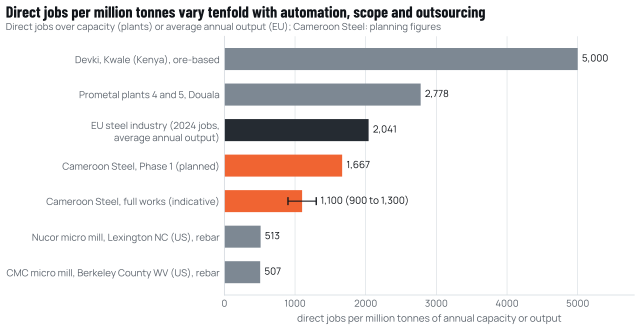
Source: Nucor, 7 April 2022 [S03]; West Virginia Public Broadcasting, 8 December 2022 [S04]; EUROFER, European Steel in Figures 2025 [S02]; Journal du Cameroun, 19 January 2024 [S07]; Capital FM Kenya, 20 November 2022 [S05]; Cameroon Steel public planning figures [S11]. Ratios are Cameroon Steel arithmetic; Nucor and CMC capacities converted at 0.907 t per short ton.
Cameroon Steel’s planning values sit in the middle of this range: about 1,670 direct jobs per million tonnes for a first phase of 0.3 Mtpa nameplate capacity (1,670 to 1,850 per million tonnes of its expected sustained output of 270,000 to 300,000 t a year), falling to about 1,100 (900 to 1,300) per million tonnes at the full 1 Mtpa, because shared functions such as the laboratory, the power substation, administration and the medical service do not grow in proportion to tonnage [S11]. Three choices will move the final number within that range:
- Make or buy for maintenance and services. A works that employs its own maintenance crews, laboratory and logistics will have more direct jobs and fewer contractor jobs; one that outsources them shifts employment to local suppliers, which is the subject of Chapter 6.
- Degree of automation. Modern melt shops and rolling mills run with automated furnace programmes, robotic sampling and tagging, and camera-based inspection. These reduce manual posts but raise the share of technicians and engineers.
- Product scope. Each new product line (sections, beams, merchant bar) adds a mill crew; a future direct-reduction module for Cameroonian ore would add a further process area with its own operators and maintainers.
The direction of travel is clear from the benchmarks: fewer people per tonne, each with more training. The most automated plants in Figure 1.2 employ the fewest people, but a larger share of them are technicians who maintain drives, sensors and control software. For Cameroon, this means that the quality of the training pipeline matters more than its volume.
1.4 Construction jobs are many but temporary; operating jobs are fewer but durable
A steelworks creates two very different labour demands. The construction phase brings a peak of civil, structural, mechanical and electrical trades lasting, on Cameroon Steel’s planning assumption, 18 to 30 months per phase; the operating phase brings a smaller permanent workforce for the life of the plant, typically several decades. Nucor’s Lexington micro mill illustrates the ratio: about 500 construction jobs for about 200 permanent posts [S03]. For the first phase at Mboro, Cameroon Steel uses a planning assumption of a construction peak of about 800 workers (600 to 1,000), against about 500 permanent direct jobs [S11]. Table 1.2 compares the two.
Table 1.2 Construction and operations compared, first phase of a phased EAF works (planning values)
| Dimension | Construction | Operations |
|---|---|---|
| Duration | 18 to 30 months for a phase, repeated for later phases (assumed) | Life of the plant, typically several decades |
| Peak or steady headcount, Phase 1 | About 800 workers at peak, range 600 to 1,000 (assumed) | About 500 direct jobs, range 450 to 550 (planned) |
| Main employers | Civil, steel-erection, mechanical and electrical contractors; equipment suppliers’ supervisors | The steel company; maintenance, logistics and service contractors |
| Dominant trades | Masons, formworkers, steel fixers, welders, pipefitters, riggers, electricians, crane operators | Process operators, maintenance and automation technicians, metallurgists, HSE staff |
| Skill legacy | Welders and electricians certified on site keep portable credentials | Plant-specific competence that grows with tenure; career ladders |
| Main labour risks | Influx, short contracts, working at height, lifting, heat | Molten metal, moving machinery, electrical energy, process safety |
| Policy lever | Local hiring quotas for contractors; certification of trades on site | Apprenticeships, career paths, retention and succession |
Source: Cameroon Steel public planning figures (construction peak assumed; operations planned) [S11]; Nucor, 7 April 2022 [S03]; hazards from IFC, EHS Guidelines for Integrated Steel Mills, 2007 [S55].
The construction phase is the first and best chance to build portable skills. Each phase of a steelworks needs hundreds of welders, electricians, scaffolders and riggers. If the contracts require those trades to be tested and certified on site, a share of them leave the project with recognised qualifications that the Kribi cluster’s later builders will use. If they are not, the peak passes and leaves little behind. Chapter 9 sets out how the phasing of a works can be used to roll trained construction workers into later phases and into operations.
1.5 Each direct job supports several more along the supply chain
Steel’s employment effect extends well beyond the plant fence. The World Steel Association and Oxford Economics estimated that the industry employed 6.1 million people directly worldwide in 2017 and that "for every 2 jobs in the steel sector, 13 more jobs are supported" across its supply chain [S01]. For the European Union, EUROFER estimates a Type I employment multiplier of 6.2 and a Type II multiplier, which also counts jobs supported by employees’ spending, of 8.6 [S02]. In Kenya, Devki’s ore-based plant announced 9,000 indirect jobs alongside its 2,500 direct ones, a ratio of 3.6 to 1 [S05].
These multipliers are upper bounds for Cameroon, because they reflect economies where steel plants buy most of their goods and services from domestic suppliers. Cameroon’s industrial supply chains are thinner, and many inputs to a steelworks (graphite electrodes, refractories, ferro-alloys, spare parts) are imported. Cameroon Steel’s planning figure for indirect employment in the first phase is accordingly conservative: about 1,000 indirect jobs (800 to 1,500), or roughly two per direct job [S11]. Whether the real ratio is closer to two or to six depends on deliberate supplier development, which Chapter 6 treats as a skills question as much as a procurement one.
1.6 Steel jobs are formal, salaried and technical, which is rare in Cameroon
The quality of steel jobs matters as much as their number. In Cameroon in 2021, 86.6% of employment was in the informal sector and only 5.1% of workers held a job in the formal private sector [S12]. Workers in the formal private sector earned on average 118,200 FCFA a month in their main job, against 77,100 FCFA in the non-agricultural informal sector and 48,200 FCFA in informal agriculture; 71.7% of their dependent workers had a written fixed-term or open-ended contract, against 19.8% in the non-agricultural informal sector [S12]. Only 11.0% of all employed persons were covered by an insurance scheme in their main job [S12].
A steelworks offers the opposite profile: written contracts, payslips, social-security registration, structured training and a career ladder from operator to manager. It also trains people in skills, such as high-voltage electrical work, hydraulics, precision welding, programmable logic controllers and laboratory testing, that command a premium across industry. That is why the employment case for steel in Cameroon rests less on the raw number of jobs, which is modest against a labour force of 11.5 million [S14], than on the kind of jobs and on the skills they leave in the economy.
The policy implication follows directly. Because the jobs are technical, they will go to Cameroonians only if Cameroonians have been trained for them before the plant opens. A works that starts without a local pipeline has to rely on expatriate staff for its first years, and every expatriate post is a training opportunity deferred. The chapters that follow examine whether Cameroon’s labour market and education system can supply that pipeline, and what it would take.
Other sources cited in the English text
- S55Environmental, Health, and Safety Guidelines for Integrated Steel Mills. IFC, World Bank Group, 30 Apr 2007.ifc.org/content/dam/ifc/doc/2000/2007-integrated-steel-mills-ehs-guide…
- S38Zone industrialo-portuaire de Kribi (KPIZ): jusqu’à +8 points de croissance et 150 000 emplois attendus sur 15 ans. Investir au Cameroun, 4 Mar 2026.investiraucameroun.com/gestion-publique/0403-23163-zone-industrialo-po…
- S39Cameroon launches $860m Kribi industrial zone to process raw materials locally. Ecofin Agency, 27 Feb 2026.ecofinagency.com/news/2702-53326-cameroon-launches-860m-kribi-industri…
- S08Production: les acteurs en présence. Cameroon Tribune, 11 May 2026.cameroon-tribune.cm/article.html/76600/fr.html/details_2
- S82Annual report on Form 10-K for the fiscal year ended 31 August 2025 ("Any reference in this Annual Report to a ton refers to the U.S. short ton, a unit of weight equal to 2,000 pounds"). Commercial Metals Company (US Securities and Exchange Commission, EDGAR), Fiscal year 2025 (accessed 11 Oct 2026).sec.gov/Archives/edgar/data/22444/000002244425000138/cmc-20250831.htm
- S06Tosyali Algérie: mise en service du complexe des tôles d’acier plat (2,5 Mt). Algérie Eco, 28 Nov 2024.algerie-eco.com/2024/11/28/tosyali-algerie-mise-en-service-du-complexe…
- S14World Development Indicators, Cameroon: population by age, labour force, ILO modelled labour indicators, Human Capital Index. World Bank, upd. 8 Oct 2026.api.worldbank.org/v2/country/CMR/indicator/SL.UEM.TOTL.ZS?format=json
本章引用的资料来源
方括号内的标记对应以下来源(按原文语言列出),完整列表见附录。 完整来源列表
- S11Cameroon Steel reference configuration RC-1 (planning estimate), edition 10 October 2026 (RC-1.1). Cameroon Steel,2026年10月10日.按标题和日期引用
- S01Economic and social impact of the global steel industry (infographic). World Steel Association and Oxford Economics,2019年5月.worldsteel.org/wp-content/uploads/Steel-social-and-economic-impact.pdf
- S02European Steel in Figures 2025. EUROFER,2025年6月.eurofer.eu/assets/publications/brochures-booklets-and-factsheets/europ…
- S12Troisième enquête sur l’emploi et le secteur informel (EESI3), phase 1: enquête emploi, rapport principal (2021 data; Tables 2.9, 3.7, 3.24 and 4.1 are cited). Institut national de la statistique (INS), Cameroon,2023年11月(文件:2025年7月).ins-cameroun.cm/wp-content/uploads/2025/07/EESI3_Rapport-principal_Emp…
- S03Nucor to build new rebar micro mill in North Carolina. Nucor Corporation,2022年4月7日.nucor.com/news-release/nucor-to-build-new-rebar-micro-mill-in-north-ca…
- S04Rebar manufacturing facility coming to Eastern Panhandle. West Virginia Public Broadcasting,2022年12月8日.wvpublic.org/story/economy/rebar-manufacturing-facility-coming-to-east…
- S05Devki opens Sh50bn steel plant in Kwale. Capital FM Kenya,2022年11月20日.capitalfm.africa/devki-opens-sh50bn-steel-plant-in-kwale/
- S07Prometal inaugure deux usines évaluées à 57 milliards F. Journal du Cameroun,2024年1月19日.fr.journalducameroun.com/prometal-inaugure-deux-usines-evaluees-a-57-m…
引用本章
Cameroon Steel(2026)。只要培训先于炼钢炉启动,喀麦隆就能为本国钢铁工业培养所需人才(中文摘要版)。白皮书08,第1章:钢厂创造数以百计的高技能稳定岗位,其供应链规模更大数倍。CS-WP-08。https://www.cameroon-steel.com/zh/library/skills-for-steel/jobs-a-steelworks-creates/
来源