本页为本章中文摘要;英文全文附于其后,可展开阅读。
本章目录(1)
公开失业率看似不高(2021年按国家调查口径为6.1%),却掩盖了两个更严峻的事实:56.4%的就业人员处于不充分就业状态;失业率随学历上升,高等教育学历者为17.6%,女性大学毕业生达28.2%[S12]。只有5.1%的劳动者在正规私营部门就业,非农非正规部门占52.0%,非正规农业占34.7%[S12]。正规私营部门月均收入为11.82万中非法郎,全国中位数为4.5万中非法郎,最低工资为6万中非法郎[S12][S34]。克里比所在的南部大区就业率最高、开放失业率仅2.2%,但工伤率高、参保率低[S12]。招聘将主要依托三个人才库:需要培训的南部大区青年、愿意迁居的杜阿拉和雅温得有经验技术员,以及全国各工程师学校和大学技术学院的毕业生。对钢厂而言,这意味着拥有大量受过教育的求职者,却很少有工业经验,雇主的责任是培养经验,而不是指望招到经验。
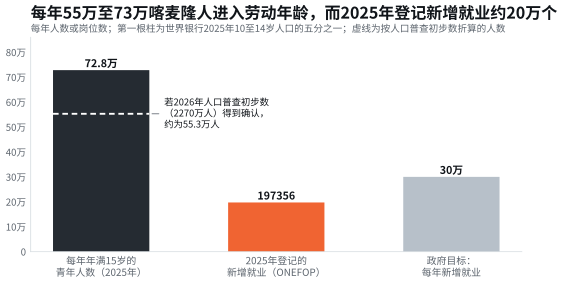
资料来源:世界银行《世界发展指标》,2025年10至14岁人口除以五(Cameroon Steel计算)[S14];人口普查初步数,《喀麦隆日报》(Journal du Cameroun)2026年10月5日[S19];《喀麦隆论坛报》2026年5月8日援引ONEFOP数据[S17]。
英文全文 12分钟 · 2870词Cameroon has young workers in abundance but few formal industrial jobs in which to train them
Cameroon’s labour market does not lack people; it lacks formal, skilled jobs and the experience that only such jobs provide. About 730,000 young Cameroonians reach working age every year on World Bank estimates, or about 550,000 if the provisional 2026 census count is confirmed, while the national employment observatory recorded about 197,000 new jobs in 2025 [S14][S19][S17]. Open unemployment looks low, at 6.1% on the national survey definition in 2021, but it hides two harder facts: more than half of workers (56.4%) are underemployed, and unemployment rises with education, reaching 17.6% among people with higher education and 28.2% among women graduates [S12]. Only one worker in twenty holds a formal private-sector job [S12]. For a steelworks, this means a deep pool of candidates with schooling but very few with industrial experience, and a responsibility to build that experience rather than to recruit it.
2.1 A young population adds 550,000 to 730,000 people of working age each year
Cameroon’s population reached about 29.9 million in 2025, growing at 2.6% a year; 41.1% of Cameroonians are under 15 and 56.1% are aged 15 to 64 [S14]. The country is now majority urban, at 55.7% [S14]. The cohort now aged 10 to 14 numbers about 3.64 million, which means that roughly 728,000 young people will reach the age of 15 in each of the next five years, and the population aged 15 to 24 already stands at about 5.95 million [S14]. The labour force, on International Labour Organization (ILO) modelled estimates, was about 11.5 million in 2025, of whom 43.9% were women [S14].
These are World Bank estimates. The fourth general population and housing census (RGPH4) closed its field count in October 2026 with about 22.7 million residents recorded [S19], about 24% fewer than the World Bank’s 2025 figure. The provisional 2026 census count of 22.7 million, if confirmed, would lower this cohort to about 550,000 (728,122 × 22.7 / 29.9), and would lower the other absolute numbers in this section in the same proportion; the rates and shares used in this chapter, which come from surveys, are not affected. Until the final census results are published, this paper shows both values (Figure 2.1).
These numbers frame the scale of any industrial project. A steelworks with 500 to 1,300 direct jobs will not change national labour aggregates; Cameroon’s challenge is measured in hundreds of thousands. What a steelworks can do is different and, for skills, more important: it can create a training ground in which several thousand Cameroonians acquire industrial competences over its life, and it can anchor a cluster at Kribi in which those competences are used again. KPIZ, the company created in February 2026 to develop the Kribi industrial-port zone, expects the zone as a whole to generate up to 150,000 direct and indirect jobs over 15 years [S38].
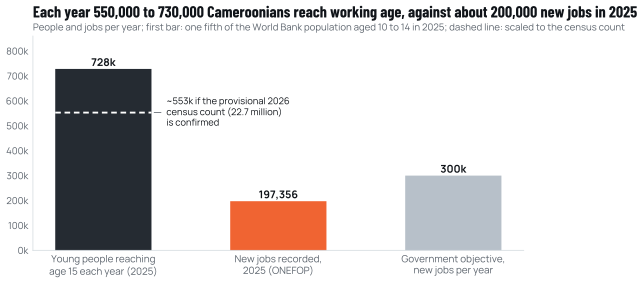
Source: World Bank, World Development Indicators, population aged 10 to 14 in 2025 divided by five (Cameroon Steel arithmetic) [S14]; provisional 2026 census count, Journal du Cameroun, 5 October 2026 [S19]; Observatoire national de l’emploi et de la formation professionnelle (ONEFOP), as reported by Cameroon Tribune, 8 May 2026 [S17].
The comparison in Figure 2.1 is not a measure of unemployment: many young people stay in education, work in family farms or enterprises, or take informal work that no registry records. But it shows why industrial jobs that come with training carry a value beyond their number. Every formal technical job is a place where a young person can convert schooling into a recognised skill.
2.2 Open unemployment is low; underemployment is the real problem
Cameroon’s open unemployment rate is low by international standards. The ILO’s modelled estimate puts it at 3.6% of the labour force in 2025, and youth unemployment (ages 15 to 24) at 6.5% [S14]. The National Institute of Statistics (INS) third employment and informal-sector survey (EESI3), conducted between May and July 2021, measured an ILO unemployment rate of 6.1% for persons aged 14 and over [S12]. Unemployment is concentrated in the cities: 15.4% in Douala, 11.7% in Yaoundé, 9.4% in urban areas overall and 1.6% in rural areas [S12]. In urban areas it reaches 22.0% among people aged 20 to 24, and 31.5% among young urban women of that age [S12].
Unemployment, however, captures only those who have no work at all and are actively looking. The broader measure that the INS uses, global underemployment, also counts people who work fewer hours than they wish (visible underemployment) and people whose earnings from their main job fall below the minimum hourly wage (invisible underemployment). It stood at 56.4% of employed persons aged 14 and over in 2021. On the series comparable with earlier surveys, which covers persons aged 10 and over, it fell from 70.6% in 2010 to 61.4% in 2021; the national development strategy, SND30, targets less than 50% by 2030 [S12][S41]. On the ILO’s composite measure of labour underutilisation, which adds time-related underemployment and the potential labour force to unemployment, 26.2% of the extended labour force was underused in 2021 [S12].
Table 2.1 Cameroon labour-market indicators relevant to industrial recruitment
| Indicator | Value | Year | Source |
|---|---|---|---|
| Population | 29.9 million | 2025 | World Bank WDI [S14] |
| Population, provisional census field count (RGPH4) | 22.7 million | 2026 | Journal du Cameroun [S19] |
| Population growth | 2.6% a year | 2025 | World Bank WDI [S14] |
| Share aged under 15 | 41.1% | 2025 | World Bank WDI [S14] |
| Population aged 15 to 24 | about 5.95 million | 2025 | WDI cohorts, Cameroon Steel sum [S14] |
| Labour force (ILO modelled) | 11.5 million, 43.9% women | 2025 | World Bank WDI [S14] |
| Labour force participation, women and men (ILO modelled) | 56.6% and 73.9% | 2025 | World Bank WDI [S14] |
| Unemployment (ILO modelled), total and ages 15 to 24 | 3.6% and 6.5% | 2025 | World Bank WDI [S14] |
| Unemployment, ILO definition, ages 14+ (national survey) | 6.1%; Douala 15.4%; Yaoundé 11.7% | 2021 | INS, EESI3 [S12] |
| Global underemployment, ages 14+ | 56.4% (ages 10+: 61.4%, against 70.6% in 2010) | 2021 | INS, EESI3 [S12] |
| Share of employment in the informal sector | 86.6% | 2021 | INS, EESI3 [S12] |
| Share of employment in the formal private sector | 5.1% | 2021 | INS, EESI3 [S12] |
| Salaried share of employment | 38.6% | 2021 | INS, EESI3 [S12] |
| Employment in industry (ILO modelled) | 14.6% | 2025 | World Bank WDI [S14] |
| Vulnerable employment (own-account and contributing family workers) | 67.6% | 2025 | World Bank WDI [S14] |
| Youth not in employment, education or training (ILO harmonised) | 23.2%; women 30.4%, men 14.7% | 2021 | World Bank WDI [S14] |
| Mean and median monthly income from main job | 75,700 and 45,000 FCFA | 2021 | INS, EESI3 [S12] |
| National minimum wage, non-agricultural sector | 60,000 FCFA a month | 2023 | Decree No. 2023/00338/PM [S34] |
Source: as listed in the table. ILO modelled estimates are harmonised international series and differ in definition and age band from the national survey.
2.3 In Cameroon, more schooling has meant more unemployment
The most striking feature of Cameroon’s labour market for an industrial employer is that unemployment rises with education. In 2021 the ILO unemployment rate was 1.6% among people with no schooling, 6.1% among those with lower secondary education, 9.5% with upper secondary and 17.6% with higher education [S12]. The gap between women and men widens at every level and is largest among graduates: 28.2% of women with higher education were unemployed, against 12.1% of men (Figure 2.2). The World Bank’s series, based on the same survey, shows the same pattern: unemployment of 18.8% among people with advanced education against 4.4% among those with basic education [S14]. Graduates are also the only education group whose global underemployment rose between 2010 and 2021, from 44.3% to 49.9% [S12].
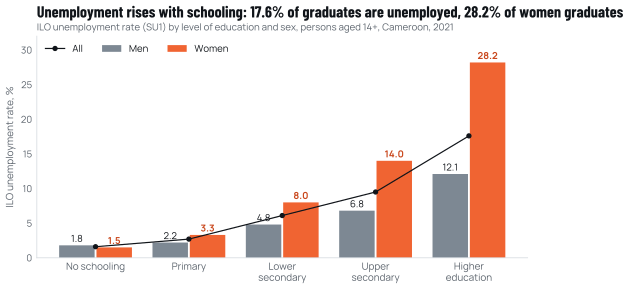
Source: INS, EESI3 Phase 1, main employment report, Table 4.1 [S12].
Three explanations are usually advanced, and all three bear on a steelworks. First, educated young people queue for formal, salaried jobs, which are scarce, rather than enter informal work; the unemployed interviewed by the INS wanted an average of 188,625 FCFA a month and said they would accept no less than 122,780 FCFA, far above the national median income of 45,000 FCFA [S12]. Second, much of higher education has been general rather than technical, so graduates often lack the practical competences employers look for. Third, links between schools and employers are weak: only 1.1% of the unemployed used a public employment or placement agency to look for work, while 34.5% relied on family and friends [S12].
For Cameroon Steel and other industrial employers, the first explanation is an opportunity: a formal, technical job with training and a career path is exactly what educated young Cameroonians are queuing for. The second and third explanations are the problem this paper addresses. A diploma is a starting point, not a competence, and the plant will need to work with schools to close the distance between the two.
2.4 Only one worker in twenty holds a formal private-sector job
Cameroon’s employment is overwhelmingly informal. In 2021 the non-agricultural informal sector accounted for 52.0% of jobs and informal agriculture for 34.7%; the public sector employed 8.2% of workers and the formal private sector only 5.1% (Figure 2.3) [S12]. The picture for young workers aged 14 to 34 is similar: 5.7% in the formal private sector and 59.2% in the non-agricultural informal sector [S12]. On the ILO’s modelled estimates, 67.6% of employment is "vulnerable", that is own-account or contributing family work [S14].
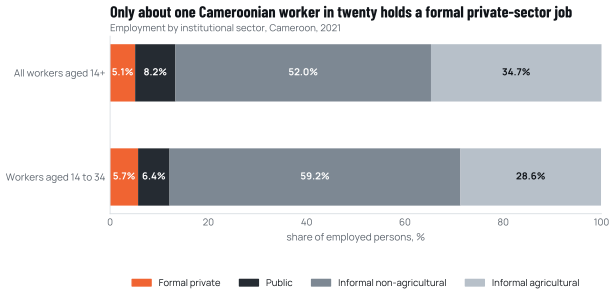
Source: INS, EESI3 Phase 1, main employment report, Table 3.7 [S12].
The consequences for industrial skills are direct. Most Cameroonian workers acquire their skills on the job in small informal enterprises: of the quarter of the population aged 14 and over who had followed vocational training, 39.3% had learned on the job, and only 18.9% in a training institute or centre [S12]. Informal apprenticeship in workshops produces real competences in welding, mechanics and electrical work, but it rarely teaches the procedures, standards and safety disciplines that a continuous-process plant requires, and it rarely leads to a certificate an employer can trust. Cameroon’s formal private sector, in turn, is small, so few young people have had the chance to work inside one. The formal private sector also works long hours, 51.6 hours a week on average against a legal norm of 40 hours for non-agricultural establishments [S12], a reminder that the shift systems of a steelworks have to be designed and staffed properly from the start.
Steel jobs would also be relatively well paid by national standards. The mean monthly income in the formal private sector was 118,200 FCFA in 2021, and the median 90,000 FCFA, against a national median of 45,000 FCFA and a minimum wage of 60,000 FCFA set in 2023 [S12][S34]. Those differences make formal industrial jobs attractive and retention manageable, provided the jobs come with training and progression. They also mean that once trained, technicians will be sought by other employers, a point that argues for sector-wide rather than company-only training (Chapter 10).
2.5 The South Region works more but trains and insures less
The Kribi industrial-port zone lies in the South Region, in the Océan department. The EESI3 survey shows a regional labour market with distinctive features [S12]:
- High participation and employment. The South has the highest labour-force participation rate of any survey region, 64.9%, and the highest employment rate, 63.5%; its youth employment rate (ages 15 to 34) is 52.6%, second only to the East.
- Low open unemployment. The ILO unemployment rate in the South was 2.2% in 2021, against 6.1% nationally; women’s unemployment was 3.5% and men’s 1.2%.
- Above-average vocational training. 32.2% of people aged 14 and over in the South had followed vocational training, against 25.0% nationally, and a larger share of it at secondary and post-secondary level than elsewhere.
- High accident rates and low insurance. 15.4% of employed persons in the South reported a work accident in the previous twelve months, against 9.1% nationally, and only 6.6% were covered by an insurance scheme in their main job (Chapter 8).
Low unemployment in a largely rural region means that most people work, often in farming, fishing, small trade or informal services, rather than that skilled labour is idle. Recruitment for a Kribi steelworks will therefore draw on three pools: young people from the South Region who need training, experienced technicians from Douala and Yaoundé who will relocate if jobs are attractive, and a national pool of graduates from the country’s engineering schools and IUTs (Chapter 3).
Kribi itself has grown quickly with the deep-water port, but its current population is not known with any precision. The last census with published local results, in 2005, counted 70,565 people in the two Kribi communes, 29,886 in Kribi 1er and 40,679 in Kribi 2e [S62]; the 2026 census had published no commune results at the time of writing [S19]. Any plan that recruits several hundred workers locally, and brings several hundred more during construction, needs better data on the local labour pool, housing and services; this is listed among the evidence gaps in Chapter 11.
2.6 Where a steelworks’ workforce will come from
The survey data allow a first sketch of the pools from which a Kribi employer would recruit, and of their characteristics.
Young people of the South Region. The region’s young people are more likely to be working than their peers elsewhere, but mostly in farming, fishing, small trade and informal services, and they have had more exposure to vocational training than the national average [S12]. They are the natural recruits for operator, yard, dispatch and support roles, and for the first apprenticeship intakes, provided that training is offered close to home and that selection rewards aptitude rather than prior industrial experience.
Graduates in the large cities. Douala and Yaoundé concentrate both the institutions that train technicians and engineers and the highest unemployment rates in the country: 15.4% and 11.7% respectively in 2021, and far higher among young graduates [S12]. Unemployed or underemployed graduates of mechanical, electrical, chemical and industrial programmes are the fastest source of technicians and junior engineers, provided they are willing to move to Kribi and are offered structured conversion training.
Experienced industrial workers. Douala’s rolling mills, wire and mesh plants, cement works, breweries, power plants and port operators employ people with years of experience in maintenance, electrical work, rolling and logistics. The country’s steel and metalworking firms alone were reported in 2026 to employ about 5,000 people [S08]. These workers are the most valuable recruits for supervisory and senior technical posts in the first years, but recruiting them takes skills from other employers; a responsible plan combines a limited number of experienced hires with a large training effort, rather than relying on poaching.
Migrants and the diaspora. One employed person in five in Cameroon is a migrant within the country, and in the Littoral region outside Douala the share reaches 43% [S12], a sign that Cameroonian workers move for work. Cameroonian engineers and technicians working abroad, including in steel and other heavy industries, are a further pool that no statistic currently measures; a targeted recruitment campaign could reach them.
Two further features of the labour market favour an employer that trains. Employment is stable once obtained: the average tenure in a job was 10.6 years in 2021, which the INS describes as reflecting very low job mobility [S12]. And the average age of employed people was 38.3 years [S12], so a works that recruits mainly young people will need to plan for leadership succession from within rather than through external hiring.
2.7 What this means for a steelworks
Four implications follow for any heavy-industry employer at Kribi.
- Recruit for potential, train for competence. Selection should test aptitude, numeracy, mechanical reasoning and safety attitude rather than prior industrial experience, which few candidates will have. Training budgets and timelines must be sized accordingly.
- Use the educated unemployed. Graduates of IUTs and engineering schools who are unemployed or underemployed in Douala and Yaoundé are an immediate source of technicians and engineers, provided the plant offers structured conversion training.
- Hire locally where the training can be local. Operator and support roles can be filled largely from the South Region if training starts early enough; technician and engineering roles will draw nationally at first.
- Plan for competition. As KPIZ grows, port operators, energy producers, cement and agro-industrial plants will compete for the same maintenance and electrical technicians. A shared training pipeline is cheaper than a wage war.
The next chapter examines the institutions that would supply that pipeline.
Other sources cited in the English text
- S38Zone industrialo-portuaire de Kribi (KPIZ): jusqu’à +8 points de croissance et 150 000 emplois attendus sur 15 ans. Investir au Cameroun, 4 Mar 2026.investiraucameroun.com/gestion-publique/0403-23163-zone-industrialo-po…
- S41Stratégie nationale de développement 2020 to 2030 (SND30). Republic of Cameroon, MINEPAT (FAOLEX copy), 2020.faolex.fao.org/docs/pdf/cmr211554.pdf
- S62Répertoire actualisé des villages du Cameroun, 3e Recensement général de la population et de l’habitat (2005), volume IV, tome 07 (arrondissements of Kribi I and Kribi II). Bureau central des recensements et des études de population (BUCREP); copy published by the Institut national de la statistique, Census of 2005 (report n.d.).ins-cameroun.cm/wp-content/uploads/2025/06/Repertoire_actualise_villag…
- S08Production: les acteurs en présence. Cameroon Tribune, 11 May 2026.cameroon-tribune.cm/article.html/76600/fr.html/details_2
本章引用的资料来源
方括号内的标记对应以下来源(按原文语言列出),完整列表见附录。 完整来源列表
- S12Troisième enquête sur l’emploi et le secteur informel (EESI3), phase 1: enquête emploi, rapport principal (2021 data; Tables 2.9, 3.7, 3.24 and 4.1 are cited). Institut national de la statistique (INS), Cameroon,2023年11月(文件:2025年7月).ins-cameroun.cm/wp-content/uploads/2025/07/EESI3_Rapport-principal_Emp…
- S34Décret n° 2023/00338/PM du 21 mars 2023 (salaire minimum interprofessionnel garanti). Prime Minister’s Office (FAOLEX copy),2023年3月21日.faolex.fao.org/docs/pdf/cmr217528.pdf
- S14World Development Indicators, Cameroon: population by age, labour force, ILO modelled labour indicators, Human Capital Index. World Bank,更新:2026年10月8日.api.worldbank.org/v2/country/CMR/indicator/SL.UEM.TOTL.ZS?format=json
- S19Cameroun: bouclage du 4e RGPH, 22,7 millions d’habitants recensés (provisional field count). Journal du Cameroun,2026年10月5日.fr.journalducameroun.com/cameroun-bouclage-du-4e-rgph-227-millions-dha…
- S17Retombées: plus de 197 000 emplois créés en 2025. Cameroon Tribune,2026年5月8日.cameroon-tribune.cm/article.html/76537/en.html/details_2
引用本章
Cameroon Steel(2026)。只要培训先于炼钢炉启动,喀麦隆就能为本国钢铁工业培养所需人才(中文摘要版)。白皮书08,第2章:喀麦隆青年劳动力充裕,但可供其接受培训的正规工业岗位稀少。CS-WP-08。https://www.cameroon-steel.com/zh/library/skills-for-steel/labour-market-and-youth/
来源