喀麦隆的起点很不相同。2021年,9.1%的就业人员报告过去12个月内发生过工伤,仅11.0%参保;在南部大区,这两个比例分别为15.4%和6.6%,职业病发生率也最高[S12]。法律框架已经具备,包括《劳动法》关于职业健康安全、企业医疗服务的规定[S33],以及按风险等级缴纳1.75%至5%工资的工伤保险费[S32]。欠缺的是在车间落实这些规定的能力和文化。钢厂的关键风险包括钢水与蒸汽爆炸、吊运重物、运动机械、电能、气体和受限空间、高处作业和高温应力,每一项都有对应的控制措施和能力要求。建议的四项工具是:按ISO 45001建立管理体系[S58]、全区通用的安全护照、基于能力的关键作业授权,以及模拟训练和未遂事件学习。目标是建设期所有承包商达到“受管理”阶段,运营第三年所有工艺区域达到“主动”阶段。
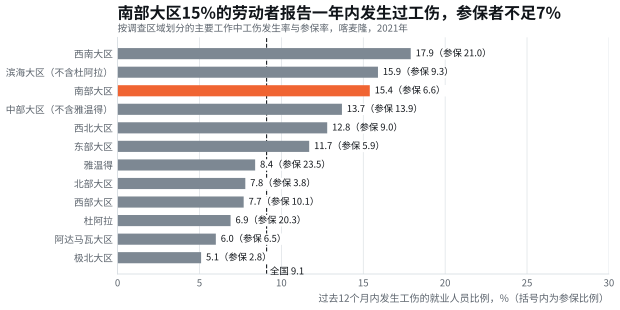
资料来源:国家统计局(INS),EESI3第一阶段就业调查主报告,表3.24[S12]。
英文全文 11分钟 · 2543词Safety is a skill to be trained, certified and led, and in the South Region it starts from a low base
A steelworks concentrates almost every serious industrial hazard on one site: molten metal at furnace temperature, suspended loads of tens of tonnes, high-voltage electricity, fast-moving rolling lines, toxic and asphyxiating gases, heat and noise [S55]. The best steel companies have shown that these hazards can be controlled: the lost-time injury frequency of companies reporting to the World Steel Association fell by 15% between 2022 and 2024, to 0.72 injuries per million hours worked [S51]. Cameroon’s starting point is very different. In 2021, 9.1% of employed Cameroonians reported a work accident in the previous twelve months, and in the South Region, where Kribi lies, 15.4%, with only 6.6% of workers insured [S12]. Closing that gap is not a matter of rules and equipment alone. It requires treating safety as a competence that every worker, supervisor and contractor must learn, demonstrate and practise, and as the first skill taught in every training programme described in this paper.
8.1 A steelworks concentrates the hazards of heavy industry
The International Finance Corporation’s environmental, health and safety guidelines for steel identify the occupational hazards specific to the industry: physical hazards from heavy loads, grinding and cutting and rolling; heat and hot liquids; radiation; respiratory hazards from dust and fumes; chemical hazards; noise; and fire and explosions, on top of the hazards common to all large industrial facilities, such as electricity, work at height and confined spaces [S55][S56]. In an EAF works, the most severe of these come together in the melt shop and the caster, where a small quantity of water trapped under molten steel can cause a violent explosion, and in the cranes that carry ladles of liquid steel overhead.
Globally, work remains a major cause of death. The International Labour Organization estimates that nearly three million workers die every year from work-related accidents and diseases: about 2.6 million from diseases and about 330,000 from accidents [S54]. Agriculture, construction, forestry and fishing, and manufacturing are the most hazardous sectors, accounting together for about 200,000 fatal injuries a year, 63% of the total [S54]. Men die from work-related causes at about three times the rate of women (51.4 against 17.2 per 100,000 working-age adults), reflecting their concentration in hazardous jobs [S54].
8.2 Cameroon’s baseline: frequent accidents and little insurance
Cameroon’s national employment survey asked workers whether they had suffered a work accident or an occupational disease in the previous twelve months. In 2021, 9.1% of employed persons reported an accident in their main job and 6.5% an occupational disease; only 11.0% were covered by insurance in their main job [S12]. The figures vary sharply by region (Figure 8.1). In the South Region, 15.4% of workers reported an accident and 15.5% an occupational disease, the highest disease rate of any region, while only 6.6% were insured [S12]. Workers in the formal private sector reported an accident rate of 9.3%, close to the average, but 55.8% of them were insured, against 5.6% in the non-agricultural informal sector [S12].
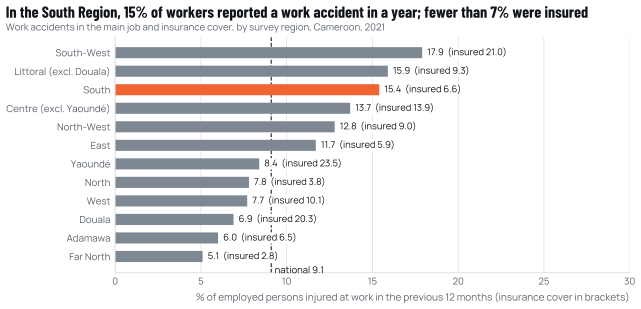
Source: INS, EESI3 Phase 1, main employment report, Table 3.24 [S12].
These self-reported figures are not comparable with the injury frequency rates that companies publish, which count lost-time injuries per million hours worked. They are, however, a clear signal: most Cameroonian workers, including those a Kribi steelworks would hire, have worked in environments where injuries are common, procedures are informal and insurance is absent. Fires and explosions are a recognised melt-shop hazard [S55][S56]. In 2024 the Ministry of Defence began building a fire and rescue centre to serve Douala’s industrial zone [S80].
The legal framework is in place. Cameroon’s Labour Code requires occupational health and safety conditions to be set by ministerial order in line with international labour standards and allows labour inspectors to order immediate measures (articles 95 and 96); makes a company medical service compulsory (articles 98 and 99); and creates a national commission for occupational health and safety (article 120) [S33]. Cameroon also ratified the ILO Occupational Safety and Health Convention, 1981 (No. 155) on 1 October 2021, which the ILO now counts among its fundamental conventions; it has not ratified the conventions on the promotional framework for occupational safety and health (No. 187), safety and health in construction (No. 167) or the prevention of major industrial accidents (No. 174) [S73][S74]. Employers pay occupational-injury contributions of 1.75%, 2.5% or 5% of gross salary according to the risk class of their activity [S32], which gives every employer a direct financial interest in preventing accidents. What the framework cannot supply is the competence and culture to apply it on the shop floor.
8.3 What good performance looks like in steel
The steel industry measures and publishes its safety performance more systematically than most. The World Steel Association’s sustainability indicators show a lost-time injury frequency rate (lost-time injuries and fatalities per million hours worked) of 0.85 in 2022, 0.76 in 2023 and 0.72 in 2024 for its reporting members, and an average of 6.77 to 8.98 training days per employee a year over the same period (Figure 8.2) [S51]. Its annual safety and health data report tracks potential serious injuries and fatalities, total recordable injuries, lost-time injuries, fatalities, process safety and sickness absence [S52], and the association has published a set of safety and health principles for the industry [S53].
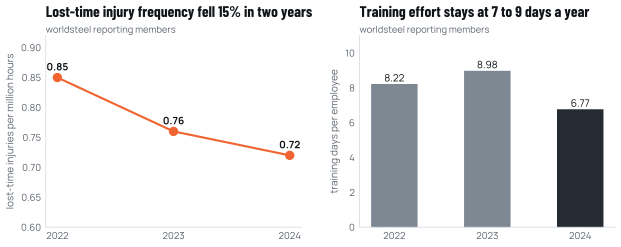
Source: worldsteel, Sustainability Indicators, 2025 edition (2022 to 2024 data) [S51].
Two points stand out. First, frequency rates of below one lost-time injury per million hours are achievable in an industry with severe hazards; they result from systems, not luck. Second, training is continuous: the best performers spend several days a year per employee on training throughout working lives, not only at induction. For a new works, the benchmark is therefore not the Cameroonian average but the industry’s best practice, and the training budget should be sized to reach it.
8.4 Critical risks call for specific competences
Most fatal accidents in steel arise from a small number of critical risks, each with known controls. Table 8.1 lists the main ones for an EAF long-products works, with the controls and the competences each requires. The competences are the safety core of every role in the skills matrix of Chapter 4.
Table 8.1 Critical risks in an EAF long-products works, controls and competences
| Critical risk | Where | Key controls | Competence and training required |
|---|---|---|---|
| Molten metal and steam explosions | Melt shop, ladle furnace, caster | Water-leak detection; dry materials and tools; exclusion zones during tapping and casting; aluminised protective clothing | Molten-metal awareness; emergency drills; leak recognition; caster breakout response |
| Suspended loads and overhead cranes | Yard, melt shop, caster, dispatch | Crane inspection; rated lifting gear; exclusion under loads; signaller certification | Crane-operator licence; rigging and signalling; lift planning for non-routine lifts |
| Moving machinery | Rolling mill, conveyors, bundling | Guarding; interlocks; lockout and tagout of energy sources; permit to work | Isolation and lockout; permit-to-work systems; cobble-clearing procedures |
| Electrical energy | Substation, furnace transformer, drives | Electrical authorisations; switching procedures; arc-flash protection | Graded electrical authorisations; high-voltage switching; arc-flash awareness |
| Gases and confined spaces | Furnace off-gas system, ladles, pits, tanks | Gas detection; ventilation; entry permits; standby rescue | Gas testing; confined-space entry and rescue; breathing apparatus |
| Work at height | Maintenance, construction | Platforms and guardrails; harness systems; scaffold inspection | Working at height; scaffold inspection; rescue from height |
| Heat stress | Melt shop, caster, reheating furnace | Work-rest cycles; hydration; cooled rest areas; medical screening | Recognition of heat illness; first aid |
| Traffic and mobile plant | Yard, dispatch, port interface | Segregated routes; speed limits; reversing aids | Mobile-plant licences; site traffic rules |
| Hot work and fire | Maintenance, oil and hydraulic systems | Hot-work permits; fire watch; fixed fire protection | Hot-work permit holders; fire response teams |
Source: Cameroon Steel analysis based on IFC, EHS Guidelines for Integrated Steel Mills and General EHS Guidelines, 2007 [S55][S56], and on worldsteel safety principles [S53].
8.5 Culture matures step by step, and leaders set the pace
Rules and equipment do not on their own prevent accidents; behaviour does. Organisations typically move through recognisable steps, from a reactive culture in which safety is addressed after incidents and blame is the norm, through compliance with rules and permits, to a managed system of risk assessment and audit, and then to proactive and finally owned cultures in which leaders spend time in the field, near misses are reported freely and any worker can stop unsafe work without fear (Figure 8.3).
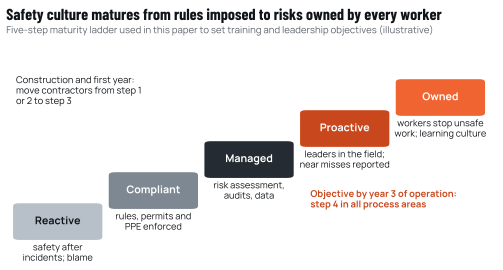
Source: Cameroon Steel framework, adapted from common practice in heavy-industry safety management.
For a new works in Cameroon, two transitions matter most. During construction, the challenge is to bring contractors, many of whom come from informal or reactive environments, to a managed system quickly: every worker on site needs a safety induction, a record of training and a clear right to refuse unsafe work, and every contractor needs a safety plan that is checked and enforced. During the first years of operation, the challenge is to build a proactive culture in which supervisors, most of them newly promoted, lead safety in the field. Cameroon Steel’s objective, set out in Figure 8.3, is a managed system across all contractors from the first year and a proactive culture in all process areas by the third year of operation.
8.6 Construction is the first test
The first safety test of a steelworks comes long before the first heat. During construction, between 600 and 1,000 workers employed by many contractors will work at height, lift heavy steel structures and equipment, dig foundations and trenches, and install high-voltage systems, often in tropical heat and heavy rain [S11]. Many of them will come from informal workplaces where procedures are rarely written down. Experience on large projects shows that a few practices determine whether construction is safe:
- A single set of site rules applied to every contractor and subcontractor, with the owner’s safety team empowered to stop work.
- Induction and competence checks before anyone starts work, recorded in the safety passport, with additional authorisations for lifting, work at height, excavation, hot work and electrical work.
- Supervision ratios that keep a competent supervisor close to every crew engaged in high-risk work, and daily briefings on the day’s hazards.
- Lift planning for every heavy or non-routine lift, approved by a competent person, with exclusion zones enforced.
- Heat and rain management, including work-rest cycles, drinking water, shaded rest areas and suspension of work at height or lifting in storms.
- Medical cover and emergency response on site from the first day, with evacuation arrangements to a hospital able to treat serious trauma and burns.
Construction is also where the safety culture of the future plant is set. Workers who move from construction into operations, and supervisors who learn to run a disciplined site, carry those habits into the works. Contractors who perform well on safety should be rewarded with future work; those who do not should be removed.
8.7 Process safety and emergency response
Beyond personal safety, a steelworks must manage process safety: the prevention of major events such as explosions from water in contact with molten metal, failures of furnace cooling systems, releases of carbon monoxide from off-gas systems, oxygen fires and large fires in hydraulic or cable systems. The worldsteel safety and health data report tracks process safety as a distinct indicator [S52], and the IFC’s steel guidelines identify fire and explosion as a specific hazard of the industry [S55]. Process safety depends on design, but also on skills: operators who understand why interlocks exist and do not bypass them, maintenance technicians who restore protective systems correctly, and emergency teams trained and drilled for the plant’s worst credible events. A works at Kribi should also coordinate its emergency plans with neighbouring tenants of the industrial zone and with local emergency services, so that resources can be shared in a major incident.
8.8 Health is part of the same skill set
Occupational health in a steelworks covers heat, noise, dust and fumes, and the ergonomic strain of manual tasks. The Labour Code’s requirement for a company medical service [S33] provides the base: pre-employment and periodic medical examinations, hearing and lung-function monitoring, and heat-stress management. The South Region adds public-health priorities that a responsible employer cannot ignore: in the 2018 national health survey, HIV prevalence among adults aged 15 to 49 was 5.8% in the South, the highest of any region, and 33.4% of children aged 6 to 59 months tested positive for malaria, against 24.0% nationally [S61]. A workforce health programme that includes prevention, testing and treatment referrals for HIV, malaria prevention at accommodation and on site, and health education for workers’ families protects both people and production.
8.9 Making safety a certified skill
Safety becomes a skill when it is taught to a standard, tested and recorded. Four instruments can make that happen in the Kribi cluster:
- A management system to an international standard. ISO 45001, published in 2018, specifies requirements for occupational health and safety management systems [S58]. Designing the works’ system to that standard from the start, and requiring it of major contractors, gives a common language for audits and improvement.
- A safety passport for every worker. A personal record of inductions, training modules, authorisations and medical clearances, recognised by all employers in the zone, would allow contractors’ workers to move between sites without repeating basic training, and would make it impossible to work on a critical task without the right authorisation.
- Competence-based authorisations. Permits to work, lockout and tagout, confined-space entry, crane operation and electrical switching should be authorised only after training and a practical assessment, renewed periodically.
- Simulation and incident learning. Simulators and animated incident videos, such as those offered by worldsteel’s steeluniversity [S50], allow workers to rehearse emergencies; a no-blame system for reporting and learning from near misses turns everyday events into training material.
International lenders will expect this. IFC Performance Standard 2 requires employers to provide a safe and healthy work environment and to protect workers, including those engaged by contractors and in the supply chain [S57]. For Cameroon Steel, however, the reason is more direct: a works whose workforce is largely new to heavy industry can only be safe if safety is taught first, tested always and led by example.
Other sources cited in the English text
- S56Environmental, Health, and Safety (General) Guidelines. IFC, World Bank Group, 30 Apr 2007.ifc.org/content/dam/ifc/doc/2000/2007-general-ehs-guidelines-en.pdf
- S54Nearly 3 million people die of work-related accidents and diseases. International Labour Organization, 26 Nov 2023.ilo.org/resource/news/nearly-3-million-people-die-work-related-acciden…
- S80Cameroun: le Mindef lance les travaux de construction d’un Centre de secours de sapeurs-pompiers à Douala. Journal du Cameroun, 21 Feb 2024.fr.journalducameroun.com/cameroun-le-mindef-lance-les-travaux-de-const…
- S73Ratifications for Cameroon (51 conventions; No. 89 ratified 25 May 1970 and No. 155 ratified 1 Oct 2021, both in force). ILO, NORMLEX.normlex.ilo.org/dyn/nrmlx_en/f?p=NORMLEXPUB:11200:0::NO::P11200_COUNTR…
- S74Up-to-date Conventions and Protocols not ratified by Cameroon (including Nos. 167, 171, 174, 187 and 190 and the Protocol of 1990 to No. 89). ILO, NORMLEX.normlex.ilo.org/dyn/nrmlx_en/f?p=1000:11210:0::NO:11210:P11210_COUNTRY…
- S52Safety and health in the steel industry: Data report 2025. World Steel Association, 2025.worldsteel.org/media/publications/safety-and-health-in-the-steel-indus…
- S53Safety and health (principles, policy paper, fundamentals). World Steel Association.worldsteel.org/safety-and-health/
- S11Cameroon Steel reference configuration RC-1 (planning estimate), edition 10 October 2026 (RC-1.1). Cameroon Steel, 10 Oct 2026.Cited by title and date
- S61Enquête démographique et de santé du Cameroun 2018 (EDSC-V), final report FR360. INS and ICF (DHS Program), 2020.dhsprogram.com/pubs/pdf/FR360/FR360.pdf
- S50steeluniversity: learning for the steel industry (simulations, courses, safety videos). World Steel Association.steeluniversity.org/
- S57Performance Standard 2: Labor and Working Conditions. International Finance Corporation, 1 Jan 2012.ifc.org/content/dam/ifc/doc/2010/2012-ifc-performance-standard-2-en.pd…
本章引用的资料来源
方括号内的标记对应以下来源(按原文语言列出),完整列表见附录。 完整来源列表
- S12Troisième enquête sur l’emploi et le secteur informel (EESI3), phase 1: enquête emploi, rapport principal (2021 data; Tables 2.9, 3.7, 3.24 and 4.1 are cited). Institut national de la statistique (INS), Cameroon,2023年11月(文件:2025年7月).ins-cameroun.cm/wp-content/uploads/2025/07/EESI3_Rapport-principal_Emp…
- S33Loi n° 92/007 du 14 août 1992 portant Code du travail. Republic of Cameroon (FAOLEX copy),1992年8月14日.faolex.fao.org/docs/pdf/cmr198304.pdf
- S32Republic of Cameroon: Corporate, Other taxes. PwC Worldwide Tax Summaries,审阅:2026年8月14日.taxsummaries.pwc.com/republic-of-cameroon/corporate/other-taxes
- S58ISO 45001:2018, Occupational health and safety management systems: requirements with guidance for use. International Organization for Standardization,2018年3月.iso.org/standard/63787.html
- S55Environmental, Health, and Safety Guidelines for Integrated Steel Mills. IFC, World Bank Group,2007年4月30日.ifc.org/content/dam/ifc/doc/2000/2007-integrated-steel-mills-ehs-guide…
- S51Sustainability indicators (2025 report; 2022 to 2024 data). World Steel Association.worldsteel.org/wider-sustainability/sustainability-indicators/
引用本章
Cameroon Steel(2026)。只要培训先于炼钢炉启动,喀麦隆就能为本国钢铁工业培养所需人才(中文摘要版)。白皮书08,第8章:安全是需要培训、认证和领导的技能,而南部大区的起点较低。CS-WP-08。https://www.cameroon-steel.com/zh/library/skills-for-steel/safety-culture-as-a-skill/
来源